Financial support will be used primarily to strengthen the infrastructure of the cancer center, and not for specific research projects or patient care. The letter must be signed by the director and deputy director of the Cancer Center, the Chief Physician of the Hospital, the Dean of the Faculty of Medicine and the Fiscally Responsible Administrative Director. The Chief Physician of the Hospital, the Dean of the Faculty of Medicine (if any) and the fiscally responsible Administrative Director must declare their commitment to the long-term future of the cancer center.
Oversight of cancer center faculty appointments and their regular review for continued membership (ie, final authority to determine which individuals will be productive, contributing members of the cancer center). At a minimum, joint supervision (for example, with a department head) of the recruitment of individuals to be members of the cancer center. Full or shared control of dedicated research space and resources and equipment dedicated to the Cancer Center; this oversight provides independent flexibility to strengthen and develop the Center's research capabilities and resource needs.
Name and describe the current key structural elements/units of the cancer center, their functional duties/responsibilities, levels of authority, and interfaces/relationships. Name and describe the future key structural elements/units of the cancer center, their functional duties/responsibilities, levels of authority, and interfaces/relationships. What is the overall quality of the science going on in the center and its programs.
Provide a detailed description of the cancer center's tumor and biobank(s), with particular reference to the center's policies for the operation of the tissue bank and for the use of tumor tissue (comprehensive clinical documentation, standard operating procedures and quality control). ).
Shared Resources / Core Facilities
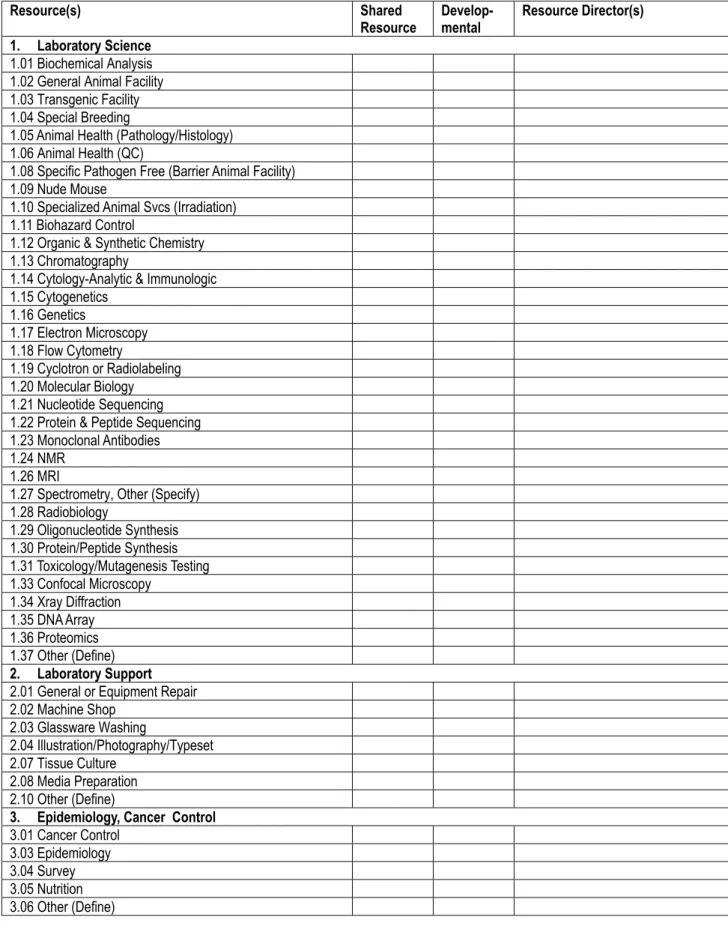
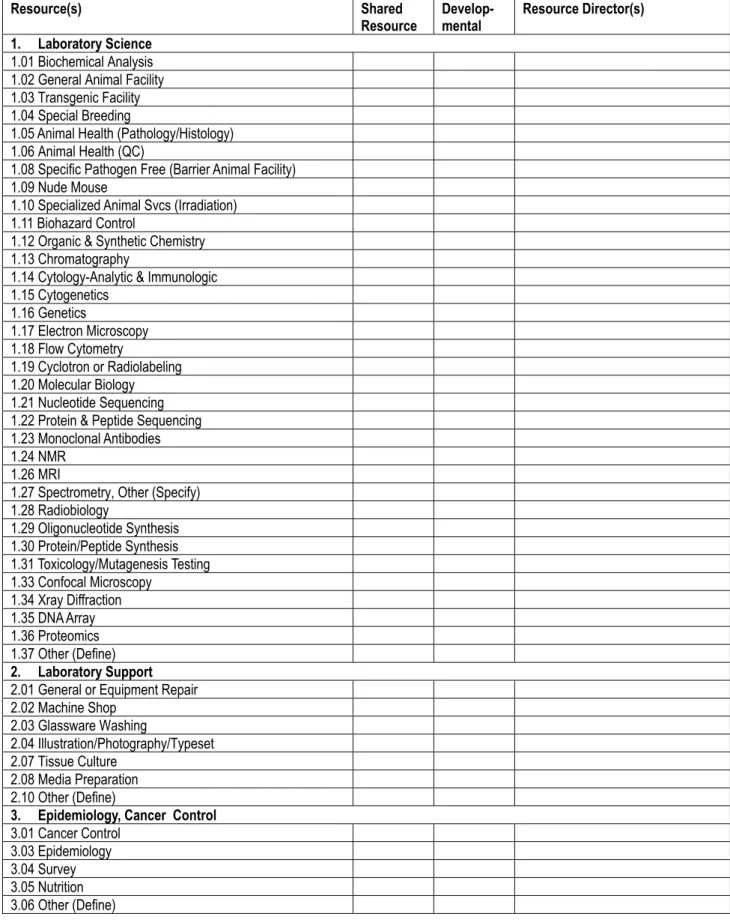
Shared Resources/Core Facilities Operated by the Cancer Center Appendix 4: Shared Resources/Core Facilities operated by the Cancer Center
Shared Resources/Core Facilities not Operated by the Cancer Center Appendix 5: Shared Resources/Core Facilities not operated by the Cancer Center
Summary of Current Laboratory and Clinical Research Activities
Summary of Future Laboratory and Clinical Research Topics / Research Programs
Clinical Care
- Clinical Care - Basic Information
- Fields of Specific Competence
- Multidisciplinary Care For your information
- Patient Pathways
- Patient Pathways - General Overview
- Patient Pathways - Disease-specific Patient Pathways (examples) Describe the specific pathways for patients suffering from
- Multidisciplinary Tumor Boards For your information
- Multidisciplinary Tumor Boards - Current Situation
- Multidisciplinary Tumor Boards - Future Situation Appendix 15: Multidisciplinary Tumor Boards - Future Situation
- Psychosocial and Palliative Care
- Guidelines / Standard Operating Procedures (SOPs)
- Information Technology at the Cancer Center – Current Situation / Future Plans
- Information Technology at the Cancer Center – Current Situation
- Information Technology at the Cancer Center – Future Plans
- Documentation, Clinical Cancer Registry, Long Term Follow-up
- Clinical Performance Monitoring / Quality Management and Assessment Describe the current state of 'Clinical performance monitoring / Quality management
- Cancer Trials Activity
- Documentation of Attempts to Establish a Stable Interaction with Local Oncologists and Hospitals / Community Outreach
Number of newly diagnosed cancer patients treated in 2007 in affiliated institutions within the catchment area, who are reported to the cancer centre's registry. State the number of cancer patients who were newly diagnosed in the cancer center or elsewhere in 2007, and whose treatment started in 2007 in affiliated institutions within the catchment area, and who have been reported to the cancer center's registry. Identify the cancer center's specific areas of expertise (eg, rare tumor entities, specific diagnostic or therapeutic options).
Multidisciplinary care of all cancer patients from diagnosis to palliative care is one of the key principles of a comprehensive cancer center. For your information: "Patient Journey" is the path a patient will take from the first contact with the cancer center (self-referral, doctor/hospital referral), entering the cancer center (central entry point for all cancer patients) until leaves the center or until treatment is completed. Please describe the role of tumor panels in facilitating research (case finding and enabling recruitment are areas where Cancer Center researchers could accelerate efforts in the future).
Describe the Information Technology structure and systems planned to be operated at the cancer center. Is there a clinical trials office that is an integral part of the comprehensive cancer center that provides assistance with the planning, initiation and execution of clinical trials, or is there a clinical trials office that serves all disciplines, of which cancer is one. The principal investigator or a Hospital/Institution is the primary author and custodian of the clinical trial protocol.
It was initiated by a pharmaceutical company or other commercial entity and not by an investigator at the cancer center. For your information: Comments from one of the reviewers involved in the evaluation of the proposals of the first call: "The creation of regional networks should be better understood in the context of the overall mission of a comprehensive cancer center and its specific goals. The director for Regional Activities/Issues can facilitate the efforts of a comprehensive cancer center in this regard."
Provide a detailed overview of existing collaborations/collaborations/partnerships between the cancer center with local and regional hospitals, office-based oncologists, general practitioners, etc. If there is a competitive situation for patients with another hospital/hospitals, provide some detail on how this affects the cancer center . What outreach programs are offered by the cancer center (eg, promoting cancer prevention and early detection; preventing cancer through community education; encouraging behaviors that promote a healthier lifestyle).
Education and Training
Collaboration with local and regional oncologists and hospitals is important for accrual of patients for clinical trials and research projects." A comprehensive cancer center must define the community or region it serves and maintain a productive outreach effort to address problems related to cancer. Describe the current activities/programs offered by the cancer center for interdisciplinary training of physicians, medical scientists, scientists, nurses and allied professions.
It is important that you focus on the added value from the cancer centre; do not elaborate on 'standard' or 'routine' education/training.
Self-assessment
Local Funding for the Cancer Center
Requested Funding
Summary
Bylaws
Statements of Support
Declaration
Completion Date: Enter the date this project is expected to be completed. date-format: dd.mm.yyyy) Grant amount: Enter the total amount of the grant awarded in Euros. Number of all cancer patients treated at the cancer center in 2007: Give the number of inpatients and outpatients (column 1); number of hospitalized patients (column 2); percentage of hospitalized patients (column 3); number of outpatients (column 4); percentage of outpatients (column 5). Reflect the number of patients coming to the cancer center, not the number of visits.
Do not include any patient more than once if they were not treated for two malignancies in 2007. Number of patients newly diagnosed at the cancer center or elsewhere in 2007 and whose treatment began at the cancer center in 2007: Give the number of in- and outpatients (column 1); number of hospitalized patients (column 2); percentage of hospitalized patients (column 3); number of outpatients (column 4); percentage of outpatients (column 5). Do not include any patient more than once unless they had two malignancies diagnosed in 2007.
Number of (A) patients newly enrolled in therapeutic trials in 2007: Enter the number of (A) patients (inpatients and outpatients; column 1); number of patients enrolled in investigator initiated trials (IIT) where the Principal Investigator (PI) is a member of the cancer center (column 2); Percentage of patients/column 2 to total patients/column 1 (column 3); number of patients enrolled in investigator-initiated trials where the PI is not a member of the cancer center (column 4); Percentage of patients/column 4 to total patients/column 1 (column 5); number of patients enrolled in clinical trials initiated by industry (column 6); Percentage of patients/column 6 to total number of patients/column 1 (column 7). Number of newly diagnosed cancer patients treated in 2007 in affiliated institutions within the catchment area and who are reported to the cancer centre's registry: State the number of cancer patients newly diagnosed in the cancer center or elsewhere in 2007 and whose treatment started in 2007 in affiliated institutions within the catchment area and who are reported to the cancer center's register. Number of (C)' patients' newly enrolled in therapeutic trials in 2007: Enter the number of (C) patients (column 1);.
Caution: Do not include any patient more than once unless they have two malignancies diagnosed in 2007. ICD: List the ICD numbers of the cancer sites focused on in Table 9. Number of cases: List the total number of cases with ICD numbers (in according to column 8), diagnosed in 2007.
17 - Clinical research studies - initiated by an investigator of the applicant institution (Investigator Initiated Trials - IIT only). PI: Provide the last name and first initial of the title of the Principal Investigator: Provide the concise title of this trial/study. If the trial or other clinical study applies to more than one possible anatomical site, enter the term "more" in this column.
Epidemiological (Epi), Observational (Obs) or Outcome (Out) Trials: Studies in cancer patients and healthy populations that do not involve intervention or change in the status of the participants, e.g. studies surveillance, risk assessment, outcome, environment and behavior. Targeted Accrual: Total number of patients or participants required for the entire study, as stated in the study protocol (no target range).