Max-Planck-Institut für Mathematik Bonn
New perspectives on categorical Torelli theorems for del Pezzo threefolds
by
Soheyla Feyzbakhsh Zhiyu Liu
Shizhuo Zhang
Max-Planck-Institut für Mathematik Preprint Series 2023 (7)
Date of submission: March 24, 2023
New perspectives on categorical Torelli theorems for del Pezzo threefolds
by
Soheyla Feyzbakhsh Zhiyu Liu
Shizhuo Zhang
Max-Planck-Institut für Mathematik Vivatsgasse 7
53111 Bonn Germany
Department of Mathematics Imperial College
London SW7 2AZ United Kingdom
Institute for Advanced Study in Mathematics Zhejiang University
Hangzhou
Zhejiang Province 310030 P. R. China
College of Mathematics Sichuan University Chengdu
Sichuan Province 610064 P. R. China
MPIM 23-7
FOR DEL PEZZO THREEFOLDS
SOHEYLA FEYZBAKHSH, ZHIYU LIU AND SHIZHUO ZHANG
Abstract. LetYdbe a del Pezzo threefold of Picard rank one and degreed≥2. In this paper, we apply two different viewpoints to study Yd via a particular admissible subcategory of its bounded derived category, called the Kuznetsov component:
(i) Brill–Noether reconstruction. We show thatYdcan be uniquely recovered as a Brill–Noether locus of Bridgeland stable objects in its Kuznetsov component.
(ii) Exact equivalences. We prove that, up to composing with an explicit auto-equivalence, any Fourier–Mukai type exact equivalence of Kuznetsov components of two del Pezzo threefolds of degree 2≤d≤4 can be lifted to an equivalence of their bounded derived categories. As a result, we obtain a complete description of the group of exact auto-equivalences of Kuznetsov component ofYdof Fourier–
Mukai type.
In an appendix, we classify instanton sheaves on quartic double solids, generalizing a result of Druel.
Contents
1. Introduction 1
2. Background: (weak) Bridgeland stability conditions 3
3. Del Pezzo threefolds of Picard rank one 7
4. Moduli spaces on quartic double solids 9
5. Moduli spaces on cubic threefolds 12
6. Brill–Noether reconstruction 14
7. Uniqueness of the gluing object 17
8. Auto-equivalences of Kuznetsov components 22
Appendix A. Moduli space of instanton sheaves on quartic double solids 24
References 28
1. Introduction
Let Y be a del Pezzo threefold of Picard rank one, which is an index two prime Fano threefold. By [Isk77], it belongs to one of the five families of threefolds classified by their degree 1≤d≤5, see Section2.
By a series of papers of Bondal–Orlov and Kuznetsov, the bounded derived category Db(Y) of these Fano threefolds admit a semiorthogonal decomposition
Db(Y) =⟨Ku(Y),OY,OY(1)⟩=⟨Ku(Y),QY,OY⟩,
where QY ∼=LOY OY(1)[−1] is a rankd+ 1 vector bundle for d≥ 2. This paper aims to employ two different viewpoints to extract the critical information ofY from its admissible subcategoryKu(Y), called the Kuznetsov component.
I. Brill–Noether reconstruction. In [BBF+20,APR22], authors apply stability conditions onKu(Y) for degreed= 2,3 to show that one can uniquely recoverY as a subscheme of a moduli space of stable objects in Ku(Y). The following Theorem shows that we can describe this subscheme explicitly as a Brill–Noether locus. This generalises the classical picture for degreed= 4, as discussed in Section6.1.
We denote by i: Ku(Y) ,→ Db(Y) the inclusion functor with the right and left adjoints i! and i∗, respectively. By [PY20], [FP21] and [JLLZ21], there is a unique Serre-invariant stability condition on
2010Mathematics Subject Classification. Primary 14F05; secondary 14J45, 14D20, 14D23.
Key words and phrases. Derived categories, Brill–Noether locus, Bridgeland moduli spaces, Kuznetsov components, Categorical Torelli theorems, Fano threefolds, Auto-equivalences.
1
Ku(Y) up to the action ofGLf+2(R) ford≥2, see Section2. Denote byMσ(Ku(Y), v) the moduli space1 of stable objects of a numerical classv∈ N(Ku(Y)) in the Kuznetsov componentKu(Y) with respect to a stability conditionσ.
Theorem 1.1(Theorem6.2). LetY be a del Pezzo threefold of Picard rank one and degreed≥2, and let σ be a Serre-invarinat stability condition onKu(Y). ThenY is isomorphic to the Brill–Noether locus2
BNY :={F ∈ Mσ(Ku(Y),[i∗Op]) :∃k∈Zsuch that dimCHom(F[k], i!QY)≥d+ 1}
whereOp is the skyscraper sheaf supported at a pointp∈Y.
This means that these del Pezzo threefolds are uniquely determined by their Kuznetsov components and the objecti!QY. But we know they are determined by their Kuznetsov components already (known as Categorical Torelli Theorem), which suggests that the distinguished objecti!QY is intrinsically determined byKu(Y). The next step is to show this is indeed the case.
Denote byrotation functor Othe auto-equivalence ofKu(Y) sendingE∈ Ku(Y) toLOY(E⊗ OY(H)).
Theorem 1.2 (Theorem 7.1). Let Y and Y′ be del Pezzo threefolds of Picard rank one and degree 2≤d≤4, andΦ :Ku(Y)−≃→ Ku(Y′)be an exact equivalence.
(i) If2≤d≤3, there exist a unique pair of integers m1, m2 ∈Zwith 0≤m1≤3 whend= 2and 0≤m1≤5 whend= 3, so that
Φ(i!QY)∼=Om1(i′!QY′)[m2].
(ii) If d = 4, there exists a unique pair of integers m1, m2 and a unique auto-equivalence TL0 ∈ Aut0(Ku(Y′))(see Section7.3for definition) so that
Φ(i!QY)∼=Om1◦TL0(i′!QY′)[m2].
Here i′:Ku(Y′),→Db(Y′)is the inclusion functor.
To prove degree d= 2,3 cases, we identify the objecti!QY via certain unique property of it. Up to rotations and shifts, we can assume any exact equivalence Φ : Ku(Y) −≃→ Ku(Y′) acts trivially on the numerical Grothendieck group. Take a stable objectE inKu(Y) of the same class asi!QY, then we show RHom(i∗Op, E) is a two-term complex for all pointsp∈Y if and only if E∼=i!QY. Combining it with analysis of the moduli space of stable objects in Ku(Y) of class [i∗Op] gives Theorem 1.2. For degree d= 4 case, we use the classical notion of thesecond Raynaud bundles.
By [PY20], Serre-invarint stability conditions onKu(Y) for degreed≥2 areO-invariant as well. Thus combining Theorem1.1and1.2we give a new proof forCategorical Torelli Theorem when 2≤d≤4.
Corollary 1.3 (Corollary 7.10). Let Y and Y′ be del Pezzo threefolds of Picard rank one and degree 2≤d≤4 such that Ku(Y)≃ Ku(Y′), thenY ∼=Y′.
II. Exact equivalences. The second viewpoint is to combine the categorical techniques developed in [LNSZ21] with geometric analysis of stable objects inKu(Y) to show that any Fourier–Mukai type exact equivalence of Kuznetsov components of two del Pezzo threefolds of degree 2≤d≤4 can be lifted to an equivalence of their bounded derived categories.
Theorem 1.4 (Theorem 7.1). Let Y and Y′ be del Pezzo threefolds of Picard rank one and degree 2 ≤ d ≤ 4, and let Φ :Ku(Y) → Ku(Y′) be an exact equivalence of Fourier–Mukai type such that Φ(i!QY) =i′!QY′. ThenΦ =f∗|Ku(Y)for a unique isomorphismf:Y →Y′.
Clearly, combining Theorem1.2with Theorem1.4provides an alternative proof ofCategorical Torelli theorem for del Pezzo threefold of degree 2≤d≤4. Furthermore, we obtain a complete description of the group AutFM(Ku(Y)) of exact auto-equivalences ofKu(Y) of Fourier–Mukai type. For a groupGand a subsetS ⊂G, we denote by⟨S⟩the subgroup ofGgenerated byS.
Corollary 1.5 (Corollary8.4). IfY is a del Pezzo threefolds of Picard rank one and degree d. Then we have3
1Letσ= (Z,A), then up to a shift we may assume Im[Z(v)]≥0, then we only consider stable objects in the heartAto define the moduli spaceMσ(Ku(Y), v)
2Note that for anyF ∈ Mσ(Ku(Y),[i∗Op]), we prove RHom(F, i!QY) =Cδ[k+ 1]⊕Cd+δ[k] whereδis either zero or one. Hence there exists at most onek∈Zso that dimCHom(F[k], i!QY)≥d+ 1.
3By [LPZ22, Theorem 1.3], any exact equivalence between Kuznetsov components of quartic double solids is of Fourier–
Mukai type. The same also holds for del Pezzo threefolds of degreed= 4 asKu(Y)≃Db(C) for a smooth curveC.
(1) AutFM(Ku(Y)) =⟨Aut(Y),O,[1]⟩when2≤d≤3, and (2) AutFM(Ku(Y)) =⟨Aut(Y),Aut0(Ku(Y)),O,[1]⟩whend= 4.
Here the subgroupAut0(Ku(Y))is defined in Section7.3.
We may write elements of AutFM(Ku(Y)) in a more explicit way, see Corollary8.4.
Related work. Here is the list of relevant results for del Pezzo threefoldsYd of degreed:
d= 2. In [BT16] and [APR22], the categorical Torelli theorem (Corollary1.3) has been proved forgeneric quartic double solids. It has been proved for non-generic cases in [BP22] via Hodge theory for K3 categories. But in Theorem1.1, we give an explicit expression for Y as a Brill–Noether locus of stable objects inKu(Y2), and so provide a new proof for the categorical Torelli theorem.
d= 3. In [BMMS12] and [PY20], the categorical Torelli theorem has been proved for cubic threefolds by reducing it to classical Torelli theorem. In [Liu23], the author computes group of auto-equivalences of Kuznetsov component of cubic threefolds of Fourier-Mukai type via a completely different method and provides a new proof of categorical Torelli theorem for cubic threefold by construct- ing a Hodge isometry between cubic threefolds. In [BBF+20], the cubic threefoldY3 has been described geometrically as a sub-locus of a moduli space of stable objects in Ku(Y3). Theorem 1.1gives a point-wise description of it as a Brill-Noether locus.
d= 4. We knowY4 is the intersection of two quadrics inP5, and by [New68], it can be reconstructed as the moduli spaceM of stable vector bundles of rank two with fix determinant of odd degree over the associated genus two curve C2. We have Ku(Y4)≃Db(C2). As discussed in Section 6.1, our categorical Brill-Noether locus in Theorem1.1 matches with the classical moduli spaceM. Other than del Pezzo threefolds, various versions of categorical Torelli theorems are also obtained, see [PS22] for recent development. In particular, in [JLZ22] the authors provide a Brill–Noether reconstruction for index one prime Fano threefolds, and as a result, the refined categorical Torelli theorem is proved.
In [Dru00,Qin21a,Qin21b,LZ22], a classification of rank two instanton sheaves and the corresponding moduli space in the Kuznetsov component have been discussed for del Pezzo threefolds of degree d≥3.
In AppendixA, we discuss degreed= 2 case.
Organization of the article. In Section2, we recall the basic definitions and properties of (weak) stabil- ity conditions on del Pezzo threefolds of Picard rank oneYd of degreedand their Kuznetsov components Ku(Yd). In particular, we introduce Serre-invariant stability conditions on Ku(Yd) and describeKu(Yd) for eachd≥2. In Section3, we collect results of general wall-crossing for del Pezzo threefolds which will be used in later sections. In Section4, we describe the moduli space ofσ-stable objects of the same class as twice of ideal sheaf of lines in the Kuznetsov component of a quartic double solid. In Section 5 we classifyσ-stable objects of the same class as three times of ideal sheaf of line in the Kuznetsov component of a cubic threefold. In Section 6we prove Theorem1.2. In Section7 we provide aBrill–Noether recon- structionfor del Pezzo threefold of Picard rank oneYdwith repsect toKu(Yd) and its gluing objecti!QYd, proving Theorem1.1. Then we provecategorical Torelli theorem1.3. In Section8we prove Corollary1.5.
In AppendixAwe classify semistable sheaves of rank two,c1= 0, c2= 2, c3= 0 on quartic double solids.
Acknowledgements. We would like to thank Arend Bayer, Daniele Faenzi, Sasha Kuznetsov, Franco Rota and Richard Thomas for useful conversations. The first author acknowledges the support of EP- SRC postdoctoral fellowship EP/T018658/1. The third author is supported by ERC Consolidator Grant WallCrossAG, no. 819864 , ANR project FanoHK, grant ANR-20-CE40-0023 and partially supported by GSSCU2021092. The second author would like to thank Institute for Advanced Study in Mathematics at Zhejiang University for financial support and wonderful research environment. Part of the work was fin- ished when the third author is visiting Max-Planck institute for mathematics, IASM–Zhejiang University, Sichuan University and MCM–China Academy of Science. He is grateful for excellent working condition and hospitality.
2. Background: (weak) Bridgeland stability conditions
In this section, we briefly review the notion of (weak) stability condition on Db(Y) and Ku(Y) when Y :=Yd is a del Pezzo threefold of Picard rank one and degreed. By [Isk77], every del Pezzo threefold of Picard rank one belongs to following five families, indexed by their degreed:=H3∈ {1,2,3,4,5}:
• Y5=P6∩Gr(2,5) is a codimension 3 linear section of Grassmannian Gr(2,5).
• Y4=Q∩Q′ is intersection of two quadric hypersurfaces inP5.
• Y3⊂P4is cubic threefold.
• Y2is a quartic double solid, i.e. a double cover of P3with smooth branch divisorR∈ | OP3(4)|.
• Y1is a degree 6 hypersurface of weighted projective space P(1,1,1,2,3).
2.1. Weak stability conditions on Db(Y). For anyb∈R, consider the full subcatgeory of complexes Cohb(Y) =
E−1−→d E0 : µ+H(kerd)≤b , µ−H(cokerd)> b ⊂Db(Y) (1) Then Cohb(Y) is the heart of a bounded t-structure on Db(Y) by [Bri08, Lemma 6.1]. For any pair (b, w)∈R2, we define a group homomorphismZb,w:K(Y)→Cby
Zb,w(E) :=−ch2(E)H+wch0(E)H3+b(H2ch1(E)−bH3ch0(E)) +i
H2ch1(E)−bH3ch0(E)
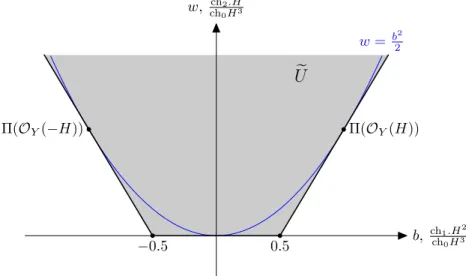
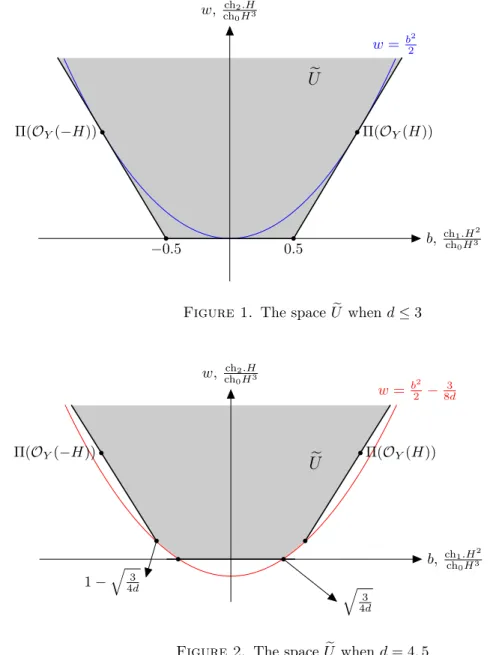
. (2) In [Li19], the author defined an open region Ue ⊂ R2 as the set of points (b, w) ∈ R2 above the curve w= 12b2−8d3 and above tangent lines of the curvew=12b2 at (k,k22) for allk∈Z.
b, chch1.H2
0H3
w= b22 w, chch2.H
0H3
−0.5 0.5
U e
Π(OY(H)) Π(OY(−H))
Figure 1. The spaceUe whend≤3
b, chch1.H2
0H3
w=b22 −8d3 w, chch2.H
0H3
q3 4d
1−q
3 4d
U e
Π(OY(H))Π(OY(−H))
Figure 2. The spaceUe whend= 4,5
In Figures, we plot the (b, w)-plane simultaneously with the image of the projection map Π : K(Y)\
E: ch0(E) = 0 −→ R2, E p−→
ch1(E).H2
ch0(E)H3 , ch2(E).H ch0(E)H3
.
Proposition 2.1 ([BMS16, Proposition B.2]). There is a continuous family of weak stability conditions onDb(Y)parametrized byUe ⊂R2, given by4
(b, w)∈Ue 7→ (Cohb(Y), Zb,w).
We now expand upon the above statements. The function−Re[ZIm[Zb,w(E)]
b,w(E)] for objectsE∈Cohb(Y) gives the same ordering as
νb,w(E) = (ch
2(E).H−wch0(E)H3
chbH1 (E).H2 if chbH1 (E).H2̸= 0,
+∞ if chbH1 (E).H2= 0, (3)
where chbH(E) := exp(−bH).ch(E).
Definition 2.2. Fix a pair (b, w)∈U. We saye E∈Db(Y) isνb,w-(semi)stable if and only if
• E[k]∈Cohb(Y) for somek∈Z, and
• νb,w(F) (≤)νb,w E[k]/F
for all non-trivial subobjectsF ,→E[k] in Cohb(Y).
Here (≤) denotes<for stability and≤for semistability.
The image Π(E) ofνb,w-semistable objectsE with ch0(E)̸= 0 isoutside Ue by [Li19, Proposition 3.2], so in particular,
∆H(E) = ch1(E).H22
−2(ch0(E)H3)(ch2(E).H) ≥ 0. (4) Proposition 2.3 (Wall and chamber structure). Fix v ∈K(Y) with ∆H(v)≥0 and ch≤2(v)̸= 0.
There exists a set of lines {ℓi}i∈I in R2 such that the segments ℓi∩Ue (called “walls of instability”) are locally finite and satisfy
(a) If ch0(v)̸= 0then all lines ℓi pass through Π(v).
(b) If ch0(v) = 0then all lines ℓi are parallel of slope chch2(v).H
1(v).H2.
(c) The νb,w-(semi)stability of any E ∈ Db(Y) of class v is unchanged as (b, w) varies within any connected component (called a “chamber”) of Ue\S
i∈Iℓi.
(d) For any wallℓi∩Ue, there is an integerki and a mapf:F →E[ki] inDb(Y)such that – for any(b, w)∈ℓi∩Ue, the objectsE[ki], F lie in the heart Cohb(X),
– E is νb,w-semistable of class v with νb,w(E) = νb,w(F) = slope (ℓi) constant on the wall ℓi∩Ue, and
– f is an injectionF ,→E[ki] inCohb(Y)which strictly destabilises E[ki] for(b, w)in one of
the two chambers adjacent to the wallℓi. □
2.2. Kuznetsov component. The Kuznetsov componentKu(Y) is the right orthogonal complement of the exceptional collectionOY,OY(1) in Db(Y) sitting in the semiorthogonal decomposition
Db(Y) =⟨Ku(Y),OY,OY(H)⟩=⟨Ku(Y),QY,OY⟩,
whereQY :=LOY OY(1)[−1] is a rankd+ 1 vector bundle ford≥2 (see Section3.2for more details). We can identify the numerical Grothendieck group N(Ku(Y)) of Ku(Y) with the image of Chern character map
ch :K(Ku(Y))→H∗(X,Q).
It is a rank 2 lattice spanned by the classes v=
1, 0, −1 dH2, 0
and w=
0, H, −1 2H2,
1 6 −1
d
H3
. With respect to this basis, the Euler form onN(Ku(Y)) is represented by the matrix
−1 −1 1−d −d
. (5)
Consider any admissible subcategoryi:C,→Db(Y). It has left and right adjointsi∗ andi!. Similarly, the embeddingl:C⊥ ,→Db(Y) andr: ⊥C,→Db(Y) has left and right adjoints. We know that any object E∈Db(Y) lies in the exact triangles
r◦r!(E)→E→i◦i∗(E) , i◦i!(E)→E→l◦l∗(E).
4We replaced the pair (α, β) with (w= 12α2+12β2, b=β).
We define the right mutation alongC to be the functor
RC :=r◦r!: Db(Y)→r(⊥C) and the left mutation alongC to be
LC :=ℓ◦ℓ∗: Db(Y)→l(C⊥).
By [Kuz04, Propostion 3.8], we knowLC|r(⊥C)andRC|l(C⊥)are mutually inverse equivalence between the two orthogonal⊥C → C⊥ andC⊥→⊥C. Moreover,
(LC)|r(⊥C)=SDb(Y)◦r◦S⊥−1C◦r∗ , (RC)|l(C⊥)=SD−1b(Y)◦l◦SC⊥◦l∗. HereST denotes the Serre functor of a triangulated categoryT (if it exists).
LetE∈Db(Y) be an exceptional object. Then the triangulated subcategory⟨E⟩generated byEis an admissible subcategory. The embedding functori:⟨E⟩ → T has the left and right adjoints
i∗=E⊗RHom(F, E)∗, i!(F) =E⊗RHom(E, F).
We will abuse notations and writeREandLEfor the corresponding right and left mutations, respectively.
We finish this section by defining the rotation functor. [Kuz04, Lemma 4.1, Lemma 4.2] implies that the functor
O: Db(Y)→Db(Y), O(−) =LOY(− ⊗ OY(H)) (6) is an auto-equivalence ofKu(Y), called rotation functor. By [Kuz04, Lemma 4.1], we have
SKu(Y−1 )=O2[−3].
The rotation functor Oinduces an auto-isometry of numerical Grothendieck group N(Ku(Yd)) for each d. In particular ford= 3, we have
v O −2v+w O v−w O v.
And ford= 2, we have
v O −v+w O −v.
2.3. Bridgeland stability conditions on Ku(Y). For any pair (b, w) ∈ Ue, consider the tilted heart Coh0b,w(Y) = ⟨Fb,w[1],Tb,w⟩where Fb,w (Tb,w) is the subcategory of objects in Cohb(X) with νb,w+ ≤b ( νb,w− > b). By [BLMS17, Proposition 2.14], the pair σb,w0 :=
Coh0b,w(X), Zb,w0
is a weak stability condition on Db(Y), whereZb,w0 :=−iZb,w. We denote the corresponding slope function by
µ0b,w(−) :=−Re[Zb,w0 (−)]
Im[Zb,w0 (−)].
Lemma 2.4 ([FP21, Proposition 4.1]). Any σb,w0 -(semi)stable objectE∈Coh0b,w(Y)isνb,w-(semi)stable if it does not lie in an exact triangle of the form
F[1]→E→T
where F ∈ Fb,w is νb,w-(semi)stable and T ∈ Coh0(X). Conversely, take a νb,w-(semi)stable object E such that either
(1) E∈ Tb,w andHom(Coh0(X), E) = 0, or (2) E∈ Fb,w andHom(Coh0(X), E[1]) = 0.
ThenE isσ0b,w-(semi)stable.
By restricting weak stability conditionsσb,w0 to the Kuznetsov componentKu(Y), we obtain stability conditions on it.
Theorem 2.5 ([BLMS17, Theorem 6.8]). For every pair(b, w)in the subset V :=
(b, w)∈Ue: −1
2 ≤b <0, w < b2 or −1< b <−1
2, w≤b2+b+1 2
⊂ U ,e the pair σ(b, w) = (A(b, w), Z(b, w))is a Bridgeland stability condition onKu(Yd)where
A(b, w) := Coh0b,w(Yd)∩ Ku(Yd) and Z(b, w) :=Zb,w0 |Ku(Yd).
Proof. Applying the same argument as in the proof of [BLMS17, Theorem 6.8] shows that σ(b, w) is a Bridgeland stability condition onKu(Yd) if−1< b <0 and
νb,w(OYd(−2H)[1])≤νb,w(OYd(−H)[1])≤b < νb,w(OYd)≤νb,w(OYd(H)).
On the stability manifold which we denote by Stab(Ku(Y)) we have:
(1) a right action of the universal covering spaceGLf+2(R) of GL+2(R): for a stability condition σ= (P, Z) ∈ Stab(Ku(Y)) and ˜g = (g, M) ∈ GLf+2(R), where g : R → R is an increasing function such that g(ϕ+ 1) = g(ϕ) + 1 and M ∈ GL+2(R), we define σ·g˜ to be the stability condition σ′= (P′, Z′) withZ′=M−1◦Z andP′(ϕ) =P(g(ϕ)) (see [Bri09, Lemma 8.2]).
(2) a left action of the group of exact auto-equivalencesAut(Ku(Y))of Ku(Y): for Φ∈Aut(Ku(Y)) and σ ∈ Stab(Ku(Y)), we define Φ·σ = (Φ(P), Z◦Φ−1∗ ), where Φ∗ is the automorphism of K(Ku(Y)) induced by Φ.
Remark 2.6. Note that all stability conditionsσ(b, w) for (b, w)∈V lie in the same orbit with respect to the action ofGLf+2(R) by [PY20, Proposition 3.5] 5. Hence ifE∈ Ku(Yd) is σ(b, w)-(semi)stable with respect to some (b, w)∈V, then it isσ(b, w)-(semi)stable with respect to any (b, w)∈V.
We now give a case by case investigation of the categoryKu(Yd) whend≥2:
d= 5. Y5 is a linear section of codimension 3 of Gr(2,5). Let U be the restriction of the tautological rank 2 subbundle from Gr(2,5) toY5, and letU⊥ = ker(OY⊗Hom(OY,U∗)→ U∗), then [Kuz12, Lemma 4.1] gives
Ku(Y5) =⟨U, U⊥⟩.
d= 4. Y4 is an intersection of 2 quadrics in P5. By [Kuz12, Theorem 5.1], there exists a curve C of genus 2 such that we have an equivalenceKu(Y4)∼= Db(C2). Hence, there is a unique Bridgeland stability condition onKu(Y4) up to the action ofGLf+2(R) by [Mac07].
d= 3. Y3is a cubic 3-fold, andKu(Y3) is a fractional Calabi–Yau category of dimension 53, i.e. SKu(Y3
3)= [5]. Note that by [Kuz04, Lemma 4.1, Lemma 4.2], we have SKu(Y−1
3)=O2[−3]. In this case, we only consider Serre-invariant stability conditions onKu(Y3), i.e. those σ∈Stab(Ku(Y3)) so that SKu(Y3).σ=σ.˜gfor some ˜g∈GLf+2(R). By [PY20], all stability conditions constructed in Theorem 2.5 are Serre-invariant. And it is proved in [FP21, Sections 4 & 5] and [JLLZ21, Theorem 4.25]
that all Serre-invariant stability conditions on Ku(Y3) lie in the same orbit with respect to the action ofGLf+2(R).
d= 2. Y2 is a double cover of P3 ramified in a quartic surface. By [Kuz19, Corollary 4.6], the Serre functor of Ku(Y2) is SKu(Y3) = τ[2] where τ is the auto-equivalence of Ku(Y2) induced by the involutionτ of the double covering. As the involutionτ preserves Coh(X) and Chern characters, the stability conditionsσ(b, w) constructed in Theorem2.5are Serre-invariant, see [PY20, Lemma 6.1]. Moreover, [FP21, Theorem 3.2 & Remark 3.8] and [JLLZ21, Theorem 4.25] implies that all Serre-invariant stability conditions on Ku(Y2) lie in the same orbit with respect to action of GLf+2(R).
3. Del Pezzo threefolds of Picard rank one
In this section, we gather all results which are valid for del Pezzo threefoldY of Picard rank one and degreed. By [Kuz09], for any E∈Db(Y), we know
χ(OY, E) = ch0(E) +H2ch1(E)d+ 3
3d +Hch2(E) + ch3(E).
3.1. Instanton bundles and their acyclic extensions. An instanton of chargenonY is a Gieseker- stable vector bundle E with ch≤2(E) = (2,0,−nHd2) satisfying instanton condition H1(Y, E(−1)) = 0.
By [Kuz12, Lemma 3.5], for each instanton bundle E, we haveh1(E) =n−2, thus there exists a unique short exact sequence
0→E→E˜→ On−2Y →0
5This is proved forV ∩U, but the same proof is valid forV.
such that ˜E is acylic, i.e. Hi(Y,E) = 0 for any˜ i. Note that ˜E=LOYE and is of Chern character nv=
n, 0, −nH2 d , 0
. Moreover, it isνb,w-semistable forb <0 andw≫0.
Let ℓd be the line passing through Π(nv) = (0,−d1) and Π(OY(−H)) = (−1,12), so it is of equation w=−d+22d b−d1. Ifd= 2, thenℓd coincides with the boundary ofUe, and ifd≥3, then it intersects∂Ue at two points with b-valuesbd1< bd2 so that
bd1≤ −1 and − 2
d+ 2 =bd2. (7)
Lemma 3.1. Take a class α∈K(X)with ch≤2(α) =n
1,0,−Hd2
such that n≤d+ 1. Then there is no wall for class α above ℓd. In particular, an object E ∈Cohb(Y) of Chern characterα which is νb,w- semistable forb <0 andw≫0 satisfiesRHom(OY, E) = Hom(OY, E[1])[−1]and hencech3(E)≤0.
Proof. Suppose for a contradiction that there is such a wallℓ for classαabove ℓd with the destabilising sequence E1 → E → E2. Let b1 < b2 be the intersection points of ℓ with the boundary∂Ue. Then for i= 1,2,
µ+H(H−1(Ei))≤ b1 and b2≤ µ−H(H0(Ei)).
Let (r, cH) = ch≤1(H−1(E1)) + ch≤1(H−1(E2)), then (r+n, cH) = ch≤1(H0(E1)) + ch≤1(H0(E2)), so
b2(r+n)≤c ≤ b1r. (8)
Note that if rk(H−1(Ei)) = 0, thenH−1(Ei) = 0. Ifd= 2, thenℓd lies on the boundary∂Ue, so we have b1<−32 and −12 < b2, so (8) gives−12(r+n)< c <−32rwhich has no solution forn≤3. Ifd≥3, then combining (7) and (8) gives−d+22 (r+n)< c <−r which is not possible fork≤d+ 1.
For the second claim, we knowEis semistable at the large volume limit, so Hom(OY, E) = 0. Also the first part implies that E is νb,w-semistable for all (b, w)∈Ue over ℓd. Since the line segment connecting Π(E) and Π(OY(−2)) is aboveℓd, we have Hom(E,OY(−2H)[1]) = Hom(OY, E[2]) = 0. And we know that Hom(OY, E[i]) = Hom(E,OY(−2)[3−i]) = 0 for i̸= 1. Thusχ(E) =−hom(OY, E[1]) = ch3(E)≤
0, which gives ch3(E)≤0.
As a result of the above lemma, we may identity Gieseker stable sheaves with the large volume limit stable ones.
Lemma 3.2. Let E be an object of classch(E) =nv where1≤n≤d+ 2. Then E isνb,w-(semi)stable forb <0andw≫0(or equivalently, 2-Gieseker-(semi)stable) if and only ifE is a Gieseker-(semi)stable sheaf.
Proof. By [BBF+20, Proposition 4.8], the 2-Gieseker-(semi)stability forEcoincides withνb,w-(semi)stability forb <0 andw≫0. Then in the following we will show 2-Gieseker-(semi)stability forE coincides with Gieseker-(semi)stability
It is clear that ifE is 2-Gieseker-stable, then E is Gieseker-stable. Conversely, ifE is Gieseker-stable but strictly 2-Gieseker-semistable, then we can find an exact sequence 0 → E1 → E → E2 → 0 such thatEi are 2-Gieseker-semistable of classes ch(Ei) = (ki,0,kdiH2, mi), where 1≤ki≤n−1≤d+ 1 and mi ∈Z≤0. By the stability ofEi, we have mi ≤0 for anyi from Lemma 3.1. Since m1+m2 = 0, we have ch(Ei) =kiv and contradicts the Gieseker-stability ofE.
And it is clear that if E is Gieseker-semistable, then E is 2-Gieseker-semistable. Now assume that E is 2-Gieseker-semistable but not Gieseker-semistable. Then the maximal destabilizing subsheafE1 of E with respect to Gieseker-semistability has class ch(E1) = (k1,0,−kd1H2, m1) where 1≤ k1 < n and
mi∈Z>0. But this contradicts Lemma3.1as well.
3.2. The bundle QY and its projection. For any smooth Fano threefold Y of index 2 and degree d≥2, we define the sheafQY to be the kernel of the following evaluation map
0→ QY → OY ⊗Hom(OY,OY(1))−→ Oev Y(1)→0. (9) We have
ch(QY) =
d+ 1, −H, −1
2H2, −1 6H3
. (10)
Lemma 3.3. The sheafQY is aµH-stable locally-free sheaf.
Proof. When the degree dof Y satisfies d ≥2, OY(1) has no base-point by [Isk99, Theorem 2.4.5.(i)], henceQY is a bundle of rank d+ 1. If it is not µH-stable, there is a stable reflexive sheaf Q′ ⊂ QY of bigger or equal slope, thusµH(Q′)≥0. Since it is also a subsheaf ofO⊕hY 0(OY(1)) and all stable factors of the latter are direct sum ofOY, we getQ′ is a direct sum ofOY which is not possible ash0(QY) = 0 by
the definition.
Consider the semiorthogonal decomposition Db(Y) =⟨Ku(Y),OY,OY(H)⟩. We knowQY ∼=LOY OY(1)[−1].
Consider the embeddingi:Ku(Y),→Db(Y). We knowQY ∈ ⟨OY(−H),Ku(Y)⟩, thus it lies in the exact triangle
i!QY =ROY(−H)(QY)→ QY → OY(−H)⊗RHom(QY,OY(−H))∨.
TheµH-stability ofQY implies that Hom(QY,OY(−H)[i]) = 0. Taking Hom(OY(H),−) from the exact sequence (9) implies that hom(QY,OY(−H)[1]) = hom(OY(H),QY[2]) = 0. Thus
hom(QY,OY(−H)[2]) =χ(QY,OY(−H)) = 1. (11) Hence i!QY is a two-term complex lying in the exact triangle
OY(−H)[1]→i!QY → QY (12) which is of Chern character ch(i!QY) =dv. In Sections 4 and 5 we show that if d= 2 and d = 3, the objecti!QY is Bridgeland-stable inKu(Y) and it is the only such object which is not Gieseker-stable.
4. Moduli spaces on quartic double solids
In this section, we always fix Y to be a del Pezzo threefold of degree two, i.e. a quartic double solid.
We aim to classify Bridgeland semistable objects of class 2vin Ku(Y) as described in the following.
Proposition 4.1. Let σ be a Serre-invariant stability condition on Ku(Y) and E ∈ Ku(Y) be a σ- (semi)stable object of class 2v. Then up to a shift, E is either a Gieseker-(semi)stable sheaf ori!QY. Proof. By the uniqueness of Serre-invariant stability condition, we can assume that E ∈ A(b, w) is a σ(b, w)-(semi)stable object of class6−2v. We divide the proof into several cases.
Step 1. First we assume that E isσ0b
0,w0-semistable for some (b0, w0)∈V. Then by Lemma2.4, we have an exact sequence in Coh0b0,w0(Y)
F[1]→E→T, where F ∈ Cohb0(Y) with νb+
0,w0(F) ≤ b and T = 0 or supported on points. Now by the σb0
0,w0- semistability of E, we know thatF isνb0,w0-semistable. By Lemma3.1, F is νb0,w-semistable for w≫0 and ch3(F)≤ 0, which implies T = 0 and F[1] = E. Thus E[−1] isνb,w-semistable for w ≫0, which implies thatE[−1] is a Gieseker-semistable sheaf by Lemma3.2.
Step 2. Now we assume thatE is not σb,w0 -semistable for any (b, w)∈V. By [BMT14, Proposition 2.2.2], we can assume that there is an open ballU′⊂R2 containing the point (b, w) = (−1,12) such that for any (b, w)∈U−1,1
2 :=U′∩V, we have E∈ A(b, w) and the Harder–Narasimhan filtration ofE with respect to σb,w0 is constant.
LetB be the destabilizing quotient object ofE with minimum slope andA→E→B be the destabi- lizing sequence ofE with respect toσ0b,w for (b, w)∈U−1,1
2. HenceA, B∈Coh0b,w(Y), which gives Im(Zb,w0 (E))≥Im(Zb,w0 (B))>0, Im(Zb,w0 (E))>Im(Zb,w0 (A))≥0 (13) for all (b, w)∈U−1,1
2. Since Im(Z−1,0 1 2
(E)) = 0, by the continuity, we have Im(Z−1,0 1 2
(A)) = Im(Z−1,0 1 2
(B)) = 0. Therefore, if we assume that ch≤2(B) = (x, yH,z2H2) for x, y, z∈Z, from Im(Z−1,0 1
2
(B)) = 0 we get z=−x−2y. Thus we have
ch≤2(B) =
x, yH, −x−2y 2 H2
, ch≤2(A) =
−2−x, −yH, x+ 2y+ 2
2 H2
(14) and by (13) we get
1−2b2+ 2w= Im(Zb,w0 (E)) ≥ Im(Zb,w0 (B)) = (2b2−2w−1)x
2 −(b+ 1)y >0 (15)
6We put the shifted class−2vto get sure Im[Z(b, w)]≥0 for (b, w)∈V.
for all (b, w)∈U−1,1
2. Moreover, by definition we have µ0b,w(E)> µ0b,w(B) for any (b, w)∈U−1,1 2 where µ0b,w(−) =−Re[ZIm[Z0b,w0 (−)]
b,w(−)], thus
−2b
1−2b2+ 2w =µ0b,w(E) > µ0b,w(B) = (bx−y)
(2b2−2w−1)x2 −(b+ 1)y. (16) Now by (15),b <0 and (16), we have
−2b > bx−y. (17)
On the other hand, from [BLMS17, Remark 5.12], we have µ0b,w−
(E) :=µ0b,w(B)≥min{µ0b,w(E), µ0b,w(OY), µ0b,w(OY(1))}
for any (b, w)∈V. Note thatµ0−1,1 2
(OY) =−2,µ0−1,1 2
(OY(1)) =−1 andµ0b,w(E)>0 when (b, w)∈U−1,1
2
as Re[Zb,w0 (E)] = 2b <0, thus µ0b,w(B)≥ −2. By taking the limit b → −1 and w→ 12 and combining with (17), we get
2≥ −x−y≥0.
Case 1. −x−y= 0. Then (16) for−y=xgives
−2b
1−2b2+ 2w > (b+ 1)
(2b2−2w−1)12+ (b+ 1), which has no solution for (b, w)∈V.
Case 2. −x−y= 1. Then ch≤2(B) = (x,(−x−1)H,(x2+ 1)H2). SinceB isσ0b,w-semistable, Lemma 2.4implies that ch≤2(B) is a possible class for ch≤2of aνb,w-semistable objectB′[1] whereB′∈Cohb(Y).
By [Li19, Proposition 3.2], the only possible cases arex=±1 and ±2. Using (16), we get x=−2 and other cases are ruled out. Then we see ch≤2(B′) = (−2, H,0). But then νb,w-semistability of B′ for (b, w)∈U−1,1
2 and wall and chamber structure described in Proposition2.3 implies thatB′ is νb=−1,w- semistable when 12 < w < 12 +ϵ. Since there is no wall for B′ crossing the vertical lineb =−1, we get B′ isνb=−1,w-semistable forw≫0. ThusB′ is a µH-stable sheaf which is not possible by the folowing Lemma4.2.
Case 3. −x−y = 2. Then we have ch≤2(B) = (x,(−x−2)H,(x2 + 2)H2). By [Li19, Proposition 3.2], we have |x| ≤ 3. Using (16), we get x = −3 and other cases are ruled out. Then ch≤2(B) = (−3, H,12H2). We claim that RHom(OY, B) = 0, which implies ch(B) = (−3, H,12H2,16H3). Indeed, sinceOY,OY(−2)[2]∈Coh0b,w(X), by Serre duality we have Hom(OY, B[i]) = Hom(B,OY(−2)[3−i]) = 0 fori̸= 0,1. We know lim(b,w)→(−1,1
2)µ0b,w(B) = +∞, so by shrinking the open ballU′, we may assume (µ0b,w)−(A)> µ0b,w(B)> µ0b,w(OY(−2)[2]) (18) Then σ0b,w-semistability of B and OY(−2)[2] implies that Hom(OY, B[1]) = Hom(B,OY(−2)[2]) = 0 Moreover, usingE∈ Ku(Y), we have Hom(OY, B) = Hom(OY, A[1]). Then (18) gives Hom(OY, A[1]) = Hom(A,OY(−2)[2]) = 0, so the claim follows. Then Lemma4.3implies thatB=QY[1] =LOY OY(1).
We know ch(A) = ch(OY(−1)[2]), so lim(b,w)→(−1,1
2)Zb,w0 (A) = 0, thus ifA is notσ0b,w-semistable for any (b, w)∈U′, then the destabilising factorsAiall satisfy lim(b,w)→(−1,1
2)Im[Zb,w0 (Ai)] = 0. Since by (18), we knowµ0b,w(Ai)≥0, we have Re[Zb,w0 (Ai)]≤0 for alli. This implies that lim(b,w)→(−1,1
2)Re[Zb,w0 ](Ai) = 0, and so ch≤2(Ai) is a multiple of ch≤2(OY(−1)) which is not possible. ThusAis σb,w0 -semistable with
Hom(A,OY(−1)[2]) = Hom(OY(1), A[1]) = Hom(OY(1), B)̸= 0.
This shows that A = OY(−1)[2] and so E = i!QY[1] as Hom(QY[1],OY(−1)[3]) = 1 by (11). Finally Lemma4.4 completes the proof.
Lemma 4.2. Let F be a slope stable sheaf with ch≤2(F) = (2,−H, sH2, tH3). Then s≤ −12. And if s=−12, thent≤13. Moreover, whens=−12 andt= 13,F is locally free.
Proof. Assume that s > −12. By [Li19, Proposition 3.2], we have s = 0. Thus ch≤2(F) = ch≤2(F∨∨) and we can assume that F is reflexive. Since ch−11 (F) = 1, there is no wall for F intersects with b = −1. Since the line segment connecting Π(F) and Π(OY(−2)) intersects with b =−1 inside Ue, we have Hom(F,OY(−2)[1]) = H2(F) = 0. And by the µH-stability we have H0(F) = 0, which implies
χ(F) = c3(F)+12 < 0. However, since F is reflexive and has rank two, we get c3(F) ≥ 0 by [Har80, Proposition 2.6]7, which makes a contradiction.
Now we assume that s = −12. Since there is no wall for F intersects with b = −1 and the line segment connecting Π(F) and Π(OY(−2)) intersects withb=−1 insideUe, we have Hom(F,OY(−2)[1]) = H2(F) = 0. Hence byH0(F) = 0, we seeχ(F) = 2t−23 ≤0, which impliest≤ 13.
Finally, whens=−12 andt=13, we knowF is reflexive. Byc3(F) = 0, F is locally free. Lemma 4.3. Let F be a µH-stable sheaf of class ch≤2(F) = (3,−H, sH2), then s ≤ −12. When s =
−12, we have ch3(F) ≤ −16H3. Moreover, s = −12 and ch3(F) = −16H3 if and only if F = QY = LOY OY(1)[−1].
Proof. We know s ≤ −12 from Lemma [Li19, Proposition 3.2]. When s = −12, since ch−
1 2
1 (F) = 12, and the line segment connecting Π(F) and Π(OY(−2)) intersects b = −12 inside U, we know thate Hom(F,OY(−2)[1])) = H2(F) = 0. Since H0(F) = 0 by the µH-stability of F, we see χ(F) ≤ 0, which implies ch3(F)≤ −16H3.
Now assume that s = −12 and ch3(F) = −16H3. Then F is reflexive by the previous results. Thus F[1] isν0,w-semistable for anyw > 0. Since the line segment connecting Π(F) and Π(OY(2)) intersects with b= 0 inside Ue, we see Hom(OY(2), F[1]) = Hom(F,OY[2]) = 0. Thus from χ(F,OY) = 4, we see hom(F,OY)≥4. Pick four sections and consider the corresponding extension
O⊕4Y →G→F[1]
Letℓbe the line connecting Π(F) and Π(OY). We knowGisνb,w-semistable for (b, w)∈ℓ∩Ue asF[1] and OY areνb,w-stable of the same slope. Moreover, Hom(OY, F[1]) = 0. Since ch(G) = ch(OY(1)), [BBF+20, Proposition 4.20] implies that G∼=OY(1). Thus F ∼=QY as h0(G) = 4 and Hom(OY, F[1]) = 0. Note that theµH-stability ofQY follows from Lemma3.3.
Lemma 4.4. Let σbe a Serre-invariant stability condition on Ku(Y). Then i!QY isσ-stable.
Proof. We can assume thatσ=σ(−12, w) for some 14 > w >0. As ch−1(QY[1]) = ch−1(OY(−1)[1]) = 12 is minimal, both QY and OY(−1)[1] are νb=−1
2,w-stable for any w > 0. Then Lemma 2.4 implies that QY[1],OY(−1)[2] ∈ Coh0b=−1
2,w and both areσ0b,w-stable. Thus by the exact sequence (12), i!QY[1] ∈ A(−12, w). Suppose for a contradiction thati!QY[1] is notσ(−12, w)-semistable, and letF be the desta- bilizing quotient object of minimum slope. We can write the class [F] =xv+yw forx, y∈Z. Then by takingw= 325, one can check the only integersx, ysatisfying
Im(Z−01
2,w(i!QY[1]))≥Im(Z−01
2,w(F))>0 and
µ0−1
2,w(QY[1])≤µ0−1
2,w(F)< µ0−1
2,w(i!QY[1]) (19)
are (x, y) = (−1,1). The left-hand inequality in (19) comes from the short exact sequence (12) and the fact that µ0b=−1
2,w(QY[1]) < µ0b=−1
2,w(OY(−1)[2]) for any w > 0. By [PY20, Theorem 1.1], we know that F fits into a triangle OY(−1)[1] → F → Ol(−1) for a line l ⊂ Y. However Hom(i!QY[1], F) =
Hom(i!QY[1],Ol(−1)) = 0, which makes a contradiction.
Remark 4.5. Note thati!QY[1] is not stable in double tilted heart Coh0b=−1
2,w. In fact it is destablized by OY(−1)[2]. There is no wall in the (b, w)-plane which would make i!QY[1] stable. The objects E fitting in a triangleQY[1]→E[1]→ OY(−1)[2] are obtained from triangle 12as all possible extensions in the other direction. This corresponds to a blow up at the point [i!QY] in the Bridgeland moduli space Mσ(Ku(Y),2v) ofσ-stable objects of class 2v inKu(Y) with the exceptional locus parametrizing those semistable sheaves of rank two,c1= 0, c2= 2 andc3= 0 not in Ku(Y). For more details, see SectionA.
7Although [Har80, Proposition 2.6] only states forP3, it is well-known that it also works for any smooth projective threefold.