First, the paper provides a broader perspective on the analysis of the Internal Market by examining its close links with the rapidly changing economic environment. The environment in which the Internal Market operates in the 21st century is very different from the context of the Internal Market at the beginning of the 1990s. Third, since the early 1990s, several rounds of enlargements have taken place, leading to the expansion of the Internal Market.
Moreover, these gains could be doubled by removing most of the remaining internal market barriers. Sharper competition on the internal market contributed to the elimination or takeover of the least efficient companies. There are several reasons why the internal market has not reached its full potential.
Secondly, other instruments that ensure the proper functioning of the internal market are not fully operational. Based on this analysis, a new vision of the internal market in the 21st century can be outlined. Therefore, facilitating such adjustment processes in EMU by promoting competition should be an essential part of the internal market in the 21st century.
The internal market is necessary to improve the competitiveness of European companies at the global level.
INTRODUCTION
THE CHANGING ENVIRONMENT OF THE INTERNAL MARKET
- Single Market Programme
- Economic and Monetary Union
- How the EMU complements and enforces the mechanisms of
- The Internal Market as an instrument for rapid adjustment in
- Labour mobility as a tool of adjustment in EMU
- EU enlargement
- Demographic change
- Increased importance of services
- Globalisation
With the increased tradability of services, global competition has increased and improvements in the competitiveness of European service sectors have become more urgent. Second, the creation of EMU has reinforced the integration and competitive effects of the internal market by reducing the costs of cross-border activities (eliminating the costs of managing multiple currencies and exchange rate risks) and by increasing the transparency of prices. In particular, the recent accession of ten new Member States has significantly increased the size of the single market, while at the same time posing a challenge to its proper functioning.
On the one hand, the entry of the Central and Eastern European countries increased the pool of consumers and provided firms with additional opportunities to draw on a wider range of comparative advantages that characterize the different member states. However, immigration can have positive effects on the functioning of the labor market by alleviating labor shortages in certain areas. On the one hand, the EU is confronted by the dominance of the US in sectors with high knowledge content.
India's challenge is no less real - especially in the service sector, where it has a major advantage. The potential rapid growth of the Chinese and Indian economies not only creates new competitors for Europe, but also offers new opportunities with their large and growing markets.
EMPIRICAL EVIDENCE ON THE EFFECTS OF THE INTERNAL
Microeconomic effects
- Market Integration
- Trade flows
- FDI flows
- Mergers and Acquisitions
- Price dispersion and price levels
- Competition
- Turbulence in market leadership, reduction in price-
- Business dynamism
- Price rigidities
- International dimension
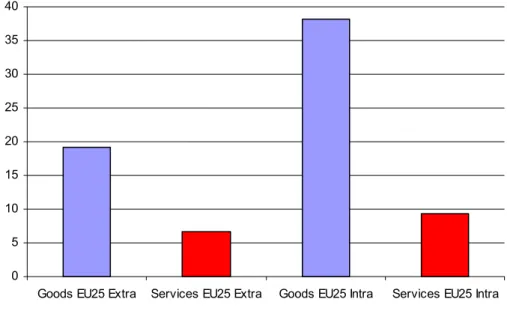
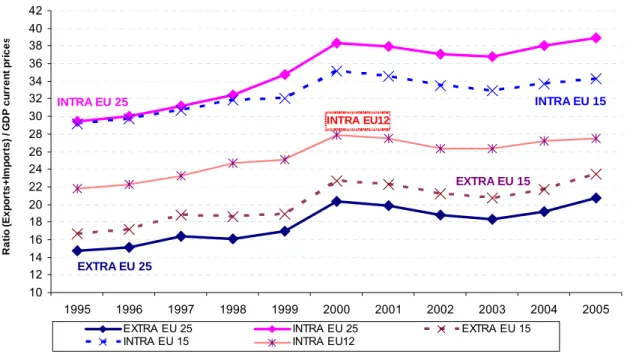
However, the concentration in the core leads to an increase in the prices of immobile factors of production. The ratio of intra-EU25 manufacturing trade to GDP increased strongly in the second half of the 1990s (especially from 1998), fueled by trade growth between the EU15 and the Central and Eastern European countries during the run-up to the latter's EU accession. The available data (see Figure 3-4) clearly shows that the Internal Market has not yet fully played its role in the service sectors.
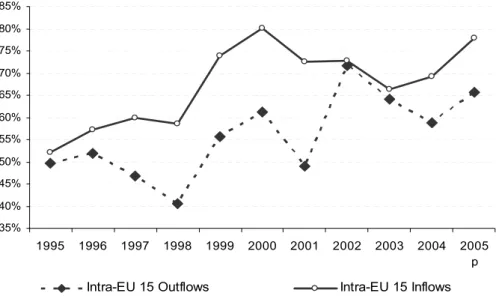
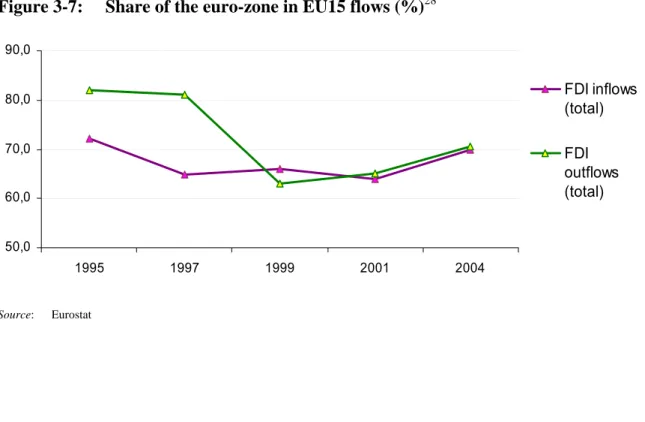
Overall, FDI activity in the EU15 has increased in the years following the implementation of the Internal Market Programme. Since 1999, the declining trend of the share of the euro area economies in the total inward and outward FDI flows of the EU15 seems to have come to an end. These claims are supported by the available evidence showing that the introduction of the Internal Market program in the late 1980s coincided with a wave of mergers and acquisitions, largely fueled by cross-border takeovers of EU companies (both intra-EU deals and takeovers by non-EU companies). businesses ).
Second, the reduction of market barriers may lead to an increase in the share of cross-border M&A in the overall EU deals. In the EU25, progress has been even more remarkable as the new Member States become increasingly integrated with the rest of the EU and gradually adopt the single market acquis. In 2001, the level of price dispersion of traded goods in the euro area was already very close to that of the United States (while it remained clearly higher in "Europe")37.
Stronger competition in the domestic market may also contribute to the elimination or acquisition of less efficient firms, leaving fewer (larger and more efficient) producers in the market. The latest figures show55 that the average entry rate over the period was twice as high in the US as in most eurozone countries and the UK. Price reductions dominate all recorded price changes in the eurozone (about 40%), with the exception of services.
The available data confirms the increasing openness of the EU economy, as the share of trade outside the EU25 in GDP - despite the slowdown observed in recent years - has increased since the mid-1990s (see Figure 3- 1). This has not been the case in the EU, where non-EU exporters have also benefited from the elimination of trade barriers within the EU and from the application of the principle of mutual recognition. The same picture emerges from M&A data, which show that the share of the EU in the number of companies targeted by M&A operations has declined continuously since the 1990s.
Since 2000, EU companies have been less active on global markets than companies from the rest of the world, especially in the fast-growing Asian service sectors67. The EU's apparent lagging behind ICT industries can be attributed to the lack of progress so far in creating a competitive internal market for services (which are the main users of ICT) and a European innovation deficit.
Macroeconomic effects
WHY HAS THE POTENTIAL OF THE INTERNAL MARKET NOT
- Slow transposition and incorrect application of Internal Market
- Inadequate standards and insufficient mutual recognition
- Product standards
- New Approach
- Mutual recognition
- Public procurement
- Barriers remaining in services sectors
- Services in general
- Retail trade
- Financial services
- Network industries
- Fiscal barriers
- Free movement of people
- Barriers to the diffusion of knowledge and innovation
Still, it is somewhat disappointing that 15 years after the so-called 'completion of the internal market' several barriers continue to hamper cross-border activities within the EU. Given the need to weigh the interests of all parties involved, speeding up the decision-making process can be difficult. The targets agreed under the Lisbon strategy for growth and jobs and peer pressure through reporting on Member States' performance in the Internal Market Scoreboard have had a positive impact.
Nevertheless, the transposition deficit of the 25 Member States averaged 1.9% in June 2006, still above the agreed target of 1.5%. Given the prominent role of the internal market as an adjustment mechanism in EMU, the poor performance of many euro area Member States is of particular concern in this regard. Cross-border transactions in services often require the presence of the service provider in both countries, creating uncertainty as to which country should apply the rules.
While EMU and the introduction of the euro provided a major impetus to financial integration in the EU, the financial sectors in the member states continue to reflect specific national conditions and preferences. Finally, the existence of 25 different tax systems creates barriers to the mobility of factors and therefore to the full implementation of the Internal Market.
REFLECTIONS ON THE INTERNAL MARKET IN THE 21 ST CENTURY
All member states contribute to the good functioning of the internal market, which can be considered a common good. The aim of this action plan was to remove the remaining barriers in order to improve the efficiency of the internal market. In the EU15, only 0.1% of the working-age population changes their country of residence in a given year.
In the US, about 3 percent of the working-age population moves to another country each year. In particular, the accession of Central and Eastern European countries increased the potential benefits of the internal market. Nevertheless, immigration can have positive effects on the functioning of the internal market by reducing labor shortages in certain areas.
The expansion of the scope of the internal market (which was much more narrowly focused on manufacturing industries under the single market program) reflects the growing economic importance of service sectors. The effect of EMU FDI is difficult to separate from the effect of the internal market. Therefore, the trade promotion effect of the internal market is not limited to the promotion of intra-EU trade.
In general, the process of enlargement and consolidation of the internal market have not hindered trade relations with third countries. This chapter examines various factors that prevent the full exploitation of the potential of the internal market. Wholesale and retail trade accounted for over 50% of economy-wide productivity growth in the US after 1995.
For example, there is now a strong presence of Western European companies in the markets of the ten new member states. Therefore, the separation (unbundling) of the bottleneck segments, which generally have inherent natural monopoly characteristics from the potentially competitive segments (such as production, supply and maintenance), is a cornerstone of the market opening process. In the EU-15, only 0.1% of the working-age population changes their country of residence in a given year.
In comparison, in the US, about 3% of the working-age population moves to another state each year. This was also reflected in the recent public consultation on the future of the Internal Market. Therefore, facilitating the adjustment processes in EMU will be an essential component of the Internal Market in the 21st century.
Lebrun (1990), "The impact of the internal market by industrial sector: The challenge for the Member States", Europese economie, speciale editie.