Architecting Cloud-Enabled Systems: A Systematic Survey of Challenges and Solutions
Muhammad Aufeef Chauhan1, Muhammad Ali Babar1,2, Boualem Benatallah3
1,2CREST – Centre for Research on Engineering Software Technologies
1IT University of Copenhagen, Denmark
2The University of Adelaide, Australia
3University of New South Wales, Australia
[email protected], [email protected], [email protected]
Abstract
The literature on the challenges of and potential solutions to architecting cloud-based systems is rapidly growing, but is scattered. It is important to systematically analyze and synthesize the existing research on architecting cloud-based software systems in order to build a cohesive body of knowledge of the reported challenges and solutions. We have systematically identified and reviewed 133 papers that report architecture related challenges and solutions for cloud-based software systems. This paper reports the methodological details, findings, and implications of a systematic review that has enabled us to identify 44 unique categories of challenges and associated solutions for architecting cloud-based software systems. We assert that the identified challenges and solutions classified into the categories form a body of knowledge that can be leveraged for designing or evaluating software architectures for cloud- based systems. Our key conclusions are that a large number of primary studies focus on middleware services aimed at achieving scalability, performance, response time and efficient resource optimization. Architecting cloud-based systems presents unique challenges as the systems to be designed range from pervasive embedded systems and enterprise applications to smart devices with Internet of Things (IoTs). We also conclude that there is a huge potential of research on architecting cloud-based systems in areas related to green computing, energy efficient systems, mobile cloud computing and IoTs.
Keywords
Cloud Computing, Software Architecture, Systematic Literature Review.
1. Introduction
Cloud computing has become an active area of research and practice. It offers on demand scalability and flexibility of Information Communication Technology (ICT) (i.e. Computing, Storage, and Network) resources [1-3] based on its utility and service provisioning approach.
Public, private and hybrid cloud deployment models are used to offers ICT resources as Infrastructure as a Service (IaaS), Platform as a Service (PaaS) and Software as a Service (SaaS) [1, 2, 4-6]. Cloud computing has been quickly making inroads in several domains for designing, developing, and deploying a diverse set of applications such as social networking sites, multiplayer gaming portals, scientific workflow systems and enterprise applications [7].
An increasing popularity and adoption of cloud computing has also surfaced a large number of challenges that need appropriate solutions. One of the key challenges of cloud computing is designing, evaluating and implementing suitable architectural solutions for cloud-enabled software intensive systems and services. Like in any other large-scale software intensive system, Software Architecture (SA) plays a vital role in cloud-enabled systems. The role of SA in cloud computing needs to be well-understood in terms of how SA can help to design cloud-based systems and can facilitate the bridging of the gap between higher-level abstractions and low-level algorithmic details. Like many other areas of cloud computing, researchers have started conducting extensive and systematic research on identifying the key challenges of and devising appropriate solutions to address the challenges of architecting cloud-based systems. Being an emerging area of research and practice, the reported literature on SA challenges and solutions for cloud-enabled systems is growing fast but is scattered. It
is difficult for researchers and practitioners to gain easy access to systematically identified peer-reviewed studies reporting challenges and solutions for cloud-based systems. Whilst there have been some reviews on cloud computing, to the best of our knowledge, there has been no effort to systematically identify and rigorously analyze and report the literature on SA-related challenges and solutions for cloud-enabled systems. In order to fill this gap, we decided to conduct a Systematic Literature Review (SLR) [8] of SA-related challenges and solutions to cloud-based software systems. The primary objective of this research is:
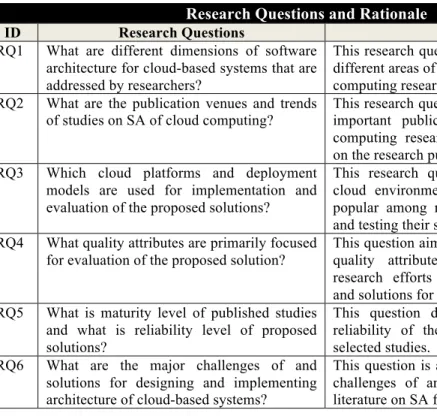
This primary objective of our SLR has been operationalized into several questions that have been shown in Table 1 along with their respective rationale. We designed and evaluated a research protocol using the SLR guidelines reported in [8]. The systematic searches were performed in two stages. In the first stage, only papers published in journals were selected. In the second stage, we also searched some of the high impact cloud computing related conferences to ensure that most of the relevant studies were included in this SLR. Our study planning, execution, and reporting were guided by our experiences of using and extending SLR methodology and the reports on best practices of and lessons learnt from SLR [9-11].
The primary contributions of this work include:
• A systematic review of the state of the art of challenges and solutions for architecting cloud-based software intensive systems. The systematically discovered and synthesized architectural knowledge can be leveraged by the practitioners for designing and evaluating suitable software architectural solutions for the cloud-based systems.
• A systematically built taxonomy of research on software architectures of cloud-based systems for studying and categorizing the identified challenges and solutions related to architecting cloud-based systems. The main categories in the taxonomy are: Resource and Service Management, Workflow Management, Service Level Agreement (SLA) Compliance and Energy Awareness.
• Identification of a set of quality attributes that have been frequently reported in the context of cloud-enabled systems; these quality attributes can support discussions and decisions for designing and evaluating architectures for cloud-based systems, especially platforms and applications levels solutions. This review has also revealed that some quality attributes (e.g. security, privacy, and interoperability) have not attracted much attention but are becoming increasingly critical for cloud-based systems. Hence, researchers need to pay more attention to studying and supporting those quality attributes.
1.1. Software Architecture
Designing and evaluating suitable SA of a large-scale complex system, one of the key characteristics of cloud-based systems, are not only extremely important but also hugely challenging. Several dozen definitions of SA have been reported. That is why it is difficult to claim that there is a widely accepted definition of SA [12]. Recent trend of describing SA as a set of design decisions and the rationale underpinning those design decisions has highlighted the importance of rationale in designing and describing SA [13]. Bass et al. [14] have defined software architecture as “a set of structures that are needed to reason about a system and software elements of the system. Structures of SA represent the partitioning and interaction decisions taken to divide the responsibilities of satisfying requirements among a set of components and defining their relationships with each other.” A structural partitioning is guided by the specific requirements and constraints of an application [14]. We describe software architecture of cloud-based systems in terms of architecture challenges that are
To provide a systematic map and review of the literature related to software architecture for cloud-enabled systems and to analyze and synthesize the selected primary studies in order to identify: (i) the challenges that need to be addressed for architecting cloud-enabled systems and (ii) the key attributes of the solutions that are proposed for addressing the identified challenges.
addressed by the researchers and a brief overview of the architectural solutions to solve the challenges. We have grouped the related concepts for classifying the challenges and solutions of designing SAs for cloud-enabled systems in multiple categories.
1.2. Survey Structure
Section 2 provides an overview of the methodology, research objectives and the approach used to synthesize the findings. Section 3 describes the selected studies’ classification into different research themes and analyzes the findings corresponding to the research objectives.
Section 4 provides a comprehensive overview of the identified architectural challenges and synthesizes the corresponding solutions. Section 5 provides a perspective on commercial cloud offerings versus research approaches. Section 6 discusses the validity threats to this research. Section 7 provides concluding remarks.
2. Research Methodology
We used Systematic Literature Review (SLR) [8] method, which is a systematic and repeatable process to identify, extract, assess, synthesize and report all available evidence (or information) on a particular research topic (i.e. architectures for cloud-based systems). Our research began by systematically designing and reviewing and implementing research protocols. Following are the activities and artifacts of this research study.
Research Protocol - The research study protocol included research background and motivation, research objectives, research questions, criteria for inclusion and exclusion of the papers, search strategies, selection of target electronic data sources along with customized search string for each of the data sources, detail of the search and selection processes for the relevant papers, and the data extraction and synthesis. The protocol also specified a set of measures to assess the quality of the selected studies.
Research Questions - Our research questions were derived from the objectives of our study.
Table 1 presents the research questions and their respective rationale.
Table 1: Research Questions and their respective Rationale Research Questions and Rationale
ID Research Questions Rationale
RQ1 What are different dimensions of software architecture for cloud-based systems that are addressed by researchers?
This research questions is aimed at identifying different areas of research focused by the cloud computing research community.
RQ2 What are the publication venues and trends of studies on SA of cloud computing?
This research question aims at highlighting the important publication venues of the cloud computing research and provide information on the research publication trends.
RQ3 Which cloud platforms and deployment models are used for implementation and evaluation of the proposed solutions?
This research question aims at highlighting cloud environments and deployment models popular among researchers for implementing and testing their solutions.
RQ4 What quality attributes are primarily focused for evaluation of the proposed solution?
This question aims at identifying the important quality attributes that have attracted the research efforts for architectural challenges and solutions for cloud-based systems.
RQ5 What is maturity level of published studies and what is reliability level of proposed solutions?
This question determines the maturity and reliability of the research published in the selected studies.
RQ6 What are the major challenges of and solutions for designing and implementing architecture of cloud-based systems?
This question is aimed at identifying the main challenges of and solutions reported in the literature on SA for cloud-based systems.
Target Data Sources - We performed systematic searches for journal papers on electronic databases that had been accessible online. We did not look for information in books and printed sources. Table 2 presents a list of our selected electronic database. These four
electronic databases are expected to cover most of the peer-reviewed literature on software engineering and computer sciences according to our work reported in [9, 15]. We also performed complementary manual searches on high impact cloud computing conferences and journals (to be described in Search and Study Selection Process section) that results in selection of 3 papers from Wiley, but we have not shown it in Table 2 because systematic searches were not performed on Wiley.
Table 2: Electronic Data Sources Data Sources
Electronic Database URI
IEEE http://ieeexplore.ieee.org/Xplore/
ACM http://dl.acm.org/
Springer http://www.springerlink.com/
ScienceDirect http://www.sciencedirect.com/
Search Query - We performed searches on the chosen digital libraries using the search queries composed of keywords selected based on the following strategies.
• Derived the major terms from the research objectives and the research questions.
• Identified alternatives and related terms. Literature related to the cloud computing is often referred with different cloud service models such as infrastructure as a service, software as a service and platform as a service. Therefore, we included the names of different service models while preparing our search string. We also included different names used for the cloud computing including cloud and cloud technologies in our search string.
• Used Boolean “or” and “and” operators to link the major terms of the strings for target databases when the search engines allowed the use of Boolean operators.
• Performed pilot searches to validate the effectiveness of the constructed search queries.
The following search string represents our generic search query used for this SLR.
(“cloud computing" OR "cloud" OR "cloud technologies”) AND ("architecture" OR
"architectures" OR "software as a service" OR "SaaS” OR "platform as a service" OR
"PaaS" OR "infrastructure as a service" OR "IaaS")
We included “* as a service” and “*aaS” in the search query to minimize the risk of missing a relevant paper during our search. We did not use “AND” clause with architecture keyword, because our initial searches had revealed that there were not many studies that were using architecture keyword in title or abstract. We customized the generic search query according to the standards of each of the target digital libraries to get more accurate search results. We performed searches using customized search strings on papers’ metadata.
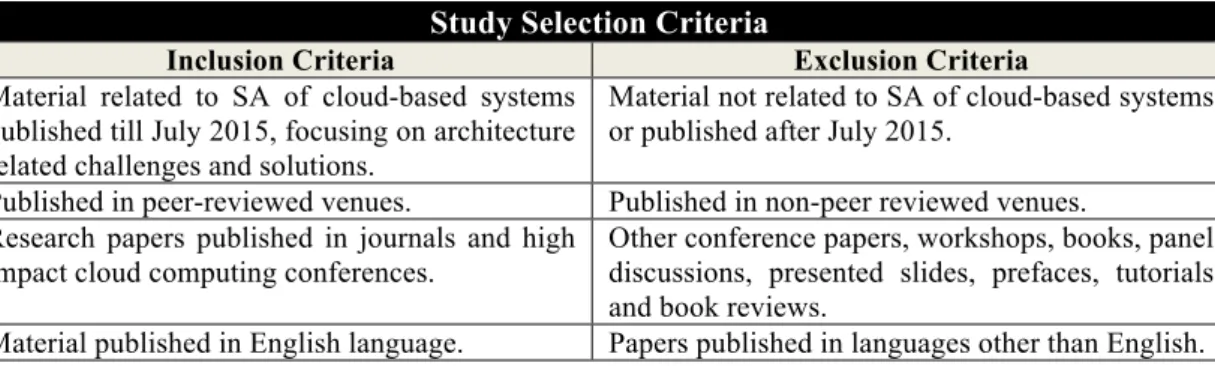
Inclusion and Exclusion Criteria - We selected peer-reviewed papers published till July 2015. We decided to include only journals and high impact conference venues in our searches for selecting and reviewing high quality papers. We excluded the papers that were not related to SA on cloud computing or were not addressing any aspect of SA. In case of different versions of the same paper were published, we included the most comprehensive version.
Table 3 shows our inclusion and exclusion criteria for selecting the papers in this review.
Table 3: Inclusion and Exclusion Criteria Study Selection Criteria
Inclusion Criteria Exclusion Criteria
Material related to SA of cloud-based systems published till July 2015, focusing on architecture related challenges and solutions.
Material not related to SA of cloud-based systems or published after July 2015.
Published in peer-reviewed venues. Published in non-peer reviewed venues.
Research papers published in journals and high impact cloud computing conferences.
Other conference papers, workshops, books, panel discussions, presented slides, prefaces, tutorials and book reviews.
Material published in English language. Papers published in languages other than English.
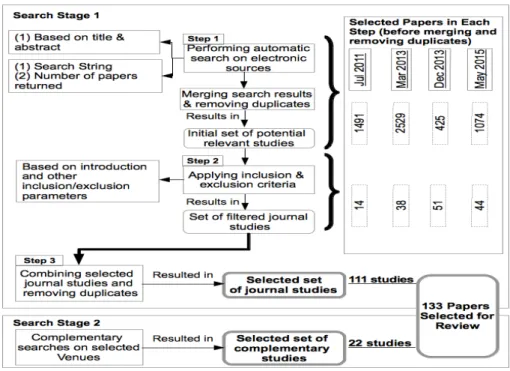
Search and Study Selection Process – An SLR usually takes a significant amount of time to complete, certainly much more than the traditional literature review. Given the continuously growing landscape of cloud-based research and practice, we decided to carry out this SLR in multiple stages. We carried out first phase of searches in July 2011 using the protocol developed for this SLR. Those searches helped us to select the first set of papers for reviewing and gaining an initial understanding of the literature. Three more phases of searches were carried out in: April 2013, December 2013 and July 2015. Our multi-staged strategy to carry out this SLR enabled us to include a large number of papers reporting mature results. Figure 1 provides some details of the searches and their outcomes at different stages.
Figure 1: Search and Study Selection Process
We performed systematic searches in the four digital libraries (i.e. IEEE, ACM, Springer and ScienceDirect) using the search query described earlier. We retrieved 1491 papers from all the searches. We filtered the papers according to the inclusion and exclusion criteria and selected 14 journal papers, which were rigorously reviewed for setting the foundation of this review. We repeated the whole search process again in April 2013 to the papers published between 2011 and April 2013. After performing the searches and merging them together, we got 2529 papers. After applying the inclusion and exclusion criteria, we selected another 38 papers. We performed the third and fourth rounds of searches by following the same process in December 2013 and May 2015. After combining the search results from the previously selected papers and removing the duplicates, we selected 111 journal papers. Then we performed complementary manual searches on high impact conferences and journals that were known for publishing papers on cloud computing research including IEEE International Conference on Cloud Computing, IEEE/ACM International Symposium on Cluster, Cloud and Grid Computing, IEEE International Conference on Cloud Computing Technology and Science, IEEE/ACM International Conference on Utility and Cloud Computing, and Software Practice and Experience Journal. As a result we selected 22 more papers in the review that resulted in 133 papers selected for this review.
Data Extraction, Synthesis and Classification – We extracted the relevant data using the data extraction form that is shown in Table 24 (Appendix A). We used EndNote and Excel spreadsheets for maintaining the bibliographic information of the studies and the extracted data. The extracted data were organized in groups based on the main focus of this SLR.
We synthesized the data with respect to architecture challenges and corresponding solutions.
Whilst the review is focused on architecture level solutions, the information about the reported algorithms was also extracted and synthesized to ensure completeness of the results as some of the challenges had been addressed by combining architectural abstractions with algorithmic strategies. Researchers have proposed several approaches (e.g. Noblit and Hare [16] and Cruzes and Dybå [17]) for synthesizing qualitative data from a SLR.
Based on our knowledge and experience, we used thematic analysis [17] for synthesizing the data extracted from the reviewed papers. According the guidelines provided in [17] by Dyba and Cruze, the data synthesis approach begins by identifying codes based on the concepts that interest to the research. Then the codes are translated into themes and sub-themes. AT the last stage, relations between themes and sub-themes are investigated to create higher order themes. We developed a catalogue of codes based on the analysis of the data. That catalogue consisted of multiple sub-catalogues. The codes were assigned to the reviewed studies according to: the publication venues, the main challenges addressed, the cloud environments utilized for evaluating the solutions, and the delivery models of the reported solutions. The codes for architectural challenges and solutions were assigned to the selected studies according to the main architectural challenges a particular study addressed, and were used to perform synthesis at two levels of abstraction: main categories of themes and sub-categories of themes. If a study addressed architectural challenges that belonged to more than one category, it was classified in both categories.
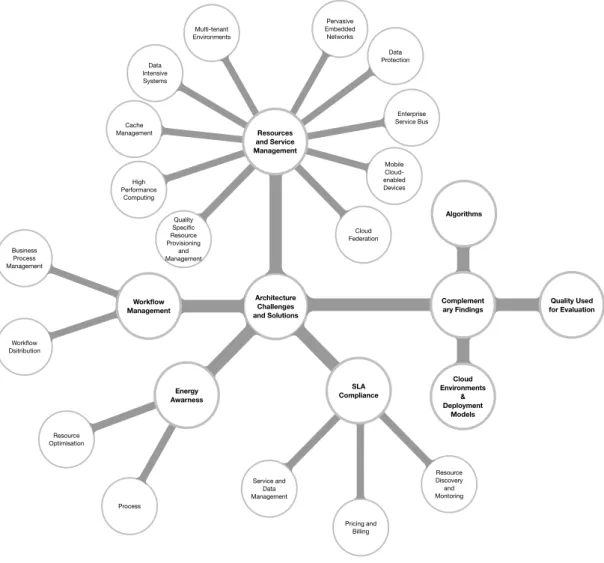
Figure 2: Taxonomy of SA Research on Cloud Computing
Quality Specific Resource Provisioning
and Management High
Performance Computing
Cache Management
Data Intensive Systems
Multi-tenant Environments
Pervasive Embedded Networks
Data Protection
Enterprise Service Bus
Mobile Cloud- enabled Devices
Cloud Federation
Workflow Dsitribution Business Process Management
Resource Optimisation
Process
Service and Data Management
Resource Discovery and Montoring
Pricing and Billing Architecture
Challenges and Solutions Resources and Service Management
Algorithms
Complement ary Findings
Cloud Environments
&
Deployment Models
Quality Used for Evaluation
SLA Compliance Energy
Awarness Workflow Management
We used the line of argument approach [16] to combine the parts of the challenges and the solutions in order to provide a comprehensive overview of the challenges and the associated solutions. We used reciprocal translation synthesis approach [16] in order to combine similar or related solutions. Section 3.1 describes the identified categories of the themes, the sub- themes and the corresponding primary studies included in the relevant categories.
Figure 2 presents the taxonomy that we devised to categorize the key findings from this SLR.
We built the taxonomy based on the papers reviewed in the first round of this SLR as depicted in Figure 1. We classified the papers in different categories and sub-categories based on the main theme of each of the studies. Each category and its subcategories were explored in term of the challenges and the proposed solutions to enable researchers and practitioners to have an in-depth view of the reported approaches, the quality attributes and the target deployment models used to identify suitability of the cloud environments with respect to a particular dimension of architecture quality. An analysis of the studies in each category and its corresponding subcategories in terms of software architecting challenges and solutions has been presented in Section 4. We have presented a classification of the studies with respect to cloud environment in Section 3.5, as the solutions that have been presented in the selected studies focus on different types of cloud environments and deployment models. Moreover, to achieve specific quality attributes, e.g. scalability, architecture-centric solutions need to be complemented by appropriate algorithms; therefore, we present a list of algorithms that have been reported in the selected studies in Section 3.7. We have built a quality attribute map used for evaluations in the reported studies with respect to the main categories in Figure 2 in Section 3.8. Section 3.9 reports the results from our analysis of the quality assessment of the reviewed studies.
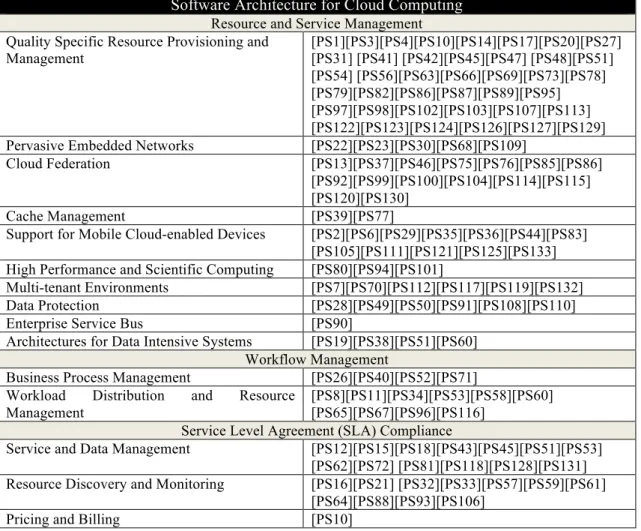
Table 4: Primary Studies’ Distribution over Thematic Categories
Software Architecture for Cloud Computing Resource and Service Management Quality Specific Resource Provisioning and
Management
[PS1][PS3][PS4][PS10][PS14][PS17][PS20][PS27]
[PS31] [PS41] [PS42][PS45][PS47] [PS48][PS51]
[PS54] [PS56][PS63][PS66][PS69][PS73][PS78]
[PS79][PS82][PS86][PS87][PS89][PS95]
[PS97][PS98][PS102][PS103][PS107][PS113]
[PS122][PS123][PS124][PS126][PS127][PS129]
Pervasive Embedded Networks [PS22][PS23][PS30][PS68][PS109]
Cloud Federation [PS13][PS37][PS46][PS75][PS76][PS85][PS86]
[PS92][PS99][PS100][PS104][PS114][PS115]
[PS120][PS130]
Cache Management [PS39][PS77]
Support for Mobile Cloud-enabled Devices [PS2][PS6][PS29][PS35][PS36][PS44][PS83]
[PS105][PS111][PS121][PS125][PS133]
High Performance and Scientific Computing [PS80][PS94][PS101]
Multi-tenant Environments [PS7][PS70][PS112][PS117][PS119][PS132]
Data Protection [PS28][PS49][PS50][PS91][PS108][PS110]
Enterprise Service Bus [PS90]
Architectures for Data Intensive Systems [PS19][PS38][PS51][PS60]
Workflow Management
Business Process Management [PS26][PS40][PS52][PS71]
Workload Distribution and Resource Management
[PS8][PS11][PS34][PS53][PS58][PS60]
[PS65][PS67][PS96][PS116]
Service Level Agreement (SLA) Compliance
Service and Data Management [PS12][PS15][PS18][PS43][PS45][PS51][PS53]
[PS62][PS72] [PS81][PS118][PS128][PS131]
Resource Discovery and Monitoring [PS16][PS21] [PS32][PS33][PS57][PS59][PS61]
[PS64][PS88][PS93][PS106]
Pricing and Billing [PS10]
Energy Awareness
Energy Aware Resource Optimization [PS5][PS9][PS24][PS25][PS55][PS84]
Energy Efficient Process [PS74]
3. Results and Analysis
The following sub-sections provide the results from this SLR in terms of the classification of the reviewed studies in different categories, distribution of the studies over publication venues, and cloud environments and deployment models used by the studies.
3.1. Research Themes Categories
Based on the analysis of the reviewed studies’ main focus, we classified the selected studies into four key categories as shown in Table 4. If a study belongs to more than one category, it has been assigned to multiple categories. However, while reporting the findings in Section 4, we have discussed the studies under one of the categories to avoid repetition and keep the structure of this review uncluttered.
Following is a brief description of the main categories.
• The studies classified into Resource and Service Management category provide solutions for managing applications and services on the cloud with respect to the desired functional and quality requirements. The studies included in this category also provide solutions to protect services and data that belong to multiple tenants.
• The studies classified in Workflow Management category provide solutions for managing distributed workflows for processing computing intensive and security sensitive data.
• The studies classified into Service Level Agreement (SLA) Compliance category provide solution to satisfy SLAs in cloud-based software systems. SLA compliance is treated as a separate category rather than making it a part of Resource and Service Management because papers included in this category of theme are not only providing resource management solutions but also providing solutions for SLA specific service discovery, monitoring pricing and billing.
• The studies classified into Energy Awareness category provide energy efficient solutions.
Subcategories corresponding to main categories of themes are elaborated in Section 4. A complete list of the selected studies’ references can be found in Appendix C.
3.2. Data Sources
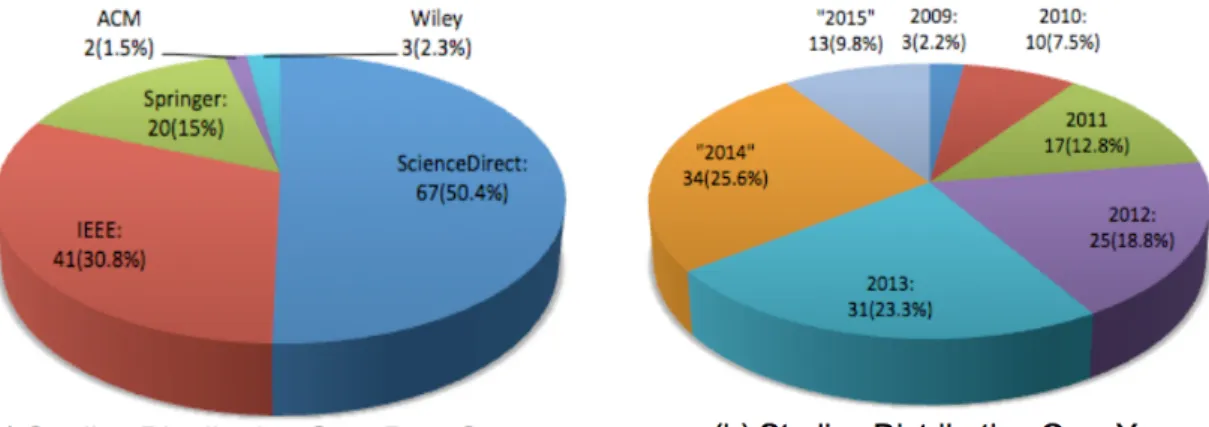
Figure 3(a) shows the distribution of the reviewed studies over the digital libraries used in this SLR. ScienceDirect is the most prominent source with 67 (66%) studies. IEEE is the second with 41 (22%) studies published followed by Springer with 20 (12%) studies. There are 3 papers (2.3%) published by Wiley and 2 (1.5%) published by ACM.
Figure 3: Studies Distribution
3.3. Publications Over Years
Figure 3(b) shows the distribution of the papers based on publication years. We did not specify the starting date for the publication on the topic (i.e. Software Architecture in cloud- based systems) in our searches. Our results show that 2009 is the first year with 3 papers published discussing SA of the cloud-based systems. There has been a significant increase in number of papers during the following years; 10 in 2010, 17 in 2011, 25 in 2012, 31 in 2013, 34 in 2014 and 13 till July 2015. These results indicate that the number of papers reporting research on SA of Cloud-based system has been increasing.
3.4. Number of Papers published in Different Venues
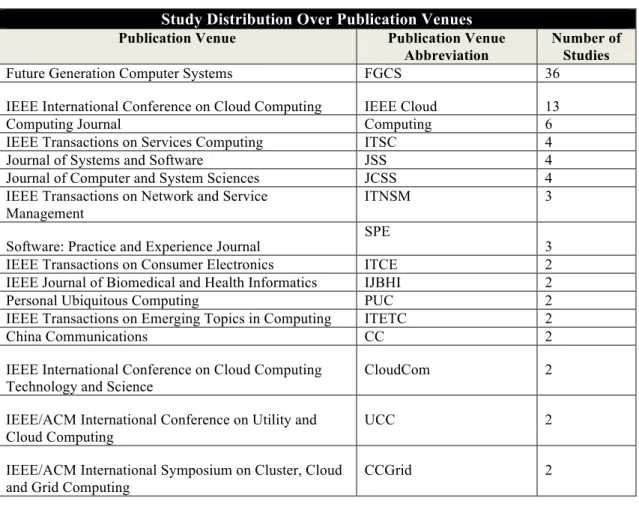
Table 5 shows the venues in which the papers on software architecture of cloud-based systems have been published. Table 5 lists only those venues that have published two or more papers on the reviewed topic. Journal of Future Generation Computer Systems has published the most (i.e. 36 papers) papers; it can be expected because this journal has been publishing an extensive amount of research on cloud computing related topics. The IEEE International Conference on Cloud Computing has published 13 papers on the topic. The Computing journal published 6 papers. The IEEE Transactions on Service Computing, the Journal of Systems and Software and the Journal of Computer and System Sciences have published 4 papers each. The IEEE Transactions on Network and Service Management and the Software Practice and Experience Journal have published three papers each. All the remaining journals and conference venues shown in Table 5 have published 2 papers each.
Table 5: Publication Venues
Study Distribution Over Publication Venues
Publication Venue Publication Venue
Abbreviation
Number of Studies
Future Generation Computer Systems FGCS 36
IEEE International Conference on Cloud Computing IEEE Cloud 13
Computing Journal Computing 6
IEEE Transactions on Services Computing ITSC 4
Journal of Systems and Software JSS 4
Journal of Computer and System Sciences JCSS 4
IEEE Transactions on Network and Service Management
ITNSM 3
Software: Practice and Experience Journal SPE
3
IEEE Transactions on Consumer Electronics ITCE 2
IEEE Journal of Biomedical and Health Informatics IJBHI 2
Personal Ubiquitous Computing PUC 2
IEEE Transactions on Emerging Topics in Computing ITETC 2
China Communications CC 2
IEEE International Conference on Cloud Computing Technology and Science
CloudCom 2
IEEE/ACM International Conference on Utility and Cloud Computing
UCC 2
IEEE/ACM International Symposium on Cluster, Cloud and Grid Computing
CCGrid 2
3.5. Cloud Environments Used
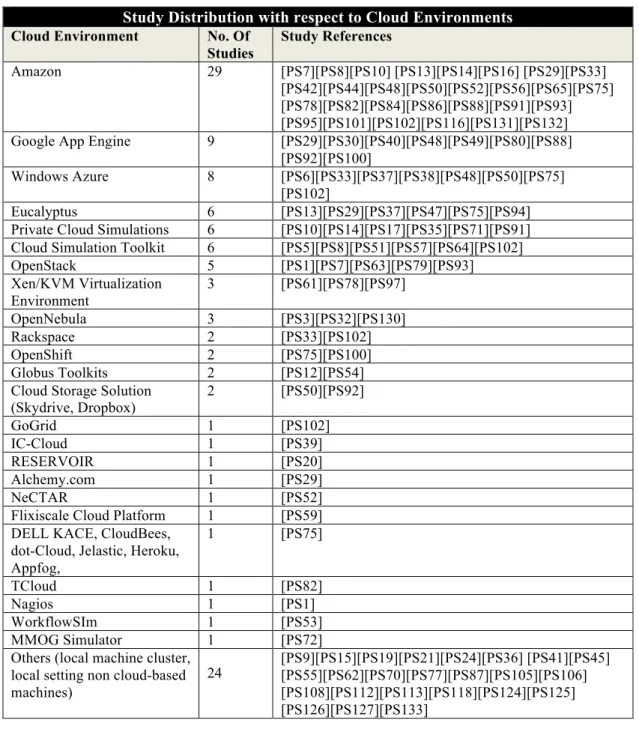
The reviewed papers have used different cloud environments to implement and deploy the proposed solutions as shown in Table 6. Amazon is on the top of the list with 29 reviewed papers using Amazon as the environment to implement the proposed solutions. Google App
Engine and Windows Azure are at the second and third places with 9 and 8 papers respectively using them for implementing the proposed solutions. There are also a significant numbers of papers whose solutions have been tested using private cloud environments and local hardware infrastructure as a simulated cloud environment.
Table 6: Cloud Environment used for research reported in the primary studies Study Distribution with respect to Cloud Environments
Cloud Environment No. Of Studies
Study References
Amazon 29 [PS7][PS8][PS10] [PS13][PS14][PS16] [PS29][PS33]
[PS42][PS44][PS48][PS50][PS52][PS56][PS65][PS75]
[PS78][PS82][PS84][PS86][PS88][PS91][PS93]
[PS95][PS101][PS102][PS116][PS131][PS132]
Google App Engine 9 [PS29][PS30][PS40][PS48][PS49][PS80][PS88]
[PS92][PS100]
Windows Azure 8 [PS6][PS33][PS37][PS38][PS48][PS50][PS75]
[PS102]
Eucalyptus 6 [PS13][PS29][PS37][PS47][PS75][PS94]
Private Cloud Simulations 6 [PS10][PS14][PS17][PS35][PS71][PS91]
Cloud Simulation Toolkit 6 [PS5][PS8][PS51][PS57][PS64][PS102]
OpenStack 5 [PS1][PS7][PS63][PS79][PS93]
Xen/KVM Virtualization Environment
3 [PS61][PS78][PS97]
OpenNebula 3 [PS3][PS32][PS130]
Rackspace 2 [PS33][PS102]
OpenShift 2 [PS75][PS100]
Globus Toolkits 2 [PS12][PS54]
Cloud Storage Solution (Skydrive, Dropbox)
2 [PS50][PS92]
GoGrid 1 [PS102]
IC-Cloud 1 [PS39]
RESERVOIR 1 [PS20]
Alchemy.com 1 [PS29]
NeCTAR 1 [PS52]
Flixiscale Cloud Platform 1 [PS59]
DELL KACE, CloudBees, dot-Cloud, Jelastic, Heroku, Appfog,
1 [PS75]
TCloud 1 [PS82]
Nagios 1 [PS1]
WorkflowSIm 1 [PS53]
MMOG Simulator 1 [PS72]
Others (local machine cluster, local setting non cloud-based machines)
24 [PS9][PS15][PS19][PS21][PS24][PS36] [PS41][PS45]
[PS55][PS62][PS70][PS77][PS87][PS105][PS106]
[PS108][PS112][PS113][PS118][PS124][PS125]
[PS126][PS127][PS133]
3.6. Deployment Models Used
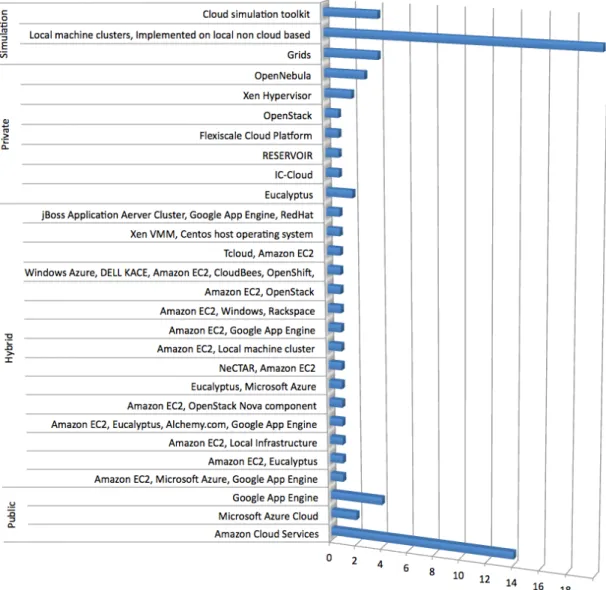
It has been stated that cloud computing solutions can have different deployment models. The reviewed papers reported solutions for not only the three commonly known deployment models (i.e. public, private and hybrid), but some papers also used local infrastructure as a simulated cloud environment. Figure 4 shows the number of papers that used different deployment model or simulated cloud environments. Our SLR has revealed that Amazon Web Services (AWS), Windows Azure and Google App Engine are commonly used public cloud environments. Eucalyptus, OpenStack, AWS and Windows Azure are common choices for implementing hybrid solutions. Eucalyptus, Flexiscale cloud platform, UC-Cloud and
RESERVOIR have been used for private clouds. Grids, cloud simulations toolkits, and local machines clusters have also been used for building and using simulated cloud environments.
Figure 4: Studies Distribution with respect to Cloud Deployment Models
3.7. The Named Algorithmic Solutions
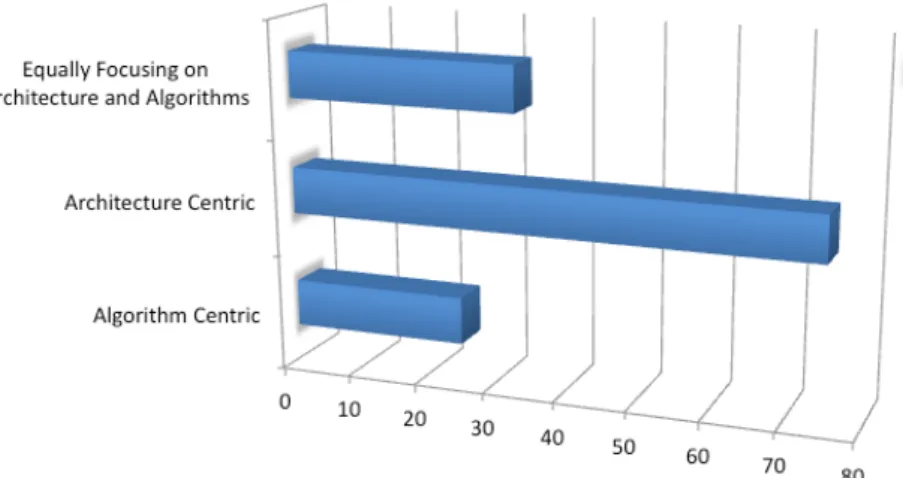
The reviewed papers have reported solutions to the challenges of cloud-enabled systems with primary focus on architecture-centric solutions, algorithm-centric solutions, or a combination of both. During the papers selection and data extraction phases, we analyzed the algorithmic aspects that complement architecture solutions for specific quality attributes. For example, to achieve scalability based on cost, the primary study [PS39] proposed a Cost-Aware Scaling algorithm to complement architecture solution for scalability. There are 25 studies that provide algorithm-centric solutions, whereas the number of papers providing architecture specific solutions and combination of algorithmic and architecture solutions are 75 and 33 respectively as shown in Figure 5. Table 7 lists the papers that have reported the algorithmic solutions specific to corresponding architecture solutions. However, the Table 7 does not show the algorithms that have not been reported with a particular name.
Figure 5: Studies Distribution with respect to Solutions Abstraction Table 7: Algorithms used or proposed in the Selected Studies Algorithms Used to Complement Architecture Based Solutions
Algorithm-Centric Solutions
SI-Cache [PS77] Task Management Algorithm [PS95]
Cost-Aware Scaling Algorithm [PS39] Modified Vickrey Auction (MVA) and Continuous Double Auction (CDA)
[PS103]
Additive Homomorphic Probabilistic public key Encryption (AHPE)
[PS91] HEFT, Greedy task queue and LATE Scheduling Algorithms
[PS8]
Proxy Re-encryption [PS91] Median-Edge Detector (MED) and Inter-Slice Predictor (ISP) algorithms
[PS17]
Additive Homomorphic Proxy Re- encryption
[PS91] Partitioning Algorithm based on TABU Search
[PS34]
Extension to MapReduce [PS38]
[PS19]
[PS60]
Place/Transition Petri nets based SBP Model
[PS71]
Feature Placement Algorithm [PS70] O-SLA and R-SLA Algorithms [PS72]
Local Consistency and Global Consistency Auditing Algorithms
[PS82] Energy Optimization Method based on Lyapunov
[PS25]
Meta-data index creation, query expansion, peer tracker and information retrieval algorithms
[PS87] Genetic Algorithms [PS31]
[PS111]
Algorithm & Architecture-Centric Solutions Spot Instance-Aware Provisioning
Algorithm
[PS14] Assisted Anycast (AA) [PS9]
Backtracking Algorithm [PS66] Multi-fixed Sequencer Protocol [PS21]
Reactive & Predictive Algorithm Models
[PS47] TF-IDF Algorithm [PS88]
Service Provider Search Engine (SPSE) Algorithm
[PS107] Virtual Machine Share Allocation Strategy and Thick Client
Reserved Allocation Optimization Strategy
[PS45]
ProfminVM, ProfRS & ProfPD Algorithms
[PS102] MT-PerfMod and Mt-ResElas Algorithms
[PS56]
Automatic Data Streaming Service (ADSS) Algorithm
[PS96] LHS, Moldflow and GA Algorithms
[PS63]
Partitioned Balanced Time Scheduling (PBTS)
[PS11] Posterioir Playfair Searchable Encryption (PPSE)
[PS86]
Modified Best Fit Decreasing (MBFD) Algorithm
[PS5] Particle Swarm Optimization (PSO) Algorithm
[PS94]
Minimization of Migration (MM) Policy
[PS5] Ciphertext Policy Attribute- based Encryption (CP-ABE)
[PS68]
Extension to MOGAs, NSGA-II &
SPEA2 Algorithms
[PS41] Sieving Algorithm [PS53]
Full Anycast (FA) [PS9] BestFit, BFResvResource and BFReschedReq Algorithms
[PS64]
Smarter Simulated Annealing Algorithm
[PS117]
3.8. Research Themes Categories and Quality Attributes Matrix
Since software architecture design decisions play a significant role in support or inhibiting different quality attributes, we decided to draw a matrix of the research themes’ categories and the quality attributes on which different papers have focused. We believe that such a matrix can be useful to quickly figure out the quality attributes addressed in the papers that fall under certain category of the research themes. Figure 6 shows the distribution of the papers with respect to quality attributes that are shown on X-axis and the categories are shown on Y-axis. Scalability, performance, efficient resource utilization, CPU utilization and response time are the most frequently reported quality attributes in papers reporting architectural challenges and solutions for cloud-based systems. The bubble at each of the intersections of X-axis and Y-axis shows the number of corresponding papers. For example, the intersection of Performance and Resource and Service Management indicates that there are 36 papers that have reported challenges and solutions related to performance in the context of resources and service management issues.
Figure 6: Quality Attributes distribution with respect to the Categories
3.9.
Quality Assessment of the StudiesOne of the critical, albeit optional, steps of an SLR is to assess the quality of the primary studies included in the review. Hence, we assessed the quality of the reviewed primary studies using a quality checklist devised based on the quality assessment criteria for primary studies provided by Dybå and Dingsøyr [19, 20]. Table 8 shows the questions used to assess the quality of the papers included in this review.
We used ternary scale with values of Yes (1), Partial (0.5) or No (0). With Q1, we assessed if a primary study’s findings were based on research or not (on opinions). The question 2 accessed whether or not a study clearly reported the research objectives and the addressed challenges. The question 3 was used to analyze if a study had clearly stated the evaluation
setting in which the proposed solutions and the corresponding implementations were evaluated. The question 4 was used to evaluate whether or not a study had reported the data to support the evaluation results. The question 5 purported to assess whether or not a study clearly reported the limitations of the proposed solutions, and stated directions for improvement and future enhancements in the solutions. The answer to this question helped us to determine the future research scope of the problem areas discussed in a paper.
Table 8: Quality Assessment Criteria (a tailored version of the propositions from [19, 20]) Quality Assessment Criteria
Id Question
Q1 Is paper based upon research or is it merely a “lessons learned” report based upon expert opinion?
Q2 Is there a clear statement of aim of the research and research objectives?
Q3 Is there an adequate description of the evaluation context in which proposed solutions are evaluated?
Q4 Have the data been reported to support evaluation findings?
Q5 Are selected primary studies reporting limitations and areas for improvement?
Table 25 (Appendix B) shows the quality score for each of the papers in this SLR. All of the papers have value score 1 for Q1 as none of the reviewed papers had reported lessons learned or experience reports. The average scores for Q2, Q3 and Q4 are 0.99, 0.93 and 0.74 respectively. It shows that the aim and context of the research were clearly reported in all of the papers and the findings have been reported in satisfactory manner. An average value score of Q5 is 0.53, which means many of the selected papers have not provided clear directions for their future work and enhancements. The aggregated average quality assessment score is 4.2 out of 5, which indicates that the reviewed papers were of high quality.
4. Analysis of the Challenges and Solutions
In this section, we provide a detailed analysis of the identified architectural challenges (problems) and the corresponding solutions. For each of the identified architectural challenge, we have listed fine-grained problems, which have been addressed by one or more of the selected studies. We have classified the papers reporting similar challenges in the same category of themes. When a paper has reported different challenges, that paper has been classified into more than one category or subcategory. The primary studies have been further classified into subgroups to have a specialized grouping of closely related topics. The challenges associated with the categories and subcategories have been tabulated in the following sections and the solutions corresponding to the problems have been described.
Based on our analysis, the identified architectural challenges and the solutions have been categorized under different themes. The categorized architectural challenges and solutions form a body of knowledge that can facilitate architecture design and analysis of SaaS and PaaS for achieving specific architecture qualities and functional requirements. The listed challenges have been identified for their relevance to IaaS (I), PaaS (P) and SaaS (S), and if these correspond to an essential quality characteristic (E) of the cloud-based systems or a complementary quality characteristic (C) that provide an efficient cloud-based solution. The challenges that are addressing scalability, elasticity, reliability, security and multi-tenancy have been characterized as essential. Whereas the challenges that are addressing the quality characteristics that improve quality of a cloud-enabled system but their absence may not severely impact the service model of a system, are characterized as complementary. For example in Table 9, for interoperability challenge that is relevant to PaaS and SaaS and is a complementary characteristics of the system, it is identified as {PSC}. In the remainder of this section, each architecture challenge has been classified according to this scheme.
4.1.
Resource and Service ManagementThe papers that have been classified into this category report the challenges related to architecture solutions for resource and service management. The middleware acts as a bridge between applications and underlying IaaS cloud resources. Based on the extracted data, we analyzed and classified the challenges into ten subcategories. The following subsections describe the reported challenges and solutions.
4.1.1. Quality-Specific Resource Provisioning and Management
Challenges: One of the primary challenges associated with the resource and service management on clouds is the incorporation of quality characteristics in the solutions. Table 9 shows the challenges associated with incorporated quality attributes. By addressing the listed
Table 9: Resource Provisioning and Management - Quality Attribute Problems
Challenge Description Study
Reference Interoperability Support for interoperability to simultaneously use
multiple collaborative cloud services and data.
{PSC}
[PS41]
[PS86]
Privacy Trusted cloud services to process private data. {SC} [PS4]
Data placement strategies with respect to privacy requirements. {PSC}
Trusted service providers (to achieve desired level of security and privacy). {SC}
[PS10]
Compliance with legal and regulatory requirements.
{PSC}
Availability Acquiring extra nodes for the high availability of applications. {PSE}
[PS31]
Isolating components deployed on distributed nodes.
{PSE}
Identifying bottlenecks associated with response time and resolving them automatically. {PSC}
[PS47]
Avoid overloading of infrastructure resources and
SLA violations. {IPSE} [PS102]
Availability according to performance parameter.
{PSE} [PS3][PS123]
Scalability Accurately identifying traffic patterns for dynamic scalability. {IPSE}
[PS47]
Autonomous and scalable self-organized clouds for
utilizing publically acquired resources. {IPSC} [PS103]
[PS113]
Portability Improving portability of applications and services.
{SC}
[PS78]
Avoiding vendor lock-in for low-level resources and application-level services. {SC}
Security Secure management of 3D medical images data.
{PSC}
[PS17]
Security as a Service to support IaaS cloud users.
{IPSE}
[PS97]
Handling security liabilities of cloud providers and
hosted virtual machines (VMs). {IPE} [PS98]
Elasticity Resource elasticity according to QoS parameters.
{IPSE}
[PS56][PS124]
Consistency Consistency of the replicated services on multiple
clouds. {PSC} [PS82]
Performance Efficient multi-media information retrieval. {SC} [PS87]
Adaptability Support adaptability of service transmission environment according to specific QoS requirements in cloud and provide communication space specific to a customer’s needs. {PSC}
[PS73]
challenges, design time (interoperability, privacy, portability, security and consistency) and runtime (availability, scalability, elasticity, performance and adaptability) quality of cloud solutions can be improved.
Solutions: To address the challenges of simultaneously using multiple collaborative cloud services to satisfy the needs of end users while maximizing profit, Hassan et al. [PS41]
propose an architecture of Combinatorial Auction (CA) based Cloud Market model, CACM.
This solution provides an auction policy for virtual organization based dynamic cloud platform among cloud providers. Ribeiro et al. [PS86] present a proxy based architecture to preserve interoperability, confidentiality and searchability of shared cross-enterprise documents. The proxy is based on Posterioir Playfair Searchable Encryption (PPSE) algorithm that hides search patterns for maintaining data confidentiality.
Two studies, [PS4] and [PS10], have proposed an architecture to handle the privacy challenges (data hosting on secure places and trusted service provisioning) using trusted cloud services, data placement strategies and trusted service providers. In order to overcome the challenges of trusted cloud services and data placement strategies, a study [PS4] presents a platform to allow home services to be selectively opened to remote users and semi-trusted external services. To tackle the issues of trusted service providers and legal and regulatory compliance, Buyya et al. [PS10] propose a concept of cloud market, where users can interact with the market and make request for resources according to the applications’ needs with the help of cloud broker. The cloud broker facilitates service selection for end users.
To counter the challenges of acquiring extra nodes for the high availability of applications and isolating components deployed on distributed nodes, Frincu [PS31] presents an architecture-centric solution which finds the optimal number of component types needed on nodes so that every type is presented on every allocated node by using Genetic Algorithms.
Iqbal et al. [PS47] present an architecture-centric solution for availability by automatically detecting the bottlenecks associated with response time using heuristics and active profiling of CPU utilization.
Wu et al. [PS103] present two economic strategies for scalable and autonomous resource allocation mechanisms: (i) Modified Vickrey Auction (MVA) when the resources are sufficient and (ii) Continuous Double Auction (CDA) when resources are insufficient.
Ardagna et al. [PS113] provide a catalogue of scalability patterns for vertical and horizontal scaling on a single platform, shared platforms, cluster platforms, multiple shared platforms and multiple clustered platforms. By dynamically negotiating resources among Cloud Coordinators in the InterCloud environment, Wu et al. [PS102] intend to solve the problem regarding overloading resources and SLA violations. An et al. [PS3] present a publisher/subscriber based replication framework for autonomous virtual machines management using different types of performance and availability mechanisms. Kanso and Lemieux [PS123] propose a layered middleware in which high availability agents monitor and control state aware applications with the help of integration agents. Petcu et al. [PS78]
present a layered architecture to increase portability of the applications among cloud environments and to avoid vendor lock-in. The architecture proposes loosely coupled applications layers, cloud neutral APIs and unified resource representation from multiple cloud environments.
Castiglione et al [PS17] present a security architecture for dynamic and adaptive security 3D medical data imagery using security watermarks in images. Varadharajan et al. [PS97] present a security architecture to provide a baseline security for protecting cloud infrastructure. The architecture is based on Service Provider Attach Detection (SPAD) and Tenant-Specific Attach Detection (TSAD) approaches. Vera-del-Campo et al. [PS98] present DocCloud
security architecture that focuses on plausible deniability, anonymity of indexer, recommenders and intermediate nodes, and oblivious routing. Kaur et al. [PS56] present a framework for dynamic scalability of cloud resources based on desired performance parameters by examining incoming request patterns and their corresponding response rates.
Kirschnick et al. [PS124] propose a Management Tier-based architecture that provides programmable APIs to the application developers for automatically deploying applications on IaaS cloud. Qin et al. [PS82] present a two level auditing architecture, which is based on heuristic auditing strategy and looks for commonalities of violations and staleness of the data so that the users can verify data consistency. Rocha et al. [PS87] present a layered architecture for meta-data and video segment retrieval using ontologies to track and share video segments among cloud nodes.
Noh and Kim [PS73] present a communication bus network architecture for multimedia services in cloud. The solution consists of adaptation middleware and communication bus providing logical and physical end-to-end connections. The proposed model supports profiles of collected information from the user, devices and network to support adaptation.
Table 10: Resource Provisioning and Management – Monitoring and Deployment Problems
Challenge Description Study
Reference Monitoring System monitoring for compliance with dynamic scalability
scheme. {IPSE} [PS54]
[PS79]
[PS122]
Adaptation of monitoring infrastructure with respect to quality requirements. {IPSE}
Capturing and monitoring applications’ key performance indicators. {IPSEC}
Non-intrusive monitoring of cloud services. {PSC}
Resource Allocation
Selecting suitable service providers for hosting application services. {IPSC}
[PS27]
[PS126]
[PS127]
[PS129]
Managing stakeholders’ conflicts during resource allocation.
{PSC}
Quantitatively accessing and evaluating stakeholders and their satisfaction. {PSC}
Autonomic resource allocation and adjustment against risk, trust, reliability and economic efficiency. {IPSC}
Explicit architectural constraints for resource allocation,
replication, migration and de-allocation. {PC} [PS20]
Modeling and simulation of cloud resources with respect to different types of QoS parameters. {IPC}
[PS51]
Optimized hosting of the resources in cloud data centers.
{IPC} [PS63]
Mapping multi-media tasks to Virtual Machines (VMs) and
deploy the VMs on physical servers. {IPC} [PS95]
Service Selection
Autonomous selection of appropriate services and service providers in order to reduce resource utilization cost. {SC}
[PS48]
[PS102]
Collaboration among cloud service providers (service
discovery, advertisement and composition). {IPC} [PS48]
Providing scalable service scheduling mechanism that considers dynamic number of service providers and extensible QoS requirements. {PC}
[PS107]
Market-oriented resource and service provisioning. {PSC} [PS14]
Discovery of cloud resources that are compliant with end user needs. {PSC}
[PS89]
Service Deployment
Handling a large number of service deployment requests in a short period of time. {IPC}
[PS66]
Avoid redundant deployment of services in the cloud. {PSC}
Resource deployment according to optimization criteria.
{PSC}
Challenges: Applications and services deployed on a cloud need to be monitored for their execution according to desired quality parameters. In case an anomaly is detected, additional resources need to be allocated. The papers classified in this subcategory deal with monitoring, selection and deployment of services on a cloud according to specific parameters. The challenges are listed in Table 10.
Solutions: Katsaros et al. [PS54] present a layered architecture [21] to monitor cloud-based applications. The monitoring components are deployed on, PaaS for monitoring the infrastructure and application data, IaaS for monitoring the hardware resources, and SaaS for monitoring applications. Povedano-Molina et al. [PS79] present a Distributed Architecture for Resource manaGement and mOnitoring in cloudS (DARGOS) to determine status and availability of physical resources and services. The presented publisher subscriber paradigm intends to help to accurately measure physical and virtual resources in cloud with the help of monitoring metrics. Inzinger et al. [PS122] propose an architecture for monitoring and adaptability of the resources on heterogeneous distributed clouds. The architecture consists of a Monitoring Engine that monitors the resources, Adaptation Rule Engine that prepares adaptation rules and Deployment Module that deploys the applications on the cloud.
Ferrer et al. [PS27] propose a holistic approach for cloud service provisioning and single abstraction of multiple coexisting cloud architectures for broader cloud service eco-system.
Melendez et al. [PS126] propose a layered architecture that consists of a scheduler layer and a broker layer. The broker layer receives provisioning requests from end users whereas the scheduler layer schedules and deploys application components on underlying IaaS cloud. The broker layer consists of a Dynamic Resource Pool Manager that takes user specification as input, provisions the resources according to the specification and monitors the resources after provisioning. Mohamed and Jaroodi [PS127] provide a middleware (MidCloud) for effective utilization of replicated cloud services and resources to reduce negative impact of dynamic service response delays. The layers consists of service registry that registers services on cloud, monitoring agents that monitor client applications and servers, and service adapters that adapt and deploy the services to minimize the delays. Salama and Bahsoon [PS129]
present a synthesis of auto-scaling and self-awareness patterns and design tactics. Sensors, monitoring components and actuators are main elements of auto-scaling pattern. Self- awareness, interaction-awareness, time-awareness and goal-awareness are main elements of self-awareness patterns.
To address the issues of resource allocation, replication, and migration,Chapman et al.
[PS20] present a policy including the requirements and constraints that a provider must specify while deploying and hosting a multi component application on cloud. Jararweh et al.
[PS51] present CloudExp, a cloud simulation toolkit to simulate different types of quality parameters for testing cloud applications. Li et al. [PS63] present an optimization strategy that is based on decomposing a deployment task into sub-tasks, which are then converted into virtual applications that can be deployed on suitable IaaS cloud resources. Song et al. [PS95]
present a queue-based approach for task management, which is based on allocation deadline to optimize the performance of multi-media services. Itani et al. [PS48] present the architecture of a routing decision engine named ServBGP that has been designed by reusing the decision logic of the standard Border Gateway Protocol (BGP). The ServBGP decision engine facilitates the selection of appropriate service provider path based on specific quality attributes and autonomously forwards the customer service request along with appropriate provider paths based on pricing and reputation criteria.
Wu et al. [PS102] report three algorithms for maximizing resource utilization and countering the challenge of selecting appropriate IaaS service providers. The algorithms focus on