0
Implementation of Demand Side Flexibility
from the perspective of Europe’s Energy Directives
A Joint Working Group Report from
the Concerted Actions for the Energy Efficiency Directive (EED),
Renewable Energy Source (RES) Directive &
Energy Building Performance Directive (EPBD)
Final Report, 21 august 2015
1
Table of Contents
Foreword ... 2 Abbreviations and definitions ... 4
1. Executive Summary ... 6
1.1 Conclusions 6
1.2 Recommendations 7
2. Introduction ... 9
3. About Demand Side Flexibility ... 10
3.1 DSF Explained 10
3.2 Benefits and Costs 13
3.3 Market Segments and Actors 14
3.4 Profiling Systems are a barrier to DSF 15
3.5 Alternatives to DSF 15
4. Best Practices ... 17
4.1 Practical Examples 17
4.2 Recent Reports 19
5. Europe’s Energy Directives and DSF………..………24
5.1 Renewable Energy Sources Directive (2009/28/CE) 24
5.2 Energy Efficiency Directive (2012/27/EU) 25
5.3 Energy Buildings Performance Directive (2010/31/EU) 26
6. View of the Joint Working Group……….………..………..28 7. References………..29
2
Foreword
By providing a trusted forum for cooperation and for exchanging experiences, a Concerted Action (CA) helps Member States (MS) learn from each other, avoid pitfalls, and build on successful approaches when implementing an EU Directive. CA programs are financed under the Intelligent Energy Europe Programme or under the Horizon 2020 program of the European Commission. Three Concerted Actions are in place for three energy-related EU directives:
• Energy Efficiency Directive (EED)
• Renewable Energy Directive (RES)
• Energy Performance of Buildings Directive (EPBD)
More specifically, the objectives of the CAs are to:
• Stimulate sharing information by establishing dialogues and discussions between MS and different organisations that are involved in implementation of a EU Directive
• Share best practices from national implementation
• Create favourable conditions for an accelerated degree of convergence of national procedures in related matters.
• Develop status overviews of implementation and relevant developments for the relevant Directive A joint working group with members from the three Concerted Actions has compiled this report. These members are:
• Edwin Edelenbos (leader) of ACM (the Netherlands) representing CA EED
• Mikael Togeby of Ea Energy analyses (Denmark) representing Danish Energy Agency in CA RES
• Kim B. Wittchen of Danish Building Research Institute, Aalborg University (Denmark) representing CA EPBD
For this public report the JWG has contacted several researchers, agencies and companies for developing a better understanding of DSF. The JWG thanks everybody who has contributed to this project. Although the JWG has carefully considered views and comments from all involved third parties as much as possible, it cannot be excluded that certain text parts may not entirely reflect third party views. This report reflects only the view of the JWG and not of any third party or the European Union, European Commission (including the Intelligent Energy Europe Programme and the Horizon 2020 Programme) or Member States.
3
"Integrating renewables cost-efficiently … requires flexible markets, both on the supply and demand side. The business case for a more active participation of demand is clear - demand side response alone could save our economy up to 100 Billion Euro per year… To activate it we need to remove remaining obstacles in our market rules; we need active consumers with real choice; and we need prices that are market-based and unregulated."
Miguel Arias Cañete
EU Commissioner for Climate Action & Energy, April 2015
4
Abbreviations and definitions
Ancillary Service Service necessary to support the transmission of electric power from seller to purchaser given the obligations of control areas and transmitting utilities within those control areas to maintain reliable operations of the interconnected transmission system. Usually only TSOs use ancillary services, but in future DSOs may become active with similar types of services for local or regional grid management objectives (‘constraint management’).
CA Concerted Action
CEER Council of European Energy Regulators. CEER is where the National Regulatory Authorities cooperate and exchange best practices on a European level. A key objective of CEER is to facilitate the creation of a single, competitive, efficient and sustainable EU internal energy market that works in the public interest.
CPP Critical Peak Pricing is a type of Time of Use pricing, where some predefined price levels can be activated, e.g. with a day’s notice. CPP offers lower year-round pricing during non-peak hours in exchange for substantially higher pricing during critical peak hours or days. Critical peak periods or event days occur at times of increased wholesale prices due to heightened consumption (e.g. very hot or cold days) or when the stability of the system is jeopardized (e.g. risk of black-outs). The maximum number and length of critical peak periods can be agreed upon with end- users in advance. In this report CPP is considered a type of Demand Side Flexibility.
CPP can be both grid and market related. That means that both suppliers and grid operators can ‘activate’ the critical peak periods.
DG ENER Directorate-General for Energy. One of 33 policy-specific departments in the European Commission.
DR Demand Response. Changes in electric usage by end-users consumption patterns in response to changes in the price of electricity over time, or to incentive payments.
DSF Demand Side Flexibility. Preferred wording in this paper for Demand Response or Demand Side Management or Demand Side Response for two reasons. First the link with the need for flexibility is stronger. Second ‘response’ suggests automated responses from customers, which is not a given.
DSO Distribution System Operator. In many MS DSOs manage the lower and medium voltage networks or the local/regional networks. The number and size of DSOs differs from MS to MS. Usually DSOs are publicly owned. In general DSOs are responsible for connecting all customers (except large industrial customers) to the electricity grid.
EED Energy Efficiency Directive (2012/27/EU)
EPBD Energy Buildings Performance Directive (2010/31/EU)
5
Explicit DSF Explicit or incentive based DSF is DSF where a signal is provided to a customer with the aim to change electricity consumption. Usually the incentives reflect wholesale market price developments or network constraints.
Implicit DSF Implicit or price-based DSF is DSF where different time periods have different grid tariffs or different market prices (supply prices). The aim is that customers shift their usage from peak periods to base periods. Most simple type of implicit DSF is Time of Use. The most advanced type of implicit DSF is real time pricing, which is usually only relevant for market related flexibility.
JWG Joint Working Group
MS Member States
NZEB Nearly Zero-Energy Building. A nearly zero-energy building is defined in Article 2 of the EPBD recast as “a building that has a very high energy performance. The nearly zero or very low amount of energy required should be covered to a very significant extent by energy from renewable sources, including energy from renewable sources produced on-site or nearby”.
Prosumer A consumer that produces energy, usually with PV-panels (‘solar’), small wind turbines or other small scale RES. Prosumers may or may not be more aware of energy costs and may or may not be more involved than consumers that only consume energy as a commodity.
RES Directive Renewable Energy Source Directive (2009/28/EC)
SCADA-systems SCADA (Supervisory control and data acquisition) is control systems used in industry to monitor and control production.
Smart Building A building connected to the electricity grid that is capable in adjusting usage, storage, generation or other types of flexibility as a response to signals or incentives received from grid operators or market players. A Smart Building may or may not be a nearly zero-energy building.
ToU Tariffs Time of Use tariffs aim at encouraging people to use energy during periods of the year, month or day when overall energy consumption is lower. In principle, ToU is not aimed at reducing overall energy demand, merely at shifting the demand from one period to another. The peak hours or days are invariable and known a long time in advance by the end-users. Two to four levels of prices may be distinguished and in addition, prices may also vary according to the season. In this report ToU tariffs are considered a simple type of Demand Side Flexibility. Although ToU tariffs exist in many MS already for many years they contribute in a simple way to flexibility needs in the electricity system. ToU tariffs are often grid related. That means that grid operators (usually the DSOs) define peak and base hours.
TSO Transmission System Operator. In many MS TSOs manage the high voltage networks or national (or supra regional) network. Some MS have only one TSO, other MS have multiple TSOs. Usually TSOs are publicly (state) owned. In general TSOs are responsible for connecting large industrial customers to the electricity grid.
‘opt in’ Explicit permission by a customer or end user to participate in a DSF-program. This should generally mean that customer or end user allows the DSF-provider to retrieve and process metering or usage data for DSF, to provide price or other signals and to settle according agreed conditions until the customer chooses to opt out.
6
1 Executive Summary
Demand Side Flexibility (DSF) is the capacity to change electricity usage by end-users from their normal or current consumption patterns in response to changes in the price of electricity over time, or to incentive payments. These price changes or incentives can be grid related and market related. Grid operators may provide customers with grid related signals to manage congestion or to keep the frequency of the network stable. Price signals from the market can come from the wholesale market, e.g. day-ahead or intra-day markets. Suppliers or other commercial parties (such as aggregators that collect small quantities of end user flexibility and give those aggregated volumes a value on wholesale markets or as ancillary service) may provide customers with price signals because, e.g. when
wholesale prices are very low or extremely high.
The price signals or incentives are expected to result in customer changes that may or may not have an impact on the convenience and comfort level of end-users. In general, it is expected that DSF for consumers can only be successful if the impact of DSF on the comfort and convenience level for consumers is minimal. The success of DSF among consumers is likely to be defined by a combination of the willingness of consumers to respond to signals actively, and the availability of smart devices, smart systems and smart buildings to allow consumers to respond passively to signals via controlled equipment.
1.1 Conclusions
DSF has the potential for contributing to an affordable, reliable and sustainable electricity system. DSF is considered to have many and high potential benefits as it increases the flexibility of the system. The existing electricity system already includes a lot of flexibility. Most of this flexibility is delivered by generators and some few large customers. The increase of intermittent (renewable) generation will result in a greater need for flexibility. That does not necessarily mean that this flexibility should come from DSF alone. Storage, fuel shift technologies, more interconnection between MS and optimal functioning of the EU internal energy market will all contribute to meeting ‘the need for flexibility’.
DSF should be promoted where the approach is the most economical. In some cases, centralised solutions (e.g. supply solutions) may be more cost effective to implement. Often, DSF is considered to be effective in delivering the balance in tight capacity situations because of relatively low investment costs (e.g. use of existing industrial equipment and control systems) combined with high activation costs (e.g. delay of generation).
For a successful introduction or development of DSF solutions among consumers and SMEs, the JWG considers the following conditions to be essential:
• Smart metering is required for sophisticated DSF solutions. Additional sub-metering such as in buildings may increase the energy-efficiency potential.
• Comfort control and convenience are expected to be essential for consumers and SMEs. Smart appliances and control equipment in buildings seem to be necessary to make consumers and SMEs more active, especially when pricing signals remain weak or limited.
• Business cases for DSF are expected to be positive, particularly in situations or in buildings where existing materials and processes can be used (extended with smartness or control functionalities).
7
• DSF should be part of a flexibility-mix available to market players and grid operators. DSF solutions should reflect costs where costs and benefits should be considered at system level.
• DSF is inextricably linked with variable prices and tariffs. This includes both price increases and price decreases. In case of low(er) prices, DSF may result in higher energy usages. DSF makes clear that energy efficiency may in some situations potentially conflict with energy savings. Tariffs should be carefully designed to avoid unintended consequences like the creation of new peak loads.
• DSF is not an objective in itself. DSF should only be implemented when and where needed or advantageous.
1.2 Recommendations
The JWG has the following recommendations:
1. The EED, RES and EPBD Directives should all explicitly consider Demand Side Flexibility.
Each Directive should consider DSF as a potential solution to maximize social welfare during the transition towards a sustainable energy society. At this moment, only the EED takes DSF into account.
The RES Directive should describe DSF as a potential solution to improve integration of intermittent electricity production from renewable sources and to reduce the amount of curtailment. MS should be encouraged to develop a better understanding of the effects of the increasing share of electricity from renewable sources in generation on grids, markets and customers and the need for DSF solutions. The JWG has identified many types of DSF and many potential benefits, yet a clear view on when and where DSF is needed most is missing.
The EPBD should also describe DSF as buildings, including commercial and non-residential buildings, can function as flexible ‘customers’ and can therefor contribute to increasing social welfare as well. MS should be encouraged to ensure that the flexibility potential of buildings in smart grids is maximized and taken into account when calculating the energy performance of buildings. To develop a better understanding of the value of smart or flexible buildings the EPBD should describe guidelines or a framework for developing methods (for all types of energy sources) to define this value.
2. DSF is not statutorily possible for many end-users at this moment, e.g. profiling systems may block any incentive for DSF. MS should identify the barriers. It is recommended to describe the barriers per type of end user (industrial, services and households), per market (such as wholesale or ancillary services), and per market participant (end-user, supplier, aggregator, renewable energy generators, grid and system operators). The end-user perspective is critical for the identification process. The identification process of the barriers is preferably coordinated at a European level, as there is a clear link between all national barriers and the European internal-market objectives (especially for wholesale markets).
3. MS should create a detailed overview of where and when DSF is profitable taking social welfare into account. Based on that overview, MS should develop a roadmap for deployment of DSF.
In some MS, it might be most beneficial to start with DSF for industrial and large service sector customers in the day-ahead market before rolling DSF out in other markets and among other customers, such as households and SMEs. The roadmap should describe how to bridge the gaps between ‘statutorily possible’, ‘realisable in practice’ and ‘beneficial for customers’. The roadmap should also distinguish between grid and market needs for flexibility.
8
Customers, suppliers, aggregators, DSOs and TSOs should be involved. The roadmap can give guidance to new pilots, developing large-scale DSF-solutions and how to reap the benefits in a customer-friendly way.
4. A successful rollout of DSF services does not necessarily mean that MS need to introduce the most advanced services, such as real-time pricing or demand as ancillary services, from the start. In line with the roadmap, a stepping-stone approach can foster development of DSF, for example by starting with the introduction of Time-of-Use tariffs or Critical Peak Pricing. What are the periods or time blocks when DSF is most needed from a grid perspective and market perspective? MS should consider research on this question to start using variable or dynamic pricing that reflect underlying costs during specific periods or time blocks.
5. DSF requires variable prices or incentives. It is important to develop systems that can help manage this in a simple manner. An online system to show dynamic prices and incentives should be developed. That should include all dynamic price components from grid and market.
Automation equipment should be able to read the price information. The format used should be able to show all types of dynamic prices. Costumers and retailers should not be limited in their type of contracts. After selection of location (= grid company), retailer, contract type and maybe individual parameters the total price should be shown in a standardised format. Small and medium companies as well as households would benefit of such a system. Third party suppliers of automation systems could compete to offer the best and most user-friendly equipment.
6. It should be recognized that technological developments, such as increasing availability of sophisticated smart devices and control equipment can stimulate penetration of DSF solutions among consumers and businesses. This can result in improved energy efficiency and system flexibility. However, DSF may occasionally lead to increased energy consumption at an end- user level. Flexible and dynamic tariffs may result in pricing signals to increase electricity consumption. In case of pre-heating or cooling, a building can function as a storage facility where the benefit of flexibility is higher than the loss for storage of energy. A system
perspective is necessary to reap the full potential of DSF. Buildings providing DSF capacity may need modified energy-performance requirements and additional metering (sub-metering).
7. Aggregators are needed to activate DSF among small customers. Aggregators can have a stimulating function and aggregators should be facilitated to operate without causing costs (additional or otherwise) for other market participants, such as suppliers. In case the signals from aggregators to customers result in imbalance positions for the traditional suppliers, new settlement guidelines should be developed that are aligned with national balancing
regimes.
9
2 Introduction
Demand Side Flexibility (DSF) or Demand Response is the capacity to change electricity usage by end-users from their normal or current consumption patterns in response to changes in the price of electricity over time, or to incentive payments (sometimes referred to as "implicit" and "explicit"
demand response, respectively). Reactions may include moving electricity demand in time, cutting off usage, or shifting fuel (for example using gas for heating instead of using electricity for heating). DSF can be motivated by market prices, distribution tariffs or reliability signals. In the future, other energy carriers like district heating and natural gas may also benefit from DSF.
Integration of renewable energy is the perspective of the Renewable Energy Sources (RES) Directive (2009/28/EC). This includes increasing the value of electricity from renewable sources when
generation is high (avoid curtailing generation in surplus situations), securing reduced demand when renewable generation is low (deficit situations), and helping with the short-term balancing of the grid (managing reduced predictability).
The Energy Efficiency Directive (2012/27/EU) states that MS should encourage demand-side
resources, including access to markets with demand-response programs. MS also have to ensure that demand-response providers, such as aggregators, can participate and are treated in a non-
discriminatory manner. MS will also ensure the removal of those incentives in transmission and distribution tariffs that are detrimental to the overall efficiency (including energy efficiency). As National Regulatory Authorities (NRAs) are responsible for setting grid tariffs, these regulators play an
important role in facilitating demand-side flexibility.
In relation to the Energy Performance of Buildings Directive (EPBD) (2010/31/EU), the question is whether certain systems in buildings and the buildings’ thermal mass can be controlled in order to be used as energy storage, and thus providing flexibility. Utilisation of DSF to shift energy usage in time may occasionally lead to increased (final) energy consumption, especially when systems or buildings are used as storage facilities. This may seem as a contradiction to the general wish to increase energy efficiency, but if the additional energy need is covered by renewable energy sources, it may still lead to reduced CO2 emissions and, depending on the circumstances, even overall primary energy savings.
Furthermore, it is important to keep the transition towards a sustainable energy society affordable for users of the energy system, including consumers.
A joint working group (JWG), in which CA EED, CA RES and CA EPBD cooperate (together with input from CEER), was established in September 2014 to boost the exchange of information and to facilitate discussions on a wide variety of DSF-related developments and topics within the three CA programs.
The key objective for the JWG DSF was: to define key success factors and potential threats for implementing EU Directives and regulation; to facilitate or stimulate effective DSF-solutions in the EU and its Member States taking into account the need for energy efficiency, the evolving share of renewable electricity generation and the key role that buildings, including nearly-zero energy, will have in the future. The report highlights actions to be taken by member states, the EU or other institutions in order to promote an efficient implementation of DSF.
10
3 About Demand Side Flexibility
3.1 DSF Explained
The electricity system must always be in balance. The generation of electricity must match demand – each and every second. Electricity has traditionally been consumed as needed by end-users – and balance was realized by adjusting generation.
Demand Side Flexibility (DSF) is the capacity to change electricity usage by end-users from their normal or current consumption patterns in response to changes in the price of electricity over time, or to incentive payments. Reactions can take many forms:
• Moving electricity demand in time, e.g. postponing demand to avoid expensive hours, or to benefit from hours with low prices.
• Shifting away from electricity e.g. to natural gas (so-called fuel shift) or vice versa.
• Activating back-up generators. In some cases, such generators are placed “behind the meters” and act as demand reductions.
Figure 1. Different types of demand side flexibility. Source: THEMA Consulting Group, 2014.
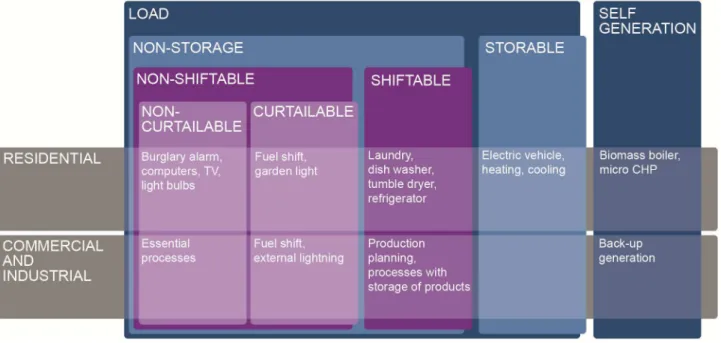
Different kind of loads can act as demand side flexibility (inspired by Xian He, 2013):
1. Non curtailment load (Base load). Not all electricity consumption is changeable. The base load can be considered inelastic to signals (e.g. burglary alarm for households).
2. Curtailable load. This kind of electricity consumption can be switched off at given times or periods. Curtailment can happen as reduced service (e.g. switching off decorative lighting when price is high) or as fuel shift (e.g. industries may use fuel instead of electricity when the electricity price is high). The curtailed electricity will not be consumed at a later point in time.
11
3. Shiftable load. This is electricity consumption that can be moved to a different moment (earlier or later). In many cases, the total consumption will remain the same (e.g. when charging an electric vehicle later). If the change operation involve pre-heating or precooling, the total consumption may increase due to extra service level or reduced efficiencies. Even if the total end-user demand increases overall benefits may exist, e.g. reduced CO2 emissions.
4. Storable load, meaning that this kind of electricity consumption can be used at the same moment as usual, but the electricity can be generated, transported and stored at a different moment such as when wholesale electricity prices are high. The final energy-savings effect is likely to be negative because storage is less efficient than immediate consumption, but at system level there could still be a primary energy savings effect if for example the process allows replacing electricity from thermal generation with wind or solar generation.
5. Self-generation is generation located at customers’ site. This can be back-up generation, e.g. at hospitals or data centres, or micro wind or PV. If the generation is fuel based it can result in increased CO2 emissions due to less efficiency in decentralised plants compared with central plants. Micro wind and PV can be reduced if these creates an over generation of electricity.
DSF can have different approaches regarding the consumption of electricity and it is also clear that DSF does not necessarily results in energy savings (see also the THINK-report). Very low or negative prices can result in increased demand, and new technologies like storage and fuel shifts (such as power-to-gas) will result in higher electricity consumption. Negative prices can occasionally occur when renewable energy cannot be curtailed and the generated electricity causes congestion problems or when an inflexible power generation meets unexpected low demand causing imbalance in the grid (because the volume of electricity is not used as expected). Negative prices are still uncommon, but in Germany negative prices occur more and more on days with high wind and solar generation.
The following figure contains examples of all five load types.
Figure 2: Different load types (inspired by the THINK-report)
12
It is recommended to consider the above load mix with the customer perception of impact on comfort or convenience. DSF may or may not have an impact on comfort and the JWG learned that there are concern among consumers about DSF having too much of an impact on comfort. The JWG that consumers will not respond to pricing signals to reduce energy consumption if it will have impact on their way of life. However, DSF in combination with controlled equipment may result in automated responses to signals and minimal impact on comfort. Refrigerators (within limits, while not
compromising health), heat pumps, electric vehicles, radiators, water heaters, water storage systems or air-conditioning systems may, for a short amount of time, be curtailed resulting in a minimum change in temperature i.e. in a minimum comfort impact.
Laundry machines, dish washers or electric heaters (such as boilers) may sometimes be allowed by consumers to start later, depending on pricing signals and parameters set by the consumer (‘smart washing’). It seems that new technological developments like adding communication technologies in home appliances are required to take advantage of DSF as effectively as possible among households.
The success of DSF among consumers is likely to be defined by a combination of willingness of consumers to respond to signals actively, and availability of smart appliances to allow consumers to respond to signals passively via controlled equipment. Although outside the scope of this report, the JWG sees a strong link with the concept of ‘Internet of Things’.
Time-of-Use (ToU) tariffs have been used in many MS for many years, e.g. in relation to grid tariffs.
Such tariffs may still be relevant, and may be supplemented by more advanced price signals, e.g.
hourly day-ahead prices or real-time prices. In France, the Tempo tariff represents a type of tariff called critical peak pricing (CPP). The Tempo tariff has six price levels. The expensive price levels are activated the day before operation. A maximum of 43 blue days (medium expensive) and 22 red days (most expensive) can be used per year. The tariffs target households with high demand (e.g. because of electric heating), and small businesses. Automated systems are used to shift the set-points of the electric heating thermostats.
While behavioural changes may be relevant for simple ToU prices, automation will, in many cases, be needed with regard to more advanced prices or signals. Larger companies often have control systems that can be used to receive prices and to control selected electricity demands. As technology for communications and computation further develops, prices for controlling demand are reduced, and new opportunities may arise for small businesses and households, e.g. with regard to air conditioning, electric heating or electric vehicles.
Support systems needed for implementation of demand response may also deliver energy-efficiency improvements, e.g. with smart meters, feedback systems, automatic or remote control etc. Several pilot studies regarding DSF indicate that signals may be more effective if not limited to price signals only. In the Duneworks report (Duneworks, 2013), it is stated that: ‘People are not motivated by pricing incentives alone. Environmental motives, comparisons with peers, "the desire to contribute", control, comfort, ease, and well-being are important motivators as well.’
13
3.2 Benefits and Costs
DSF has the potential for providing multiple benefits and can be an answer to questions like:
• How to keep energy costs affordable or even reduce costs for end-users (households as well as companies)? Will moving demand towards hours with low prices lower costs?
• How to facilitate integration of renewable-electricity generation? Can MS increase the share of renewable electricity in generation by increasing demand in hours with large generation from wind and solar?
• How to deliver synergies with energy efficiency? Can MS use control equipment in buildings to realise energy efficiency? Or need MS to stimulate innovation and develop advanced control methods (such as for nearly zero-energy buildings)?
• How to enhance utilisation of the transmission and distribution grid (including security and reliability) and reduce the need for grid investments and optimise capacity of the existing grid?
Can MS reduce demand in hours when and where the grid is fully utilised?
• How to stimulate competition in markets? Is it possible to reduce demand in hours with insufficient generation or to increase demand in hours with excess generation?
• How to reduce the need for costly back-up peak generation that runs only a few hours a year?
Will it help to delay demand in these hours?
The CEER Consultation Paper (CEER, 2014) ‘Future Role of DSOs describes the following explain:
‘DSF can play an important role in releasing system wide benefits (as a result of reducing the costs of decarbonisation) for wholesale markets, networks and ultimately consumers’.
While DSO costs generally comprise less than 30% of the current customer bill, this proportion may increase as DSOs are asked to connect or accommodate more renewable generation, electric-vehicle charging points or heat pumps, which may require grid reinforcement. DSF has the potential for reducing these costs. In the future, other energy carriers like district heating and natural gas may also benefit from DSF.
The cost side of DSF is related to the metering systems, data management, the control systems needed, and in some cases also to negative impacts on comfort or production. These costs can be relatively high compared with the benefits, especially for small energy users. The best examples of DSF may be where existing equipment can be used, e.g. an existing meter and existing control systems. Such equipment may be used for various purposes, and the benefit of DSF alone may often not be sufficient to argue for extra investments.
In case of dynamic pricing or real-time pricing, high-frequency data, and advanced settlement procedures and processes are needed. This may also result in greater risks to privacy and security that need to be managed.
Advanced DSF solutions for consumers and businesses will also result in higher costs for
communication with these end-users compared with simple DSF solutions like ToU-tariffs or CPP.
14
3.3 Market Segments and Actors
Demand Side Flexibility can be motivated by:
• Market prices (e.g. day-ahead prices or intra-day prices, hourly prices or time-of-use contracts)
• Distribution tariffs (e.g. simple time-of-use tariffs)
• Reliability signals (e.g. from the TSO)
• Incentive payments to customers from independent demand service providers who sell on the (aggregated) flexibility on the markets (e.g. day ahead or intraday).
DSF can also deliver ancillary services, like regulating power or automatic reserves to the TSO, as this is a domain for TSOs. Examples will be discussed in chapter 4.
Many industrial electricity users today can choose to buy electricity with an hourly price, e.g. a day- ahead price where the prices are announced the afternoon before the operation day. Depending on the type of production, the company may plan their electricity demand, e.g. to avoid the most expensive hours. Measurement and settlement of electricity demand can be done hourly. In some cases (e.g. cold storage), demand can be optimised on all days, because of the ability to store energy.
In other cases, changed production are only be relevant on days with extreme prices, e.g. an aluminium plant may stop production during periods with extremely high prices.
The volume of electricity demand is recognised to be important for the economic benefit of demand response. Therefore, a prioritised list of relevant end-user groups could be:
• Industrial users with processes that can be controlled (aluminium, steel, cold storage).
• Service sector (with air conditioning or electric heating).
• Households (with air conditioning, electric water or space heating or electric vehicles).
Currently there is no clear overview about the costs and benefits of DSF. In some situations, the economic benefit may be limited for households and SMEs with limited electricity demand. The costs of e.g. automation can be greater than the benefits. On the other hand, introduction of automation may lead to increased comfort, which cannot be valued. Also, ToU-tariffs can be valuable for customers, such as in MS where households use high volumes of electricity or in MS where the price volatility is high.
For large industrial electricity users, the relevant actors are:
• The Industrial end-user.
• The electricity retailer and balance responsible party.
• The spot market.
Contracts between company and retailer may vary, e.g. some companies have a contract with hourly prices and free volumes – while others (the largest electricity users) need to report their expected demand for the next day. The setup is a result of a commercial negotiation.
15
For electricity users with a smaller demand, the situation is more complex. It can be relevant to use an aggregator. The aggregator can have several tasks:
• To provide communications and control equipment that is relevant to control a large number of small demands.
• To send pricing or activation signals to end-users. Prices and signals can cover all relevant markets.
• To aggregate demand.
These tasks can be done by the retailer or by a specialised company that can sell the service to several retailers. To benefit the DSF, customers must have hourly settlement of demand. We refer to CEER for principles that should be applied for customer contracts (contracts, prices and conditions must be transparent, product must be simple to understand, etc.).
3.4 Profiling Systems are a Barrier to DSF
Many consumers still have analogue metering systems with yearly meter readings for annual bill settlements. Aggregation of large numbers of yearly meter readings in combination with analyses of electricity transport and consumption result in calculated and/or estimated consumption patterns for such consumers. These are called ‘’profiles’’. Profiles are calculated average consumption patterns that do not reflect the actual consumption of individual users.
Profiling systems, like in the Netherlands, can take into account double tariff systems (ToU) where peak and off-peak are recorded separately. In such cases, the profiling system can work within each of these periods. However, due to the fact that profiles are calculated in advance and do not reflect actual consumption, the profiling systems are a barrier for development of DSF. In the Netherlands, the general consumer profiles may be replaced by profiles for consumers with specific characteristics, such as households with PV or households with an electric vehicle. This would be more accurate, but would not allow for settlement based on the individual hourly demand.
Customers with smart meters, but without hourly settlement cannot buy electricity according to their own hourly demand. The grid company may read the meter with hourly values each night, but the data may not always be used directly in the cost settlement. Their hourly demand is computed as a profile that can be defined for different user groups (as in Finland) or as the residual demand for all
customers without hourly settlement (as in Denmark where this is computed continuously per grid company). Profiling systems can be efficient for distribution of average costs to customers, but remove the economic motivation for DSF for users.
3.5 Alternatives to DSF
As described, DSF can potentially offer several benefits, though it can be considered a new
technology and may need some support to be fully applied. However, alternatives to DSF exist, e.g.
peaking plants like gas turbines can be an alternative in hours with very high prices and tight capacity balance.
16
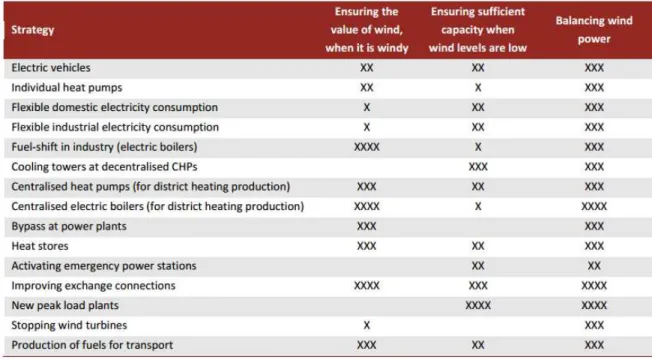
In Figure 3, different options for flexibility are listed. The options are assessed qualitatively in terms of their potential contribution to addressing three different types of needs:
• Ensuring the value of wind when it is windy (and similar for solar power). This is related to increasing electricity demand or reducing electricity generation. A demand-side option can be fuel shift in industry from natural gas to electricity when electricity prices are low or electric boilers or heat-pumps in district-heating systems. On the supply side, generators can achieve increased flexibility by investing in turbine by-pass. With turbine by-pass, the boiler can be maintained heated, while the need for electricity generation is limited. This can be relevant if the low electricity prices only exist for a few hours.
• Ensuring sufficient capacity when wind levels are low (and similar for solar power). The challenge for traditional generators is that the volume of electricity needed from them in the market is reduced when renewable electricity generation is expanded, whereas the capacity needs in hours with low wind or solar levels remain almost the same. Demand side flexibility can help by reducing demand in such situations. Supply side options include peak power plants and increased transmission capacity. Balancing wind power (and similar for solar power). Wind power can be difficult to predict and new resources are needed to the short-term balancing. Both demand side and supply side can be used to create the balance with up and down regulation.
Figure 3. DSF and alternatives to obtain flexibility. The number of x’s indicates the potential. The table is developed for a country with district heating and combined heat and power production. Source: The City of Aarhus (2012): The future requirements for flexibility in the energy system.
17
4 Best Practices
4.1 Practical Examples
Reaction to day-ahead prices
In the winter of 2002/2003, the Nordic market experienced unusually high spot prices. Analyses indicated that the demand in Norway was reduced with roughly 1,000 MW (or more than 5% of the winter peak). This reduction (mainly by industry) helped the Nordic countries through the period with low inflow in the hydro systems. A smaller reaction was found in the other Nordic countries.
Demand as reserves
The Norwegian TSO, Stattnet, has for years managed a program to attract industrial demand to be used as reserves (RKOM1). The program acts by a capacity payment for resources to be used as regulating power (manual reserves, tertiary reserves). The program is active during winter and has activated in the order of 200–1,000 MW demand. Generally speaking, these resources have a high variable cost, and are seldomly activated.
In the UK, it is possible to be an independent aggregator. An aggregator, like the company Kiwi Power, can activate DSF from different end-users – independent of the retailer the end-users may have. The flexibility is then sold to the TSO. KiWi Power has announced that it successfully predicted grid demand and adjusted power consumption at a set of hotels, hospitals, commercial offices, water treatment plants and public buildings to deliver a total of 47 megawatt-hours of demand response over the course of 45 events2. The program has been especially successful at attracting back-up
generation. This is mainly generators that are used uninterruptable power supply (UPS) to cover local demand at hospitals, airports or computer centres. They do not export electricity, because that would require a special license but can cut their supply from the national grid when there is a shortage of electricity (Grünewald and Torriti, 2013).
Demand as frequency reserves (primary reserve)
The standard frequency in Europe's electricity grid is 50 Hz. Frequency stability is crucial for the entire system and everything that is connected with the grid. Frequency stability is traditionally related to the balance between generation and consumption. Electricity demand can also deliver frequency-
controlled reserves. This is an automated reserve (primary reserve) that can be activated very quickly (e.g. within 30 sec.). Typically, this reserve is delivered by power plants running below their full capacity. This reserve is activated if the stability of frequency is at risk.
Thermostatically-controlled demand can be operated in a way so the set-points are adjusted according to the frequency. In a cooling device (a refrigerator or freezer), the set-points can be slightly increased if the frequency decreases. This would turn off the coolest devices – those that would turn off soon.
The impact on comfort is minimal, and, with a large number of units controlled, a smooth proportional regulation can be obtained. ENTSO-E (2015) has recommended this to be standard in the long term.
ENTSO-E recommends there should be developed norms within the EcoDesign framework, so all future thermostatically-controlled equipment includes this feature.
1 RKOM: Regulating Power Option Market (Regulerkraftopsjonsmarkedet)
2 See: https://www.greentechmedia.com/articles/read/europes-new-models-for-demand-response
18 Peak load
In Italy, peak load management is an important instrument for demand management (the so-called Interruptible Electric Service) is in place. The instant interruption of electricity is one of the tools used to ensure the safety of the electrical system, and promptly to balance transmission grids and to manage local congestion issues. The assignee of the interruptability service makes one or more loads in its facility available for instant interruption, which occurs when a signal transmitted by Terna (TSO) is received. For each MW of interruptible power made available, Terna reimburses the assignee based on the monthly consumption of the interruptible loads, namely a sum consisting of a fixed and variable amount, the latter depending on the number of interruptions. The service can be provided by medium- voltage and high-voltage sites connected to the grid with a power of at least 1 MW at the point of delivery. In 2014, 290 industrial customers offered interruptible loads, according to Terna.
Demand as regulating power (tertiary reserve)
Regulation power is a manual reserve that the TSO activates to release primary reserves (restore frequency). Typically, regulating power (up or down regulation) is delivered by traditional power plants.
In Denmark, a 10 MW minimum limit is used for suppliers of regulating power, however several units may be aggregated. The TSO require on-line meters to be used to verify that activated regulating power is delivered. In Denmark, a few examples of demand-delivering regulating power exist, e.g.
electric boilers or heat-pumps in district-heating systems. Other types of demand are not used – and this is mainly because of the requirement of online meters, and that a plan for future demand must be reported.
In the FlexPower project (Ea Energy Analyses, 2013), an alternative market for regulating power was designed with special focus on making flexibility attractive for the demand side. It is important that delivering regulating power is uncomplicated for the end-user. Key features of the suggested market design are:
• The end-user should receive a price signal every five minutes. This would be the final settlement price for electricity and the end-user can use any amount of electricity. When this system is applied to a large number of users (many with automated control systems) the desired up or down regulation can be realised.
• The balance responsible party or the retailer was responsible for predicting the expected change in demand vis-à-vis the TSO. This is based on historical data, including data for demand in situations with similar prices.
The system can coexist with the present system for regulating power. Practical tests indicated that, with many end-users, the suggested system could work and give predictable results. Predictability is important for the TSO.
Industrial DSF in the spot market
For customers in, e.g. Denmark, with a large electricity demand, it is easy to be active with demand- side flexibility. The electricity demand in the company is settled based on the hourly consumption, and the company may choose to buy electricity at the spot price with free volume. The price will then be the spot price (determined by the day before for each hour at Nordic power exchange, Nord Pool) plus a fixed mark-up.
19
The term “free volume” means that the company does not have to report the amount of electricity it will use the next day. The retailer will predict the demand for all its customers, based on historical
demand. With many customers, the demand is relatively easy to predict (based on information about indicators like type of day and outdoor temperature).
The company receives the next day’s prices around 13.00 the day before. If the company have processes that can be moved in time, then this can be done to minimize the demand in expensive hours, and maximize demand in the cheapest hours. The company can develop its own strategy, e.g.
if it will react all days, or only when the price difference is high.
With this set-up, demand-side flexibility is uncomplicated for the end-user, and the flexibility will enter the market as price-dependent bids – and will influence the price formation.
Today, other end-users (<100,000 kWh/year) cannot receive economic benefit from demand-side flexibility as the profiling system does not allow for this. For ancillary services, demand-side flexibility is not practical as the procedures and rules in place were designed for generators. Both areas (profiling system and procedures for ancillary services) are under development, and may soon allow for more demand-side flexibility.
Self-generation
Small-scale generation, e.g. solar PV or micro wind, are in some cases connected “behind the meter”.
Dependent on the support scheme and metering regulation, end-users may be motivated to adapt their demand to the volume of local generation. If, for instance, the cost of electricity bought from the grid is more expensive than the price received for electricity delivered to the grid, the end-user is motivated to increase demand instead of exporting locally-generated electricity. This can be positive for the system since a surplus of electricity is likely to coincide with a general high generation from renewable sources.
As an example, the current Danish subsidy rules for small PV is so that generation that is used locally have the full value including all tariffs and taxes (300 €/MWh). If the generated electricity is exported to the grid, it has the value of 80 €/MWh for the first 10 years of its lifetime, and 50 €/MWh for the next 10 years. The owner is motivated to control demand (move in time) to reduce export – or to invest in a battery. A hybrid system with PV and battery is available on the market. In an earlier subsidy scheme, a net metering concept was used, and, in this case, all generation had the high price (including tariffs and taxes) as long as there was a yearly net demand.
4.2 Recent Reports
Demand response in the Nordic electricity market.
The Nordic Council of Minsters has commissioned a study about demand-side flexibility (Thema, 2014). The report finds that the efficiency of the Nordic power market is generally high, but further development of the market design can help increase the efficiency of (consumer) flexibility. The report gives two recommendations:
• Grid tariffs should reflect the underlying (efficient) grid costs to provide efficient demand response: “Grid tariffs according to marginal losses, interruptible contracts and capacity pricing may incentivize increased end-user flexibility. Such grid tariffs should however not be implemented in order to increase flexibility, but in order to reflect underlying grid costs more efficiently.”
20
• DSF requires dynamic prices or incentives. It is important to develop systems that can help manage this in a simple manner. The introduction of standard data formats on relevant price signals would stimulate transparency and easy access to these data. This can support the development of technology and services for flexible energy management resulting in energy efficiency. The system should cover all retailers and all grid companies – and should not pose any limitation on the design of tariffs and contracts3. The Terma report: “Imposing standard data formats for price signals in the power contract, tariffs and other relevant data will reduce the cost of automated demand response from small consumers. Cost efficient automation is a precondition for the development of technology and services for energy management based on price signals. In addition to promoting demand response, such automation will also
promote energy efficiency. Nordic coordination could further increase the market potentials for new technology and energy services.”
The report highlights that alternatives to demand-side flexibility exist and that: “No specific measures to promote demand flexibility should be implemented without a better understanding on how the value of (demand) flexibility will develop in view of the likely changes in the Nordic power system.’’ The report states in November 2014 that it was not the time to initiate a Nordic strategy for demand response.
Lessons from EG3-report
In January 2015, an Expert Group under the Task Force Smart Grids of the European Commission published ‘Regulatory Recommendations for the Deployment of Smart Grids’ (EG3, 2015). EG3 is a stakeholder group directly reporting to DG ENER. Among the stakeholders are regulators and all relevant trade organisations, such as telecoms, energy, appliances, grid and system operation, etc.
The report focuses on flexibility, including demand response, electric vehicles, power-to-heat and storage. The report highlights a set of 14 recommendations regarding market rules and commercial arrangements, measurement of flexibility, consumers, grid operation, and incentives (including to grid operators). Most of the recommendations are at a high level and leave room for further implementation and development. For this work, the following three elements and recommendations are extracted from the EG3-report:
a. Relations between market roles
EG3 describes a market model where aggregators and suppliers both can have contracts with end customers. Also, DSOs have a relation with customers for grid access and generation management.
However, for distribution network constraint management, EG3 only sees a relation between DSOs and aggregators and suppliers. Although their model does not indicate any direct contract between TSOs and customers, the JWG assumes that this can be the case for large industrials. The model described by EG3 is important for DSF development as the role of the aggregator is fully taken into account. However, it is not clear to the JWG how the balancing responsibility should be arranged. In what DSF-situation should a settlement or contract be in place between aggregators and suppliers and should aggregators have balancing responsibility?
3 For examples of standard price format see:
webstore.iec.ch/webstore/webstore.nsf/artnum/049261!opendocument, www.openadr.org/assets/docs/openadr_primer.pdf and drrc.lbl.gov/openadr
21
b. Balance responsibility for aggregators and connections
Aggregators are expected to collect flexibility in small quantities from customers, like consumers and SMEs, bundle these small quantities and then participate with this flexibility on the wholesale markets (especially day-ahead and intraday markets). It is also expected that aggregators will provide their customers with signals that will result in a change in energy usage.
As described in chapter 3, so-called profiles are used by grid operators and suppliers to calculate the amount of electricity for any given time. The use of profiles is inevitable with analogue meters, but is also often used with smart meters. Suppliers use standard profiles for purchasing the electricity for customers, and for the balance of the grid, it is crucial that a supplier has his portfolio in perfect balance.
Signals from aggregators to customers will result in greater differences between the existing profiles and the actual consumption by customers. Where a profile system is used in combination with aggregator signals, the supplier will be faced with increased imbalance positions. This may cause extra imbalance costs. This may be an obstacle for rolling out successful DSF pilots among small users to larger groups of small users. EG3 is currently working on a follow up report where this issue will be addressed.
The recommendation by EG3 is that “MS should ensure that the definition of balance responsibility in a connection is put in place. That responsibility must be unambiguously defined in relation to all market participants that supply/receive energy and/or invoke flexibility on that connection”.
c. Framework for domestic customers
EG3 clearly states that consumers and SMEs should always ‘opt in’ for DSF services. Although not mentioned in the executive summary and recommendations, it is also stated that the consumers and SMEs should always be able to ‘opt out’ again. The JWG considers this an important element in the discussion about participation in DSF programs by consumers.
However, opting-in is only relevant for market contracts such as real-time contracts or other dynamic- tariff-based contracts between suppliers or aggregators and customers. The JWG considers
widespread introduction of ToU-tariffs for many MS in Europe as a good start. For grid tariffs, the need for opt-in or opt-out may be less relevant (at least not on an individual basis).
SEDC report on Demand Response
The Smart Energy Demand Coalition (SEDC) is an industry group dedicated to making the demand side ‘a smart and interactive part of the energy value chain’. In 2014, SEDC published a report called
‘Mapping Demand Response in Europe Today’. The report describes the situation of Demand Response in Europe according to the EED. The report focusses only on the market part (consumers, SMEs, enterprises) of DSF.
22
Figure 4: SEDC mapping of market related DSF activities in Europe
Figure 4 describes the view of SEDC regarding the presence of market based DSF in MS. This means that grid related ToU-tariffs, which are common is several MS, are not taken into account. The JWG had noticed that the status or colour that SEDC applies for a certain MS (in figure 4) can be arguable.
Nevertheless the message from SEDC is clear: Market based DSF is not common and even (probably) not allowed in most MS.
From the report: “Only Belgium, Great Britain, Finland, France, Ireland and Switzerland have reached a level where Demand Response is a commercially viable product offering. Sweden, the Netherlands, Austria and Norway may remain ‘yellow’, depending on regulatory developments. In other words, while Demand Response companies may be established, regulatory barriers may remain an issue and hinder market growth. The remainder of European Member States will stay ‘orange’ or ‘red’, meaning that aggregated Demand Response is either illegal or impossible due to regulation. Here we see a critical disconnect between political promises and regulatory reality. While policies promise consumer benefits, regulation hinders their delivery to consumers.”
The overall conclusion is that ”in the majority of Member States today, Demand Response is either illegal or impossible due to regulation.” The report describes rules and criteria that focus on
customers, including consumers. The key message is that all customers should be able to sell their flexibility. SEDC encourages the Commission and the regulators to make it legal to participate in Demand Response programs.
The JWG supports the main conclusion of SEDC. It should definitely be legal to participate in Demand Response. According the EED, legal barriers should be removed. It should be realised that Demand Response is not an objective in itself but an instrument for grid operators and free market participants to achieve optimal costs and energy efficiency. Regarding Demand Response for consumers, there are concerns that the cost-benefit analyses may be negative due to high costs for developing demand response products and/or lacking strong financial incentives to respond to.
Therefore, removing legal barriers may not automatically result in successful Demand Response for consumers. It is recommended that – after removing legal barriers- MS develops a roadmap of where and when DSF is profitable. In some MS, it might be most beneficial to start with DSF for industrial and large business customers in the day-ahead market, before rolling DSF out in other markets and
23
among other customers, such as households and SMEs. The roadmap should describe how to bridge the gap between ‘legally possible’ and ‘profitable and needed’. Customers, suppliers, aggregators, DSOs and TSOs should be involved. The roadmap can give guidance to new pilots, developing large- scale DSF-solutions and how to reap the benefits in a customer-friendly way. A condition for such a roadmap is that it should be in line with the principles for the EU Internal Energy Market. This still leave room for national and regional flexibility solutions.
EvolvDSO
As described before, DSF can be market related or grid related. This means that market players, like suppliers and aggregators, and grid operators can both activate DSF solutions and provide signals to users (including consumers). For supply of electricity (and natural gas) to consumers most MS apply a so called supplier-centric model, that means that the supplier, not the DSO, is the single point of contact for the customer. As DSF has also potential for the DSO, it is relevant to pay attention to the question: Should DSOs be allowed to contract end users including consumers for DSF-solutions or should that only be allowed for suppliers and aggregators? The discussion about if and how DSOs should have direct contact with customers is closely related with the market design principles for energy markets. This is to a large extend outside the scope of this report. Nevertheless the JWG considers it important to address the issue. The EvolvDSO-project has described this issue.
EvolvDSO (“Development of methodologies and tools for new and evolving DSO roles for efficient distributed RES integration in distribution networks”) is an active project carried out by a consortium of 16 partners co-funded by the European Commission (Seventh Framework Programme). EvolvDSO aims to define future roles of DSOs and develop tools required for managing these new roles.
EvolvDSO expects that adopting these roles will result in DSOs facilitating and supporting current and potential new energy markets in the smart grid environment.
Regarding flexibility, EvolvDSO states that consumers (and so called ‘prosumers’) could bring flexibility, from distributed generation units or flexible loads to the system. This flexibility can help to integrate generation based on intermittent renewable sources. The report describes that a DSO can have the role of a neutral market facilitator. This means that the DSO enables flexibility sources to reach the market. The report also describes that a DSO can have the role of a distribution constraints market officer. This means that the DSO allows contracts and activates flexibility in a way that it can be activated to relieve specific distribution-network constraints. The JWG considers this as two important conclusions of the project because it clarifies the objective for a DSO to become active with DSF towards users. Where market based DSF signals can be provided (by suppliers or aggregators) for economic reasons, the DSO should activate flexibility to relieve grid constraints. In addition to this, the DSO should facilitate the market players in a neutral way.
The EvolvDSO-project recognizes that both the system and the regulatory framework can be specific and differ from MS to MS. It is stated that “The adaptation of the current regulatory framework towards the evolution/creation of these roles would be highly influenced by the specific context of a particular system. The differences amongst the European distribution systems make it highly difficult to foresee a specific path […]. Furthermore, it is expected that the [DSO] roles and its related services would be adapted to the specific needs of the system in question.” The JWG considers, in line with the
recommendation, to develop roadmaps that take into account specific needs for flexibility.
24
5 Europe’s Energy Directives and DSF
5.1 Renewable Energy Sources Directive (2009/28/CE)
The renewable energy directive from 2009 provides a legal framework within which each EU MS must work to deliver on its renewable energy commitment, but it leaves open a wide range of policy options for how exactly to deliver those commitments. Since each MS has a different mix of renewable energy resources, and the flows of electricity and renewable fuels across national borders are restricted by the existing infrastructure, there is a significant potential for minimising the costs and for optimising the benefits of renewable energies through cooperation between MS and through the sharing of best practices.
The directive can be seen as a positive discrimination in favour of renewable energy. This is to counterbalance the fact that many existing energy systems, rules and networks are developed to non- renewable energy.
The directive sets binding targets for MS so that the EU as a whole will reach a 20% share of energy from renewable sources in gross final energy consumption by 2020 and a 10% share of renewable energy specifically in the transport sector. New targets for 2030 are 40% greenhouse gas reduction (compared to 1990) and a minimum of 27% renewable energy sources and energy savings. The EU policy framework aims to make the European Union's economy and energy system more competitive, secure and sustainable by 2030.
CA-RES addresses each of the main areas covered in the Directive: support schemes and
cooperation mechanisms, buildings and district heating systems, training and information, electricity networks, biomass mobilisation and sustainability, renewables in transport, and guarantees of origin.
The second phase of the Concerted Action to support the implementation of the Renewable Energy Directive 2009/28/EC (CA-RES II) was launched by Intelligent Energy Europe (IEE) in August 2013 to provide a structured and confidential framework for the exchange of information between the 28 Member States, Norway and Iceland during their implementation of the Renewable Energy Source Directive.
The directive and demand side flexibility
The directive does not mention “demand response” or “demand side flexibility”. However, the term
“intelligent networks” is used and this can be understood as “smart grid” in today’s professional slang.
§16.1: Member States shall take the appropriate steps to develop transmission and distribution grid infrastructure, intelligent networks, storage facilities and the electricity system, in order to allow the secure operation of the electricity system as it accommodates the further development of electricity production from renewable energy sources, including interconnection between Member States and between Member States and third countries.
§16.2, c: Member States shall ensure that when dispatching electricity generating installations, transmission system operators shall give priority to generating installations using renewable energy sources in so far as the secure operation of the national electricity system permits and based on transparent and non-discriminatory criteria. Member States shall ensure that appropriate grid and market-related operational measures are taken in order to minimise the curtailment of electricity produced from renewable energy sources.
25
If significant measures are taken to curtail the renewable energy sources in order to guarantee the security of the national electricity system and security of energy supply, Members States shall ensure that the responsible system operators report to the competent regulatory authority on those measures and indicate which corrective measures they intend to take in order to prevent inappropriate
curtailments.
Possible transposition issues in relation to the directive and demand side flexibility The text in the directive is quite broad and in the absence of an explicit reference to the role of DSF it is up to member states to assess if changes in regulation are necessary to increase demand side flexibility and thereby allowing to reduce curtailment.
On 9 April 2014 the Commission published the new guidelines on state aid for environmental
protection and energy (2014–2020). In order to integrate renewable energy sources into the market it is important that producers sell electricity directly on the market and are subject to requirements of the market. Starting from 2016 the producers renewable energy (who are beneficiaries of incentives) should be subject to the standard responsibilities of balancing standard, except for the lack of liquid markets for balancing intraday. It will however, be possible to outsource this responsibility to other companies such as aggregators. The guidance entered into force in July 2014 and MS shall implement it.
5.2 Energy Efficiency Directive (2012/27/EU)
All MS are required to use energy more efficiently at all stages of the energy chain – from the transformation of energy and its distribution to its final consumption. The Energy Efficiency Directive (EED) will help remove barriers and overcome market failures that impede efficiency in the supply and use of energy and provides for the establishment of indicative national energy efficiency targets for 2020. The EED also establishes a common framework of measures for the promotion of energy efficiency within the Union.
One of the key issues for energy efficiency is in energy generation: monitoring of efficiency levels of new energy generation capacities, national assessments for co-generation and district heating potential and measures for its uptake to be developed, including recovery of waste heat, demand side resources to be encouraged.
The EED entered into force on 4 December 2012 and most of its provisions are expected to have been implemented by 5 June 2014.
The key articles in the EED regarding demand response are article 15.4 and article 15.8.
The key message of article 15.4 is that Member States must have regulation and legislation that contains no barriers for participation in demand response.
§15.4: Member States shall ensure the removal of those incentives in transmission and distribution tariffs that are detrimental to the overall efficiency (including energy efficiency) of the generation, transmission, distribution and supply of electricity or those that might hamper participation of demand response, in balancing markets and ancillary services procurement. Member States shall ensure that network operators are incentivised to improve efficiency in infrastructure design and operation, and, within the framework of Directive 2009/72/EC, that tariffs allow suppliers to improve consumer participation in system efficiency, including demand response, depending on national circumstances.