Submitted 5 August 2015 Accepted 16 November 2015 Published8 December 2015
Corresponding author Jos´e Luis Ros-Santaella, [email protected]
Academic editor Mar´ıa ´Angeles Esteban
Additional Information and Declarations can be found on page 14
DOI10.7717/peerj.1478
Copyright
2015 Ros-Santaella et al.
Distributed under
Creative Commons CC-BY 4.0
OPEN ACCESS
Intramale variation in sperm size:
functional significance in a polygynous
mammal
Jos´e Luis Ros-Santaella1,2, Eliana Pintus3and Jos´e Juli´an Garde1 1SaBio, IREC (CSIC–UCLM–JCCM), Albacete, Spain
2Department of Animal Science and Food Processing/Faculty of Tropical AgriSciences, Czech University of Life Sciences Prague, Prague, Czech Republic
3Department of Veterinary Sciences/Faculty of Agrobiology, Food and Natural Resources, Czech University of Life Sciences Prague, Prague, Czech Republic
ABSTRACT
Studies concerning the relationships between sperm size and velocity at the intraspecific level are quite limited and often yielded contradictory results across the animal kingdom. Intramale variation in sperm size may represent a meaningful factor to predict sperm velocity, due to its relationship with the level of sperm competition among related taxa. Because sperm phenotype is under post-copulatory sexual selection, we hypothesized that a reduced intramale variation in sperm size is associated with sperm competitiveness in red deer. Our results show that low variation in sperm size is strongly related to high sperm velocity and normal sperm morphology, which in turn are good predictors of male fertility in this species. Fur-thermore, it is well known that the red deer show high variability in testicular mass but there is limited knowledge concerning the significance of this phenomenon at intraspecific level, even though it may reveal interesting processes of sexual selection. Thereby, as a preliminary result, we found that absolute testes mass is negatively associated with intramale variation in sperm size. Our findings suggest that sperm size variation in red deer is under a strong selective force leading to increase sperm function efficiency, and reveal new insights into sexual selection mechanisms.
Subjects Animal Behavior, Cell Biology, Evolutionary Studies, Zoology
Keywords Sexual selection, Sperm competition, Sperm morphology, Sperm velocity, Testes size, Red deer
INTRODUCTION
sheath and reduced midpiece; reviewed in:Van der Horst & Maree, 2014). However, when sperm competition is intense, selection is thought to favor tight quality control (Birkhead & Immler, 2007), for instance, by reducing the intramale variation in sperm size (e.g., in-sects:Fitzpatrick & Baer, 2011; birds:Calhim et al., 2011; mammals:Sandera, Albrecht &ˇ Stopka, 2013) and the percentage of sperm abnormalities (e.g., birds:Rowe & Pruett-Jones, 2011; mammals:G´omez Montoto et al., 2011;L¨upold, 2013), as well as by increasing the proportion of live sperm (e.g., insects:Garc´ıa-Gonz´alez & Simmons, 2005). Intraspecific studies concerning the significance of intramale variation in sperm size are quite limited but also needed, because they can reveal relationships with sperm traits associated with sperm competitiveness and contribute to a better understanding of previously reported patterns across animal populations and species (Kleven et al., 2008;Laskemoen et al., 2013).
Sperm swimming speed is probably the best-studied sperm trait relative to fertilization success (Simmons & Fitzpatrick, 2012;Fitzpatrick & L¨upold, 2014), although factors determining sperm velocity are still not well established. Sperm size has been linked to sperm velocity in a range of inter- and intraspecific studies, but these results have been inconsistent (Humphries, Evans & Simmons, 2008;Kleven et al., 2009;L¨upold et al., 2009a;
Fitzpatrick & L¨upold, 2014;Simpson et al., 2014). For instance, in species with internal fertilization, the few intraspecific studies investigating these kinds of relationships have yielded contradictory results (e.g., mammals:Malo et al., 2006;Firman & Simmons, 2010), even within the same species (Passer domesticus:Helfenstein, Podevin & Richner, 2009;
Cramer et al., 2014). Recently,Mossman et al. (2013)reported that low variation in the length of sperm components is associated with a high percentage of motile sperm in humans. Therefore, studies concerning the links between sperm kinetics and intramale variation in sperm size might provide a better understanding of sperm functionality.
It is well known that high levels of sperm competition are related to increased relative testes mass (Birkhead & Møller, 1998). For this reason, relative testes mass has been widely used as a proxy measure of post-copulatory sexual selection (for review see:Simmons & Fitzpatrick, 2012). The degree of elaboration of pre-copulatory traits also has been associated with testes size and both positive, negative or no relationships have been found (Meril¨a & Sheldon, 1999;Preston et al., 2003;Malo et al., 2005a;Simmons & Emlen, 2006;
Kelly, 2008). Moreover, interspecific studies have shown that large relative testes mass is related to low variation in sperm size both between and within males, such as in birds (Immler, Calhim & Birkhead, 2008;Kleven et al., 2008) and mammals (Sandera, Albrechtˇ & Stopka, 2013;Varea-S´anchez et al., 2014). However, intraspecific studies about the significance of the variation in testicular size are scarce even though they might reveal interesting processes of sexual selection (Meril¨a & Sheldon, 1999;Schulte-Hostedde & Millar, 2004;Liao et al., 2013).
In deer, sperm competition is likely to be more frequent in species that form large breeding groups that vary in membership from day to day (Clutton-Brock, Guinness & Albon, 1982), such as in the red deer (Jarnemo, 2011;P´erez-Gonz´alez & Carranza, 2011;
some degree of promiscuity (Guinness, Lincoln & Short, 1971), and the large numbers of aggregating females should increase the mating opportunities of less competitive males because dominant males may be unable to defend large harems (P´erez-Gonz´alez & Carranza, 2011). Moreover, as a signal of risk of sperm competition in this species, the red deer have large testes in relation to their body size when compared with other species from the Cervidae family (Clutton-Brock, Guinness & Albon, 1982), and low within male variation in sperm size (Malo et al., 2006). Furthermore,Malo et al. (2005a)reported that relative testes size in red deer was positively related to antler size and complexity (pre-copulatory sexually selected trait), which in turn positively covaried with sperm velocity (post-copulatory sexually selected trait).
The aims of this study were twofold. First, we examined the relationships between the intramale variation in sperm size and sperm characteristics such as sperm velocity and normal morphology, which are related to male fertility in this species (Malo et al., 2005b;
Ram´on et al., 2013). Because sperm competition predicts intramale variation in sperm size across related taxa (see references above), low variation in sperm size in red deer may confer an advantage in post-copulatory sexual selection by enhancing sperm competitive-ness. Second, taking into account that testicular size is positively related to elaborate pre-copulatory traits (antlers, male–male competition;Malo et al., 2005a) and shows high vari-ability between stags (Mart´ınez-Pastor et al., 2005;Pintus, Ros-Santaella & Garde, 2015), we hypothesized that variation in absolute testes mass is related to the intramale variation in sperm size as demonstrated at the interspecific level in several animal taxa. Under these hypotheses, we expected to find relationships between intramale variation in sperm size and sperm function, which can reveal new insights into sexual selection processes.
MATERIALS & METHODS
Animal sampling
This study was approved by the “Comit´e de ´Etica en Investigaci ´on de la Universidad de Castilla-La Mancha”. All animals were handled in accordance with Spanish Animal Protection Regulation RD53/2013, which conforms to the European Union Regulation 2003/65/CE. Stags were legally hunted in their natural habitat in accordance with the harvest plan of the game reserve. The harvest plans were made in accordance with Spanish Harvest Regulation, Law 2/93 of Castilla-La Mancha, which conforms to the European Union regulations. Landowners and managers of the red deer populations gave permission to the authors to use the samples.
not establish the exact time of death of each animal, this variable was not include as a covariate in our analyses.
Testes mass and sperm analyses
All of the reagents were purchased from Sigma-Aldrich (Madrid, Spain), unless otherwise indicated. Testes mass was recorded to the nearest 0.01 g using an electronic balance (EK-400H balance; A&D Co., Tokyo, Japan) after removing the epididymis and the spermatic cord with a surgical blade. Though the use of relative testes mass is highly preferable for studies such as this, we were unable to quantify male body mass or body size of individual stags due to the working conditions in the field. We therefore chose to use absolute testes mass (i.e., the combined mass of the left and right testis) in the current study. Despite the limitations of such approach, absolute testes mass can still be informative, for example, as a factor that influences variation in sperm size.
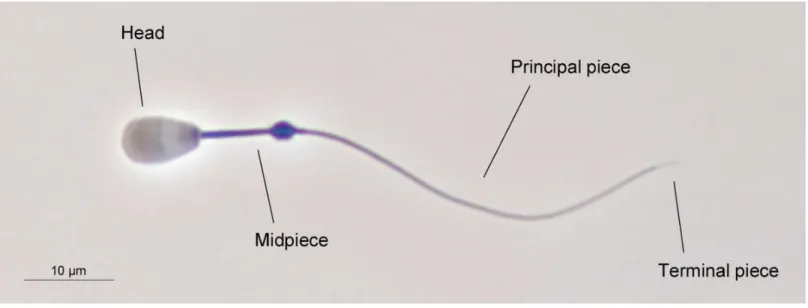
Sperm morphometry was assessed as previously described (Ros-Santaella, Dom´ınguez-Rebolledo & Garde, 2014). Briefly, sperm samples were directly recovered from the cauda of both epididymides and fixed in 2% glutaraldehyde-0.165 M cacodylate/HCl buffer (pH 7.3). Sperm smears were air-dried for one day, then immersed in the fixative solution for 5 min and immediately mounted, sealing the edges with DPX mountant for histology. Sperm samples were photographed using a high-resolution DXM1200 camera (Nikon, Tokyo, Japan) under phase-contrast microscopy, using an Eclipse E600 microscope (Nikon, Tokyo, Japan) and a 40X objective (Nikon, Tokyo, Japan). The resolution of the photographs was 3,840×3,072 pixels (TIFF format). A scale of 10µm (181 pixels) was used for the measurements. The pixel size was 0.055µm in the horizontal and vertical axes. Sperm lengths were assessed using ImageJ software (National Institutes of Health, Bethesda, MD, USA). We measured the following sperm traits: head width, head length, flagellum length, and midpiece length. From these measurements, we calculated other morphometric parameters such as total sperm length, principal plus terminal piece length, head area, head perimeter, and head ellipticity (head length/head width). The main structures of red deer spermatozoon are shown inFig. 1. A total of 25 spermatozoa per male were measured, as previously described (Malo et al., 2006;Ros-Santaella, Dom´ınguez-Rebolledo & Garde, 2014).
Sperm morphology was evaluated under phase-contrast microscopy using an Eclipse E600 microscope (Nikon, Tokyo, Japan), and a 40X objective (Nikon, Tokyo, Japan). Two hundred spermatozoa per animal were assessed. Normal sperm morphology was calculated as the proportion of spermatozoa without any morphological abnormalities (e.g., pyriform head, detached head, macrocephalic and microcephalic head, bent midpiece, coiled tail, and proximal cytoplasmic droplet). A single trained researcher assessed sperm morphology in order to avoid different evaluation criteria. An example of normal sperm phenotype is shown inFig. 1.
Figure 1 The main structures of red deer spermatozoon.The photograph was taken under phase contrast microscopy (40X objective). Scale bar, 10µm.
down to 25×106spermatozoa/mL with bovine gamete medium (BGM-3, for medium composition see:Dom´ınguez-Rebolledo et al., 2010) and incubated at 37◦C in a water bath for 15 min. After dilution and incubation, a sub-sample of 5µL was loaded into a Makler counter chamber (chamber depth: 10µm; Sefi-Medical instruments, Haifa, Israel) at 37◦C for kinetics analysis. The CASA system consisted of an Eclipse 80i triocular optical phase contrast microscope (Nikon, Tokyo, Japan), equipped with a warming stage at 37◦C and a Basler A302fs digital camera (Basler Vision Technologies, Ahrensburg, Germany). Videos were captured and analyzed using the Sperm Class Analyzer software (Microptic S.L., Barcelona, Spain). The analysis was carried out using a 10X negative phase-contrast objective (Nikon, Tokyo, Japan). A total of four descriptors of sperm motility were recorded analyzing a minimum of 250 sperm per sample: average path velocity (VAP,µm/s), curvilinear velocity (VCL,µm/s), straight linear velocity (VSL,
µm/s), and progressive sperm motility (%). Progressive sperm motility was defined as the sperm that swim forward in a straight line (i.e., straightness≥80%). Thus, spermatozoa
with an abnormal swimming path (e.g., tight circles) were not included in the proportion of progressive sperm motility. Average path velocity (VAP), VCL, and VSL are strongly related to fertility in this species (Malo et al., 2005b). The standard parameter settings were as follows: 25 frames/s; 20–60µm2for the head area; and a VCL>10µm/s to classify a spermatozoon as motile, as previously described (Dom´ınguez-Rebolledo et al., 2011). Additionally to these cut-offsettings, each recorded video was visually checked in order to ensure that neither debris nor dead-spermatozoa were included as motile sperm.
Statistical analysis
to check data normality and homogeneity of variance, respectively. The intramale coefficient of variation (CV=standard deviation/mean×100) was calculated using the measurements of each spermatozoon, for each male. We also calculated the intermale CV from the average of each morphometric parameter. To check for differences between the intramale CV of the sperm head and flagellum components, we used paired samples Student’st-test. For this analysis we used the average intramale CV of the sperm head (length, width, area, ellipticity, and perimeter) and flagellum parameters (flagellum, midpiece, and principal plus terminal piece lengths) for each male. Absolute testes mass was log10transformed due to the high variability found between males. Principal component analysis (PCA) was performed to obtain a single parameter describing sperm velocity. Average path velocity (VAP) was significantly correlated with VSL and VCL (r=0.86;P<0.001 andr=0.54;P=0.024, respectively), whereas, VCL and VSL were positively associated, but not significantly (r=0.10;P=0.691). Principal components
with an eigenvalue>1 were retained. Pearson’s correlation (two-tailed) test was used to assess the relationships between the intramale CV for the sperm size parameters with absolute testes mass and the different sperm traits evaluated (i.e., sperm velocity, progressive sperm motility, normal sperm morphology, and sperm number).
RESULTS
CV in sperm size and its relationships with sperm kinetics and normal sperm morphology
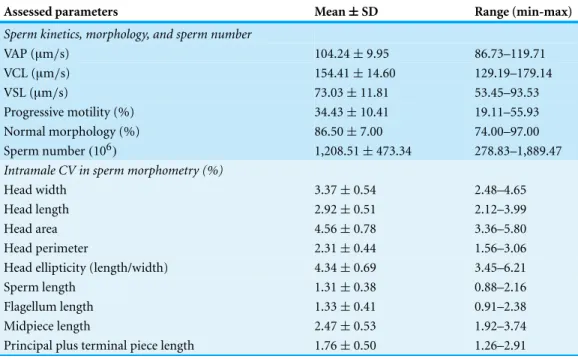
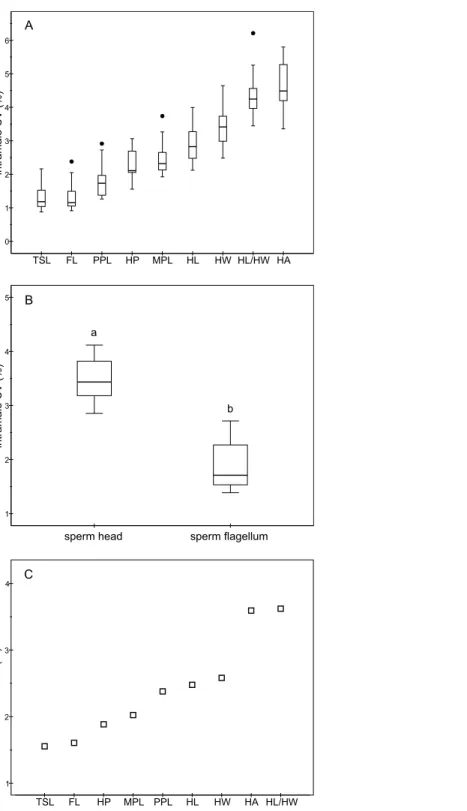
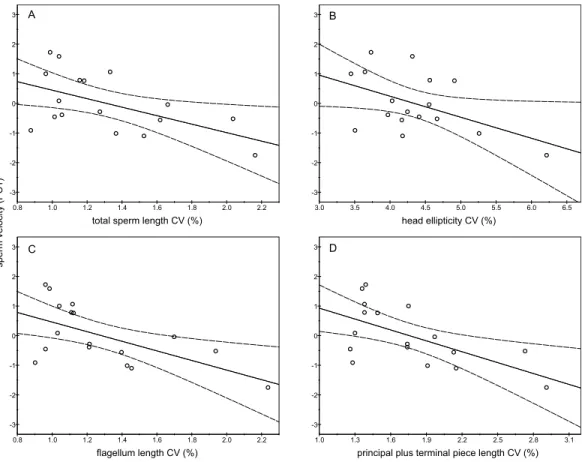
The descriptive statistics of sperm parameters are shown inTable 1. The mean value of the intramale CV of the total sperm length was low (1.31%). Similarly, mean values of the remaining intramale CV of the sperm morphometry parameters were generally low to moderate, ranging from 1.33% to 4.56% (Table 1andFig. 2A). Moreover, the intramale CV of the flagellum measures was significantly lower than that found in the sperm head measures (t=17.53;df =16;P<0.001;Fig. 2B). The intermale CV of the sperm head and the flagellum parameters were also low to moderate, ranging from 1.56% to 3.62% (Fig. 2C). Principal component analysis (PCA) rendered only one component with an eigenvalue>1 that explained 68.77% of the variance in the sperm velocity variables (Table 2). All sperm velocity variables (VAP, VCL, and VSL) were positively and significantly related to PC1 scores (P<0.05;Table 2). The eigenvalues and the variance explained by the other components are also shown inTable 2. Sperm velocity showed negative relationships with the intramale CV of the total sperm length (r= −0.54;P=0.025;Fig. 3AandTable S1), head ellipticity (r= −0.49;P=0.047;
Fig. 3BandTable S1), flagellum length (r= −0.61;P=0.010;Fig. 3CandTable S1),
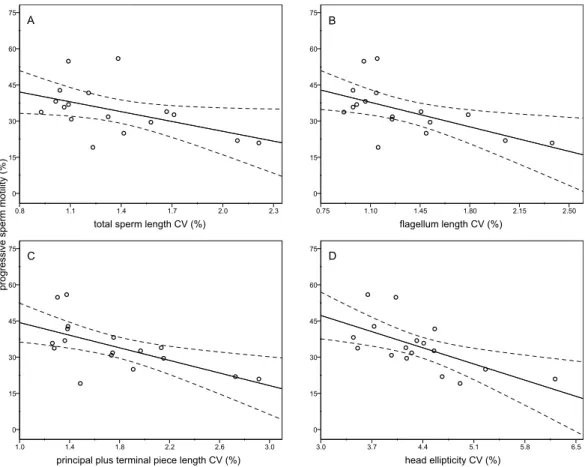
and principal plus terminal piece length (r= −0.61;P=0.009;Fig. 3DandTable S1). The percentage of sperm with progressive motility showed negative relationships with the intramale CV of the total sperm length (r= −0.49;P=0.045;Fig. 4AandTable S1), flagellum length (r= −0.57;P=0.016;Fig. 4BandTable S1), principal plus terminal piece length (r= −0.63;P=0.007;Fig. 4CandTable S1), and head ellipticity (r= −0.63;
Table 1 Sperm parameters in red deer (N=17).
Assessed parameters Mean±SD Range (min-max)
Sperm kinetics, morphology, and sperm number
VAP (µm/s) 104.24±9.95 86.73–119.71
VCL (µm/s) 154.41±14.60 129.19–179.14
VSL (µm/s) 73.03±11.81 53.45–93.53
Progressive motility (%) 34.43±10.41 19.11–55.93
Normal morphology (%) 86.50±7.00 74.00–97.00
Sperm number(106) 1,208.51±473.34 278.83–1,889.47
Intramale CV in sperm morphometry (%)
Head width 3.37±0.54 2.48–4.65
Head length 2.92±0.51 2.12–3.99
Head area 4.56±0.78 3.36–5.80
Head perimeter 2.31±0.44 1.56–3.06
Head ellipticity (length/width) 4.34±0.69 3.45–6.21
Sperm length 1.31±0.38 0.88–2.16
Flagellum length 1.33±0.41 0.91–2.38
Midpiece length 2.47±0.53 1.92–3.74
Principal plus terminal piece length 1.76±0.50 1.26–2.91
Notes.
VAP, average path velocity; VCL, curvilinear velocity; VSL, straight linear velocity; SD, standard deviation; CV, coeffi -cient of variation.
Table 2 Principal component analysis (PCA) to determine overall sperm velocity.
Sperm velocity variables PC1 loadings
Eigenvectors P
VAP 0.991 <0.0001
VCL 0.590 0.0127
VSL 0.856 <0.0001
Variance explained (%) 68.767
Eigenvalue 2.063
Notes.
Principal components with an eigenvalue>1 are shown. PC1 loadings (i.e., eigenvectors andPvalues) are correlation coefficients between the PC1 scores and the original variables of sperm velocity (VAP, VCL, and VSL). The results for the PC2 and PC3 were: PC2 (eigenvalue: 0.906; variance explained: 30.204%) and PC3 (eigenvalue: 0.031; variance explained: 1.029%).
VAP, average path velocity; VCL, curvilinear velocity; VSL, straight linear velocity; PC, principal component.
and perimeter were negatively related to the percentage of normal sperm morphology (r= −0.54;P=0.027 andr= −0.53;P=0.029, respectively;Table S1). The Pearson’s correlations of the intramale CV in the sperm morphometry parameters with sperm kinetics and normal sperm morphology are shown inTable S1.
Absolute testes mass, CV in sperm size, and sperm number As expected, the absolute testes mass exhibited high variability between males
Figure 3 Relationships between sperm velocity and the intramale coefficient of variation in sperm size.Relationships between sperm velocity and the intramale CV of: (A) total sperm length:r= −0.54; P=0.025; (B) head ellipticity:r= −0.49;P=0.047; (C) flagellum length:r= −0.61; P=0.010; (D) principal plus terminal piece length:r= −0.61;P=0.009. CV, coefficient of variation; PC1, principal component 1.
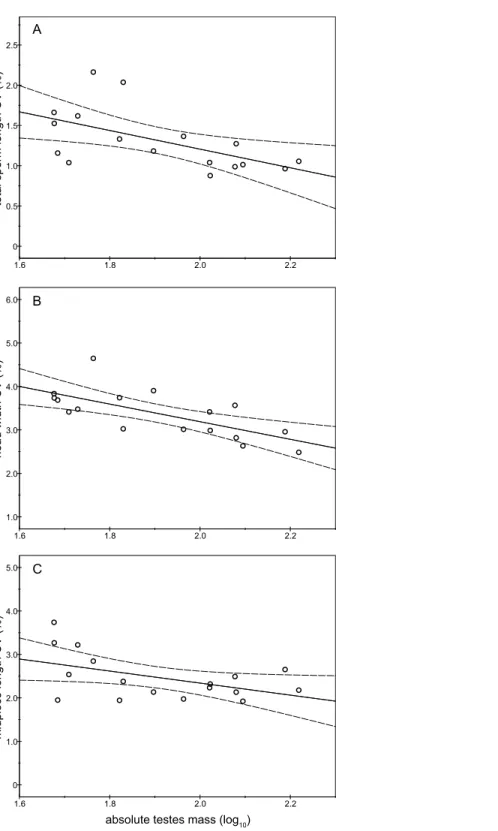
(Mean±SD). We found significant and negative relationships between absolute testes mass and the intramale CV of total sperm length (r= −0.58;P=0.016;Fig. 5Aand
Table S1), sperm head width (r= −0.70;P=0.002;Fig. 5BandTable S1), and midpiece length (r= −0.49;P=0.046;Fig. 5CandTable S1). The same relationship trends were also
found for the remaining intramale CV of the sperm morphometry parameters, although they were not significant (P>0.05;Table S1). We did not find any significant relationship between the intramale CV in sperm size and sperm number (P>0.05;Table S1). Finally, we found a positive relationship between absolute testes mass and sperm number, but it was not significant (r=0.35;P=0.371).
DISCUSSION
Figure 4 Relationships between the percentage of sperm with progressive motility and the intramale coefficient of variation in sperm size.Relationships between progressive sperm motility and the intra-male CV of: (A) total sperm length:r= −0.49;P=0.045; (B) flagellum length:r= −0.57;P=0.016; (C) principal plus terminal piece length:r= −0.63;P=0.007; (D) head ellipticity:r= −0.63;P=0.007. CV, coefficient of variation.
observed across animal populations and species (Immler, Calhim & Birkhead, 2008; Laske-moen et al., 2013). In addition, intramale variation in sperm head size is negatively related to normal sperm morphology. Highlighting the significance of our findings, previous studies reported that sperm velocity and normal morphology are related to male fertility and the sex ratio at the time of birth in red deer (Malo et al., 2005b;Gomendio et al., 2006), suggesting that post-copulatory sexual selection reduces variation in sperm size. Moreover, absolute testes mass was negatively related to intramale variation in sperm size (i.e., sperm length, head width, and midpiece length), though we suggest this result is treated with caution as both relative testes mass and male mating tactic (i.e., harem defender versus sneaker) could influence this relationship. This trend of relationship between testes mass and intramale CV in sperm size is linked to the level of sperm competition and extrapair paternity among related taxa (Kleven et al., 2008;Sandera, Albrecht & Stopka, 2013ˇ ). Our results tentatively suggest that large testes in red deer lead to sperm closer to the putative optimal size, which potentially enhances sperm competitiveness.
success. As a generalization of our study, intramale and intermale variations in sperm size were low both for the head and the flagellum structures, suggesting that in red deer stabilizing selection might act on sperm to reduce their variation in size. Moreover, we found that the variation in sperm measures was higher for those of the sperm head than for the sperm flagellum, as previously reported in murine rodents (Varea-S´anchez et al., 2014). Such a result may be linked to the size difference between X and Y chromosome bearing spermatozoa found in humans (X is larger than Y;Cui & Matthews, 1993), as these size differences are more significant for the sperm head than for the flagellum components (Cui & Matthews, 1993;Cui, 1997). Recently,Mossman et al. (2013)reported that the variation in the length of sperm components in humans undergoing treatment for infertility correlated with the proportion of motile sperm, but the authors did not find any association with sperm velocity parameters. However, in two closely related species of lizards, the relationships between the intramale variation in sperm size and sperm velocity showed contradictory results (Blengini et al., 2014). In agreement withMossman et al. (2013), we found that the intramale variation in sperm size is negatively related to the percentage of sperm with progressive motility. Further, in our study, we found a strong negative relationship between the intramale variation in sperm size and sperm velocity, which in turn is highly related to male fertility in red deer (Malo et al., 2005b).
In the present study, the intramale CV of the principal plus the terminal piece length showed a strong relationship with sperm velocity. On the contrary, we did not find any significant relationship between sperm velocity and the intramale CV of the sperm midpiece length, probably because glycolysis, which appears to be carried out along the length of the principal piece, is the most important source of ATP for the tail, instead of oxidative phosphorylation in the midpiece (Turner, 2006). Further, in red deer, the length of the principal plus the terminal piece in relation to the rest of the flagellum as well as head ellipticity play an important role in determining sperm velocity (Malo et al., 2006). For this reason, ejaculates with more uniform size of these sperm traits may be more successful at achieving fertilizations under competitive mating scenarios. Moreover, we found that the intramale variation in the sperm head size (area and perimeter) is negatively correlated with the percentage of normal sperm morphology, which in turn plays a key role in male fertility as well as in the offspring’s sex ratio in red deer (Malo et al., 2005b;
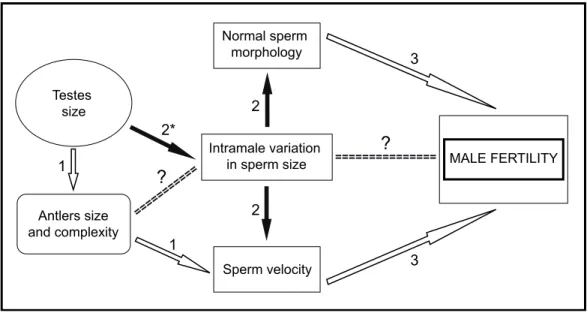
Figure 6 General scheme of male traits related to sperm competitiveness and fertility in red deer.White arrows indicate positive relationships. Black arrows indicate negative relationships. (1)Malo et al., 2005a; (2) Present work; (3)Malo et al., 2005b.∗, In the present work we have used absolute testes mass instead of relative testes mass. ?, Needs to be evaluated.
We found high variability in absolute testes mass among red deer males as previously described (Mart´ınez-Pastor et al., 2005;Pintus, Ros-Santaella & Garde, 2015). Studies in natural populations of ungulates, such as red deer and Soay sheep, have shown that testes size (both relative and absolute) is positively correlated with antler and horn size (Preston et al., 2003;Malo et al., 2005a), copula rates, and siring success (Preston et al., 2003). Our results show that large absolute testes mass is also associated with low sperm size variability. Furthermore, we found a positive relationship between absolute testes mass and sperm number, but it was not significant. We speculate that these results may reflect an increase in testes mass in order to produce more size-uniform sperm as occurs at intraspecific level (birds:Immler, Calhim & Birkhead, 2008; mammals:Sandera, Albrecht &ˇ Stopka, 2013). This idea is somewhat supported by the fact that, across species, both sperm morphology and sperm number are influenced by testicular architecture (e.g., relative proportion of spermatogenic tissue and size of the tubule lumen;L¨upold et al., 2009b;Rowe & Pruett-Jones, 2011) and the efficiency of spermatogenesis (e.g., shorter duration of the cycle of the seminiferous epithelium;Ramm & Stockley, 2010).
and could have an effect on the main sperm traits evaluated. With the findings of the present work, we can add new information to the general scheme about the male traits that potentially enhance sperm competitiveness, which in turn determine male fertility in red deer (Fig. 6). Our next step is to examine the possible relationships between sperm phenotype, testicular architecture, and spermatogenic features, as well as whether intramale variation in sperm size is a predictor of male fertilization ability. Our results highlight the importance of assessing intramale variation in sperm size for an enhanced understanding of post-copulatory sexual selection mechanisms.
ACKNOWLEDGEMENTS
The assistance provided by Alvaro Dom´ınguez-Rebolledo, Alfonso Bisbal, Enrique del Olmo, Mari Cruz Sotos, and Zandra Maulen is gratefully acknowledged. Authors acknowledge Gregorio Moreno-Rueda for his insightful comments and Christina Baker for English language editing. Landowners, managers, and rangers are acknowledged for facilitating access to samples.
ADDITIONAL INFORMATION AND DECLARATIONS
Funding
JLRS and EP were supported by the project CIGA 20145001 (Czech University of Life Sciences, Prague, Czech Republic). The funders had no role in study design, data collection and analysis, decision to publish, or preparation of the manuscript.
Grant Disclosures
The following grant information was disclosed by the authors: Czech University of Life Sciences: CIGA 20145001.
Competing Interests
The authors declare there are no competing interests.
Author Contributions
• Jos´e Luis Ros-Santaella conceived and designed the experiments, performed the
experiments, analyzed the data, wrote the paper, prepared figures and/or tables, reviewed drafts of the paper.
• Eliana Pintus conceived and designed the experiments, performed the experiments,
analyzed the data, wrote the paper, reviewed drafts of the paper.
• Jos´e Juli´an Garde conceived and designed the experiments, contributed reagents/materials/analysis tools, reviewed drafts of the paper.
Animal Ethics
The following information was supplied relating to ethical approvals (i.e., approving body and any reference numbers):
Protection Regulation RD53/2013, which conforms to the European Union Regulation 2003/65/CE. Stags were legally hunted in their natural habitat in accordance with the harvest plan of the game reserve. The harvest plans were made in accordance with Spanish Harvest Regulation, Law 2/93 of Castilla-La Mancha, which conforms to the European Union regulations. Landowners and managers of the red deer populations gave permission to the authors to use the samples.
Data Availability
The following information was supplied regarding data availability: The data set is included asData S1.
Supplemental Information
Supplemental information for this article can be found online athttp://dx.doi.org/ 10.7717/peerj.1478#supplemental-information.
REFERENCES
Birkhead TR, Immler S. 2007.Making sperm: design, quality control and sperm competition.
Society of Reproduction and Fertility Supplement65:175–181.
Birkhead TR, Møller AP. 1998.Sperm competition and sexual selection. London: Academic Press.
Blengini CS, Sergio N, Gabriela C, Giojalas LC, Margarita C. 2014.Variability in sperm form and function in the context of sperm competition risk in twoTupinambislizards.Ecology and Evolution4:4080–4092DOI 10.1002/ece3.1262.
Calhim S, Double MC, Margraf N, Birkhead TR, Cockburn A. 2011.Maintenance of sperm variation in a highly promiscuous wild bird.PLoS ONE6:e28809
DOI 10.1371/journal.pone.0028809.
Clutton-Brock TH, Guinness FE, Albon SD. 1982.Red deer: behaviour and ecology of two sexes. Chicago: Chicago University Press.
Cramer ERA, Laskemoen T, Stensrud E, Rowe M, Haas F, Lifjeld JT, Sætre G, Johnsen A. 2014.
Morphology-function relationships and repeatability in the sperm of passer sparrows.Journal of Morphology8:1–8DOI 10.1002/jmor.20346.
Cui KH. 1997.Size differences between human X and Y spermatozoa and prefertilization diagnosis.
Molecular Human Reproduction3:61–67DOI 10.1093/molehr/3.1.61.
Cui KH, Matthews CD. 1993.X larger than Y.Nature366:117–118DOI 10.1038/366117b0.
Dom´ınguez-Rebolledo AE, Fern´andez-Santos MR, Bisbal A, Ros-Santaella JL, Ram ´on M, Carmona M, Mart´ınez-Pastor F, Garde JJ. 2010.Improving the effect of incubation and oxidative stress on thawed spermatozoa from red deer by using different antioxidant treatments.
Reproduction, Fertility, and Development22:856–870DOI 10.1071/RD09197.
Dom´ınguez-Rebolledo AE, Mart´ınez-Pastor F, Bisbal AF, Ros-Santaella JL, Garc´ıa- ´Alvarez O, Maroto-Morales A, Soler AJ, Garde JJ, Fern´andez-Santos MR. 2011.Response of thawed epididymal red deer spermatozoa to increasing concentrations of hydrogen peroxide, and importance of individual male variability.Reproduction in Domestic Animals46:393–403 DOI 10.1111/j.1439-0531.2010.01677.x.
Fitzpatrick JL, Baer B. 2011.Polyandry reduces sperm length variation in social insects.Evolution 65:3006–3012DOI 10.1111/j.1558-5646.2011.01343.x.
Fitzpatrick JL, L¨upold S. 2014.Sexual selection and the evolution of sperm quality.Molecular Human Reproduction0:1–10DOI 10.1093/molehr/gau067.
Garc´ıa-Gonz´alez F, Simmons LW. 2005.Sperm viability matters in insect sperm competition.
Current Biology15:271–275DOI 10.1016/j.cub.2005.01.032.
Gomendio M, Malo AF, Soler AJ, Fern´andez-Santos MR, Esteso MC, Garc´ıa AJ, Roldan ERS, Garde J. 2006.Male fertility and sex ratio at birth in red deer.Science314:1445–1447 DOI 10.1126/science.1133064.
G ´omez Montoto L, Maga˜na C, Tourmente M, Mart´ın-Coello J, Crespo C, Luque-Larena JJ, Gomendio M, Roldan ERS. 2011.Sperm competition, sperm numbers and sperm quality in muroid rodents.PLoS ONE6:e18173DOI 10.1371/journal.pone.0018173.
Griswold MD. 2004.Perspective on the function of Sertoli cells. In: Skinner MK, Griswold MD, eds.Sertoli cell biology. San Diego: Elsevier Academic Press, 15–18.
Guinness F, Lincoln GA, Short RV. 1971.Reproductive cycle of female red deer,Cervus elaphus L.
Journal of Reproduction and Fertility27:427–438DOI 10.1530/jrf.0.0270427.
Helfenstein F, Podevin M, Richner H. 2009.Sperm morphology, swimming velocity, and longevity in the house sparrowPasser domesticus.Behavioral Ecology and Sociobiology 64:557–565DOI 10.1007/s00265-009-0871-x.
Humphries S, Evans JP, Simmons LW. 2008.Sperm competition: linking form to function.BMC Evolutionary Biology8:319DOI 10.1186/1471-2148-8-319.
Immler S. 2008.Sperm competition and sperm cooperation: the potential role of diploid and haploid expression.Reproduction135:275–283DOI 10.1530/REP-07-0482.
Immler S, Calhim S, Birkhead TR. 2008.Increased postcopulatory sexual selection reduces the intramale variation in sperm design.Evolution62:1538–1543
DOI 10.1111/j.1558-5646.2008.00393.x.
Jarnemo A. 2011.Male red deer (Cervus elaphus) dispersal during the breeding season.Journal of Ethology29:329–336DOI 10.1007/s10164-010-0262-9.
Kelly CD. 2008. Sperm investment in relation to weapon size in a male trimorphic insect?Behavioral Ecology19:1018–1024DOI 10.1093/beheco/arn058.
Kleven O, Fossøy F, Laskemoen T, Robertson RJ, Rudolfsen G, Lifjeld JT. 2009.Comparative evidence for the evolution of sperm swimming speed by sperm competition and female sperm storage duration in passerine birds.Evolution63:2466–2473
DOI 10.1111/j.1558-5646.2009.00725.x.
Kleven O, Laskemoen T, Fossøy F, Robertson RJ, Lifjeld JT. 2008.Intraspecific variation in sperm length is negatively related to sperm competition in passerine birds.Evolution62:494–499 DOI 10.1111/j.1558-5646.2007.00287.x.
Laskemoen T, Albrecht T, Bonisoli-Alquati A, Cepak J, De Lope F, Hermosell IG,
Johannessen LE, Kleven O, Marzal A, Mousseau TA, Møller AP, Robertson RJ, Rudolfsen G, Saino N, Vortman Y, Lifjeld JT. 2013.Variation in sperm morphometry and sperm competition among barn swallow (Hirundo rustica) populations.Behavioral Ecology and Sociobiology67:301–309DOI 10.1007/s00265-012-1450-0.
L¨upold S. 2013.Ejaculate quality and constraints in relation to sperm competition levels among eutherian mammals.Evolution67:3052–3060DOI 10.1111/evo.12132.
L¨upold S, Calhim S, Immler S, Birkhead TR. 2009a.Sperm morphology and sperm velocity in passerine birds.Proceedings of the Royal Society B276:1175–1181DOI 10.1098/rspb.2008.1645.
L¨upold S, Linz GM, Rivers JW, Westneat DF, Birkhead TR. 2009b.Sperm competition selects be-yond relative testes size in birds.Evolution63:391–402DOI 10.1111/j.1558-5646.2008.00571.x.
Malo AF, Garde JJ, Soler AJ, Garc´ıa AJ, Gomendio M, Roldan ERS. 2005b.Male fertility in natural populations of red deer is determined by sperm velocity and the proportion of normal spermatozoa.Biology of Reproduction72:822–829DOI 10.1095/biolreprod.104.036368.
Malo AF, Gomendio M, Garde J, Lang-Lenton B, Soler AJ, Roldan ERS. 2006.Sperm design and sperm function.Biology Letters2:246–249DOI 10.1098/rsbl.2006.0449.
Malo AF, Roldan ERS, Garde J, Soler AJ, Gomendio M. 2005a.Antlers honestly advertise sperm production and quality.Proceedings of the Royal Society B272:149–157
DOI 10.1098/rspb.2004.2933.
Mart´ınez-Pastor F, Guerra C, Kaabi M, Garcia-Macias V, De Paz P, Alvarez M, Herraez P, Anel L. 2005.Season effect on genitalia and epididymal sperm from Iberian red deer, roe deer and Cantabrian chamois.Theriogenology63:1857–1875
DOI 10.1016/j.theriogenology.2004.08.006.
Meril¨a J, Sheldon BC. 1999.Testis size variation in the greenfinchCarduelis chloris: relevance for some recent models of sexual selection.Behavioral Ecology and Sociobiology45:115–123 DOI 10.1007/s002650050545.
Mossman J, Pearson JT, Moore HD, Pacey A. 2013.Variation in mean human sperm length is linked with semen characteristics.Human Reproduction28:22–32DOI 10.1093/humrep/des382.
Parker GA. 1998.Sperm competition and the evolution of ejaculates: towards a theory base. In: Birkhead TR, Møller AP, eds.Sperm competition and sexual selection. London: Academic Press, 3–54.
Pemberton JM, Albon SD, Guinness FE, Clutton-Brock TH, Dover GA. 1992.Behavioral estimates of male mating success tested by DNA fingerprinting in a polygynous mammal.
Behavioral Ecology3:66–75DOI 10.1093/beheco/3.1.66.
P´erez-Gonz´alez J, Carranza J. 2011.Female aggregation interacts with population structure to influence the degree of polygyny in red deer. Animal Behaviour 82:957–970
DOI 10.1016/j.anbehav.2011.07.023.
Pintus E, Ros-Santaella JL, Garde JJ. 2015.Beyond testis size: links between spermatogenesis and sperm traits in a seasonal breeding mammal.PLoS ONE10:e0139240
DOI 10.1371/journal.pone.0139240.
Pitnick S, Hosken DJ, Birkhead TR. 2009.Sperm morphological diversity. In: Birkhead TR, Hosken DJ, Pitnick S, eds.Sperm biology: an evolutionary perspective. Oxford: Academic Press, 69–149.
Pizzari T, Parker GA. 2009.Sperm competition and sperm phenotype. In: Birkhead TR, Hosken DJ, Pitnick S, eds.Sperm biology: an evolutionary perspective. Oxford: Academic Press, 207–245.
Preston BT, Stevenson IR, Pemberton JM, Coltman DW, Wilson K. 2003.Overt and covert competition in a promiscuous mammal: the importance of weaponry and testes size to male reproductive success.Proceedings of the Royal Society B270:633–640
Ramm SA, Stockley P. 2010. Sperm competition and sperm length influence the rate of mammalian spermatogenesis.Biology Letters6(2):219–221DOI 10.1098/rsbl.2009.0635.
Ram ´on M, Soler AJ, Ortiz JA, Garc´ıa-Alvarez O, Maroto-Morales A, Roldan ERS, Garde JJ. 2013.
Sperm population structure and male fertility: an intraspecific study of sperm design and velocity in red deer.Biology of Reproduction89:110DOI 10.1095/biolreprod.113.112110.
Ros-Santaella JL, Dom´ınguez-Rebolledo AE, Garde JJ. 2014.Sperm flagellum volume determines freezability in red deer spermatozoa.PLoS ONE9:e112382DOI 10.1371/journal.pone.0112382.
Rowe M, Pruett-Jones S. 2011.Sperm competition selects for sperm quantity and quality in the australian Maluridae.PLoS ONE6(1):e15720DOI 10.1371/journal.pone.0015720.
ˇS and era M, Albrecht T, Stopka P. 2013.Variation in apical hook length reflects the intensity of sperm competition in murine rodents.PLoS ONE8:e68427DOI 10.1371/journal.pone.0068427.
Schulte-Hostedde AI, Millar JS. 2004.Intraspecific variation of testis size and sperm length in the yellow-pine chipmunk (Tamias amoenus): implications for sperm competition and reproductive success.Behavioral Ecology and Sociobiology55:272–277DOI 10.1007/s00265-003-0707-z.
Simmons LW, Emlen DJ. 2006.Evolutionary trade-offbetween weapons and testes.Proceedings of the National Academy of Sciences of the United States of America 103:16346–16351
DOI 10.1073/pnas.0603474103.
Simmons LW, Fitzpatrick JL. 2012.Sperm wars and the evolution of male fertility.Reproduction 144:519–534DOI 10.1530/REP-12-0285.
Simpson JL, Humphries S, Evans JP, Simmons LW, Fitzpatrick JL. 2014.Relationships between sperm length and speed differ among three internally and three externally fertilizing species.
Evolution68:92–104DOI 10.1111/evo.12199.
Soler AJ, Garde JJ. 2003. Relationship between the characteristics of epididymal red deer spermatozoa and penetrability into zona-free hamster ova.Journal of Andrology24:393–400.
Stopher KV, Nussey DH, Clutton-Brock TH, Guinness F, Morris A, Pemberton JM. 2011.The red deer rut revisited: female excursions but no evidence females move to mate with preferred males.Behavioral Ecology22:808–818DOI 10.1093/beheco/arr052.
Turner RM. 2006.Moving to the beat: a review of mammalian sperm motility regulation.
Reproduction, Fertility, and Development18:25–38DOI 10.1071/RD05120.
Van der Horst G, Maree L. 2014.Sperm form and function in the absence of sperm competition.
Molecular Reproduction and Development81:204–216DOI 10.1002/mrd.22277.