INTRODUCTION
Japanese encephalitis (JE) is a major public health problem in Southeast Asia. The mosquito vectors involved in the transmission of this viral infection mainly belong to the Culex vishnui subgroup which includes the three important species, namely Cx. tritaeniorhynchus Giles, 1901, Cx. vishnui Theobald, 1901 and Cx. pseudovishnui
Colless, 1957( Diptera: Culicidae)1. Larvae of these spe-cies are known to occur in fresh water habitats such as paddy fields, ground pools, ponds, wells and ditches while adults prefer to rest outdoors2. However, in India, Cx.
tritaeniorhynchus was reported to rest predominantly in-doors in Bellary district of Karnataka state3. Yet another report from Mysore indicated that larvae of Cx. tritaeniorhynchus inhabiting ground pools varied in some of their morphological characters from those inhabiting paddy fields4. Such behavioural variations have been in-dicative of the presence of genetically isolated
popula-tions of a taxon which have been subsequently identified as sibling species in the case of anophelines such as
Anopheles fluviatilis and An. subpictus Grassi, 1899 (Diptera: Culicidae). These observations reported in the case of Cx. tritaeniorhynchus added a new dimension to the already complex nature of the members of the sub-group whose identification as adults also remains diffi-cult. These circumstances warranted a morphological and molecular characterization of the geographically and eco-logically variant populations of the important JE vector
Cx. tritaeniorhynchus of this subgroup. MATERIAL & METHODS
Study area
Geographical locations in Bellary district, Mysore and Mandya districts in Karnataka, where biological and behavioural variations have been reported in Cx. tritaeniorhynchus formed the primary study sites. JE prone areas such as Warangal and Karim Nagar districts
Morphological and molecular characterization of the ecological, biological
and behavioural variants of the JE vector
Culex tritaeniorhynchus:
An
assessment of its taxonomic status
A.R. Rajavel, N. Pradeep Kumar, R. Natarajan, P. Vanamail, A. Rathinakumar & P. Jambulingam
Vector Control Research Centre (ICMR), Indira Nagar, Puducherry, India
ABSTRACT
Background & objectives: Culex tritaeniorhynchus (Diptera: Culicidae), an important vector of Japanese encephalitis belongs to the Culex vishnui subgroup which includes two other vector species namely, Cx. vishnui
and Cx. pseudovishnui. Many varieties and types of Cx. tritaeniorhynchus have been reported, besides populations that exhibit behavioural and biological differences. This study was undertaken to find out whether Cx. tritaeniorhynchus populations exhibiting behavioural and biological variations, and those from different geographical areas, are comprised of more than one taxon or belong to a single taxon.
Methods: Morphological characterization was done by examining 153 morphological and morphometric characters in the larval (75), pupal (60) and adult stages (18) of five geographical populations of Cx. tritaeniorhynchus. Molecular characterization was done by PCR amplification of mitochondrial cytochrome c oxidase (COI) gene sequences (DNA barcodes) and another hypervariable genetic marker, the ribosomal DNA (16S). One-way ANOVA, principal component analysis (PCA) and discriminant factor analysis (DFA) were done for statistical analyses using the statistical package SPSS IBM version 19.0.
Results: Morphological characterization showed that no intraspecific differentiation can be made among the five geographical populations of Cx. tritaeniorhynchus. Molecular characterization done by DNA barcoding also showed that the COI sequences of all the five populations of Cx. tritaeniorhynchus grouped into a single taxonomic clade plus the genetic differentiation among these was non-significant and the overall gene flow among the populations was very high. Analysis of the ribosomal DNA also confirmed that the Cx. tritaeniorhynchus populations belonged to a single taxon.
in Telangana state (erstwhile Andhra Pradesh state) and areas of repeated epidemic outbreaks of JE such as Gorakhpur district of Uttar Pradesh state were the other study sites. All these study sites are known to be erst-while JE epidemic prone areas. In addition, samples from West Bengal, Tamil Nadu and Assam were also included for molecular characterization.
Two villages within the Bellary Developmental Block, namely Rupanagudi (15o 03.209' N, 77o 03.738' E) and Moka (15o 14.027' N, 77o 03.622' E) were selected for mosquito collections because of the reported behavioural variation of resting indoors (endophilism) in
Cx. tritaeniorhynchus3. Mysore (12o 18.841' N, 76o 37.740' E) and Mandya (12o 30.359' N, 76o 50.024' E) districts are the sites where biological variation in the form of differences in the morphological structures of larvae of Cx. tritaeniorhynchus has been reported4. Chalapalli (18o 15.061' N, 79o 27.106' E)and Rajapalli (18o 13.744' N, 79o 26.073' E) villages of Chelpur Primary Health Cen-tre (PHC), Uppalpalli village (18o 10.774' N, 79o 28.535' E) of Uppal PHC and Medipalli village (18o 03.242' N, 79o 27.135' E) of Hasanparthy PHC were the mosquito collection sites in Warangal and Karimnagar districts. Mosquito collection sites in Gorakhpur were Mahesra (26o 49.305' N, 83o 21.243' E), Rampurkhud (26o 50.350' N, 83o 26.183' E), Sekurwa (26o 49.006' N, 83o 20.834' E) (Chargawan PHC), Karimnagar (Nagar Nigam) (26o 48.364' N, 83o 23.042' E), Kusmitakia (26o 44.868' N, 83o 20.834' E), Shivpur (26o 39.918' N, 83o 29.899' E) (Pipraich PHC) and Rudrapur (26o 39.269' N, 83o 15.009' E) (Khajani PHC).
Collection of mosquitoes
Field work was carried out during February to November 2009 in study localities of Bellary, Mysore and Mandya districts for collection of mosquitoes of the
Culex vishnui subgroup. Adult collections from both in-door and outin-door resting sites were made in the morning between 0900 and 1000 hrs and in the evening between 1700 and 1800 hrs using an oral aspirator and torch light. In Moka and Rupanagudi villages of Bellary district, apart from exclusive human dwellings and cattlesheds, most of the houses had the cattle together with the inmates shar-ing the dwellshar-ing, which were considered as mixed dwell-ings. One man hour collection of indoor resting mosqui-toes was done in each of these types. Collection of outdoor resting mosquitoes was done in the paddy fields, in the vegetation along irrigation channels, hay stacks in the open, and cotton fields using an oral aspirator. Larval collection was done in the villages, from the paddy fields, irrigation channels and ditches by using a dipper.
Mosquito collection in Mysore and Mandya was mainly focused on larval collections because morphologi-cal variations have been reported in larvae of JE vector from these areas. Larval collection was done in Mysore City from Kukarhalli tank area. The vast area adjacent to the tank was a marsh grassy region with large puddles of water stagnation that formed the larval habitats. Another location of larval collection in the city was the Vidyaranyapuram farm where fodder grass is cultivated. Larval collection outside the city area was done in the paddy fields, irrigation channels, ditches and ponds in both Mandya and Mysore. Indoor and outdoor resting collection of adults was made in Chikpalya village in Mandya.
Adult and larval collections of Cx. vishnui subgroup mosquitoes were made in Warangal and Karimnagar dis-tricts of Andhra Pradesh during August 2010 and in Gorakhpur district of Uttar Pradesh during September 2010, since peak densities of Cx. tritaeniorhynchus have been reported during the respective months in these study sites. Adults were collected from both indoor and out-door resting habitats and larval collections were done in paddy fields, ground pools and irrigation channels. Voucher specimens of mosquitoes collected from all the study areas have been deposited in the mosquito museum at the Vector Control Research Centre, Puducherry5–6.
Morphological characterization
Specimens obtained from different study areas formed five different geographical populations, viz. (i) Bellary, (ii) Mysore City, (iii) Mysore outskirts and Mandya, (iv) Warangal and Karimnagar, and (v) Gorakhpur. Morpho-logical characterization was based on the study of larvae, pupae, adult females and males of Cx. tritaeniorhynchus
of all the five populations. Majority of the specimens ex-amined were those obtained through associated rearing, so that the adult could be linked to its larval and pupal skins.
Larva: There are about 186 pairs of seta found in mosquito larva besides the comb scales, pecten and anal papillae, of which around 48 pairs are commonly used in different keys for identification of species. In this study, 75 characters including length, width and ratios were used, for which 197 IV instar larvae and larval skins were ex-amined.
Female: In the case of adult females, six characters, namely colour of erect scales on vertex, anterior 0.7 of mesonotum (dark or pale brown), mesonotum scales (fine or coarse), accessory pale scales on the ventral side of proboscis (present or absent), plume scales on wing (nar-row or broad), and dark scaling in hind femur were ex-amined in 1821 specimens. Since, the cibarial characters are generally used in differentiating closely related spe-cies of genus Culex, the cibarial armature was dissected and mounted for 29 specimens and five cibarial charac-ters, namely cibarial width and length of larger dorsal papillae, number of smaller dorsal papillae, length and number of cibarial teeth were also examined.
Male: In the case of adult males, seven characters, namely length of proboscis in relation to palpal segment 5, dorsal apical pale band on palpal segment 2, dorsal median pale band on palpal segment 3, ventrolateral tufts on palpal segment 3, setae on ventral surface of probos-cis, distal setae (d-f) of subapical lobe and number of fin-ger like processes on phallosome were examined in 385 specimens.
Molecular characterization
Cytochrome c oxidase 1 gene: Altogether, 143 speci-mens of Cx. tritaeniorhynchus collected from different parts of the country (Karnataka, Kerala, Andhra Pradesh, West Bengal, Tamil Nadu, Assam and Uttar Pradesh) were subjected to PCR amplification of mitochondrial cyto-chrome c oxidase (COI) gene sequences (DNA barcodes), a genetic marker established to be species specific, in or-der to delineate whether any cryptic species existed among
Cx. triteaniorhynchus. This included 135 specimens from the study areas (Bellary 36, Mysore City 22, Mysore out-skirts 25, Warangal 29 and Gorakhpur 23), besides eight specimens of Cx. tritaeniorhynchus collected in Kerala, West Bengal, Tamil Nadu and Assam. Also eight speci-mens of Cx. pseudovishnui and six specimens of Cx. vishnui which are the other two species of the Cx. vishnui
subgroup, collected from the study areas were included in the analysis.
About 600 bp of the mitochondrial cytochrome c oxi-dase gene was PCR amplified following the protocol de-scribed by Kumar et al7. Total DNA was extracted from 3 legs of the specimens using Genelute Mammalian DNA Miniprep kit (Sigma-Aldrich, U.S.A). The extracted DNA was dissolved in 30 μl of deionized water. 5' COI region of mitochondrial DNA was amplified in Eppendorff Mastercycler Gradient S (Germany) using following cy-cling conditions. The 50 μl reaction was set up using Qiagen Taq PCR Core kit (Qiagen, Germany). The reac-tion components included 1.5 U of Thermus aquaticus
DNA Polymerase, 5 μl of 10× PCR Buffer, 2.5 mM Mag-nesium chloride, 10 μl Q solution, 1 μl of dNTP mixture and 1 μl of 10 pmol of forward and reverse DNA primers GGATTTGGAAATTGATTAGTTCCTT-3' and 5'-AAAAATTTTAATTCCAGTTGGAACAGC-3' along with 2 μl of template DNA7. The reaction parameters were as follows: Initial denaturation of 5 min (95°C) followed by 5 cycles of 94°C for 40 sec (denaturation), 45°C for 1 min (annealing), and 72°C for 1 min (extension) and 35 cycles of 94°C for 40 sec (denaturation), 51°C for 1 min (annealing), 72°C for 1 min (extension), and a final ex-tension at 72°C for 10 min. The amplified fragments were run on a 1% agarose gel to check the integrity of the frag-ments and the PCR product was purified by QIAGENGmbH PCR purification kit. The purified prod-ucts were eluted to 20 μl of deionized water, and a por-tion of it was lyophilized in a Speed Vac concentrator (Thermo Electron Corporation, Waltham, MA) followed by custom sequencing. Both reads (from forward primer as well as reverse primer) were done, and the sequences were analyzed as follows. The DNA sequences were sub-jected to alignment using ClustalW. Sequence divergences among individuals were quantified by using the Kimura two-parameter (K2P) distance model8. A neighbour join-ing (NJ) tree of K2P distances was constructed to provide a graphic representation of the clustering pattern among different species9-10. These analyses of the sequences were conducted using MEGA version 3.1 software11.
Ribosomal DNA
1 min at 72°C. The final elongation step provided was 72°C for 7 min.
Statistical analysis
Data on different morphological characters examined were subjected to one-way ANOVA for assessing the dif-ferences among the populations of Cx. tritaeniorhynchus
and post-hoc test was used to make pair-wise compari-son of each characteristic using Bonferroni method. Prin-cipal component analysis (PCA) was done to derive small number of factors, of many observed characteristics. Number of factors were considered based on eigen value of >1. Discriminant factor analysis (DFA) was done to find the variables, which were most useful for discrimi-nating between individuals of different populations. In discriminant factor analysis, Pillai’s trace statistics were performed to determine whether the clusters were sig-nificantly different from each other. Within-class covari-ance, matrices were assumed to be equal and prior prob-abilities were taken into account while performing the discriminant analysis. For all statistical tests p <0.05 was considered statistical significance. All these analyses were performed using statistical package for social sciences, SPSS IBM version 19.0.
For molecular characterization, the PCR reactions were ran on a 1.5% agarose gel. The amplified fragments were purified using Qia quick PCR purification kit (Qiagen, Germany) and sent for custom sequencing. The DNA sequences were aligned in ClustalW software and were subjected to NJ phylogenetic analysis in MEGA 4.0 software11. The DNA sequence polymorphism was ana-lyzed in DNASP 5.013.
RESULTS
In Bellary, all the three species of the Cx. vishnui
subgroup, Cx. tritaeniorhynchus, Cx. pseudovishnui and
Cx. vishnui were collected and Cx. tritaeniorhynchus was found to be the predominant species. Among the indoor resting habitats, resting density of Cx. tritaeniorhynchus
was in the order of cattleshed > mixed dwelling > human dwelling, with per man hour densities of 315, 273.43, and 41.11, respectively. The overall indoor resting den-sity of this species in Bellary was high (202.15 per man hour) compared to the outdoor resting density (17 per man hour). The density of Cx. pseudovishnui and Cx. vishnui was < 1 per man hour in all the resting habitats. In the larval collections done in Bellary, only Cx. tritaeniorhynchus was obtained. In larval collections made in Mysore and Mandya, larvae of Cx. tritaeniorhynchus, Cx. vishnui, and Cx. pseudovishnui were obtained. A
to-tal of 4048 adult specimens were obtained as study mate-rial. Of these, 387 specimens were collected as adults and 342 adults emerged from larval collections were mounted on minuten while the others were preserved in pill boxes. From the larval collections done, 928 larvae, larval skins and pupal skins were mounted on slides.
In Warangal and Gorakhpur, Cx. tritaeniorhynchus,
Cx. pseudovishnui and Cx. vishnui were obtained in adult collections, with Cx. tritaeniorhynchus being the predomi-nant species in both the areas. The per man hour density (PMD) of resting Cx. tritaeniorhynchus in Warangal was 30.22 in human dwellings, 88.67 in cattlesheds and 417.8 in outdoors and in Gorakhpur it was 28, 36.62 and 318.02 respectively. In both the areas, high density of the spe-cies was found in outdoor habitats, indicating the exophilic behaviour. Density of Cx. pseudovishnui and Cx. vishnui
was very low in both the areas, being < 1 per man hour in human dwellings and cattlesheds. In outdoor habitats, PMD of Cx. pseudovishnui was 1.05 and 1.39 while that of Cx. vishnui was 0.52 and 2.31 in Warangal and Gorakhpur respectively. In Warangal, larvae of Cx. tritaeniorhynchus were obtained mostly from paddy fields while in Gorakhpur it was from the ground pools and vacant plots. Very high density (250 per dip) of larvae of
Cx. tritaeniorhynchus was observed in a vacant plot in Karimnagar village of Gorakhpur where JE case had been recorded. A total of 830 adults of Cx. tritaeniorhynchus
obtained from different collection sites in Warangal and 860 adults from different collection sites in Gorakhpur were mounted on minuten, while the rest were preserved in pill boxes. From larval collections made, 200 and 260 larvae, larval skins and pupal skins from Warangal and Gorakhpur were mounted on slides.
Morphological characterization
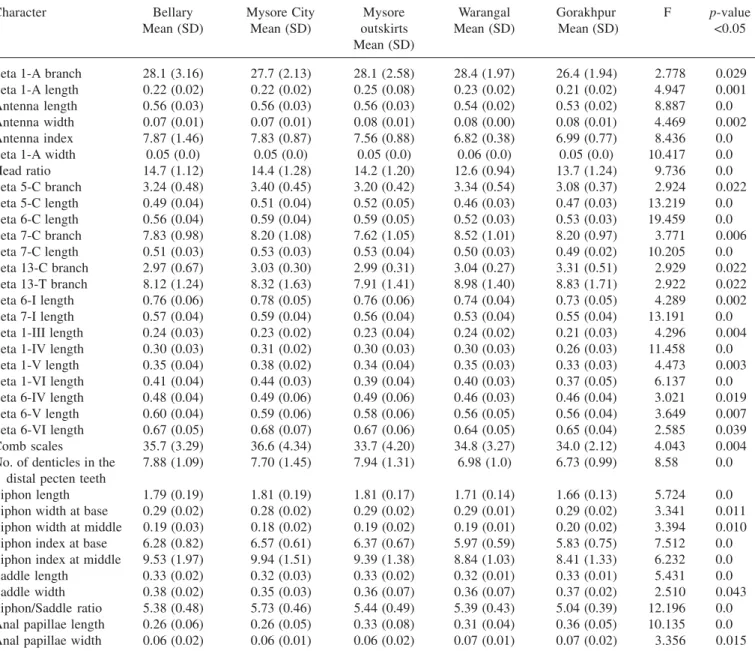
base, siphon index at base, siphon index at middle, saddle length, saddle width, siphon/saddle ratio and anal papil-lae index were shorter in length and number of branches were lesser in Gorakhpur and Warangal populations than in Mysore City, Mysore outskirts and Bellary populations. However, between Gorakhpur and Warangal populations, the Warangal population had longer/higher number of branches.
Multivariate analysis of the larval populations
Principal component analysis (PCA) of the morpho-logical analysis extracted five factors with eigen-values of more than one. The Kaiser-Meyer-Olkin (KMO) mea-sure of sampling adequacy was 0.566. Cumulatively, these
factors explained 73.03% of the total variability in the data. The first factor (F1) explained 19.57% of the total variability, while the second factor (F2) explained 11.28%. Similarly, the third factor (F3) and fourth factor (F4) ex-plained 6.05% and 5.13% of the total variability, respec-tively. Altogether, the first four factors explained 42.02% of the total variability. Characters such as seta 6-V length, 6-IV length, 6-III length; 6-VI branch, 6-I length, 5-C length, antennal length, 6-C length, 7-I length and saddle width showed high magnitude on F1. Siphon index at base, siphon/saddle ratio, siphon index at middle, siphon length, siphon width at base, and siphon width at middle showed high magnitude on F2. Seta 13-T branch, number of den-ticles on apical pecten teeth, number of pecten teeth, seta
Table 1. Morphological analysis of larvae of Culex tritaeniorhynchus of different geographical populations using one-way ANOVA test
Character Bellary Mysore City Mysore Warangal Gorakhpur F p-value Mean (SD) Mean (SD) outskirts Mean (SD) Mean (SD) <0.05
Mean (SD)
Seta 1-A branch 28.1 (3.16) 27.7 (2.13) 28.1 (2.58) 28.4 (1.97) 26.4 (1.94) 2.778 0.029 Seta 1-A length 0.22 (0.02) 0.22 (0.02) 0.25 (0.08) 0.23 (0.02) 0.21 (0.02) 4.947 0.001 Antenna length 0.56 (0.03) 0.56 (0.03) 0.56 (0.03) 0.54 (0.02) 0.53 (0.02) 8.887 0.0 Antenna width 0.07 (0.01) 0.07 (0.01) 0.08 (0.01) 0.08 (0.00) 0.08 (0.01) 4.469 0.002 Antenna index 7.87 (1.46) 7.83 (0.87) 7.56 (0.88) 6.82 (0.38) 6.99 (0.77) 8.436 0.0 Seta 1-A width 0.05 (0.0) 0.05 (0.0) 0.05 (0.0) 0.06 (0.0) 0.05 (0.0) 10.417 0.0 Head ratio 14.7 (1.12) 14.4 (1.28) 14.2 (1.20) 12.6 (0.94) 13.7 (1.24) 9.736 0.0 Seta 5-C branch 3.24 (0.48) 3.40 (0.45) 3.20 (0.42) 3.34 (0.54) 3.08 (0.37) 2.924 0.022 Seta 5-C length 0.49 (0.04) 0.51 (0.04) 0.52 (0.05) 0.46 (0.03) 0.47 (0.03) 13.219 0.0 Seta 6-C length 0.56 (0.04) 0.59 (0.04) 0.59 (0.05) 0.52 (0.03) 0.53 (0.03) 19.459 0.0 Seta 7-C branch 7.83 (0.98) 8.20 (1.08) 7.62 (1.05) 8.52 (1.01) 8.20 (0.97) 3.771 0.006 Seta 7-C length 0.51 (0.03) 0.53 (0.03) 0.53 (0.04) 0.50 (0.03) 0.49 (0.02) 10.205 0.0 Seta 13-C branch 2.97 (0.67) 3.03 (0.30) 2.99 (0.31) 3.04 (0.27) 3.31 (0.51) 2.929 0.022 Seta 13-T branch 8.12 (1.24) 8.32 (1.63) 7.91 (1.41) 8.98 (1.40) 8.83 (1.71) 2.922 0.022 Seta 6-I length 0.76 (0.06) 0.78 (0.05) 0.76 (0.06) 0.74 (0.04) 0.73 (0.05) 4.289 0.002 Seta 7-I length 0.57 (0.04) 0.59 (0.04) 0.56 (0.04) 0.53 (0.04) 0.55 (0.04) 13.191 0.0 Seta 1-III length 0.24 (0.03) 0.23 (0.02) 0.23 (0.04) 0.24 (0.02) 0.21 (0.03) 4.296 0.004 Seta 1-IV length 0.30 (0.03) 0.31 (0.02) 0.30 (0.03) 0.30 (0.03) 0.26 (0.03) 11.458 0.0 Seta 1-V length 0.35 (0.04) 0.38 (0.02) 0.34 (0.04) 0.35 (0.03) 0.33 (0.03) 4.473 0.003 Seta 1-VI length 0.41 (0.04) 0.44 (0.03) 0.39 (0.04) 0.40 (0.03) 0.37 (0.05) 6.137 0.0 Seta 6-IV length 0.48 (0.04) 0.49 (0.06) 0.49 (0.06) 0.46 (0.03) 0.46 (0.04) 3.021 0.019 Seta 6-V length 0.60 (0.04) 0.59 (0.06) 0.58 (0.06) 0.56 (0.05) 0.56 (0.04) 3.649 0.007 Seta 6-VI length 0.67 (0.05) 0.68 (0.07) 0.67 (0.06) 0.64 (0.05) 0.65 (0.04) 2.585 0.039 Comb scales 35.7 (3.29) 36.6 (4.34) 33.7 (4.20) 34.8 (3.27) 34.0 (2.12) 4.043 0.004 No. of denticles in the 7.88 (1.09) 7.70 (1.45) 7.94 (1.31) 6.98 (1.0) 6.73 (0.99) 8.58 0.0
distal pecten teeth
9-C branch, and seta 7-C branch showed high magnitude on F3. Antenna width and antennal index showed high magnitude on F4. DFA could distinguish five significant clusters for Mysore City, Mysore outskirts, Bellary, Warangal and Gorakhpur populations (Pillai’s trace = 0.923, F = 1.57, p <0.012). Characters that showed high factor loading on F1 included length of setae I, III, 6-IV, 6-V, 5-C, 6-C, 7-I, antenna width and saddle width, while characters that showed high factor loading on F2 included only siphon length, siphon index at middle, si-phon index at base, and sisi-phon/saddle ratio.
Analysis based on variables related to length and indices
Principal component analysis was also done by con-sidering only the variables related to length and indices. The KMO measure of sampling adequacy was 0.672. Cumulatively, these factors explained 76.16% of the total variability in the data. The first factor (F1) explained 30.31% of the total variability, while the second factor (F2) explained 16.96% of the total variability; together the first two factors explained 47.27% of the total variability. Characters such as length of seta III, 6-IV, 6-V, 6-I, 7-I, antenna length, saddle width, and siphon width at base showed high magnitude on F1. Siphon index at base, siphon/saddle ratio, siphon index at middle, and siphon length showed high magnitude on F2. The analysis showed that increase in length is not specific to siphonal characters alone but also for other body setae.
Analysis based on variables related to number
Principal component analysis by considering only the variables related to number of branches of setae was also performed. The KMO measure of sampling adequacy was 0.526. Cumulatively, these factors explained 68.21% of the total variability in the data. The first factor (F1) ex-plained 13.71% of the total variability, while the second factor (F2) explained 8.81% of the total variability, the third factor (F3) explained 7.67%, the fourth factor (F4) explained 6.91% and fifth factor (F5) explained 6.17%; together the first five factors explained 43.27% of the to-tal variability. Characters such as number of branches of seta 13-T, seta 8-C, 9-C, number of pecten teeth and num-ber of denticles on apical pecten teeth showed high mag-nitude on F1. Branch number on seta 1-IV, III, and V showed high magnitude on F2. Branch number of seta 13-C and 10-C showed high magnitude on F3. Branch number of seta 6-I, and 7-I showed high magnitude on F4. Branch number of seta 1-VI and 7-C showed high magnitude on F5. It showed there was no significant dif-ference among the five populations in relation to the num-ber of branches of the various setae.
Larval habitat-wise analysis
Besides, analysis of the morphological characters of different geographical populations, analysis was done based on larvae obtained from different larval habitats. The mean values of the characters considered for mor-phological analysis showed significant difference among the seven habitats, namely ground pools, irrigation ca-nals, paddy fields, rock pools, seepages, sewage and swamps, based on one-way ANOVA. Among the 66 char-acters, only 18 were found to be significantly different (Table 2). The pair-wise comparison of morphological characters using Bonferroni test revealed that characters such as antenna length, siphon length, siphon index at base, siphon index at middle, and siphon/saddle ratio were shorter in ground pool than irrigation canals, paddy fields, rock pools, seepages, sewage and swamps; length of seta 5-C and 7-C shorter in ground pools, irrigation canals and paddy fields than rock pools, seepages, swamps and sewages; length of seta 6-C shorter in ground pools and paddy fields than irrigation canals, seepages, sewage and swamps; number of comb scales higher in sewage and swamps than ground pools, irrigation canals and paddy fields.
Pupa
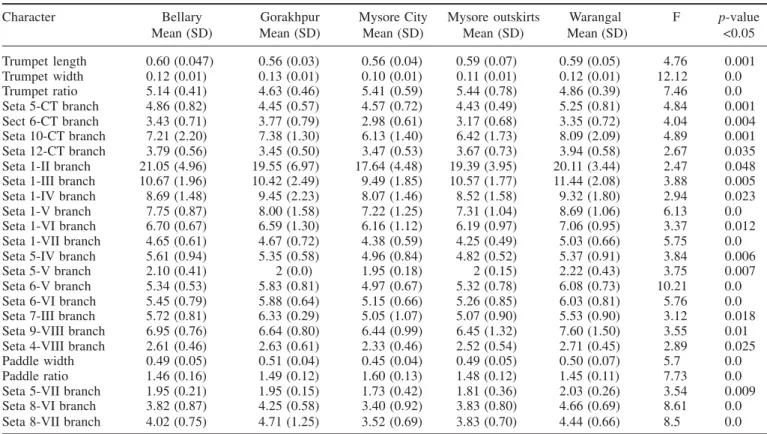
Of the 60 morphological characters examined in pu-pae, 42 characters, excluding those which were similar in all the populations, were considered for morphological analysis of the five populations based on one-way ANOVA. Among the 42 characters only 25 were signifi-cantly different in the one-way ANOVA (Table 3). The pair-wise comparison of morphological characters using Bonferroni test showed that trumpet length of Gorakhpur and Mysore City populations was similar and Mysore out-skirts and Warangal populations was similar while Bellary population had trumpet length greater than all other popu-lations. Trumpet width of Bellary and Warangal popula-tions was similar while other populapopula-tions significantly differed from each other. Seta 5-CT branch number of Gorakhpur and Mysore outskirts populations was similar while other populations significantly differed from each other. Paddle width of Bellary and Mysore outskirts popu-lations was similar while other popupopu-lations significantly differed from each other. Seta 9-VIII branch number of Mysore City and Mysore outskirts populations was simi-lar while other populations significantly differed from each other. Seta 5-VII branch number of Gorakhpur and Bellary populations was similar while other populations significantly differed from each other.
seta 12-CT, seta 1-III, seta 1-IV, seta1-VI, seta 5-CT, seta 4-VIII, and seta 5-VII. In characters such as trumpet width, branch number of seta 5-CT, seta 10-CT, seta 1-V, seta 1-VI, seta 6-V, seta 6-VI, seta 9-VIII, and seta 8-VI, both Mysore City and Mysore outskirts populations were sig-nificantly different from Warangal population. With
re-spect to trumpet width, branch number of seta 6-CT, seta 6-V, seta 8-VI, seta 8-VII, and paddle width, Mysore City population was significantly different from Gorakhpur population. Paddle ratio of Mysore City population was significantly different from all other populations. With respect to 22 characters related to number of branches,
Table 2. Morphological analysis of larvae of Culex tritaeniorhynchus from different larval habitats using one-way ANOVA test
Character Ground pool Irrigation canal Paddy field Rock pool Seepage Sewage Swamp F p-value Mean (SD) Mean (SD) Mean (SD) Mean (SD) Mean (SD) Mean (SD) Mean (SD) <0.05 Antenna length 0.53 (0.02) 0.55 (0.03) 0.55 (0.02) 0.58 (0.02) 0.57 (0.02) 0.54 (0.01) 0.56 (0.03) 7.68 0.0 Antenna width 0.08 (0.007) 0.07 (0.008) 0.08 (0.008) 0.08 (0.004) 0.07 (0.007) 0.08 (0.006) 0.07 (0.008) 3.16 0.01 Antenna index 6.79 (0.63) 7.58 (0.80) 7.36 (1.26) 7.44 (0.34) 7.94 (0.81) 6.76 (0.43) 7.92 (0.83) 5.15 0.0 Seta 5-C length 0.47 (0.03) 0.49 (0.05) 0.49 (0.04) 0.53 (0.03) 0.52 (0.04) 0.50 (0.03) 0.52 (0.04) 5.73 0.0 Seta 6-C length 0.53 (0.03) 0.56 (0.05) 0.54 (0.04) 0.56 (0.03) 0.58 (0.04) 0.58 (0.04) 0.59 (0.04) 10.10 0.0 Seta 7-C length 0.49 (0.02) 0.50 (0.04) 0.51 (0.03) 0.54 (0.03) 0.53 (0.04) 0.52 (0.04) 0.53 (0.03) 7.45 0.0 Seta 13-C branch 3.36 (0.53) 3.1 (0.92) 2.95 (0.34) 3.08 (0.58) 3.03 (0.21) 3.20 (0.44) 3.02 (0.29) 2.69 0.02 Seta 6-I length 0.74 (0.04) 0.77 (0.07) 0.75 (0.05) 0.75 (0.05) 0.76 (0.06) 0.73 (0.05) 0.78 (0.05) 2.95 0.01 Seta 7-I branch 1.92 (0.23) 2 2 2 2 2.10 (0.22) 2.01 (0.07) 3.52 0.0 Seta 7-I length 0.54 (0.04) 0.57 (0.05) 0.55 (0.04) 0.57 (0.04) 0.57 (0.03) 0.56 (0.02) 0.59 (0.04) 7.28 0.0 Comb teeth 33.48 (2.03) 34.72 (3.16) 34.71 (3.72) 35.07 (2.30) 35.54 (3.61) 38.80 (3.33) 36.47 (4.43) 2.76 0.01 Siphon length 1.62 (0.14) 1.82 (0.22) 1.77 (0.15) 1.77 (0.2) 1.78 (0.17) 1.88 (0.18) 1.81 (0.19) 4.34 0.0 Siphon width at base 0.29 (0.02) 0.30 (0.02) 0.28 (0.02) 0.27 (0.01) 0.28 (0.01) 0.28 (0.02) 0.28 (0.02) 4.69 0.0 Siphon width at middle 0.21 (0.02) 0.20 (0.02) 0.19 (0.02) 0.19 (0.02) 0.19 (0.02) 0.21 (0.008) 0.18 (0.02) 5.64 0.0 Siphon index at base 5.57 (0.68) 6.17 (0.86) 6.23 (0.67) 6.55 (0.92) 6.43 (0.62) 6.75 (0.34) 6.55 (0.63) 7.06 0.0 Siphon index at middle 7.96 (0.99) 9.04 (1.88) 9.39 (1.60) 9.58 (1.71) 9.55 (1.08) 9.04 (0.75) 9.99 (1.54) 5.65 0.0 Saddle length 0.33 (0.01) 0.34 (0.03) 0.33 (0.02) 0.34 (0.03) 0.33 (0.02) 0.31 (0.03) 0.32 (0.03) 2.76 0.0 Siphon/Saddle ratio 4.91 (0.35 5.43 (0.52) 5.43 (0.43) 5.15 (0.32) 5.45 (0.48) 6.10 (0.24) 5.69 (0.46) 11.28 0.0 F—Fishers’s test statistics based on one-way ANOVA.
Table 3. Morphological analysis of pupae of Culex tritaeniorhynchus of different geographical populations using one-way ANOVA test
Mysore City, Mysore outskirts and Bellary populations were similar having lesser number than the Gorakhpur and Warangal populations, but between the Gorakhpur and Warangal populations, the Gorakhpur population had lesser number.
Multivariate analysis of the pupal populations
Principal component analysis of the morphological analysis extracted five factors with eigen-values of more than one. The KMO measure of Sampling Adequacy was 0.662. Cumulatively, these factors explained 67.18% of the total variability in the data. The first factor (F1) ex-plained 31.64% of the total variability, while the second factor (F2) explained 11.74% of the total variability; to-gether the first two factors explained 43.38% of the total variability. Characters such as branch number of seta 1-V, seta 1-VI, seta 1-IV, and seta 1-III showed high mag-nitude on F1. Trumpet ratio and trumpet width showed high magnitude on F2. F1 was significantly different in all five populations, whereas F2 was different in all five populations except the trumpet width, which was similar in Bellary and Warangal populations. DFA could distin-guish five significant clusters for Mysore City, Mysore outskirts, Bellary, Warangal and Gorakhpur populations (Pillai’s trace = 0.447, F = 2.37, p <0.001). Characters that showed high factor loading on F1 included branch number of seta 1-V, 1-VI, 1-IV, 1-VII, and 1-III, while characters that showed high factor loading on F2 included trumpet width and trumpet ratio.
Female
Morphological characters examined in adult females did not show any variation between the different populations. For most of these characters including that of the accessory pale scales on the ventral side of proboscis, over 90% of the specimens of Mysore City, Mysore out-skirts, Bellary, Warangal and Gorakhpur populations were similar. For characters related to the cibarial armature, one-way ANOVA showed that only the cibarial width significantly (p <0.05) differed among the populations.
‘ Male
All the morphological characters examined in adult males including the length of proboscis in relation to pal-pal segment 5, and genital characters of distal setae (d-f) of subapical lobe, and number of finger like process on phallosome, were similar in the Mysore City, Mysore out-skirts, Bellary, Warangal and Gorakhpur populations.
Molecular characterization
Cytochrome c oxidase 1 gene: The phylogenetic tree
generated along with an outgroup is provided (Fig. 1). In the analysis it was found that all the COI sequences (143) of Cx. tritaeniorhynchus grouped into a single taxonomic clade. Also, the other two species included in the study branched as separate two taxonomic clusters. The statisti-cal significance of this branching pattern was found to be highly significant (the interior Branch test with 1000 rep-lications showed the statistical significance of the clades to be 99% for Cx. tritaeniorhynchus; Cx. pseudovishnui and
Cx. vishnui) indicating these to be three distinct species. The K2P genetic distance (d) recorded for these three species were found to be negligible (0.0073; 0.0080 and 0.0088 respectively) indicating the specimens included under each category to be of single taxonomic units. The interspecific ‘d’ was found to be 0.0768 between Cx. tritaeniorhynchus and Cx. pseudovishnui; 0.0586 between
Cx. tritaeniorhynchus and Cx. vishnui. The interspecific ge-netic distance between Cx. pseudovishnui and Cx. vishnui
was recorded to be 0.0591. These interspecific values also denote these three taxonomic clades to be three distinct spe-cies categories. Besides, the study clearly indicated the utility of DNA barcode approach to distinguish these three morphologically similar species, which are important vec-tors of Japanese encephalitis.
Also, the five different populations of Cx. tritaenio-rhynchus from Bellary, Mysore City, Mysore outskirts, Warangal and Gorakhpur were subjected to phylogenetic analysis to understand the genetic variability in geographi-cally isolated populations. The K2P genetic distance (d) values between the populations were found to be negli-gible. The genetic differentiation estimated among these five populations (Fst = 0.00500) was found to be non-significant (χ2 = 347.92; p = 0.6103) and the overall gene flow (Nm) among the populations computed was found to be very high (99.51). The maximum genetic differen-tiation was recorded among Mysore outskirts and Gorakhpur populations (Fst = 0.03996), which also re-corded the least gene flow (Nm = 12.01). However, this highest genetic differentiation value recorded among these populations was also not significant genetically (χ2 = 34.643; p = 0.5331). The above observations indicate negligible genetic variability among the five populations of Cx. tritaeniorhynchus.
Ribosomal DNA (16S) analysis
Fig. 2:Phylogenetic (Neighbour-joining) analysis of the hyper variable ribosomal DNA sequences of Culex tritaeniorhynchus
from different study areas; BLR—Bellary; GKP—Gorakhpur; MND—Mysore outskirts; MYS—Mysore City; WGL— Warangal.
specimens collected and analyzed from different geo-graphical localities in the study belonged to a single taxo-nomic unit.
DISCUSSION
A total of 153 morphological and morphometric char-acters in the larval (75), pupal (60) and adult stages (18) of Cx. tritaeniorhynchus, were examined in this study to find out whether Cx. tritaeniorhynchus populations exhibit behavioural and biological variations, and those from different geographical areas, are comprised of more than one taxon or belong to a single taxon.
ANOVA results indicated that several morphologi-cal characters differ significantly among the five popula-tions of Cx. tritaeniorhynchus studied. Larvae from Bellary, Mysore City, and Mysore outskirts had setae with lesser number of branches/shorter in length compared to those from Gorakhpur and Warangal. But no relationship could be established in terms of geographical distribu-tion from the southern to northern region because Gorakhpur population had the lesser number/shorter length compared to Warangal population. Principal com-ponent analysis (PCA) revealed that among the larval characters, variables related to the body hair accounted significantly for variations among the populations rather than the variables related to the siphon and the saddle. PCA done independently for variables related to number and variables related to length and indices showed that there was no significant difference among the five popu-lations in relation to the number of branches of the vari-ous setae, but it differed significantly in relation to length and indices. In larval chaetotaxy, based on which larval description of a species is done, emphasis is given to the branch number of various body setae rather than on the length of the setae, for the reason that the former is con-sidered as fixed characters, while the latter is subject to variability. In the discriminant factor analysis also, the characters that were responsible for differentiating the five populations as five different clusters were those re-lated to length and indices of the setae and not the num-ber of branches. It is, therefore, evident that there is no basis to consider that any of the five populations of
Cx. tritaeniorhynchus is different from the others. Earlier reports on morphological variations in Cx. tritaeniorhynchus were all based on very few characters examined in the larvae. Significant morphological differ-entiation in four populations collected from Bellary, Cuddalore, Pune and the Microbial Containment Com-plex laboratory culture in India, based on siphon, saddle and pecten teeth related variables has been reported14. However, all the 11 characters considered by them for analysis were only of length and indices related to siphon, saddle and anal gills. The present study has shown that these variables are not reliable for differentiating the popu-lations. This is also substantiated by the values obtained for the siphon index in the two studies, while the earlier study found the siphon index to be highest in Cuddalore population ranging from 9.42–16 compared to other popu-lations including that of Bellary, this study showed that the siphon index of Bellary population ranged from 6.45– 16 indicating that Cuddalore population cannot be differ-entiated from Bellary population based on the siphon index.
In another study, Cx. tritaeniorhynchus populations from Mysore City (ground pools) and outside Mysore (paddy fields) were differentiated as two varieties, based on morphological variations in comb scales, pecten teeth, denticles on the apical pecten tooth, siphon index, anal gills index and the length of basal hair tufts on siphon4. Mysore City (ground pools) population was named as va-riety one having shorter siphon index, shorter anal gills index, less comb scales and longer basal hair tufts on si-phon, while outside Mysore (paddy fields) population was named as variety two having longer siphon index, longer anal gills index, more comb scales and shorter basal hair tufts on siphon. Analysis of the same two populations collected by us also showed that ground pool larvae had shorter siphon index, length of siphon shorter, less comb scales and width of siphon at middle greater, and com-pared to larvae of paddy fields. But larvae collected in swamp (Mysore City) showed longer siphon index, length of siphon longer, and more comb scales compared to lar-vae in paddy fields indicating that characters related to length can be influenced by the habitats. Further, habitat-wise analysis of the larvae from all the five study areas showed that, of the 18 variables found to be significantly different between the various larval habitats, 16 variables are related to length and indices, which again substanti-ates that these are not reliable for differentiating the Cx. tritaeniorhynchus populations into varieties.
The range values of the different morphological char-acters of larvae recorded in our study, as well as the ear-lier studies4, 14, were compared with that of taxonomic descriptions and larval chaetotaxy tables available for Cx. tritaeniorhynchus of Thailand, Oriental region, Japan and Korea and South-western Asia2, 15-17. It was found that values obtained in our study to that of the other two earlier studies4, 14 were all within the range provided by these authors, showing that any conclusion based on variations in the larval characters in considering
Cx. tritaeniorhynchus as variant populations is not reasonable.
In systematic studies it is important to include all life stages because evidence of relationships cannot always be found readily in the same stage18–19. While earlier stud-ies on morphological variations in Cx. tritaeniorhynchus
variability being the branch number of seta V, VI, 1-IV, 1-VII, and 1-III. But for these characters also, Mysore City, Mysore outskirts and Bellary populations were simi-lar having lesser number than the Gorakhpur and Warangal populations, while between the Gorakhpur and Warangal populations, the Gorakhpur population had lesser number. Further, it was seen that the values ob-tained for different characters in our study were all within the range provided for pupal chaetotaxy of Cx. tritaeniorhynchus2, 17, 20. Thus, none of the five popula-tions can be treated as specifically different from the oth-ers.
In the adult stage, the females of the different popu-lations of Cx. tritaeniorhynchus did not show any varia-tion in the morphological characters studied. More than 90% of the specimens examined were similar for these characters. Among the cibarial armature characters also, many were similar, and though the cibarial width differed significantly among the populations, it was found that Bellary and Warangal populations were similar for this character. Further, it was found that our results of the cibarial characters were comparable to that of the base-line data of the same characters provided for Cx. tritaeniorhynchus in Taiwan and the Oriental region2, 21. In Thailand, Cx. tritaeniorhynchus of the different provinces were categorized into three types based on the number of cibarial teeth, siphon index ratio and mating behaviour22. But their results for the three types show overlapping values for these characters. With regard to the cibarial teeth, both type A and type C have < 16 teeth, while the siphon index ratio is shorter, moderate and long and the mating behaviour is moderate stenogamous, non-stenogamous and moderate non-stenogamous respectively in type A, type B and type C. Their observation that besides the morphotaxonomic studies, other studies such as cyto-genetic and biochemical studies and cross mating were also carried out but were not found significantly useful as markers to separate strains, shows that there is no basis to consider different populations of Cx. tritaeniorhynchus
as types A, B and C.
In the case of males also, none of the characters stud-ied were found to vary between the different populations of Cx. tritaeniorhynchus. The male genitalia characters con-sidered to be of importance in taxonomic differentiation also showed no evidence to consider that any of the five populations is different from the others. The intraspecific variations reported in Culex vishnui subgroup species in-cluded one variant in Cx.tritaeniorhynchus which was based on the length of the finger-like processes on the lat-eral plate of phallosome23. Measurement of this character is highly subjective as it could vary with the condition of
the mounting of the specimen. It should also be noted that
summorosus, which was described as a subspecies of Cx. tritaeniorhynchus mainly based on this character has been synonymized with Cx. tritaeniorhynchus and is now not a valid taxon24.
The results of the morphological characterization done in the present study by examining a total of 153 charac-ters in the larva, pupa, female and male of Cx. tritaenio-rhynchus of the Bellary, Mysore City, Mysore outskirts, Warangal and Gorakhpur populations showed that all populations is of the same species and no intra-specific differentiation can be made. This is conclusively proved by the molecular characterization done by DNA barcoding in which it was found that the COI sequences of all the five populations of Cx. tritaeniorhynchus grouped into a single taxonomic clade and the genetic differentiation among these five populations was found to be non-sig-nificant, and the overall gene flow among the popula-tions was found to be very high. Further, the ribosomal DNA, which is a hypervariable genetic marker, also con-firmed that Cx. tritaeniorhynchus specimens collected and analyzed from different geographical localities in the study belonged to a single taxonomic unit.
Extensive study of the morphological characters and their analysis done in the present study has made it clear that for a given species one population can differ from another population in few morphological characters, but unless this variation is consistent and is significantly out-side the known chaetotaxic range of that character for that species, there is no rationale to categorize the popu-lations into Variety or Type.
The present study has also shown that the endophilic resting behaviour of Cx. tritaeniorhynchus in Bellary re-ported earlier is not a function of genetic variability in the population3. Besides, the arid conditions of Bellary to which these authors have attributed the indoor resting, our observations indicated that cohabitation of cattle along with humans in the same dwelling (mixed dwelling) at-tracts this zoophilic species to the cattle and also pro-vides a suitable humid condition for resting inside the mixed dwellings that constitute the majority of dwellings in the villages of Bellary. This is substantiated by the re-sults of our resting densities which showed that resting density in the mixed dwellings was 6.65 times higher than that in exclusive human dwellings.
The phylogenetic analysis of the three species of the vishnui subgroup namely, Cx. tritaeniorhynchus,
Cx. pseudovishnui and Cx. vishnui showed that
Correspondence to: Dr A.R. Rajavel, Scientist ‘D’, Vector Control Research Centre (ICMR), Indira Nagar, Puducherry–605 006, India. E-mail: [email protected]
Received: 7 August 2014 Accepted in revised form: 28 October 2014
relationship between these species compared to the Cx. tritaeniorhynchus which is found to be predominant.
The COI sequences (DNA barcodes) of the three spe-cies, Cx. tritaeniorhynchus, Cx. pseudovishnui and Cx. vishnui deposited in the Gene Bank is an additional mo-lecular tool which is now available for identification of these different taxa. While morphological identification of these species can be done with keys already available, the problem faced in identification of rubbed specimens that have lost the scales, can now be resolved with this new molecular tool.
ACKNOWLEDGEMENTS
The study was supported by the DST, Govt. of India, Grant No. SR/SO/AS-79/2007 awarded to the first author.
REFERENCES
1. Reuben R, Tewari SC, Hiriyan J, Akiyama J. Illustrated keys to species of Culex (Culex) associated with Japanese encephalitis in Southeast Asia (Diptera: Culicidae). Mosq Syst 1994; 26: 75– 96.
2. Sirivanakarn S. Medical entomology studies. III. A revision of the subgenus Culex in the Oriental region (Diptera: Culicidae).
Contrib Am Entomol Inst 1976; 12: 1–272.
3. Kanojia, PC, Geevarghese G. First report of high-degree endophilism in Culextritaeniorhynchus (Diptera: Culicidae) in an area endemic for Japanese encephalitis. J Med Entomol 2004;
41: 994–6.
4. Fakoorziba MR, Vijayan VA. Variation in morphological char-acters of Culex tritaeniorhynchus (Diptera: Culicidae), a Japa-nese encephalitis vector at Mysore, India. J Commun Dis 2003;
35: 206–13.
5. Rajavel AR, Natarajan R, Vaidyanathan K, Soniya VP. A list of the mosquitoes housed in the mosquito museum at the Vector Control Research Centre, Pondicherry, India. J Am Mosq Con-trol Assoc 2005; 21: 243–51.
6. Rajavel AR, Natarajan R, Vaidyanathan K, Jambulingam P. Sys-tematic list of the species added to the mosquito museum at the Vector Control Research Centre, Pondicherry, India. J Am Mosq Control Assoc 2011; 27: 8–14.
7. Kumar NP, Rajavel AR, Natarajan R, Jambulingam P. DNA barcodes can distinguish species of Indian mosquitoes (Diptera: Culicidae). J Med Entomol 2007; 44: 1–7.
8. Kimura M. A simple method for estimating evolutionary rate of base substitutions through comparative studies of nucleotide
se-quences. J Mol Evol 1980; 16: 111–20.
9. Saitou N, Nei M. The neighbour-joining method: A new method for reconstructing phylogenetic trees. Mol Biol Evol 1987; 4:
406–25.
10. Hajibabaei M, Janzen DH, Burns JM, Hallwachs W, Hebert PD. DNA barcodes distinguish species of tropical Lepidoptera. Proc Natl Acad Sci U.S.A. 2006; 103: 968–71.
11. Kumar S, Tamura K, Nei M. MEGA3: Integrated software for molecular evolutionary genetics analysis and sequence alignment.
Brief Bioinform 2004; 5: 150–63.
12. Shouche YS, Patole MS. Sequence analysis of mitochondrial 16S ribosomal RNA gene fragment from seven mosquito species.
J Biosci 2000; 25: 361–6.
13. Librado P, Rozas J. DnaSP v5: A software for comprehensive analysis of DNA polymorphism data. Bioinformatics 2009; 25:
1451–2.
14. Kanojia PC, Paingankar MS, Patil AA, Gokhale MD, Deobagkar DN. Morphometric and allozyme variation in Culex tritaeniorhynchus mosquito populations from India. J Insect Sci
2010; 10: 138.
15. Bram RA. Contribution to the mosquito fauna of Southeast Asia. II. The genus Culex in Thailand (Diptera: Culicidae). Contrib Am Entomol Inst (Ann Arbor) 1967; 2: 1–234.
16. Tanaka K, Mizusawa K, Saugstad ES. A revision of the adult and larval mosquitoes of Japan (including the Ryukyu Archi-pelago and the Ogasawara Islands) and Korea (Diptera: Culi-cidae). Contrib Am Entomol Inst (Ann Arbor) 1979; 16: 1–987. 17. Harbach RE. The mosquitoes of the subgenus Culex in south-western Asia and Egypt (Diptera: Culicidae. Contrib Am Entomol Inst (Ann Arbor) 1988; 24: 1–240.
18. Reinert JF. Comparative anatomy of the female genitalia of gen-era and subgengen-era in tribe Aedini (Diptgen-era: Culicidae). Part XIII. Genus Ochlerotatus Lynch Arribalzaga. Contrib Am Entomol Inst (Ann Arbor) 2002; 33: 1–111.
19. Belkin JN. The mosquitoes of the South Pacific (Diptera: Culi-cidae); v 2. Berkeley and Los Angeles: University of California Press 1962; p. 608 and 412.
20. Tanaka K. Studies on the pupal mosquitoes of Japan (10) Culex
(Culex) (Diptera: Culicidae). Jpn J Syst Ent 2004; 10: 9–42. 21. Chen CY. Studies on morphology of the cibarium in culicine
mosquitos: I. Eight species of culicines common in the Taipei area, Taiwan. J Formosan Med Assoc 1972; 71: 282–91. 22. Sucharit SK, Surathin K, Shrestha SR. Vectors of Japanese
en-cephalitis virus (JEV): Species complexes of the vectors. South-east Asian J Trop Med Public Health 1989; 20: 611–20. 23. Kaur S, Monika Airi, Tewari PK. Intraspecific variations in three
vector species of Culex vishnui subgroup (Diptera: Culicidae) based on male genitalia. Entomon 2009; 34: 123–36.
24. Colless DH. Notes on the culicine mosquitoes of Singapore. II. The Culex vishnui group (Diptera: Culicidae), with descrip-tions of two new species. Ann Trop Med Parasitol 1957; 52: