OpenWordNet-PT: an open Brazilian
Wordnet for reasoning
Val´eria de Paiva
Alexandre Rademaker
Gerard de Melo
OpenWordNet-PT: An Open Brazilian Wordnet for Reasoning
∗
Valeria de Paiva
†Alexandre Rademaker
‡Gerard de Melo
§December 10, 2012
Abstract
Brazilian Portuguese needs a Wordnet that is open access, downloadable and changeable, so that it can be improved by the community interested in using it for knowledge representation and automated deduction. This kind of resource is also very valuable to linguists and computer scientists interested in extracting and rep-resenting knowledge obtained from texts. We discuss briefly the reasons for a Brazilian Portuguese Wordnet and the process we used to get a preliminary version of such a resource. Then we discuss possible steps to improving our preliminary version.
Keywords: Wordnet, Portuguese, lexical resources, SUMO Ontology.
1
Motivation
WordNet [7] is an extremely valuable resource for re-search in Computational Linguistics and Natural Lan-guage Processing in general. WordNet has been used for a number of different purposes in information sys-tems, including word sense disambiguation, informa-tion retrieval, automatic text classificainforma-tion, automatic text summarization, and dozens of other knowledge in-tensive projects.
We started a project at Fundac¸˜ao Getulio Vargas (FGV) in Brazil, whose goal, in the long run, is to use formal logical tools to reason about knowledge obtained from texts in Portuguese. Originally we had expected to be able to use some existing Brazilian Wordnet, out of the box, but it turns out that these are not available in the form that we need it. There are some attempts.
∗We would like to thank Francis Bond for help in getting
OpenWordNet-PT online and for general discussions. We also thank Adam Pease for introducing us and helping to start this project.
†School of Computer Science, University of Birmingham,
Eng-land
‡Escola de Matem´atica Aplicada, FGV, Brazil §ICSI, Berkeley, USA
There is the project WordNet.PT (Portuguese Word-Net) from the “Centro de Linguistica da Universi-dade de Lisboa” headed by Prof. Palmira Marrafa. But this is available online only, no download avail-able and, as far as we can see on their webpages, lit-tle development has happened recently to this project. The WordNet.PT version available online has about 19000 lexical expressions, from different semantic fields. The fragment made available online includes expressions from subdomains such as art, clothing, ge-ography, health, institutions, living entities and trans-portation, but no description of other domains and/or future releases of the database are discussed. The group has also a newer version of WordNet.PT called
WordNet.PTglobal [10] which pays attention to different varieties of Portuguese, like African varia-tions of the language. But while this is very in-teresting for linguistic comparative research and use-ful for online queries (http://www.clul.ul.pt/ wnglobal/), this smaller version of WordNet.PT is not available for download and hence cannot be the tar-get of modifications and improvements.
suggested by the Global Wordnet Association, and the 164 Core Base Concepts indicated by the EuroWordNet project. But again this wordnet is available online only and with a restrictive license that requires payment.
Finally, there is a first version of a Brazilian Por-tuguese version of Wordnet developed by Bento Dias da Silva and collaborators [6, 13]. But this also cannot be downloaded, is not available online and is not being maintained on an open access basis, which is one of the strongest points of Princeton WordNet.
Open access availability is one of the main reasons we would like to create a new Portuguese Wordnet, which we are calling OpenWordNet-PT (or OpenWN-PT for short). This is because we believe that resources like Wikipedia and WordNet need to be open and mod-ifiable by others in order to improve over time.
With a similar philosophy of open access to ours, there is also the work of Hugo Oliveira and Paulo Gomes on Onto.PT ([8]), another lexical ontology for the Portuguese language, structured similarly to Prince-ton’s WordNet, in the process of development at the University of Coimbra, Portugal. Unlike our own OpenWordNet-PT, Onto.PT is not connected to the synsets in the Princeton WordNet. Due to this, existing Princeton WordNet-focused resources like inter-lingual links in EuroWordNet, mappings to the SUMO ontol-ogy and DBpedia/YAGO cannot be used in conjunction with this resource.
2
OpenWordNet-PT
OpenWordNet-PT is being created by drawing on a two-tiered methodology so as to offer high precision for the more salient and frequent words of the language, but also high recall in order to cover a wide range of words in the long tail. We thus combine manual base concept annotation with statistical cross-lingual projection tech-niques.
2.1
Cross-Lingual Projection
As a starting point, we applied the UWN/MENTA methodology [4, 3], developed by one of the authors of this paper in conjunction with Gerhard Weikum, to the Portuguese language.
In a first step, the information in the English Prince-ton WordNet is projected to Portuguese by using trans-lation dictionaries to map the English members of a synset to possible Portuguese translation candidates. In
order to disambiguate and choose the correct transla-tions, feature vectors for possible translations are cre-ated by computing graph-based statistics in the graph of words, translations, and synsets. Additional mono-lingual wordnets and parallel corpora are used to en-rich this graph. Finally, statistical learning techniques are then used to iteratively refine this information and build an output graph connecting Portuguese words to synsets.
In a second step, Wikipedia pages are linked to rel-evant WordNet synsets by learning from similar graph-based features as well as gloss similarity scores. Such mappings allow us to attach the article titles of the Por-tuguese Wikipedia with WordNet synsets, thus further increasing the coverage.
2.2
Base Concept Annotation
Using cross-lingual projection, we obtain a resource with good coverage. In order to have high precision for the most important concepts of a language, we rely on human annotators.
In particular, we decided to rely on a set of Base Concepts. The Global WordNet Association aims at the development of wordnets for all languages of the world and to extend the existing wordnets to full cover-age and many parts-of-speech. In 2006, the association launched a project to start building a completely free worldwide wordnet “grid”. This grid would be built around a shared set of concepts, which would be ex-pressed in terms of the original Wordnet synsets and SUMO [11] terms.
guarantee the consistency of the taxonomy and to make sure that all lexical items with a heavy use in Portuguese were described. This process is under development at the moment. Currently, Portuguese annotators are re-vising the base concepts by manually choosing appro-priate Portuguese words and by manually writing ap-propriate Portuguese gloss descriptions.
2.3
Project Status
OpenWordNet-PT is freely available as an open-source project1. The data is also available for online browsing2
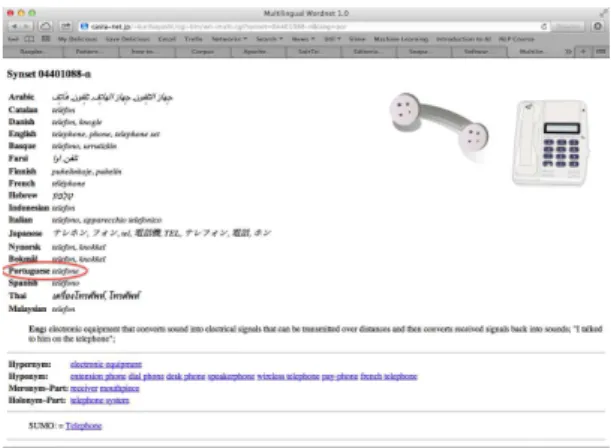
via the online interface developed by Francis Bond [1]. This interface, depicted in Fig. 1, is particularly insight-ful, as it displays Portuguese entries in conjunction with entries in several other languages given by other open-source wordnet projects.
Figure 1: Francis Bond’s Open Multilingual Wordnet website
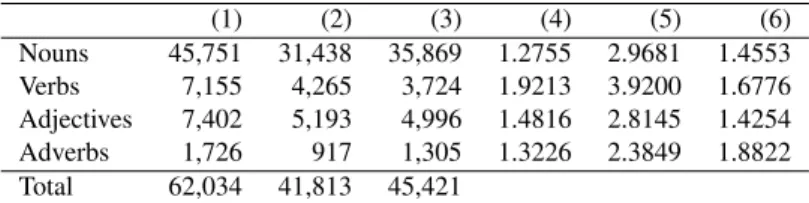
In total, our resource has 62,034 sense-word pairs, and 45,421 unique words. These include 2,498 manu-ally entered sense-word pairs as well as an additional 1,299 manually written Portuguese synset glosses. Ad-ditional statistics regarding the lexical coverage are pro-vided in the appendix.
The raw coverage seems reasonable in number of terms in the ontology, but we need to make sure that the quality of the items is comparable and in particular that the level of detail is approximately the right one for our intended application.
1https://github.com/arademaker/wordnet-br/
2http://casta-net.jp/˜kuribayashi/cgi-bin/
wn-multi.cgi
3
Perspectives
3.1
OpenWordNet-PT and SUMO
We started from an informal project discussing how logic and automated reasoning could have a bigger im-pact, if coupled with natural language processing. We also wanted to make sure that we could obtain some (ideally most) of the advances already made for En-glish text understanding to Portuguese text understand-ing and reasonunderstand-ing.
Building on previously developed technology, like the Xerox PARC XLE (Xerox Language Engine) sys-tem and trying to adapt that syssys-tem to Brazilian Por-tuguese seemed a good idea. However, the AI and logic components of the system come at the end of a long pipeline of modules which require expertise on pro-cessing of natural language. In particular we felt that a Brazilian Portuguese version of WordNet that could be freely distributed to others was an essential part of it. Wordnet is an important component of the XLE Uni-fied Lexicon (UL [2]), as the logical formulae cre-ated by the Abstract Knowledge Representation (AKR) component of the system are given meaning, in terms of Wordnet synsets. A previous version of the sys-tem used, instead of the Unified Lexicon, the propri-etary Cyc [9] concepts as semantics. As discussed in [5] the sparseness of Cyc concepts was the main reason to move away from Cyc onto a version of the Bridge system based on the unified lexicon and WordNet.
Having a Brazilian version of WordNet and a map-ping from Portuguese words to that would allow us to use a knowledge representation system very similar to the AKR (Abstract Knowledge Representation) used in the PARC Bridge system. Having our version of the Portuguese WordNet based on basic concepts we hope to leverage the huge manual construction effort which constitutes the mapping from WordNet to SUMO [12]. Through a partnership with Adam Pease, (the techni-cal editor of SUMO), we additionally intend to use the SUMO hierarchy to check the consistency between the Portuguese version of WordNet and the English one.
3.2
Intended Application
Getulio Vargas. The DHBB consists of 7,553 dictio-nary entries, out of which 6,584 are biographies of im-portant politicians in Brazil’s recent history. There are also 969 topical entries, concerning institutions, events and descriptions relating to the history and economy of Brazil after 1930. The dictionary is available online, but since the project was started in the 1970s the infor-mation is not properly linked, which makes querying its data somewhat unwieldy.
We intend to process all of the DHBB entries and we plan to extract from them the main SUMO con-cepts referenced. Using these main SUMO concon-cepts we want to bootstrap a fledgeling Ontology of Histori-cal Biographies, already started and documented in the Development section of SUMO. From the analysis of the SUMO concepts uncovered in the biographical en-tries, we want to discover new relationships between the historical characters described in the DHBB.
Here are some examples of the kinds of questions that this association of text of biography entry with collec-tions of SUMO concepts will allow us to answer: (1) Amongst Brazilian first rank politicians how many are from S˜ao Paulo? (2) Has the proportion of Paulistas in-creased of dein-creased since the 1930s? Since 1965 when Brasilia became the Capital of Brazil has the proportion changed? (3) What are the important Brazilian politi-cal families, corresponding to the Kennedys, the Bushs, etc? (4) What are the prevalent occupations among Brazilian historical figures? Are they mostly lawyers by training?
4
Conclusion
OpenWordNet-PT combines high recall with high pre-cision for the more salient words in the language. The work in this project is only starting, but we have many plans to measure and increase the quality of the Por-tuguese lexical resource, as well as many plans to use the resource in its current form. The data is freely avail-able for download as well as for online browsing.
References
[1] Francis Bond and Kyonghee Paik. A survey of wordnets and their licenses. In Proceedings of
the 6th Global WordNet Conference (GWC 2012),
Matsue, 2012.
[2] D. Crouch and T.H. King. Unifying lexical re-sources. InProceedings of the Interdisciplinary Workshop on the Identification and
Representa-tion of Verb Features and Verb Classes,
Saar-bruecken, Germany, 2005.
[3] G. de Melo and G. Weikum. Menta: inducing mul-tilingual taxonomies from wikipedia. In Proceed-ings of the 19th ACM international conference on
Information and knowledge management, pages
1099–1108. ACM, 2010.
[4] Gerard de Melo and Gerhard Weikum. Towards a universal wordnet by learning from combined evidence. InProceedings of the 18th ACM Con-ference on Information and Knowledge
Manage-ment (CIKM 2009), pages 513–522, New York,
NY, USA, 2009. ACM.
[5] V. De Paiva, DG Bobrow, C. Condoravdi, R. Crouch, L. Karttunen, TH King, R. Nairn, and A. Zaenen. Textual inference logic: Take two.
Proceedings of the Workshop on Contexts and On-tologies, Representation and Reasoning, page 27, 2007.
[6] B. C. Dias-Da-Silva, H. R. Moraes, M. F. Oliveira, R. Hasegawa, D. A. Amorim, C. Paschoalino, and A. C. Nascimento. Construc¸˜ao de um thesaurus eletrˆonico para o portuguˆes do brasil. In Processa-mento Computacional do Portuguˆes escrito e fal-ado (Propor), pages 1–10, 2000.
[7] C. Fellbaum. WordNet: An electronic lexical
database. The MIT press, 1998.
[8] Hugo Gonc¸alo Oliveira and Paulo Gomes. In-tegrating lexical-semantic knowledge to build a public lexical ontology for Portuguese. In Nat-ural Language Processing and Information
Sys-tems, Proceedings of 17h NLDB, volume 7337 of
LNCS, pages 210–215, Groningen, The Nether-lands, June 2012. Springer.
[9] D.B. Lenat. Cyc: A large-scale investment in knowledge infrastructure. Communications of the ACM, 38(11):33–38, 1995.
pages 70–74, Edinburgh, Scotland, July 2011. As-sociation for Computational Linguistics.
[11] I. Niles and A. Pease. Towards a standard up-per ontology. InProceedings of the international conference on Formal Ontology in Information
Systems-Volume 2001, pages 2–9. ACM, 2001.
[12] I. Niles and A. Pease. Linking lexicons and ontologies: Mapping wordnet to the suggested upper merged ontology. In Proceedings of the 2003 International Conference on Information
and Knowledge Engineering, Las Vegas, Nevada,
2003.
[13] Carolina Scarton and Sandra Aluisio. Heranc¸a au-tom´atica das relac¸˜oes de hiperˆonimia para a word-net.br. Technical Report NILC-TR-09-10, USP, Sao Carlos, SP, Brazil, 2009.
A
Some OpenWordNet-PT
Statis-tics
In Table 1, columns 1-3 numbers by POS are: (1) word-sense-pairs; (2) unique words/terms; and (3) synsets with portuguese words. Columns 4-6 apresent averages of polysemy and senses by POS: (4) the average poly-semy (number of senses per word, tot avg. 1.3658); (5) the average polysemy excluding monosemous, (num-ber of senses per word excluding words with only one sense, tot. avg. 3.0100); and (6) the average number of sense lexicalizations excluding unlexicalized (num-ber of words per synset for those synsets that have at least one Portuguese word, tot. avg. 1.4836).
(1) (2) (3) (4) (5) (6) Nouns 45,751 31,438 35,869 1.2755 2.9681 1.4553 Verbs 7,155 4,265 3,724 1.9213 3.9200 1.6776 Adjectives 7,402 5,193 4,996 1.4816 2.8145 1.4254 Adverbs 1,726 917 1,305 1.3226 2.3849 1.8822 Total 62,034 41,813 45,421
Table 1: The size of OpenWN-BR and averages about polysemy and senses
(1) Source or Target (2) Source and Target
hypernymy 68,002 22,002
instance-of/has-instance 7,899 4,540
part meronymy 7,964 4,247
member meronymy 8,591 2,802
substance meronymy 637 332
has-category 6,494 2,213
cause 163 76
entailment 370 162
similar 13,998 3,524
closely-related 2,595 1,117
attribute 1,068 516
antonym 4,907 1,863