J Educ Eval Health Prof 2016; 13: 33 • http://dx.doi.org/10.3352/jeehp.2016.13.33
Research article
Open Access
Medical laboratory science and nursing students’ perception of
the academic learning environment at a Philippine university
using the Dundee Ready Education Environment Measure
Jonathan M. Barcelo
*Department of Medical Laboratory Science, Saint Louis University School of Natural Sciences, Baguio, Philippines
Abstract
Purpose: This study aimed to compare the perception of the academic learning environment between medical laborato-ry science students and nursing students at Saint Louis University, Baguio City, Philippines. Methods: A cross-sectional survey research design was used to measure the perceptions of the participants. A total of 341 students from the Depart-ment of Medical Laboratory Science, School of Natural Sciences, and the School of Nursing answered the Dundee Ready Education Environment Measure (DREEM) instrument from April to May 2016. Responses were compared according to course of study, gender, and year level. Results: The total mean DREEM scores of the medical laboratory science students and nursing students did not difer signiicantly when grouped according to course of study, gender, or year level. Medi-cal laboratory science students had signiicantly lower mean scores in the sub-domains ‘perception of learning’ and ‘per-ception of teaching.’ Male medical laboratory science students had signiicantly lower mean scores in the sub-domain ‘perception of learning’ among second year students. Medical laboratory science students had signiicantly lower mean scores in the sub-domain ‘perception of learning.’ Nursing students identiied 7 problem areas, most of which were relat-ed to their instructors. Conclusion: Medical laboratory science and nursing students viewed their academic learning envi-ronment as ‘more positive than negative.’ However, the relationship of the nursing instructors to their students needs im-provement.
Keywords: Cross-sectional studies; Medical laboratory science; Nursing students; Perception; Philippines
Introduction
The Dundee Ready Educational Environment Measure (DREEM) instrument is commonly used to evaluate the learn-ing environment of medical science and other health science students in various academic settings, and the results can be used to compare diferent institutions ofering health courses [1,2,3,4]. Since having been developed over 10 years ago, this instrument has been used to outline the strengths and
weak-nesses of institutions based on the perceptions of their stu-dents [5]. In the Philippines, the DREEM is not commonly utilized to determine the perceptions of students concerning their learning environment. Aside from the lack of records on the strengths or weaknesses of institutions ofering health pro-fessions courses, the Commission on Higher Education has also reported that tertiary level schools in the Philippines face several problems, such as having unqualiied or poorly trained teachers, inadequate facilities, and dilapidated instructional materials (Southeast Asian Ministers of Education Organiza-tion, Innovation and Technology [SEAMEO INNOTECH], 2003). In recent years, non-traditional instruction methodolo-gies such as the utilization of technology have been adopted and implemented at some higher education institutions in the *Corresponding email: [email protected]
Received: September 1, 2016; Accepted: September 21, 2016;
Published online: September 22, 2016 his article is available from: http://jeehp.org/
Philippines, but a gap exists between the level of prioritization of this educational reform and its degree of implementation [6]. Hence, it would be ideal to determine the perceptions of health science students concerning their learning environment, in order to initiate relevant educational reforms.
his study describes the perceptions of medical laboratory science students and nursing students at Saint Louis Universi-ty, Baguio CiUniversi-ty, Philippines. Speciically, the study compared the total DREEM scores, sub-domain scores, and DREEM item scores between medical laboratory science and nursing students. he results could provide a reference point for fur-ther improvement of the curricula of medical laboratory sci-ence and nursing studies in the Philippines.
Methods
Study design
A cross-sectional survey research design was used.
Materials and subjects
he participants in this study were students of Saint Louis University, Baguio City, Philippines. he inclusion criteria in the study are currently enrolled students in their second and third year during the academic year of 2015-2016. First-year students were excluded because their basic professional cours-es were not yet completed. Fourth-year students were also ex-cluded because they are deployed across various primary, sec-ondary, and tertiary health institutions in diferent provinces of Luzon, making it diicult to distribute and retrieve ques-tionnaires.
he total number of participants was 1,147 (571 second-year students and 576 third-year students) and the significance level was set at 5%, with the conidence level at 95%. A total of 421 questionnaires were distributed to randomly selected stu-dents in the Department of Medical Laboratory Science, School of Natural Sciences, and in the School of Nursing. Only 341 students answered and returned the questionnaire. he ques-tionnaires were distributed and the data were collected from April to May, 2016.
he DREEM instrument was used to determine the students’ perception of learning, teaching, academic atmosphere, and their social and academic self-perception. For each item on the questionnaire, students provided a score rangingfrom0 to4 (0 = strongly disagree, 1 = disagree, 2 = unsure, 3 = agree, and 4 = strongly agree). Out of a total of 50 questions, 9 nega-tive items were scored in a reverse manner prior to analysis and interpretation (items 4, 8, 9, 17, 25, 35, 39, 48, and 50) [6]. The demographic profiles of the respondents, including de-tails such as course, year level, and age, were also obtained to compare the mean scores. he DREEM instrument has been
used in several countries, translated into 8 languages, and ap-plied to evaluate the perceptions of medical students and stu-dents of other allied health courses [1]. As a generic instru-ment for providing a proile of a health institution’s strengths and weaknesses, the DREEM instrument is generally accepted as valid [6]. he use of DREEM tool from Rof et al. [7] was permitted by Dr. Sue Rof.
Statistical analysis
he scores of students were obtained and reported as mean ± standard deviation. A perfect score on the DREEM question-naire is 200. he means of the subscales and individual DREEM items were also obtained to determine problem areas. he sot-ware program IBM SPSS ver. 20.0 (IBM Co., Armonk, NY, USA) was used for statistical analysis. To determine signiicant differences in total mean scores, subscale mean scores, and DREEM item mean scores, independent t-test was utilized. If applicable, one-way analysis of variance with a post hoc Tukey honest signiicant diference test was also utilized. A inding of
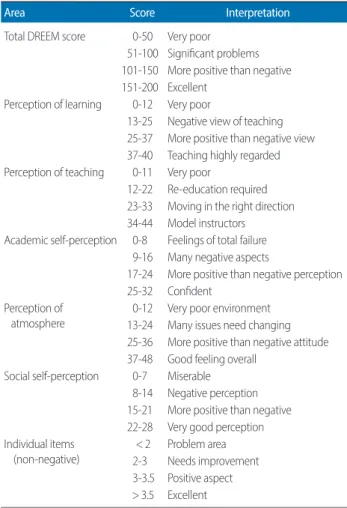
Table 1. Score interpretation of mean subscale and total DREEM scores
Area Score Interpretation
Total DREEM score 0-50 Very poor 51-100 Signiicant problems 101-150 More positive than negative 151-200 Excellent
Perception of learning 0-12 Very poor
13-25 Negative view of teaching 25-37 More positive than negative view 37-40 Teaching highly regarded Perception of teaching 0-11 Very poor
12-22 Re-education required 23-33 Moving in the right direction 34-44 Model instructors Academic self-perception 0-8 Feelings of total failure
9-16 Many negative aspects
17-24 More positive than negative perception 25-32 Conident
Perception of atmosphere
0-12 Very poor environment 13-24 Many issues need changing 25-36 More positive than negative attitude 37-48 Good feeling overall
Social self-perception 0-7 Miserable 8-14 Negative perception 15-21 More positive than negative 22-28 Very good perception Individual items
(non-negative)
< 2 Problem area 2-3 Needs improvement 3-3.5 Positive aspect > 3.5 Excellent
P< 0.05 was considered signiicant in this study. he interpre-tation of the mean scores for total DREEM scores, sub-domains, and individual DREEM items was based on Table 1 [2].
Ethics approval
Prior to data collection, this study was submitted to the Saint Louis University Research Ethics Committee (Protocol No. 2016-014) for approval. Only those who signed the informed consent were given questionnaires.
Results
he total average DREEM score from the students’ evalua-tions was 121.26 ± 20.18 out of a total of 200 points, which can be interpreted as a ‘more positive than negative’ perception of the learning environment at the academic institution. Mean scores for all students were also calculated for the sub-domains of perception of learning (27.67± 5.11/40), perception of teach-ing (26.70 ± 4.84/44), perception of the academic atmosphere (29.28 ± 5.59/48), academic self-perception (21.06 ± 4.32/32), and social self-perception (16.55± 3.25/28). Table 2 shows that, generally, nursing students had higher mean scores in the sub-domains of perception of learning, perception of teaching, and social self-perception. Among them the diferences in the mean sub-domain scores for perception of learning and perception of teaching between the two student groups were statistically signiicant In contrast, the mean scores of medical laboratory science students in academic self-perception were higher, but the diference was not statistically signiicant.
Table 3 shows that female nursing students had the highest mean total DREEM scores and highest mean scores in per-ception of learning, perper-ception of atmosphere, and social self-perception, while female medical laboratory science students
Table 2. Mean subscale and total DREEM score of medical laboratory sci-ence and nursing students at Saint Louis University, Baguio City, Philip-pines from April to May, 2016
Sub-domain Medical laboratory
science (n = 242)
Nursing
(n = 99) P-value
Perception of learning 27.20 (4.62) 28.80 (6.02) 0.009 Perception of teaching 26.36 (4.32) 27.56 (5.85) 0.037 Academic self-perception 21.13 (4.14) 20.88 (4.74) 0.643 Perception of atmosphere 29.34 (5.17) 29.15 (6.53) 0.779 Social self-perception 16.35 (2.94) 17.03 (3.89) 0.078 Total DREEM score 120.38 (17.95) 123.41 (24.77) 0.270
Values are presented as number (%).
DREEM, Dundee Ready Education Environment Measure.
Table 3. Mean subscale and total DREEM score of medical laboratory science and nursing students at Saint Louis University, Baguio City, Philippines from April to May, 2016 by gender
Subscale Medical laboratory science Nursing F-value P-value
Male (n = 74) Female (n = 169) Male (n = 32) Female (n = 66)
Perception of learning 26.18 (4.45) 27.62 (4.64) 28.28 (5.65) 29.15 (6.19) 4.24 0.006 Perception of teaching 25.81 (3.85) 26.57 (4.51) 27.71 (6.04) 26.70 (4.84) 2.08 0.102 Academic self-perception 20.39 (3.96) 21.44 (4.18) 20.34 (5.13) 21.17 (4.59) 1.34 0.260 Perception of atmosphere 28.46 (4.91) 29.69 (5.26) 27.97 (6.48) 29.82 (6.53) 1.63 0.182 Social self-perception 16.07 (2.86) 16.48 (2.96) 16.66 (4.31) 17.20 (3.73) 1.46 0.226 Total DREEM score 116.91 (17.05) 121.80 (18.17) 120.66 (24.40) 125.26 (25.07) 1.99 0.115
Values are presented as number (%).
DREEM, Dundee Ready Education Environment Measure.
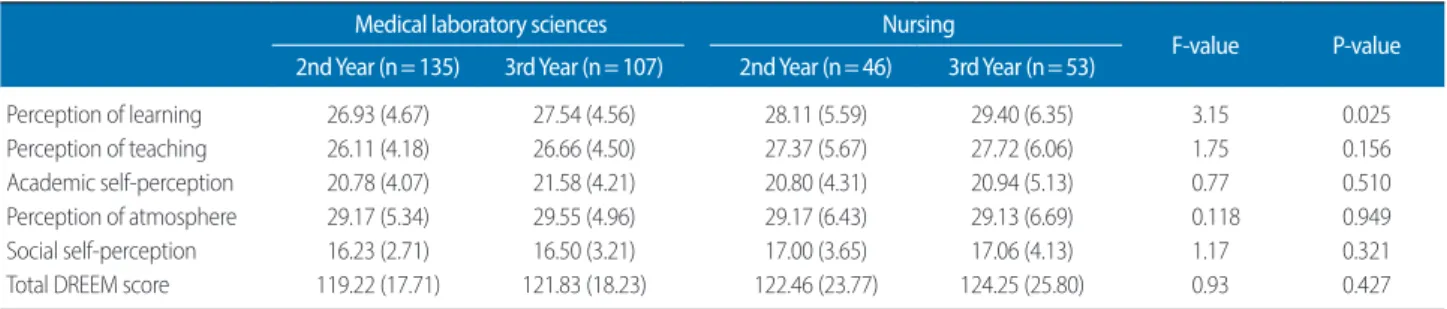
Table 4. Mean subscale and total DREEM score of medical laboratory science and nursing students of Saint Louis University, Baguio City, Philippines from April to May, 2016 by year level
Medical laboratory sciences Nursing
F-value P-value
2nd Year (n = 135) 3rd Year (n = 107) 2nd Year (n = 46) 3rd Year (n = 53)
Perception of learning 26.93 (4.67) 27.54 (4.56) 28.11 (5.59) 29.40 (6.35) 3.15 0.025 Perception of teaching 26.11 (4.18) 26.66 (4.50) 27.37 (5.67) 27.72 (6.06) 1.75 0.156 Academic self-perception 20.78 (4.07) 21.58 (4.21) 20.80 (4.31) 20.94 (5.13) 0.77 0.510 Perception of atmosphere 29.17 (5.34) 29.55 (4.96) 29.17 (6.43) 29.13 (6.69) 0.118 0.949 Social self-perception 16.23 (2.71) 16.50 (3.21) 17.00 (3.65) 17.06 (4.13) 1.17 0.321 Total DREEM score 119.22 (17.71) 121.83 (18.23) 122.46 (23.77) 124.25 (25.80) 0.93 0.427
Values are presented as number (%).
had a higher mean score on academic self-perception, and male nursing students had the highest mean score on percep-tion of teaching. Male medical laboratory science students had the lowest mean total DREEM score and lowest mean scores in perception of learning, perception of teaching, aca-demic self-perception, and social self-perception. Male nurs-ing students had the lowest mean score in perception of atmo-sphere. However, only the diference in mean score in percep-tion of learning was statistically signiicant.
Table 4 shows that the mean total DREEM scores were high-er among third-year students than second-year students in both courses. The highest average total DREEM score and highest average scores in perception of learning, perception of teaching, academic self-perception, and social self-perception were provided by third-year nursing students. he lowest mean total DREEM score and lowest scores in perception of learn-ing, perception of teachlearn-ing, and social self-perception were provided by second-year medical laboratory science students, while the lowest mean scores in academic self-perception and perception of atmosphere were provided by second-year nurs-ing students and third-year nursnurs-ing students, respectively. Only the mean score in the perception of learning among the stu-dents was signiicantly diferent.
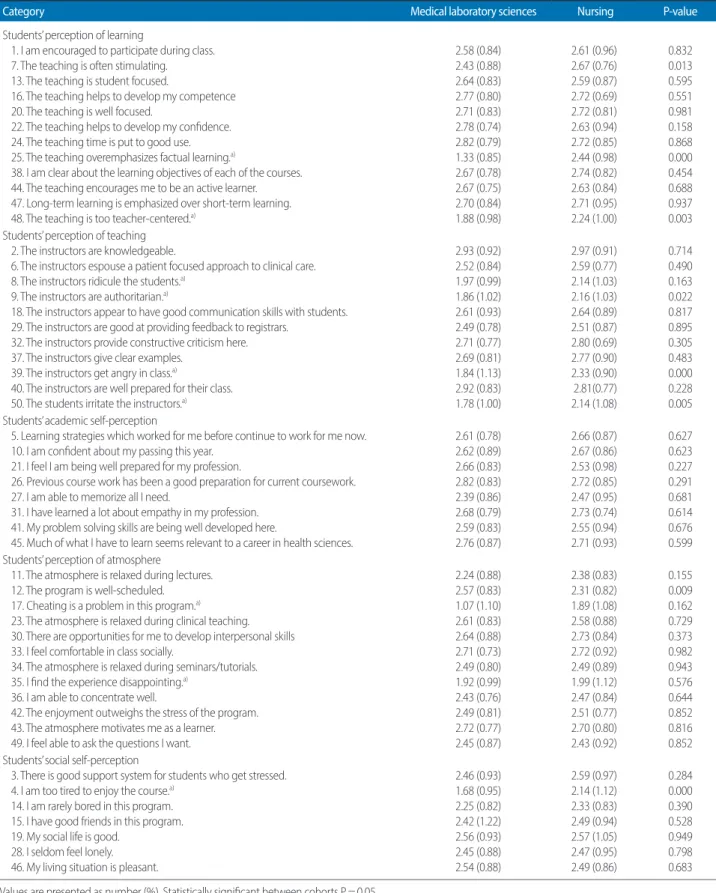
Table 5 shows the mean DREEM scores of medical labora-tory science and nursing students per item. he scores ranged from 1.07 ± 1.10 to 2.44 ± 0.98 for negative items (scores were reversed) and 2.25 ± 0.82 to 2.97 ± 0.91 for positive items, in-dicating that the students perceived these items as either prob-lem areas or aspects that needed improvement. Furthermore, there were 7 negatively stated items rated by nursing students, which had mean scores greater than 2. Since the scores were reversed, a mean score of > 2 is interpreted as a problem area. Hence, a lower score on negatively stated items is desirable [2]. Medical laboratory science students and nursing students had signiicantly diferent scores on item 7 (‘teaching is oten stim-ulating’), item 25 (‘over-emphasis on factual learning’), item 48 (‘teaching is too teacher-centered’), item 9 (‘instructors are authoritarian’), item 39 (‘the instructors get angry in class’), item 50 (‘the students irritate the instructors’), item 12 (‘the program is well-scheduled’), and item 4 (‘being too tired to enjoy the course’). For negatively stated items, nursing stu-dents had a mean score greater than 2 (scores are reversed), implying a less desirable response compared to medical labo-ratory science students.
Discussion
Overall, medical laboratory science students and nursing students did not have signiicantly diferent perceptions of their academic learning environments. The mean total DREEM
scores of the students were ‘more positive than negative.’ his means that the academic learning environment can still be improved to benefit the students. Among the different sub-domains, the mean scores on the perception of learning and perception of teaching signiicantly difered between medical laboratory science and nursing students. When grouped into gender and year level, only the sub-domain ‘perception of learn-ing’ was considered to be signiicantly diferent (Tables 3, 4).
he diferences in DREEM scores may be attributed to sev-eral factors related to the curriculum, faculty proile, subjects offered, and types of academic requirements. Since medical laboratory science students and nursing students do not have similar academic requirements, especially in third year, the diferences in the mean scores under perception of learning may be attributed to academic requirements ‘per se’.
Diferences in the total DREEM scores and mean scores for sub-domains between male and female students have been re-ported in other studies [3,8-10] although the results have not been consistent regarding whether either gender has higher mean scores for the total score, sub-domain scores, or individ-ual DREEM item scores. One possible explanation, though, is the difference in the population of female students in these health professions courses compared to males. Similar to what has been found in other studies at several academic institutions, there were more females enrolled in health science courses compared to males in this study [2-4,9-11]. Having more fe-male students in a course may cause the academic environ-ment to be more suited to women [10], which leads to a ‘femi-nized’ assessment design and implementation in the tertiary level [12]. However, male chiropractic students had higher to-tal DREEM scores and higher scores in the ive sub-domains, and this population was comprised more of males than females [3]. his inconsistency in the scores may be related to the gen-der proile of the respondents and may warrant further study.
he diferences in the perception of male and female medi-cal laboratory science and nursing students in this study could also be related to diferences in their learning styles. Male nurs-ing and midwifery students have been reported to be less re-lective observers than females, but more borderline divergers and accommodators in their learning style [13]. However, male physiotherapy students were reported to be more assim-ilators and convergers, while females were described to be ac-commodators and divergers [14]. Unfortunately, there is no available data on the learning styles of medical laboratory sci-ence students. hese data from other studies imply that learn-ing styles may be independent of gender and course.
third-Table 5. Mean scores of medical laboratory science and nursing students from Saint Louis University, Baguio City, Philippines from April to May, 2016 for each Dundee Ready Education Environment Measure item
Category Medical laboratory sciences Nursing P-value
Students’ perception of learning
1. I am encouraged to participate during class. 7. The teaching is often stimulating. 13. The teaching is student focused.
16. The teaching helps to develop my competence 20. The teaching is well focused.
22. The teaching helps to develop my conidence. 24. The teaching time is put to good use. 25. The teaching overemphasizes factual learning.a)
38. I am clear about the learning objectives of each of the courses. 44. The teaching encourages me to be an active learner. 47. Long-term learning is emphasized over short-term learning. 48. The teaching is too teacher-centered.a)
2.58 (0.84) 2.43 (0.88) 2.64 (0.83) 2.77 (0.80) 2.71 (0.83) 2.78 (0.74) 2.82 (0.79) 1.33 (0.85) 2.67 (0.78) 2.67 (0.75) 2.70 (0.84) 1.88 (0.98) 2.61 (0.96) 2.67 (0.76) 2.59 (0.87) 2.72 (0.69) 2.72 (0.81) 2.63 (0.94) 2.72 (0.85) 2.44 (0.98) 2.74 (0.82) 2.63 (0.84) 2.71 (0.95) 2.24 (1.00) 0.832 0.013 0.595 0.551 0.981 0.158 0.868 0.000 0.454 0.688 0.937 0.003 Students’ perception of teaching
2. The instructors are knowledgeable.
6. The instructors espouse a patient focused approach to clinical care. 8. The instructors ridicule the students.a)
9. The instructors are authoritarian.a)
18. The instructors appear to have good communication skills with students. 29. The instructors are good at providing feedback to registrars.
32. The instructors provide constructive criticism here. 37. The instructors give clear examples.
39. The instructors get angry in class.a)
40. The instructors are well prepared for their class. 50. The students irritate the instructors.a)
2.93 (0.92) 2.52 (0.84) 1.97 (0.99) 1.86 (1.02) 2.61 (0.93) 2.49 (0.78) 2.71 (0.77) 2.69 (0.81) 1.84 (1.13) 2.92 (0.83) 1.78 (1.00) 2.97 (0.91) 2.59 (0.77) 2.14 (1.03) 2.16 (1.03) 2.64 (0.89) 2.51 (0.87) 2.80 (0.69) 2.77 (0.90) 2.33 (0.90) 2.81(0.77) 2.14 (1.08) 0.714 0.490 0.163 0.022 0.817 0.895 0.305 0.483 0.000 0.228 0.005 Students’ academic self-perception
5. Learning strategies which worked for me before continue to work for me now. 10. I am conident about my passing this year.
21. I feel I am being well prepared for my profession.
26. Previous course work has been a good preparation for current coursework. 27. I am able to memorize all I need.
31. I have learned a lot about empathy in my profession. 41. My problem solving skills are being well developed here.
45. Much of what I have to learn seems relevant to a career in health sciences.
2.61 (0.78) 2.62 (0.89) 2.66 (0.83) 2.82 (0.83) 2.39 (0.86) 2.68 (0.79) 2.59 (0.83) 2.76 (0.87) 2.66 (0.87) 2.67 (0.86) 2.53 (0.98) 2.72 (0.85) 2.47 (0.95) 2.73 (0.74) 2.55 (0.94) 2.71 (0.93) 0.627 0.623 0.227 0.291 0.681 0.614 0.676 0.599 Students’ perception of atmosphere
11. The atmosphere is relaxed during lectures. 12. The program is well-scheduled. 17. Cheating is a problem in this program.a) 23. The atmosphere is relaxed during clinical teaching. 30. There are opportunities for me to develop interpersonal skills 33. I feel comfortable in class socially.
34. The atmosphere is relaxed during seminars/tutorials. 35. I ind the experience disappointing.a)
36. I am able to concentrate well.
42. The enjoyment outweighs the stress of the program. 43. The atmosphere motivates me as a learner. 49. I feel able to ask the questions I want.
2.24 (0.88) 2.57 (0.83) 1.07 (1.10) 2.61 (0.83) 2.64 (0.88) 2.71 (0.73) 2.49 (0.80) 1.92 (0.99) 2.43 (0.76) 2.49 (0.81) 2.72 (0.77) 2.45 (0.87) 2.38 (0.83) 2.31 (0.82) 1.89 (1.08) 2.58 (0.88) 2.73 (0.84) 2.72 (0.92) 2.49 (0.89) 1.99 (1.12) 2.47 (0.84) 2.51 (0.77) 2.70 (0.80) 2.43 (0.92) 0.155 0.009 0.162 0.729 0.373 0.982 0.943 0.576 0.644 0.852 0.816 0.852 Students’ social self-perception
3. There is good support system for students who get stressed. 4. I am too tired to enjoy the course.a)
14. I am rarely bored in this program. 15. I have good friends in this program. 19. My social life is good.
28. I seldom feel lonely. 46. My living situation is pleasant.
2.46 (0.93) 1.68 (0.95) 2.25 (0.82) 2.42 (1.22) 2.56 (0.93) 2.45 (0.88) 2.54 (0.88) 2.59 (0.97) 2.14 (1.12) 2.33 (0.83) 2.49 (0.94) 2.57 (1.05) 2.47 (0.95) 2.49 (0.86) 0.284 0.000 0.390 0.528 0.949 0.798 0.683
year and fourth-year students [15]. he diferences in the mean scores of medical laboratory science and nursing students may be attributed to the nature of the course of study itself. The subjects offered to second-year medical laboratory science students and second-year nursing students are almost the same except for introductory professional courses, that is, introduc-tory clinical chemistry for medical laboraintroduc-tory science students and community and public health for nursing students. Simi-larly, both courses start their clinical duties during their third year. Furthermore, the instructors for non-professional sub-jects in both courses came from allied departments. It was then expected that second-year medical laboratory science students and nursing students should have similar total scores and sub-domain scores on the DREEM instrument. It was also to be expected that the perceptions of third-year medical laboratory science students and third-year nursing students should be diferent, but only the mean score under the sub-domain ‘per-ception of learning’ was statistically signiicantly diferent be-tween the two groups of third-year students (Table 4).
Nursing students identiied more problem areas compared to medical laboratory science students. Most of the problem areas identiied by nursing students were related to their in-structors, although the greatest problem area was identiied as ‘over-emphasis on factual learning’. Some of the perceived prob-lem areas for their instructors were: ‘teaching is too teacher-centered,’ ‘instructors ridicule the students,’ ‘instructors are authoritarian,’ ‘instructors get angry in class,’ and ‘the students irritate the instructors.’
The role of instructors is crucial in the formation of their students [16]. Nursing instructors are faced with several chal-lenges when educating their students to ensure that their stu-dents provide safe patient care in various healthcare settings. These challenges include managing students in the clinical setting to promote safe patient care. However, instructors who lack experience in managing students may display negative behavior. his could be a reason why instructors may display aloof, intimidating, demeaning, arrogant, or unfair attitudes towards their students [17]. Consequently, the behavior of in-structors may cause stress for nursing students.
his study has revealed that there is a need to further im-prove the academic learning environment of students and to address the concerns revealed by the students in this study. Furthermore, this study reports the perceptions of medical laboratory science and nursing students, providing initial data on proiling the educational setting of medical laboratory sci-ence and nursing schools in the Philippines. he information could be used as a basis for improving the academic learning environment of health science students in the country.
Conlict of interest
No potential conlict of interest relevant to this article was reported.
ORCID:
Jonathan M. Barcelo: http://orcid.org/0000-0002-0022-7470Supplementary materials
Audio recording of the abstract. Raw data iles are available.
References
1. Miles S, Swit L, Leinster SJ. he Dundee Ready Education Envi-ronment Measure (DREEM): a review of its adoption and use. Med Teach 2012;34:e620-e634. http://dx.doi.org/10.3109/01421 59X.2012.668625
2. Payne LK. Comparison of students’ perceptions of educational environment in traditional vs. accelerated second degree BSN programs. Nurse Educ Today 2013;33:1388-1392. http://dx.doi. org/10.1016/j.nedt.2012.11.003
3. Palmgren PJ, Chandratilake M. Perception of educational envi-ronment among undergraduate students in a chiropractic train-ing institution. J Chiropr Educ 2011;25:151-163. http://dx.doi. org/10.7899/1042-5055-25.2.151
4. Sunkad MA, Javali S, Shivapur Y, Wantamutte A. Health sciences students’ perception of the educational environment of KLE University, India as measured with the Dundee Ready Educa-tional Environment Measure (DREEM). J Educ Eval Health Prof 2015;12:37. http://dx.doi.org/10.3352/jeehp.2015.12.37 5. Bakhshialiabad H, Bakhshi M, Hassanshahi G. Students’
percep-tions of the academic learning environment in seven medical sciences courses based on DREEM. Adv Med Educ Pract 2015; 6:195-203. http://dx.doi.org/10.2147/AMEP.S60570
6. Marcial DE. Teaching and learning with technology in higher education institutions in the Philippines. PeLS Online J 2012; 3:50-66.
7. Rof S, McAleer S, Harden RM, Al-Qahtani M, Ahmed AU, Deza H, Groenen G, Primparyon P. Development and validation of the Dundee ready education environment measure (DREEM). Med Teach 1997;19:295-299.
9. Hamid B, Faroukh A, Mohammadhosein B. Nursing students’ perceptions of their educational environment based on DREEM Model in an Iranian University. Malays J Med Sci 2013;20:56-63. 10. Brown T, Williams B, Lynch M. he Australian DREEM: evalu-ating student perceptions of academic learning environments within eight health science courses. Int J Med Educ 2011;2:94-101. http://dx.doi.org/10.5116/ijme.4e66.1b37
11. Ousey K, Stephenson J, Brown T, Garside J. Investigating percep-tions of the academic educational environment across six un-dergraduate health care courses in the United Kingdom. Nurse Educ Pract 2014;14:24-29. http://dx.doi.org/10.1016/j.nepr.2013. 06.012
12. Evans C, Waring M. Student teacher assessment feedback pref-erences: the inluence of cognitive styles and gender. Learn Indi-vid Differ 2011;21:271-280. http://dx.doi.org/:10.1016/j.lindif. 2010.11.011
13. D’Amore A, James S, Mitchell EK. Learning styles of irst-year undergraduate nursing and midwifery students: a
cross-section-al survey utilising the Kolb Learning Style Inventory. Nurse Educ Today 2012;32:506-515. http://dx.doi.org/10.1016/j.nedt.2011. 08.001
14. Milanese S, Gordon S, Pellatt A. Proiling physiotherapy student preferred learning styles within a clinical education context. Phys-iotherapy 2013;99:146-152. http://dx.doi.org/10.1016/j.physio. 2012.05.004
15. Mohd Said N, Rogayah J, Haizah A. A study of learning envi-ronments in the Kulliyyah (Faculty) of Nursing, International Islamic University Malaysia. Malays J Med Sci 2009;16:15-24. 16. Strouse SM, Nickerson CJ. Professional culture brokers: Nursing
faculty perceptions of nursing culture and their role in student formation. Nurse Educ Pract 2016;18:10-15. http://dx.doi.org/ 10.1016/j.nepr.2016.02.008