УДК 37.018.43.091.53
Borisov Borislav Dimitrov, Doctor of Economics, Associate professor, IBSDU (Sofia, Bulgaria)
SCIENTIFIC PROVOCATION AS A METHOD FOR STIMULATING THE PARTICIPATION OF DISTANCE LEARNING STUDENTS
The paper reviews provocation as a possible motivating factor to stimulate the interest of distance learning students in the subject studied, to catalyze their research potential and make them active participants in the learning process. It is mostly applicable in the event-oriented learning model. The distance learning model may include a great variety of teaching methods, which, if properly selected, multiply its positive effects and make it a preferable alternative to the conventional learning model. The introduction of a provocative element in the learning process of case studies based on real or hypothetical cases and situations and requiring field research and collection of information as well as the role-playing model relates the educational process to the real-life business and provides the students with the necessary attitude and skills to conduct independent research as well as to gather and process the collected information.
Keywords: distance learning, scientific provocation, case studies, role-playing games.
Let us explain first of all the meaning of the notion “provocation”. It has a negative meaning in the everyday language – this word is perceived as a lie, manipulation, insidiousness and blackmail. Dictionaries explain “provocation” as an incitement and instigation of persons, groups and organizations to actions that may have negative consequences. But it is not so dark at all. The etymology of the word is related to the latin “provocatio” (challenge, appeal) and in the Roman law it meant a means of defense the defendant through appeal to the people. The term “provocation” is also used in medicine for explaining one of the methods for diagnostics. The method of provocation reasonably exists also in the art of theatre, in applied sociology and in politics too. In the science of inventions – heuristics – the provocation is the crucial point in generating untraditional ideas and decisions. That’s why in this paper the provocation will be discussed as a possible method for stimulating the interest of the students towards the studied matters, for catalyzing their explorative flair and manifesting their character as active participants in the teaching process. The provocation could be used both in its bad or good meaning – it depends most of all of the aim of its application.
The distance learning, applied first by using radio, then television, and now the global informational web Internet, has its advantages and disadvantages, compared to the conventional working learning. The advantages are the convenience and the accessibility of everyone to receive the studied materials and tasks in his home or office directly and to send
Ма і і а і ,2011, № 3, Т.2
http://mmi.fem.sumdu.edu.ua/
his decisions and workings out back. Apart from this that form of learning saves time and costs both to the student and to the teacher. The studied materials could be quickly enriched and updated by the teacher. The disadvantages of the distance learning, compared to the conventional forms is the limitation of the direct contact „student – teacher”, in which the teacher could apply different pedagogical methods and approaches, related to the individual characteristics and needs of each student. The emotional influence in team working and the educational effect of cooperative work are strongly limited. Some conventional methods that have proved their efficiency, such as lectures, presentations, dialogue procedures, are also inapplicable. The students may feel isolation, due to impossibility to meet other students, to exchange ideas and to help each other. The cooperation between the student and the teacher can be synchronous (in one and the same time) and asynchronous (in different time), but not face-to-face in the classroom. In that sense the feedback, informing the teacher for the level of studying, for the additional questions and tasks for each student is rather delayed. Last but not least we must have in mind that it is possible for very good students not to present themselves excellent to their teacher only because of their lower extent of computer skills.
The contemporary Web-based courses can be different types, starting by studying in classroom, where apart from traditional way of presenting information, WWW can be used too, passing through studying in classroom, using Web-based activities for learning and concluding with courses in which the information is given only through Internet sites. Apart from these general methods of learning, using affordance of Web-based materials for the courses, there exist a lot of specific approaches in the distance learning with Internet. The great part of these methods, their purpose and realization are fully explained from Bannan and Milheim [1, . 383]. mThe traditional means of learning include mailing of materials for the course, reading of literature as an electronic text and also use of asynchronous means of communication, such as discussion groups and computer conferences.
According to the quoted authors Bannan and Milheim, together with the traditional ones there exist specific Web-based activities, such as saving and sending by mail discussions between the students which are in the multi-users’ dialogues and students’ communication in real time, using these dialogues. The description, the realization and the contents of most of these activities are included in the following table 1.
Table 1 – Specific learning activities in distance education with Internet
Specific activity Way of realization Contents
1 2 3
Delivery of information Sending of information by mail
Distribution of information, related to the course;
Guidelines, describing how the participants may subscribe for one or more multi-users’ dialogues
Cooperation in the course E-mail Asynchronous communication between the students and the teacher;
Support for different questions; Support for evaluation; Management of course’s work
Group communication Discussion groups Asynchronous discussions;
Questions, related to different activities in the course; Possibility for feedback;
Guidelines from the teacher Usage of links to external
learning materials
Links Reading of additional materials;
Access to data bases, guides or software for course activities Usage of links, given
from the students
Supportive links Allow students to publish their own Web-links to the total site of the course
Real-time cooperation Multi-users’ dialogues Support for the innovative ideas with the participation of the students in an interactive environment
Ма і і а і ,2011, № 3, Т.2
Extension of table 1
1 2 3
Group discussion Computer conference Support of the discussions on a given subject; Possibility of textual questions and answers; Creation of trunk structure of the conversations Participation in “the
electronic society”
External participation Participation of people who are not from the same class; Sending of messages, giving themes and examining of personal sites
Copying of dialogues Dialogues for exchange Copying and sending by mail of textual dialogues from the discussion groups or from the computer conference;
Providing of records for later examination and analyses
Access to literature Electronic text Posting of classic and other literature in the web for downloading and reading;
Providing of access to the texts, presentations and other materials;
The possibility of comments allows the students to include their own comments in definite places in the text
Elaboration of Web-materials
Creation of Web-pages Involves the students in the synthesis of Web-based contents; Individual creation of actual Web-materials
Usage of example projects
Publishing of projects Delivery of examples of finished projects and other students’ works;
Used as models, discussions, examinations
Iliana Nikolova distinguishes two models of distance education with Internet –
event-oriented design model and model of a course, based on textual and graphic information,
which may be called theoretical-informative model[2]. The Event-Oriented Design Model as Web-based learning is described from Welsh in 1997 [3]. This model has three main characteristic elements:
asynchronous and synchronous way of learning;
specification of the given aims and the strategy of learning;
determination of informational technologies that are most suitable for achieving these aims.
In the event-oriented model the course is created as a sequence of individual modules. Every module consists of sequence of definite activities and events, each of them directed to conducting a definite task of learning. Apart from this, each event has its definite type. Some events are fully synchronouos, when the whole class and the teacher participate in them. Others are limited synchronous, consisting of two or more participants. Some of the events are
asynchronous, because in them participate only one person.
The event-oriented design model consists of synchronous, limited synchronous and asynchronous model of learning. Compared to the other forms for distance learning, there are not only synchronous or only asynchronous communications between the participants of the course. For example, in some of the older forms of distance learning the student is given some textbooks (or he buys them himself) and then he studies alone before he takes the examination. If he wants to meet the teacher, he needs to travel to a definite school, so he needs money and time. In this sense the event-oriented design model of distance learning with Internet possess possibilities which remove at great extent that kind of difficulties in communication.
The event-oriented design model can be expanded with a model, based on the textual and graphic information. The text and graphics are the most essential elements of the Web-based education that could be included in a distance course. The main characteristic of such courses is that they are a kind of “deliverers” of information. They can replace lectures for a given
Ма і і а і ,2011, № 3, Т.2
http://mmi.fem.sumdu.edu.ua/
subject. The simplest example is the courses in which the communication is conducted by e-mail. More complicate are the courses in which there is a discussion forum or bulletin board. These means of communication allow teachers and students to save and to examine the messages of all participants in the course. In this way the students can return back and see the explanations of the teacher for all previous lessons. The teacher can see all comments of different students and he can comprehend the extent of acquisition of studied material. The students can also read the messages of their colleagues and to help each other. In this way the discussion forum could be defined also as an online classroom. In spite of this, the discussion forum could only help discussions for some problems, but it could not go deeply in a given theme. That’s why such forums must be applied only as an additional means to the distance course, but it could not be the essence and the aim of the course.
The scientific-provocation model is suitable for the event-oriented model. It could be applied by assigning a case, describing real situation, a case, describing a hypothetic situation or a case, based on insufficient or even incorrect information. An example of a case, based on a real situation, can be the description of the crisis with the cleanness in Sofia. The students, studying law, finance, public administration or other discipline, including in its subject local management, could be given the question is it correct the government to support the capital in solving the problem with finding a place for bailment of wastes or is it correct the budget to support Sofia financially in implementing new technologies for bailment of wastes and is it possible some of the incomes from the corporate taxes to be ceded for solving that problem. The provocation here is in the social opinion, coming from a lot of politicians’ speeches that can incline students from the correct answer.
The formulation of a case, based on an unreal, hypothetic situation is at first sight an easier task, because it is not necessary to apply concrete examples, but in that case the described situation must be more complicated and must suppose alternatives in decisions. It must direct to additional investigations too. Including a provocative element in the case could be achieved by the way of presenting the situation, by the different points of view of the participants or by the task itself.
A case, based on unreal or partially incorrect information aims to provoke deeper research of the problem by the students and discovering the incorrect facts. For example, the students can be given a task to explain the reasons for including Bulgaria in the third group, i.e. that of the poorly developed countries by the index ”Index of human development” in 2006, deferring to Romania and Turkey. The research would show that this is not so and our country is between the averagely developed countries on 54-th place, followed by Romania – on 60-th place and Turkey – on 92-nd place. The reasons for defining these values are in the components of the index, namely in life expectancy, the level of education and the living standard.
It is clear that the case is the most proper method of learning in applying the scientific-provocation approach. The learning case is a narrative explanation of series of events or situations around a specific problem or a circle of problems. There exist a great variety of problems that could be parts from educational cases. The important thing is that they must be structured in an appropriate way for achieving the educational aims. The perfect way of making it is the outlining of three logical elements of the case – introduction, report and conclusion. In the introduction there must have answers to the following questions:
Where and what is the context the situation passes, what are the facts and the
evidences, characterizing this situation?
Who are the main participants, institutions, bodies and what is their relation to the problem?
What are the interests of every separate participant?
Ма і і а і ,2011, № 3, Т.2
The report answers the following questions:
What kinds of problems in the situation arise as a result from interlacing interests, events and facts?
Which are the events and the factors that contribute to extending the problem?
What is the behavior of every participant in the given situation?
The conclusion must solve the problem by answering the following questions:
What are the results of not solving the problem?
How it can be solved?
What can guarantee the stability of the decision?
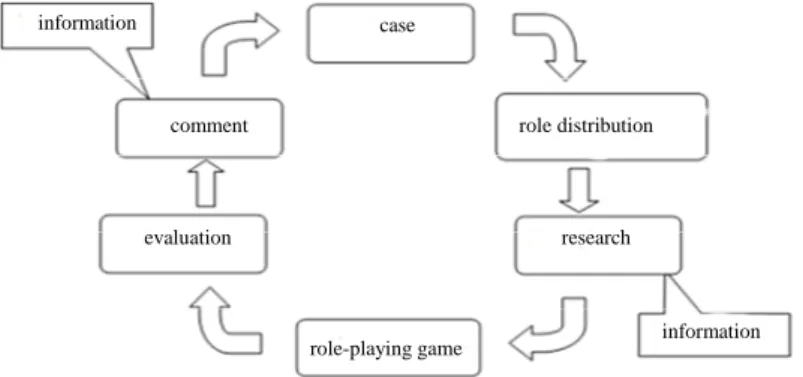
The possibilities of organizing a discussion forum through Internet supposes the use of one more method of learning, that of role-playing games. The distribution of the students in groups and giving an individual task for each of the groups allow students to “dive” in a real situation, to add objectivity to the themes, for which they have any or not enough direct experience. The role-playing games make possible for the students to convince themselves that most of the problems are complicated, concern different interests and that for solving a problem there are a lot of decisions. The scientific-provocation moment in education through role-playing games comes from opposing the participants and the defense of mutually excluded ideas. After the end of the game it is obligatory for the teacher to comment the behavior of each of the participants and the level of the scientific validity of their positions. By doing this he must give the information that escape from the students’ attention. If solving of a case by private study is more suitable when there is only one correct answer, the role-playing games are preferable for situations, supposing a lot of possible decisions. The cycle of education by using role-playing games is described in the following figure (figure 1).
information
comment
case
role distribution
research
information role-playing game
evaluation
Figure 1 – Cycle of the educational process when applying the event-oriented model and
the method of role-playing games
In conclusion we may say that the distance learning may include a great variety of teaching methods, which, if properly selected, multiply its positive effects and make it a preferable alternative to the conventional learning models. Trough introducing a provocation in learning for solving different cases, based on real or hypothetic situations and for cases, requiring private supply of necessary information and also by using the role-playing method the educational process acquires the characteristics of studying by doing, approaches the educational process to practice and creates attitudes and skills in the students for making private researches, data collecting and handling the necessary information.
Ма і і а і ,2011, № 3, Т.2
http://mmi.fem.sumdu.edu.ua/
Ма і і а і ,2011, № 3, Т.2 http://mmi.fem.sumdu.edu.ua/
20
1. Bannan B. Existing Web-Based Instruction Courses and Their Design / B. Bannan, W. D. Milheim // Badrul Khan Web-Based Instruction Educational Technology. – New Jersey : Englewood Cliffs, 1997. – P. 383.
2. И [Е ] / И. Н , Е. К –
Р : http://www-it.fmi.uni-sofia.bg/courses/elearning/OsnovniVuprosi/metodi_ modeli.html.
3. Welsh T.M. An Event-Oriented Design Model for Web-Based Instruction / T.M. Welsh // Badrul Khan Web-Based Instruction Educational Technology. – New Jersey : Englewood Cliffs, 1997.
Б.Д. Б и в
і і і і і і
У є ,
,
. В є
- є . Д є
, , , ,
. Д
, ,
,
, є
, .
К і : і , і , , іі .
Б.Д. Б и в
В ,
,
. О
- . Д
, ,
, , .
Д ,
,
,
, ,
.
К : , , ,