Multi-Channel Electroencephalogram
(EEG) Signal Acquisition and its Effective
Channel selection with De-noising Using
AWICA for Biometric System
B.Sabarigiri #1, D.Suganyadevi #2
#
Sree Saraswathi Thyagaraja College, Pollachi, Tamilnadu, INDIA. Department of Computer Science,
1
2
Abstract— the embedding of low cost electroencephalogram (EEG) sensors in wireless headsets gives improved authentication based on their brain wave signals has become a practical opportunity. In this paper signal acquisition along with effective multi-channel selection from a specific area of the brain and denoising using AWICA methods are proposed for EEG based personal identification. At this point, to develop identification system the steps are as follows. (i) the high-quality device with the least numbers of channels are essential for the EEG signal acquisition and Selecting the equipment and verdict the best portions on the scalp is the primary step. (ii) Scrutiny of the acquired EEG signals and de-noising from EMG, ECG, EOG Signals and power line artifacts using AWICA (iii) Obtain the features from the Enhanced EEG signals by Wavelet Transform (WT) and LS-SVM Classification in the MATLAB Environment. Based on the outcome, there is possibility for implementation of an EEG based Practical biometric system.
Keyword- AWICA Method, LS-SVM Classification, Electroencephalogram (EEG), MATLAB, Wavelet Transform (WT),
I. INTRODUCTION
Biometrics such as Fingerprints, Retina, Voice, Iris and Face are energetically used for Identifying Individuals. At the present time, Electroencephalogram (EEG) biometrics using brain signals have befall fascinating as Personal recognition tools. On behalf of that, to take out EEG signals from human Scalp are indispensable. There are techniques like electroencephalography (EEG), magneto encephalography (MEG), function magnetic resonance imaging (fMRI), and positron emission tomography (PET) have been utilized. Each technique has its own Pros and Cons. To scrutinize brain wave signals, Electroencephalography (EEG) Measurement is non-invasive and inexpensive, highly accurate recording method and it has an enviable property for exceptional time resolution and low cost of instrumentation.
The recorded brain waves that can be Processed (De-Noising, Feature Extraction, Classification and Matching) and used in access control systems (Unlock Doors, Get access to bank accounts, Biometric Passports, Access Computer Data and Entry restrictions) when security is needed. Whereas, using EEG for Biometrics has many advantages, (1) An Effective liveness Detection method [1], (2) EEG has an effective external force detection method to enhance the anti-spoofing capability of the existing biometric system to meet higher security requirement applications [2]. (3) EEG is hard to mimic, (4) EEG can be used as an excellent complementary modality to the existed biometric systems which are not easy to be forged. (5) No one can gain access to the brain waves, because it is safely protected inside the skull. (6) Our brain activities are changeable. So this is first changeable biometrics system [3]. The practice to mine the human brain information provides a new research prototype as EEG-Based Biometry. Idea about the “Pass-Thoughts” using as a biometry in the realistic applications is having various troubles. To launch the EEG based biometric system the price of the equipment, Time taken for the Signal mining from human skull, tolerability of the end user become a very big nuisance. However, So many researches and bulky amount of investments are rising progressively developing EEG Based systems for various applications. At this time, to investigate the feasible traditions to EEG Based Biometric in the real time deployment is highly essential.
based on EEG authentication tool proposed in [10], [11].
III.EEGSIGNAL ACQUISITION
While bearing in mind real time exploitation of EEG based biometrics, Low price devices for signal acquisition, uncomplicated mechanisms, and less time utilization are required. At this point the following devices were compared with diverse parameters.
TABLE I
Low Cost EEG Sensors and Its Comparison [12], [13], [14]
Name of the Device Neuro Sky Mindset EEG Emotive Epoc Neuro headset Enobio No. of Channels 1+1 References 14+2 References 8 (or) 20 Channels
Cost $200 $1500 €3995(8 Channels) €12495(20 Channels)
Type of Signal
Extraction Brain Wave Only
EEG, Gyro, Facial Expression
EEG,EOG,EMG,ECG Signals
PC Connection Available Available Available
Real time Data Exchange
Yes, But There is
no Use in Project Yes Yes
Update Per
Second Only Once
Four Times per
Second 16bit Per Second
Stability Very Low High Very High
Affordability Good Good Good
Time Taken for
Setup the device 15 Seconds 2-10 Mins 2-10 Mins Sampling Rate Up to 512SPS 128SPS 500SPS
Usage in stages Attention,
Meditation Expressive, Short Term Excitement, Meditation, Frustration Boredom, Cognitive Meditation, Excitement, Expressive Programming
Source Less Availability Available Available Artifact Resilience No Yes Yes
Fig 1: 14-Visual Cortex Electrode Position of EEG Epoc Neuroheadset
The EEG Measurements is obtained based on the Emotiv EPOC Research EEG neuroheadset in Fig 4: a 14 channel bio potential sensors with gold-plated connectors offer optimal positioning for accurate spatial resolution (plus CMS/DRL references, P3/P4 Reference Locations). 14 EEG channel names based on the International 10-20 locations are in Fig 1: AF3, F7, F3, FC5, T7, P7, O1, O2, P8, T8, FC6, F4, F8, and AF4.
Fig 2: EEG Epoc Headset
The sampling rate of the emotive EEG headset is 128 Hz on the output (To ensure the precise output values, the Emotiv headset has the internal sampling rate of 2048Hz frequency) with 1.95 µv least significant bit (LSB) voltage resolution, Therefore it is possible to detect VEPs (Which can be beneficial to deduce latencies of electrical impulse exchange representing uniqueness of neural-wiring of subjects brains), since average amplitude for VEP waves falls between 5 to 10 microvolt’s.
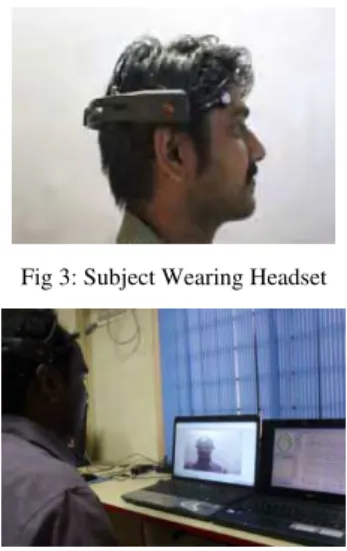
Fig 3: Subject Wearing Headset
Fig 4: Displaying self-Image using webcam and EEG Signals Acquisition through EEG Epoc Headset
device, particularly focus given on the number channels used is 1, 2, 4 and 14.
Fig 5: Single Channel Selection Plotted with Biosignalplot
Fig 6: Two Channel Selection-O1, O2 Electrodes
Fig 7: Four Channel Selection
V. REMOVAL OF ARTIFACTS USING AWICA
A. Artifacts Avoidance
Managing artifacts is to avoid their occasion by issuing suitable directives to users. Instructing individuals to steer clear of generating artifacts during data collection has the benefit that it desires less computational demand among the artifacts handling methods, since it is assumed that no relic is present in the signal. But it has a number of drawbacks.
First there is no leeway to stop our heart during the EEG signal extraction. Even in the case of EOG and EMG activities, it is not easy to organize eye and other progress activities during the data recording in our body. Second the amount of ocular and force activity during the online operation does not exist, and power line interference is also manifest. Third collecting possible amount of data mining will be less due to artifacts presents in the EEG signal, particularly in cases where a consumer has a neurological disability.
Fig 8: EEG Signal Contaminated with Artifacts and ECG Artifacts in EEG.
B. Cancelation of Artifacts
The proposed algorithm [15] combines the valuable ICA knack of sorting out artifacts from brain waves, mutually among the online interference (50Hz) termination achieved by adaptive filtering. Wavelet based de-noising used to extract the low frequency component in order to eliminate the High frequency component the EMG signal. The main steps of hybrid Pre-processing AWICA approach are the following.
Step 1: The extracted EEG data can be processed by adaptive filtering, which removes the power line interference, broken wire contacts and electrode impedance (50Hz and above).
Step2: To apply Wavelet Transform algorithm to 14 channels of the multichannel recordings separately. Finally, set of signals with different frequencies were obtained.
Step3: The base line was removed using wavelet decomposition and the signal was de-noised by wavelets. Step 4: To identify and select the highly correlated artifact components and produce the new data set. Step 5: To transfer the constructed data set to Independent Component Analysis (ICA) Block.
Step 6: To make the signal to be uncorrelated and apply the whitening in order reduces the dimensionality and to light the computational charge.
Step 7: To estimate the independent components and remove ones related to the artifacts.
Step 8: According to the sources ICA would split and cleaned the signals. The correlated EOG, ECG and EMG signals should be classified which will be eliminated using FASTICA.
Step 9: Finally, to perform the wavelet reconstruction by (7) using the non-selected details and cleaned details after ICA step; finally, we obtain the multichannel recordings in which the artifacts are removed.
Fig 9: Default 14-Channel after Artifacts Removal using AWICA Method
VI.FEATURE EXTRACTION AND CLASSIFICATION
A. Feature Extraction
localized in both time and frequency context. Last of all, The Wavelet Transform is an efficient feature extraction from non-stationary signals such as EEGs.
B. Data Reduction
It is reducing the amount of data generated after wavelet transform by without losing the Original in sequence of the signal features. All the data Reduction methods will lose some amount of useful data features on data reduction process. So now we required a new method to reduce the feature set but not leaving any features extracted from the EEG Signals. So, here we applied weighted mean to reduce the value but which is not leaving any feature vectors.
C.EEG Signal Classification
The Classification Performance is depends on Features which is supplied to the classifier. So, Improving the Feature Extraction and Feature Reduction Method will give the accurate classification Results for EEG Signals. The System will give only two results Authenticated/ Not Authenticated. So, The Least Square Support Vector Machine (LS-SVM) had been used.
VII. ANALYSIS AND DISCUSSIONS
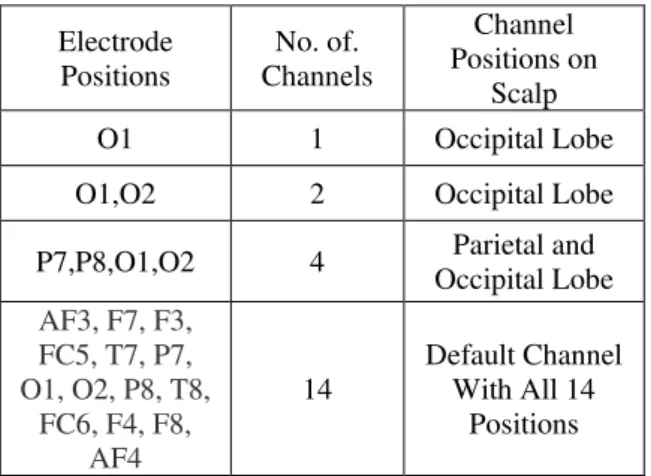
First, Emotiv EPOC neuroheadset EEG signal is a non-invasive system and does not need any surgical involvement. But, it might take relatively long time to set up the Emotiv EPOC headset, which potentially makes the EEG authentication service impractical. Adjusting sensors on the correct locations by avoiding hair is making some troubles. So, Building the adjustable extraction device will solve this issue. In this proposed system requires only sensors, which are placed on a subject's scalp over the parental and occipital lobes, thus eliminating other sensors might moderately resolve the problem. Second, Emotiv EPOC device have 6 surface electrode placements in the parental and occipital lobes portions. Name of the locations are P3, P4, P7, P8, O1 and O2. In this P3 and P4 are reference locations, Therefore in our authentication system we tested with the following combinations (i) O1 (ii) O1 and O2 (iii) P7, P8, O1 and O2 (iv) all the fourteen channels. From the four combinations P7, P8, O1 and O2 channels producing enhanced results. Fig.7 shows that four channel selection without artifacts removal which provides excellent signal quality to the suitable self-image stimuli. Since, the investigational results, visual analysis of the brain wave signals producing unique patterns, hence practical implementation of an EEG-based biometric system is achievable.
TABLE 2:EEGSIGNALS LOCATIONS USED FOR AUTHENTICATION
Electrode Positions No. of. Channels Channel Positions on Scalp
O1 1 Occipital Lobe
O1,O2 2 Occipital Lobe
P7,P8,O1,O2 4 Parietal and Occipital Lobe AF3, F7, F3,
FC5, T7, P7, O1, O2, P8, T8,
FC6, F4, F8, AF4
14
Default Channel With All 14
Positions
TABLE 3: NO. OF CHANNELS AND TAR,TRR AND ACCURACY OF PROPOSED SYSTEM
No. of. Channels 1 2 4 14
Accuracy (%) 95% 93% 97% 96%
True Acceptance Rate(TAR) 100% 100% 100% 100% True Rejection Rate(TRR) 8.33% 5.13% 4.49% 3.84% Time Taken for the Process (In Seconds) 5.09 6.49 7.62 16.98
VIII. CONCLUSION
[4] The electroencephalogram as a biometric. In Canadian Conference on Electrical and Computer Engineering, volume 2, pages 1363– 1366, 2001.
[5] M. Poulos, M. Rangoussi, V. Chrissikopoulos, and A. Evangelou. Parametric person identification from the EEG using computational geometry. volume 2, pages 1005–1008, The 6th IEEE International Conference on Electronics, Circuits and Systems, Pafos, Cyprus, 1999.
[6] K. Ravi and R. Palaniappan. Leave-one-out authentication of persons using 40Hz EEG oscillations. In The International Conference on Computer as a Tool, volume 2, pages 1386–1389, Belgrade, Serbia & Montenegro, 2005.
[7] Muhammad Kamil Abdullah, Khazaimatol S Subari, Justin Leo Cheang Loong and Nurul Nadia Ahmad, “Analysis of Effective Channel Placement for an EEG-Based Biometric System”, EMBS Conference on biomedical Engineering and Sciences, Kualalumpur, Malaysia, 2010 IEEE.
[8] Sabbir Ibn Arman, Arif Ahmed, and Anas Syed, “Cost-Effective EEG Signal Acquisition and Recording System” , International Journal of Bioscience, Bio chemistry and Bio informatics, Vol 2 No 3, Sep 2012.
[9] P. Tangkraingkij, C. Lursinsap, S. Sanguansintukul and T. Desudchit, “Selecting Relevant EEG Signal Locations for Personal Identification Problem Using ICA and Neural Network”, ACIS International Conference on Computer and Information Science, 2009 Eigth IEEE.
[10] A. Riera, A. Soria-Frisch, M. Caparrini, C. Grau, and G. Ruffini. Unobtrusive biometric system based on electroencephalogram analysis. EURASIP Journal on Advances in Signal Processing, 2008:18, 2008.
[11] S. Sun. Multitask learning for EEG-based biometrics. In International Conference on Pattern Recognition, pages 1–4, Tampa, FL, 2008.
[12]
[13]
[14]