___________________________
Corresponding author:
Dragana Ignjatovic Micic
,
Maize Research Institute S. Bajica 1,
Belgrade, Serbia, email:
[email protected]
,phone: + 381 11 37 56 627mob: +381 64 840
6029,fax: +381 11 37 56 707
UDC 575:633.15 DOI: 0.2298/GENSR1301145V
Original scientific paper
POTENTIALLY A NEW SUBTYPE OF THE CYTOPLASMIC MALE STERILITY
S-TYPE IN MAIZE
Jelena VAN ETOVI , Dragana IGNJATOVI -MICI *, Ana NIKOLI ,
Sofija BOŽINOVI , Ksenija MARKOVI , Violeta AN ELKOVI
Maize Research Institute Zemun Polje ,Zemun Polje – Belgrade,Serbia
Vancetovic J., D. Ignjatovic Micic, A. Nikolic, S. Bozinovic, K.Markovic and
V. Andjelkovic (2013):
Potentially a new subtype of the cytoplasmic male
sterility S-type in maize. Genetika, Vol 45, No. 1, 145-151.
In gene-bank maize collection of Maize Research Institute Zemun Polje (MRI)
two samples with untypical mtDNA profile for cytoplasmic male sterility (cms)
were identified. These two samples showed typical multiplex polymerase chain
reaction (PCR) band for cms-S, but also an additional band of unknown nature. It
is assumed that the additional band is the result of a rearrangement of the two
mitochondrial episomes characteristic for the cms-S in maize or a duplication of
the part of cms-S mitochondrial genome. Additional field and laboratory
experiments are necessary in the further lightening of this phenomenon.
Key words: cytoplasmic male sterility, episom, multiplex PCR reaction,
MRI gene-bank
INTRODUCTION
In maize (Zea mays L.) three types of cytoplasmic male sterility (cms) are known: C, T and
S-type. Among them, S-type is the most abundant (
BECKETT, 1971,
VANCETOVICet al., 2010) and
with the highest number of sources (
BECKETT, 1971). Also, this type is the least stabile one
(
WEIDERet al., 2009), i.e. it shows the largest degree of the late break of sterility. This is
probably the consequence of the presence of higher number of alleles on the restorer-of–fertility
Rf3 loci or the 2L chromosomal region tightly linked with Rf3 loci (
GABAY-
LAUGHNANet al.,
2004) as well as of spontaneous nuclear and cytoplasmic mutations on some other loci that cause
reversion of sterile to fertile plants (
GABAY-
LAUGHNANet al, 1995).
for the three types of cms (
BECKETT, 1971). This procedure, however, requires a lot of field
work, time, and the obtained data are not completely reliable. However, a method of multiplex
polymerase chain reaction (PCR) developed for this purpose by
LIUet al. (2002) is more reliable
and much faster (
IGNJATOVI-
MICIet al., 2006).
In the MRI maize gene-bank additional 85 new sources of cms-S among local varieties
from the Ex Yugoslav territories were revealed by the method of multiplex PCR. Apart from
these, two new potential sources of cms-S were discovered in two varieties. They were
characterized with a regular PCR band for cms-S and with an additional band not characteristic
for either known type of cms in maize (
VANCETOVICet al., 2010). For the confirmation that this
is a truly new phenomenon, it was necessary to analyze all known sources of cms-S together
with these two samples by the multiplex PCR method. If the expected differences were revealed,
they would make an argument for potential existence of a new cms-S subtype in maize.
The aim of this research was to confirm the existence of a new cms-S subtype in two
local varieties from Ex Yugoslav teritory.
MATERIALS AND METHODS
In this work 24 sources of cms-S (provided by the courtesy of Marty Satch, the director of the
Maize Genetics Cooperation Stock Center, Illinois, Urbana) and two sources from Ex Yugoslav
collection of MRI, that previously have shown an extra band in the PCR analysis, were analyzed
(Table 1). The sterility rating, i.e. LB-late break of sterility according to the Cornell Cytoplasms
stocks data, for both standard and Ex Yugoslav samples according to field experience are also
given in Table 1.
The sterility rating scale used was according to
BECKETT's (1966):
1 = Completely male sterile, no anthers exerted
2 = Male sterile, sterile anthers exerted
3 = Partially fertile, subnormal anthers, some pollen shed, number of anthers highly variable
4 = Slightly subnormal anthers, more than 75% of the anthers exerted, pollen shed
5 = Normal anthers exerted at or before silking time
The first Ex Yugoslav variety was represented by the progeny of one ear (cytoplasm is
inherited only maternally, so in the next generations it is uniform), and the second variety by the
progenies of two ears. Sources from the Ex Yugoslav collection were found during the
experiment for search of hypothetical restorer cytoplasm for ms10 gene in maize (
VIDAKOVICet
al, 2002). They were revealed by crossing of single plants from the varieties, and than
backcrossing of progenies from these crosses with heterozygous ms10/Ms10 tester. For the final
backcross progenies with more than 1/3 of sterile plants it was supposed that they contain some
type of cms, since expected frequency of ms10/ms10 sterile plants was 1/8. (For the progenies
with eventual restorer cytoplasm, expectation was that they would be a 100% fertile).
All these samples were analyzed by multiplex PCR method (
LIUet al, 2002). Three
samples that had known types of cms (S, T and C) were included as controls. DNA extraction
was done from six seeds per genotype with CTAB buffer. The PCR reaction mix contained 1 x
PCR buffer, 1.5 mM MgCl
2, 0.8 mM dNTP, 50 pmol of CMSSF, CMSSR, CMSTF, CMSTR,
final elongation 72°C/5 min. The amplified fragments were separated on 1.5% agarose gels,
stained with ethidium-bromide and photographed.
Table 1. List of analyzed genotypes, their classification (according to BECKETT, 1966) and sterility rating
RESULTS
All the sources of cms-S obtained from the Maize Genetics Cooperation Stock Center,
Urbana, Illinois, have shown the characteristic multiplex PCR band for cms-S (Figure 1). On the
other hand, the two Ex Yugoslav sources have shown another band, non-characteristic for any
type of cms in maize. In the second Ex Yugoslav source, the progeny of the first ear did not give
the additional band, implying the existence of cytoplasmic variability in this variety. It should be
# Genotype Type of cms Sterility rating (indicating LB-late break of male sterility)
1 Control for cmsS S 1
2 Control for cmsT T 1
3 Control for cmsC C 1
4 B-14AHt ML S 3-4
5 B-37Ht CA Probably S 1
6 B-37Ht D Unclassified 1-2
7 B-37Ht EK Probably S 1
8 B-37Ht G S 1
9 B-37Ht J S 1
10 B-37Ht K Probably S 1
11 B-37Ht ME Unclassified 1
12 B-37Ht MY Probably S 1
13 B-37Ht PS Probably S 1
14 B-37Ht S S 1
15 B-37Ht SD Probably S 1
16 A-619 B Unclassified 5
17 A-619 F Probably S 3
18 A-619 H Probably S 3
19 A-619 R S 3-4
20 A-619 VG S 4
21 A-619 W Probably S 4
22 A-632 I S 4
23 A-632 IA Probably S 3-4
24 A-632 M S 1-4
25 A-632 TA Probably S 3-5
26 A-632 TC Two sources of cytoplasm 4
27 Co-220 L Probably S 4
28 OP Ex Yu 1/1 ? 1
29 OP Ex Yu 2/1 ? 1
noted that the typical S-band in the known sources, as well as in the progeny of the first ear of
the second Ex Yugoslav variety, was much stronger than in the two potentially new sources.
Figure 1.PCR amplification of CMS types with specific primers for C, T and S cytoplasm. Lanes 1, 2 and 3 – controls for CMS_S, CMS_C and CMS_T; Lanes 4 to 13 - CMS-S genotypes from Maize Genetics Cooperation Stock Center (A-619 H, A-619 R, A-619 VG, A-619 W, A-632 I, A-632 IA, A-632 M, A-632 TA, A-632TC, Co-220 L); Lanes 14, 15 and 16 – genotypes from MRI gene bank (OP Ex Yu 1/1, OP Ex Yu 2/1, OP Ex Yu 2/2). Amplification products giving a new profile with two bands (a new CMS-S sub- type?) are shown in lines 14 and 16.
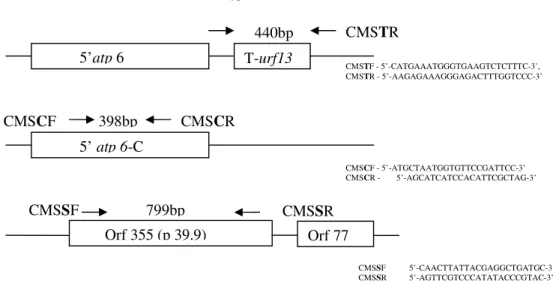
Figure 2. mtDNA recombinant regions of T, C and S cytoplasm types and the binding sites of the specific primers (taken from LIU et al., 2002)
5’
atp
6
T-
urf13
CMS
T
R
CMSTF - 5’-CATGAAATGGGTGAAGTCTCTTTC-3’, CMSTR - 5’-AAGAGAAAGGGAGACTTTGGTCCC-3’
5’
atp 6
-C
398bp
CMS
C
F
CMS
C
R
CMSCF - 5’-ATGCTAATGGTGTTCCGATTCC-3’ CMSCR - 5’-AGCATCATCCACATTCGCTAG-3’
Orf 355 (p 39.9)
Orf 77
799bp
CMS
S
F
CMS
S
R
CMSSF 5’-CAACTTATTACGAGGCTGATGC-3’ CMSSR 5’-AGTTCGTCCCATATACCCGTAC-3’
DISCUSSION
Since cms in plants is coded by genes that are located on the mitochondrial DNA
(
SCHNABLEand
WISE, 1998), different PCR product profiles with specific cms-S primers in two
varieties indicate changes in mitohondrional genome that could have caused occurrence of a new
source of cms-S. The maize CMS-S mitochondrial genome appears to exist mostly as linear
molecules (
SCHARDL
et al, 1984;
ALLENet al, 2007). In cms-S mitochondria, the genome
structure is complicated by the existence of two linear double-stranded DNA episomes, S1 (6397
bp) and S2 (5453 bp) (
LEVINGSand
SEDEROFF, 1983;
PAILLARDet al, 1985). These episomes
have identical terminal inverted repeats (IRs) of 208 bp (
LEVINGS and
PRING, 1979).
Recombination between the episomal and integrated IRs results in the rearrangement of the
mitochondrial genome that can cause the reversion of sterile to fertile plants (
SCHARDLet al,
1984). A similar process could be the reason for additional PCR band in the two varieties. The
explanation includes the mode of PCR reaction of the two progenies of the second variety.
Namely, the first ear progeny had the profile characteristic for the cms-S, while the second ear
progeny profile was modified with additional band that could arise from the rearrangement of the
mitochondrial genome in this variety.
Typical S-band was much stronger in the known sources compared to the S band in the
two varieties. At the same time the S band in the two varieties was about the same strength as the
additional band. It was shown that the repeated region R contains two himeric open reading
frames (ORFs), i.e. ORF355 and ORF77 in cms-S (
ZABALAet al, 1997).
Expression analysis
identified R region and ORF77 as the most important candidate gene for S-CMS (
ZHANGet al.,
2003;
MATERAet al., 2011
).
The binding sites of the specific primer pairs are located within
ORF355 sequence (Figure 2). Since the primer binding sites are highly specific and the band
intensities are similar it could be assumed that the PCR profile is the consequence of the
duplication of a smaller part of the cms-S mitochondrial genome. More ever, as the additional
band is not characteristic for C or T-type of cms, we exclude the possibility that this result is the
consequence of the mixture of two known types of cms. In the work of
LIUet al. (2002), minor
molecular differences between cms subtypes did not affect primer specificity or PCR product
lengths, as all tested lines matched the pattern of the respective B37 reference material. These
results support our speculation on some more severe genetic rearrangements within mtDNA.
In any case, it is necessary to test these potentially new sources in the field with the Rf
genotypes for cms-T, S and C, in order to confirm affiliation of the two sources to cms-S. If this
would be the case, it would be the confirmation of a new subtype within the cms-S. On the other
hand, if these genotypes do not belong to any known type of cms in maize, there is a possibility
that a new cms type is discovered, although this assumption is less probable. Besides, additional
molecular research on the mitochondrial genome of these two sources is necessary.
ACKNOWLEDGEMENT
This work was supported by Ministry of Education and Science, Republic of Serbia, through the
project TR31028
.
Received August 18th, 2012
REFERENCES
ALLEN, J.O., C.M. FAURON, P. MINX, L. ROARK, S. ODDIRAJU, G.N LIN, L. MEYER, H. SUN, K. KIM, C. WANG, F. DU, D. XU, M.
GIBSON, J. CIFRESE, S.W. CLIFTON, K.J. NEWTON (2007): Comparisons among two fertile and three male-sterile mitochondrial genomes of maize. Genetics177:1173–1192.
BECKETT, J.B. (1971): Classification of male-sterile cytoplasms in maize (Zea mays L.). Crop Sci 11: 724-727.
GABAY-LAUGHNAN, S., G. ZABALA., J.R. LAUGHNAN (1995): S-type cytoplasmic male sterility in maize. In: The maize handbook (Eds. Freeling M. and Walbot V.), ed., Springer, USA, NEWYORK.
GABAY-LAUGHNAN, S., C.D. CHASE, V.M. ORTEGA, L. ZHAO (2004): Molecular-genetic characterisation of CMS-S restorer-of-fertility alleles identified in mexican maize and teosinte. Genetics 166: 959-970.
IGNJATOVI -MICI , D., A. NIKOLI , S. MLADENOVI DRINI , J. VAN ETOVI ANDV. LAZI -JAN I (2006): Identification of sterile cytoplasm (CMS) in maize by using specific mtDNA primers. Genetika 38 (3): 227-233.
LEVINGS, III S., D.R., PRING (1979): Molecular basis of cytoplasmic male sterility in maize. In: Physiological genetics, Academic press, New York, USA.
LEVINGS, C.S., R.R. SEDEROFF (1983): Nucleotide sequence of the S-2 mitochondrial DNA from the S cytoplasm of maize. Proc Natl Acad Sci USA 80: 4055-4059.
LIU, Z., S.O. PETER, M.U. LONG (2002): A PCR assay for rapid discrimination of sterile cytoplasm types in maize. Crop Sci
42: 566-569.
MATERA, J.T., J. MONROE, W. SMELSER, S. GABAY-LAUGHNAN, K.J. NEWTON (2011): Unique Changes in Mitochondrial Genomes Associated with Reversions of S-Type Cytoplasmic Male Sterility in Maizemar. PLoS ONE 6(8): e23405.
PAILLARD, M. R.R. SEDEROFF, C.S. LEVINGS III (1985): Nucleotide sequence of the S-1 mitochondrial DNA from the S cytoplasm of maize. EMBO J 4: 1125–1128.
SCHARDL, C.L., D.M. LONSDALE, D.R. PRING, K.R. ROSE (1984): Linearization of maize mitochondrial chromosomes by recombination with linear episomes. Nature 310: 292–296.
SCHNABLE, P.S., R.P. WISE (1998): The molecular basis of cytoplasmic male sterility and fertility restoration. Trends Plant Sci 3: 175-180.
VANCETOVIC, J., M. VIDAKOVIC, D. IGNJATOVIC-MICIC, A. NIKOLIC, K. MARKOVIC, V. ANDJELKOVIC (2010): The structure of sterile cytoplasm types within a maize genebank collection. Russ J Genet 46: 836-840.
VIDAKOVIC, M., M. VIDAKOVIC, J. VANCETOVIC (2002): A new search for restorer cytoplasm: The restorer cytoplasm for the gene ms10 most probably does not exist in maize. J Hered 9: 444-447.
WEIDER, C., P. STAMP, N. CHRISTOV, A. HUSKEN, X. FOUEILLASSAR, K.-H. CAMP, M. MUNSCH (2009): Stability of cytoplasmic male sterility in maize under different environmental conditions. Crop Sci 49: 77-84
ZABALA, G., S.GABAY-LAUGHNAN, J.R., LAUGHNAN (1997): The nuclear gene Rf3 affects the expression of the mitochondrial chimeric sequence R implicated in S-type male sterility in maize. Genetics 147: 847–860.
ZHANG, S.Q., K.D. ZHANG, H.L. XIAO, Y.L. ZHENG (2003): Expression analysis of orf77 and R region in mitochondrial DNA of S type CMS maize. Yi Chuan Xue Bao. (Journel of Genetics and Genomics) 30:277-82.