Evaluation of Morphological Diversity, Mitotic
Instability and Fertility in Tritipyrum
Zolfaghar SHAHRIARI1,2*, Mohammad Taghi ASSAD1, Hosein Shahsavand HASANI1 and Bahram HEIDARI1
1
Shiraz University, Department of Crop production and Plant Breeding, College of Agriculture, Shiraz,
IRAN. Corresponding Author: Email: [email protected]
2
General Department of Education, Fars province, IRAN
Abstract
Tritipyrum is prone to mitotic instability, stiff straw and low fertility. A complete randomized design was used to evaluate morphological diversity, fertility and grain yield of 7 new synthetic Tritipyrum lines and their F1 offspring’sin a cross with bread
wheat. Fertility, harvest index, biological yield, 1000-grains weight (TGW) and grain yield of Tritipyrum derived genotypes were significantly lower than bread wheat and Triticale. The morphology of Tritipyrum was found to be similar with wheat lines and hybridization between Tritipyrum and bread wheat was efficient for developing early maturelines and reducing stiff straw and plant height. Results showed that mitotic instability in small size grains (TGW< 30 g) were significantly higher than heavy grains (TGW> 30 g) in both parental and F2progenies .Euploidyof Tritipyrum derived
genotypes were significantly lower than Triticale and bread wheat. Results suggested that the larger and heavier grains show higher frequency of euploidy and that can be useful for maintenance of the genetic stability of Tritipyrum genotypes. Tritipyrum as a new man made cereal is a good genetic resource for wheat breeding and may complements the role of bread wheat wherever environmental condition is not suitable for wheat cultivation.
Keywords: Amphiploid, Aneuploid, Euploid, Stiff Straw, Tritipyrum
Introduction
The incorporation of alien genetic material from Thinopyrum into common wheat through wide hybridization has increased the genetic diversity for improvement of drought and salinity tolerance, disease resistance and others traits in wheat (Chen Q, 2005; Allahdoo, et al., 2009). A new cereal, Tritipyrum, with a range of
requirements of a successful commercial salt tolerant crop. Tritipyrum is prone to problems which had been observed in early Triticales, e.g. chromosome instability and low fertility (Shahsavand hassani et al., 1998; Shahsavand hassani, et al., 2000; Shahriari, et al., 2012).Tritipyrum exhibited a considerable amount of instability in the form of aneuploidy with a proportion of plants having lost chromosomes and some having addition chromosomes (Shahsavand hassani, et al., 2000).
The assessment of today’s Tritipyrum situation in comparison with Triticale and the possible problems facing breeders in future is not an easy undertaking.Research works on Triticale in recent years show the importance of this first man-made cereal (Oudjehih and Boukaboub, 2000; Tosun, et al., 2003; Akgun and Altindal, 2010). There is no reason that the same success should not be achieved in the case of Tritipyrum (Shahsavand hassani, et al., 2000; Kamyab, et al., 2012, Shahriari, et al., 2012). Therefore, given the importance of new man made crops, the aim of this study were to study the morphological diversity and fertility of Tritipyrum and to evaluate its mitotic instability as compared with triticale and bread wheat.
Materials and Methods
Tritipyrum primary lines including Az/b; La/b; (Ka/b)(Cr/b),F5; (Ma/b)(Cr/b);
(St/b)(Cr/b),F3; Ma/b and Cr/b were selected, based on results of a previous study
that showthese genotypes were the most promising lines for growing conditions in Iran (Shahsavand hassani et al., 2000). Tritipyrum lines were crossed with a bread wheat cultivar named Navid. Spikes of each line of Tritipyrum(2n=6x=42, AABBEbEb) were emasculated, which subsequently pollinated with pollen grains from Navid and their F1 and F2 seeds were produced. SevenTritipyrum genotypes along with their F1
progenies, Triticale 4118 promising line and the cultivar Navidwere sown in a
greenhouse based on a complete randomized design scheme with 3 replicates. The seeds of Triticale and bread wheat collected from the research farm of College of Agriculture, Shiraz University, Iran. Total tiller and fertile tiller number, day to flowering and maturity, plant height at maturity, stiff straw (%of spike shattering), grain yield per plant, 1000-grains weight, grain number per spike, biological yield, harvest index and fertility was recorded for all genotypes. Fertility was
quantifiedbased on the number of grain per spikelet of the main spike (Elneskog Staam and Marker, 2002). For mitotic chromosome counting, the primary Tritipyrum lines and their F2 progenies were evaluated in a complete randomized design. The
Tritipyrum lines and the promising Triticale line were divided into two classes based on their 1000-grains weight (less and higher than 30 g). “Navid” bread wheat cultivar was classified as the heavy grain class (heavier than 30 g). Grains were germinated in Petri dish and then planted in small pots that were allowed to grow to form a proper size for chromosome counting. The chromosome number of all lines was counted in 5 metaphase plates by minor modification of the conventional root tip squash protocol (Tosun, 1999; Oudjehih and Boukaboub, 2000; Oudjehih and Bentouati, 2006). All data were subjected to the analysis of variance using SPSS statistical software. Means were compared using Duncan multiple range test (DMRT) at the 0.05 significance level. The Ward hierarchical cluster analysis (Jaynes, et al., 2003) wasperformed using the means of grain yield, fertility and TGWfor all
Results and Discussion
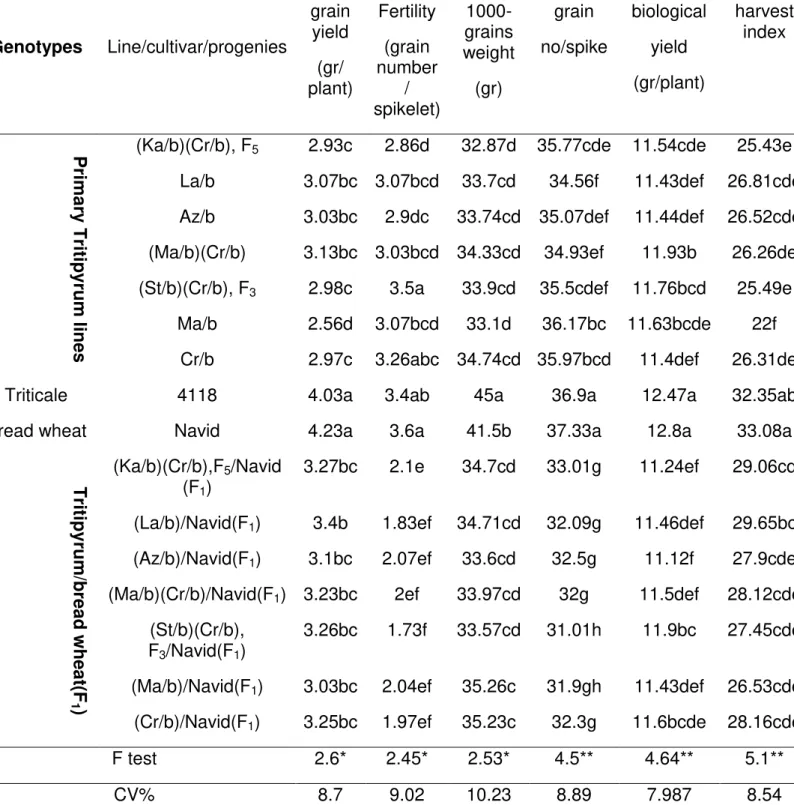
Yield components of hexaploidTritipyrum-derived genotypes and the promising Triticale line (no. 4118) and bread wheat “Navid cultivar” are evaluated(Table 1). Grain yield (p < 0.05) and TGW (p < 0.01) of Tritipyrum derived genotype was significantly lower than Triticale and bread wheat. Fertility of 5 parental
Tritipyrumgenotypes had no significant differences with Triticale (p > 0.05). The fertility of St/b*Cr/b (F3) Tritipyrum genotype was similar to bread wheat and Triticale.
Harvest index and biological yield of Tritipyrum derived genotypes was significantly lower than that of Triticale and bread wheat. The overall results demonstrated that Tritipyrum have reasonable agronomical performance and moderate fertility which is in agree withKing, et al., (1997), Shahsavand hassani, et al., (1998, 2000, 2006) and Shahriari, et al., (2012).
Analysis of variance showed significant differences among Tritipyrum derived
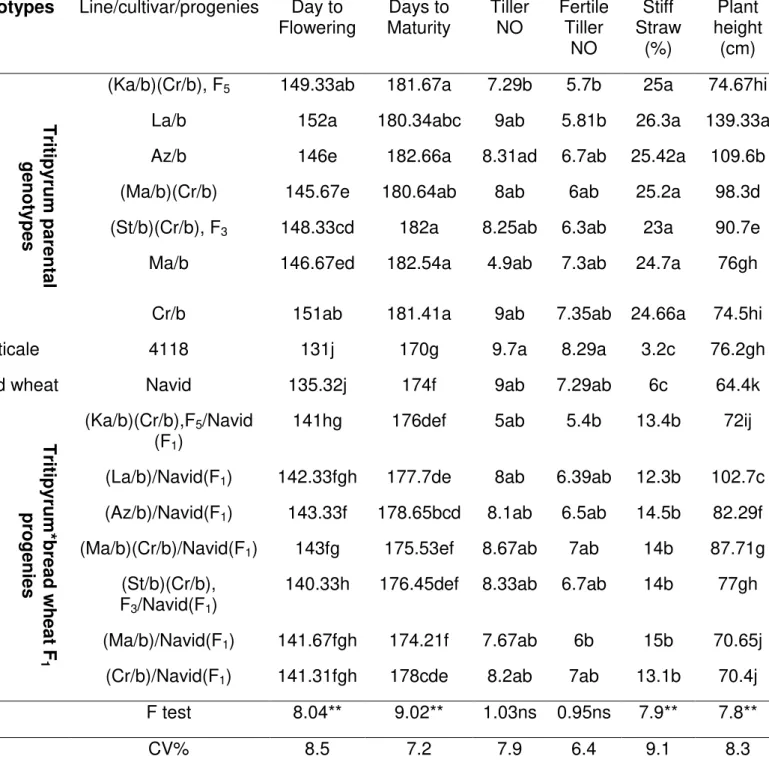
genotypes, bread wheat and Triticale for height, day to flowering, day to maturity and stiff straw (Table2). Plant height variations showed that Tritipyrum derived genotypes were significantly taller than “Navid” semi dwarf bread wheat. There is no significant difference between plant height of some of Tritipyrum derived genotypes and that of Triticale. There was no significant difference between tiller and fertile tiller number of Tritipyrum derived genotypes and that of bread wheat and Triticale. All parental Tritipyrum genotypes were significantly late flowered and late matured than bread wheat and Triticale. There was no significant difference between maturity of four Tritipyrum/bread wheat F1[ Ma/b*Navid(F1), St/b*Cr/b (F3)*Navid(F1),
Ma/b*Cr/b*Navid(F1) and Ka/b*Cr/b(F5)*Navid(F1)] and their parental bread wheat “
Navid cultivar”. Tritipyrum derived genotypes stiff straw was significantly more than that of bread wheat and Triticale. Tritipyrum/wheat F1 offspring’s showed significantly
lower stiff straw than their parental Tritipyrum lines. In general, the morphology of Tritipyrum derived genotypes was predominantly similar to “Navid” Iranian bread wheat (King et al., 1997). The experiment showed that hybridization of bread wheat and Tritipyrum is hopeful for reducing plant height, stiff straw and for early
maturityimprovement.
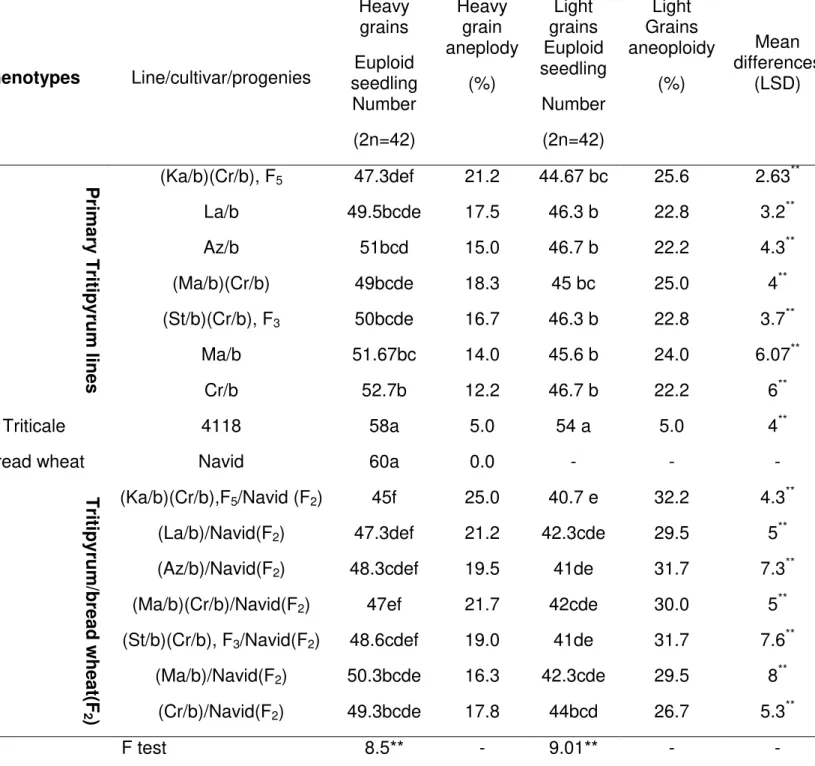
Analysis of variance indicated that the effect of grain weight on mitotic chromosome stability was significant (Table 3). There was a significant difference (p<0.01)
between euploid plants means within light and heavy grains of Tritipyrum derived genotypes and Triticale. Chromosome number investigation of the light-grain class showed that Tritipyrum-derived genotypes were significantly more mitotically instable than Triticale and four F2 progenies showed significantly high mitotic instability than
their parental Tritipyrum genotypes. Euploid seedlings means among heavy grains of all Tritipyrum-derived genotypes (parental Tritipyrum genotypes and F2 progenies)
were significantly lower than Triticale and bread wheat as control. Euploied seedlings means among heavy grains of F2 progenies showed no significant difference with
between grain characteristics and aneuploid frequency (Tsuchiya, 1973; Suarez and Favret, 1986; Oudjehih and Boukaboub, 2000; Tosun, et al., 2003;Akgun and
Altindal, 2010; Shahriari, et al., 2012).
Table 1. Yield components of hexaploidTritipyrum-derived genotypes compared with a promising Triticale (4118) and bread wheat “Navid cultivar”.
Columns with the same letter(s) were not significantly different based on Duncan test at p≤0.05. * and ** significant at 0.05 and 0.01, respectively.
Genotypes Line/cultivar/progenies
grain yield (gr/ plant) Fertility (grain number / spikelet) 1000-grains weight (gr) grain no/spike biological yield (gr/plant) harvest index P rim a ry Tri tipyr um li ne s
(Ka/b)(Cr/b), F5 2.93c 2.86d 32.87d 35.77cde 11.54cde 25.43e
La/b 3.07bc 3.07bcd 33.7cd 34.56f 11.43def 26.81cde
Az/b 3.03bc 2.9dc 33.74cd 35.07def 11.44def 26.52cde
(Ma/b)(Cr/b) 3.13bc 3.03bcd 34.33cd 34.93ef 11.93b 26.26de
(St/b)(Cr/b), F3 2.98c 3.5a 33.9cd 35.5cdef 11.76bcd 25.49e
Ma/b 2.56d 3.07bcd 33.1d 36.17bc 11.63bcde 22f
Cr/b 2.97c 3.26abc 34.74cd 35.97bcd 11.4def 26.31de
Triticale 4118 4.03a 3.4ab 45a 36.9a 12.47a 32.35ab
Bread wheat Navid 4.23a 3.6a 41.5b 37.33a 12.8a 33.08a
Tritipy rum/ bre a d w he a t( F 1 )
(Ka/b)(Cr/b),F5/Navid
(F1)
3.27bc 2.1e 34.7cd 33.01g 11.24ef 29.06cd
(La/b)/Navid(F1) 3.4b 1.83ef 34.71cd 32.09g 11.46def 29.65bc
(Az/b)/Navid(F1) 3.1bc 2.07ef 33.6cd 32.5g 11.12f 27.9cde
(Ma/b)(Cr/b)/Navid(F1) 3.23bc 2ef 33.97cd 32g 11.5def 28.12cde
(St/b)(Cr/b), F3/Navid(F1)
3.26bc 1.73f 33.57cd 31.01h 11.9bc 27.45cde
(Ma/b)/Navid(F1) 3.03bc 2.04ef 35.26c 31.9gh 11.43def 26.53cde
(Cr/b)/Navid(F1) 3.25bc 1.97ef 35.23c 32.3g 11.6bcde 28.16cde
F test 2.6* 2.45* 2.53* 4.5** 4.64** 5.1**
Table 2. Morphological diversity and stiff straw(%) of Tritipyrum derived
genotypes compared with Iranian Bread wheat and a promising Triticale (4118).
Columns with the same letter(s) were not significantly different according to Duncan test at p≤0.05. * and ** significant at 0.05 and 0.01, respectively.
Genotypes Line/cultivar/progenies Day to Flowering
Days to Maturity
Tiller NO
Fertile Tiller
NO
Stiff Straw
(%)
Plant height
(cm)
Tritipy
rum
pa
re
nt
a
l
ge
not
y
pe
s
(Ka/b)(Cr/b), F5 149.33ab 181.67a 7.29b 5.7b 25a 74.67hi
La/b 152a 180.34abc 9ab 5.81b 26.3a 139.33a
Az/b 146e 182.66a 8.31ad 6.7ab 25.42a 109.6b
(Ma/b)(Cr/b) 145.67e 180.64ab 8ab 6ab 25.2a 98.3d
(St/b)(Cr/b), F3 148.33cd 182a 8.25ab 6.3ab 23a 90.7e
Ma/b 146.67ed 182.54a 4.9ab 7.3ab 24.7a 76gh
Cr/b 151ab 181.41a 9ab 7.35ab 24.66a 74.5hi
Triticale 4118 131j 170g 9.7a 8.29a 3.2c 76.2gh
Bread wheat Navid 135.32j 174f 9ab 7.29ab 6c 64.4k
Tritipy
rum*bre
a
d
wh
e
a
t F
1
progenie
s
(Ka/b)(Cr/b),F5/Navid
(F1)
141hg 176def 5ab 5.4b 13.4b 72ij
(La/b)/Navid(F1) 142.33fgh 177.7de 8ab 6.39ab 12.3b 102.7c
(Az/b)/Navid(F1) 143.33f 178.65bcd 8.1ab 6.5ab 14.5b 82.29f
(Ma/b)(Cr/b)/Navid(F1) 143fg 175.53ef 8.67ab 7ab 14b 87.71g
(St/b)(Cr/b), F3/Navid(F1)
140.33h 176.45def 8.33ab 6.7ab 14b 77gh
(Ma/b)/Navid(F1) 141.67fgh 174.21f 7.67ab 6b 15b 70.65j
(Cr/b)/Navid(F1) 141.31fgh 178cde 8.2ab 7ab 13.1b 70.4j
F test 8.04** 9.02** 1.03ns 0.95ns 7.9** 7.8**
Table 3. Mean comparison between euploid plants in light grain and heavy grain genotypes(60 seedlings per replication)..
Columns with the same letter(s) were not significantly different according to Duncan test at p≤0.05. * and ** significant at 0.05 and 0.01, respectively.
Genotypes Line/cultivar/progenies
Heavy grains
Euploid seedling Number
(2n=42)
Heavy grain aneplody
(%)
Light grains Euploid seedling
Number
(2n=42)
Light Grains aneoploidy
(%)
Mean differences
(LSD)
P
rim
a
ry
Tri
tipyr
um
li
ne
s
(Ka/b)(Cr/b), F5 47.3def 21.2 44.67 bc 25.6 2.63**
La/b 49.5bcde 17.5 46.3 b 22.8 3.2**
Az/b 51bcd 15.0 46.7 b 22.2 4.3**
(Ma/b)(Cr/b) 49bcde 18.3 45 bc 25.0 4**
(St/b)(Cr/b), F3 50bcde 16.7 46.3 b 22.8 3.7**
Ma/b 51.67bc 14.0 45.6 b 24.0 6.07**
Cr/b 52.7b 12.2 46.7 b 22.2 6**
Triticale 4118 58a 5.0 54 a 5.0 4**
Bread wheat Navid 60a 0.0 - - -
Tritipy
rum/
bre
a
d
whe
a
t(
F
2
)
(Ka/b)(Cr/b),F5/Navid (F2) 45f 25.0 40.7 e 32.2 4.3**
(La/b)/Navid(F2) 47.3def 21.2 42.3cde 29.5 5**
(Az/b)/Navid(F2) 48.3cdef 19.5 41de 31.7 7.3**
(Ma/b)(Cr/b)/Navid(F2) 47ef 21.7 42cde 30.0 5**
(St/b)(Cr/b), F3/Navid(F2) 48.6cdef 19.0 41de 31.7 7.6**
(Ma/b)/Navid(F2) 50.3bcde 16.3 42.3cde 29.5 8**
(Cr/b)/Navid(F2) 49.3bcde 17.8 44bcd 26.7 5.3**
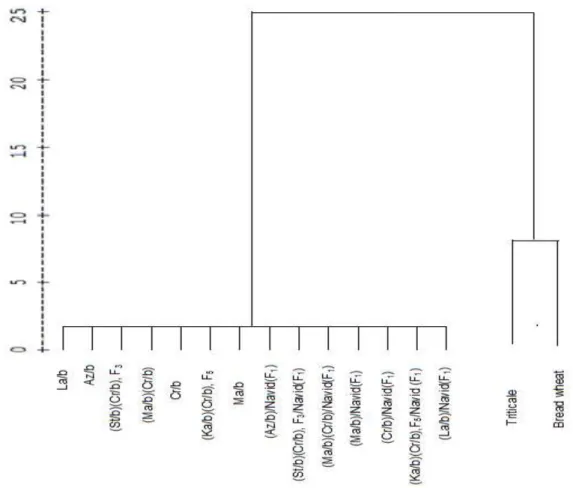
The cluster analysis technique is used for parental selection in breeding programs (El-Deeb and Mohamed, 1999; Leilah and Al-Khateeb, 2005) and/or crop modeling (Jaynes, et al., 2003). Squared Euclidean distance was able to cluster genotypes using the Ward hierarchical cluster analysis based on grain yield, 1000 grains weight and fertility (Figure 1). All genotypes separated into two main groups including 1) Tritipyrum derived genotypes and 2) Triticale and bread wheat. Cluster analysis showed that Triticale is more resemble than Tritipyrum to bread wheat. These data emphasized that more breeding researchesare neededto overcome limitations against Tritipyrumcultivations.
Figure 1. The tree dendrogram of cluster analysis (Squared Euclidean distance) for grain yield, fertility and 1000 grains weight in Tritipyrum derived genotypes, promising Triticale line and Iranian bread wheat cultivar ‘Navid’.
Conclusion
References
Akgun, I., Altindal, N., (2010) Relationship among aneuploidy, germination rate and seed shriveling in 6X-Triticales. Turkish J Field Crops, 15(1), 25-28.
Allahdoo, M., Siahsar B.A., Shahsavand hassani H., Pour A.K., Nazhad, N.M., (2009) The identification of Eb chromosome in Tritipyrum Primary lines using
random and semi random primers. Trakia J Sci., 4, 1-6.
Assad, M.T., (1997) Agricultural field experiments design and analysis. Shiraz University Press, Shiraz.
Chen, Q., (2005) Detection of alien chromatin introgression from Thinopyrum into Wheat using S genomic DNA as a probe-A landmark approach for
Thinopyrum genomic research. Cytogenetic Genome Research, 109, 350-359.
El-Deeb, A.A., Mohamed, N.A., (1999) Factor and cluster analysis for some quantitative characters in sesame (Sesamum indicum L.).The Annual Conference ISSR.Cairo, Egypt, December 4-6.
Elneskog Staam P., Marker A., (2002) Chromosome composition, stability and fertility of Alloploid between Triticumturgidumvar. carthlicum and
Thinopyrumjunceiforme. Hereditas, 136, 59-65.
Jaynes, D.B., Kaspar T.C., Colvin T.S., James D.E., (2003) Cluster analysis of spatial temporal corn yield pattern in an Iowa field. Agronomy Journal 95: 574–586. Kamyab, M., Shahsavand Hassani, H., Tohidinejad, E., (2012) Agronomic behavior
of a new cereal (Tritipyrum: AABBEbEb) compared with modern Triticale and Iranian bread wheat cultivars. Journal of Agricultural Science and
Technology B, 2, 38-51.
King, I.P., Law, C.N., Cant, K.A., Orford, S.E., Reader, S.M., Miller, T.E., (1997) Tritipyrum, a Potential New Salt-tolerantCereal. Plant Breed., 116, 127-132.
Leilah, A.A., Al-Khateeb, S.A., (2005). Statistical analysis of wheat yield under
drought conditions. Journal of Arid Environments, 61, 483–496.
Oudjehih, B., Boukaboub, A., (2000) Cytogenetic study of Triticale. Agricultures, 9, 519-523.
Oudjehih, B., Bentouati, A., (2006) Chromosome numbers of the 59 species of Eucalyptus L’Herit.(Myrtaceae). CARYOLOGIA, 59(3), 207-212.
Shahriari, Z., Assad, M.T., ShahsavandHasani, H., (2012) Drought Resistance and Mitotic Instability of Tritipyrum Compared with Triticale and Bread Wheat. Not Bot HortiAgrobo., 40(1), 170-176.
Shahsavand Hassani, H., Caligari, P.D.S., Miller, T.E., (1997) Production of
Secondary Tritipyrum: Assessment of Chromosome Constitution by in situ Hybridization. Proc. 3rd. Inter. Symp.“New genetical approaches to crop improvement”.Tando Jam, Pakistan.
Shahsavand Hassani, H., (1998) Development and cytogenetic studies of a potential new salt tolerant cereal, Tritipyrum. Ph.D. Thesis, The University of
Reading, UK.
(1998) An assessment of Tritipyrum, a new potential cereal with salt tolerance.8th. Inter. Wheat genet.Symp., Saskatoon, Canada.
Shahsavand hassani, H., King, I.P., Reader, S.M., Caligari, P.D.S., Miller, T.E., (2000) Can Tritipyrum, a new salt tolerant potential amphiploid, be a successful cereal like Triticale?. J AgricSciTechnol., 2, 177-195.
Shahsavand hassani, H., Reader, S.M., Miller, T.E., (2006) Agronomical and adoption characters of Tritipyrum lines in comparison with Triticale and Iranian wheat. Asian J Plant Sci., 5(3), 553-558.
Siahsar, B.A., Allahdo, M., Shahsavand Hassani, H., (2011) Genetic variation among and within Tritipyrum (Thinopyrumbessarabicum × Triticum durum) lines using PCR-based molecular markers.Cien. Inv. Agr., 38(1), 127-135.
Suarez, E.Y., Favret, E.A., (1986) Aneuploidy as an explanation of high values of phenotypic variability in commercial wheat varieties. Cereal Research Communications, 14(3), 229-235.
Tosun, M., (1999) Karyotype analysis in hexaploid Triticale. Turkish J Agric and Forestry, 23, 943-949.
Tosun, M., Halilo-Lu, K., Ta_Pınar, S.M., Sa_Söz, S., (2003) Test weight, kernel shriveling, and aneuploidy frequency in Triticale. New Zealand J Agric Res., 46, 27-30.