RECOMENDAÇÕES DE BUGS SIMILARES PARA
HENRIQUE SANTOS CAMARGOS ROCHA
RECOMENDAÇÕES DE BUGS SIMILARES PARA
MANTENEDORES DE SOFTWARE
Tese apresentada ao Programa de Pós-Graduação em Ciência da Com-putação do Instituto de Ciências Exatas da Universidade Federal de Minas Gerais como requisito parcial para a obtenção do grau de Doutor em Ciência da Computação.
Orientador: Marco Túlio de Oliveira Valente
Co-Orientador: Humberto Torres Marques-Neto
HENRIQUE SANTOS CAMARGOS ROCHA
RECOMMENDING SIMILAR BUGS TO
SOFTWARE MAINTAINERS
Thesis presented to the Graduate Program in Computer Science of the Federal Univer-sity of Minas Gerais in partial fulfillment of the requirements for the degree of Doctor in Computer Science.
Advisor: Marco Túlio de Oliveira Valente
Co-Advisor: Humberto Torres Marques-Neto
Ficha catalográfica elaborada pela Biblioteca do ICEx - UFMG
Rocha, Henrique Santos Camargos.
R672r Recommending similar bugs to software maintainers. / Henrique Santos Camargos Rocha. – Belo Horizonte, 2016.
xxiv, 122 f.: il.; 29 cm.
Tese (doutorado) - Universidade Federal de
Minas Gerais – Departamento de Ciência da Computação.
Orientador: Marco Túlio de Oliveira Valente. Coorientador: Humberto Torres Marques Neto.
1. Computação - Teses. 2. Software – Manutenção
3. Sistemas de recomendação. 4.Mineração de dados
(Computação). I. Orientador. II. Coorientador. III. Título.
Acknowledgments
I would like to acknowledge and thank all those who helped me along the long road that is a doctoral degree.
First and foremost, I thank God for everything.
A special thanks for my parents, siblings, and family members who gave me the emotional support through all those years. Another special thanks to my girlfriend for her support and understanding. I also would like to thank my friends, specially the ones who noticed my absence in many social events while I was busy with my research. I would like to express my sincere gratitude to my advisor Prof. Marco Túlio de Oliveira Valente and my co-advidor Prof. Humberto Torres Marques-Neto for the con-tinuous support of my Ph.D study and related research, for their patience, motivation, and immense knowledge. Their guidance helped me in all the time of research and writing of this thesis. I could not have imagined having better advisors and mentors for my Ph.D study.
My sincere thanks also goes to Dr. Gail C. Murphy, who provided me an oppor-tunity to join her team as intern, and who gave access to the laboratory. Without her precious support it would not be possible to conduct this research.
I also thank all the research colleagues at the LabSoft in UFMG and SPL in UBC. I consider many them good friends, who also share the search for knowledge and research. Only in the academia we can find so many different and interesting people with so many common goals.
I would like to thank the Mozilla foundation and its contributors who provided me with their bug tracking data which was invaluable to my research.
Finally, I thank the remaining members of my thesis committee: Prof. Dr. E-duardo Magno Lages Figueiredo, Prof. Dr. Marcelo de Almeida Maia, and Prof. Dr. Leonardo Gresta Paulino Murta, for participating in my defense and their insightful comments and revision which improved my research from various perspectives.
“I am wiser than this man, for neither of us appears to know anything great and good; but he fancies he knows something, although he knows nothing; whereas I, as I do not know anything, so I do not fancy I do. In this trifling particular, then, I appear to be wiser than he, because I do not fancy I know what I do not know.” (Socrates – Plato’s Apology, 21-d)
Resumo
Normalmente, a manutenção de um software gira em torno do tratamento de relatórios que descrevem erros, ou bugs. Isto representa um grande esforço do time envolvido nesta tarefa, especialmente em projetos de código aberto. Desenvolvedores destes pro-jetos selecionam os bugs que desejam resolver em repositórios específicos. Geralmente, o esforço geral não é coordenado e pode implicar em trabalho redundante. Além disso, destaca-se que desenvolvedores enfrentam trocas de contexto o que pode impactar neg-ativamente na sua respectiva produtividade. Assim, entende-se que se os desenvolve-dores trabalharem continuamente em bugs similares, essas trocas de contexto podem ser mitigadas. Nesta tese é proposto e avaliado um sistema de recomendação de bugs que auxilie um desenvolvedor a tratar bugs similares, minimizando assim a troca de contexto. Primeiramente, realizou-se uma caracterização do fluxo de tratamento de bugs seguido pelos desenvolvedores Mozilla, onde foram identificadas oportunidades de incluir recomendações de bugs similares, como por exemplo, que desenvolvedores menos experientes gastam mais tempo procurando por um bug do que realizando a sua correção. Em seguida, o sistema de recomendação proposto na tese, denominado NextBug, foi avaliado usando bugs resolvidos no passado do ecossistema Mozilla. Os resultados foram comparados a uma técnica de vanguarda para detecção de bugs du-plicados e mostrou-se que o NextBug desempenha tão bem quanto esta técnica de referência. Finalmente, se reporta um estudo de campo realizado para monitorar os bugs corrigidos para sistemas Mozilla durante uma semana e se analisou e-mails en-viados aos desenvolvedores que corrigiram estes bugs perguntado se eles trabalhariam nas recomendações fornecidas pelo NextBug. Do total de 66 desenvolvedores, 39 (59%) afirmaram que eles poderiam trabalhar nas recomendações. Além disso, 44 desenvolve-dores (67%) expressaram interesse em usar o NextBug como um plug-in instalado no repositório de bugs.
Palavras-chave: Manutenção de software, tratamento de bugs, relatório de erro,
sistema de recomendação, mineração de texto.
Abstract
The maintenance work to be performed on software systems, whether feature develop-ments or defects, is typically described as a bug or issue report. Bug handling represents a major effort in most software projects, specially for popular open source systems. In such systems, developers self-select bugs from the many open bugs in a repository when they wish to perform work on the system. However, developers’ work is not coordinated which can lead to redundant work when handling bugs. Moreover, developers face con-text changes during their work which has a negative impact on their productivity. Therefore, if developers are guided to work on similarly related bug reports, the con-text changes can be mitigated, improving their productivity. In this thesis, we propose and evaluate a recommender that suggests similar bugs that a developer can fix after handling a giving bug. The recommender is inspired by techniques originally designed to detect duplicated bug reports. To the best of our knowledge, there is currently no other research aimed to recommend similar bugs to help developers on addressing more bugs. First, we characterize the bug handling workflow followed by Mozilla developers, when we identify an opportunity to include recommendations of similar bugs in this workflow. For instance, we discovered that less skilled developers require more time to find a bug than actually fixing it. Second, we evaluate the proposed recommender, called NextBug, using past bugs resolved in the Mozilla ecosystem and we compare the results with a state-of-the-art technique for detecting duplicated bugs. The results show that NextBug performs just as well as this more complex technique. Finally, we report a field study where we monitored the bugs fixed for Mozilla during a week. We sent mails to the developers who fixed these bugs, asking whether they would consider working on the recommendations provided by NextBug; 39 developers (59%) stated that they would consider working on these recommendations; 44 developers (67%) also expressed interest in seeing NextBug plugin installed in their bug tracking systems.
Palavras-chave: Software maintenance, bug handling, bug report, recommendation
system, text mining.
List of Figures
1.1 Amazon screenshot adapted to show the books’ recomendation. . . 5
2.1 Modification Requests classification. Source: ISO/IEC 14764(2006) . . . . 10 2.2 Modeling in the Information Retrieval Process. . . 15 2.3 Cosine Similarity. . . 17
3.1 Standard Bugzilla Workflow (version 5.x) [Bugzilla Team, 2015]. . . 29 3.2 Workflow used by Mozilla’s customized version of Bugzilla. The cells with
a check mark represent valid transitions and white cells indicate there is no transition between these states. Dark gray cells are used when the begin-ning and end state are the same (i.e., there are no loops in the workflow). Resolved and Verified (colored red) indicate states that a bug is considered closed. This image was provided by a BMO Maintainer in 2015-12-29. . . . 30 3.3 Bug Life Cycle Workflows: (a) Mozilla’s customized version, (b) Older
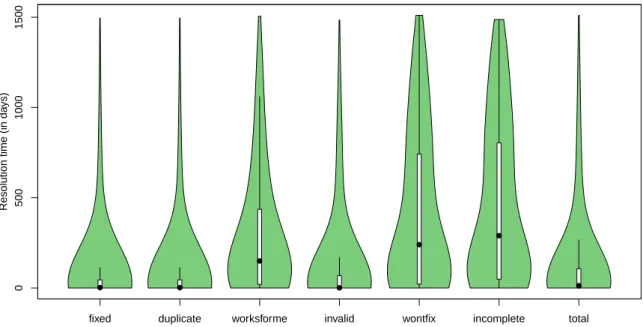
Bugzilla version (3.x) . . . 30 3.4 Fragment of a BFG for Firefox . . . 32 3.5 Violin plots showing the distribution of resolution times (in days) per bug
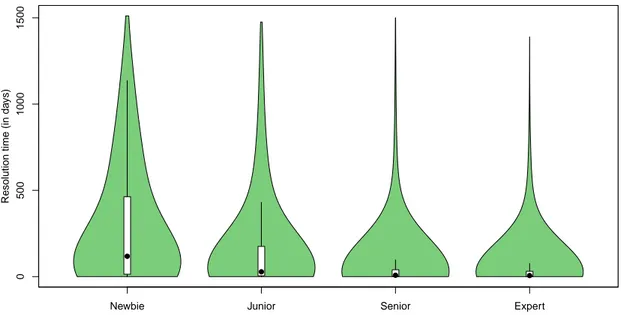
status. . . 34 3.6 Distribution of resolution times (in days) for each developer skill category. 36 3.7 BFG for all Mozilla bugs. . . 37 3.8 BFG for Fixed Mozilla bugs. . . 40 3.9 BFGs for fixed bugs on Mozilla systems: (a) Core, (b) Firefox. . . 42 3.10 BFGs according to Developers’ Skill Profiles: (a) Newbie, (b) Junior, (c)
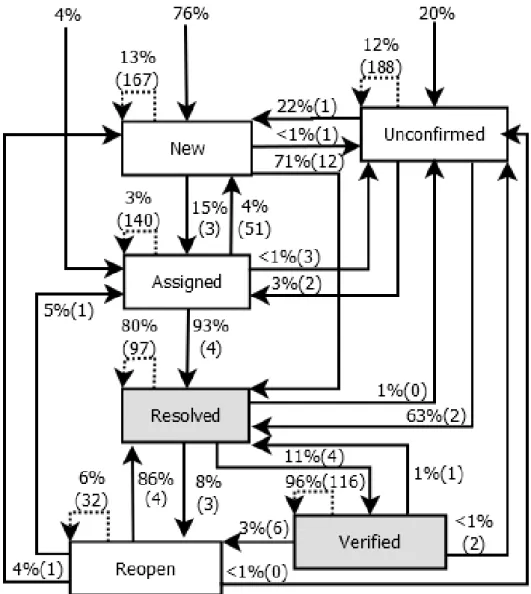
Senior, and (d) Expert. . . 44
4.1 Proposed approach for recommending similar bugs . . . 48 4.2 Screenshot showing the original Bugzilla interface for browsing a bug
en-hanced with the NextBug plug-in. Similar bugs are shown in the lower right corner. . . 51
5.1 Fixed issues per month . . . 58
5.2 Files changed per mapped issue . . . 59
5.3 Maximal overlap scenarios (boxes represent files changed to conclude a bug): (a) the context of the first bug is reused by the recommended bug; (b) no new files are included in the context of the recommended bug. . . 64
5.4 Feedback (Fb) . . . 68
5.5 Precision (P) . . . 69
5.6 Likelihood (L) . . . 70
5.7 Recall (Rc) and Maximum Recall (Max Rc) . . . 71
5.8 F-score (F1) . . . 71
5.9 NextBug Feedback (Fb), Precision (P), Likelihood (L), Recall (Rc), and F-score (F1) without the component filter . . . 72
5.10 F-score (F1): (a) Ω = 0.25, (b) Ω = 0.5 . . . 74
5.11 F-score (F1): (a) Ω = 0.75, (b) Ω = 0.5 . . . 74
5.12 Precision considering assigned developers . . . 76
5.13 Likelihood considering assigned developers . . . 76
5.14 Fixed issues per month . . . 78
5.15 Files changed/browsed per mapped issue . . . 79
5.16 Feedback (Fb) results: (a) Commits, (b) Context . . . 80
5.17 Precision (P) results: (a) Commits, (b) Context . . . 81
5.18 Likelihood (L) results: (a) Commits, (b) Context . . . 81
5.19 Recall (Rc) results: (a) Commits, (b) Context . . . 82
5.20 F-score (F1) results: (a) Commits, (b) Context . . . 82
6.1 E-mail sent to a Mozilla developer . . . 86
List of Tables
3.1 Mozilla bugs (2012) classified by their resolution status . . . 33
3.2 Types of Mozilla Users Registered in Bugzilla . . . 35
3.3 Developers Classification by Skill . . . 36
3.4 Top-10 Mozilla products considering fixed bugs registered in BMO . . . 41
5.1 Issues per Severity . . . 58
5.2 Files changed per mapped issue . . . 59
5.3 Top-10 Mozilla systems by issues with changed files . . . 60
5.4 Features ofREP(q, b) . . . 62
5.5 Parameters of REP . . . 63
5.6 Execution Time (ms) . . . 77
6.1 Field study results . . . 87
6.2 Examples of useful recommendations, according to Mozilla developers (in-cluding the textual similarity between the query and the provided recom-mendations) . . . 88
6.3 Examples of incorrect recommendations, according to Mozilla developers (including the textual similarity between the query and the provided rec-ommendations) . . . 88
6.4 Reasons for not following a recommendation . . . 89
6.5 Usefulness of a Bugzilla extension . . . 90
A.1 Survey Answers . . . 107
Contents
Acknowledgments ix
Resumo xiii
Abstract xv
List of Figures xvii
List of Tables xix
1 Introduction 1
1.1 Problem and Motivation . . . 1
1.2 Objective and Contributions . . . 3
1.3 Publications . . . 5
1.4 Outline of the Thesis . . . 6
2 Background and Related Work 9 2.1 Software Maintenance . . . 9
2.1.1 Benefits of Periodic Maintenance . . . 11
2.1.2 Context Changes . . . 12
2.1.3 Issue Tracking Systems . . . 13
2.2 Information Retrieval . . . 14
2.2.1 Pre-processing Index Terms . . . 15
2.2.2 Vector Space Model . . . 16
2.3 Bug Characterization and Visualization . . . 17
2.4 Detecting Duplicated Bug Reports . . . 18
2.5 Assigning Bugs to Developers . . . 21
2.6 Analyzing Similar Issue Reports . . . 24
2.7 Recommendation Systems in Software Engineering . . . 24
3 Bug Characterization Study 27
3.1 Mozilla Maintenance Process . . . 27 3.1.1 The Life Cycle of Mozilla Bugs . . . 28 3.1.2 Understanding the Workflow . . . 31 3.2 Bug Flow Graphs . . . 31 3.3 Dataset Overview . . . 33 3.3.1 Mozilla Bugs . . . 33 3.3.2 Mozilla Users . . . 35 3.3.3 Developers Profile . . . 35 3.4 Study Results . . . 37 3.4.1 Overall Workflow Analysis . . . 37 3.4.2 Fixed Bugs Workflow . . . 39 3.4.3 Workflow of Top Systems in Number of Fixed Bugs . . . 41 3.4.4 Developers Workflow . . . 43 3.5 Threats to Validity . . . 46 3.6 Final Remarks . . . 46
4 Recommendations of Similar Bugs 47
4.1 Proposed Approach . . . 47 4.1.1 Rationale . . . 49 4.2 NextBug: A Prototype Implementation . . . 50 4.2.1 Main Features . . . 50 4.2.2 Architecture and Algorithms . . . 53 4.3 Final Remarks . . . 55
5 Retrospective Study 57
5.1 Comparative Study . . . 57 5.1.1 Data Collection . . . 57 5.1.2 Technique for Comparison: REP . . . 60 5.1.3 Study Design . . . 63 5.1.4 Evaluation Metrics . . . 65 5.1.5 Comparison Results . . . 68 5.1.6 Configuration Without the Component Filter . . . 71 5.1.7 Oracle Sensibility Testing . . . 73 5.1.8 Alternative Evaluation: Assigned Developers . . . 75 5.1.9 Execution Time . . . 77
5.1.10 Summary of Findings . . . 78 5.2 Second Study: Mylyn . . . 78 5.2.1 Mylyn Dataset . . . 78 5.2.2 Study Design . . . 79 5.2.3 Results . . . 79 5.3 Threats to Validity . . . 83 5.4 Final Remarks . . . 83
6 Field Study 85
6.1 Study Design . . . 85 6.2 Results . . . 87
6.2.1 Question #1: Would you consider working on one of these bugs next? . . . 87 6.2.2 Question #2: Would you consider useful a Bugzilla extension
with recommendations? . . . 89 6.3 Threats to Validity . . . 91 6.4 Final Remarks . . . 91
7 Conclusion 93
7.1 Discussion . . . 93 7.1.1 Can we avoid context changes on issue handling? . . . 93 7.1.2 Does our approach increase developer’s productivity? . . . 94 7.1.3 Applicability . . . 95 7.1.4 Can we improve the measured evaluation results? . . . 96 7.2 Contributions . . . 97 7.3 Future Work . . . 98
Bibliography 99
Appendix A Field Study Answers 107
Chapter 1
Introduction
In this chapter, we start by stating our problem and motivation (Section 1.1). Next, we discuss our objectives, goals, and intended contributions (Section 1.2). Then, we present our current publications (Section 1.3). Finally, we present the outline of this thesis (Section 1.4).
1.1
Problem and Motivation
The importance of software maintenance in software engineering is well-established, as well as the costs and complexity inherent to this activity [Tan and Mookerjee, 2005; Mookerjee, 2005; Aziz et al., 2009; Junio et al., 2011]. In most software organiza-tions, systems are maintained periodically, i.e., maintenance requests1 are grouped and
implemented as part of software projects [Tan and Mookerjee, 2005; Marques-Neto et al., 2013]. Studies show the advantages of periodic maintenance such as dilution of costs, decrease of system degradation, and better use of software engineering prac-tices [Banker and Slaughter, 1997; Tan and Mookerjee, 2005]. However, open-source projects typically adopt continuous maintenance policies, where the maintenance re-quests are addressed by developers with different skills and commitment levels, as soon as possible, after being registered in an issue tracking system [Mockus et al., 2002; Tan and Mookerjee, 2005; Liu et al., 2012]. Therefore, maintenance in open-source systems usually does not take benefit of the gains of scale that happen when requests are handled in batch [Tan and Mookerjee, 2005].
1
In this thesis, we preferably use the term bug or issue to refer to maintenance work items such as tasks, requests, reports, defects, enhancements, tickets, etc. The main reason is that bug is the term used in the Mozilla systems we analyze in this research. We also use issue because it is a very common terminology among related work.
Another problem faced by popular open-source systems is related to the issue reporting process. Usually, certified developers, as well as common users, can report any fault perceived in the software. However, this process is not coordinated, which results in a high amount of reported issues from which many are invalid or duplicated [Liu et al., 2012]. In 2005, a certified maintainer from the Mozilla Software foundation made the following comment on this situation: “everyday, almost 300 bugs appear that need triaging. This is far too much for only the Mozilla programmers to handle” [Anvik et al., 2006]. Our data indicates that, in 2012, the number of reported issues for the Mozilla projects increased approximately 110% when compared to 2005. In this context, any process or tool that improves issue processing can provide a relevant impact on the maintenance and evolution of open-source systems.
Furthermore, software developers make several changes of context in a typical workday. These changes normally happen due to meetings, mails, instant messaging, etc., or when a given task is concluded and they need to choose a new task to work on. Regardless the reasons, the negative effects of context changes on developers’ productivity are well-known and studied. For example, in a recent survey with industry developers, more than 50% of the participants answered that a productive workday is one that flows without context changes and having no or few interruptions [Meyer et al., 2014]. Another study shows that developers spent at least two thirds of their time in activities related to acquiring task context, i.e., searching, navigating, and understanding the code relevant to the task at hand [Ko et al., 2005]. We argue that this time can be reduced if developers consistently decide to work on a new task similar to a previously concluded one. More specifically, context changes are reduced by guiding developers to work on a set of bugs B0, B1, ..., Bn, where Bi requires
changes on parts of the system related to a previous bug Bi−1, for i >0. By following
this workflow, context changes are mitigated because the order of the bugs naturally reproduces the work performed under a periodic maintenance policy, i.e., a bug that is selected, comprehended, and fixed at a given time helps on further bug corrections. The same principle also applies when fixing such bugs simultaneously.
1.2. Objective and Contributions 3
tracking system that are very similar to one she is currently working on (or planning to work on). Therefore, productivity can also increase by reminding developers of other bugs that are potentially similar to one she is currently browsing in the tracking system.
To clarify our motivation, consider the following Mozilla bug that was fixed by a developer on February 12, 2009:2
Bug 475327 - [Linux] New Tab button is still right side of the Tab bar
When the developer fixed this bug, another bug with a similar description was also available in Mozilla’s tracking system.
Bug 474908 - Dragging a tab in a window with only one tab detaches the tab
This second bug was fixed by the same developer of the first one, 24 days after the first bug. Fixing the second bug required changes in one XML file that also was changed by the developer when fixing the first bug. In the interval between working on these bugs, the respective developer remained active, fixing another 12 non-related bugs. To find out how often such a situation occurs, we retrospectively analyzed bugs reported for Mozilla systems from January 2009 to October 2012. For 67% of the bugs, just after the developers fixed a bug B, they chose to work on a bug B′′
even though a more similar bug B′
in terms of changed files was available in the tracking system. As a result, for 43K Mozilla bugs, a developer may have required less context changing and been more productive by choosing a different bug.
1.2
Objective and Contributions
Our main objective is to design and evaluate an approach to recommend similar bugs to maintainers based on the textual description of each bug stored in issue tracking platforms, such as Bugzilla and Jira. The recommendations should be presented each time a developer browses the page containing the main description of a bug, with a minimal runtime cost. The intention is to remind the developer about bugs similar to the one he/she is browsing. In our previous motivating example (Section 1.1), the page describing Bug 475327 should be extended with a list of bugs with a similar textual description, like Bug 474908.
More specifically, suppose that a developer manifests interest in a bug with a short description q (a textual document). In this case, we intend to rely on text
2
mining techniques to retrieve open bugs with short descriptionsdj similar to q and to
recommend them to the maintainers.
We claim the proposed approach is compatible with the current software main-tenance process followed by open-source systems for the following reasons: (a) it is based on recommendations, and therefore maintainers are not required to accept extra bugs to fix; (b) it is fully automatic and unsupervised and therefore does not depend on human intervention; (c) it relies on information readily available in issue track-ing systems and therefore requires little effort to compute. Despite that, assumtrack-ing the recommendations effectively capture similar bugs, we claim they can contribute to introduce gains of scale similar to the ones achieved with periodic maintenance policies.
The proposed recommender is based on techniques originally designed for detect-ing duplicated bug reports. Even tough contemporaneous and more complex techniques for detecting duplicate bugs usually perform better than simpler ones, our results show this is not the case for similar bugs recommendations. More specifically, our results show that the technique proposed in the thesis—which is lightweight and simple—can perform just as well as more complex techniques. Therefore, our focus is to analyze the feasibility of similar bugs recommendations and not to argue that our approach fosters productivity gains, even though it is possible to see indirect evidence of that effect.
Our inspiration for this work are the recommendation systems widely used by online stores (e.g., Amazon)3 which serves as an interesting analogy to our approach.
Online stores recommend other “related” products whenever you browse a product. For example, when we browse a book on Amazon, other similar books on related subjects are also presented (Figure 1.1). Even though not every client accepts the recommendations, those that do contribute to increase the store’s sales. Similarly, we propose in this thesis a recommendation system to improve the number of bugs handled by maintainers of open source systems.
The intended contributions of this thesis are: (a) a novel application of bug mining techniques to recommend similar bug reports to developers; (b) a tool to enhance a bug tracking system with recommendations of similar bugs; (c) a lightweight technique to characterize the maintenance process followed by software developers, which showed the importance of supporting developers on finding more bugs of interest; (d) a quantitative study on a large-scale bug repository, which compares our approach with a state-of-the-art technique and shows that it is possible to predict similar bugs; (e) a survey study with Mozilla developers, which showed that developers can recognize similar bugs recommendations.
3
1.3. Publications 5
Figure 1.1: Amazon screenshot adapted to show the books’ recomendation.
In the quantitative study, we analyze 65K Mozilla and 2.6K Mylyn bugs by ap-plying our recommender technique. We check whether the recommendations provided by the recommender share a subset of the same source files. The results show that we were able to predict bugs whose fixes indeed share the same source files, and as a consequence, context change can be mitigated by working on them.
In the qualitative study, we surveyed 66 Mozilla developers, by presenting them to similar bugs recommendations (that were still unresolved in the system) and by asking them two questions. The main goal of this survey is to verify if developers can recognize similar bugs recommendations. We also plan to reveal the developers opinion on extending their bug tracking system with similar bugs recommendations.
1.3
Publications
The work described in this thesis includes material from the following publications:
• Henrique Rocha, Marco Túlio Valente, Humberto Marques-Neto, Gail Murphy. An Empirical Study on Recommendations of Similar Bugs. 23rd IEEE Interna-tional Conference on Software Analysis, Evolution, and Reengineering (SANER), pages 46-56, 2016.
• Henrique Rocha, Guilherme de Oliveira, Humberto Marques-Neto, Marco Túlio Valente. NextBug: A Bugzilla Extension for Recommending Similar Bugs. Jour-nal of Software Engineering Research and Development (JSERD), vol. 3, issue 1, pages 1-14, 2015.
• Henrique Rocha, Guilherme de Oliveira, Humberto Marques-Neto, Marco Túlio Valente. NextBug: A Tool for Recommending Similar Bugs in Open-Source Systems. Brazilian Software Conference (CBSoft) – Tool Track, pages 53-60, 2014 (best tool award).
• Henrique Rocha, Humberto Marques-Neto, Marco Túlio Valente. Agrupamento Automático de Solicitações de Manutenção. First Latin-America School of Soft-ware Engineering (ELA-ES), pages 9-9, 2013 (3rd best PhD work award).
The following publications represent earlier research efforts during this Ph.D:
• Henrique Rocha, Cesar Couto, Cristiano Maffort, Rogel Garcia, Clarisse Simoes, Leonardo Passos, and Marco Tulio Valente. Mining the impact of evolution categories on object-oriented metrics. Software Quality Journal, vol. 21, issue 4, pages 529-549, 2013.
• Hugo Brito, Humberto Marques-Neto, Ricardo Terra, Henrique Rocha, and Marco Tulio Valente. On-the-fly extraction of hierarchical object graphs. Journal of the Brazilian Computer Society, vol. 19, issue 1, pages 15-27, 2013.
• Henrique Rocha and Marco Tulio Valente. How Annotations are Used in Java: An Empirical Study. In 23rd International Conference on Software Engineering and Knowledge Engineering (SEKE), pages 426-432, 2011.
1.4
Outline of the Thesis
We organized the remainder of this work as follows:
• Chapter 2 describes background information on software maintenance,
1.4. Outline of the Thesis 7
also discuss work on issue reports, including characterization and visualization techniques, work aiming to detect duplicate issues, to assign issues to developers, and to group similar issues.
• Chapter 3 describes the Mozilla maintenance process focusing on its bug
han-dling workflow. We analyze and characterize a large dataset of Mozilla bugs. We also present and discuss a lightweight technique, called Bug Flow Graphs, aimed to better understand and visualize the workflow followed in the maintenance of open source systems. Finally, we perform a characterization study focusing on the workflow followed when fixing bugs in the Mozilla ecosystem.
• Chapter 4 presents our approach to recommend similar bug reports to
devel-opers. We also present a supporting tool, called NextBug, implemented as a Bugzilla addon.
• Chapter 5 presents a retrospective study to evaluate our approach in a
quanti-tative dimension. First, we compare NextBug against REP [Sun et al., 2011], a state-of-art technique to detect duplicate bugs. Second, we show how NextBug performs on a smaller system (Mylyn), which has fewer bugs.
• Chapter 6 shows the results of a field study conducted with Mozilla developers,
where they were presented with similar bugs provided by NextBug and asked a few questions about them.
Chapter 2
Background and Related Work
In this chapter, we present background information related to this thesis. First, we present central concepts on Software Maintenance (Section 2.1) and Information Re-trieval (Section 2.2). Then, we present work on bug characterization and visualization (Section 2.3) that is related to our characterization study in the next chapter. We also discuss techniques to detect duplicated bug reports (Section 2.4), and to assign bug reports to developers (Section 2.5), which are related to our work. Moreover, we present a brief review on studies that also work with similar bug reports (Section 2.6). Besides, we provide an overview on Recommendation Systems on Software Engineer-ing (Section 2.7), since our approach is based on recommendation system principles. Finally, we conclude with general remarks on the discussed topics (Section 2.8).
2.1
Software Maintenance
Software maintenance is an important activity in a software’s life cycle. Basically, it includes all the tasks performed to modify a software while preserving its in-tegrity [ISO/IEC 14764, 2006; ISO/IEC 12207, 2008]. Normally, understanding the software which is being modified corresponds to a great part of a maintenance ef-fort [Tan and Mookerjee, 2005]. The importance of maintenance is well known both in the academia and in the industry. The Lehman and Belady [1985] laws point out that a system must be continuously adapted otherwise it becomes progressively less satis-factory until it is discarded. The complexity of maintenance tasks is also well-known. Usually, maintenance activities are one of the most problematic parts of a software life cycle due to their inherent complexity [Tan and Mookerjee, 2005; Ahn et al., 2003; Heales, 2002].
Software maintenance is also a costly process [Tan and Mookerjee, 2005]. There
are several studies that highlight and discuss the costs associated with maintenance tasks. Coleman et al. [1994] claim that 40% to 60% of production costs are devoted to maintenance. Other study presents a worse case scenario, showing that software maintenance activities may consume up to 80% of the total costs during a system’s life time [Alkhatib, 1992]. Erlikh [2000] shows that for legacy systems up to 90% of the system’s resources are consumed by maintenance tasks. There are also studies that highlight the increasing amount of money spent in software maintenance activities. In the 1980’s, it was estimated that annually US$ 30 billion was spent with maintenance tasks worldwide [Chan et al., 1996; Swanson and Beath, 1989]. In the 1990’s, IEEE estimated that US companies expended over US$ 70 billion per year with software maintenance [Sutherland, 1995]. We did not find recent studies with more current estimates on the costs of maintenance activities. However, there are no evidences that they have decreased.
Software maintenances is typically performed based on a proposed Modification Request (or Change Request). According to ISO/IEC 14764 [2006] these requests are classified into two categories: correction orenhancement. Correction activities can be sub-categorized into corrective or preventive tasks. Enhancement activities are also sub-categorized further into adaptive or perfective. Figure 2.1 shows an overview of this classification [ISO/IEC 14764, 2006].
Figure 2.1: Modification Requests classification. Source: ISO/IEC 14764(2006)
nec-2.1. Software Maintenance 11
essary changes in which a software must operate and perfective tasks intend to improve the software beforehand.
There are two policies to deal with software maintenances: continuous or periodi-cally. Under a continuous policy the modification requests are handled in a ad-hoc way, i.e., as soon as possible after the assignment of a request to a maintainer. On the other hand, under periodic policies, the maintainers handle the software maintenance at pre-defined time intervals and, thus, several requests are addressed together. Open-source systems most often employ a continuous maintenance policy, while organizations prefer to adopt a periodic policy [Tan and Mookerjee, 2005; Junio et al., 2011].
As this thesis focus on maintenance tasks addressed following a periodic policy, we discuss the central characteristics of such policies in Section 2.1.1.
2.1.1
Benefits of Periodic Maintenance
Most open-source systems adopt an uncoordinated reporting process, where both users and testers can report a modification request [Liu et al., 2012]. This practice usually results in a continuous maintenance process, where maintainers address the change requests a soon as possible.
On the other hand, commercial software is often maintained under a periodic policy. Basically, the preference for this policy happens due to two reasons: scale eco-nomics and software degradation [Tan and Mookerjee, 2005]. The first reason is the gain obtained with scale economics. Periodic policy provides scale economics by reduc-ing the fixed costs inherent to maintenance activities by 36% [Banker and Slaughter, 1997]. Other reason for following periodical policies is the mitigation of system degra-dation, since each maintenance activity may contribute to the structural degradation of a system, as pointed out by Lehman and Belady [1985]. Thus, instead of perform-ing maintenance tasks after each change request, it is better to optimize the tasks implementing more change requests in each maintenance cycle [Tan and Mookerjee, 2005].
study comparing two types of periodical maintenance policies: uniform and flexible. Uniform policy performs periodical maintenance tasks at fixed time intervals, while flexible policy perform maintenance tasks at varying intervals. The authors propose a model that considers previous empirical studies to reduce the costs of maintenance and replacement activities. They evaluated several parameters and scenarios on periodical maintenance such as: percent of reuse of original code, system degradation, waiting costs, productivity improvements, and useful life of the system. The results showed several situations where flexible policies perform better than uniform ones.
Junio et al. [2011] evaluate the advantages of grouping maintenance requests to achieve scale economics. They proposed a process, called PASM, that fosters the usage of best software engineering practices when handling maintenance requests. The au-thors applied their approach in the information technology department at PUC Minas. The results showed that after adopting PASM, maintainers spent more time on soft-ware engineering activities and less on codification tasks. Marques-Neto et al. [2013] proposed a quantitative approach to evaluate software maintenance services. Their ap-proach is an adaptation of a method originally proposed to characterize the workload of e-commerce services. They rely on clustering techniques to generate a compact model that represents maintenance tasks workflow. The authors claimed the approach can help organizations to better understand and improve their own maintenance process.
2.1.2
Context Changes
In software development, developers are more productive when focusing on related tasks and topics. Context changes may interrupt a developer focus and, therefore, affect his/her productivity. In fact, the negative impacts of context changes have been revealed by several researchers [Meyer et al., 2014; Murphy, 2014]. Most developers agree that context changes are bad for their productivity, as 72% responded in a sur-vey [Meyer et al., 2014]. Moreover, over 50% of software developers considered few interruptions and context changes as a definition for a productive day [Murphy, 2014]. Ko et al. [2005] measure the amount of time developers spend understanding the code when working on maintenance tasks. They measured the percentage of time developers spend on activities such as reading code or API, and navigating dependencies. The results showed that, on average, developers spend two thirds of their time in activities related to task context.
2.1. Software Maintenance 13
changing is Eclipse Mylyn [Kersten and Murphy, 2006]. As a developer works on an indicated task, Mylyn tracks the artifacts touched and changed, building a degree-of-interest model that describes how important each part of each artifact is to the task. This model is stored per task and when a task change occurs, Mylyn can re-display to a developer the artifacts earlier worked on as part of that task. Cassandra is a task rec-ommender that aims to schedule the maintenance work in order to minimize conflicting changes in parallel software development [Kasi and Sarma, 2013]. The system relies on Mylyn to get contextual data, which is communicated to a centralized scheduler component. This component identifies potential conflicts in order to recommend task orders that restrict dependent tasks that share common files from being concurrently edited.
We claim that the recommendation of similar bus proposed in this thesis also helps to reduce context changes and consequently improve developers’ productivity. If developers consistently work on similar tasks (either sequentially or concurrently), their time caused by context changes will decrease.
2.1.3
Issue Tracking Systems
Issue tracking systems (ITS) are software systems that maintain a dataset of main-tenance modification requests (i.e., problems, issues or bug reports) for one or more projects. Usually, these systems provide a web interface that allows users to interact with the tracking system and the reported issues [Anvik et al., 2006]. Such interaction may include different operations like reporting a new issue, sending an attachment file, or providing comments for an issue.
Most open-source projects use an ITS to support their maintenance processes. The ITS provides a central knowledge repository about the issues handling progress. It also serves as a communication channel for geographically distributed developers and users [Anvik et al., 2006; Ihara et al., 2009]. Currently, there are several ITSs that are used in software maintenance and development. Following, we describe some of the most popular systems:
• Bugzilla:1 is a free ITS developed by Mozilla, implemented in Perl. According to
Bugzilla web site, there are over 1200 organizations or projects using its system.
• Jira:2 is a commercial system developed by Atlassian. Jira also provides
man-agement features integrated with its bug tracking features.
1
http://www.bugzilla.org, verified in 2016-05-16.
2
• Mantis:3 is a another free and open-source ITS implemented in PHP.
• Trac:4 is an open-source ITS that supports integration with version control
platforms such as Subversion, Git, Mercurial, among others. Trac also supports some project management tools.
• RedMine:5 is another ITS that provides project management features along
with issue tracking services. Another important feature is integration with version control systems.
The recommender proposed in this thesis uses the Bugzilla repository. However, it is possible to generalize our proposal to other ITSs that maintain similar issue data.
2.2
Information Retrieval
Information retrieval (IR) deals with the representation, storage, and organization of structured or unstructured data [Baeza-Yates and Ribeiro-Neto, 1999; Raghavan and Wong, 1986]. As IR techniques handle textual documents [Baeza-Yates and Ribeiro-Neto, 1999; Wang et al., 2008], and most artifacts required by a software maintenance process—including code—are textual, IR techniques can be used to handle such doc-uments [Marcus and Menzies, 2010]. Our approach relies on IR techniques to extract semantic information from issue reports.
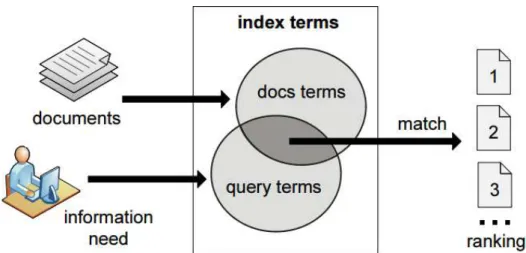
Usually, applications that employ IR techniques need to be properly modeled. This modeling consists in building a logical framework for representing the documents in the dataset. An IR model also defines a ranking function to quantify the similarity between documents and queries (user information needs). The ranking function is used to classify the documents, ordering by their relevance to the query (Figure 2.2).
Formally, an IR model is as a quadruple [D, Q, F, R(qi, dj)] where D is a logical
representation for the documents in the dataset, Q is a logical representation for the user queries, F is a framework for modeling documents and queries, andR(qi, dj) is a
ranking function between a queryqi and a document dj.
Most IR models adopt index terms to represent the data (documents and queries). In a general form, any word with a semantic significance can be an index term. Thus, index terms summarize the textual content adding simplicity to the documents and queries representation. Since not every term is equally useful to represent the data,
3
http://www.mantisbt.org, verified in 2016-05-16.
4
http://trac.edgewall.org, verified in 2016-05-16.
5
2.2. Information Retrieval 15
Figure 2.2: Modeling in the Information Retrieval Process.
it is a common step for several models to assign numerical weights to each indexed term [Raghavan and Wong, 1986].
2.2.1
Pre-processing Index Terms
2.2.2
Vector Space Model
Previous studies that apply IR techniques to issue reports have adopted the vector space as its IR model [Ko et al., 2006; Runeson et al., 2007; Wang et al., 2008; Alipour et al., 2013]. The vector space model (VSM) is a classic modeling approach to process documents and queries by decomposing them into t-dimensional vectors, where t is the number of different index terms in the document collection. In the classical VSM, the index terms are assumed to be mutually independent [Baeza-Yates and Ribeiro-Neto, 1999; Raghavan and Wong, 1986]. The weightswi are positive real numbers that represent the i-th indexed term in the vector. The weights calculation is based on the following observations: (i) high frequency terms are more important for describing documents (term frequency – tfi), and (ii) terms that occur in most documents are less important to discriminate relevant documents (inverse document frequency –idfi). The Equation 2.1 uses the term frequency and the inverse term frequency to calculate wi, which is referred as tf-idf weighting scheme [Baeza-Yates and Ribeiro-Neto, 1999].
wi =tfi×idfi = (1 + log2fi)×log2
N ni
(2.1)
where fi is the frequency of the i-th term in the document, N is the number of
doc-uments in the collection, and ni is the number of documents in which the i-th term
occurs.
The similarity between the vectors of a document dj and a query q is described
by the ranking function in Equation 2.2:
Sim(dj, q) = cos(Θ) =
− → dj • −→q
||−→dj|| × ||−→q||
=
Pt
i=1wi,d×wi,q
q Pt
i=1(wi,d) 2
× q
Pt
i=1(wi,q)
2 (2.2)
This function is often called cosine similarity because it measures the cosine of the angle between two vectors as illustrated in Figure 2.3. Since all weights are greater or equal to zero, we have0≤Sim(dj, q)≤1, where zero indicates that there is no relation
2.3. Bug Characterization and Visualization 17
Figure 2.3: Cosine Similarity.
2.3
Bug Characterization and Visualization
In this section, we present works aiming either to characterize or to visualize bugs. These work share common goal to help developers better understand the bugs reports and the maintenance process.
Guo et al. [2010] analyse the factors that could affect the fixing of bugs in Win-dows 7 and Vista. They also performed a survey with 358 developers, which showed how reputation and seniority affect the chances of bugs to be fixed. Based on the characterization, the authors propose a prediction model to identify the probability of a new bug to be fixed. Their prediction showed 68% of precision and 64% of recall for Windows 7 bug fixes.
Zimmermann et al. [2012] characterize which bugs are reopened for Windows 7 and Vista. This is a continuation on their previous work on characterizing fixed bugs [Guo et al., 2010]. Basically, they show the impact of different bug report fea-tures on the probability of bug reopening. Joorabchi et al. [2014] characterize non-reproducible bugs from six systems, for a total of 32K bugs. Their study tries to understand the causes for a bug to be marked as non-reproducible. They classify non-reproducible bugs into six categories, and show workflow patterns for them.
Minelli and Lanza [2013] developed a tool, called DFlow, to visualize the workflow of developers. DFlow is implemented in Pharo Smalltalk, and it analyses the developers tasks inside an IDE.
Ihara et al. [2009] propose a graph based visualization technique to analyze bug resolution process. They propose a general model and the bug workflow is adapted to fit such model. Therefore, it is a more generic and automated technique. However, the adaption do not accurately represent all the states and transitions of the workflow followed by developers.
Critical Assessment: The presented characterization studies analyze a specific type
of bug report (fixed, reopen, or non-reproducible) to understand the bugs and them work towards a prediction model. The visualization techniques tries to help managers and developers by showing the bugs to better analyze and understand the maintenance process.
2.4
Detecting Duplicated Bug Reports
Recent studies have focused on finding duplicated issue reports in bug tracking systems. Duplicated reports can hamper the bug triaging process and may waste maintenance resources [Cavalcanti et al., 2013]. Typically, studies for finding duplicate issues employ traditional information retrieval techniques such as natural language processing, vector space model, and cosine similarity. For example, Ko et al. [2006] analyze the linguistic characteristics of bug reports. They proposed an approach that uses natural language processing to parse the bug reports’ summaries and suggest a better structured report. They also claim that their approach can help in finding similar bug reports. Although, they did not provide any experimental evaluation on this.
Runeson et al. [2007] worked only with natural language data in their approach to find duplicated reports. They used VSM and measured similarity using three different metrics: Cosine, Jaccard, and Dice. Their experiments showed better results using the Cosine Similarity when compared to the other two. To evaluate the approach, they measured only recall rate achieving around 31% for their top-5 list of duplicated reports. They also conducted interviews with maintainers who evaluated positively the approach.
Classification-2.4. Detecting Duplicated Bug Reports 19
Based Heuristic which favors the natural language information. The natural language processing uses the classic Vector Space Model (VSM) and Cosine Similarity to process the bug reports. They also analyzed the impact of using summaries and full descriptions to detect duplicates. Their dataset was composed by bug reports from two open-source systems: Eclipse and Firefox. The Eclipse dataset has 220 bug reports, from which 44 were duplicates manually inserted for testing. The Firefox dataset is composed by 1,492 bug reports. In this dataset, they used the first 50 days of reports as a training set (744 bugs) and the remaining as a test set (754 bugs). The authors measured high recall rate values (between 55% and 95%) for their approach.
Jalbert and Weimer [2008] proposed an approach for bug duplication detection that uses a model classifier employing textual semantic information, linear regression, and graph clustering. The textual information processing follows different steps when compared to other bug duplication studies. The authors used a different weight formula and they not used an Inverse Term Frequency (IDF). They performed a statistical anal-ysis that indicates the IDF weight gives worst results for the bug duplication problem. They used a graph clustering technique originally designed for social networks and ap-plied it to issue reports. In this case, the bug reports represent the nodes and the edges connect nodes with similar textual information. The authors build a classifier based on linear regression that uses the clusters and textual information as features. The evaluation was based on Mozilla bug reports from February 2005 to October 2005, for a total of 29,000 bug reports. They evaluated their approach measuring the recall rate, which performed only 1% better than the approach considered as baseline [Runeson et al., 2007].
Sun et al. [2010] proposed an approach to detect duplicate reports by using dis-criminative models. First, they preprocessed each issue using standard techniques (stemming, stop-words removal, etc.) and organized them into a hash-map like struc-ture. Then, the approach trains a classifier based on a Support Vector Machine (SVM) algorithm. A noteworthy aspect of this work is the analysis of features selection and several possible similarity measurements. Their evaluation showed a recall rate around 65% for a recommendation list with 20 reports. According to the authors, this recall rate represents an improvement up to 43% over previous techniques.
200K bug reports. Their evaluation measures the recall rate@k and the mean average precision. They show a small improvement of their extended BM25F method over the classic one. We compare REP to our proposed recommender in Chapter 5. We also describe REP in more detail in Section 5.1.2.
Tian et al. [2012] proposed another approach to classify whether a bug report is a duplicate or not. Initially, the authors discussed that there are basically two approaches for duplicated report detection: report retrieval and report classification. Report retrieval searches for duplicate reports in a similar way as information retrieval searches for documents. Report classification address the task as a classification prob-lem and assign a label (duplicate or not) to new reports. The authors claim that such lines complement each other. Despite that, their approach falls on the classification category. They implemented several extensions over the work of Jalbert and Weimer [2008] such as: (i) a variant of the BM25F method, (ii) a relative similarity measure to better differentiate a duplicate report from a similar one, and (iii) using the product information on each bug report to improve the similarity measurement. They also compared their results to the work of Jalbert and Weimer [2008], and their approach showed a better accuracy and F-score. Their evaluation results showed accuracy and F-score values of 24% and 38% respectively.
Nguyen et al. [2012] proposed an approach, called DBTM, to detect duplicate bug reports that combines features provided by information retrieval and topic-based techniques. The authors used a machine learning generative process called Latent Dirichlet Allocation (LDA) to extract the topic-based information presented in bug re-ports. The information retrieval technique used to extract the textual information was the BM25F. Both techniques were combined using another machine learning technique called Ensemble Averaging. They used the same dataset presented by Sun et al. [2011]. The authors measured only the recall rate in their evaluation and their results were better than the ones from Sun et al. [2011].
Liu et al. [2012] proposed an approach to improve the search quality in bug tracking systems. The authors claim that searching for reports is an important step for bug triaging and to find duplicate reports. The approach uses a supervised machine learning technique to better rank the bug reports and therefore improve the search quality. Their evaluation measured the average rank of the results, mean average precision, and F-score. They achieved better values for all measured metrics over other searching techniques.
2.5. Assigning Bugs to Developers 21
the software architecture and quality guidelines. The approach uses BM25F [Robert-son et al., 2004] method and cosine similarity to retrieve the textual, categorical, and contextual information. The authors then compare the following classifiers algorithms: 0-R, C4.5, KNN (nearest neighbors), Logistic Regression, and Naive Bayes. The dataset used for their experiments is composed by five years of bug reports from the Android operating system, for a total of 37,236 reports with 1,063 duplicates. Their evaluation measured accuracy (precision), kappa (which measures the agreement between the clas-sifier and the classes), and the area under a Receiver Operation Characteristic (ROC) curve. They report that the algorithm C4.5 achieved the better results, presenting high precision values (above 84%).
Cavalcanti et al. [2013] presented an exploratory study on bug repositories and the task of finding duplicate bug reports. The authors used nine software projects with different characteristics. The bug duplication problem was found in all of the studied projects. Their work showed many guidelines that may contribute to reduce the number of duplicates and improve the techniques used to detect them.
Critical Assessment: the presented works aim to identify duplicate issue reports by
using information retrieval techniques. Most of them rely on the Vector Space Model and on standard pre-processing techniques (e.g., stemming) to extract and model the information in each issue. The similarity measurement is usually either a cosine or a customized BM25F. None of the discussed works deal with similar reports.
2.5
Assigning Bugs to Developers
22 bugs from Firefox. They achieved low recall values (bellow 10%) but their precision was high (around 60%).
Anvik and Murphy [2011] proposed another approach to recommend which de-veloper to assign a bug report. This work is an extended version of the paper discussed in the last paragraph [Anvik et al., 2006]. One of the improvements is that the recom-mendation system suggests additional information besides the developers. The revised recommendation system also suggests which component the report should be assigned to and which other project members should be aware of the issue. Despite this, the approach remains basically the same as in the previous paper. However, the authors proposed a new set of heuristics to label each report and also analyzed six machine learning algorithms to improve precision. They concluded that the Support Vector Ma-chine (SVM) performs better than the other algorithms and their precision increased considering their previous work (around precision 75% for the same systems).
Tamrawi et al. [2011] proposed an approach, called Bugzie, based on fuzzy sets to assign bug reports to developers. The authors claim that a bug report describes technical aspects related to the issue. Bugzie models the fixing expertise of developers to correct these technical aspects using fuzzy sets. They use the fuzzy membership function to rank developers to each indexed term and a combination formula to find the most capable fixer for a bug report. The approach incrementally updates the fuzzy sets as new bug reports are resolved. The Bugzie accuracy for top-5 recommendations is in the range of 70% to 83%.
Kagdi et al. [2012] proposed another approach to recommend suitable developers and also the source code part to resolve an issue report. Their work is an extension of the xFinder method proposed by [Kagdi et al., 2008]. They begin by extracting identi-fiers and comments from the source files to create a system corpus which is processed using the Latent Semantic Indexing (LSI) algorithm to create a indexed representa-tion and to reduce dimensions. The issue’s summary is used as a query for the LSI index. The result is a ranked list of source code units (classes, methods, etc.) that best represents the queried issue. The commit log history of these source code units in the version control system is then analyzed. The analyzed log is used to determine developers that corrected (committed) the source code. For the evaluation, the au-thors rely on an accuracy measure that resembles a likelihood metric. They conducted experiments on three open-source systems: ArgoUML, Eclipse, and KoOffice. They measured an accuracy for developer recommendations between 47% and 96% for bug reports and between 43% and 60% for feature requests.
2.5. Assigning Bugs to Developers 23
not require mining the bugs or commits repository and does not require training. The source files are preprocessed using Latent Semantic Indexing (LSI) to create an indexed corpus. The new arriving issue report is queried on the corpus to find the most related source files. Thus, the header comments in such source files are used to extract the developer information for the issue report. For the evaluation, they used issue reports and source files from three open-source systems: ArgoUML, jEdit, and MuCommander. The number of issue reports tested ranged from 91 (ArgoUML) to 141 (jEdit), which may be considered a small set. They measured precision and recall and compared their approach to other works [Anvik et al., 2006; Kagdi et al., 2012]. Their approach performed 20% better for one test but on the others the difference did not have a statistical relevance.
Shokripour et al. [2013] proposed a two-phase approach to assign developers to issue reports. They indexed terms from the nouns presented in the source code files used to correct past issues. According to the authors, these index results are simpler than in other similar studies. They used the information presented in the version control system and the patch files to map which files were modified to correct each issue. The first phase consists in searching the index for the source files that are most likely to be changed to correct a new issue. In the second phase, they use the source files from the previous phase to find which developers corrected the files, and then recommend the appropriate developers to address the new issue. Their dataset is composed by two open-source software: Eclipse and Firefox. In their evaluation, they measured an accuracy of 89% for Eclipse and 59% for Firefox.
Naguib et al. [2013] propose an approach based on activity profile to recommend developers to work on an issue. First, they categorize the bug reports into topics using Latent Dirichlet Allocation (LDA) algorithm. Second, they mine historic data to analyze the developer’s actions on reviewing, assigning, and resolving bugs to identify roles. After that, the authors associate the LDA topics with the developer’s role. This creates an activity profile that reveals the developers areas of expertise.
Critical Assessment: There is limited common ground among the presented works
2.6
Analyzing Similar Issue Reports
There are few studies that deal with similar issue reports. Weiß et al. [2007] developed an approach that suggests the fixing effort (in person-hours) required to correct an issue. As argued by the authors, the implementation time to fix an issue is particularly challenging to predict because fixing a bug is a search process that involves under-standing the source code, execution traces, states, and history. Their approach uses the nearest neighbor algorithm to group similar issues together and estimate the effort based on the average time spent fixing similar issues.
Wang et al. [2010] proposed an approach called Rebug-Detector that detects source code defects related to polymorphism. The authors claim that if a method in the source causes a defect, then overridden methods may also cause similar ones. The approach begins by extracting term information from bug reports. Then it locates the defected methods from the source code using the bug report information. After that, Rebug-Detector measures the similarity among all overridden methods related to the defective one. Finally, Rebug-Detector shows which methods may cause similar defects. The approach detected 61 defects in the experiments from which 21 are real defects and 10 are suspected ones.
Critical Assessment: In spite of the fact that those works identify similarity in issues
or code fragments, none of them aim to recommend similar bugs to mitigate the context changes.
2.7
Recommendation Systems in Software
Engineering
2.8. Final Remarks 25
Zimmermann et al. [2004] designed the ROSE recommendation system, which uses association rules to detect co-changes in source files. The evaluation strategy of the ROSE system is specially noteworthy. Unlike other studies that measure only precision and recall, the ROSE evaluation also measured feedback and likelihood which are more appropriate metrics for recommendation systems. Since these metrics are useful to evaluate any type of recommendation system, we employ these in our retrospective study (Chapter 5).
Holmes and Murphy [2005] presented a RSSE called Strathcona. This system helps developers in finding API code examples by analyzing the structural context of the source code. According to the authors their main contributions are: a set of heuristics to determine structural similarity, and to show the utility of structural similarity in software examples.
Some of the studies described in Section 2.5 can be considered recommendation systems that suggest the most capable developer to correct an issue. Even though several RSSEs have been proposed, to the best of our knowledge there is no recommen-dation system aimed to suggest similar bug reports. Usually, a maintainer who wants to correct related issues, must search for them manually, which is a time consuming task that may dissuades developers to work on maintenance requests on a regular basis.
2.8
Final Remarks
Chapter 3
Bug Characterization Study
In this chapter, we present a characterization study focused on how open source systems handle bugs. Our goal is to shed light on the maintenance process followed by a major open source project and identify possible bottlenecks and improvement opportunities. Basically, our characterization relies on graphs—called Bug Flow Graphs (BFG)—that describe the workflow followed when resolving bugs.
The chapter is organized as follows. Section 3.1 describes the overall maintenance process followed by Mozilla systems (our selected open source ecosystem for this study), detailing Mozilla bug life cycle workflow. Section 3.2 describes the concept of Bug Flow Graphs. Section 3.3 presents and analyzes the dataset of Mozilla bugs used in this study. Section 3.4 reports the study results, using BFGs to analyze the maintenance workflow of Mozilla bugs. Section 3.5 presents threats to validity. Finally, Section 3.6 concludes the chapter.
3.1
Mozilla Maintenance Process
In Mozilla software, a maintenance request begins when someone posts an issue report in Bugzilla. This report includes pre-defined fields, natural language text, attachments, and dependencies. Bugzilla stores the issue reports information in a relational database (MySQL by default). After the new issue is reported and saved in Bugzilla repository, it must be analysed by a project member to confirm whether it is valid or not. This process is called triage (or bug triage), and the person responsible for the triaging is called the triager [Anvik and Murphy, 2011].
The Bugzilla user who submits an issue report is called reporter. When this user creates a new report, the following fields are automatically filled by the system and cannot be changed later: issue identification key, thereporter, creation date, and time.
Other fields can be filled by the reporter but may be changed later by the triager, such as: product, component, hardware, operating system, version, priority, and severity.
The most important fields rely on natural language text, such as full description, summary, and comments. The full description contains detailed information describing the issue and how someone can reproduce it. The short description, or summary, is a compact version of the full description highlighting the most important information on the issue. There is also an additional comments field, which contains discussions about the issue and possible approaches to solve the problem. The comments can also contain links to other issues with more information or duplicated reports. Thereporter may attach a file in the issue report, which is usually a screenshot of the perceived bug or a patch containing the source code correction.
There are other fields that are filled by the triager and not by the reporter, as the issue progress through its states. These fields are the developer assigned to handle the issue, the current status of the issue report, and the resolution status.
3.1.1
The Life Cycle of Mozilla Bugs
A bug life cycle documents the workflow followed by the bug until its resolu-tion [Bugzilla Team, 2015]. The Mozilla Foundaresolu-tion employs Bugzilla as the official issue tracking system for all its projects, including Firefox. Bugzilla provides a standard bug workflow (as illustrated in Figure 3.1) which is composed of the following states: Unconfirmed, Confirmed, In_Progress, Resolved, and Verified [Bugzilla Team, 2015]. However, Firefox workflow shows different states than those presented by the standard Bugzilla workflow. We questioned a BMO1 maintainer about these
differences, who answered the following to us:
“This is because default workflow of Bugzilla changed a few years ago, and Mozilla still uses the old one. (...) However, if it’s different to the default for earlier Bugzilla, those will be customizations.” – BMO’s Maintainer (2015-12-29)
In other words, Mozilla systems are using a customized and older version of the Bugzilla workflow. The states found for Mozilla bugs in 2012 are: Unconfirmed, New, Assigned, Resolved, Verified, and Reopen.2 From these states, three have the
same names and representation as the standard Bugzilla (Unconfirmed, Resolved, and Verified), and two states have different names but representing equivalent information
1
BMO is Mozilla’s customized version of Bugzilla (https://bugzilla.mozilla.org, verified 2016-04-20).
2
3.1. Mozilla Maintenance Process 29
Figure 3.1: Standard Bugzilla Workflow (version 5.x) [Bugzilla Team, 2015].
(Confirmed ≡ New and In_Progress ≡ Assigned). Only Reopen does not have an equivalent status in the current Bugzilla workflow. Figure 3.2 shows the states for BMO and the valid transitions between them. {Start}represents the possible states a new bug report can start in the workflow, i.e., it denotes which states a newly created bug is registered in the tracking system.
Figure 3.3a shows the BMO workflow where the vertices represent the states and the edges represent the transitions between them. This workflow resembles an earlier version of Bugzilla (version 3.x and earlier), which is reproduced in Figure 3.3b. When we compare both workflows, there are indeed many customizations in BMO over the older version. For instance, BMO has more transitions and one less state (Closed). We searched Mozilla bugs data and found that BMO used to have this state in the past, however the last bug marked as Closed was resolved in 2006. We asked a BMO maintainer why they removed the Closed status and his answer was:
Figure 3.2: Workflow used by Mozilla’s customized version of Bugzilla. The cells with a check mark represent valid transitions and white cells indicate there is no transition between these states. Dark gray cells are used when the beginning and end state are the same (i.e., there are no loops in the workflow). Resolved and Verified (colored red) indicate states that a bug is considered closed. This image was provided by a BMO Maintainer in 2015-12-29.
(a) BMO (b) Older Bugzilla
Figure 3.3: Bug Life Cycle Workflows: (a) Mozilla’s customized version, (b) Older Bugzilla version (3.x)
con-3.2. Bug Flow Graphs 31
sidered invalid in the standard workflow. For example, the transition from New to Unconfirmed is present in BMO (Figures 3.2 and 3.3a), but it does not exist in the standard old Bugzilla workflow (Figure 3.3b). The BMO workflow is specific to the Mozilla ecosystem, and may not reflect other open source projects.
3.1.2
Understanding the Workflow
In this study, we focus on the workflow followed by Firefox bugs under the BMO version. Figure 3.3a shows the possible paths followed by a Firefox bug during its life cycle. When a bug is registered, it is set as Unconfirmed, New, or Assigned. In some systems, common users can only register unconfirmed bugs. On the other hand, super-users may register unconfirmed, new, or assigned bugs. They may also promote unconfirmed bugs to a new or assigned status. The bug status changes to Assigned whenever a developer is assigned to work on it. When the developer finishes his work, its status changes to Resolved. Unconfirmed and new bugs may also move directly to Resolved without passing through Assigned. There are two main reasons for this event: (i) the bug is not valid, or (ii) a volunteer posted a correction before someone was officially assigned to work on the bug. Finally, the quality assurance (QA) team verifies the bug resolution. If the bug passes this verification, its status changes to Verified.
If a resolved or verified bug proves to be incorrect or flawed, its status changes to Reopen to developers to start working on it again. A reopened bug can return to the earlier states of the maintenance process (New, Assigned) or be concluded as resolved. A reopen, resolved, or verified bug can also return to Unconfirmed if the bug is never confirmed on the system. A bug is closed when it is either resolved or verified, otherwise it is considered open. A closed bug has one of the following resolution status: Fixed, Duplicate,WontFix, WorksForMe,Invalid, andIncomplete. A successfully fixed bug is marked as Fixed. If there is in the tracking system another report describing the same bug, then the bug is marked as Duplicate. A bug that will not be fixed is marked as WontFix. When a developer can not reproduce the bug, it is marked as WorksForMe. If the bug is not valid, then it is marked as Invalid. A vague report description that developers cannot understand or a support request are marked as Incomplete.

![Figure 3.1: Standard Bugzilla Workflow (version 5.x) [Bugzilla Team, 2015].](https://thumb-eu.123doks.com/thumbv2/123dok_br/15744985.126082/53.892.206.699.138.648/figure-standard-bugzilla-workflow-version-x-bugzilla-team.webp)