UDK 637.5'3:.513.22
EFFECT OF DIFFERENT ELECTRICAL STUNNING
METHODS ON MEAT QUALITY OF MARMARA KIVIRCIK
BREED LAMB IN TURKEY REPUBLIC
*EFEKTI RAZLI^ITIH METODA ELEKTRI^NOG OMAMLJIVANJA NA
KVALITET MESA KOD MARMARA KIVIRCIK JAGNJADI U TURSKOJ
S. K. Büyükünal, B. Nazli**
The effects of head-only electrical stunning method were com-pared with the effects of head- back electrical stunning method. A to-tal of 90 kivircik breed lambs were randomly allocated immediately prior to slaughter to one of three stunning treatments: control group (C), head only group (HO; 1.0 A- AC for 3 s at a frequency of 50 Hz), head to back group (HB; 1,0 A- AC for 3 s at a frequency of 50 Hz) elec-trical stunning. Meat quality was assessed by examining pH, colour as L, a, b values, water holding capacity (WHC) and shear force.
The effect on meat quality was assessed in head-only electrically stunned, head to back electrically stunned and non-stunned lambs. Shear forces were not significantly different between treatments. How-ever colour (L*,a*,b*), water holding capacity (WHC) and muscle ulti-mate pH were found to be significantly higher (P<0.05) between the groups.
Key words: lamb, electrical stunning, meat, quality
Pre-slaughter stunning is compulsory according to EU Council Direc-tive 93/119 Š4¹. Protecting welfare in the pre-slaughter period, and protecting slaughterhouse workers against animals' reflex movement, lambs are not slaugh-tered without stunning in slaughterhouses Š1, 20¹. At the same time this practice may affect the meat quality like the type of suckling, lairaging, transport condition and handling such extrinsic factors are likely to affect meat quality through stress, which decreases muscular glycogen reserves, a process which may lead to high
Introduction /Uvod
* Rad primljen za {tampu 30. 01. 2008. godine
ultimate pH of meat Š2¹. Electric stunning is the most common commercially used method in the EU. There are several methods used to apply the electrodes used with electrical stunning apparatus like head-only, brisket and head-to-back Š7¹.
Electrical stunning methods are effective and produce instantaneous insensibility by the induction of epileptiform activity in the brain Š8¹. The few stud-ies on sheep examine the effect of the type of stunning on bleeding efficiency Š9¹, petechial haemorrhages Š6¹, blood pressure and muscular activity Š16¹, final pH Š14¹, meat quality parameters such as colour, tenderness, juiciness Š20¹ and meat quality parameters, the presence of haemorrhages and the bone fractures Š18¹ but not different electrical stunning methods effects on meat quality parameters.
Animals /@ivotinje
Ninety male lambs of the Kivircik breed from the flock of the Experi-mental Farm of Istanbul University were slaughtered at 5 months of age. Animals were separated into three group (n = 30 each) for pre-slaughter handling. In the first group, the lambs were slaughtered without previous stunning. The second group was electrically stunned by the head only method at 1 A for 3 s. The other group was electrically stunned by the head to back method at 1 A for 3 s. Immedi-ately after stunning, the lambs were slaughtered using conventional procedures. The carcasses were chilled at 6oC for 24 h in a conventional chiller.
Measurement /Merenje
Instrumental meat quality was assessed in the M. longissimus dorsi between 11.12. thoracal vertebrae.
The pH was measured rapidly after carcass dressing (pH 0), 45 min-utes later (pH 45), 4 hours later (pH 4), 24 hours later (pH 24), 48 hours later (pH 48) and 72 hours later (pH 72) with a penetrating electrode adapted to a portable Hanna HI 8314 electro pH meter.
Twenty-four hours post mortem, the M. longissimmus dorsi was re-moved from the carcass after measuring pH24, and cut into four equal portions. One portion packed in a plastic tray over-wrapped with permeable gas film and stored at 3oC prior to analysis for initial meat quality. Twenty-four hours post mor-tem water holding capacity (WHC) and colour (asL, a, bvalues), 72 hours post mortem shear force (SF) were determined.
The rest of the samples were vacuum packed in Cryovac barrier bags. Samples were taken, as required at 24h, 48h and 72h. During this time the bags were stored at 3oC.
The samples were analysed for pH, colour, WHC as percentage free water Š20¹. SF was evaluated using an Instron Texture Analyser (model 1140)
equipped with a kremear shear head. Samples were read at 500 kg load cell and 50 range.
Data Analysis /Analiza podataka
The data of the meat quality variables were analysed by the SPSS Š17¹, using the analysis of variance (ANOVA).
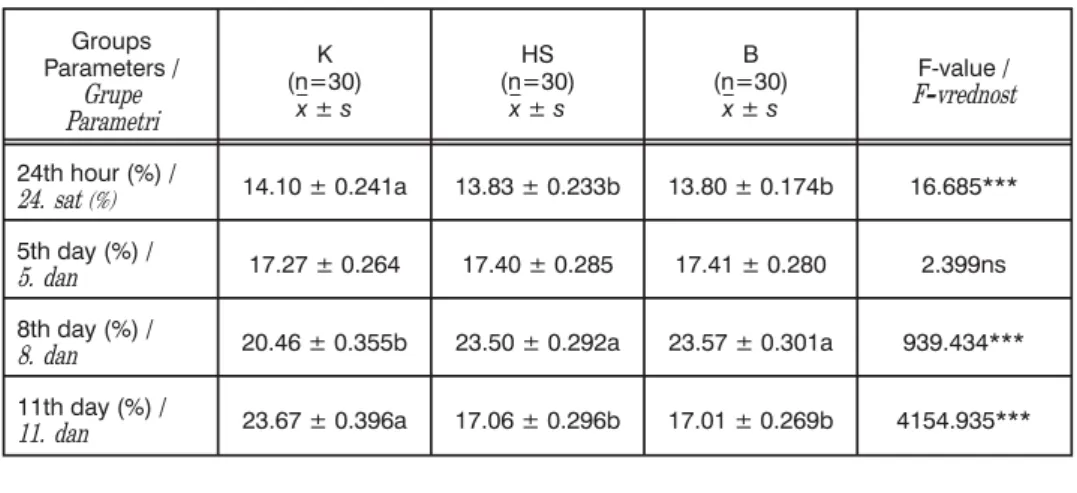
Results of the effect of pre slaughter handling (PSH) during ageing on the meat parameters are presented in Tables 1-4.
Table 1.Effect of pre-slaughter handling and ageing on the pH of meat in Marmara Kivircik lambs/
Tabela 1. Efekat rukovanja pre klanja i zrenja na pH mesa kod Marmara Kivircik jagnjadi
Groups Parameters /
Grupe Parametri
C (n=30)
x ± s
HO (n=30)
x ± s
HB (n=30)
x ± s
F-value /
F-vrednost
0 minute /
0 minuta 7.05 ± 0.050 7.04 ± 0.047 7.03 ± 0.064 2.024ns
45th minute /
45 minuta 6.91 ± 0.040a 6.74 ± 0.053c 6.79 ± 0.045b 104.357***
2nd hour /
2 sata 6.79 ± 0.050a 6.55 ±0.057c 6.60 ± 0.052b 165.498***
3rd hour /
3 sata 6.68 ± 0.060a 6.38 ±0.076c 6.43 ± 0.096b 119.686***
4th hour /
4 sata 6.57 ± 0.060a 6.22 ±0.093b 6.26 ± 0.080b 172.557***
8th hour /
8 sati 6.33 ± 0.080a 5.91 ± 0.108b 5.83 ± 0.048c 311.081***
12th hour /
12 sati 6.05 ± 0.100a 5.70 ± 0.107b 5.64 ± 0.036c 198.139***
24th hour /
24 sata 5.83 ± 0.040a 5.79 ± 0.049b 5.79 ± 0.034b 7.582***
48th hour /
48 sati 5.92 ± 0.030a 5.89 ± 0.024b 5.86 ± 0.031c 28.508***
72th hour /
72 sata 6.00 ± 0.030a 5.98 ±0.027b 6.02 ± 0.044a 11.691***
***: P<0.001 ns: P>0.05
Table 2.Meat colour measurement with Minolta / Tabela 2. Merenje boje mesa koriste}i Minoltu
Groups Parameters / Grupe Parametri K (n=30)
x ± s
HS (n=30)
x ± s
B (n=30)
x ± s
F-value /
F-vrednost
L 64.17 ± 2.283a 43.93 ± 2.601c 49.02 ± 4.189b 112.659***
a 16.13 ± 1.169c 18.56 ± 1.077b 21.27 ± 3.041a 16.838***
b 14.53 ± 1.211a 8.92 ± 1.196c 12.72 ± 2.418b 28.142***
***: P<0.001
Table 3.Water holding capacity – WHC measurement / Tabela 3. Kapacitet zadr`avanja vode–merenje WHC
Groups Parameters / Grupe Parametri K (n=30)
x ± s
HS (n=30)
x ± s
B (n=30)
x ± s
F-value /
F-vrednost
24th hour (%) /
24. sat(%) 14.10 ± 0.241a 13.83 ± 0.233b 13.80 ± 0.174b 16.685***
5th day (%) /
5. dan 17.27 ± 0.264 17.40 ± 0.285 17.41 ± 0.280 2.399ns
8th day (%) /
8. dan 20.46 ± 0.355b 23.50 ± 0.292a 23.57 ± 0.301a 939.434***
11th day (%) /
11. dan 23.67 ± 0.396a 17.06 ± 0.296b 17.01 ± 0.269b 4154.935***
***: P<0.001 ns: P>0.05
Table 4. Shear force measurement with Instron Texture Analyser (Newton)/ Tabela 4. Merenje meko}e mesa koriste}i Instron instrument za analizu teksture (Newton)
Groups Parameters / Grupe Parametri K (n=30)
x ± s
HS (n=30)
x ± s
B (n=30)
x ± s
F-value /
F-vrednost
MLD 1801.90 ± 304.942 1705 ± 374.585 1686.4 ± 422.729 0.280ns
pH /pH
The values of pH 45 were similar to those found by Paulicket al. Š14¹. During the first 72 hours post mortem except pH 0, pre-slaughter handling affects the decrease in pH (Table 1). However other studies in lambs Š19¹ showed no sig-nificant differences in the pH 0, pH 45 and pH 24 with the stunning method. Head-only electrical stunning method had an effect on the final pH of the muscle. From 45 minutes onwards significant differences between the different pre-slaughter handling groups were found in pH values. In the control group the lowest value was reached at 24 hours post mortem. On the other hand in the other two groups the lowest value was reached at 18 hours post mortem. Our results agree with those of Vergara and Gallego Š20¹ and Paulicket al. Š14¹, pH decreases more rap-idly, and ageing starts earlier. Petersen and Blackmore Š15¹ found that the in-creased muscle activity in animals stunned electrically is probably responsible for their more rapid post-mortem pH decline.
Meat colour /Boja mesa
Meat of the non stunned lambs was brighter (higher L* values) than that of electrically stunned groups and the difference between the groups was sig-nificant statistically. Also pre slaughter handling affected a* and b* values (Table 2). In similar, studies on domestic birds show that electrically stunned turkeys Š5¹ and broilers Š11¹ have redder meat (higher a* values) than those stunned with CO2.
Water holding capacity /Kapacitet zadr`avanja vode
Significant differences were found between the pre slaughter handling groups in WHC values except on days 5 (Table 3). In all groups (C, HO and HB), WHC decreased (more water expelled) with storage (14.10 ± 0.241, 13.83 ± 0.233 and 13.80 ± 0.174% at 24 h post mortem to 20.46 ± 0.355, 23.50 ± 0.292, 23.57 ± 0.301 at 8 days post slaughter, for C, HO and HB, respectively). This agrees with the study of Koohmaraie, Whipple and Crouse Š10¹, Moore and Young Š12¹ and Vergara and Gallego Š20¹. In the C group the highest percentage of water expelled was at 11 days postmortem and 3 days earlier in the HO and HB groups. The tendency to release more water in the C group after 8 days post mortem sug-gests their initial juiciness could be greater.
Shear force /Meko}a mesa
enzyme present, but also on the muscle pH Š13¹. Vergara and Gallego Š20¹ did not find any differences between the stunned and non-stunned lamb meat shear force value.
The effect on meat quality was assessed in head-only electrically stunned, head-to-back electrically stunned and non-stunned lambs. Shear forces were not significantly different between treatments. However colour (L*,a*,b*), WHC, muscle ultimate pH were found to be significantly higher (P<0.05) between the groups. It is concluded that some of the meat quality parameters are affected by electrical stunning methods.
ACKNOWLEDGEMENT:
This work was supported by Research Fund of the Istanbul University. Project number T-80/23072002.
1. Anil M. H., McKinstry J. L., Wotton S. B.: Electrical stunning and slaughter of pigs: Guidelines for good welfare assurance. Fleischwirtschaft International, 3, 8-13, 1997. - 2. Devine C. E., Graafhuis A. E., Muir P. D., Chrystall B. B.: The effect of growth rate and ulti-mate pH on meat quality of lambs. Meat Science, 35, 63-77, 1993. - 3. Dransfield E.: Model-ling post-mortem tenderisation- V: Inactivation of calpains. Meat Science, 37, 391-409, 1994. - 4. EU Council Directive 93/119. On the protection of animals at the time of slaughter or killing. Official Journal of European Community, 1340/21, 1993. - 5. Fleming B. K., Fron-ing G. W., Beck M. M., Sosnicki A. A.: The effect of carbon dioxide as a preslaughter stun-ning method for turkeys. Poultry Science, 70, 2201-2206, 1991. - 6. Gilbert K. V., Devine C. E.: Effect of electrical stunning on petechial haemorrhages and on the blood pressure of lambs. Meat Science, 7, 197-207, 1982. - 7. Gilbert K. V., Devine C. E., Hand R., Ellery S.: Electrical stunning and stillness of lambs. Meat Science, 11, 45-58, 1984. - 8. Gregory N. G., Wotton S. B.: Sheep slaughtering procedures. I. Survey of abattoir practise. British Vet-erinary Journal, 140, 281-286, 1984. - 9. Kirton A. H., Frazerhurst L. F., Woods E. G., Chrys-tall B. B.: Effect of Electrical Stunning Method and Cardiac Arrest on Bleeding Efficiency Residual Blood and Blood Splash in Lambs. Meat Science, 5, 347-353, 1981. - 10. Koohma-raie M., Whipple G., Crouse J. D.: Acceleration of postmortem tenderization in lambs and Brahman-cross beef carcasses through infusion of calcium chloride. Journal of Animal Sci-ence, 68, 1278-1283, 1990. - 11. Mohan Raj A. B., Grey T. C., Audsely A. R., Gregory N. G.: Effect of electrical and gaseous stunning on the carcass and meat quality of broilers. Poul-try Science, 31, 725-733, 1990. - 12. Moore V. J., Young O. A.: The Effects of Electrical Stimulation, Thawing, Ageing and Packaging on the Colour and Display Life of Lamb Chops. Meat Science, 30, 131-145, 1991. - 13. Murachi T.: Calpain and calpastatin. Trends Biochemistry Science, 8, 167-169, 1983. - 14. Paulick C., Stolle F. A., Von Mickwitz G.: Influ-ence od different methods of stunning on meat quality of sheep. Fleischwirtschaft, 68, 3,
Conclusion /Zaklju~ak
264-271, 1988. - 15. Petersen G. V., Blackmore D. K.: The effect of different slaughter meth-ods on the post mortem glycolysis of muscle in lambs. New Zealand Veterinary Journal, 30, 195-198, 1982. - 16. Petersen G. V., Carr D. H., Davies A. S., Pickett B. T.: The effect of differ-ent methods of electrical stunning of lambs on blood pressure and muscular activity. Meat Science, 16, 1-15, 1986. - 17. SPSS.SPSS for Windows: advanced statistics release 9.0.1. Chicago, USA:SPSS, 1999. - 18. Velarde A., Gispert M., Diestre A., Manteca X.: Effect of Electrical Stunning on Meat and Carcass Quality in Lambs. Meat Science, 63, 3538, 2003. -19. Vergara H., Gallego L.: Effect of type suckling and length of lactation period on car-casss and meat quality in intensive lamb production systems. Meat Science, 52, 2, 221-226, 1999. - 20. Vergara H., Gallego L.: Effect of electrical stunning on meat quality of lamb. Meat Science, 56, 345-349, 2000.
EFEKTI RAZLI^ITIH METODA ELEKTRI^NOG OMAMLJIVANJA NA KVALITET MESA KOD MARMARA KIVIRCIK JAGNJADI U TURSKOJ
S. K. Bujukunal, B. Nazli
Efekti metoda elektri~nog omamljivanja samo glave pore|eni su sa efektima elektri~nog omamljivanja od glave do le|a. Izdvojeno je nasumi~no ukupno 90 jagnjadi Kivircik rase neposredno pre klanja radi sprovo|enja jednog od tri vrste tretmana omamlji-vanja: kontrolna grupa (C), grupa gde je tretirana samo glava (HO; 1,0 A-AC za 3 s pri frekvenciji of 50 Hz), grupa tretmana od glave do le|a (HB; 1,0 A-AC za 3 s pri frekvenciji od 50 Hz) elektri~nim omamljivanjem. Kvalitet mesa je ocenjen ispitivanjem pH, boje kao vred-nosti L, a, b, kapacitet zadr`avanja vode (WHC), i meko}e mesa.
Efekat na kvalitet mesa je procenjen kod jagnjadi koja su elektri~no omamljena u predelu glave, u predelu od glave do le|a, i kod jagnjadi koja nisu omamlji-vana. Meko}a mesa se nije zna~ajno razlikovala me|u tretmanima. Me|utim, boja (L, a, b), kapacitet zadr`avanja vode (WHC) i krajnji pH mi{i}a su se razlikovali po grupama, od-nosno bili su zna~ajno vi{i (p<0,05).
Klju~ne re~i: jagnje, elektri~no omamljivanje, kvalitet
ÕFFEKTÀ RAZLI^NÀH METODOV ÕLEKTRI^ESKOGO OBOL[ENIÂ NA
KA^ESTVO MÂSA UMARMARA KIVIRICIKÂGNÂT V TURCII
S. K. Biyikinal, B. Nazli
Õffektì metodov Ìlektri~eskogo obolçeniÔ tolÝko golovì sranenì s Ìffektami Ìlektri~eskogo obolçeniÔ ot golovì do spini. Nami vìdeleno naobum sovokupno 90 ÔgnÔtKiviricikporodì neposredstvenno do uboÔ radi prove-deniÔ odnogo iz trÒh vidov le~eniÔ obolçeniÔ: kontrolÝnaÔ gruppa (K), gruppa, gde le~ena tolÝko golova (NO; 1,0A-AS za 3 s pri ~astote ot 50Hz) Ìlektri~eskim obol{eniem. Ka~estvo mÔsa oceneno ispìtaniempH, cveta v ka~estve stoimostiL, a, b, moçnostÝ zader`ki vodì (MZV), i mÔgkosti mÔsa.
Õffekt na ka~estvo mÔsa ocenen u ÔgnÔt, Ìlektri~eski obolçÒniìe v predelah golovì, v predelah ot golovì do spinì, i u ÔgnÔt, ne obolçenì. MÔgkostÝ mÔsa ne zna~itelÝno razli~alasÝ me`du le~eniÔmi. Me`du tem, cvet (L, a, b), moçnostÝ zader`ki vodì (MZV) i kraynÔÔpHmì{c razli~alisÝ po gruppah, to estÝ bìli zna~itelÝno bôlÝ{ie (r<0,05).