Papageno down the ages:
A study in fowling methods, with particular reference
to the Palaeolithic of Western Europe
Papageno a través de las épocas: un estudio sobre los métodos de la cría de aves
que hace especial referencia al Paleolítico en la Europa Occidental
KEY WORDS: Fowling, hawking, hunter-gatherer, Palaeolithic. PALABRAS CLAVE:Caza, cetrería, cazadores-recolectores, Paleolítico.
Anne EASTHAM*
ABSTRACT
Man has exploited wild birds, from Modern times, at least as far back into the post as the Middle Palaeolithic. The fowling strategies have remained strikingly in widely differing societies and localities. Uniformly, they depend upon a sophisticated understanding of specific avian behaviour to create the simplest and most effective ways to take the birds. A comparable diversity of species is found in medieval hunting manuals, in Egyptian tomb paintings and in the bone records of Palaeolithic occupation sites in western Europe: this argues that the same techniques must have been used.
RESUMEN
El hombre ha explotado las aves salvajes desde la época antigua, por lo menos desde el Paleolítico Medio. Sorprendentemente, las estra-tegias aquí presentadas han sobrevivido en sociedades y localidades muy diferentes. Todas se muestran uniformes al depender de una sofis-ticada comprensión del comportamiento aviar específico para crear las formas más sencillas y efectivas de atrapar las aves. Encontramos una comparable diversidad de especies en los manuales de caza del medioevo, en las pinturas funerarias egipcias y en los registros óseos de los yacimientos ocupados en el Paleolítico en Europa Occidental, lo que parece constituir un argumento a favor del uso de las mismas técnicas en las distintas épocas.
LABURPENA
Gizakiak aspalditik ustiatzen ditu hegazti basatiak, gutxienez Erdi Paleolitotik. Hemen aurkeztuko ditugun estrategiak, harrigarria badirudi ere, oso gizarte eta leku desberdineetan erabiltzen dira oraindik ere. Alabaina, estrategia horiek guztiak uniformeak agertzen dira, denak oina-rritzen direlako hegaztien berariazko jokabide modu berezia ulertu beharrean: estrategia horiek sinpleak eta eragingarriak izan behar dira he-gaztiak harrapatu ahal izateko. Espezie ugari aurkitzen ditugu bai Erdi Aroko heiza-liburuetan bai Egiptoko ehorzketa-pinturetan edota Europako Mendebaldeko Paleolitiko aztarnategietan aurkitutako hezurretan. Horrekin guztiarekin esan dezakegu tekina berdinak erabili bide zirela aro desberdinetan.
* ANNEEASTHAM, Labordy Ymchwil Cleddau. Cleddau Laboratory for Archaeozoological analysis.
Dolau, Dwrbach, Fishguard, Pembrokeshire, Wales. SA65 9RN. E-mail: [email protected]
RO A L D DA H L first published ‘Danny the
Champion of the World’ a story for children in 1975. In the story Danny and his father create a ‘landmark in the history of poaching’ by filling 200 raisins, beloved of greedy pheasants, with sleeping tablets and by this means bag a record 120 birds. This is a modern innovation tacked on to an ancient method of fowling by making the birds drunk on Nux Vomica or the lees of wine. It is just one of a very extensive repertory of techniques used by peoples at all times and regions to gather food in season. Later there was conflict between the needs of food gatherers and
Literary and artistic sources give an insight into the history and methods employed in the art of fowling, while the archaeological remains provide some information about what was consumed during historic and prehistoric times. In the later periods these sources of information may be mutually supportive but in attempting to understand the hunting techniques of Palaeolithic peoples we lack documentary support.
RICHARD BLOME’s Gentleman’s Recreation of
1686 and NICHOLAS COX’s 1721 work on the same subject come at the end of a long line of sporting manuals produced all over Europe for the education of the gentry in sporting method and etiquette.
Famous amongst these were Helme’s A Jewell
for Gentrie of 1614, GERVASE MARKHAM Hunger’s
Prevention:or the Whole Arte of Fowling of 1621 and medieval works like the Livre de la Chasse by GASTON PHOEBUS, Count of Foix (1331-1391) - the
translation of which was made by EDWARDDUKEof
York while imprisoned in Pevensey Castle 1406–13 and appeared under the title Master of Game -, the Libro de la Monteria of ALFONSOXIthe
Boke of St Alban’s ascribed to DAME JULIANA
BERNERS, or the poem by Gace de la Vigne Le
Roman des Deduis, all emphasise the pleasures gained, and the skills acquired from fowling and hunting with hawks, although the chase was also regarded as a training ground for war and Spanish texts are specific on the matter. ALFONSO XI OF
CASTILLE(1312 – 49) stipulated:
‘A knight should always engage in anything to do with arms and chivalry and if he cannot do so in war, he should do so in activities which resemble war’.
The initial requirement insisted on in the manuals is for the hunter to understand what Çtoday we call the ethology of the prey species, their haunts and preferences and on this understanding construct devices for their capture.
As BLOME puts it, ‘Fowling is an art for the
taking all manner of fowl, either by enticement or enchantment, as calls, intoxicating baits, or the like, or else by guns, nets, engines, traps, setting dogs etc.’ Later he adds that: ‘It is easy to ensnare any creature or fowl, if their nature is fully understood and what they delight in either for food or exercise.’
The ‘Enchantments’ included disguise in the form of a stalking horse or even a false bush behind which the hunter waited until the bird was within range. By the time of BLOME or COX, the
weapon was often a gun but earlier, bows and arrows or throwing sticks were used. Another form of enticement is found in the different types
of call, which is imitated with various whistles and devices a combination of disguise and call was effective for certain species. It is possible to imagine that the upright, skin-clad figure with a bow in his mouth on the panel in the cave of Trois Frères in Ariège, could have been engaged in a comparable activity as part of a hunting strategy. Certainly, some of the bone flutes and whistles recovered in the excavation of Upper Palaeolithic deposits would have been capable of producing sound in imitation of bird calls.
The preparation of drugs from specific plant poisons, which leave the flesh untainted are described in some detail by BLOME and others, including the unknown country squire EDWARD
DAVIES. The drugs were based on three main
poisons: Nux vomica or gall nut, hemlock and lees of wine, all of which rendered the birds and especially wildfowl sufficiently senseless to be gathered up. There can be no archaeological evidence for a naturally derived drug, which leaves no trace. Yet classical sources and Egyptian records suggest that a considerable knowledge of the properties of plants and other materials was already in existence from the earliest times. The use of this knowledge continued into recent times. EDWARD DAVIES of Carnarvon writes in his
commonplace book of 1725‘ a direction to take all sorts of fowls, and birds such as crows and so forth: take such sorts of seeds as the fowls or birds are wont to feed on and lay it soaking in the mother of wine mixed with cicute (Water hemlock) and, when well soaked throw it in the places where the birds or fowls feed and they’ll be presently drunk and loose in their senses and you may take them in your hand.’
Another effective preparation in the same category was birdlime. Both BLOME and COX
recapitulate the recipe. Holly bark, stripped from the tree in June, was boiled in water until the green bark could be separated from the lower layers. It was then rotted under a layer of hemlock, dock, and other weeds until soft enough to pound to a paste in a mortar and washed a second time.
sizes, from Geese, anseridae, and Ducks, anatidae, to waders on the marshes, small passerines, perching on twigs or to larks and other ground feeding birds caught on the limed tips of the grasses. It was even possible to catch the legs of waterfowl on sticks driven into the muddy banks of ponds and rivers and concealed by the water. Blome describes the taking of migrant Thrushes, Turdidae, on bushes in this way, and Cox elaborates on the use of limed grasses and ears of corn:
‘go into the field adjacent to your house and carry a bag of chaff and threshed ears and scatter these together 20 yards wide. Then take the limed ears and stick them up and down, with the ears leaning or at the end touching the ground. Then, retire from the place and traverse the grounds all round about, the birds being disturbed in their haunts fly thither and, picking at the ears of corn and finding that they stick upon them, they straightway mount up from the earth and in their flight the birdlimed straws lay under their wings and falling are not able to disengage themselves from the straws, and so, are easily taken.’
Again there is no evidence for the use of birdlime in the archaeological record of any period. Nevertheless, the ingredients are readily to hand and the skill in its implementation lies more in understanding avian behaviour and how to apply that knowledge than in the technology of birdlime production. For a hunter-gatherer population on the move it would have the advantage that supplies could be cached, without deteriorating, at sites where fowling was practised on a seaso nal basis and would be ready for use whenever the group returned.
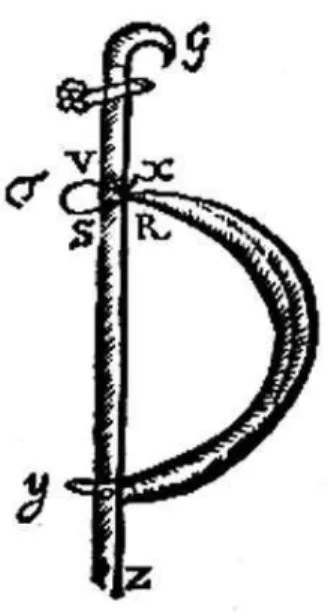
Springs, lines, pitfalls and horse hair nooses were effective for catching a diversity of species on their own or in combination with lime [Fig.1.] Sometimes multiple nooses on a circular frame would be used to take Thrushes on migration or more specifically on mistletoe [Fig.2.]. But, probably the most productive device was the net, the designs for which had remained virtually unchanged since its use was first depicted in Egyptian tomb paintings.
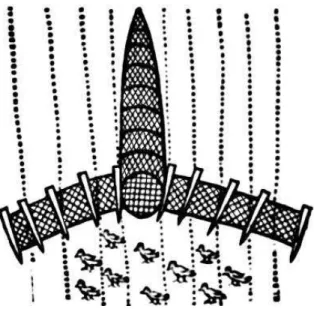
By the sixteenth and seventeenth centuries, the use of nets was complex and ingenious and usually combined with other incentives or devices to attract the birds to the trap. Essentially, they are all variations on the flat, spread net used vertically or as a drag net, different types of clap net, drawn together either by mechanical means or in the hand, tunnel nets and hand held bat nets [Figs. 3, 4, 5 & 6].
Fig.1. The horse hair noose – after Blome 1686.
Fig.2. Multiple horse hair noose for catching Thrushes – after Blome 1686.
Fig. 4. Hand drawn clap net for sparrows – after Blome
1686.
Fig. 5. Hand held bat nets – after Blome 1686.
Fig. 6. Day net for taking Larks and small birds between August and November – after Blome 1686.
Fig. 7. Net for taking Woodcock in cockroads – after Blome 1686.
Flat, nets set vertically in woodland drives, or cockshuts were the most effective way of catching Woodcock, Scolopax rusticola. GEORGE OWEN
writing his Description of Penbrokshire 1603, gives a account of taking Woodcock in woods with nets at ‘cocke shoote tyme, which is the twylight after the breaking of the day and before the closinge of the night.’ Often they took several birds at a time, up to twenty-eight in an evening and it was said that a hundred or six score had been taken in a single twenty-four hours [Fig. 7]. By comparison, the entry in the Holkham Hall gamebook of 20th November 1829 that WILLIAM
CHANTREY ‘killed at one shot two Woodcock’ looks
Fig. 8. Bramble nets for taking Coots, Moorhens and Partridges – after Blome 1686.
Fig. 9. Tunnel nets for taking Partridges – after Blome 1686.
Tunnel nets were a further variation. They were used to take Quail and Partridge on the ground by gently driving the birds into the mouth of the tunnel, often attracted by a trail of grain [Fig. 9]. An enlargement of the tunnel net came to be used for catching large numbers of wildfowl during the Autumn and Winter months. Originally a simple net or pipe into which Duck could be led by following a dog or call duck as a decoy, these were developed into elaborate structures in Holland during the 16th century and continued on estates or in commercial use until the early part of the 20th
century. An important element of the success of the duck decoy was the piper dog, which, like the fox, the natural enemy of wildfowl, served both as an attraction and an object of menace to be kept under surveillance. In order to do so, like the
medieval image of the geese flocking to the preaching fox, they followed him into the trap (KEAR 1990, MARCHINGTON 1980). Although decoy
tunnels were particularly effective in areas where large numbers of migratory waterfowl rested, they were also used to detrimental effect on resident stocks at the time of the moult when the birds were unable to fly until the practice became illegal.
The deployment of a different type of decoy used the natural reactions of fear and aggression towards the presence of a predator to catch small birds as they attacked an owl tethered to perches on the ground. Blome recounts and illustrates the way in which Horned or Eagle owls, Bubo bubo, were frequently employed in this strategy but the mobbing instinct in passerine species, though particularly evident as a response to the presence of owls, operates as a response to a diversit y of raptorial birds. Once gathered round the owl, birds could readily be netted or caught on limed sticks [Fig.10]. A misericord carving of the 14th
mortem. At the site of Le Morin, Gironde, (MO U R E R CH A U V I R É 1975, GO U R I C H O N 1994) a
calculated 54 individuals were found and a similar number were excavated in the debris of the clandestine excavations at the Grotte de Bourrouilla at Arancou, Pyrénées Atlantiques; while at the nearby site of the Abri Dufaure on the Gave d’Oleron both Snowy and Eagle owl appeared in the various levels of the occupation. A totemic requirement for their flesh, for their plumage, the use of their claws as clothing fasteners or as barbs on harpoons are some of the reasons which have been offered for the puzzle of the preferential hunting of large owls. Their use as decoys for other birds seems equally viable as a function in a society of hunter-gatherers. In parietal art, the engravings interpreted as Snowy owls Nyctea scandiaca engraved in the tréfond at the Grotte des Trois Frères, Montesquieu Avantes, [Fig. 12] has marks above the heads of the two adult owls which just might be taken to represent small birds and the sketch of a horned owl, perhaps Bubo bubo standing in a similar position above a void in Chauvet bears a marked resemblance to the owl on the misericord in Gloucester Cathedral (CHAUVET et al. 1995), [Fig
13] .
Fig. 10. A method of taking birds by the use of Owl decoys and nets – after Blome 1686.
Fig. 11. Small birds mobbing a Horned owl, a misericord in Gloucester Cathedral.
Fig. 12. Snowy owls in the tréfond at the Grotte des Trois Frères, Ariège.
Hawks rather than owls were more frequently used in hunting. In the Middle Ages, falconry was a gentry sport for people with time and a certain amount of money to spend. It was never an economic pursuit. The Boke of St Albans, 1486, famously listed with a certain sense of humour the rightful order of ownership for each species of Hawk and Falcon, one which was synonymous with the medieval vision of the natural order. Apart from eagles and vultures, whose ownership was the prerogative of princes and who were not of much practical use in the chase, the manuals describe nine species of accipter and falcon and their characteristics when hunting in the field (HANDS 1975). In aristocratic households, the
falconer was among the highest paid servants and high prices were paid for young birds. The best were used in the exchange of gifts between monarchs and in the 15th century Scandinavian birds were regarded as the finest available in the European market. They were used for taking all kinds of wildfowl, Cranes, Bustards and waders for the table. Nevertheless, hawking was never as effective as the nets and devices commonly used by the fowler (CUMMINS1988).
Concern for the preservation of game was a continuing issue for the British crown - even from Anglo-Saxon times - according to Thomas Lyttleton’s Treatise on Tenures of around 1462, as interpreted in the 17th century by Sir Edward Coke and recounted by William Nelson (NELSON
1751). In 1016 Canute was created with having introduced forest laws and the Norman kings reinforced their application to the taking of game. Edward III issued a series of statutes prohibiting the unlawful taking or stealing of hawks. Henry VII gave some protection to herons, pheasants and partridges, and demanded forfeiture to the king of certain hawks and falcons; the taking of eggs of falcons and swans carried a sentence of imprisonment (Henry VII Statute 19 and 11). HENRY VIII passed an ‘Act against the Distruction
of Wild-fowl’, which created a closed season for wildfowl from 31st May until 31st August; under
statute 25 it became illegal to take the eggs of wildfowl, Cranes, Bustard, Bittern, Spoonbill or Heron between 31st March and 30th June. Some
of this legislation may have been concerned with the conservation of stocks but a great deal was motivated by a fear that the trapping devices used for subsistence by poor tenant farmers and labourers in the countryside were so efficient as to deprive the landowners of their sport. The legislation and the limits it imposed upon the
employment of traditional devices turned many skilled fowlers into poachers and reduced the sport of the gentry to the use of the shotgun.
Blome claimed that the classical world had no use for falconry. Nevertheless, Greek and Latin texts are full of imagery and references to fowling and avian predation. It is true that neither Plato nor Aristotle valued the arts of hunting except as an adjunct to the training of youth for the arts of war or as part of pastoral life (Politics I.3). Zenophon, however, likens the skills of hunting hares to the wiles required in the acquisition of friends. In the comparison the hounds are the agents by which contact is made and the nets are the charm and attention and devotion with which the new friend is captivated (Memorabilia III). But it is the epic poems, which demonstrate that hunting with hawk, hound and snaring devices was a well understood part of Greek life. There are also references to shooting eagles with bow and arrow. Homer, composing in the 8th century BC and capturing scenes of dramatic action in his narrative, reverts repeatedly to imagery of various forms of hunting with eagles and hawks descending on their prey. In the Odyssey, in Penelope’s dream the eagle descends on her geese but, more significantly for the denouement of the story, Telemachus is reassured that his father will return and put his house in order,
‘Just as the eagle swooped down from the crags
where it was born and bred, just as it snatched could touch the ground
the goose fattened up for the kill inside the house,
so, after many trials and roving long and hard, Odysseus will descend on his house and take revenge.’ (Bk 15. LINE194-198)
Father and son discovering each other again, weep:
They cried out, shrilling cries, pulsing sharper Than birds of prey –Eagles, vultures with hooked
claws-When farmers plunder their nests of young too young to fly. (Bk 16. LINE246 – 249)
The metaphor appears to reflect a familiarity with the taking of raptors for training for the chase.
fowling method, possibly something like a giant version of the multiple horsehair noose described by Blome:
‘With that, taking a cable used on a dark prowed ship
he coiled it over the roundhouse, lashed it fast to a tall column,
hoisting it up so no toes could touch the ground.
Then, as doves or thrushes beating their spread wings
against some snare rigged up in thickets - flying in
for a cosy nest but a grisly bed receives them–so the womens’s heads were trapped in a line,
nooses yanked their heads up, one by one so all might die a pitiful, ghastly death…
they kicked up heels for a little not for long.’ (Bk 22 LINÉ491– 499)
In the cataclysmic struggle of gods and men, told in the Iliad, even Zeus himself takes on the role of stooping raptorial bird:
‘Then off he sped with the speed of a darting hawk
That soaring up from a sheer rock face, hovering high,
Swoops at the plain to harry larks and
swallows.’ (Bk 13 LINÉ77-79)
Similar imagery is used by Virgil (1st century BC) in the Aeneid. In the Georgics he introduces a more practical commentary on seasonal tasks and weather lore; so that Winter is the time to set snares for cranes and it is possible to predict the weather by observing avian behaviour, emphasising the necessity for a close observation as part of the fowler’s skill.
A later Latin writer, Longus, towards the end of the 2nd century ADre-writes the story of D
APHNIS
and CHLOE, setting the tale on the island of Lesbos
and embellishing it with a degree of humour and with details taken from daily life. In Book II a party of youths, on holiday from Methymna, row out to snare Geese, Ducks and Bustard. They interrupt the lovers and beat up Daphnis when his goats eat their makeshift mooring line. In the following Winter, the lovesick Daphnis, forbidden a meeting with Chloe sets snares and twigs coated with birdlime outside the cottage in which she is confined, since fowling would look like a legitimate activity for the time of year. The Thrushes,
Pigeons and Starlings arrive in large numbers and are safely taken; by a happy accident he gets to see the girl as well.
Bone reports from excavations of Roman sites in Europe indicate that, although there was a considerable reliance on farmed stock of domestic fowls and geese, other species like Ostrich, Flamingo, Crane or Peacock were hunted or reared for the table and towards the latter part of the 3rdand 4thcenturies small passerines including
those snared by Daphnis appear in the midden deposits. The late 3rd century version of M.
GABBIUS Apicius advice on cookery - aimed at the
gourmet rather than the peasant end of the market - includes recipes for all types of wildfowl and game bird as well as Thrush and Turtledove.
In the documents which have come down to us from the early civilisations of the Near East the hunting of wild birds is recorded somewhat diversely. In Egyptian tomb paintings, the practice of hunting and wildfowling does not appear to have been affected by any great divisions of class. Hunting and fishing trips into the Nile marshes seem to have been undertaken by master and servant equally, although, the manual work of netting is not usually done by members of the executive ruling classes. Senior court officials and their servants participated in exploiting the riches of the land and the waters.
In Mesopotamia and in the art of Asia Minor, throughout the periods from the Early Dynastic to the Babylonian and Hittite empires the attitude to birds appears to have been tied into ideas of hierarchical order. Eagles and winged beasts are used as heraldic symbols of power: Eagles are shown on cylinder seals and in architectural detail in single and double headed form. Other birds may have carried different meanings. A sculpted stele from Lilith, dated to the early 3rd or late 2nd
millenium BC, depicts pairs of Barn owl Tyto alba as the bringer of death. Death and its rituals was evident in the 7th millenium BC paintings of
vultures at Catal Huyuk, which mirror the Neolithic practice of exposing the dead on platforms outside the settlement (MELLAART1965). Hunting for the pot was also carried out. In the late Assyrian period, cylinder seals are described as featuring Ostriches. Struthio camelus is now extinct in Egypt. During the 19thcentury, S.c.syriacus
was common in the region round Kuwait and Bahrain until 1914 and previously in Arabia as far as 33.50N. LAYARDin 1853 on his journeys through
falcons at the Houbara bustard Chlamydotis undulata. The images on the cylinder seals may possibly be used to denote either species.
On the alluvial plains of southern Mesopotamia, at Abu Salabikh, a 3rdmillenium BC
tell site gives evidence of regular wildfowling on the marshes and the canals linking the site to the Euphrates river (POSTGATE 1980, MATTHEWS and
POSTGATE 1994). At the same period and on the
same site a young child was buried together with his Goshawk Accipiter gentilis. This dual interrment seems to demonstrate the importance of falconry to both marsh and desert dwellers possibly as a means of subsistence but certainly as a mark of status. Layard in his travels emphasises the value of hawks and how they are prized among Persians and Kurds alike for the taking of specific prey and to demonstrate the prowess of the bird and the skills of its handler. He also reflects how close is the bond between man and bird among the Bedouin when, one day Suttum’s falcon Hattab flies at a Bustard, is attacked by a kite and disappears. As he weeps, Suttum exclaims that Hattab was not a bird, he was a brother.
In Egyptian tomb decoration there are many detailed illustrations of the methods used in the culling of wildfowl and other species in the Nile delta from every dynastic period. The tombs of the great western cemetery of Gizeh, situated on the west side of the pyramid of Cheops and to the north of the pyramid of Chephren were built for the senior servants and officials of the kings of the III – VI dynasties. The decoration of some of these tombs contains images, which demonstrate the importance of birds in the lives of the executive classes. The mastaba cemetery G6000 was begun during the reign of Cheops and has had been assigned to a variety of dates within the 3rd
millenium BC by successive archaeologists. It was recently re-recorded by the Department of Ancient Egyptian, Nubian and Eastern art of the Museum of Fine arts, Boston [K. R. WEEKS1994].
The tomb of Iymery, estates steward to the king of Upper and Lower Egypt, – Mastaba G6020 -provides an example of how important it was to make provision for the after life. The first chamber shows the provisioning of the deceased. The offerings processed along the east wall feature geese, probably Grey lag, Anser anser, since these were regularly kept in captivity and probably domesticated, and, on the fourth register of the west wall, a man leads two Common cranes, Grus grus, and a Demoiselle crane, Anthropoides virgo. From the text, each represents 1,000 cranes [Fig 14]. Pictures of cranes are not an unusual feature in the tombs. There are a number at Saqqara in tombs from the Vth andVIth dynasties; it would appear that they were netted and kept in captivity in troops or flocks and sometimes force fed [HOULIHAN 1986].
At the present day, the Common crane has a distribution which is restricted to the delta and the Upper Nile; the Demoiselle crane is seldom seen in Egypt though large numbers over-winter in the Sudan, so that the frequency of both species in the imagery of the tombs may reflect the known decrease in population since medieval times in all their habitat areas [CRAMPed 1982].
Scenes on the walls of the second chamber of the tomb of Iymery depict the activities of daily life within the household and out on the fields or the marshes. Cattle are butchered, ducks plucked and cooked, entertainment offered; in a picture on the north wall, wildfowl are taken in a hexagonal clap net to which three men are roped ready to haul in when the overseer gives the signal.
At Saqqara, the VIth dynasty tomb of Hesi, who became Vizier to Kings Pepi and Teti, depicts the techniques used in capturing the birds of the fields and marshes in greater detail (N.KANAWATI&
M. ABDER-RAZIQ 1999). The middle register of the
architrave above the portico contains a rare scene of men harvesting barley; as they cut the stalks Quail and Partridge appear amongst the stubble to be quickly taken in a net drawn across the field.
[Fig.15] In many respects the design of the drag net appears to resemble that described by RICHARDBLOMEin AD 1686.
On the south portico, above the scene of fishing from a boat among the papyrus stems there are birds flying and nesting among the umbels. HOULIHAN[1986] recognised a pair of Pied
kingfishers, Ceryle rudis, an egret, Egretta sp.on its eggs, pair of Egyptian geese, Alopochen aegyptiaca, defending their nestlings from a mongoose and Purple gallinule, Porphyrio porphyro. Above the papyrus thicket a variety of birds take to the air in symmetrical rows one above the other. Amongst them Lapwing, Vanellus vanellus, Glossy ibis, Plegadis facinellus, Kingfisher, Alcedo athis, Hoopoe, Upupa epops and Turtle dove, Streptopelia turtur are readily recognisable. The scene shows the tomb owner, with his wife, fishing and fowling, while in the upper registers, to the left of the main image, the attendants arrive bringing equipment for the hunt: throwing sticks, spears and bags.
To the west of the entrance, a comparable scene is repeated and, similar bird species and their predators are depicted among the reeds. Here, the attendants are shown using nets in addition to spears and throwing sticks. Hesi himself seems to have three decoy birds in his hand, a goose, a Hoopoe and possibly a kingfisher.
Fowling with a clap net set amongst thick, aquatic vegetation is also featured on the east wall of the same chamber [Fig. 16]. In the net, Egyptian geese are crowded together, while outside Spoonbill, Platalea leucorodia, a Bittern,
Botaurus stellaris or Night Heron Nycticorax nycticorax and a Lapwing, Vanellus vanellus look on. A line of six men stand holding the rope, ready to close the net on the orders of the overse-er, at whose feet is perched another Bittern or Night heron, apparently oblivious to the struggle which is taking place.
A further variation in the type of netting may be seen on the west wall of the chamber. The second register shows birds netted in a tree – described as a sycamore fig tree – and capturing a flock of Golden orioles, Oriolus oriolus, with a single Hoopoe Upupa epops caught up in the group [Fig. 17]. The net is triangular in shape and birds are enticed to entangle themselves in its mesh with mimicked calls. In the same register spring traps have been set to catch birds on the ground and a flock of geese are being fed grain in a yard.
The conventions governing the themes of tomb decoration continued with little change into
the Middle Kingdom, 1994 - 1781 BC (A.M.
BLACKMAN 1915). The XII dynasty tomb chapel of
Ukh-Hotp, son of Senbi and Nomarch of Upper Egypt also shows the importance of wildfowling in the Nile valley. On the north wall, a scene of netting ducks, shows five men taking the strain on the rope, awaiting the signal from the overseer to haul it in. The rope is anchored at one end to a peg on the bank and at the other attached in a reef knot to the end-ties of the hexagonal net, submerged in the water. The spoils of the hunt appear among the offerings brought to the Nomarch as pictured on the north wall. Two men
Fig. 15. Catching Quail in a barley field; the tomb of Hesi at Saqqara.
carry armfuls of Pintail ducks and a possible heron. All are evidently live and attacking their captors; the heron’s beak is grasped firmly in the right hand of the second man.
The tradition persists. In the tomb of Nacht, built during the XVIII dynasty at Thebes, on the slopes of Sheikh abd’l-Qurna, probably during the reign of Thutmose IV, 1402 - 1392 BC (ABDEL
GHAFFAR SHEDID & MATTHIAS SEIDEL 1996), despite
stylistic changes, the concept and practice of hunting wild birds remained the same. The scene of Nacht and his wife and family wildfowling in the marshes shows them using the same kind of throwing sticks and his servants using a clap net identical in design to that manipulated by Iymery’s fowlers during the IV Dynasty [Fig.18].
These tombs, taken out of a considerable time span, are just a tiny sample from the huge corpus of known Egyptian funerary art. For each of them the marshes represent an unfailing resource, whose fecundity symbolises the continuity of life for the deceased and his genetic descendants. This abundance is evidenced in the simplicity of
the equipment used in the exploitation of birds, fish and mammals. In the three tomb complexes selected, spears, throwing sticks, three types of net and, in the tomb of Hesi, bows and arrows with sickle - shaped heads are the only weapons used in the taking of birds in the marshes. HOULIHAN (1986) identified 72 species of birds,
from Ostrich to Sparrow in Egyptian tombs, mainly as pictorial images on the walls but with some sculptures and mummified specimens. The portrayal of each species is sufficiently accurate for identification to be obvious. The understanding of avian “Jizz” is so clear in the pictorial record and even in the textual hieroglyphics that it speaks of a people very close to their environment. The ecological fecundity of the land became a symbol for the perpetuation of the human descent and the maintenance of world order against the forces of chaos (SHEDID& SEIDEL1996).
The concept that the fecundity of the country takes care of you as you care for it lives on among the Gundjehmi speaking peoples of Arnhem Land, Northern Territory of Australia. It is the important element in their traditional way of life and care for country is expressed in the art and in the lives of recent aboriginal groups. The poet Bill Neidjie, born on the banks of the East Alligator river, puts into words this sense of identity with the land which nurtures his people and their hunter-gatherer past:
We brought up like all animal and bird because eagle e fly round or might be jabiru, might be brolga might be goose.
Goose good eating. You got to eat goose because goose e breed up again.
Soon as wet, e got to make egg…good eating. Or goanna or long-neck turtle…
brought up because for us to eat.
Fig. 18. Nacht and his wife hunting on the Theban marshes.
Long neck turtle you got to eat
but e get plenty again, e breed up more. Even goanna e’ll breed again.
Geese…e can eat two hundred but e’ll come. E breed up here, egg…
another plain, another plain, another plain. You might get one thousand and thousand goose.
Moving back in time into the hunter-gatherer society of Mesolithic Europe, there is strong evidence for the seasonal exploitation of birds. J. G. D. CLARKin 1948 summarised the evidence for
wildfowling in the Maglemosian, Hamburgian and Erteblle cultures of northern Europe, each group representing a particular type of habitat. The Maglemosian Summer settlements on the bogs of Zealand were mainly associated with freshwater birds, the coastal dwellers of the Ertebolle culture were shown to take more marine species and the majority of them were winter migrants. Capercaille, Tetrao urogallus, was taken by both groups. The most numerous species on the Hamburgian camp sites of north Germany were geese and swans and the presence of young birds suggested that these were summer hunting sites. There is no direct evidence of nets or other snaring devices in direct association with catching birds but there are finds which suggest that these existed. For example: baskets and fishtraps dated to 8,000 BP were recovered from the wetland settlement at Noyon sur Seine (MO R D A N T &
MORDANT1992). The Mesolithic site at Friesack, in
north Germany, was occupied probably on an annual basis from the pre-Boreal into the Atlantic period – ca 9.5 – 8.2/ 7.0 Ka BP - and, in a culture comparable to the Maglemosian of Denmark, rope and nets were being made out of bast (GRAMSCH
1992). Much depends on the conditions for the preservation of these materials but the body of evidence is growing that extensive use was being made of plant fibres to create ropes and fine netting at this time. Throwing sticks similar to those illustrated in Egyptian paintings were also found in the context of the Danish Maglemosian (CLARK 1948). Arrows also are recorded as being found in association with avian bone on late Palaeolithic and Mesolithic sites. At Meiendorf, a Hamburgian occupation site in Schleswig-Holstein, a Ptarmigan, Lagopus mutus, and a Crane, Grus grus, were recovered with apparent arrow wounds to the pelvis and sternum (RUST1937).
The seasonal exploitation of game and wildfowl as practised by Mesolithic people has been found to continue into the Neolithic and later periods in Scotland. The early farmers at Skara Brae on Mainland, Orkney took seabirds on nearby cliffs, wildfowl on the inland waters and wading birds on the marshes and machair. In all the bones of some 43 species were present on the site, a mixture of summer and winter visitors so that it would seem that fowling was an all-year activity. In the spring the inhabitants also collected eggs and from the small sample of eggshell studied, it was established that eggs were taken from at least 18 of the species who would have bred on the island at that time (EASTHAMin press). The list
of species found at Skara Brae compares closely with another Neolithic settlement at Knap of Howar on Papa Westray. Seabirds form the greater proportion of the kill on both sites of which the Gannet, Sula bassana, was the most important. Seabird exploitation continued on an annual basis in northern Scotland, Orkney and the Hebridean islands through later prehistoric, medieval and recent times (SERJEANTSON1988) but the primary method of collection was by scaling the cliffs and taking the birds by hand.
during subsequent eras. Outside the categories of birds that were probably hunted by man, vultures, kites and corvids may well have been destroyed because they were scavenging on the meat of fresh kills lying close to the settlement areas. Some of them may have been eaten subsequently, since their meat is perfectly palatable. Other species would have been attracted to the insect life and maggots on the rotting carcases and rejected parts of the meat so that a natural food chain was likely to develop on occupation sites over time.
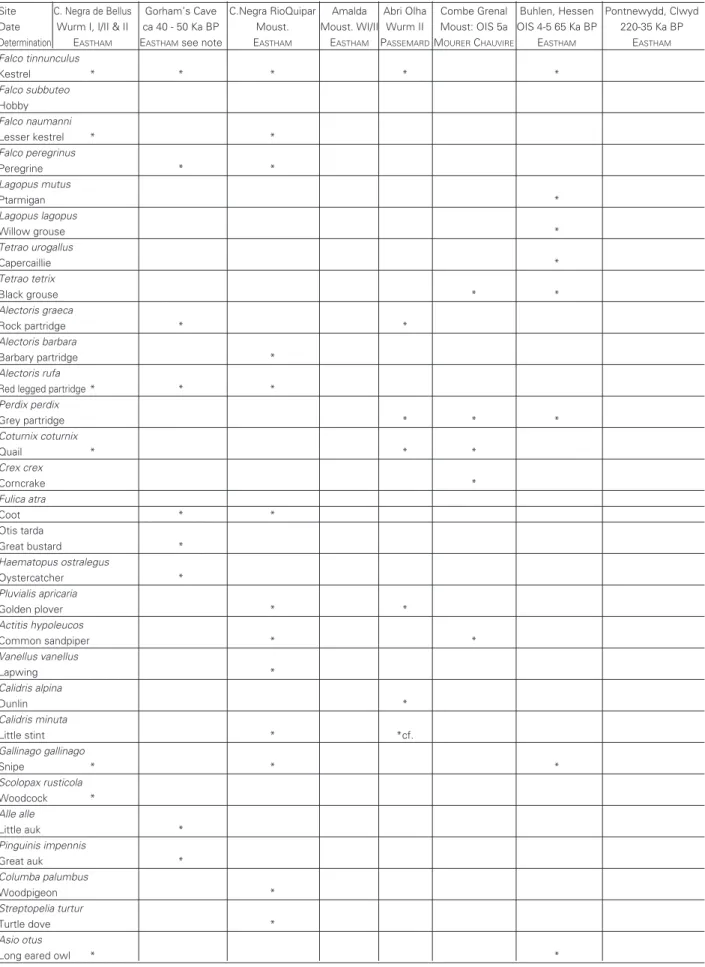
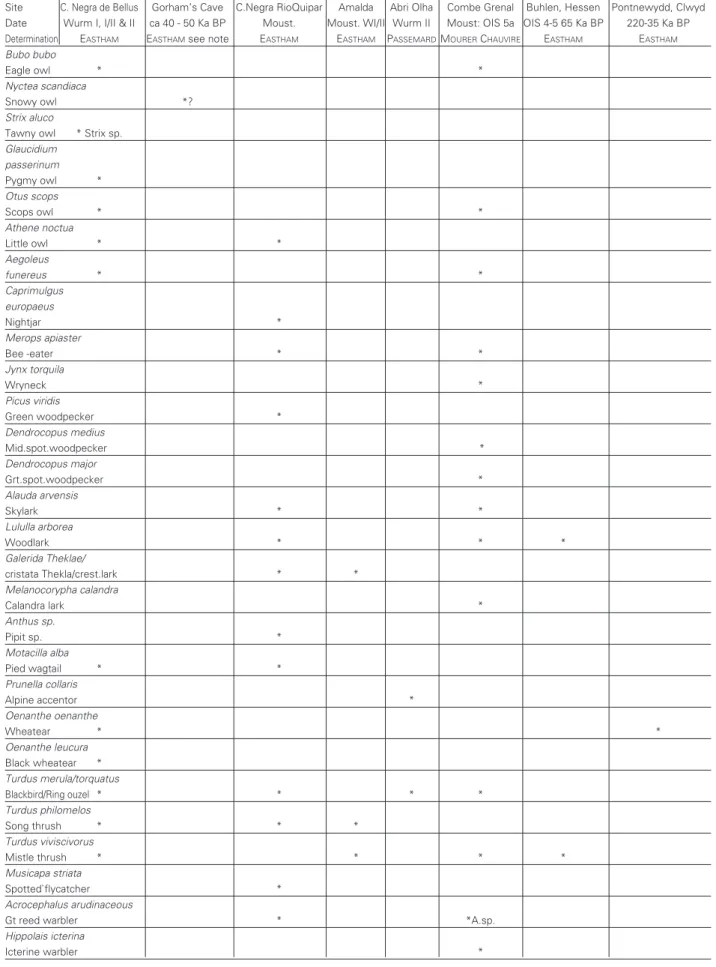
It will be useful to give a brief analysis of the birds identified as present in the deposits of the sample sites within the three sets of time parameters selected.
The late glacial cave sites of the Pyrenean foothills in south west France and along the Cantabrian coast of Spain suggest pattern of exploitation in which a diversity of hunting techniques were used (Table I). The records show that four main avian groups appear on each of these lists: waterfowl, game birds, ground feeders and small passerine species. Yet there remains the possibility that some hawks, falcons or even owls could have been taken from the nest as fledglings, tamed and trained to become part of the hunting team.
In general, the sites in Table I have certain features in common in the pattern of avian predation. The variations are often related to the location of the site but may reflect a difference in seasonal occupation. The Abri Dufaure, one of the series of Magdalenian occupation floors along the base of the Pastou cliff, near Sordes l’Abbaye, Landes, was repeatedly occupied from November until the spring, probably March (EASTHAM in
STRAUSet al 1995). Some of the bird species could
only have come there as winter migrants and the studies of ungulate teeth, reindeer in particular and the small number of fish bones confirm the findings from the bird data. Most conspicuous as winter visitors were the Great northern diver, Gavia immer, Bewick’s swan, Cygnus columbianus, geese and ducks - except for the Mallard, Anas platyrhyncos, and possibly Teal, Anas crecca but waterfowl were not the only species seeking shel-tered niche beside the Gave d’Oloron. Redwing, Turdus iliacus, tends to move south westerly in winter and the Snow finch, Montifringilla nivalis and Ptarmigan, Lagopus mutus, would have descended into the valley from the snow- bound Pyrenees. The presence of both species in the Magdalenian levels at Mas - d’Azil suggests that
these localised seasonal movements were normal (VILETTE 1983) . There is a disparity between the
broad diversity of bird species at the Abri Dufaure and the small number at the adjacent site of Duruthy. This may be explained by the evidence of the fish remains which show that the occupants of Duruthy arrived earlier in the year than the Dufaure hunters to take advantage of the September salmon run (LEGALL1995). They were
probably smoking the fish for winter use and may have had no necessity to supplement supplies with avian resources or, possibly, the two adjacent sites were mutually supportive.
It has been considered that the reindeer hunters of the Pastou sites moved with the herds on an annual basis between the Landes and the mountains. The Magdalenian occupants of the Grotte de Bourrouilla close by at Arancou, some 14 kilometres to the south west, probably exploited the avian resources of the locality in much the same way as their neighbours along the Pastou cliff, although it would appear that occupation at the Grotte de Borrouilla extended over a longer period of the year. They too were taking wildfowl on the rivers Lauhirasse, Bidouze, the Gave d’Oloron or the marshy pools to the west of the Gave but they were also catching Grouse, Lagopus mutus, L.lagopus Tetrao tetrix, Partridge, Perdix perdix, and Quail, Coturnix coturnix in the open country between. Thrushes of all species were also present at Arancou, with a number of other small passerine species, some of which would have been present only during the summer months (EASTHAM1999).
glandarius was found at Ekain and may have significance for the local ecology because, as well as being a predator of small birds and their eggs in spring it like the Crow Corvus corone and the Woodpigeon Columba palumbus found at Urtiaga, consumes acorns in large quantities as they become ripe in the Autumn. It is, therefore, normally considered a good indicator for the presence among the arboreal cover of different species of oak trees, Quercus sps.
Table II lists the birds from a number of sites in northern Spain from around 39Ka BP until about 16Ka BP, either side of the Last Glacial maximum. This arbitrary timespan covers cultural phases from the early stages of the Aurignacian at El Castillo, Puente Viesgo, Santander, and the Grotte de l’Arbreda, Gerona and Isturitz, Pyrénées Atlantiques, through levels of Solutrean to the later Perigordian at Aitzbitarte IV and Amalda caves. The range of dates is so wide that only a general impression of avian exploitation patterns can be ascertained and, as was found at sites belonging to final stages of the Last Glaciation, these patterns depend more on location and availability than on variable technology.
Bird bone assemblages from the Aurignacian layers of the cave of El Castillo include a variety of wild fowl, mainly winter migrants, a sprinkling of gamebirds, including Ptarmigan, Lagopus mutus, Hazel grouse, Bonasia bonasia and Corn crake, Crex crex, with a number of waders, among them, Grey plover, Calidris canutus, Dunlin, Calidris alpina and Black tailed godwit, Limosa limosa, who would all have been winter migrants; were probably taken on the marshes at the confluence of the Pas and the Pisuena rivers less than three kilometres from the cave. Thrushes are poorly represented at El Castillo and the few finches and buntings would all have been resident or have descended for the winter from higher ground (CABRERA1984).
At the Grotte de l’Arbreda in the foothills of the southern slopes of the eastern Pyrenees there were fewer bones of wildfowl. Teal and Garganey were likely to have been winter visitors. However Brent goose, Branta bernicla has a winter range at the present day which is restricted to coastal areas in the Low countries, Britain and western France; its presence in Mediterranean Catalonia would seem to indicate a major shift in the winter range of Brent geese at that time. It would appear to have been a more fundamental change in wintering distribution than that which affected both Great northern diver and Bewick’s swan at
the Abri Dufaure during the final phase of the Last Glaciation (VILETTE1983).
The range of game birds at Arbreda is less montane in character than the birds found at El Castillo and the number of shoreline and marshland species is increased on the eastern Spanish site. There are few thrushes, no finches or buntings but the presence of Jay, Garrulus glandarius,
Woodpigeon, Columba palumbus and Green
woodpecker Picus viridis indicates that there was deciduous woodland probably including oak species, Quercus sp. in the locality at the time.
The sites of Isturitz in the Pyrénées Atlantiques, Aitzbitarte IV and Amalda across the border in Gipuzkoa are none of them as rich in bird species as the other two. There are a number of water birds at Isturitz and at Aitzbitarte IV. Game birds are few except at Isturitz, where they reflect the montane environment of the cave and there are a minimal number of passerine species at each (BOUCHUD1952).
The Middle Palaeolithic sites selected for this survey are widely dispersed geographically across Western Europe (Table III). They include: the Upper cave at Buhlen in Hessen, Germany and Pontnewydd in Clwyd, north Wales, Combe Grenal, in the Dordogne, the Abri Olha, in the Pyrénées Atlantiques and the cave of Amalda on the Rio Azolaras in Gipuzkoa and three cave sites in southern Spain: the Cova Negra de Bellus near Jativa, in Alicante, the Cueva Negra de la Estrecha de la Rio Quipar, near Caravaca in Murcia, and Gorham’s Cave, Gibraltar. The bird bones from a number of Gibraltar caves has recently been studied by J. COOPER at the British Museum Natural History and some of the determinations (EASTHAM 1968) are currently being re-assessed.
The revisions resulting from her re-examination are not likely alter in any major way the pattern of avian exploitation evident on the site.
foreshore. Many of the wildfowl species recovered in recent excavations are typical feeders of wetland or inter-tidal zones. Grey lag, Barnacle and Brent goose, Anser anser, Branta bernicla and B. leucopsis are lowland feeders. Scoter Mela-nitta nigra and Smew, Mergus albellus take to coastal waters in winter; Goosander Mergus merganser is a fish eating species of freshwater lakes and ponds. Other species are typical inhabitants of the hillside above the cave or of the wooded valley below.
The upper cave at Buhlen is situated above the Netze river, a small tributary of the Eder which flows north to join the Fulda and the Weser in Germany. It lies not far from the Edersee, an artificial lake. However, geophysical data showed that at the time when the site was occupied, an area of lake and marshy ground existed below the cave, which accounted for the quite large numbers of wildfowl bones, including Bewick’s swan and several species of geese which occurred on the site. The interesting feature of the Buhlen Upper cave was the extensive and systematic gathering of different species of grouse, and each with its preferred habitat and types of vegetation on the hillsides above and around the cave. The seasonal information provided by the avifauna at Buhlen is mixed and suggests that the cave was occupied at different times during the year (EASTHAM1998).
The cave of Combe Grenal is of particular interest. In over fifty layers of interleaved Mousterian lithic complexes, defined as ‘Mousterian typique, La Quina, La Ferrassie and denticulate’, each appearing repeatedly in the stratigraphic sequence. In only in two of those levels - both belonging to OIS stage 5a - were any bird species been recovered, which are likely to have been hunted and brought onto the site by human intervention. They are the two lenses of layer 38, which contained a ‘denticulate’ industry and the earlier layers of 42 and 43 where the industrial aspect has been classified as ‘typique’. Although the site is near to the Dordogne River, there are no wildfowl and only one species of wader, the Common sandpiper, Actitis hypoleucos. The game birds include Black grouse, Tetrao tetrix, Grey partridge, Perdix perdix, Quail, Coturnix coturnix and Corncrake, Crex crex. There are also a considerable diversity of passerine and woodland species (MOURIRCHAUVIRÉ1975).
Despite being situated some 5.5 kilometres from the sea in the Pyrénées Atlantiques, a surprising number of species of seabirds, ducks
and waders are recorded for the Mousterian occupation at the Abri Olha (PASSEMARD1923). The
Garganey, Anas querquedula and the Scoter
Melanitta nigra are winter visitors to western Europe but Scoters are usually pelagic at that season as are Cory’s shearwater, Calonectris diomedia so that the Neanderthal hunters may have brought them up from the coast to the cave. Apart from Partridge and Quail few other birds appear to have been collected at the Abri Olha.
The avifaunal record for the Mousterian levels at cave of Amalda are shown as an example of a site on which the taking of birds played no obvious part in the hunting pattern during a particular phase of occupation. (EASTHAM 1984) All
species are resident in the locality throughout the year and in such small numbers that even these may have perished through natural causes.
The Valencian site of the Cova Negra de Bellus, near Jativa, was rich in the remain of freshwater ducks, thrushes and small game birds including Woodcock, Scolopax rusticola and Snipe, Gallinago gallinago. The only curious feature was the presence of bones of Shag, Phalocrocorax aristotelis an exclusively coastal species in the context of a cave at a considerable distance from the sea (EASTHAM1989).
Even richer in waterfowl and in wetland waders was the Neanderthal site of the Cueva Negra de la Estrecha de la Rio Quipar near Caravaca, Murcia. Some of the geese and ducks found in the deposits are winter visitors according to present day records, a few tend to be resident or dispersive. The wading species show a similar variability in seasonal movement and the migratory species would have been present during the winter months. On the other hand, the sojourn of Swifts, Bee eaters, Swallows and Martins in south west Europe are restricted to the warmer months of the year. Some of the many species of small passerines brought into the cave, like the Pied flycatcher Ficedula hypoleuca, move south for the winter and many pass through Iberia on passage fro other parts of Europe. The ecological findings indicate a moist Mediterranean woodland environment with a prevalence of deciduous forest and marshland species (EASTHAMin WALKER
the distance between the cave and these wetland areas makes it probable that humans rather than other animal predators were responsible for bringing the birds into the cave.
Wetlands were also a resource area for the Neanderthal hunters on the rock of Gibraltar (EASTHAM1968). The region of estuarine pools to the north east of the rock provided a habitat for wading species and for wintering wildfowl (FINLAYSON and GILES PACHECO 2000), although some of those in the deposits at Gorham’s cave tend to remain at sea in coastal waters. The savannah conditions to the east of the rock would have supported Bustard Otis tarda and White stork Ciconia ciconia, while the Alectoris species of Partridge were probably resident on the rock itself. The Mousterian levels show a complete absence of any of the thrushes, finches, buntings or other small passerines which are characteristic of other sites in these lists.
The material excavated at Buhlen Upper cave and at Cueva Negra near Caravaca included a very large number of avian eggshell fragments. These have not yet been identified, since it is an expensive process and so far funding has not been available. Identification would be of particular interest on a Neanderthal site and in the meantime pose important questions about the identity of the species, whether it was shell from full-term chicks which had hatched and had been thrown out by the parents or whether the eggs had been predated at an early stage of development and if so by whom. The close association of the shell fragments with other anthropogenic material suggests the human occupants may have gathered them from the nests but it is also possible that other predatory species may have been responsible. If human agency can be established it would add an interesting dimension to the hunter-gatherer life of the Neanderthal settlers and would give a firm indication of a season when they were in occupation of these caves.
One aspect of the potential exploitation of avian resources which has not been addressed in relation to Palaeolithic settlement is the possible use of raptorial bird as agents in their hunting strategies. If we consider that Accipiters, Falcons so dearly loved by nomadic groups in relatively recent times are easy to take either from the nest or as young birds, that they are easy to tame and train, that they become closely bonded with individual persons, are long lived and have characteristics which combine courage and aggression in the field with considerable
gentleness in a domestic situation, it would be surprising if they were not occasionally taken by hunter gatherer people. It is also possible to imagine that in lean times, a Peregrine falcon might usefully be launched against a colony of doves resident among the cliff faces neighbouring on the occupation site. Owls too, are easily reared, will work to order and could have been used as decoys. In addition, all raptorial birds are territorial and many species have an extensive hunting range, a behavioural trait that would facilitate the ease with which they might be used over the whole transhumant range of human groups following the seasonal reindeer migrations. The problem is that the presence of owl and other raptorial remains does not necessarily depend on hunting strategy either in the acquisition of the birds or any use to which they may have been put. It is normally argued that since some falcons are cliff dwelling and some owls roost in caves and fissures, their bones are deposited on the site through natural causes. On the other hand it could work the other way and their close association with an occupation site make it easier to take the young for taming as pets or for training as hunting birds.
Any hypothetical thoughts on fowling methods used by Palaeolithic hunter-gatherer communities, from the Middle Palaeolithic through the transition to anatomically modern humans and to the Late glacial settlements of the final Magdalenian, must be based on the bone remains. Although interference by non human agents has to come into the equation, it is worth looking for any patterns in the orders of birds taken for food. Broadly, they fall into three groups, wildfowl, game birds and waders and a mixed group of small birds, which sub-divide according to whether they are open ground feeders or passerines. This pattern is remarkably consistent over time and geography and these are the same groups of avian species targetted by Bome, Cox and their antecedents in the fowling manuals of the middle ages. The inevitable question is the availability of the means and the method.
A comparison between lithic and faunal variability on Mousterian sites in Mediterranean France (SZMIDT 2003) based on Binford’s theory
arrowheads appear in the Solutrean of eastern Spain at around 18.7 Ka BP. Near the Pastou settlements, a cervid was found to have been killed by an arrow at a crossing point of the Gave d’Oloron (Straus 1995) and animals depicted with arrows are frequent in Magdalenian art. Bone and antler spears, sagaies, needles and other other artefacts appear as part of the toolkit from the early stages of the Upper Palaeolithic settlement. Recent research into lithic microwear gives some idea of the effect on flint of working various materials (DONAHUE 1993, KEELEY 1980, ODELL
1988). It is however, impossible to define precisely which materials were worked during the preparation of traps, nets, snares and other devices, since none of them survive in the archaeological record. A few wooden objects, including travertine casts of wooden points were found at the transitional site of Abric Romaní, Barcelona (VAQUERO and CARBONELL 2000). Except perhaps for lightweight, portable items like nets, which might be classed as situational gear and retained for further use on future occasions, much of the equipment used for fowling, would have been constructed in situ, on an ad hoc basis, relying on the hunter’s understanding of the behaviour patterns of his prey. Horse hair nooses, snares, pitfalls and hooks and lines would not survive in the archaeological record and the only justification for suggesting that such means may have been employed is the diversity of bird species recovered in excavation.
A similar knowledge of the properties and resources of edible plants was seasonally used in support of subsistence and in different ways for the manufacture of tools. Two lump of pitch, originally recovered in 1963 from a Middle
Palaeolithic camp site of Konigsaue in the foothills of the Hartz mountains. Embedded in one were fragments of flint and wood and a human finger print. Recent analysis has identified these as tar manufactured from birch resin at temperatures over 300 0C (KOLLER et al 2001). The discovery
was held to demonstrate that in some directions Neanderthal man was in possession of a high level of technical expertise. It is equally probable that they were also capable making of birdlime to trap birds, either from holly bark or mistletoe berries according to the recipe inherited by the writers of the17thcentury AD. It is difficult not to
accept that plants were also used in medicinal applications and as poisons. Indeed, the Shamanic interpretation of Upper Palaeolithic cave paintings depends upon a concept of altered consciousness, which was likely to have been induced by drugs.
Table I. Bird species recovered from selected Mousterian or Neanderthal occupation sites in western Europe
Site C. Negra de Bellus Gorham’s Cave C.Negra RioQuipar Amalda Abri Olha Combe Grenal Buhlen, Hessen Pontnewydd, Clwyd Date Wurm I, I/II & II ca 40 - 50 Ka BP Moust. Moust. WI/II Wurm II Moust: OIS 5a OIS 4-5 65 Ka BP 220-35 Ka BP Determination EASTHAM EASTHAMsee note EASTHAM EASTHAM PASSEMARDMOURERCHAUVIRE EASTHAM EASTHAM Calonectris diomedia
Cory’s shearwater *
Phalocrocorax aristotelis
Shag * *
Ciconia ciconia
White stork * Ardea cinerea
Grey heron *cf. purpurea C. columbianus
Bewick’s swan *
Anser erythropus
Ls whitefront goose *
A. anser
Grey lag goose * A.Sp *A.sp *
Branta bernicla
Brent goose *
Branta leucopsis
Barnacle goose *
Tadorna ferruginea
Ruddy shelduck * *
Anas penelope
Wigeon * *
A. platyrhyncos
Mallard * * * * * *
A.acuta Pintail * A.strepera
Gadwall *
A.crecca Teal * * *
A.querquedula
Garganey * *
Netta rufina
Red crested pochard * * Aythya ferina Pochard * * Aythya nyroca
Ferruginous duck *
Clangula hyemalis
Long tailed duck * Melanitta nigra
Common scoter * *
Melanitta fusca
Velvet scoter * Mergus merganser
Goosander *
Mergus serrator
Red breasted merganser *
Mergus albellus
Smew *
Accipiter gentilis
Goshawk *
Buteo buteo
Buzzard * *
Buteo rufinus
Rough legged buzzard *? *
Aquila chrysaetos
Golden eagle *
Aquila cf, pomarina
Ls. spotted eagle *
Table I. Continuación
Site C. Negra de Bellus Gorham’s Cave C.Negra RioQuipar Amalda Abri Olha Combe Grenal Buhlen, Hessen Pontnewydd, Clwyd Date Wurm I, I/II & II ca 40 - 50 Ka BP Moust. Moust. WI/II Wurm II Moust: OIS 5a OIS 4-5 65 Ka BP 220-35 Ka BP Determination EASTHAM EASTHAMsee note EASTHAM EASTHAM PASSEMARDMOURERCHAUVIRE EASTHAM EASTHAM Falco tinnunculus
Kestrel * * * * *
Falco subbuteo Hobby Falco naumanni
Lesser kestrel * *
Falco peregrinus
Peregrine * *
Lagopus mutus
Ptarmigan *
Lagopus lagopus
Willow grouse *
Tetrao urogallus
Capercaillie *
Tetrao tetrix
Black grouse * *
Alectoris graeca
Rock partridge * *
Alectoris barbara
Barbary partridge *
Alectoris rufa
Red legged partridge * * * Perdix perdix
Grey partridge * * *
Coturnix coturnix
Quail * * *
Crex crex
Corncrake *
Fulica atra
Coot * *
Otis tarda
Great bustard * Haematopus ostralegus
Oystercatcher * Pluvialis apricaria
Golden plover * *
Actitis hypoleucos
Common sandpiper * *
Vanellus vanellus
Lapwing *
Calidris alpina
Dunlin *
Calidris minuta
Little stint * *cf.
Gallinago gallinago
Snipe * * *
Scolopax rusticola Woodcock * Alle alle
Little auk *
Pinguinis impennis
Great auk *
Columba palumbus
Woodpigeon *
Streptopelia turtur
Turtle dove *
Asio otus
Table I. Continuación
Site C. Negra de Bellus Gorham’s Cave C.Negra RioQuipar Amalda Abri Olha Combe Grenal Buhlen, Hessen Pontnewydd, Clwyd Date Wurm I, I/II & II ca 40 - 50 Ka BP Moust. Moust. WI/II Wurm II Moust: OIS 5a OIS 4-5 65 Ka BP 220-35 Ka BP Determination EASTHAM EASTHAMsee note EASTHAM EASTHAM PASSEMARDMOURERCHAUVIRE EASTHAM EASTHAM Bubo bubo
Eagle owl * *
Nyctea scandiaca
Snowy owl *?
Strix aluco
Tawny owl * Strix sp. Glaucidium
passerinum Pygmy owl * Otus scops
Scops owl * *
Athene noctua
Little owl * *
Aegoleus
funereus * *
Caprimulgus europaeus
Nightjar *
Merops apiaster
Bee -eater * *
Jynx torquila
Wryneck *
Picus viridis
Green woodpecker *
Dendrocopus medius
Mid.spot.woodpecker *
Dendrocopus major
Grt.spot.woodpecker *
Alauda arvensis
Skylark * *
Lululla arborea
Woodlark * * *
Galerida Theklae/
cristata Thekla/crest.lark * * Melanocorypha calandra
Calandra lark *
Anthus sp.
Pipit sp. *
Motacilla alba
Pied wagtail * *
Prunella collaris
Alpine accentor *
Oenanthe oenanthe
Wheatear * *
Oenanthe leucura Black wheatear * Turdus merula/torquatus
Blackbird/Ring ouzel * * * *
Turdus philomelos
Song thrush * * *
Turdus viviscivorus
Mistle thrush * * * *
Musicapa striata
Spotted`flycatcher * Acrocephalus arudinaceous
Gt reed warbler * *A.sp.
Hippolais icterina
Table I. Continuación
Site C. Negra de Bellus Gorham’s Cave C.Negra RioQuipar Amalda Abri Olha Combe Grenal Buhlen, Hessen Pontnewydd, Clwyd Date Wurm I, I/II & II ca 40 - 50 Ka BP Moust. Moust. WI/II Wurm II Moust: OIS 5a OIS 4-5 65 Ka BP 220-35 Ka BP Determination EASTHAM EASTHAMsee note EASTHAM EASTHAM PASSEMARDMOURERCHAUVIRE EASTHAM EASTHAM Sylvia hortensis
Orphean warbler *
Sylvia melanocephala
Sardinian warbler *
Phylloscopus bonelli
Bonelli’s warbler *
Parus major
Great tit * *
Sitta europea
Nuthatch *
Oriolus oriolus Golden oriole * Garrulus glandarius
Jay * *
Nucifraga caryocatactes Nutcracker
Petronia petronia
Rock sparrow *
Fringilla coelebs
Chaffinch * *
Coccothraustes. coccothraustes
Hawfinch * *
Carduelis chloris
Greenfinch * *
Pyrrhula pyrrhula
Bullfinch *
Carduelis cannabina
Linnet * * *? C.flammea
Milaria calandra
Corn bunting * * *
Emberiza citrinella
Yellowhammer * *
Montifringilla nivalis
Snow finch *
Table II. Bird species recovered from selected early Upper Palaeolithic sites
Site Isturitz Gr. Salle Aitzbitarte IV Amalda El Castillo Arbreda Date Late - mid Aurig. Sol.-Aurig.17.9Ka 16.-17.5,19.0,27.4 Aurignacian 17.3- 39.9Ka BP
Ka Sol.- per.V Vaufrey et al. In E.Aurig- Sol. Determination BOUCHUD EASTHAM EASTHAM CABRERA VILETTE
Podiceps auritis/nigricollis
Slav/Blk neck grebe *
Branta bernicla Brent goose * *
Tadorna tadorna Shelduck * * *
Anas penelope Wigeon *
A. platyrhyncos Mallard * * * *
A. clypeator Shoveler * *
A. crecca Teal * *
A. querquedula Garganey * *
Melanitta fusca Velvet scoter * *
Mergus serrator Red breasted merganser * *
Mergus merganser Goosander * Neophron percnopteris Egyptian vulture *
Elanus caeruleus Black shouldered kite *
Accipiter gentilis Goshawk *
Buteo buteo Buzzard * Buteo lagopus Rough legged buzzard * Aquila chrysaetos Golden eagle * Circaetus gallicus Short toed eagle
Falco tinnunculus Kestrel * * * * *
Falco naumanni Lesser kestrel *
Falco vespertinus Red footed falcon *
Falco subbuteo Hobby * *
Falco peregrinus Peregrine * *
Lagopus mutus Ptarmigan * * *
Lagopus lagopus Willow grouse * Tetrao urogallus Capercaillie *
Tetrao tetrix Black grouse *
Bonasia bonasia Hazel grouse *
Alectoris graeca Rock partridge * *
Alectoris rufa Red legged partridge *
Perdix perdix Grey partridge * * * *
Coturnix coturnix Quail *
Crex crex Corncrake *
Porzana porzana Spotted crake *
Fulica cristata Crested coot *
Grus grus/primigenius Crane *
Otis tarda Great bustard *
Burhinus oedicnemus Stone curlew *
Charadrius morinellus Dotterel *
Charadrius vociferus Killdeer *
Pluvialis squatarola Grey plover *
Vanellus vanellus Lapwing *
Calidris canutus Knot * *
Calidris alpina Dunlin *
Limosa limosa Blk tailed godwit *
Tringa totanus Redshank *
Chlidonias niger Black tern *
Scolopax rusticola Woodcock *
Gallinago gallinago Snipe *
Gallinago media Great snipe *
Alle alle Little auk *
Columba palumbus Woodpigeon *
Asio otus Long eared owl *
Asio flammeus Short eared owl * * *
Bubo bubo Eagle owl * * *
Table II. Continuación
Site Isturitz Gr. Salle Aitzbitarte IV Amalda El Castillo Arbreda Date Late - mid Aurig. Sol.-Aurig.17.9Ka 16.-17.5,19.0,27.4 Aurignacian 17.3- 39.9Ka BP
Ka Sol.- per.V Vaufrey et al. In E.Aurig- Sol. Determination BOUCHUD EASTHAM EASTHAM CABRERA VILETTE
Strix aluco Tawny owl * * *
Athene noctua Little owl *
Caprimulgus sp. Nightjar *
Coracias garrulus Roller *
Picus viridis Green woodpecker *
Alauda arvensis Skylark * *
Galerida cristata Crested lark * *
Cinclus cinclus Dipper *
Saxicola rubetra Whinchat
Oenanthe oenanthe Wheatear *
T. merula/torquatus Blackbird/Ring ouzel * * *
Turdus iliacus Redwing *
Turdus philomelos Song thrush
Turdus viviscivorus Mistle thrush * * *
Garrulus glandarius Jay * * *
Nucifraga caryocatactes Nutcracker *
Sturnus vulgaris Starling *
Coccothraustes coccothraustes Hawfinch *
Milaria calandra Corn bunting * *
Emberiza citrinella Yellowhammer * Emberiza melanocephala Blackcap *
Plectrophenax nivalis Snow bunting *
Table III. Bird species recovered from sites dated to the Late Glacial and early Holocene in southwest France and northern Spain
Site Abri Dufaure Grt de Bourouilla Duruthy Aitzbitarte IV Ekain Erralla Urtiaga Date 10.9-14.0 Kyr BP 12-13 Kyr BP 11.1 - 13.8 Azil/ Magd: 9.5-16.5Kyr BP 12.3-15.7 Kyr BP 8.7-17.0
Kyr BP Kyr BP
Determination EASTHAM EASTHAM DELPECH EASTHAM/ELORZA EASTHAM EASTHAM EASTHAM
Gavia immer
Gt northern diver * Tachybaptus
ruficollis
Little grebe *
Podiceps sp.
Grebe sp *
Phalocrocorax phalocrocorax Cormorant Botaurus stellaris
Bittern *
Ardea cinerea
Grey heron *
Cygnus cygnus
Whooper swan *
C. columbianus
Bewick’s swan * Cygnus olor
Mute swan *
A.fabalis
Bean goose *
A. anser
Grey lag goose * *
Branta leucopsis
Barnacle goose *
Tadorna tadorna
Shelduck * *
Anas penelope
Wigeon * * *
A. platyrhyncos
Mallard * * * * *
A.clypeator
Shoveler *
A.crecca Teal * A.querquedula
Garganey *
Netta rufina
Red crested pochard *
Mergus serrator Red breasted
merganser * *
Elanus caeruleus Black shouldered
kite *
Gypaetos barbatus
Lammergeier * * *
Accipiter gentilis
Goshawk *
Buteo buteo
Buzzard * * *
Buteo rufinus Rough legged
buzzard *
Aquila chrysaetos
Table III. Continuación
Site Abri Dufaure Grt de Bourouilla Duruthy Aitzbitarte IV Ekain Erralla Urtiaga Date 10.9-14.0 Kyr BP 12-13 Kyr BP 11.1 - 13.8 Azil/ Magd: 9.5-16.5Kyr BP 12.3-15.7 Kyr BP 8.7-17.0
Kyr BP Kyr BP
Determination EASTHAM EASTHAM DELPECH EASTHAM/ELORZA EASTHAM EASTHAM EASTHAM
Circaetus gallicus
Short toed eagle *
Falco tinnunculus
Kestrel * * * * *
Falco naumanni
Lesser kestrel *
Falco peregrinus
Peregrine * * *
Falco rusticolus
Gyrfalcon * *
Lagopus mutus
Ptarmigan * * * * *
Lagopus lagopus
Willow grouse * *
Tetrao urogallus
Capercaillie *
Tetrao tetrix
Black grouse *
Alectoris rufa Red legged
partridge * *
Perdix perdix
Grey partridge * * * * *
Coturnix coturnix
Quail * *
Grus grus/
primigenius Crane *
Otis tarda
Great bustard *
Haematopus` ostralegus
Oystercatcher *
Burhinus oedicnemus
Stone curlew *
Tringa totanus
Redshank * *
Vanellus vanellus
Lapwing *
Chlidonias niger
Black tern *
Scolopax rusticola
Woodcock *
Alle alle Little auk Pinguinis impennis
Great auk *
Columba palumbus
Woodpigeon *
Asio otus
Long eared owl *
Bubo bubo
Eagle owl *
Nyctea scandiaca
Table III. Continuación
Site Abri Dufaure Grt de Bourouilla Duruthy Aitzbitarte IV Ekain Erralla Urtiaga Date 10.9-14.0 Kyr BP 12-13 Kyr BP 11.1 - 13.8 Azil/ Magd: 9.5-16.5Kyr BP 12.3-15.7 Kyr BP 8.7-17.0
Kyr BP Kyr BP
Determination EASTHAM EASTHAM DELPECH EASTHAM/ELORZA EASTHAM EASTHAM EASTHAM
Strix aluco
Tawny owl * *
Jynx torquilla
Wryneck *
Dendrocopus minor Ls spotted
woodpecker *
Alauda arvensis
Skylark * * * * *
Lululla arborea
Woodlark * * * * *
Calandrella cinerea Ls short toed lark Anthus spinoletta
Water pipit *
Phoenicurus phoenicurus
Redstart *
Saxicola rubetra
Whinchat *
Oenanthe oenanthe
Wheatear * *
Turdus merula
Blackbird * * * * *
Turdus iliacus
Redwing * * *
Turdus philomelos
Song thrush * *
Turdus viviscivorus
Mistle thrush * * * *
Musicapa striata
Spotted`flycatcher *
Parus major
Great tit *
Acrocephalus scirpaceous
Reed warbler *
Sylvia atricapilla
Blackcap *
Phylloscopus collybita
Chiffchaff * *
Lanius sp.
Shrike sp. *
Garrulus glandarius
Jay * * *
Sturnus vulgaris
Starling * * * *
Fringilla coelebs
Chaffinch * *
Montifringilla nivalis
Snow finch *
Carduelis chloris