Differentiation of stress load resistant calves by the
help of insulin-like growth factor–I (IGF–I) in serum
Diferencovanie teliat odolných stresovej zá
ť
aži
pomocou inzulínu podobného rastového faktoru–I
(IGF–I) z krvného séra
Juraj PETRÁK* and Ondrej DEBRECÉNI
Slovak University of Agriculture in Nitra, Faculty of Agrobiology and Food Resources, Tr. A. Hlinku 2, 949 76 Nitra, Slovak Republic. [email protected] *corresppondence
Abstract
Animals do not respond uniformly to stress load. It leads to energy losses and body damage during stressor exposure. One of the hormones activated by stress,
providing the repair of the body during and after load, is growth hormone. It acts directly on cells, but mainly through insulin-like growth factor-I (IGF-I), which protects cells from apoptosis and promotes their growth and proliferation. Changes in
concentrations of IGF-I in the circulation during psychical load at individual excitatory types of calves (EHb+ highly reactive, EHb° medium reactive and EHb- low reactive) are not known. Calves type EHb+ and EHb° are more resistant to stress than EHb- type calves. The aim of our study was to measure the levels of IGF-I immediately after the application of psychical form of load with the calves differentiated according to different types of excitation. Differentiation of excitatory types of calves was done after 20 minute habituation test.Habituation test was performed in habituation chamber. Immediately before and after habituation calves were taken blood from jugular vein by syringe. Blood sampling was allowed to clot in a refrigerator at 4 °C and after 4 to 6 hours, it was centrifuged at 1200 rpm for 10 min. Then serum was drawn in from the syringe and frozen in aliquots volume in eppendorf vessel until further processing at -20 °C. Serum samples of calves were treated enzyme-linked immunosorbent assay ELISA - test. The highest levels of IGF-I in all types of calves were in the resting blood collection. Within of individual type of excitation in a
concentration IGF-I before and after load significant difference was not found. After application of psychical form of stress the concentration of IGF-I in blood of the calves declined.
Abstrakt
Na stresovú záťaž zvieratá neodpovedajú uniformne. Počas pôsobenia stresovej záťaže dochádza k energetickým stratám a poškodeniu tela jedinca. Jedným z hormónov aktivovaných stresom, zabezpečujúci reparáciu organizmu počas a po záťaži je rastový hormón. Pôsobí na bunky priamo, ale hlavne prostredníctvom inzulínu podobného rastového faktoru-I (IGF-I), ktorý chráni bunky pred rozvojom apoptózy a podporuje ich rast a proliferáciu. Zmeny koncentrácie IGF-I v cirkulácii počas akútnej stresovej záťaže u jednotlivých excitačných typov teliat (EHb+
vysokoreaktívne, EHb°strednereaktívne a EHb-nízkoreaktívne) nie sú známe. Cieľom štúdie bolo zmerať hladiny IGF-I tesne po pôsobení psychickej formy záťaže teliat diferencovaných podľa jednotlivých excitačných typov. Teľatá boli zaradené do príslušných excitačných typov v habituačnom teste ktorý trval 20 minút. Habituačný test bol prevedený v habituačnej komore. Tesne pred a po habituačnom teste
teľatám bola odobratá krv z krčnej žily pomocou hemosky. Krvné vzorky sa následne nechali voľne zrážať v chladničke pri 4 °C od 4 do 6 hodín a následne boli
centrifugované 10 minút pri 1200 otáčkach. Potom sérum bolo odsaté a zamrazené v ependorfkách na -20 °C do ďalšieho spracovania. Vzorky séra získané od teliat boli spracované pomocou imunoenyzmatickej metódy ELISA. Najvyššie koncentrácie IGF-I u všetkých excitačných typov teliat boli v kľudovom odbere. V rámci
jednotlivých excitačných typov koncentrácia IGF-I po záťaži klesala avšak nemá štatistickú významnosť. Po aplikácii psychickej formy stresu koncentrácia IGF-I v krvi u teliat klesá.
Kľúčové slová: teľatá, excitačné typy, habituácia, sérum, stres
Rozšírený abstrakt
Na stresovú záťaž nereagujú zvieratá uniformne. Jedným z hormónov aktivovaných stresom, zabezpečujúci reparáciu organizmu počas a po záťaži je rastový hormón. Pôsobí na bunky priamo, ale hlavne prostredníctvom inzulínu podobného rastového faktoru - I (IGF-I), ktorý chráni bunky pred rozvojom apoptózy a podporuje ich rast a proliferáciu. Zmeny koncentrácie IGF-I v cirkulácii počas akútnej stresovej záťaže u jednotlivých excitačných typov teliat (EHb+ vysokoreaktívne, EHb°strednereaktívne a EHb-nízkoreaktívne) nie sú známe. Teľatá typu EHb+ a EHb° lepšie odolávajú stresu ako teľatá typu EHb- (Debrecéni, 2001). Ak sa zviera dostane do novej, preňho neobvyklej situácie, reaguje zvýšenou spontánnou činnosťou centrálnej nervovej sústavy. Tomuto javu hovoríme excitácia CNS. V dôsledku toho vzniká v CNS napätie, ktoré sa kompenzuje spontánnymi motorickými, alebo emočnými prejavmi. Z predchádzajúcich experimentov vyplynulo, že teľatá s vysokou lokomočnou aktivitou v teste habituácie radíme do kategórie EHb+ typu. Tieto
zvieratá sú v testoch schopné eliminovať málo intenzívne stresové situácie prevažne behaviorálne. Adaptácia prebehne bez vzniku stresu a jeho energetických
a fyziologických následkov. Takéto zvieratá sa ľahko adaptujú v chovateľských podmienkach a dosahujú lepšie produkčné ukazovatele. EHb+ zvieratá majú
pôsobení psychickej forme záťaže u teliat diferencovaných podľa jednotlivých excitačných typov.
Teľatá boli prevezené do experimentálneho centra hospodárskych zvierat pri katedre špeciálnej zootechniky, kde absolvovali 7 dňové adaptačné obdobie na nové
podmienky. Do experimentu bolo zaradených 21 ks teliat - býčkov. Kŕmené boli senom a jadrovou zmesou 2,5 kg na deň a kus rozdelenou v dvoch dávkach - ráno a večer. Voda bola v dispozícii ad libitum. V dni experimentu bol urobený kontrolný (kľudový) odber krvi od testovaných zvierat medzi 8.00 – 9.00 hodinou ráno. V priebehu vykonávania experimentov boli každodenne v dopoludňajších hodinách dva jedince testované v teste habituácie. Vybrané jedince boli zo skupiny ráno oddelené do susedného boxu kde mali k dispozícii len vodu a seno.
Diferenciácia excitačných typov teliat bola spravená po 20 minútovom teste habituácie. Rozdelenie zvierat podľa vzrušivosti ich nervovej sústavy podľa excitačných typov EHb+, EHb-, EHb° sme previedli metódou diferenciácie
excitačných typov rutinným testom habituácie podľa (Debrecéni, 1990). Údaje pre diferenciáciu sme získali podľa počtu prejdených štvorcov jednotlivých zvierat
získaných v habituačnej komore počas 20 minútového habituačného testu. Následne sa pre každé zviera stanovil príslušný excitačný typ. Habituačná komora má
štandardné parametre 16 °C až 20 °C, 75% – 80% vlhkosť vzduchu, je zvukotesná, štandardne osvetlená, podlaha je rozdelená na rovnaké opticky zvýraznené štvorce, ktorých veľkosť zhruba zodpovedá dĺžke tela zvieraťa. Pohyb zvieraťa v komore bol sledovaný prostredníctvom web kamery. Po habituácii bola zvieratám odobratá krv z vény juguláris a jedinec bol presunutý do ustajňovacích priestorov. Pobyt
v habituačnej komore bol považovaný za psychickú formu stresu.
Krv teliat bola odobraná z vena juguláris hemoskou (jednorázová samonasávacia plastiková odberová tuba). Krv po odbere sa nechala zrážať v chladničke pri 4 °C a po 4 až 6 hodinách bola centrifugovaná pri 1200 ot./min 10 min. Potom z hemosky bolo odsaté sérum a zamrazené na - 20 °C. Takýmto spôsobom bola spracovaná krv po jednotlivých odberoch v priebehu experimentov.
Spracovanie séra teliat bolo urobené imunoenzymatickým kvantitatívnym rozborom ELISA - testom. Na spracovanie IGF-I bola použitá súprava: Octeia Insulin like growth factor-1, IGF-I AC-27F1 ELISA (IDS Ltd. Boldon, England). Spracovanie vzoriek bolo prevedené podľa príslušného pracovného návodu pre túto súpravu. Optická absorbancia bola meraná na (Microplate Reader Model DV 990BV4, UniEquip Deutschland).
Výsledky boli spracované v prostredí tabuľkového kalkulátora Excel, pričom štatistická významnosť bola hodnotená pomocou t-testu.
Najvyššie hladiny IGF-I u všetkých typov teliat boli v kľudovom odbere v porovnaní zo záťažovým odberom. Po aplikácii psychickej formy záťaže koncentrácia IGF-I v krvi teliat u všetkých excitačných typov klesala. Najvyššie hladiny IGF-I po
pôsobení psychickej záťaže boli zaznamenané u typu EHb+. Najnižšie hladiny IGF-I po pôsobení psychickej záťaže boli u typu EHb°. Pravdepodobne geneticky
Introduction
Stress load is associated with increased energy consumption which is provided with the body's own energy resources. Breeder looses the increase and production of livestock and the expensive feed by which animals offset the negative energy balance of the stress load. The development of stress response can directly contribute to the development of various pathological conditions that can lead to severe damage of the body. The most frequently observed diseases were associated with cardiovascular and autoimmune system, the development of cancer, mental disorders and reproductive disorders. Therefore, there is an attempt to choose
animals that are able to adapt to various forms of stressors in relation to the changes of inner and surrounding environment.
One of the methods of determining the appropriate type of animal for a stud in terms of ability to adapt to various stressors is their grading according to excitability of their nervous system. We grade them as highly EHb+, medium EHb° and low excitatory EHb- (Debrecéni, 2001). The intensity of excitement - excitability, measured by the number of reactions per time unit and speed of habituation, are used for individual characteristics of the properties of the central nervous system. Habituation is a form of adaptation of the CNS, by which the body gradually decreases the reaction until it stops responding completely to a little intensive initiative. Out of the behavioural indicators suitable for mutual comparison and evaluation of animals in terms of excitation (response to stimulus), motor activity has proved to be the only
appropriate. It represented an unambiguous indicator of excitement, measurable with all the individuals (Debrecéni, 1999).
Sensitization, and thus the effects of chronic stress are closely related to the excitability of CNS and its ability of habituation in a stressful situation. If the animal gets into a new, unusual situation, it is responding by an increased spontaneous activity of central nervous system. This phenomenon is called CNS excitation. As a result, there arises a tension in the CNS, which is compensated by spontaneous motor or emotional symptoms (Debrecéni, 1998). Previous experiments showed that the calves with a high movement activity are classified into EHb+ type category in a habituation test. These animals are in tests able to eliminate little intensive stressful situations mostly behaviourally. Accumulated reactive potential the CNS
compensates by a movement activity. Adaptation takes place without stress and its energy and physiological consequences. These animals are easily adapted in farming conditions and they achieve better production parameters. EHb+ animals have the lowest resting (after immobilization) levels of cortisol in comparison with EHb- and EHb° (Debrecéni, 1988). EHb- type calves involve metabolic mechanisms into compensation of a load. They have a low limit for the development of a stress syndrome. In conventional farming situations, they suffer from chronic stress with all the circulatory, immune and energy consequences. They reach low efficiency and they suffer from diseases associated with metabolic problems. They are not suitable for mass-rearing conditions. Compared with EHb+ and EHb°, they have the highest resting levels of plasma epinephrine (Debrecéni, 1988).
Cells that have been damaged to the extent that they can not perform its function, thus cells that can damage the integrity of the organism, are removed from the body (Masopust, 2003; Waldmeier, 2003). Insulin-like growth factor-I (IGF-I) has significant anti-apoptotic effects. IGF-I promotes growth, tissue repair and metabolism in the body.
IGF-I is involved in the regulation of apoptosis axis. Signals mediated by IGF-I and its receptor promote cell survival and protect them from various apoptotic stimuli (Butt, 1999) that are developed during the effect of stress stimulus. Concentrations of IGF-I in circulation with calves differentiated by the excitation types are currently not known in terms of calves’ adaptability.
Materials and methods
Handling of calves
Calves were transported to the experimental center of livestock by the Department of Animal Husbandry, where they experienced a 7-day period of adaptation to new conditions. In the experiment were included 21 calves. They were fed on hay and feeding mixture for calves 2,5 kg per day and piece divided in two doses – morning and evening. Water was available ad libitum. In the day of the experiment, a control
blood collection from the animal was made between 8:00 and 9:00 am.
Stress load of calves
In the course of the experiments, two calves were tested in the habituation test daily in the morning between 8:00 and 9:00 am. Chosen animals were selected from the group in the morning. They were taken to a neighbouring stall, where have available only water and hay. Differentiation of excitatory types of calves was done after 20 minute habituation test. Division of animals according to their nervous system excitability by excitatory types EHb+, EHb°, EHb- was done by a method of differentiation of excitatory types by a routine test of habituation according to (Debrecéni, 1990). We obtained the data for the differentiation according to the number of squares walked by individual animals in a habituation chamber during a 20 minute habituation test. The habituation test was conducted in a habituation
chamber. Subsequently, for each animal, the appropriate type of excitation was determined. Habituation chamber has standard parameters 16 °C till 20 °C, 75% – 80% humidity, it is soundproof, normally lighting, the floor is divided into equal squares visually highlighted the size of which roughly corresponds to the length of the tested animal body. The movement of the animal in the chamber was monitored by web cameras. After habituation animals were taken blood from jugular vein by veterinary syringe. After habituation test and blood collected from the jugular vein again the animal was transferred to a shed. The stay in habituation chamber was considered as psychical form stress.
Processing of blood samples
immunoenzymatic quantitative analysis ELISA - test. For the processing of IGF-I was used kit: Octeia Insulin like growth factor-1, IGF-I AC-27F1 ELISA (IDS Ltd. Boldon, England). Treatment of samples was transferred according to the work instructions for this kit. The optical absorbance was measured by (Microplate Reader Model DV 990BV4, UniEquip Deutschland).
Statistical processing
Processing of the results was transferred by means of a spreadsheet application Excel, and statistical significance was evaluated using a t-test.
Results
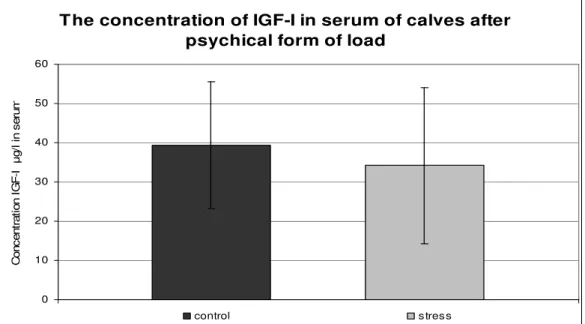
Stress load impacts the level of circulating IGF-I. With all calves, psychical form of the load caused the decline in circulation (Figure1). Between concentrations IGF-I in serum before and after psychical load significant difference was not found.
The average IGF-I concentration between individual blood collections depending on the type of excitation of the group of animals after 20 minutes of habituation is shown in Figure 1.
The concentration of IGF-I in serum of calves after psychical form of load
0 10 20 30 40 50 60
1
C
on
ce
nt
ra
tio
n
IG
F
-I
µ
g/
l i
n
se
ru
m
control stress
Figure 1. Changes in concentrations of IGF-I in circulation with calves after psychical load in the group of calves (n = 21).
The concentration of IGF-I in serum of calves divided according to types of excitatory at rest and after psychical
load 0 10 20 30 40 50 60 70 1 C o n c e n tr a ti o n I G F -I µ g /l i n s e ru m
EHb+ control EHb+ stress EHb° control Ehb° stress EHb- control EHb- stress
Figure 2. Changes in concentrations of IGF-I in circulation with the calves
differentiated according to types of excitation (EHb+ n=9), (EHb° n=7), (EHb- n=5) during individual psychical loads in the group of calves (n = 21).
The highest average resting level of IGF-I concentration reached animals belonging into EHb+. On the other side, the lowest average resting levels of IGF-I reached animals belonging into Ehb-. The highest average level of IGF-I in the blood after habituation was with the calves EHb+ and the lowest with the calves EHb°. Within of individual type of excitation in a concentration IGF-I before and after load significant difference was not found.
Discussion
From a breeding point of view, there are used markers currently that indicate the individual properties of the individual. Differentiation of animals according to a habituation test can not be done globally. From this point of view, we are looking for a particular genetic or biochemical indicator. When we simply determine this
indicator, we can determine which excitatory type of animal we are dealing with. During the effect of stress, there occur mainly catabolic processes in the body. Effort of the organism is to reduce these changes. In this process, IGF-I plays an important role thanks to its anti-apoptotic, growth and proliferative effects (Brywe, 2005; Butt, 1999). IGF-I protects the cells of the CNS, but also other organ systems from an excessive damage during stress load. Lack of IGF-I may have an impact on learning processes (Dick, 2003). With its protective properties it appears to be a suitable target of a research. In our experiments we found out that the level of IGF-I in circulation after an intensive psychical load reduction, which probably shows its intensive use by organism during the effect of load. Animals with higher resting concentrations of IGF-I are in habituation tests classified into EHb+ type that
related to the use of a permanent supply of IGF-I in the body in the aftermath of damage to cells and organ systems during load. This type of excitation is in
permanent strain as confirmed by Debrecéni (1999) on the basis of other biochemical indicators.
Conclusions
IGF-I may protect cells of the individual from their damage during the stress load. Increased resting concentrations of IGF-I are typical for individuals belonging into the category of highly excitable EHb+, which are able to adapt to not extreme demanding situations at behavioural level and do not burden biochemical adaptation
mechanisms excessively. Our results suggest that higher concentrations of IGF-I in circulating blood is potentially suitable indicator for selection of calves with a better ability to adapt to stress breeding situations.
Acknowledgements
This work was supported by projects VEGA 1/2717/12, ECACB - ITMS 26220120015
References
Brywe, K.G., Mallard, C., Gustavsson, M., Hedtjärn, M., Leverin, A.L., Wang, X., Blomgren, K., Isgaard, Jörgen., Hagberg, H. (2005) IGF-I
neuroprotection in the immature brain after hypoxia-ischemia, involvement of Akt and GSK3β? European Journal of Neuroscience, 21(6), 1489–1502. Butt, A.J., Firth, S.M., Baxter, R.C. (1999) The IGF axis and programmed cell death.
Immunol Cell Biol, 77(3), 256–262.
Debrecéni, O. (1990) Návody na praktické a seminárne cvičenia z etológie
a adaptácie hospodárskych zvierat. Nitra: Vysoká škola poľnohospodárska. Debrecéni, O. (1998) Etológia a adaptabilita hovädzieho dobytka. Nitra: Slovenská
poľnohospodárska univerzita.
Debrecéni, O. (1999) Stresadaptačné a habituačné reakcie hospodárskych zvierat : Habilitačná práca. Nitra: Vysoká škola poľnohospodárska.
Debrecéni, O. (2001) Etológia hospodárskych zvierat. Nitra: Slovenská poľnohospodárska univerzita.
Dik, M.G., Pluijm, S.M., Jonker, C., Deeg, D.J., Lomecky, M.Z., Lips, P. (2003) Insulin-like growth factor I (IGF-I) and cognitive decline in older persons. Neurobiol Aging, 24(4), 573–581.
Masopust, J. (2003) Patobiochemie buňky. Praha: Univerzita Karlova. Waldmeier, P.C. (2003) Prospects for antiapoptotic drug therapy of