AMTD
3, 4355–4382, 2010Retrieval of GOMOS limb ozone
S. Tukiainen et al.
Title Page
Abstract Introduction
Conclusions References
Tables Figures
◭ ◮
◭ ◮
Back Close
Full Screen / Esc
Printer-friendly Version Interactive Discussion
Discussion
P
a
per
|
Dis
cussion
P
a
per
|
Discussion
P
a
per
|
Discussio
n
P
a
per
|
Atmos. Meas. Tech. Discuss., 3, 4355–4382, 2010 www.atmos-meas-tech-discuss.net/3/4355/2010/ doi:10.5194/amtd-3-4355-2010
© Author(s) 2010. CC Attribution 3.0 License.
Atmospheric Measurement Techniques Discussions
This discussion paper is/has been under review for the journal Atmospheric Measure-ment Techniques (AMT). Please refer to the corresponding final paper in AMT
if available.
Retrieval of ozone profiles from GOMOS
limb scattered measurements
S. Tukiainen1, E. Kyr ¨ol ¨a1, P. T. Verronen1, D. Fussen2, L. Blanot3, G. Barrot3, A. Hauchecorne4, and N. Lloyd5
1
Finnish Meteorological Institute, Helsinki, Finland
2
Belgian Institute for Space Aeronomy, Brussels, Belgium
3
ACRI-ST, Sophia-Antipolis, France
4
Laboratoire Atmosph `eres, Milieux, Observations Spatiales (LATMOS), Verri `eres-le-Buisson, France
5
University of Saskatchewan, Saskatoon, Canada
Received: 26 August 2010 – Accepted: 20 September 2010 – Published: 8 October 2010 Correspondence to: S. Tukiainen ([email protected])
AMTD
3, 4355–4382, 2010Retrieval of GOMOS limb ozone
S. Tukiainen et al.
Title Page
Abstract Introduction
Conclusions References
Tables Figures
◭ ◮
◭ ◮
Back Close
Full Screen / Esc
Printer-friendly Version Interactive Discussion
Discussion
P
a
per
|
Dis
cussion
P
a
per
|
Discussion
P
a
per
|
Discussio
n
P
a
per
|
Abstract
The GOMOS (Global Ozone Monitoring by Occultation of Stars) instrument on board the Envisat satellite measures the vertical composition of the atmosphere using the stellar occultation technique. While the night-time data of GOMOS are proved to be of good quality, the daytime observations are more challenging due to poorer
signal-5
to-noise ratio. In this paper we present an alternative technique, which uses GOMOS limb scattered radiances instead of the stellar signal, to retrieve stratospheric ozone profiles. Like for many other limb-viewing instruments, GOMOS observations contain stray light at high altitudes. We introduce a method for removing the stray light and demonstrate its feasibility by comparing the corrected radiances against those from
10
the OSIRIS (Optical Spectrograph & Infra Red Imaging System) instrument. For the retrieval of ozone profiles, an onion peeling method is used. The first validation results suggest that the retrieval of stratospheric ozone is possible with a typical accuracy better than 10% at 22–50 km. GOMOS has measured about 350 000 daytime profiles since 2002. The new retrieval method presented here makes this large amount of data
15
finally available for scientific use.
1 Introduction
During the last few decades, extensive research efforts have been made to measure the vertical composition of the Earth’s atmosphere. Numerous satellite instruments have been deployed specifically to observe the middle atmosphere using different
mea-20
surement techniques, geometries, and wavelengths regions.
Limb-viewing instruments can directly observe solar or stellar signal as it is occulted by the atmosphere, but limb scattered indirect sunlight, or radiance, can be used as well. Compared to the nadir looking instruments, the limb-viewing technique can not achieve as good global coverage, but it yields superior vertical resolution. A major
ad-25
AMTD
3, 4355–4382, 2010Retrieval of GOMOS limb ozone
S. Tukiainen et al.
Title Page
Abstract Introduction
Conclusions References
Tables Figures
◭ ◮
◭ ◮
Back Close
Full Screen / Esc
Printer-friendly Version Interactive Discussion
Discussion
P
a
per
|
Dis
cussion
P
a
per
|
Discussion
P
a
per
|
Discussio
n
P
a
per
|
which is essential for, e.g., polar night studies. A detailed information of the past and present middle atmosphere instruments can be found elsewhere (Grant, 1989; Qu et al., 2006).
The key element of the middle atmosphere is ozone, but there are several other observable species such as NOxand HOx compounds, BrO, OClO, aerosols and even
5
metals. It is typically the wavelength band of the instrument that restricts which species are possible to detect. The obvious advantage of satellite measurements is that large quantities of global data can be gathered over long periods of time. Recent middle atmosphere studies have increasingly aimed to utilize, and sometimes combine, large satellite data sets in order to understand how ozone (or other species) are changing in
10
time (Jones et al., 2009; Kyr ¨ol ¨a et al., 2010). The goal of course is to distinguish be-tween natural variations and anthropogenic forcings in the atmosphere. Furthermore, long and consistent satellite data sets are crucial for validation of climate models.
The GOMOS (Global Ozone Monitoring by Occultation of Stars) instrument on board the Envisat satellite uses stellar occultation method to probe the atmosphere between
15
10 and 120 km. Since 2002, GOMOS has performed altogether almost one million measurements. The ozone profiles obtained from the night-time occultations are con-sidered to have typically better than 5% accuracy in the stratosphere (van Gijsel et al., 2010; Renard et al., 2008; Meijer et al., 2004). However, the majority of the daytime ozone profiles retrieved from occultations are currently of poor quality and not suitable
20
for scientific use.
In addition to the star signal, GOMOS also records the limb scattered sunlight during the daytime in similar way than e.g. OSIRIS (Optical Spectrograph & Infra Red Imaging System) on the Odin satellite (Llewellyn et al., 2004) and SCIAMACHY (SCanning Imaging Absorption SpectroMeter for Atmospheric CHartographY) on
En-25
AMTD
3, 4355–4382, 2010Retrieval of GOMOS limb ozone
S. Tukiainen et al.
Title Page
Abstract Introduction
Conclusions References
Tables Figures
◭ ◮
◭ ◮
Back Close
Full Screen / Esc
Printer-friendly Version Interactive Discussion
Discussion
P
a
per
|
Dis
cussion
P
a
per
|
Discussion
P
a
per
|
Discussio
n
P
a
per
|
2 GOMOS radiance measurements
GOMOS CCDs record light from the limb using three spatial bands. The central band measures the sum of the star and the limb scattered signal, while the upper and the lower bands measure only the limb contribution. In the operational occultation retrieval, the upper/lower band radiance is removed from the central band measurement to get
5
the pure star signal, which is then used for the retrievals. This procedure is performed for the day and twilight observations but not for night measurements when no limb contribution is present.
2.1 Saturation
The GOMOS radiance measurements suffer from CCD saturation below 30 km in the
10
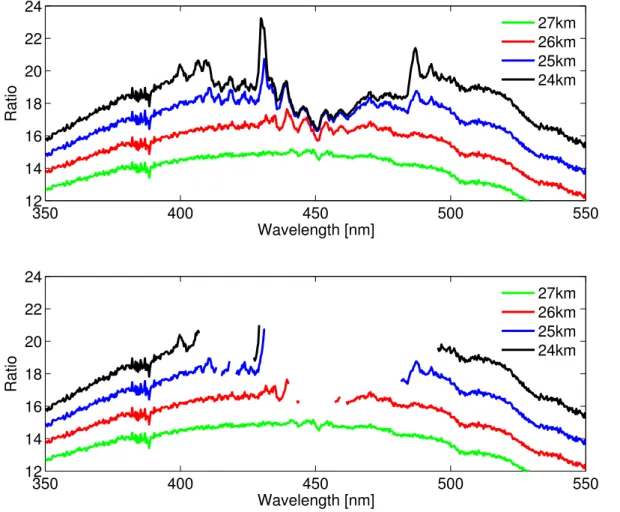
400–500 nm band. The saturated pixels are flagged in the Level 1 data but the flags are not correctly implemented in the version 5.00 of the Level 1 data. The effect of the saturation is clearly seen when looking at normalized radiances (measured radiances divided by a radiance spectrum from high altitude). A normalized radiance is also calledradiance ratio. Figure 1 shows normalized radiances between 350 and 550 nm
15
for a single scan (orbit 9758, star 83) and for a few altitudes. The upper panel is plotted using the current Level 1 data, and while the signal notably begins to saturate at 26 km, the flags are claiming the data to be good up to 24 km.
New Level 1 processing version, coming out in the end of 2010, includes improved saturation flags. The lower panel of Fig. 1 reveals that almost all saturated pixels are
20
now flagged correctly. It is important to have correct saturation flags for the successful retrieval. A common strategy in the retrieval is to take advantage of the whole UV-optical region between 280–700 nm and use dozens or even hundreds of wavelengths. This way the profiles can be retrieved for a wide altitude range. If the saturation flags are incorrect, and also saturated pixels are used in the retrieval, errors in the retrieved
25
AMTD
3, 4355–4382, 2010Retrieval of GOMOS limb ozone
S. Tukiainen et al.
Title Page
Abstract Introduction
Conclusions References
Tables Figures
◭ ◮
◭ ◮
Back Close
Full Screen / Esc
Printer-friendly Version Interactive Discussion
Discussion
P
a
per
|
Dis
cussion
P
a
per
|
Discussion
P
a
per
|
Discussio
n
P
a
per
|
2.2 Stray light
In addition to the CCD saturation, the GOMOS limb scatter measurements suffer from severe stray light contamination. Stray light refers to unwanted extra scattering ob-served by the instrument. Stray light is usually coming from source other than the intended source. The relative amount of the stray light in GOMOS radiances increases
5
with the altitude and above 100 km the signal is pure stray light.
We use the following method to remove the stray light contamination from the radi-ances. We first define mean relative stray light spectrum
S(λ)=1 n
n
X
j=1
(I(λ,j) ˆI(λ500,j)−1), (1)
whereI(λ,j) are measured radiances and ˆI(λ500,j) are the radiances at 500 nm. The
10
altitude indexj goes through the measurements above 100 km and λdenotes wave-length.
Then we compute a third degree least squares polynomial fit for each wavelength using measurements above ˆz, 90 km≤zˆ≤100 km, as the fitting range. Stray light is then extrapolated for low altitudes so that the low altitude values are constrained with
15
the spectral shape in Eq. (1). After that we do another polynomial fit using the mea-surements above ˆzand the new point at low altitude to estimate the stray light for the all measurement altitudes. Figure 2 illustrates the stray light calculation for one (400 nm) wavelength.
A few things should be noted about the algorithm. Wavelengths are treated
indepen-20
dently, which can in practice produce artificial noise on the results. Another issue is that the optimal value of ˆz and the order of the polynomial fits are unknown, and the choices can affect the results, too.
In reality, the amount of stray light may actually vary as a function of altitude leading to abnormal results from the extrapolation. Stray light is dependent on the albedo
AMTD
3, 4355–4382, 2010Retrieval of GOMOS limb ozone
S. Tukiainen et al.
Title Page
Abstract Introduction
Conclusions References
Tables Figures
◭ ◮
◭ ◮
Back Close
Full Screen / Esc
Printer-friendly Version Interactive Discussion
Discussion
P
a
per
|
Dis
cussion
P
a
per
|
Discussion
P
a
per
|
Discussio
n
P
a
per
|
below the satellite, and therefore strong albedo gradients during the measurement can disturb the usually quite constant stray light flux at high altitudes.
3 Radiance comparison
In this section we compare GOMOS radiances with OSIRIS radiances. OSIRIS is a combined UV-optical and infrared instrument dedicated to limb scatter
measure-5
ments. The instrument is flying on board the Odin satellite, launched in 2001. The OSIRIS Level 1 data is the latest version, reprocessed in the end of 2009. The GOMOS Level is also the most recent available version 5.00 from 2006. OSIRIS radiances are relatively clean of stray light below ∼70 km and therefore OSIRIS is a good reference for the validation of GOMOS radiances and the stray light
10
correction algorithm.
The criteria shown in Table 1 were used to find coincident measurements between GOMOS and OSIRIS. Using the data from the year 2004, a total of 13 matching ob-servations were found when applying the coincidence criteria and excluding data with solar zenith angle larger than 86 degrees. These observations are from a narrow
nar-15
row latitude band, around 60◦S, from January and February 2004.
3.1 Spectral resolution and noise
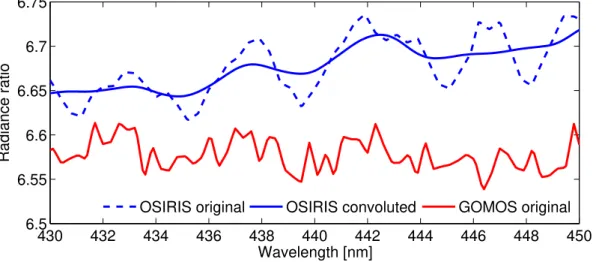
The spectral resolution of GOMOS is ∼3 nm, i.e. relatively low compared to ∼1 nm of OSIRIS. This is because the slit of GOMOS is much larger than of OSIRIS. The wider slit allows the tracking of occultating stars but it lowers the spectral resolution.
20
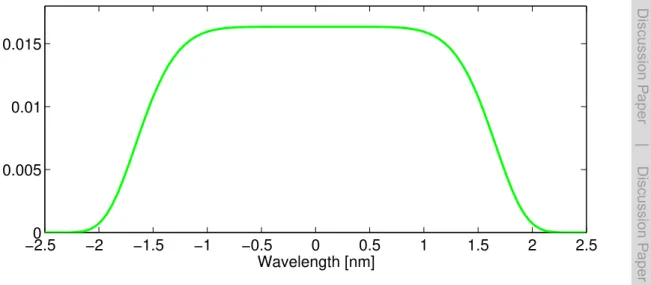
Therefore, we convoluted the OSIRIS spectra with the GOMOS slit function. The best estimate of the slit function is shown in Fig. 3.
In addition to the weak spectral resolution, the GOMOS radiances are also much noisier than those of OSIRIS. This makes it challenging to retrieve trace gases whose absorption fingerprint is small. For example, NO2 is routinely retrieved from
AMTD
3, 4355–4382, 2010Retrieval of GOMOS limb ozone
S. Tukiainen et al.
Title Page
Abstract Introduction
Conclusions References
Tables Figures
◭ ◮
◭ ◮
Back Close
Full Screen / Esc
Printer-friendly Version Interactive Discussion
Discussion
P
a
per
|
Dis
cussion
P
a
per
|
Discussion
P
a
per
|
Discussio
n
P
a
per
|
OSIRIS data using the strong NO2absorption features in the 430–450 nm region. Fig-ure 4 shows radiance ratios in this region for GOMOS and OSIRIS at 32 km. The absorption lines are barely recognizable in the GOMOS ratio, while the OSIRIS ratio is far cleaner. At higher altitudes the noise in GOMOS obscures the absorption lines even further and below∼30 km the region stars to saturate as shown in Fig. 1.
5
3.2 Absolute radiance
First, we analyze differences in the GOMOS and OSIRIS absolute radiances. The radi-ances were interpolated in wavelength and in altitude using linear interpolation. Radi-ance as a function of altitude changes non-linearly in the UV wavelengths but the high vertical sampling resolution of both instruments (1–2 km) allows linear interpolation to
10
be feasible.
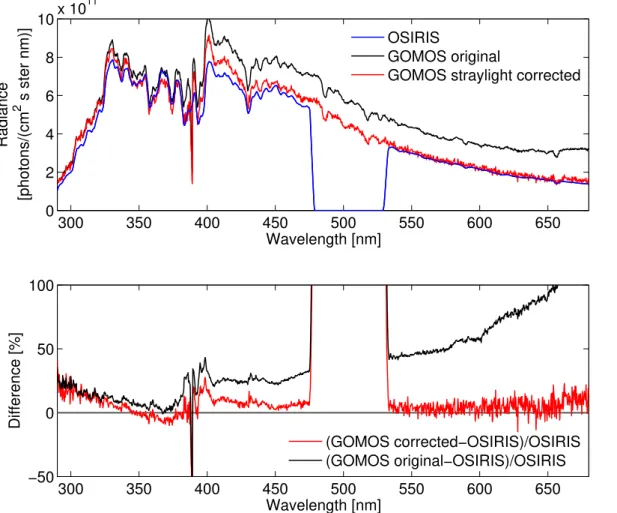
Figure 5 shows an example of an individual OSIRIS (orbit 15702, scan 25) and GOMOS (orbit 9778, star 83) match. At 50 km, the amount of stray light in the GOMOS radiance is prominent, especially in wavelengths above 400 nm. After the stray light removal, the overall agreement is significantly better but the removal
algo-15
rithm has introduced some additional noise to the radiance.
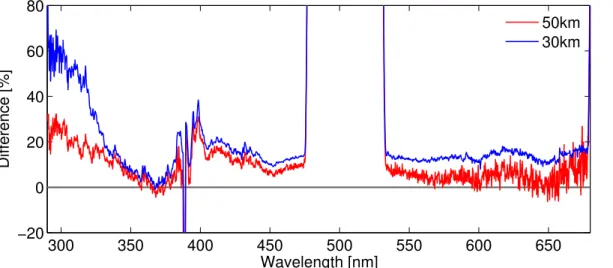
Figure 6 presents median differences between OSIRIS and stray light corrected GOMOS radiances for two different altitudes (50 and 30 km). There seems to be a pos-itive bias in the GOMOS radiance below 350 nm. The bias is increasing towards lower altitudes, being up to around 20% at 50 km and 40–60% at 30 km.
20
3.3 Radiance ratio
Instead of using absolute radiances, a common practice to counteract uncertainties e.g. from calibration and polarization is to normalize radiance spectra by a high altitude measurement. It may be a full spectrum from one altitude, typically around 50 km, or the reference can come from various altitudes depending on the wavelength.
AMTD
3, 4355–4382, 2010Retrieval of GOMOS limb ozone
S. Tukiainen et al.
Title Page
Abstract Introduction
Conclusions References
Tables Figures
◭ ◮
◭ ◮
Back Close
Full Screen / Esc
Printer-friendly Version Interactive Discussion
Discussion
P
a
per
|
Dis
cussion
P
a
per
|
Discussion
P
a
per
|
Discussio
n
P
a
per
|
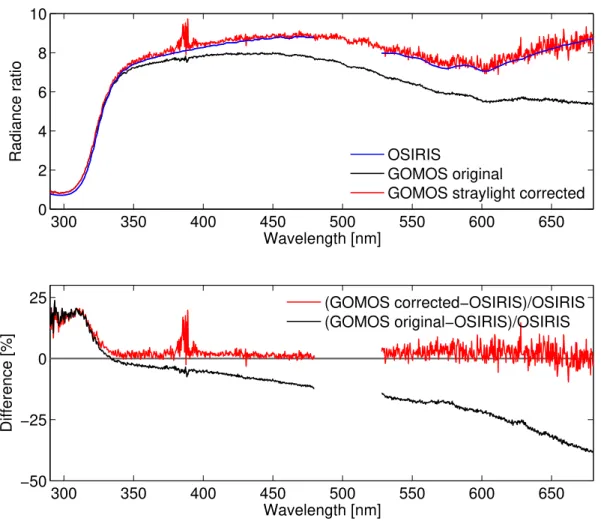
The same match as in Fig. 5 is shown in Fig. 7 but the radiances are now normalized with the 47 km spectra. The difference in the UV band is apparent and the stray light corrected ratio is noisier than the original GOMOS radiance ratio. Otherwise the agree-ment between the OSIRIS ratio and the stray light corrected GOMOS ratio is good.
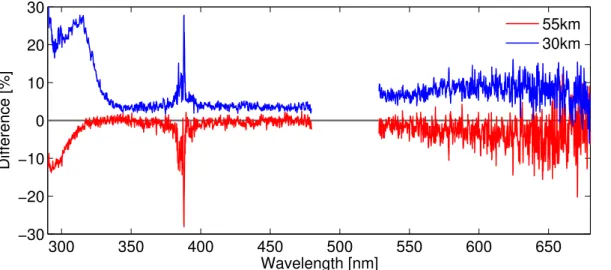
The median of the differences of the 13 matches is shown in Fig. 8 for 55 and 30 km.
5
At 30 km the GOMOS ratio is biased up to+20% below 320 nm and there is an opposed bias at 55 km. At 55 km the red end of the spectrum is quite noisy due to the stray light correction. The bias in the wavelengths 320–680 nm is 5–10 % for both investigated altitudes.
4 Inversion method
10
A slightly revised version of the inversion method described in detail in Tukiainen et al. (2008) is used for the retrieval. The fundamental idea is the same. For every mea-surement layerj, a least squares fit weighted by error is done between the model and measurement:
I(j,λ) Iref(λ)=
ˆ
Iss(j,λ,ρ)
ˆ Iref(λ)
R(j,λ)+ǫ, (2)
15
whereI(j,λ) is the observed radiance andIref(λ) is a reference measurement at∼50 km. On the right hand side, ˆIss(j,λ,ρ) is the modeled single scattering radiance, adjusted dynamically during the fitting operations, and ˆIref(λ) is the modeled reference radiance. The second term on the right:
R(j,λ)= ˆ Itot(j,λ)
ˆ
Iss(j,λ) (3)
20
AMTD
3, 4355–4382, 2010Retrieval of GOMOS limb ozone
S. Tukiainen et al.
Title Page
Abstract Introduction
Conclusions References
Tables Figures
◭ ◮
◭ ◮
Back Close
Full Screen / Esc
Printer-friendly Version Interactive Discussion
Discussion
P
a
per
|
Dis
cussion
P
a
per
|
Discussion
P
a
per
|
Discussio
n
P
a
per
|
Eq. (2) is done using the Levenberg-Marquardt method (Levenberg, 1944; Marquardt, 1963). The error termǫin Eq. (2) is used as a weight in the fitting.
The atmosphere between around 60 and 20 km is “peeled” this way from top to down to get the vertical profiles of retrieved species. With this approach, it is possible to retrieve several species simultaneously. Typically O3, aerosols and neutral air are
5
inverted together using tens (or hundreds) of wavelengths in the 280–680 nm band, while NO2is taken from a climatology and kept fixed. However, as shown in Tukiainen
et al. (2008), it is better to retrieve minor absorbers such as NO2in a separate peeling loop using much smaller wavelength windows. It should be noted that, as mentioned earlier, NO2is not currently retrieved from the GOMOS bright limb measurements due
10
to weak spectral fingerprint in the 430–450 nm band.
Radiative transfer model
It is straightforward and computationally very effective to calculate single scattering radiances in limb-viewing geometry. But in the visible wavelengths, a significant part of the photons have been scattered multiple times before observed by the instrument.
15
This makes the modeling challenging, and usually approximations are used to simplify the radiative transfer calculations.
Several models have been developed to calculate the multiple scattering radiance of the radiative transfer problem in the UV visible wavelengths. The more modern ones include eg. SASKTRAN (Bourassa et al., 2008), McSCIA (Spada et al., 2006),
20
Sciatran (Rozanov et al., 2005), MCC++ (Postylyakov, 2004), LIMBTRAN (Griffioen and Oikarinen, 2000) and Siro (Oikarinen et al., 1999).
We use a revised version of the Monte Carlo (MC) model Siro. Siro is a backward MC model – the photons are simulated from the detector towards the atmosphere. The latest Siro version is written in Fortran90 and parallelized using OpenMP framework.
25
AMTD
3, 4355–4382, 2010Retrieval of GOMOS limb ozone
S. Tukiainen et al.
Title Page
Abstract Introduction
Conclusions References
Tables Figures
◭ ◮
◭ ◮
Back Close
Full Screen / Esc
Printer-friendly Version Interactive Discussion
Discussion
P
a
per
|
Dis
cussion
P
a
per
|
Discussion
P
a
per
|
Discussio
n
P
a
per
|
from the solar angles, atmospheric composition and albedo. The running time, and precision of the solution, is naturally proportional to the number of simulated photons. With a modern CPU (Xeon E5420) using only single core, a 105 photon simulation for one wavelength takes a few seconds in the UV region. In the visible band, a similar simulation takes typically around 30 s.
5
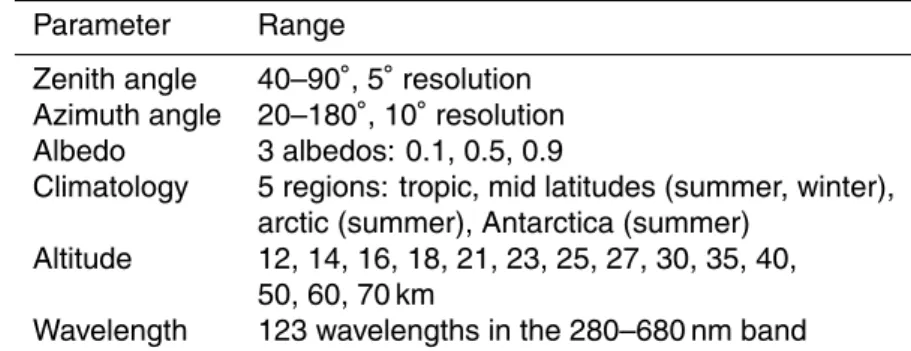
It is computationally too expensive to use Siro directly in the operational retrieval. Instead in Eq. (2) we use a fast analytical single scattering model and perform multiple scattering correction using a Siro calculated look-up table. The Siro look-up table is built with the parameters shown in Table 2. To get approximately 1% accuracy, radi-ances were simulated with 105photons.
10
5 Ozone profile validation
As there is some discrepancy in the GOMOS and OSIRIS radiances below∼350 nm, differences in retrieved ozone profiles should be expected. Above around 45 km, these wavelengths are required for successful ozone retrieval. But at lower altitudes, the information mainly comes from the Chappuis band around 600 nm, and the UV band
15
can be suppressed from the inversion to cope with the issue.
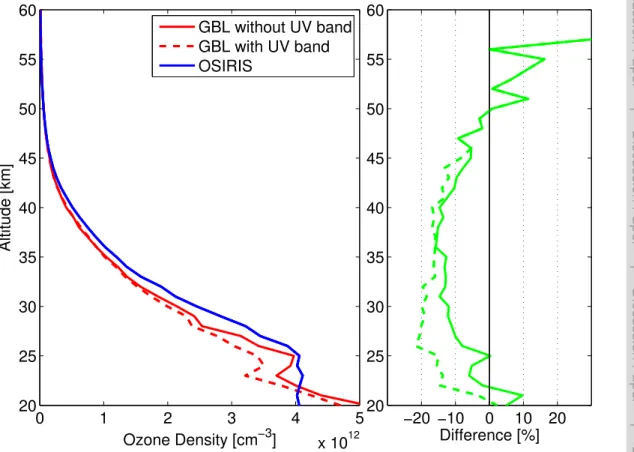
Figure 9 shows a comparison of the 13 GOMOS bright limb and OSIRIS ozone pro-file retrieved using the radiances shown in Figs. 6 and 8. The medians of the propro-files are shown in the left panel. The GOMOS profiles were retrieved with the UV band (red dashed line) and without the UV band below 45 km (red solid line). The right panel
20
shows the medians of the individual relative differences. In both cases there is a neg-ative bias below 50 km compared to OSIRIS but flagging the UV wavelengths clearly improves the agreement.
To better test the statistical accuracy of the retrieved profiles, we compare the GOMOS bright limb profiles with the GOMOS night-time occultation profiles. Due to
is-25
AMTD
3, 4355–4382, 2010Retrieval of GOMOS limb ozone
S. Tukiainen et al.
Title Page
Abstract Introduction
Conclusions References
Tables Figures
◭ ◮
◭ ◮
Back Close
Full Screen / Esc
Printer-friendly Version Interactive Discussion
Discussion
P
a
per
|
Dis
cussion
P
a
per
|
Discussion
P
a
per
|
Discussio
n
P
a
per
|
the equator between 30◦S and 30◦N. The 79 profiles are from 2003 with no more than 1◦difference in latitude, 2◦ in longitude and 15 h in time. The median of the individual relative differences is less than 10% between 22 and 50 km. Above 45 km the diurnal variation of ozone starts to take effect, and the GBL values (day) are smaller than the night occultation values, as expected. Below 22 km the standard deviation of the GBL
5
profiles increase significantly. It is difficult to follow occultating stars at low tangent altitudes, and especially when clouds enter the line of sight.
6 Discussion
There are serious defects in the GOMOS Level 1 bright limb data that complicate trace gas retrievals. The stray light contamination is a severe problem at high altitudes. In the
10
wavelengths>400 nm, stray light accounts for as much as 10–50% of the measured signal already at the 50 km altitude (see Fig. 5). Thus, it is absolutely necessary to correct for the stray light. The radiance comparisons against OSIRIS suggest that the algorithm presented in Sect. 2.2 is feasible.
In addition to the stray light, the signal saturates below around 30 km in the 400–
15
500 nm region making a large part of the spectrum useless. Current saturation flags are not trustworthy, but the situation is greatly improved with the upcoming version of the Level 1 data.
The spectral resolution of GOMOS (bright limb signal) is poor, about 3 nm compared to the∼1 nm resolution of OSIRIS. The spectra of GOMOS are also noisier than those
20
of OSIRIS. Both the weak spectral resolution and the noise make NO2retrieval difficult
and so far it has not been successful.
Furthermore, there seems to be a systematic difference between the GOMOS and OSIRIS spectra in the wavelengths below 320 nm. This cannot be explained by the stray light because the discrepancy increases at lower altitudes where the relative
25
AMTD
3, 4355–4382, 2010Retrieval of GOMOS limb ozone
S. Tukiainen et al.
Title Page
Abstract Introduction
Conclusions References
Tables Figures
◭ ◮
◭ ◮
Back Close
Full Screen / Esc
Printer-friendly Version Interactive Discussion
Discussion
P
a
per
|
Dis
cussion
P
a
per
|
Discussion
P
a
per
|
Discussio
n
P
a
per
|
OSIRIS and GOMOS measurement times, tangent point locations, and solar angles are rare and only 13 cases were investigated in this paper.
The disagreement in the UV band leads to a difference in the retrieved ozone pro-files between GOMOS bright limb and OSIRIS. It is possible to cope with the problem by suppressing the UV band in the retrieval below∼45 km. After flagging the UV band
5
(and the saturation band) the agreement with GOMOS night-time occultations was bet-ter than 10% between 22 and 50 km in the equator. The good validation result against the GOMOS night-time occultations, after flagging the UV band, suggest that the UV band is biased indeed in GOMOS and not in OSIRIS.
Despite the weaknesses in the Level 1 data, the proposed stray light removal
algo-10
rithm and the inversion method offer a promising way to utilize the whole GOMOS bright limb data set. The processing of the GBL data would roughly double the amount of useful GOMOS ozone profiles between at least 22 and 50 km. The distribution of GOMOS night-time and daytime measurements in 2004 is shown in Fig. 11.
Finally, it should be noted that the validation for profiles shown in this paper are
15
preliminary and should be repeated using other reference instruments for all latitudes. Additionally, the robustness and performance of the stray light correction could be an-alyzed more carefully in a separate study.
Acknowledgements. This work was funded by the European Space Agency through the project Trace Gas Retrieval from GOMOS Bright Limb Measurements(AO/1-5301/06/I-OL). The
au-20
AMTD
3, 4355–4382, 2010Retrieval of GOMOS limb ozone
S. Tukiainen et al.
Title Page
Abstract Introduction
Conclusions References
Tables Figures
◭ ◮
◭ ◮
Back Close
Full Screen / Esc
Printer-friendly Version Interactive Discussion
Discussion
P
a
per
|
Dis
cussion
P
a
per
|
Discussion
P
a
per
|
Discussio
n
P
a
per
|
References
Bourassa, A. E., Degenstein, D. A., and Llewellyn, E. J.: SASKTRAN: a spherical geometry radiative transfer code for efficient estimation of limb scattered sunlight, J. Quant. Spectrosc. Ra., 109, 52–73, doi:10.1016/j.jqsrt.2007.07.007, 2008. 4363
Gottwald, M., Bovensmann, H., Lichtenberg, G., Noel, S., von Bargen, A., Slijkhuis, S.,
5
Piters, A., Hoogeveen, R., von Savigny, C., Buchwitz, M. A. K., Richter, A., Rozanov, A., Holzer-Popp, T., Bramstedt, K., Lambert, J.-C., Skupin, J., Wittrock, F., Schrijver, H., and Burrows, J.: SCIAMACHY, Monitoring the Changing Earth’s Atmosphere, DLR, 2006. 4357 Grant, W. B.: Ozone Measuring Instruments for the Stratosphere, Optical Society of America,
Washington, 1989. 4357
10
Griffioen, E. and Oikarinen, L.: LIMBTRAN: A pseudo three-dimensional radiative transfer model for the limb-viewing imager OSIRIS on the ODIN satellite, J. Geophys. Res., 105, 29717–29730, doi:10.1029/2000JD900566, 2000. 4363
Jones, A., Urban, J., Murtagh, D. P., Eriksson, P., Brohede, S., Haley, C., Degenstein, D., Bourassa, A., von Savigny, C., Sonkaew, T., Rozanov, A., Bovensmann, H., and Burrows,
15
J.: Evolution of stratospheric ozone and water vapour time series studied with satellite mea-surements, Atmos. Chem. Phys., 9, 6055–6075, doi:10.5194/acp-9-6055-2009, 2009. 4357 Kyr ¨ol ¨a, E., Tamminen, J., Sofieva, V., Bertaux, J. L., Hauchecorne, A., Dalaudier, F., Fussen, D.,
Vanhellemont, F., Fanton d’Andon, O., Barrot, G., Guirlet, M., Fehr, T., and Saavedra de Miguel, L.: GOMOS O3, NO2, and NO3 observations in 2002–2008, Atmos. Chem. Phys.,
20
10, 7723–7738, doi:10.5194/acp-10-7723-2010, 2010. 4357
Levenberg, K.: A method for the solution of certain problems in least squares, Q. Appl. Math., 2, 164–168, 1944. 4363
Llewellyn, E., Lloyd, N. D., Degenstein, D. A., Gattinger, R. L., Petelina, S. V., Bourassa, A. E., Wiensz, J. T., Ivanov, E. V., McDade, I. C., Solheim, B. H., McConnell, J. C., Haley, C. S., von
25
Savigny, C., Sioris, C. E., McLinden, C. A., Griffioen, E., Kaminski, J., Evans, W. F. J., Puck-rin, E., Strong, K., Wehrle, V., Hum, R. H., Kendall, D. J. W., Matsushita, J., Murtagh, D. P., Brohede, S., Stegman, J., Witt, G., Barnes, G., Payne, W. F., Piche, L., Smith, K., War-shaw, G., Deslauniers, D. L., Marchand, P., Richardson, E. H., King, R. A., Wevers, I., McCreath, W., Kyrola, E., Oikarinen, L., Leppelmeier, G. W., Auvinen, H., Megie, G.,
30
AMTD
3, 4355–4382, 2010Retrieval of GOMOS limb ozone
S. Tukiainen et al.
Title Page
Abstract Introduction
Conclusions References
Tables Figures
◭ ◮
◭ ◮
Back Close
Full Screen / Esc
Printer-friendly Version Interactive Discussion
Discussion
P
a
per
|
Dis
cussion
P
a
per
|
Discussion
P
a
per
|
Discussio
n
P
a
per
|
doi:10.1139/p04-005, 2004. 4357
Marquardt, D.: An algorithm for least-squares estimation of nonlinear parameters, J. Soc. In-dust. Appl. Math., 11, 431–44, 1963. 4363
Meijer, Y. J., Swart, D. P. J., Allaart, M., Andersen, S. B., Bodeker, G., Boyd, I., Braathen, G., Calisesi, Y., Dorokhov, V., Claude, H., von der Gathen, P., Gil, M., Godin-Beekmann, S.,
5
Goutail, F., Hansen, G., Karpetchko, A., Keckhut, P., Kelder, H. M., Koelemeijer, R. K., Kois, B., Koopman, R. M., Lambert, J.-C., Leblanc, T., McDermid, I. S., Pal, S., Kopp, G., Schets, H., Stubi, R., Suortti, T., Visconti, G., and Yela, M.: Pole-to-pole validation of EN-VISAT/GOMOS ozone profiles using data from ground-based and balloon-sonde measure-ments, J. Geophys. Res., 109, D23305, doi:10.1029/2004JD004834, 2004. 4357
10
Oikarinen, L., Sihvola, E., and Kyr ¨ol ¨a, E.: Multiple scattering radiance in limb-viewing geometry, J. Geophys. Res., 104, 31261–31274, doi:10.1029/1999JD900969, 1999. 4363
Postylyakov, O. V.: Radiative transfer model MCC++with evaluation of weighting functions in spherical atmosphere for use in retrieval algorithms, Adv. Space Res., 34, 721–726, doi: 10.1016/j.asr.2003.07.070, 2004. 4363
15
Qu, J., Gao, W., Kafatos, M., Murphy, R., and Salomonson, V.: Earth Science Satellite Remote Sensing Vol. 1: Science and Instruments, Springer, 2006. 4357
Renard, J., Berthet, G., Brogniez, C., Catoire, V., Fussen, D., Goutail, F., Oelhaf, H., Pom-mereau, J., Roscoe, H. K., Wetzel, G., Chartier, M., Robert, C., Balois, J., Verwaerde, C., Au-riol, F., Franc¸ois, P., Gaubicher, B., and Wursteisen, P.: Validation of GOMOS-Envisat vertical
20
profiles of O3, NO2, NO3, and aerosol extinction using balloon-borne instruments and anal-ysis of the retrievals, J. Geophys. Res.-Space, 113, A02302, doi:10.1029/2007JA012345, 2008. 4357
Rozanov, A., Rozanov, V., Buchwitz, M., Kokhanovsky, A., and Burrows, J. P.: SCIATRAN 2.0 A new radiative transfer model for geophysical applications in the 175 2400 nm spectral
25
region, Adv. Space Res., 36, 1015–1019, doi:10.1016/j.asr.2005.03.012, 2005. 4363 Spada, F., Krol, M. C., and Stammes, P.: McSCIA: application of the Equivalence Theorem in a
Monte Carlo radiative transfer model for spherical shell atmospheres, Atmos. Chem. Phys., 6, 4823–4842, doi:10.5194/acp-6-4823-2006, 2006. 4363
Taha, G., Jaross, G., Fussen, D., Vanhellemont, F., Kyr ¨ol ¨a, E., and McPeters, R. D.: Ozone
pro-30
AMTD
3, 4355–4382, 2010Retrieval of GOMOS limb ozone
S. Tukiainen et al.
Title Page
Abstract Introduction
Conclusions References
Tables Figures
◭ ◮
◭ ◮
Back Close
Full Screen / Esc
Printer-friendly Version Interactive Discussion
Discussion
P
a
per
|
Dis
cussion
P
a
per
|
Discussion
P
a
per
|
Discussio
n
P
a
per
|
Tukiainen, S., Hassinen, S., Sepp ¨al ¨a, A., Auvinen, H., Kyr ¨ol ¨a, E., Tamminen, J., Haley, C. S., Lloyd, N., and Verronen, P. T.: Description and validation of a limb scatter retrieval method for Odin/OSIRIS, J. Geophys. Res., 113, D04308, doi:10.1029/2007JD008591, 2008. 4362, 4363
van Gijsel, J. A. E., Swart, D. P. J., Baray, J.-L., Bencherif, H., Claude, H., Fehr, T.,
Godin-5
AMTD
3, 4355–4382, 2010Retrieval of GOMOS limb ozone
S. Tukiainen et al.
Title Page
Abstract Introduction
Conclusions References
Tables Figures
◭ ◮
◭ ◮
Back Close
Full Screen / Esc
Printer-friendly Version Interactive Discussion
Discussion
P
a
per
|
Dis
cussion
P
a
per
|
Discussion
P
a
per
|
Discussio
n
P
a
per
|
Table 1.Coincidence criteria for the GOMOS and OSIRIS radiance matches.
Latitude 3◦
Longitude 6◦
Time 24 h
Sun zenith angle 2◦
AMTD
3, 4355–4382, 2010Retrieval of GOMOS limb ozone
S. Tukiainen et al.
Title Page
Abstract Introduction
Conclusions References
Tables Figures
◭ ◮
◭ ◮
Back Close
Full Screen / Esc
Printer-friendly Version Interactive Discussion
Discussion
P
a
per
|
Dis
cussion
P
a
per
|
Discussion
P
a
per
|
Discussio
n
P
a
per
|
Table 2.Siro look-up table parameters.
Parameter Range
Zenith angle 40–90◦, 5◦resolution Azimuth angle 20–180◦
, 10◦
resolution Albedo 3 albedos: 0.1, 0.5, 0.9
Climatology 5 regions: tropic, mid latitudes (summer, winter), arctic (summer), Antarctica (summer)
Altitude 12, 14, 16, 18, 21, 23, 25, 27, 30, 35, 40, 50, 60, 70 km
AMTD
3, 4355–4382, 2010Retrieval of GOMOS limb ozone
S. Tukiainen et al.
Title Page
Abstract Introduction
Conclusions References
Tables Figures
◭ ◮
◭ ◮
Back Close
Full Screen / Esc
Printer-friendly Version Interactive Discussion
Discussion
P
a
per
|
Dis
cussion
P
a
per
|
Discussion
P
a
per
|
Discussio
n
P
a
per
|
350 400 450 500 550
12 14 16 18 20 22 24
Wavelength [nm]
Ratio
27km 26km 25km 24km
350 400 450 500 550
12 14 16 18 20 22 24
Wavelength [nm]
Ratio
27km 26km 25km 24km
Fig. 1.Saturation in the normalized GOMOS radiances for a few altitudes. Upper panel: current
AMTD
3, 4355–4382, 2010Retrieval of GOMOS limb ozone
S. Tukiainen et al.
Title Page
Abstract Introduction
Conclusions References
Tables Figures
◭ ◮
◭ ◮
Back Close
Full Screen / Esc
Printer-friendly Version Interactive Discussion
Discussion
P
a
per
|
Dis
cussion
P
a
per
|
Discussion
P
a
per
|
Discussio
n
P
a
per
|
0.7 0.8 0.9 1 1.1 1.2 1.3 1.4
x 1011 20
40 60 80 100 120
Radiance [photons/(cm2 s ster nm)]
Altitude [km]
Original radiance
Radiance used for polynomial fitting Constrained value at 20 km
Final stray light estimatation
Fig. 2. Stray light estimation for 400 nm. The spectral shape of the stray light is used to
AMTD
3, 4355–4382, 2010Retrieval of GOMOS limb ozone
S. Tukiainen et al.
Title Page
Abstract Introduction
Conclusions References
Tables Figures
◭ ◮
◭ ◮
Back Close
Full Screen / Esc
Printer-friendly Version Interactive Discussion
Discussion
P
a
per
|
Dis
cussion
P
a
per
|
Discussion
P
a
per
|
Discussio
n
P
a
per
|
−2.50 −2 −1.5 −1 −0.5 0 0.5 1 1.5 2 2.5
0.005 0.01 0.015
Wavelength [nm]
AMTD
3, 4355–4382, 2010Retrieval of GOMOS limb ozone
S. Tukiainen et al.
Title Page
Abstract Introduction
Conclusions References
Tables Figures
◭ ◮
◭ ◮
Back Close
Full Screen / Esc
Printer-friendly Version Interactive Discussion
Discussion
P
a
per
|
Dis
cussion
P
a
per
|
Discussion
P
a
per
|
Discussio
n
P
a
per
|
430 432 434 436 438 440 442 444 446 448 450
6.5 6.55 6.6 6.65 6.7 6.75
Wavelength [nm]
Radiance ratio
OSIRIS original OSIRIS convoluted GOMOS original
Fig. 4. Comparison of GOMOS and OSIRIS spectral resolution in the NO2 retrieval region.
AMTD
3, 4355–4382, 2010Retrieval of GOMOS limb ozone
S. Tukiainen et al.
Title Page
Abstract Introduction
Conclusions References
Tables Figures
◭ ◮
◭ ◮
Back Close
Full Screen / Esc
Printer-friendly Version Interactive Discussion
Discussion
P
a
per
|
Dis
cussion
P
a
per
|
Discussion
P
a
per
|
Discussio
n
P
a
per
|
300 350 400 450 500 550 600 650
0 2 4 6 8
10x 10
11
Wavelength [nm]
Radiance
[photons/(cm
2 s ster nm)]
OSIRIS
GOMOS original
GOMOS straylight corrected
300 350 400 450 500 550 600 650
−50 0 50 100
Wavelength [nm]
Difference [%]
(GOMOS corrected−OSIRIS)/OSIRIS (GOMOS original−OSIRIS)/OSIRIS
Fig. 5.Example of the absolute radiances from from GOMOS (orbit 9778, star 83) and OSIRIS
AMTD
3, 4355–4382, 2010Retrieval of GOMOS limb ozone
S. Tukiainen et al.
Title Page
Abstract Introduction
Conclusions References
Tables Figures
◭ ◮
◭ ◮
Back Close
Full Screen / Esc
Printer-friendly Version Interactive Discussion
Discussion
P
a
per
|
Dis
cussion
P
a
per
|
Discussion
P
a
per
|
Discussio
n
P
a
per
|
300 350 400 450 500 550 600 650
−20 0 20 40 60 80
Wavelength [nm]
Difference [%]
50km 30km
Fig. 6.Median relative difference of the 13 OSIRIS and stray light corrected GOMOS absolute
AMTD
3, 4355–4382, 2010Retrieval of GOMOS limb ozone
S. Tukiainen et al.
Title Page
Abstract Introduction
Conclusions References
Tables Figures
◭ ◮
◭ ◮
Back Close
Full Screen / Esc
Printer-friendly Version Interactive Discussion
Discussion
P
a
per
|
Dis
cussion
P
a
per
|
Discussion
P
a
per
|
Discussio
n
P
a
per
|
300 350 400 450 500 550 600 650
0 2 4 6 8 10
Wavelength [nm]
Radiance ratio OSIRIS
GOMOS original
GOMOS straylight corrected
300 350 400 450 500 550 600 650
−50 −25 0 25
Wavelength [nm]
Difference [%]
(GOMOS corrected−OSIRIS)/OSIRIS (GOMOS original−OSIRIS)/OSIRIS
Fig. 7. Example of radiance ratio from from GOMOS (orbit 9778, star 83) and OSIRIS
AMTD
3, 4355–4382, 2010Retrieval of GOMOS limb ozone
S. Tukiainen et al.
Title Page
Abstract Introduction
Conclusions References
Tables Figures
◭ ◮
◭ ◮
Back Close
Full Screen / Esc
Printer-friendly Version Interactive Discussion
Discussion
P
a
per
|
Dis
cussion
P
a
per
|
Discussion
P
a
per
|
Discussio
n
P
a
per
|
300 350 400 450 500 550 600 650
−30 −20 −10 0 10 20 30
Wavelength [nm]
Difference [%]
55km 30km
Fig. 8.Median relative difference of the 13 OSIRIS and stray light corrected GOMOS radiance
AMTD
3, 4355–4382, 2010Retrieval of GOMOS limb ozone
S. Tukiainen et al.
Title Page
Abstract Introduction
Conclusions References
Tables Figures
◭ ◮
◭ ◮
Back Close
Full Screen / Esc
Printer-friendly Version Interactive Discussion
Discussion
P
a
per
|
Dis
cussion
P
a
per
|
Discussion
P
a
per
|
Discussio
n
P
a
per
|
0 1 2 3 4 5
x 1012 20
25 30 35 40 45 50 55 60
Altitude [km]
N = 13
Ozone Density [cm−3]
−20 −10 0 10 20 20
25 30 35 40 45 50 55 60
Difference [%] GBL without UV band
GBL with UV band OSIRIS
Fig. 9. Retrieved ozone profiles from the 13 GOMOS and OSIRIS radiances of Figs. 6 and 8.
AMTD
3, 4355–4382, 2010Retrieval of GOMOS limb ozone
S. Tukiainen et al.
Title Page
Abstract Introduction
Conclusions References
Tables Figures
◭ ◮
◭ ◮
Back Close
Full Screen / Esc
Printer-friendly Version Interactive Discussion
Discussion
P
a
per
|
Dis
cussion
P
a
per
|
Discussion
P
a
per
|
Discussio
n
P
a
per
|
0 1 2 3 4 5
x 1012 20
25 30 35 40 45 50 55 60
Altitude [km]
Ozone density [cm−3]
N = 79
GOMOS NIGHT OCC GBL
−20 −10 0 10 20
20 25 30 35 40 45 50 55 60
Difference [%]
Altitude [km]
Fig. 10. Comparison of the 79 GOMOS bright limb profiles and GOMOS night occultations
AMTD
3, 4355–4382, 2010Retrieval of GOMOS limb ozone
S. Tukiainen et al.
Title Page
Abstract Introduction
Conclusions References
Tables Figures
◭ ◮
◭ ◮
Back Close
Full Screen / Esc
Printer-friendly Version Interactive Discussion
Discussion
P
a
per
|
Dis
cussion
P
a
per
|
Discussion
P
a
per
|
Discussio
n
P
a
per
|
Jan Feb Mar Apr May Jun Jul Aug Sep Oct Nov Dec
−90 −70 −50 −30 −10 10 30 50 70 90
Latitude
2004 GOMOS measurements
night day