D I A B E T E S & M E T A B O L I S M J O U R N A L
his is an Open Access article distributed under the terms of the Creative Commons At-tribution Non-Commercial License (http://creativecommons.org/licenses/by-nc/3.0/) which permits unrestricted non-commercial use, distribution, and reproduction in any medium, provided the original work is properly cited.
Copyright © 2015 Korean Diabetes Association http://e-dmj.org
Diabetes Metab J 2015;39:291-303
Probiotics as Complementary Treatment for Metabolic
Disorders
Mélanie Le Barz1,2,3
, Fernando F. Anhê1,2
, hibaut V. Varin2
, Yves Desjardins2
, Emile Levy2,4,5
, Denis Roy2
, Maria C. Urdaci3 , André Marette1,2
1Department of Medicine, Faculty of Medicine, Cardiology Axis of the Québec Heart and Lung Institute, Québec, QC, 2Institute of Nutrition and Functional Foods, Laval University, Québec, QC, Canada
3University of Bordeaux, UMR 5248, CBMN, Bordeaux, France 4Research Centre, Sainte-Justine Hospital, Montreal, QC,
5Department of Nutrition, University of Montreal Faculty of Medicine, Montreal, QC, Canada
Over the past decade, growing evidence has established the gut microbiota as one of the most important determinants of meta-bolic disorders such as obesity and type 2 diabetes. Indeed, obesogenic diet can drastically alter bacterial populations (i.e., dysbi-osis) leading to activation of pro-inlammatory mechanisms and metabolic endotoxemia, therefore promoting insulin resistance and cardiometabolic disorders. To counteract these deleterious efects, probiotic strains have been developed with the aim of re-shaping the microbiome to improve gut health. In this review, we focus on beneits of widely used probiotics describing their po-tential mechanisms of action, especially their ability to decrease metabolic endotoxemia by restoring the disrupted intestinal mucosal barrier. We also discuss the perspective of using new bacterial strains such as butyrate-producing bacteria and the mu-colytic Akkermansia muciniphila, as well as the use of prebiotics to enhance the functionality of probiotics. Finally, this review in-troduces the notion of genetically engineered bacterial strains speciically developed to deliver anti-inlammatory molecules to the gut.
Keywords: Gut permeability; Insulin resistance; Metabolic disorders; Mucosal barrier; Obesity; Probiotics
Corresponding author: André Marette
Cardiology Axis of the Quebec Heart and Lung Institute, Laval University, Hôpital Laval, Pavillon Marguerite d’Youville, Bureau Y4340, Québec City, QC G1V 4G5, Canada
E-mail: [email protected]
INTRODUCTION
Trillions of microorganisms among bacteria, archaea, viruses, and fungi inhabit our gastrointestinal tract (GIT). Bacterial cells largely outnumber our own cells, and the gut microbiota is a proliic example of a symbiotic relationship as it plays a cru-cial role in host’s physiology and health. Studies based on gno-tobiotic models and fecal microbial transplants (FMT) have provided unequivocal evidence that perturbations in bacterial communities play a key role in the pathophysiology of obesity and insulin resistance [1,2]. he gut microbiota is the product of a complex interaction between host’s genetics and
environ-ment, and diet is one of the main driving forces shaping intesti-nal bacterial communities [3]. The so-called western obeso-genic diet (i.e., rich in saturated/trans fat and simple sugars and poor in ibers) is associated with speciic modulation of taxo-nomic proiles that are functionally linked with a more proin-flammatory milieu and disrupted intestinal barrier. Distur-bance of intestinal homeostasis then leads to excessive bacterial fragments/products internal diffusion, which promotes in-lammation in key insulin-responsive tissues, resulting in insu-lin resistance [4].
The current knowledge suggests that gut bacterial profiles may represent new disease predictors and that manipulation of
Review
Obesity and Metabolic Syndrome
292
Le Barz M, et al.
Diabetes Metab J 2015;39:291-303 http://e-dmj.org
the gut microbiota could be a promising approach for the pre-vention and management of metabolic diseases [5]. Indeed, Cani et al. [6] were the first group to demonstrate a positive correlation between alteration of gut microbiota population, the increase of intestinal permeability and the development of metabolic endotoxemia that is characterized by the transloca-tion of bacterial lipopolysaccharides (LPSs) into the systemic circulation and induction of inlammatory pathways in mice fed obesogenic diet.
Since Metchnikof ’s era, the ield of probiotics—live micro-organisms that, when administered in adequate amounts, con-fers a health beneit on the host (Food and Agriculture Organi-zation of the United Nations, 2002; updated by Hill et al. [7])— continues to grow thanks to the recent access to investigate the role of an increasing number of potential probiotic strains in host’s physiology. According to this deinition, the safety and eicacy of a given strain must be scientiically demonstrated in order to be considered as a probiotic. Here, we propose a criti-cal review of the most recent studies concerning the efects of probiotic bacterial strains in the prevention or treatment of metabolic disorders such as obesity, insulin resistance, diabetes mellitus and its comorbidities.
MICROORGANISMS WIDELY USED AS
PROBIOTICS
Most currently used probiotics belong to biidobacteria, lactic acid bacteria (LAB), dairy propionibacteria, yeasts ( Saccharo-myces boulardii), Bacillus, and the gram-negative Escherichia coli strain Nissle 1917 [8]. LAB represent a heterogeneous group of microorganisms broadly present in the diet, particularly by the use of non-human strains in the fermentation of dairy prod-ucts being also normal inhabitants of the gastrointestinal and urogenital tract [9]. Most of them are members of the phylum Firmicutes, while Bifidobacterium, also considered as lactic-producing bacteria, belong to Actinobacteria phylum.
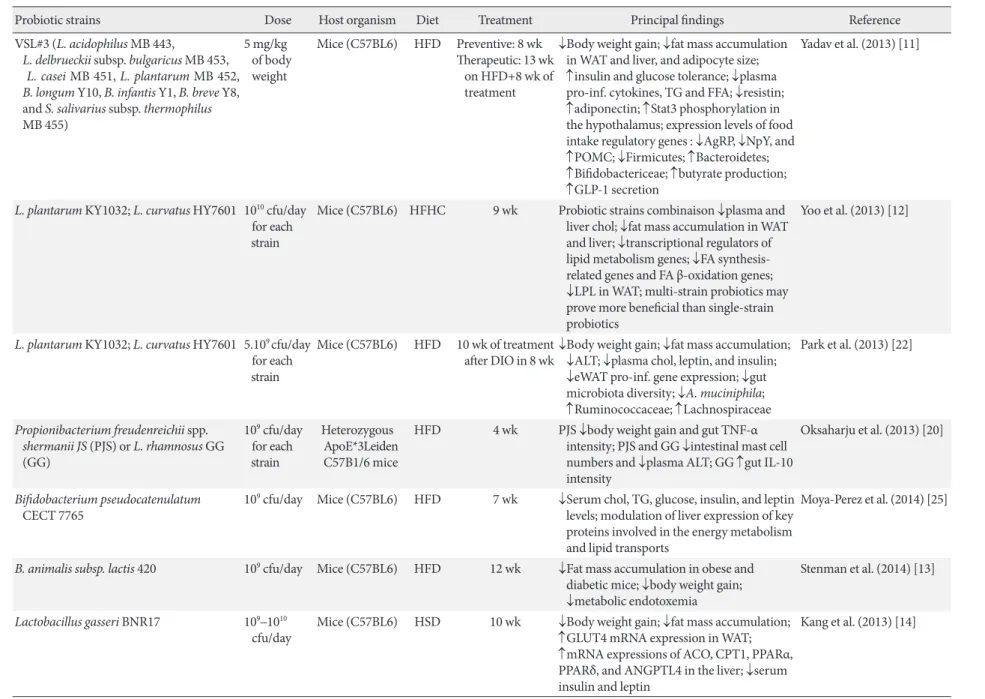
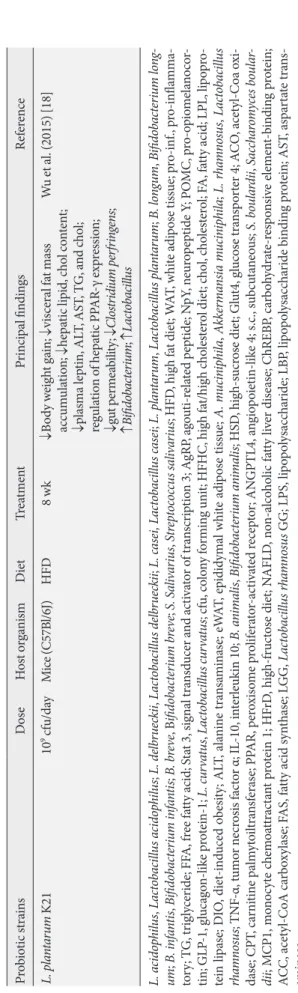
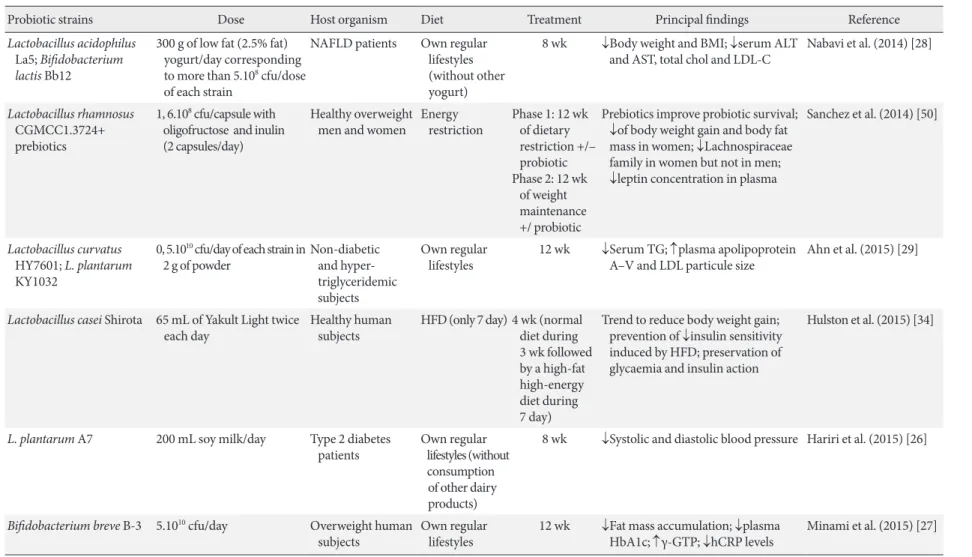
Probiotic administration has been shown to stimulate the immune response, improve lactose tolerance, help prevent diar-rhea, have an anti-inlammatory efect and even restore obesity-linked gut dysbiosis [10]. Given the relationship between obesi-ty-related disorders and gut homeostasis, probiotics may be of interest to supplement the limited arsenal of therapies against the metabolic syndrome. The diversity of reported studies in Tables 1 and 2, shows that the positive efects of probiotics are strain-speciic and the idea of a “universal strain,” that would
provide at once all the beneits associated with probiotics, is un-realistic, even for strains of the same species [7]. In the context of obesity and metabolic disorders, probiotic supplementation may help to reduce hyperphagia [11], improving control of weight gain, fat mass loss and glucose tolerance. On the con-trary, such positive efects could also be obtained without mod-ulation of caloric intake, as demonstrated by most of the report-ed studies [12-18]. To demonstrate the beneicial efect of pro-biotics in improvement of metabolic disorders, researchers have access to a variety of assays such as plasma and liver cholesterol, free-fatty acids, alanine and aspartate transaminases (hepato-toxicity markers), gene and protein expressions (involved in in-lammatory and metabolic pathways), etc. (Tables 1 and 2 for details).
For example, dairy products supplemented with Propioni-bacterium, a well-known promising non-LAB genus, may ex-ert a probiotic effect in the colon by producing metabolites such as short-chain fatty acids (SCFA), vitamins (B8, B9, and B12), and 1,4-dihydroxy-2-naphtoic acid, biidogenic and an-ti-inlammatory product (DHNA) [19]. Oksaharju et al. [20] demonstrated that Propionibacterium freudenreichii ssp. sher-mani JS has anti-inlammatory efects on high fat diet-induced inlammation in ApoE*3Leiden mice, with a decrease of intes-tinal mast cell numbers and a demonstrated intesintes-tinal but also systemic anti-inlammatory potential.
Finally, although it needs further investigation, multiple strain probiotics could confer a more efective strategy than single-strain probiotics against diet-induced obesity (DIO) [12]. Interestingly, VSL#3, a mixture of eight diferent strains of bacteria, has shown eicacy in prevention but also in the treatment of obesity and type 2 diabetes [11].
POTENTIAL MECHANISMS OF ACTIONS
293
P
ro
b
io
tics a
n
d m
et
ab
o
lic di
so
rder
s
Di
ab
et
es M
et
ab J 2015;39:291-303
h
ttp://e-dm
j.o
rg
Table 1. Recent studies about beneicial probiotic efects on metabolic disorders in mice
Probiotic strains Dose Host organism Diet Treatment Principal indings Reference
VSL#3 (L. acidophilus MB 443,
L. delbrueckii subsp. bulgaricus MB 453, L. casei MB 451, L. plantarum MB 452, B. longum Y10, B. infantis Y1, B. breve Y8, and S. salivarius subsp. thermophilus
MB 455)
5 mg/kg of body weight
Mice (C57BL6) HFD Preventive: 8 wk
herapeutic: 13 wk on HFD+8 wk of treatment
↓Body weight gain; ↓fat mass accumulation in WAT and liver, and adipocyte size; ↑insulin and glucose tolerance; ↓plasma pro-inf. cytokines, TG and FFA; ↓resistin; ↑adiponectin; ↑Stat3 phosphorylation in the hypothalamus; expression levels of food intake regulatory genes : ↓AgRP, ↓NpY, and ↑POMC; ↓Firmicutes; ↑Bacteroidetes; ↑Biidobactericeae; ↑butyrate production; ↑GLP-1 secretion
Yadav et al. (2013) [11]
L. plantarum KY1032; L. curvatus HY7601 1010 cfu/day
for each strain
Mice (C57BL6) HFHC 9 wk Probiotic strains combinaison ↓plasma and
liver chol; ↓fat mass accumulation in WAT and liver; ↓transcriptional regulators of lipid metabolism genes; ↓FA related genes and FA β-oxidation genes; ↓LPL in WAT; multi-strain probiotics may prove more beneicial than single-strain probiotics
Yoo et al. (2013) [12]
L. plantarum KY1032; L. curvatus HY7601 5.109 cfu/day
for each strain
Mice (C57BL6) HFD 10 wk of treatment
ater DIO in 8 wk
↓Body weight gain; ↓fat mass accumulation; ↓ALT; ↓plasma chol, leptin, and insulin; ↓eWAT pro-inf. gene expression; ↓gut microbiota diversity; ↓A. muciniphila; ↑Ruminococcaceae; ↑Lachnospiraceae
Park et al. (2013) [22]
Propionibacterium freudenreichii spp. shermanii JS (PJS) or L. rhamnosus GG (GG)
109 cfu/day
for each strain
Heterozygous ApoE*3Leiden C57B1/6 mice
HFD 4 wk PJS ↓body weight gain and gut TNF-α
intensity; PJS and GG ↓intestinal mast cell numbers and ↓plasma ALT; GG ↑gut IL-10 intensity
Oksaharju et al. (2013) [20]
Biidobacterium pseudocatenulatum
CECT 7765
109 cfu/day Mice (C57BL6) HFD 7 wk ↓Serum chol, TG, glucose, insulin, and leptin
levels; modulation of liver expression of key proteins involved in the energy metabolism and lipid transports
Moya-Perez et al. (2014) [25]
B. animalis subsp. lactis 420 109 cfu/day Mice (C57BL6) HFD 12 wk ↓Fat mass accumulation in obese and
diabetic mice; ↓body weight gain; ↓metabolic endotoxemia
Stenman et al. (2014) [13]
Lactobacillus gasseri BNR17 109–1010
cfu/day
Mice (C57BL6) HSD 10 wk ↓Body weight gain; ↓fat mass accumulation;
↑GLUT4 mRNA expression in WAT;
↑mRNA expressions of ACO, CPT1, PPARα,
PPARδ, and ANGPTL4 in the liver; ↓serum
insulin and leptin
Kang et al. (2013) [14]
294
L
e B
arz M, et a
l.
Di
ab
et
es M
et
ab J 2015;39:291-303
h
ttp://e-dm
j.o
rg
Probiotic strains Dose Host organism Diet Treatment Principal indings Reference
A. muciniphila 2.108 cfu/day Mice (C57BL6) HFD 4 wk ↓s.c., mesenteric, epididymal fat mass, body
weight gain, insulin resistance, endotoxemia; ↑mRNA expression of markers of adipocyte diferentiation and lipid oxydation; A. muciniphila treatment restored mucus layer thickness
Everard et al. (2013) [15]
S. boulardii Biocodex (yeast) 120 mg/day Mice (db/db) Chow diet
4 wk ↓Body weight gain; ↓fat mass accumulation;
↓hepatic steatosis (lipid content, liver weight); ↓hepatic and systemic inlammation (MCP1, IL-1β, IL-4, IL-6, TNF-α); ↑caecum weight; ↑Bacteroidetes; ↓Firmicutes; ↓Proteobacteria;
↓Tenericutes; S. boulardii treatment ↓genera associated with diabetes and inlammation in db/db mice
(i.e., Odoribacter, Ruminococcus, Prevotella)
Everard et al. (2014) [16]
L. rhamnosus GG 5.107 cfu/g
of body weight
Mice (C57BL6, female)
HFrD 8 wk ↓Development of high-fructose induced
NAFLD; ↓plasma ALT; ↓liver fat
accumulation; ↓liver expression of ChREBP, ACC1 and FAS; ↓liver inlammation (TNF-α, IL-1β); ↑gut expression of occludin and claudin-1; LGG almost normalized the elevated portal LPS levels in HFrD fed mice; ↑Bacteroidetes; ↑Firmicutes
Ritze et al. (2014) [21]
Lactobacillus paracasei CNCM I-4270 (LC), L. rhamnosus I-3690 (LR) or B. animalis subsp. lactis I-2494 (BA)
108 cells/day
(individually, not in combination)
Mice (C57BL6) HFD 12 wk Each strain attenuated weight gain,
macrophage iniltration into eWAT, markedly ↑glucose-insulin homeostasis and hepatic steatosis; BA more robustly attenuated inlammatory efect of HFD (↓TNF-α expression in eWAT and liver, ↓LBP (a marker of endotoxin load), ↑anti-inf. adiponectin levels); Lactobacillus
and Biidobacterium strains diferentially afected host inlammation, gut microbial fermentation and gut microbiota composition
Wang et al. (2015) [17]
(Continued to the next page)
295 Probiotics and metabolic disorders
Diabetes Metab J 2015;39:291-303 http://e-dmj.org P ro b io tic s tra in s D os e H os t o rga ni sm Diet T re at m ent P rin ci p al in din gs R ef er en ce L. p la n ta ru m K21 10
9 cf
u/d ay M ice (C57B l/6J) HFD 8 w k ↓ B o d y w eig h t ga in; ↓ vi scera l fa t m as s acc um u la tio n; ↓ h ep at ic li p id , c h o l co n ten t; ↓ p la sm a lep tin, AL T , A ST , T G, a n d c h o l; r egu la tio n o f h ep at ic P PAR -γ exp res sio n; ↓ gu t p er m ea bi lit
y; ↓
Cl os tr id iu m p er fr in gens ; ↑ B ii dob ac te rium ; ↑ L ac tob ac illu s W
u et a
l. (2015) [18]
L. aci d op hi lu s , L ac tob ac il lu s ac id op hi lu s ; L . de lb rue ck ii , L ac tob ac il lu s d el br u ec kii ; L. cas ei, L ac to ba ci llu s cas ei ; L . p lan tar u m , L ac tob ac il lu s p la n ta rum ; B . l ong um , B ii d ob ac te rium lo ng -um ; B . i nfa n ti s , B ii d ob ac te rium in fa n ti s ; B . b re ve , B iido ba ct er iu m b re ve ; S. S ali va riu s , St rep toc oc cu s sa liv ar iu s ; HFD , hig h fa
t diet; W
A T , w hi te adi p os e t is sue; p ro-inf ., p ro-inl amm a-to ry ; T G, t rig ly cer ide; FF A, f re e fa tt
y acid; S
ta
t 3, sig
n al t ra n sd ucer a n d ac ti va to r o f t ra n scr ip tio
n 3; A
gRP , a go u ti-r el at ed p ep tide; N pY , n eur o p ep tide Y ; PO M C, p ro-o p io m el an o co r-tin; GLP -1, g luc ag o n-li ke p ro tein-1; L. cu rv at u s , L ac tob ac il lu s c ur va tu s ; cf u , co lo n y f o rmin g uni t; HFH C, hig h fa t/hig h c h o les ter o
l diet; c
h o l, c h o les ter o l; F A, fa tt
y acid; LP
L, li p o p ro -tein li p as e; D IO , diet-in d uce d o b esi ty ; AL T , a la nin e t ra n sa min as e; eW A T , ep idid ym al w hi te adi p os e t is sue; A . mu ci ni phi la , A kk er m ans ia m u ci n ip hi la ; L . r ha m no su s , L ac tob ac il lu s rha m no su s ; TNF -α, t um o r n ecr osi s fac to
r α; IL
-10, in ter leu k in 10; B . a n im ali s , B ii d ob ac te rium a n im ali s ; HS D , hig h-s ucr os
e diet; G
lu t4, g lucos e t ra n sp o rt
er 4; A
C O , acet yl-C o a o xi -d as e; CPT , c ar ni tin e p alm yt o il tra n sf era se; P PAR , p er oxi so m e p ro lif era to r-ac ti va te d re cep to r; AN GPTL4, an gio p o iet in-li ke 4; s.c., su b cu ta n eo u s; S. b ou la rdii , Sacc ha ro m yce s bo u la r-dii ; M CP1, m o n o cyt e c h em o at trac ta n t p ro
tein 1; HF
rD
, hig
h-f
ruc
tos
e diet; N
AFLD , n o n-a lco h o lic fa tt y li ver di se as e; C hREB P, c arb o h ydra te-r es p o n si ve e lem en t-b in din g p ro tein; A C C, acet yl-C oA c arb oxy la se; F A S, fa tt
y acid sy
n th as e; L GG, L ac to bac il lu s rha m no su s
GG; LPS, li
p o p o lys acc h ar ide; LB P, li p o p o lys acc h ar ide b in din g p ro tein; A ST , a sp ar ta te t ra n s-amin as e. T ab le 1. C o nt inu ed
DNA, teichoic acids and certain cell-surface bound and secret-ed proteins as well as organic acids, bacteriocins, polyphos-phate, and fatty acids (FA), which can modulate host responses, inhibit pathogens or interact with the intestinal microbiota [23]. Furthermore, whereas a disrupted intestinal barrier con-tributes to the pathogenesis of metabolic diseases, the underly-ing causes remain unclear. Indeed, it may include changes in nutritional factors, infections (i.e., Helicobacter pylori infection leading to an increased rate of incident diabetes), exposure to toxins, lack of exposure to microbes in early childhood, as well as impaired function and diversity of the gut microbiota [24]. Moreover, probiotic strains can not only affect the intestinal microbiota directly but also afect other organs by modulating intestinal inlammation and permeability [25]. Several poten-tial mechanisms underlying the beneicial efects of probiotics are illustrated in Figs 1 and 2.
REDUCTION OF BODY OR LIVER FAT MASS
he “obese microbiome” is thought to display an increased ca-pacity to harvest energy from the diet along with a decreased ability to stimulate the production of gut factors that inhibit fat deposition [1]. Furthermore, the beneicial efect of probiotics to decrease DIO is both highly strain- and model-specific [13,18,26-28]. For example, the gut microbiota could promote storage of triglyceride in adipocytes through suppression of intestinal expression of a circulating lipoprotein lipase (LPL) inhibitor, the angiopoietin-like 4 [2]. Nevertheless, storage of excess FA is the result of unbalanced lipid absorption involv-ing LPL and lipid catabolism [29]. In fact, Yoo et al. [12], treat-ed DIO-mice with a combination of probiotics that resulttreat-ed in a decreased expression of genes involved in FA transport and
re-296
L
e B
arz M, et a
l.
Di
ab
et
es M
et
ab J 2015;39:291-303
h
ttp://e-dm
j.o
rg
Table 2. Most recent double-blinded studies of probiotic efects on metabolic disorders in humans
Probiotic strains Dose Host organism Diet Treatment Principal indings Reference
Lactobacillus acidophilus
La5; Biidobacterium lactis Bb12
300 g of low fat (2.5% fat) yogurt/day corresponding to more than 5.108 cfu/dose
of each strain
NAFLD patients Own regular
lifestyles (without other yogurt)
8 wk ↓Body weight and BMI; ↓serum ALT
and AST, total chol and LDL-C
Nabavi et al. (2014) [28]
Lactobacillus rhamnosus
CGMCC1.3724+ prebiotics
1, 6.108 cfu/capsule with
oligofructose and inulin (2 capsules/day)
Healthy overweight men and women
Energy restriction
Phase 1: 12 wk of dietary restriction +/– probiotic Phase 2: 12 wk of weight maintenance +/ probiotic
Prebiotics improve probiotic survival; ↓of body weight gain and body fat mass in women; ↓Lachnospiraceae family in women but not in men; ↓leptin concentration in plasma
Sanchez et al. (2014) [50]
Lactobacillus curvatus
HY7601; L. plantarum
KY1032
0, 5.1010 cfu/day of each strain in
2 g of powder
Non-diabetic and triglyceridemic subjects
Own regular lifestyles
12 wk ↓Serum TG; ↑plasma apolipoprotein
A–V and LDL particule size
Ahn et al. (2015) [29]
Lactobacillus casei Shirota 65 mL of Yakult Light twice each day
Healthy human subjects
HFD (only 7 day) 4 wk (normal diet during 3 wk followed by a high-fat high-energy diet during 7 day)
Trend to reduce body weight gain; prevention of ↓insulin sensitivity induced by HFD; preservation of glycaemia and insulin action
Hulston et al. (2015) [34]
L. plantarum A7 200 mL soy milk/day Type 2 diabetes patients
Own regular lifestyles (without consumption of other dairy products)
8 wk ↓Systolic and diastolic blood pressure Hariri et al. (2015) [26]
Biidobacterium breve B-3 5.1010 cfu/day Overweight human
subjects
Own regular lifestyles
12 wk ↓Fat mass accumulation; ↓plasma
HbA1c; ↑γ-GTP; ↓hCRP levels
Minami et al. (2015) [27]
297 Probiotics and metabolic disorders
Diabetes Metab J 2015;39:291-303 http://e-dmj.org
sistance in a rat model of choline-deicient diet-induced non-alcoholic fatty liver disease (NAFLD) [32]. As reported in Table 1, Ritze et al. [21] have also shown that Lactobacillus rhamnosus
GG protects against NAFLD through speciically reducing liver fat mass loss in association with modulation of the carbohy-drate-responsive element-binding protein pathway.
Moreover, in many studies, the beneicial efects allocated to probiotics on body fat mass, could be explained by complex and still unclear mechanisms that may or may not involve change in caloric intake (Tables 1 and 2). Yadav et al. [11] have demon-strated that the VSL#3 probiotic promoted the release of the hormone glucagon-like protein-1 (GLP-1), resulting in reduced food intake and improved glucose tolerance, which was corre-lated with SCFA production leading to L-cell stimulation and GLP-1 production and the modulation of several genes in-volved in food intake regulation.
RESTORATION OF MUCOSAL BARRIER
INTEGRITY AND IMMUNOMODULATION
he modulation of the intestinal immune system is also thought to ameliorate insulin sensitivity even without decreased fat mass accumulation [33,34]. he intestinal barrier is a functional enti-ty separating the gut lumen from the inner host. It comprises
298
Le Barz M, et al.
Diabetes Metab J 2015;39:291-303 http://e-dmj.org
organisms, beneicial probiotic efects can also reinforce intes-tinal barrier integrity. Indeed, mucosal permeability is adapt-able and may be directly regulated in response to extracellular stimuli, such as nutrients and bacteria. hese interactions can result in the variation of gene expression of receptors involved in numerous and diverse pathways leading to the production of cytokines and other active molecules, secreted from epithe-lial cells into the lumen inducing gut microbiota modulations.
It was recently demonstrated that DIO-mice display low-grade systemic inlammation and metabolic perturbations, in asso-ciation with reduced intestinal bifidobacteria and increased plasma levels of endotoxin (LPS), a trait strongly correlated with disrupted intestinal barrier integrity [6]. Moreover, plas-ma citrulline and intestinal FA-binding protein levels (plas-markers of gut barrier integrity) are signiicantly elevated in severely obese diabetic individuals, which was associated with increased Fig. 2. Potential direct efects of probiotics to protect gut microbiota and intestinal barrier integrity. Obesogenic diet or “Western diet” alter gut microbiota population diversity and intestinal barrier integrity. Cross-talk between ingested probiotics, gut micro-biota (commensal bacteria) and epithelial cells (1). Probiotics produce metabolites that could serve to increase both the diversity of commensal bacteria and the availability of nutrients used by intestinal epithelial cells (IEC). Commensal bacteria multiply and in turn, also produce metabolites that could be used by surrounding cells. In patients sufering from metabolic disorders, intesti-nal permeability is altered leading to an increase of low-grade inlammation and metabolic endotoxemia (2). Probiotics can in-crease production of tight- and adherens junction (TJ and AJ) proteins (3), improving gut permeability and inhibiting the pas-sage of lipopolysaccharides (LPS) into systemic circulation that decreases metabolic endotoxemia. Moreover, probiotics express microorganism-associated molecular patterns (MAMPs) that could bind to host pattern recognition receptors (PRRs) located at cell surface of IEC (1) and dendritic cells (4), and induce the activation/inhibition of signaling pathways. For example (5), probi-otics can stimulate dendritic cells leading to inhibition of pro-inlammatory CD4+ cell proliferation and activation of anti-in-lammatory pathways (Treg and plasma cell proliferation, resulting in production of anti-inanti-in-lammatory cytokines and IgA im-munoglobulins (6), respectively). Mainly present in the mucus layer, IgA reinforce the protective role of mucosal barrier. Mucus production can also be increased by probiotics that stimulate goblet cells leading to activation of mucin gene expression and therefore production of mucin glycoproteins (7). Once assembled, these proteins are excreted and form the mucus layer, which acts as barrier against pathogen colonization. However, probiotics can also induce physical barrier against pathogens or produce bacteriocins that inhibits undesirable microorganism invasion (8). TLR, Toll-like receptor; NLR, NOD-like receptor; TNF-α, tu-mor necrosis factor α; IFN-γ, interferon γ; TGF-β, transforming growth factor β; IL-10, interleukin 10.
Probiotic Commensal
Pathogen
Dendritic cell
Occludins; ZO
Plasma cell PRR
LPS
PRR (TLRs; NLRs)
PRR
lgA
TGF-β; IL-10 TJ
AJ CD4+
cell
TNF-α; IFN-γ
Treg cell B cell MAMP
B cell
Ossembled mucin glycoproteins Goblet
cell
Mucus Metabolites
Enterocytes
Codherins
Metabolic endotoxemia Low-grade inlammation Lumen
Mucus layer Intestinal epithelium
Lamina propia
Blood vessel
299 Probiotics and metabolic disorders
Diabetes Metab J 2015;39:291-303 http://e-dmj.org
small-intestinal enterocyte mass and increased enterocyte turn-over [39]. Furthermore, there are several families of innate re-ceptors which are involved in the recognition of microbe-asso-ciated molecular patterns (including Toll-like receptors, NOD-like receptors, or inlammasomes) [40]. Moreover, changes in gut microbiota modulate endotoxemia by a mechanism that af-fects gut barrier function and increases intestinal permeability, which may involve the disruption of TJ [6,41]. Cani’s group re-cently focused on the probiotic effect of Akkermansia mu-ciniphila, an interesting mucin-degrading member of the Ver-rucomicrobia phylum, and found that its administration to DIO mice decreases metabolic endotoxemia and adipose tissue inflammation by improving intestinal mucosal barrier func-tion, a trait linked to an increased mucus layer thickness [15]. Among other potential mechanisms involved in the mainte-nance of intestinal homeostasis, butyrate production has also been suggested to alleviate intestinal bowel diseases (IBDs) through its ability to inhibit histone deacetylases [42] and to ac-tivate G-coupled protein receptors [43], leading to enhanced protective immunity and improved gut barrier. Inoculation of mice with the butyrate-producers Clostridium cluster IV and XIVa or butyrate administration per se were both capable of ex-panding the colonic population of regulatory T cells (Treg), which increases the production of the anti-inlammatory cyto-kine interleukin 10 and reduces the colonic population of the pro-inlammatory CD4+ T cells [44]. Similarly, oral adminis-tration of Butyricicoccus pullicaecorum, whose presence was found to be lower in IBD patients compared with healthy sub-jects, attenuated intestinal inlammation in a rat model of colitis [45]. While the resolution of obesity-induced intestinal inlam-mation is a valuable strategy to improve whole-body metabo-lism [33], butyrate can also act at the systemic level to exert an-ti-obesity and anti-inlammatory efects [46]. Interestingly, giv-en the large body of literature supporting the bgiv-eneicial efects of butyrate, the administration of butyrate producer strains such as Faecalibacterium prausnitzii, Roseburia intestinalis, or
Anaerostipes caccae may confer predictability and safeness to potential probiotic-based treatments of several pro-inlamma-tory disorders [47,48].
PERSPECTIVES IN THE USE OF PROBIOTICS
The concomitant use of probiotics with specific prebiotics, known as sources of “non-digestible compound that, through its metabolization by microorganisms in the gut, modulates
composition and/or activity of the gut microbiota, thus confer-ring a beneicial physiological efect on the host” [49] should also be considered as mean of improving health status. Prebiot-ics can improve probiotic efects on body weight loss and main-tenance, when they are co-administrated to the host organism [50]. Moreover, inulin-type fructans (ITFs) have been shown to afect gut ecology and stimulate immune cell activity, as well as decreasing body weight gain and fat mass in obese individu-als [51]. It individu-also appears that polyphenols can, in conjunction with a probiotic strain of Bacillus, stimulate the growth of anti-inlammatory bacterial species belonging to the genus Barnesi-ella and improve the bioavailability of certain health beneicial polyphenols [52]. In the context of obesity, the use of relatively new prebiotics such as arabinoxylan (AX) and arabinoxylan oligo-saccharides (AXOS) may be promising candidates to counteract related metabolic disorders, since AX and AXOS have been linked to adiposity reduction [53] and lower meta-bolic endotoxemia [54] in obese mice, respectively. Further-more, there is growing evidence that the biidogenic and butyr-ogenic efects of AX and AXOS are relected in potential cross-feeding mechanisms, such as for ITF, in which primary degrad-ers such as Bifidobacterium selectively and competitively de-grade these fructose polymers to produce acetate and lactate that are consumed by secondary degraders such as Roseburia
to produce butyrate [55]. Interestingly, AX administration in rodents has also been involved in gut microbiota modulation; firstly by increasing Bifidobacterium and Roseburia in DIO mice [56], and secondly by shiting mucin degradation from the caecum to the colon where a higher abundance of mucolyt-ic A. muciniphila may locally produce beneficial metabolites such as propionate [57].
300
Le Barz M, et al.
Diabetes Metab J 2015;39:291-303 http://e-dmj.org
the treatment of type 1 diabetes. Another interesting potential strategy is the genetic modiication of the probiotic E. coli Nissle 1917 to produce N-acylphosphatidylethanolamines, which is converted quickly ater meals into potent appetite-suppressing lipids, know as N-acylethanolamines [60]. he aforementioned examples show the great potential of engineered strains as a strategy to treat obesity and its metabolic consequences.
CONCLUSIONS
Altogether, various studies (Tables 1 and 2) demonstrate that probiotic administration may confer beneficial effects in the prevention and treatment of obesity, inlammation and other associated metabolic disorders through various mechanisms including direct effects on mucosal barrier and surrounding cells in particular, that can impede on chronic inlammation (Figs. 1 and 2). Currently, researchers are on the path to uncov-er beneicial and detrimental gut microbiota phylotypes that could lead to the use of living probiotics in order to reshape gut bacterial communities in beneicial ways to the host. he major issue that hampers a meta-analysis comparison of all the po-tential probiotic strains is the considerable heterogeneity be-tween protocols used in many studies (model, dose, treatment, and times). For the same reason, research on probiotics are still confronted with an apparent lack of conclusive results, further limited by the small number of trials where the application of probiotics was evaluated in double-blinded large-scale cohorts studies, particularly in the context of obesity prevention. In-deed, even if FMT showed very good results in recent human trials, the fact that potential adverse efects have also been re-ported, calls for caution because probiotics are already used for obesity management. This is particularly true for specific groups (i.e., neonates infants or individuals with immune dei-ciency) that may be a greater risk for adverse efects of probiot-ics. Moreover, a better understanding of how environmental factors (i.e., culture conditions, product formulations, storage time, host metagenome and genotype and variability of con-sumer-associated factors) inluence probiotic function would ultimately be useful for unraveling the signiicant inter-individ-ual variation in response to probiotic bacteria among human subjects and for comparing outcomes of diferent clinical stud-ies. Despite the methodological and regulatory issues raised above, the field of probiotics is evolving based on a growing body of research, which is paving the way for a successful strat-egy against obesity and its related comorbidities, using strains
capable of producing well characterized molecules, or using engineered bacteria that ensures safety of use. Moreover, the increased interest in the role of the gut microbiota in host’s physiology is revealing novel potential probiotic strains while triggering a regain of interest in probiotics as a tool to manipu-late intestinal bacterial communities and therefore treat/pre-vent intestinal and systemic diseases.
CONFLICTS OF INTEREST
No potential conlict of interest relevant to this article was re-ported.
REFERENCES
1. Turnbaugh PJ, Ley RE, Mahowald MA, Magrini V, Mardis ER, Gordon JI. An obesity-associated gut microbiome with in-creased capacity for energy harvest. Nature 2006;444:1027-31. 2. Backhed F, Ding H, Wang T, Hooper LV, Koh GY, Nagy A,
Se-menkovich CF, Gordon JI. he gut microbiota as an environ-mental factor that regulates fat storage. Proc Natl Acad Sci U S A 2004;101:15718-23.
3. David LA, Maurice CF, Carmody RN, Gootenberg DB, Button JE, Wolfe BE, Ling AV, Devlin AS, Varma Y, Fischbach MA, Bid-dinger SB, Dutton RJ, Turnbaugh PJ. Diet rapidly and reproduc-ibly alters the human gut microbiome. Nature 2014;505:559-63. 4. Khan MT, Nieuwdorp M, Backhed F. Microbial modulation of
insulin sensitivity. Cell Metab 2014;20:753-60.
5. Hur KY, Lee MS. Gut microbiota and metabolic disorders. Di-abetes Metab J 2015;39:198-203.
6. Cani PD, Bibiloni R, Knauf C, Waget A, Neyrinck AM, Del-zenne NM, Burcelin R. Changes in gut microbiota control met-abolic endotoxemia-induced inlammation in high-fat diet-in-duced obesity and diabetes in mice. Diabetes 2008;57:1470-81. 7. Hill C, Guarner F, Reid G, Gibson GR, Merenstein DJ, Pot B,
Morelli L, Canani RB, Flint HJ, Salminen S, Calder PC, Sand-ers ME. Expert consensus document. he International Scien-tiic Association for Probiotics and Prebiotics consensus state-ment on the scope and appropriate use of the term probiotic. Nat Rev Gastroenterol Hepatol 2014;11:506-14.
8. Gareau MG, Sherman PM, Walker WA. Probiotics and the gut microbiota in intestinal health and disease. Nat Rev Gastroen-terol Hepatol 2010;7:503-14.
301 Probiotics and metabolic disorders
Diabetes Metab J 2015;39:291-303 http://e-dmj.org
and potential applications. World J Gastroenterol 2014;20: 16518-28.
10. Champagne CP, Gardner NJ, Roy D. Challenges in the addition of probiotic cultures to foods. Crit Rev Food Sci Nutr 2005;45: 61-84.
11. Yadav H, Lee JH, Lloyd J, Walter P, Rane SG. Beneicial meta-bolic efects of a probiotic via butyrate-induced GLP-1 hormone secretion. J Biol Chem 2013;288:25088-97.
12. Yoo SR, Kim YJ, Park DY, Jung UJ, Jeon SM, Ahn YT, Huh CS, McGregor R, Choi MS. Probiotics L. plantarum and L. curva-tus in combination alter hepatic lipid metabolism and suppress diet-induced obesity. Obesity (Silver Spring) 2013;21:2571-8. 13. Stenman LK, Waget A, Garret C, Klopp P, Burcelin R, Lahtinen
S. Potential probiotic Biidobacterium animalis ssp. lactis 420 prevents weight gain and glucose intolerance in diet-induced obese mice. Benef Microbes 2014;5:437-45.
14. Kang JH, Yun SI, Park MH, Park JH, Jeong SY, Park HO. Anti-obesity efect of Lactobacillus gasseri BNR17 in high-sucrose diet-induced obese mice. PLoS One 2013;8:e54617.
15. Everard A, Belzer C, Geurts L, Ouwerkerk JP, Druart C, Bindels LB, Guiot Y, Derrien M, Muccioli GG, Delzenne NM, de Vos WM, Cani PD. Cross-talk between Akkermansia muciniphila and intestinal epithelium controls diet-induced obesity. Proc Natl Acad Sci U S A 2013;110:9066-71.
16. Everard A, Matamoros S, Geurts L, Delzenne NM, Cani PD. Saccharomyces boulardii administration changes gut microbi-ota and reduces hepatic steatosis, low-grade inlammation, and fat mass in obese and type 2 diabetic db/db mice. MBio 2014;5: e01011-14.
17. Wang J, Tang H, Zhang C, Zhao Y, Derrien M, Rocher E, van-Hylckama Vlieg JE, Strissel K, Zhao L, Obin M, Shen J. Modu-lation of gut microbiota during probiotic-mediated attenuation of metabolic syndrome in high fat diet-fed mice. ISME J 2015;9: 1-15.
18. Wu CC, Weng WL, Lai WL, Tsai HP, Liu WH, Lee MH, Tsai YC. Efect of Lactobacillus plantarum strain K21 on high-fat diet-fed obese mice. Evid Based Complement Alternat Med 2015;2015: 391767.
19. Cousin FJ, Deutsch SM, Perez Chaia A, Foligne B, Jan G. Inter-actions between probiotic dairy propionibacteria and the in-testinal epithelium. Curr Immunol Rev 2012;8:216-26. 20. Oksaharju A, Kooistra T, Kleemann R, van Duyvenvoorde W,
Miettinen M, Lappalainen J, Lindstedt KA, Kovanen PT, Kor-pela R, Kekkonen RA. Efects of probiotic Lactobacillus rham-nosus GG and Propionibacterium freudenreichii ssp.
sherma-nii JS supplementation on intestinal and systemic markers of inflammation in ApoE*3Leiden mice consuming a high-fat diet. Br J Nutr 2013;110:77-85.
21. Ritze Y, Bardos G, Claus A, Ehrmann V, Bergheim I, Schwiertz A, Bischof SC. Lactobacillus rhamnosus GG protects against non-alcoholic fatty liver disease in mice. PLoS One 2014;9: e80169.
22. Park DY, Ahn YT, Park SH, Huh CS, Yoo SR, Yu R, Sung MK, McGregor RA, Choi MS. Supplementation of Lactobacillus curvatus HY7601 and Lactobacillus plantarum KY1032 in di-et-induced obese mice is associated with gut microbial chang-es and reduction in obchang-esity. PLoS One 2013;8:e59470.
23. O’Shea EF, Cotter PD, Stanton C, Ross RP, Hill C. Production of bioactive substances by intestinal bacteria as a basis for ex-plaining probiotic mechanisms: bacteriocins and conjugated linoleic acid. Int J Food Microbiol 2012;152:189-205.
24. homas LV, Ockhuizen T, Suzuki K. Exploring the inluence of the gut microbiota and probiotics on health: a symposium re-port. Br J Nutr 2014;112 Suppl 1:S1-18.
25. Moya-Perez A, Romo-Vaquero M, Tomas-Barberan F, Sanz Y, Garcia-Conesa MT. Hepatic molecular responses to Bifido-bacterium pseudocatenulatum CECT 7765 in a mouse model of diet-induced obesity. Nutr Metab Cardiovasc Dis 2014;24: 57-64.
26. Hariri M, Salehi R, Feizi A, Mirlohi M, Kamali S, Ghiasvand R. he efect of probiotic soy milk and soy milk on anthropomet-ric measures and blood pressure in patients with type II diabe-tes mellitus: a randomized double-blind clinical trial. ARYA Atheroscler 2015;11(1 Suppl):74-80.
27. Minami J, Kondo S, Yanagisawa N, Odamaki T, Xiao JZ, Abe F, Nakajima S, Hamamoto Y, Saitoh S, Shimoda T. Oral adminis-tration of Biidobacterium breve B-3 modiies metabolic func-tions in adults with obese tendencies in a randomised controlled trial. J Nutr Sci 2015;4:e17.
28. Nabavi S, Rafraf M, Somi MH, Homayouni-Rad A, Asghari-Jafarabadi M. Efects of probiotic yogurt consumption on met-abolic factors in individuals with nonalcoholic fatty liver dis-ease. J Dairy Sci 2014;97:7386-93.
29. Ahn HY, Kim M, Ahn YT, Sim JH, Choi ID, Lee SH, Lee JH. he triglyceride-lowering efect of supplementation with dual probiotic strains, Lactobacillus curvatus HY7601 and Lactoba-cillus plantarum KY1032: Reduction of fasting plasma lyso-phosphatidylcholines in nondiabetic and hypertriglyceridemic subjects. Nutr Metab Cardiovasc Dis 2015;25:724-33.
302
Le Barz M, et al.
Diabetes Metab J 2015;39:291-303 http://e-dmj.org
Goodman AL, Henrissat B, Oozeer R, Cools-Portier S, Gobert G, Chervaux C, Knights D, Lozupone CA, Knight R, Duncan AE, Bain JR, Muehlbauer MJ, Newgard CB, Heath AC, Gor-don JI. he impact of a consortium of fermented milk strains on the gut microbiome of gnotobiotic mice and monozygotic twins. Sci Transl Med 2011;3:106ra106.
31. Veiga P, Pons N, Agrawal A, Oozeer R, Guyonnet D, Brazeilles R, Faurie JM, van Hylckama Vlieg JE, Houghton LA, Whorwell PJ, Ehrlich SD, Kennedy SP. Changes of the human gut micro-biome induced by a fermented milk product. Sci Rep 2014;4: 6328.
32. Endo H, Niioka M, Kobayashi N, Tanaka M, Watanabe T. Bu-tyrate-producing probiotics reduce nonalcoholic fatty liver disease progression in rats: new insight into the probiotics for the gut-liver axis. PLoS One 2013;8:e63388.
33. Luck H, Tsai S, Chung J, Clemente-Casares X, Ghazarian M, Revelo XS, Lei H, Luk CT, Shi SY, Surendra A, Copeland JK, Ahn J, Prescott D, Rasmussen BA, Chng MH, Engleman EG, Girardin SE, Lam TK, Croitoru K, Dunn S, Philpott DJ, Gutt-man DS, Woo M, Winer S, Winer DA. Regulation of obesity-related insulin resistance with gut anti-inlammatory agents. Cell Metab 2015;21:527-42.
34. Hulston CJ, Churnside AA, Venables MC. Probiotic supple-mentation prevents high-fat, overfeeding-induced insulin resis-tance in human subjects. Br J Nutr 2015;113:596-602.
35. Laukoetter MG, Bruewer M, Nusrat A. Regulation of the intes-tinal epithelial barrier by the apical junctional complex. Curr Opin Gastroenterol 2006;22:85-9.
36. Rousseaux C, huru X, Gelot A, Barnich N, Neut C, Dubuquoy L, Dubuquoy C, Merour E, Geboes K, Chamaillard M, Ouwe-hand A, Leyer G, Carcano D, Colombel JF, Ardid D, Des-reumaux P. Lactobacillus acidophilus modulates intestinal pain and induces opioid and cannabinoid receptors. Nat Med 2007; 13:35-7.
37. Turner JR. Intestinal mucosal barrier function in health and disease. Nat Rev Immunol 2009;9:799-809.
38. Kailasapathy K, Chin J. Survival and therapeutic potential of probiotic organisms with reference to Lactobacillus acidophi-lus and Biidobacterium spp. Immunol Cell Biol 2000;78:80-8. 39. Verdam FJ, Greve JW, Roosta S, van Eijk H, Bouvy N, Buurman
WA, Rensen SS. Small intestinal alterations in severely obese hyperglycemic subjects. J Clin Endocrinol Metab 2011;96: E379-83.
40. Kau AL, Ahern PP, Griin NW, Goodman AL, Gordon JI. Hu-man nutrition, the gut microbiome and the immune system.
Nature 2011;474:327-36.
41. Cani PD, Neyrinck AM, Fava F, Knauf C, Burcelin RG, Tuohy KM, Gibson GR, Delzenne NM. Selective increases of biido-bacteria in gut microlora improve high-fat-diet-induced dia-betes in mice through a mechanism associated with endotox-aemia. Diabetologia 2007;50:2374-83.
42. Felice C, Lewis A, Armuzzi A, Lindsay JO, Silver A. Review ar-ticle: selective histone deacetylase isoforms as potential thera-peutic targets in inlammatory bowel diseases. Aliment Phar-macol her 2015;41:26-38.
43. Kim MH, Kang SG, Park JH, Yanagisawa M, Kim CH. Short-chain fatty acids activate GPR41 and GPR43 on intestinal epi-thelial cells to promote inlammatory responses in mice. Gas-troenterology 2013;145:396-406.e1-10.
44. Smith PM, Howitt MR, Panikov N, Michaud M, Gallini CA, Bohlooly YM, Glickman JN, Garrett WS. he microbial me-tabolites, short-chain fatty acids, regulate colonic Treg cell ho-meostasis. Science 2013;341:569-73.
45. Eeckhaut V, Machiels K, Perrier C, Romero C, Maes S, Flahou B, Steppe M, Haesebrouck F, Sas B, Ducatelle R, Vermeire S, Van Immerseel F. Butyricicoccus pullicaecorum in inlamma-tory bowel disease. Gut 2013;62:1745-52.
46. den Besten G, Bleeker A, Gerding A, van Eunen K, Havinga R, van Dijk TH, Oosterveer MH, Jonker JW, Groen AK, Reijn-goud DJ, Bakker BM. Short-chain fatty acids protect against high-fat diet-induced obesity via a PPARgamma-dependent switch from lipogenesis to fat oxidation. Diabetes 2015;64: 2398-408.
47. Quevrain E, Maubert MA, Michon C, Chain F, Marquant R, Tailhades J, Miquel S, Carlier L, Bermudez-Humaran LG, Pig-neur B, Lequin O, Kharrat P, homas G, Rainteau D, Aubry C, Breyner N, Afonso C, Lavielle S, Grill JP, Chassaing G, Chatel JM, Trugnan G, Xavier R, Langella P, Sokol H, Seksik P. Identi-ication of an anti-inlammatory protein from Faecalibacteri-um prausnitzii, a commensal bacteriFaecalibacteri-um deicient in Crohn’s disease. Gut 2015 Jun 4 [Epub]. http://dx.doi.org/10.1136/ gutjnl-2014-307649.
48. Falony G, Vlachou A, Verbrugghe K, De Vuyst L. Cross-feed-ing between Biidobacterium longum BB536 and acetate-con-verting, butyrate-producing colon bacteria during growth on oligofructose. Appl Environ Microbiol 2006;72:7835-41. 49. Bindels LB, Neyrinck AM, Salazar N, Taminiau B, Druart C,
303 Probiotics and metabolic disorders
Diabetes Metab J 2015;39:291-303 http://e-dmj.org
control the development of leukemia and associated cachexia in mice. PLoS One 2015;10:e0131009.
50. Sanchez M, Darimont C, Drapeau V, Emady-Azar S, Lepage M, Rezzonico E, Ngom-Bru C, Berger B, Philippe L, Ammon-Zuf-frey C, Leone P, Chevrier G, St-Amand E, Marette A, Dore J, Tremblay A. Efect of Lactobacillus rhamnosus CGMCC1.3724 supplementation on weight loss and maintenance in obese men and women. Br J Nutr 2014;111:1507-19.
51. Parnell JA, Reimer RA. Weight loss during oligofructose supple-mentation is associated with decreased ghrelin and increased peptide YY in overweight and obese adults. Am J Clin Nutr 2009;89:1751-9.
52. Dudonne S, Varin TV, Forato Anhe F, Dube P, Roy D, Pilon G, Marette A, Levy E, Jacquot C, Urdaci M, Desjardins Y. Modu-latory efects of a cranberry extract co-supplementation with Bacillus subtilis CU1 probiotic on phenolic compounds bio-availability and gut microbiota composition in high-fat diet-fed mice. PharmaNutrition 2015 May 1 [Epub]. http://dx.doi. org/10.1016/j.phanu.2015.04.002.
53. Delzenne NM, Neyrinck AM, Cani PD. Gut microbiota and metabolic disorders: how prebiotic can work? Br J Nutr 2013; 109 Suppl 2:S81-5.
54. Neyrinck AM, Van Hee VF, Piront N, De Backer F, Toussaint O, Cani PD, Delzenne NM. Wheat-derived arabinoxylan oli-gosaccharides with prebiotic effect increase satietogenic gut peptides and reduce metabolic endotoxemia in diet-induced obese mice. Nutr Diabetes 2012;2:e28.
55. De Vuyst L, Leroy F. Cross-feeding between biidobacteria and
butyrate-producing colon bacteria explains bifdobacterial competitiveness, butyrate production, and gas production. Int J Food Microbiol 2011;149:73-80.
56. Neyrinck AM, Possemiers S, Druart C, Van de Wiele T, De Backer F, Cani PD, Larondelle Y, Delzenne NM. Prebiotic ef-fects of wheat arabinoxylan related to the increase in biidobac-teria, Roseburia and Bacteroides/Prevotella in diet-induced obese mice. PLoS One 2011;6:e20944.
57. Van den Abbeele P, Gerard P, Rabot S, Bruneau A, El Aidy S, Derrien M, Kleerebezem M, Zoetendal EG, Smidt H, Vers-traete W, Van de Wiele T, Possemiers S. Arabinoxylans and inu-lin diferentially modulate the mucosal and luminal gut micro-biota and mucin-degradation in humanized rats. Environ Mi-crobiol 2011;13:2667-80.
58. de Moreno de LeBlanc A, Del Carmen S, Chatel JM, Miyoshi A, Azevedo V, Langella P, Bermudez-Humaran LG, LeBlanc JG. Current review of genetically modiied lactic acid bacteria for the prevention and treatment of colitis using murine mod-els. Gastroenterol Res Pract 2015;2015:146972.
59. Duan FF, Liu JH, March JC. Engineered commensal bacteria reprogram intestinal cells into glucose-responsive insulin-se-creting cells for the treatment of diabetes. Diabetes 2015;64: 1794-803.