www.atmos-chem-phys.net/8/3735/2008/ © Author(s) 2008. This work is distributed under the Creative Commons Attribution 3.0 License.
Chemistry
and Physics
CCN activation experiments with adipic acid: effect of particle
phase and adipic acid coatings on soluble and insoluble particles
S. S. Hings1, W. C. Wrobel1, E. S. Cross1, D. R. Worsnop2, P. Davidovits1, and T. B. Onasch1,2
1Department of Chemistry, Boston College, Chestnut Hill, MA 02467, USA 2Aerodyne Research Inc., Billerica, MA 01821, USA
Received: 1 February 2008 – Published in Atmos. Chem. Phys. Discuss.: 4 March 2008 Revised: 19 May 2008 – Accepted: 23 May 2008 – Published: 15 July 2008
Abstract. Slightly soluble atmospherically relevant organic compounds may influence particle CCN activity and there-fore cloud formation. Adipic acid is a frequently employed surrogate for such slightly soluble organic materials. The 11 published experimental studies on the CCN activity of adipic acid particles are not consistent with each other nor do they, in most cases, agree with the K¨ohler theory. The CCN activity of adipic acid aerosol particles was studied over a significantly wider range of conditions than in any previ-ous single study. The work spans the conditions of the pre-vious studies and also provides alternate methods for pro-ducing “wet” (deliquesced solution droplets) and dry adipic acid particles without the need to produce them by atom-ization of aqueous solutions. The experiments suggest that the scatter in the previously published CCN measurements is most likely due to the difficulty of producing uncontaminated adipic acid particles by atomization of solutions and possibly also due to uncertainties in the calibration of the instruments. The CCN activation of the small (dm<150 nm) initially dry
particles is subject to a deliquescence barrier, while for the larger particles the activation follows the K¨ohler curve. Wet adipic acid particles follow the K¨ohler curve over the full range of particle diameters studied. In addition, the effect of adipic acid coatings on the CCN activity of both soluble and insoluble particles has also been studied. When a water-soluble core is coated by adipic acid, the CCN-hindering ef-fect of particle phase is eliminated. An adipic acid coating on hydrophobic soot yields a CCN active particle. If the soot particle is relatively small (dcore≤102 nm), the CCN activity
of the coated particles approaches the deliquescence line of adipic acid, suggesting that the total size of the particle de-termines CCN activation and the soot core acts as a scaffold.
Correspondence to:S. S. Hings [email protected]
1 Introduction
As has been discussed in several publications, the effect on climate of aerosol radiative forcing may be as large as that of the greenhouse gases, but opposite in sign and much more uncertain (See for example, Kaufman and Koren, 2006; Schwartz et al., 2007; IPCC, 2007). The high uncertainties are due to the currently inadequate representation of the com-plex interactions of aerosols with climate due to their intrin-sically complex composition, morphology, and size distribu-tions.
Atmospheric aerosol particles influence global climate by direct and indirect processes (Lohmann and Feichter, 2005). The direct process of aerosol climate-forcing involves the absorption, reflection, and scattering of incoming solar ra-diation by atmospheric aerosols. The indirect process in-volves atmospheric particles serving as cloud condensation nuclei (CCN) on which water vapor condenses to form cloud droplets. CCN activity depends on the shape, size, structure, and composition of the aerosol particles (McFiggans et al., 2005; Dusek et al., 2006). An aspect of CCN activity is the subject of this work.
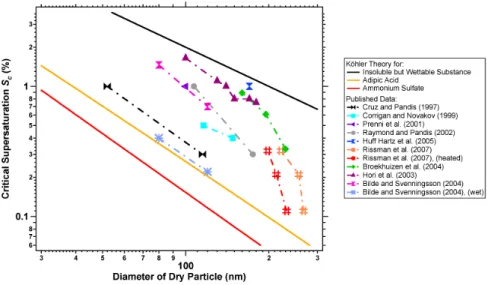
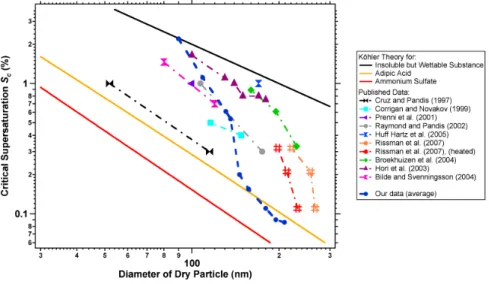
Fig. 1.Published critical supersaturations (Sc) for adipic acid as a function of dry particle size. Particles were obtained by atomizing aqueous
solutions. The source of the data is shown by the symbols as identified in the insert. The state of the particles prior to activation was dry unless otherwise noted. Critical supersaturations predicted by the standard Khler theory are shown as solid lines for (NH4)2SO4(red line),
adipic acid (orange line), and an insoluble but wettable substance (black line). See text for details.
and surface tension effects, published experimental studies on the CCN activity of slightly soluble adipic acid particles are in most cases not consistent with the K¨ohler theory and vary widely from one study to another. Adipic acid has a water solubility of 25 g/L (Saxena and Hildemann, 1996).
It has been suggested and experimentally verified for sev-eral compounds (for example succinic acid and adipic acid) that particle phase plays an important role in the activa-tion of particles consisting of slightly soluble organic com-pounds (Hori et al., 2003; Bilde and Svenningsson, 2004; Broekhuizen et al., 2004). Bilde and Svenningsson (2004) have also shown that small amounts of inorganic salts may have a significant effect on the percent critical supersatura-tion (Sc)of slightly soluble organic compounds.
1.1 Previously published Scdata for adipic acid
Figure 1 shows published adipic acid critical supersatura-tion data as a funcsupersatura-tion of particle diameter from 11 studies. In all these experiments, particles were formed by atomiz-ing aqueous solutions of adipic acid. Particles were sub-sequently dried to relative humidities between 5 and 20%. In one case only, particles were kept wet as supersaturated (i.e., deliquesced) solution droplets (designated in the figure as “wet”). In one set of experiments, Rissman et al. (2007) heated the adipic acid particles prior to drying them.
The solid lines are obtained from standard K¨ohler theory calculations described in Sect. 2. The orange line is the cal-culation for adipic acid using a concentration dependent sur-face tension. The red line is the calculation for ammonium sulfate particles and the solid black line is the K¨ohler curve for pure water that is a stand-in for a wettable but insoluble
substance (Petters and Kreidenweis, 2007). The broken lines in the figure provide visual continuity for the experimental points.
As is evident from Fig. 1, the published data for adipic acid exhibit significant scatter. For example, at 1% supersat-uration, measured critical diameters for adipic acid particles vary from 50 nm to 180 nm. The measurements of Bilde and Svenningsson (2004) for wet particles fall close to the stan-dard K¨ohler theory line for adipic acid. The measurements of Rissman et al. (2007) for the largest sized particles approach the predictions of the K¨ohler theory. All other data show higher critical supersaturations than predicted by the K¨ohler theory. The large variations in measured supersaturation are likely caused by particle phase differences (Bilde and Sven-ningsson, 2004), differences in particle preparation (Rissman et al., 2007), as will be discussed, and also possibly due to methods of CCN measurement (see Appendix).
The purpose of the present work, studying the CCN activ-ity of adipic acid, is twofold. First, we want to understand the factors governing the CCN activity of slightly soluble or-ganic compounds and, in the process, we want to explain the wide variations in the published critical supersaturation mea-surements for adipic acid. Toward these ends, we studied the CCN activity of adipic acid aerosol over a significantly wider range of conditions (particle diameter, particle phase, and particle coatings) than has been previously encompassed in any single study. Our work spans the conditions of the previous studies and also provides alternate methods for pro-ducing “wet” and dry adipic acid particles without the need to produce them by atomization of aqueous solutions.
The second purpose of our work is to understand the effect of adipic acid coatings on both soluble and insoluble cores with respect to cloud droplet activation.
2 Theory
2.1 Derivation of critical supersaturation
Cloud droplets are formed when water aggregates on the sur-face of a pre-existing particle and causes unrestrained con-densational growth. This concon-densational growth is controlled by the vapor pressure over a particle and is a function of both the curvature and the composition of the particle. Stan-dard K¨ohler theory describes this condensational growth and provides an expression for equilibrium water vapor pressure over an aqueous solution droplet yielding an expression for the supersaturation ratioSw(Pruppacher and Klett, 1997):
Sw=
p
p0 =γwxwexp(
4Mwσ
RT ρwdp
) (1)
Here, p is the vapor pressure of water over the solution droplet,p0is the equilibrium vapor pressure over a flat sur-face,γw is the activity of water,xw is the mole fraction of
water in the aqueous solution,Mwis the molar mass of water,
σ is the surface tension of the solution droplet,Ris the uni-versal gas constant,T is the temperature,ρw is the density
of water, anddpis the diameter of the droplet at water vapor
pressurep. This diameter will be designated as the solution droplet diameter.
The productγwxw represents the Raoult (or solution)
ef-fect, which increases with increasing wet diameterdp. The
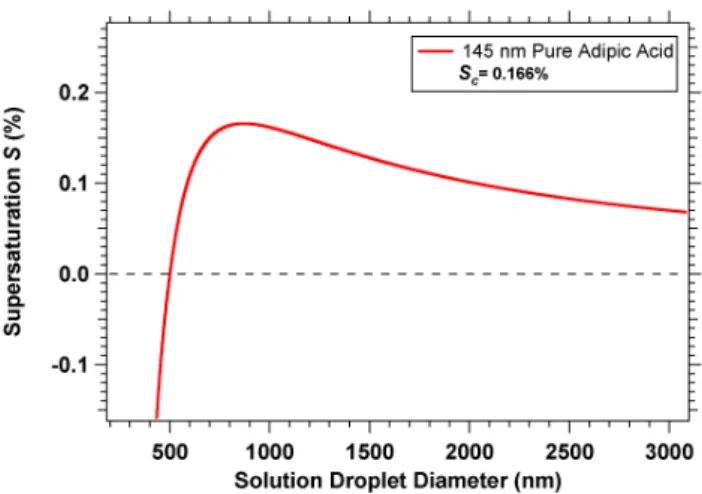
exponential term represents the Kelvin (or curvature) effect, which decreases with increasing wet diameter. These two competing effects result in a maximum with respect todpfor
Eq. (1) (See Fig. 2).
The term commonly used to describe particle growth by vapor condensation is supersaturation (S, in percent) defined as:
S=(Sw−1)·100 (2)
Figure 2 displaysSas a function of the solution droplet diam-eterdp. The maximum of this curve is known as the critical
supersaturation (Sc). An aerosol particle is CCN active (i.e.,
grows into a cloud droplet) if the ambient supersaturation exceeds this maximum. Standard K¨ohler theory describes the activation of single-component aqueous solution droplets and is used here to model ammonium sulfate and completely dissolved adipic acid.
2.2 Surface tension in calculating critical supersaturation As is evident from Eqs. (1) and (2), surface tension is a key parameter for calculating the supersaturation (Sw)and
there-fore the critical supersaturation (Sc). It has been shown that
Fig. 2. Calculated supersaturationS as a function of the solution droplet diameterdp for a particle composed of adipic acid. The
adipic acid particle has dry diameter 145 nm and a critical supersat-urationScof 0.166%.
dissolved surface active slightly soluble organic compounds can lower the surface tension of aqueous solutions, depend-ing on concentration, by as much as one third (Shulman et al., 1996 and Facchini et al., 2000). A decrease inσ lowers the critical supersaturation as predicted by K¨ohler theory.
The surface tension of an adipic acid solution can be calcu-lated from the Szyszkowski-Langmuir equation as has been done by Henning et al. (2005):
σ =σw(T )−aTln(1+bC) (3)
Here,C is the concentration of dissolved carbon (moles of carbon per kg of water) andσw(T )is the surface tension of
water at temperatureT. The parametersaandbare obtained by fitting the experimental results to Eq. (3). For pure adipic acid, Henning et al. (2005) obtaineda=0.0106 andb=11.836. 2.3 Results of critical supersaturation calculations
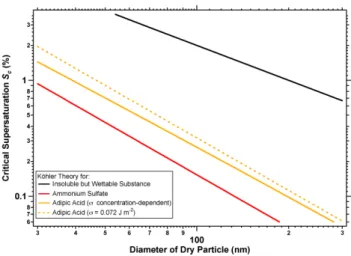
Using Eqs. (1) and (2), critical supersaturations Sc were
calculated as a function of initially dry particle diameter for three substances: Ammonium sulfate, adipic acid, and an insoluble but wettable substance. Results are shown in Fig. 3. Ammonium sulfate is modeled using the surface tension of water (0.072 J/m2). Adipic acid is modeled with both the concentration-dependent surface tension defined by the Szyszkowski-Langmuir equation (Eq. 3; ranging from 0.060– 0.072 J/m2for 30–300 nm adipic acid particles) and the surface tension of water (0.072 J/m2). The black line in Fig. 4 is the critical supersaturation for a pure water droplet. This line effectively models the growth of an insoluble but wettable spherical surface and is hereafter referred to as the “wettable line”.
Fig. 3. Critical supersaturations as a function of initially dry par-ticle diameter, calculated from K¨ohler theory for ammonium sul-fate (red), adipic acid (yellow) and an insoluble but wettable sub-stance (black). The lines for adipic acid have been modeled in two different ways: using the surface tension of water (dashed line) and using a concentration-dependent surface tension defined by the Szyszkowski-Langmuir equation (solid line). See text for details.
In such a case, the possibility exists that the droplet contains an undissolved adipic acid core surrounded by a solution of water, adipic acid, and ammonium sulfate. The presence of the ammonium sulfate allows condensational growth of the particle by addition of water without causing the complete deliquescence of the adipic acid. The presence of such a slightly soluble core that gradually dissolves as the droplet grows modifies the overall shape of the K¨ohler growth curve. Shulman et al. (1996) modified the standard K¨ohler theory to describe the effect of such a mixed composition on the activa-tion of an aerosol particle into a cloud droplet. Our modeling calculations show that under our experimental conditions, the predictions of the standard and modified K¨ohler theories are the same.
2.4 Justification of solvent-free method for generating adipic acid
As has been stated, in all previous studies of adipic acid par-ticle CCN activation, the adipic acid parpar-ticles were gener-ated by atomization of an aqueous solution (or methanol sol-vent Rissman et al., 2007). The process of atomization of a solution may introduce impurities that may be responsi-ble for the variations in the CCN activity measured in the various studies. We decided to generate “wet” (deliquesced solution droplets) adipic acid without atomization. This sec-tion provides a theoretical justificasec-tion for generating “wet” adipic acid particles by coating an ammonium sulfate core with adipic acid via vapor deposition. See Sect. 3.3 for the method of generating such particles.
In order to theoretically justify the solvent-free method
for the generation of adipic acid particles, the CCN activ-ity of ammonium sulfate particles was modeled as a func-tion of sulfate core size and adipic acid coating thickness (0–150 nm). The calculated critical supersaturation of the dual-component aerosol (Sc,dual)was compared to the
pre-dicted critical supersaturation for a single-component pure adipic acid particle (Sc,pure) of the same diameter. The Sc,dualvalues were calculated using modified K¨ohler theory
with a concentration-dependent surface tension (Shulman et al. 1998 reported that the addition of (NH4)2SO4 to adipic
acid did not significantly alter the observed surface tension). TheSc,purevalues were calculated using standard K¨ohler
the-ory with a concentration-dependent surface tension. As the mass fraction of adipic acid increases, the relative error in usingSc,dualto approximateSc,puredecreases (See Fig. 10,
where the modeled ammonium sulfate-adipic acid lines are shown to approach the K¨ohler theory for pure adipic acid). The calculations show that above 0.85 mass fraction of adipic acid, the difference between the K¨ohler theory line for pure adipic acid and the K¨ohler sulfate-adipic is less than 10%, for the range of ammonium sulfate core sizes studied in our experiments. This suggests that coating a small (NH4)2SO4
core with a mass fraction of>85% adipic acid via vapor de-position is a good approximation to experimentally obtain wet adipic acid points, as long as the mass fraction of the adipic acid is kept above 0.85.
2.5 Role of particle phase in activation of single-component aerosols
Bilde and Svenningsson 2004) studied the role of phase in the CCN activation of adipic acid particles and found that deliquesced (“wet”) adipic acid droplets activate at lower
Sc than initially dry adipic acid particles. Kreidenweis et
al. (2006) suggested that below a certain particle diame-ter, deliquescence of initially dry organic compounds of low water-solubility occurs at higher water vapor pressure than the critical supersaturation for CCN activation. In such a case, there is an activation barrier to the onset of cloud droplet growth governed by the deliquescence of the organic species (Hori et al., 2003; Broekhuizen et al., 2004). There-fore, two CCN activation regimes are identified for particles composed of slightly soluble organic compounds. For larger particles, CCN activation is governed by the K¨ohler theory. For relatively smaller particles, the CCN activation is gov-erned by the deliquescence transition. The deliquescence pressure ratio, given by (Pruppacher and Klett, 1997), is
p p0
=γwexp
4σsatMw
ddρwRT
.
(4)
Here,σsatis the surface tension of the saturated droplet, and dd the dry particle diameter. We note that the surface
The % deliquescence supersaturationSdel is obtained in
a way analogous to Eq. (2). For smaller particles and cer-tain single-component, low water-soluble organic aerosols (including adipic acid) the parameterSdel can be larger than
the predicted critical supersaturation calculated via Eqs. (1) and (2). WhenSdel>Sc,calculated, cloud-droplet activation is
controlled by the deliquescence of the particles and activa-tion occurs when the water vapor pressure is high enough to cause particle deliquescence, that is, CCN activation occurs at Sdel. However, when the condition is reached
such thatSdel<Sc,calculated, cloud-droplet activation occurs at Sc,calculated. In short, a single-component adipic acid aerosol
will only activate as a CCN after the particle has deliquesced. The water vapor pressure at which a particle deliquesces (at the calculatedSdelvalue) is also known as its deliquescence relative humidity (DRH). It must be noted that CCN activa-tion can only occur at theSdel when the particle is initially
dry and whenSdel>Sc,calculated. Initially wet particles have
already deliquesced and therefore will activate at theScvalue
predicted by K¨ohler theory.
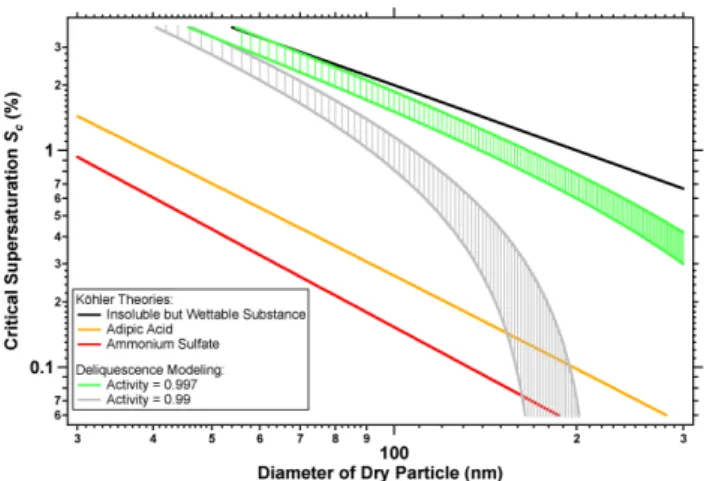
Figure 4 shows deliquescent supersaturations Sdel as a
function of dry particle diameter calculated from Eq. (4) us-ing water activities ofγw=0.990 andγw=0.997. As is
ev-ident from the figure, the deliquescent curves are strongly dependent onγw. For example, atSdel=0.3%, a particle with
a water activity of 0.990 will deliquesce at 165 nm whereas a particle with a water activity of 0.997 will deliquesce at diameter 298 nm.
Reliable activity data for adipic acid are not available and therefore activity must be calculated based on solubility and molecular weight. Using a bulk solubility of 25 g/L, Krei-denweis et al. (2006) calculated the activity coefficient of adipic acid to be 0.997. The quoted solubility is accurate to only two figures. Therefore, the activity coefficient is not likely to be more accurate. In Fig. 4 we show calculated deli-quescence curves for activity coefficients of 0.990 (gray) and 0.997 (green). The indicated borders for eachγware
calcula-tions with the two limits of surface tension quoted in the text (σ between 0.060 and 0.072 J/m2). As is shown in Fig. 7,
γw=0.990 provides a better fit to our experimental results.
2.6 Determination of the particle shape factor
Particle shape can greatly influence the CCN activity of at-mospheric aerosols. Because the methods of aerosol gen-eration used in this and other studies may produce particles that are not spherical, the shape factor needs to be considered in CCN activity measurements. Observation of the shape of nano-sized aerosol particles is usually performed with elec-tron microscopy. Such observations are complicated because it is difficult to collect the particles without altering their shape. Several attempts were made to observe the particles used in this study with a scanning electron microscope. How-ever, no consistent or reliable data were obtained. Therefore, tandem DMA-AMS measurements were used to measure the
Fig. 4. Calculated deliquescent supersaturations Sdel (plotted on
the Sc axis) as a function of the dry particle diameter for adipic
acid using water activities of 0.990 (gray) and 0.997 (green). The upper bound for each activity corresponds to a surface tension of 0.072 J/m2while the lower bound corresponds to a surface tension of 0.060 J/m2.
dynamic shape factor. This method involves selecting par-ticles by mobility and then sizing them aerodynamically in order to obtain information about particle shape. This proce-dure is described in detail in DeCarlo et al. (2004) and Slowik et al. (2004).
The general expression for relatingdva (vacuum
aerody-namic diameter) anddm (mobility diameter) measurements
is:
dva·χv·χt·ρ0
ρp Cc
dva·χv·ρ0
ρp =
dm
Cc(dm)
(5)
Here,χv andχt are the dynamic shape factors in the free
molecular and the transition regimes,ρ0is unit density,ρp
is the particle density, andCc(d)is the Cunningham slip
cor-rection factor. If one assumes thatχt=χv then for a known
particle densityρp(which is equal toρmfor particles without
internal voids), the dynamic shape factorχ of the particles can be estimated (DeCarlo et al., 2004). The dynamic shape factorχ is equal to unity for spherical particles without in-ternal voids and larger than unity for nonspherical particles. Results of these shape factor determinations are discussed in Sect. 4.2.2.
3 Experimental 3.1 Apparatus
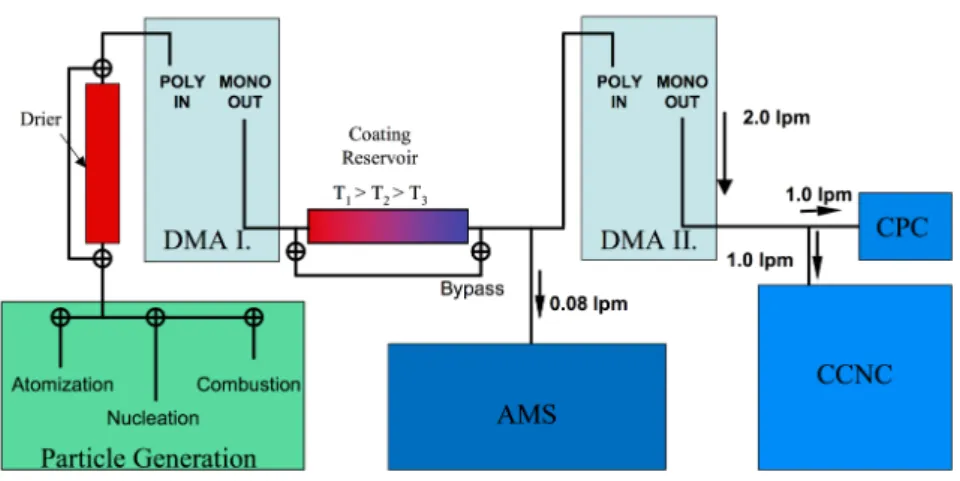
Fig. 5.Schematic of the experimental apparatus.
TSI Model 3010), a continuous-flow streamwise thermal-gradient CCN counter (CCNC, Droplet Measurement Tech-nologies), and a Time-of-Flight Aerosol Mass Spectrometer (ToF-AMS, Aerodyne Research Inc.).
With the exception of the CCNC apparatus, all instruments are either standard aerosol instrumentation or, in case of the ToF-AMS, are described in detail in the literature (Drewnick et al., 2005; DeCarlo et al., 2006).
3.1.1 Cloud Condensation Nuclei Counter
The DMT (Droplet Measurement Technologies) Cloud Con-densation Nuclei Counter (CCNC) used in this study is op-erated in a continuous flow mode. That is, the instrument provides fast sampling by continually monitoring the CCN activity of the particles passing through it. The instrument is capable of generating nearly constant values of supersat-uration between 0.07% and 3.7%. The stated accuracy of these supersaturation values is±2%. Supersaturation is eas-ily controlled and maintained, making it possible to scan the full range of supersaturations for a given particle size.
The aerosol flow introduced into the CCNC instrument is split into an aerosol and a sheath flow. The sheath flow is fil-tered, humidified and heated. This sheath flow constrains the main aerosol flow to the centerline of the cylindrical CCNC column. The inner wall of the CCNC column is continually wetted and a positive temperature gradientdT is applied to the CCNC column in the direction of the flow. Water vapor supersaturation is therefore generated along the centerline of the CCNC column (due to the difference in diffusion rates between water and heat). Particles begin to grow at the point when the supersaturation inside the instrument is equal toSc.
Droplets that grow to diameters larger than 1µm are detected by an optical particle counter (OPC) at the exit of the column and are defined as CCN active particles.
The supersaturation in the CCNC column is primarily a function of the temperature difference (dT) between the top (upstream) and the bottom (downstream) of the CCNC
col-umn. It also depends on the flow and the pressure inside the instrument. The relationship between supersaturation (S) and the measured temperature difference (dT) inside the CCN column is determined by calibration with ammonium sulfate particles at a specific flow and pressure. To obtain reliable experimental results, the CCNC apparatus has to be carefully calibrated in each specific application.
For a detailed description of the CCNC and its calibration, refer to Roberts and Nenes (2005), Lance et al. (2006), and Rose et al. (2007). Specific details relevant to our calibration measurements are presented in the Appendix.
3.2 Experimental procedures
As was stated, the previous 11 published studies of adipic acid generated the adipic acid particles by atomization of aqueous solutions. In order to explore the full range of exper-imental conditions, we generated particles both by atomiza-tion and by condensaatomiza-tion of adipic acid vapor. The follow-ing measurements were performed to study the CCN activity of adipic acid. (1) CCN activity of dry adipic acid particles generated by atomization. (2) CCN activity of dry adipic acid generated by homogeneous nucleation (condensation of adipic acid vapor). (3) CCN activity of wet adipic acid parti-cles generated by atomization. (4) CCN activity of wet adipic acid particles generated by vapor deposition of a mass frac-tion of>85% adipic acid on small ammonium sulfate cores. (This method of generating wet adipic acid is discussed in detail.) (5) CCN activity of adipic acid coated on ammonium sulfate particles as a function of coating thickness. (6) CCN activity of adipic acid coated on soot particles as a function of coating thickness.
3.3 Particle generation
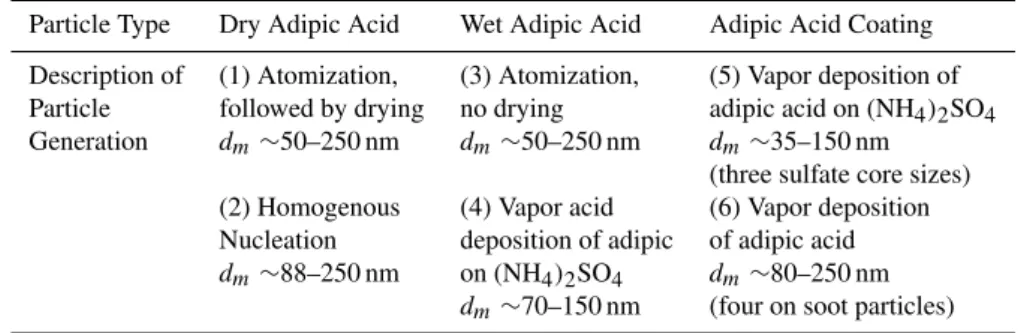
Table 1.Overview of particles studied with the method of particle generation. The dry and wet adipic acid are single-component adipic acid studies and the results are described in Sect. 4.2. The results of the adipic acid coating experiments are described in Sect. 4.3.
Particle Type Dry Adipic Acid Wet Adipic Acid Adipic Acid Coating
Description of (1) Atomization, (3) Atomization, (5) Vapor deposition of Particle followed by drying no drying adipic acid on (NH4)2SO4
Generation dm∼50–250 nm dm∼50–250 nm dm∼35–150 nm
(three sulfate core sizes) (2) Homogenous (4) Vapor acid (6) Vapor deposition Nucleation deposition of adipic of adipic acid dm∼88–250 nm on (NH4)2SO4 dm∼80–250 nm
dm∼70–150 nm (four on soot particles)
The particles are size-selected by DMA I and, if they are to be coated, they are passed through the coating reservoir.
1. An aqueous solution of adipic acid in water is atomized to generate solution droplets. The aerosol flow is then heated (∼60◦C) and passed through three diffusion dri-ers filled with silica gel.
2. Adipic acid particles are generated via homogeneous nucleation of adipic acid. Adipic acid is heated in a round bottom flask to approximately 150◦C. The airflow
through the nucleation region is 2 L/min. The particles nucleate as the flow is passed through a cooled region. This method provides pure dry (solid) adipic acid parti-cles.
3. An aqueous solution of adipic acid in water is atomized to generate solution droplets. The aerosol flow is not dried and the DMA sheath flow is humidified.
4. Adipic acid is dry-vapor deposited onto small dried am-monium sulfate particles. The amam-monium sulfate core particles are generated by atomization of an aqueous so-lution. The particles are subsequently dried by pass-ing them through a diffusion drier filled with anhydrous calcium sulfate (Drierite). The particles are then size-selected by DMA I and passed through a region con-taining a heated adipic acid reservoir. In this region, the ammonium sulfate particles are coated by adipic acid via vapor deposition.
On entering the CCNC column, the highly water-soluble am-monium sulfate core absorbs enough water to completely dis-solve the adipic acid, forming a concentrated adipic acid-ammonium sulfate aqueous solution. We postulate that wa-ter reaches the ammonium sulfate core either via diffusion through the adipic acid coating or by passage through imper-fections in the coating. Experiments as well as calculations (See Sect. 2.4) show that if the mass fraction of the ammo-nium sulfate core is small (<15%), this method provides an
aerosol particle that, from the perspective of CCN activation, can be considered to be a single-component “wet” adipic acid particle.
5. For these experiments, adipic acid is coated onto am-monium sulfate cores as described above in Part (4). 6. item Soot particles are generated by combustion of
ethylene and oxygen in a commercial McKenna burner (Slowik et al., 2004), and passed through a diffusion drier filled with activated carbon to remove flame-generated organics. The particles are then size-selected and coated by vapor deposition of adipic acid.
For convenience, the 6 types of particles studied are pre-sented in Table 1 along with the particle diameters studied for each particle type.
3.4 Measurement of Particle CCN Activity
After particle generation and size-selection, the aerosol flow is split with 2.0 L/min directed into the DMA II and 0.08 L/min into the ToF-AMS. Before and after each CCN experiment (i.e., every time a new particle size is selected), the second DMA and the CPC are used as a scanning mo-bility particle sizer (SMPS) to measure the size distribution of the particles. During a CCN experiment, the particles are size-selected a second time with DMA II in accord with the mode diameter determined during the SMPS scan. When the particles are pure adipic acid, the mode diameter is the same diameter as is selected with DMA I. However, when the par-ticles are coated, the DMA II selects the coated mode diame-ter of the particles. The resulting monodisperse aerosol flow exiting DMA II is split between the CCNC (1.0 L/min) and the CPC (1.0 L/min) instruments.
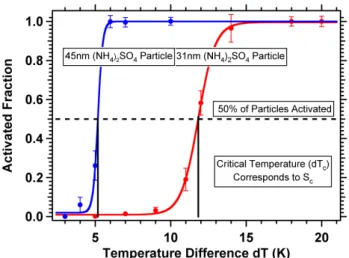
Fig. 6. Sample activation curves for 31 nm (red) and 45 nm (blue) ammonium sulfate particles. The critical supersaturation (Sc)
cal-culated from the critical temperature (dTc) is the supersaturation
where 50% of the particles are activated.
The fraction of CCN activated aerosol is the ratio of the number concentration of CCN measured by the CCNC (NCCN, i.e., number of particles that grow larger than 1µm
as detected by the OPC) to the total number concentration of particles measured by the CPC (NCPC). The critical
saturation at a particular aerosol size is defined as the super-saturation at which 50% of the particles grow into droplets (i.e., when =NCCN
NCPC=0.5).
The method of determining the critical supersaturation (Sc)is illustrated in Fig. 6 that shows examples of
activa-tion curves measured for ammonium sulfate particles of two diameters; 45 nm and 31 nm. Such curves are generated by measuring the fraction of activated aerosol and plotting this number as a function of the temperature differencedTin the CCNC column. The plot is fitted with a sigmoid function to find the critical temperature difference (dTc)where the
acti-vated fraction is 0.5. The critical supersaturation is then cal-culated from the calibration curve described in the Appendix. The width of the sigmoidal curve is due to the spread in the aerosol size distribution determined by the DMA transmis-sion function.
4 Results and discussion 4.1 Overview
The results of the CCN activation measurements are dis-cussed in this section in the order presented in Sect. 3.3. The experimental results are discussed in the framework of the modeling calculations described in Sect. 2. The experimental studies described here fall into two categories: Single com-ponent adipic acid studies (corresponding to particle types (1), (2), (3) and (4) described in Sect. 3.3) and adipic acid
coating studies (corresponding to particle types (5) and (6) in Sect. 3.3). Critical supersaturation (Sc)values as a
func-tion of particle diameter were measured for each particle type (1–6).
4.2 Single-component adipic acid
4.2.1 Dry adipic acid particles generated by atomization In this set of experiments, we conducted CCN activation studies with adipic acid particles generated by atomization of adipic acid solutions over a range of particle diameters (dm)
from 50 nm to 250 nm (described as particles type (1) and (3) in Sect. 3.3). About 15 such independent experimental CCN activation experiments were conducted. We were not able to obtain consistently reproducible data sets with adipic acid aerosols produced by atomization, nor were we able to ascertain the cause of this irreproducibility. Most likely the scatter in the data is due to trace impurities in the solution which we were not able to completely eliminate in spite of our best efforts.
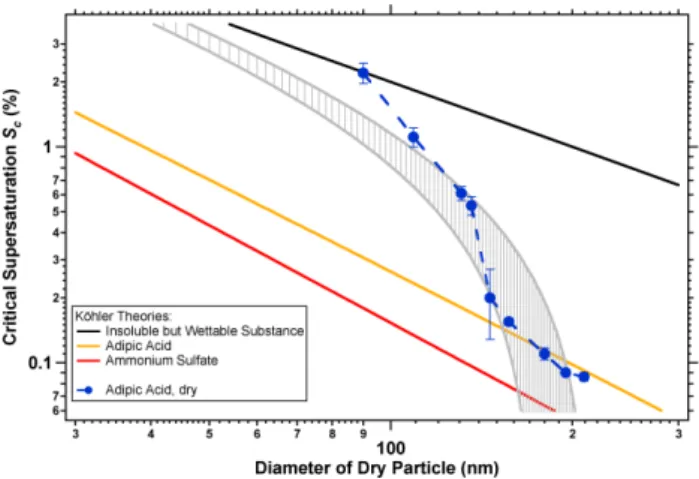
4.2.2 Homogenously nucleated dry adipic acid particles The results of CCN activation experiments with dry adipic acid particles generated by homogeneous nucleation of adipic acid vapor are shown in Fig. 7 as blue points, and cor-respond to particle type (2) described in Sect. 3.3. Here, the measured critical supersaturation (Sc) is shown as a function
of dry particle diameter (dd). Each critical supersaturation
value in the figure is the average of at least three measure-ments for every dry particle diameter (the standard devia-tion is indicated by the error bars). Measurements were con-ducted over a period of several days to ensure reproducibility. The broken line provides visual continuity for the measured points. The standard deviation of the measurements is in all cases except one less than 4% of the measured Sc values.
As is evident, the homogenous nucleation method of gener-ating adipic acid particles produces consistent results with little scatter.
The solid lines are the same calculated K¨ohler lines shown in Figs. 1 and 3. The shaded area models the deliquescence of the particles according to the Kelvin equation (Eq. 4) as dis-cussed in Sect. 2.5. The surface tension of saturated aqueous adipic acid droplets larger than 40 nm is calculated to have values between 0.060 and 0.072 J/m2(See Eq. 3). A water activity over a saturated adipic acid solution ofγw=0.99 was
chosen to provide a best fit to the experimental data. The bor-ders of the shaded region are obtained with the two limiting values of calculated surface tension (0.060 and 0.072 J/m2).
Table 2. Estimated particle dynamic shape factors as a function of particle size for dry adipic acid generated by homogeneous nucle-ation.
dm χ±1χ
100 1.04±0.16 125 1.10±0.19 151 1.22±0.19 188 1.24±0.19 200 1.26±0.19
measurements for adipic acid particles smaller than 150 nm follows the deliquescence model, supporting the suggestion of Hori et al. (2003) and Kreidenweis et al. (2006) that deliquescence-controlled activation may govern droplet for-mation for small, slightly soluble organic particles. The smallest particle (dm=88 nm) in this set of measurements
be-haves as a particle composed of an insoluble wettable mate-rial. We could not obtain data for particles smaller thandm∼
88 nm because to produce such small particles with our ho-mogenous nucleation apparatus, we had to reduce the adipic acid vapor pressure to a point where the number of particles produced was too small to perform CCN experiments. The activation of particles larger than∼150 nm follows standard K¨ohler theory.
As described in Sect. 2.6, the dynamic shape factorχ of the particles can be estimated from DMA/AMS size mea-surements via Eq. (5). The mobility diameter (dm)is
mea-sured by the DMA apparatus and the vacuum aerodynamic diameter (dva)is measured by the AMS. Using the adipic
acid bulk density of 1.36 g/cm3, we estimate the dynamic shape factors to be as shown in Table 2. The use of bulk density in Eq. (5) assumes that the particle does not contain internal voids. This seems to be a reasonable assumption for particles that are formed by vapor condensation. The un-certainties inχ are primarily due to the uncertainty in the measured vacuum aerodynamic diameter (dva), which is
ap-proximately±15%. Within these error limits, the particles do not appear to deviate significantly from a spherical shape (χ=1.0).
4.2.3 Comparison with previous studies
In Fig. 8, we once again show the previously published CCN activation data for dry adipic acid aerosol. We also include our nucleation-generated dry adipic acid aerosol data in the figure.
As is evident, some of the publishedScmeasurements are
above and some are below our values. The wide scatter in the measured CCN activity obtained in the previous studies suggests that some significant parameter or parameters vary from experiment to experiment. Our experiments do not pro-vide an explanation for these discrepancies, however we can
Fig. 7. Scplotted as a function of particle diameter for dry adipic
acid particles (blue symbols). K¨ohler theory lines are the same as in Figs. 1 and 3. The shaded area is the deliquescence region cal-culated from Eq. (4) withγw=0.990. The upper and lower bounds
correspond to solution surface tensions of 0.072 and 0.060 J/m2, re-spectively.
suggest some possible factors that may affect the results. Be-cause all previously published experiments were performed with aerosol generated by atomization, we suggest that so-lution impurities are one possible cause of the scatter in the data. We note that all the previously obtainedScresults fall
above the K¨ohler curve. That is, they are all in the region where deliquescence governs the onset of activation. There-fore, if impurities are the cause of the scatter, they must be such that some promote and others hinder particle deliques-cence.
Another possible reason for the scatter in the published measurements ofSc may be related to the shape of the
par-ticles produced by the atomization and drying process. The volume-equivalent diameter (dve)of a non-spherical particle
is smaller than its electrical mobility diameter (dm)(DeCarlo
et al., 2004). In all the published measurements, the reported diameter is the mobility diameter as measured by a DMA instrument. If the atomization-generated particles are non-spherical, their effective diameter is smaller than their mea-sureddm. Were this the case, the data points would be shifted
to the left (i. e., to a smaller effective diameter) placing the published data closer to the results obtained in our studies. A possible confirmation of this hypothesis is provided by the data of Rissman et al. (2007). They show data for both heated and unheated adipic acid particles. The heated adipic acid particle data fall to the left of the unheated adipic acid data (i.e., the heated adipic acid particles have a smaller effective diameter than the unheated particles). This might be due to a reorganization of the adipic acid during heating, resulting in more spherical adipic acid particles.
Fig. 8. Scplotted as a function of particle diameter for dry adipic acid particles from previously published studies (as in Fig. 1) shown
together with our measurements.
measurements ofSc values. Variations in the calibration of
the CCN instrument from one experimental group to another cannot be ruled out as one of the causes for the scatter in the data.
4.2.4 Wet adipic acid
As is shown in Fig. 1, there is only one previously published CCN activation study for wet adipic acid aerosol particles. The results of the published study are in agreement with stan-dard K¨ohler theory. As we stated earlier, we were not able to obtain consistent measurements with either wet or dry adipic acid aerosol produced by atomization. Most of our wet adipic acid measurements (from 5 independent runs) fell below the critical supersaturation predicted by the K¨ohler theory. We attribute the scatter in these data to residual impurities, most likely ammonia, which can play a role in experiments with wet adipic acid produced by atomization. The CCN activity of initially dry adipic acid, however, is reported to be unaf-fected by ammonia (Dinar et al., 2007).
To eliminate possible impurities in the adipic acid parti-cles (such as, for example, contamination by ammonia result-ing from the atomization process), we generated effectively wet adipic acid aerosol by coating small ammonium sulfate cores with adipic acid by vapor deposition (described as par-ticle type (4) in Sect. 3.3). Experiments were conducted with three ammonium sulfate core sizes (dcore=34 nm, 53 nm,
73 nm) coated with adipic acid. In this subset of experiments, the adipic acid mass fraction was in all cases greater than 0.85. Under these conditions, the calculatedSc of the
dual-component aerosol particle is the same to within 10% as the
Sc of a single-component adipic acid particle of equivalent
diameter (see Sect. 2.4). A plot ofSc as a function of wet
adipic acid particle diameter is shown in Fig. 9. Data from
Fig. 9.Plot of Scas a function of wet adipic acid particle diameter.
Data from present work are displayed as blue points. Data of Bilde and Svenningsson (2004) are shown as light blue stars.
the present work are displayed as blue points. Data of Bilde and Svenningsson (2004) are shown as light blue stars. As is evident, the data are in accord with standard K¨ohler theory. 4.3 Adipic acid coating experiments
4.3.1 Ammonium sulfate coated with adipic acid
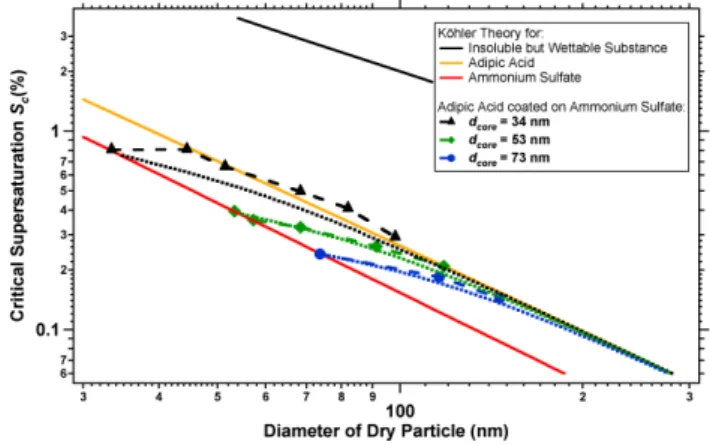
In the coating studies, three ammonium sulfate particles of diametersdcore=34, 53 and 73 nm were coated with adipic
Fig. 10.Scplotted as a function of particle diameter for adipic acid
coated ammonium sulfate particles of sizes dcore=34 nm (black),
53 nm (green) and 73 nm (blue) The dashed lines are calculated us-ing K¨ohler theory.
The solid orange and red lines in the figure are the K¨ohler curves for pure adipic acid and pure ammonium sulfate, re-spectively. The dotted lines are results of calculations using modified K¨ohler theory, taking into account the combined activity of the solution.
In each case, the uncoated ammonium sulfate particle ac-tivates on the ammonium sulfate K¨ohler theory line, even though the particle is initially a dry solid. This is a case where the calculatedScis greater than the water vapor
pres-sure at which particle deliquescence occurs (see Sect. 2.5). Ammonium sulfate particles deliquesce readily and the wa-ter vapor pressure in the CCNC instrument is always above the deliquescence vapor pressure for ammonium sulfate. As expected, with increasing adipic acid coating thickness, the measuredScvalues rise above the ammonium sulfate K¨ohler
line and approach the adipic acid K¨ohler theory line. The endpoints in the adipic acid coating studies presented here are theScdata in Fig. 9.
We note that the vapor deposited adipic acid coating is initially a dry solid. The results obtained here indicate that the addition of a hydrophilic soluble compound to dry adipic acid eliminates the effect of the deliquescence barrier to CCN activation that was observed for pure single-component dry adipic acid.
4.3.2 Soot coated with adipic acid
In this set of coating experiments, four soot particles of sizes
dcore=88 nm, 102 nm, 136 nm and 181 nm were coated with
adipic acid (described as particle type (6) in Sect. 3.3). The uncoated soot particles generated by our hydrocarbon com-bustion source are CCN inactive in the supersaturation range of 0.07–3.7%. The CCN activity of the soot coated with adipic acid was measured as a function of the adipic acid coating thickness (<3–75 nm). These experiments were
per-Fig. 11.Scplotted as a function of the total particle diameter (soot
core + adipic acid coating) for adipic acid coated soot particles of sizes dcore=88 nm (diamonds), 102 nm (squares), 136 nm
(trian-gles), and 181 nm (circles). Also included are the results for dry adipic acid obtained in this study (blue).
formed to measure the change in CCN activity when an in-soluble hydrophobic core is coated with adipic acid.
Figure 11 shows the measured critical supersaturations as a function of the total particle diameter (soot core + adipic acid coating). Our CCN activation measurements for dry adipic acid particles are included for comparison.
The points at the tops of the activation lines are soot par-ticles coated with very thin layers (<3 nm) of adipic acid. These data points indicate that a very small layer of adipic acid on a CCN-inactive particle triggers CCN activation near (or above) the calculated critical supersaturations of a wet-table solid core (the black line in Fig. 11).
As shown in the figure, the measured critical supersatu-rations for adipic acid coatings on smaller soot core sizes (dcore=88 nm and 102 nm) approach the critical
supersatura-tions measured for dry adipic acid. The particles activate at the deliquescence relative humidity DRH, orSdel of adipic
acid. See Sect. 2.5. This suggests that the soot core acts as a scaffold for the adipic acid coating and deliquescence is de-termined by the total particle diameter. The soot-adipic acid particle acts as a pure adipic acid particle during CCN activa-tion because the adipic acid completely coats the soot core. Here, the total size of the particle (and not the composition) governs CCN activation.
The Sc measurements for the larger soot core sizes
(dcore=136 and 181 nm) are displaced to the right of the dry
particle diameter. At this time we do not have a verifiable ex-planation for this observation. We suggest a possible reason for this difference between the CCN behavior of the larger and smaller coated soot particles as follows.
Since the soot itself is hydrophobic, water interacts only with the adipic acid coated onto the soot. Therefore, only the diameter of the adipic acid coating influences the CCN activity of the coated particle (producing an effective diame-ter). It is possible that the smaller soot cores are coated more thoroughly than the larger cores. A full coating yields an ef-fective diameter equal to the total particle diameter. On the other hand, a partial coating may produce adipic acid “is-lands” with an effective diameter that is smaller than the to-tal particle diameter. Other mechanisms related to shape and fractality factors could be suggested to explain the difference between small and large soot core sizes coated with adipic acid and thus, theScmeasurements for the larger soot
parti-cles remain unexplained.
5 Summary
The CCN activity of both dry and “wet” (deliquesced solu-tion droplets) adipic acid particles and the effect of adipic acid coatings on the CCN activity of soluble and insoluble particles were determined. The results of the experiments lead to the following conclusions:
1. In accord with earlier suggestions (Hori et al., 2003, and Kreidenweis et al., 2006), the CCN activation of small (dm<150 nm), dry slightly soluble organic particles is
governed by the deliquescence of the particles (where
Sdel> calculatedSc), and CCN activation follows the
deliquescence curve for the particles. For larger dry particles, where Sdel< calculated Sc, CCN activation
follows the K¨ohler curve. As expected, “wet” adipic acid particles activate at the supersaturations predicted by K¨ohler theory for all sizes measured in this study (70–200 nm).
2. A solvent-independent method for generating pure or-ganic particles (via homogeneous nucleation) was used for this study and found to provide results that were more reproducible than those obtained in our experi-ments as well as previously published experiexperi-ments with particles produced by atomizing solutions. The ho-mogeneously nucleated particles were measured to be nearly spherical (χ ≤1.2). These results suggest that the observed scatter in the published literature for the CCN activity of adipic acid particles may be related to either the impurities in the solvents used or the inadver-tent formation of non-spherical particles.
3. The experiments with adipic acid-coated ammonium sulfate aerosol particles indicate that the addition of a small mass fraction of a hydrophilic soluble compound
(e.g. ammonium sulfate) to dry adipic acid particles eliminates the effect of particle phase on CCN activa-tion, in agreement with Bilde and Svenningsson (2004). 4. An adipic acid coating on hydrophobic CCN inactive soot particle yields a CCN active particle at atmospheri-cally relevant supersaturations. For relatively small soot cores (dcore=88 nm and 102 nm), the CCN activity of
the coated particles approaches the deliquescence line of adipic acid. This suggests that for coated soot cles in this range of diameters, the total size of the parti-cle determines CCN activation and the soot core acts as a scaffold for the deposition of adipic acid vapor. It ap-pears that the CCN activation of larger coated soot cores occurs at higher supersaturations than is predicted by the deliquescence curve. It is hypothesized that larger soot particles are only partially coated with adipic acid, causing the mixed particles to be chemical composition dependent, and not total particle size dependent as ob-served for small soot core sizes.
Appendix A
CCN instrument calibration
To perform reliable CCN activation measurements requires an accurate knowledge of the relationship between the tem-perature differencedTalong the CCNC column and the su-persaturationS. This relationship is determined by calibra-tion, using a well-characterized highly soluble inorganic salt, such as (NH4)2SO4or NaCl. Previous studies have reported
a linear relationship between instrumentdTandS at a flow rate of 0.5 L/min fordT >3 K. For smallerdT the relation-ship becomes nonlinear (Rose et al., 2007; Droplet Measure-ment Technologies, 2004). In order to obtain a larger range of supersaturations, we calibrate and operate the instrument at flow rates between 0.5 L/min and 1 L/min. All of the mea-surements done in this study were obtained with CCNC flow rates near 1 L/min.
The calibration arrangement is similar to that shown in Fig. 5. Calibration was done with ammonium sulfate aerosol particles generated by atomization of an aqueous solution of (NH4)2SO4. The particles were dried to a relative
humid-ity (RH)<10% by passing the aerosol flow through diffusion driers. A narrow monodisperse size distribution (dm±10%)
was obtained by passing the particles through two Differen-tial Mobility Analyzers (DMA I and DMA II). The aerosol flow was divided between the CCNC instrument and the con-densation particle counter (CPC). Note that the CCNC counts the number of activated particles, while the CPC counts the total number of particles in the flow.
The following method was used to calibrate the CCNC in-strument. Ammonium sulfate particles of a specific size (dm)
Fig. A1. Calculated critical supersaturation as a function of CCN instrument dTfor a flow rate of 0.93 L/min.
recorded. The value ofdTwas systematically varied. Equili-bration time betweendTsettings was about 1 min. The value of the criticaldT (dTc)was recorded. (dTcis the
tempera-ture difference at which 50% of the particles are activated.) Alternately, dT was be kept constant while the particle di-ameter was systematically varied. Again, thedTc and the
corresponding particle size were recorded. The two methods yielded similar results. The critical supersaturation (Sc)was
calculated for each particle size using standard K¨ohler theory (Eqs. 1 and 2). In this way,ScvsdTccalibration plots for the
CCNC instrument were obtained.
The calibration curves for flow rates of 0.93 L/min and 1 L/min are shown in Figs. A1 and A2, respectively. These were the two flow rates used in our experiments. The nonlin-ear part of the curve was fitted to a power function:
Sc,0=y0+A·dTx(A1) (A1)
Here, Sc,0, Aand x are parameters determined by the fit.
As is evident, for dT<5 K, the calibration curves are non-linear at both flow rates. As was stated, some earlier mea-surements found the onset of the nonlinear part of the cal-ibration curve to bedT<3 K, implying that the calibration is instrument specific. While the transition to the nonlinear portion of the calibration curve appears to be insensitive to small changes in the flow rate, the slopes of the linear part of the curve are a sensitive function of the flow rate as is evi-dent in the figures. For a flow rate of 0.93 L/min the slope is 0.106 %/K; for a flow rate of 1 L/min it is 0.149 %/K. This implies a 30–40% change in slope for a∼7% change in flow rate. Thus, accurate measure and control of the flow rates used is very important. In the time period of the CCN exper-iments (∼8 months) the calibration was periodically repeated and was found to remain constant for a given flow rate.
Fig. A2. Calculated critical supersaturation as a function of CCN instrument dT for a flow rate of 1 L/min.
Acknowledgements. This research was supported by the Office of Science (BER), Department of Energy (Atmospheric Science Program) grant No. DE-FG02-05ER63995 and the Atmospheric Chemistry Program of the National Science Foundation (NSF) grant No. ATM-0525355. The author ESC was funded by the NASA Earth System Science Fellowship program. We thank Sonia Kreidenweis for helpful discussions.
Edited by: J. Abbatt
References
Bilde, M. and Svenningsson, B.: CCN Activation of Slightly Sol-uble Organics: The Importance of Small Amounts of Inorganic Salt and Particle Phase, Tellus, 56 B, 128–134, 2004.
Broekhuizen, K., Kumar, P. P., and Abbatt, J. P. D.: Partially sol-uble organics as cloud condensation nuclei: Role of trace solu-ble and surface active species, Geophys. Res. Lett., 31, L01107, doi:01110.01029/02003GL018203, 2004.
Cruz, C. N. and Pandis, S. N.: A Study of the Ability of Pure Sec-ondary Organic Aerosol to act as Cloud Condensation Nuclei, Atmos. Environ., 31, 2205–2214, 1997.
Corrigan, C. E. and Novakov, T.: Cloud Condensation Nucleus Ac-tivity of Organic Compounds: A Laboratory Study, Atmos. Env-iron., 33, 2661–2668, 1999.
DeCarlo, P. D., Slowik, J. G., Worsnop, D. R., Davidovits, P., and Jimenez, J. L.: Particle Morphology and Density Characteriza-tion by Combined Mobility and Aerodynamic Diameter Mea-surements. Part 1: Theory, Aerosol Sci. Technol., 38, 1185– 1205, doi:10.1080/027868290903907, 2004.
DeCarlo, P. F., Kimmel, J. R., Trimborn, A., Northway, M. J., Jayne, J. T., Aiken, A. C., Gonin, M., Fuhrer, K., Horvath, T., Docherty, K., Worsnop, D. R., and Jimenez, J. L.: Field-Deployable, High-Resolution, Time-of-Flight Aerosol Mass Spectrometer, Anal. Chem., 78 8281–8289, 2006.
of Ammonia, Environ. Sci. Technol., 42, 3, 793–799, 2008. Drewnick, F., Hings, S. S., DeCarlo, P. F., Jayne, J. T., Gonin, M.,
Fuhrer, K., Weimer, S., Jimenez, J. L., Demerjian, K. L., Bor-rmann, S., and Worsnop, D. R.: A New Time-of-Flight Aerosol Mass Spectrometer (ToF-AMS) – Instrument Description and First Field Deployment, Aerosol Sci. Technol., 39, 637–658, 2005.
DMT: Cloud Condensation Nuclei Counter Operator Manual DOC-0086 Revision A12, Droplet Measurement Technologies Inc., 2004.
Dusek, U., Frank, G. P., Hildebrandt, L., Curtius, J., Schneider, J., Walter, S., Chand, D., Drewnick, F., Hings, S., Jung, D., Bor-rmann, S., and Andreae, M. O.: Size matters more than chem-istry for cloud nucleating ability of aerosol particles, Science, 312, 1375–1378, 2006.
Facchini, M. C., Decesari, S., Mircea, M., Fuzzi, S., and Loglio, G.: Surface Tension of Atmospheric Wet Aerosol and Cloud/Fog Droplets in Relation to their Organic Carbon Content and Chem-ical Composition, Atmos. Environ., 34, 4853–4857, 2000. Giebl, H., Berner, A., Reischl, G., Puxbaum, H., Kasper-Giebl, A.,
and Hitzenberger, R.: CCN Activation of Oxalic and Malonic Acid Test Aerosols with the University of Vienna Cloud Con-densation Nuclei Counter, Aerosol Sci., 33, 1623–1634, 2002. Henning, S., Rosenoern, T., D’Anna, B., Gola, A. A.,
Svennings-son, B., and Bilde, M.: Cloud Droplet Activation and Surface Tension of Mixtures of Slighlty Soluble Organics and Inorganic Salt, Atmos. Chem. Phys., 5, 575–582, 2005,
http://www.atmos-chem-phys.net/5/575/2005/.
Hori, M., Ohta, S., Murao, N., and Yamagata, S.: Activation Ca-pability of Water Soluble Organic Substances as CCN, Aerosol Sci., 34, 419–448, 2003.
Huff Hartz, K. E., Tischuk, J. E., Chang, M. N., Chang, C. K., Don-ahue, M. N., and Pandis, S. N.: Cloud Condensation Nuclei Ac-tivation of Limited Solubility Organic Aerosol, Atmos. Environ., 40, 605–617, 2006.
IPCC: Climate Change 2007: The Physical Science Basis, in: Con-tribution of Working Group I to the Fourth Assessment Report of the Intergovernmental Panel on Climate Change, edited by: Solomon, S., Qin, D., Manning, M., Chen, Z., Marquis, M., Av-eryt, K. B., Tignor, M., and Miller, H. L., Cambridge University Press, Cambridge, UK and New York, NY, USA, 996 pp., 2007. Kaufman, Y. J. and Koren, I.: Smoke and Pollution Aerosol Effect
on Cloud Cover, Science, 313, 655–658, 2006.
Kreidenweis, S. M., Petters, M. D., and DeMott, P. J.: Deliquescence-Controlled Activation of Organic Aerosols, Geo-phys. Res. Lett. , 33, L068801, doi:10.1029/2005GL024863, 2006.
Kumar, P. P., Broekhuizen, K., and Abbatt, J. P. D.: Organic Acids as Cloud Condensation Nuclei: Laboratory Studies of Highly Soluble and Insoluble Species, Atmos. Chem. Phys., 3, 509–520, 2003,
http://www.atmos-chem-phys.net/3/509/2003/.
Laaksonen, A., Korhonen, P., Kulmala, M., and Charlson, R. J.: Modification of the K¨ohler Equation to Include Soluble Trace Gases and Slightly Soluble Substances, J. Atmos. Sci., 55, 853– 862, 1998.
Lance, S., Medina, J., Smith, J. N., and Nenes, A.: Mapping the Operation of the DMT Continuous Flow CCN Counter, Aerosol Sci. Technol., 40, 242–254, 2006.
Lohmann, U. and Feichter, J.: Global Indirect Aerosol Effect: a Review, Aerosol Chem. Phys. 5, 715–737, 2005.
McFiggans, G., Artaxo, P., Baltensperger, U., Coe, H., Facchini, M. C., Feingold, G., Fuzzi, S., Gysel, M., Laaksonen, A., Lohmann, U., Mentel, T. F., Murphy, D. M., O’Dowd, C. D., Snider, J. R., and Weingartner, E.: The effect of physical and chemi-cal aerosol properties on warm cloud droplet activation, Atmos. Chem. Phys., 6, 2593—2649, 2006,
http://www.atmos-chem-phys.net/6/2593/2006/.
Petters, M. D. and Kreidenweis, S. M.: A Single Parameter Repre-sentation of Hygroscopic Growth and Cloud Condensation Nu-cleus Activity, Atmos. Chem. Phys., 7, 1961–1971, 2007, http://www.atmos-chem-phys.net/7/1961/2007/.
Prenni, A. J., DeMott, P. J., Kreidenweis, S. M., Sherman, D. E., Russell, L. M., and Ming, Y.: The Effects of Low Molecular Weight Dicarboxylic Acids on Cloud Formation, J. Phys. Chem A, 105, 11 240–11 248, 2001.
Pruppacher, H. R. and Klett, J. D.: Microphysics of Clouds and Pre-cipitation, second ed., 714 pp., D. Reidel Publishing Company, Dordrecht, Holland, 1997.
Raymond, T. M. and Pandis, S. N.: Formation of Cloud Droplets by Multicomponent Organic Particles, J. Geophys. Res., 4469, 108, doi:10.1029/2003JD003503, 2002.
Rissman, T. A., Varutbangkul, V., Surratt, J. D., Topping, D. O., McFiggans, G., Flagan, R. C., and Seinfeld, J. H.: Cloud Con-densation Nucleus (CCN) Behavior of Organic Aerosol Particles Generated by Atomization of Water and Methanol Solutions, At-mos. Chem. Phys., 7, 2949–2971, 2007,
http://www.atmos-chem-phys.net/7/2949/2007/.
Roberts, G. C. and Nenes, A.: A Continuous-Flow Streamwise Thermal-Gradient CCN Chamber for Atmospheric Measure-ments, Aerosol Sci. Technol., 39, 206–221, 2005.
Rose, D., Frank, G. P., Dusek, U., Gunthe, S. S., Andreae, M. O., and P¨oschl, U.: Calibration and Measurement Uncertainties of a Continuous-Flow Cloud Condensation Nuclei Counter (DMT-CCNC): CCN Activation of Ammonium Sulfate and Sodium Chloride Aerosol Particles in Theory and Experiment, Atmos. Chem. Phys. Discuss., 7, 8193–8260, 2007,
http://www.atmos-chem-phys-discuss.net/7/8193/2007/. Saxena, P. and Hildemann, L. M.: Water-soluble organics in
atmo-spheric particles: A critical review of the literature and appli-cation of thermodynamics to identify candidate compounds, J. Atmos. Chem., 24, 57–109, doi:110.1007/BF00053823, 1996. Schwartz, S. E., Charlson, R. J., and Rhode, H.: Quantifying
Cli-mate Change – Too Rosy a Picture?, Nature Reports CliCli-mate Change, 2, 23–24, 2007.
Shulman, M. L., Jacobson, M. C., Carlson, R. J., Synovec, R. E., and Young, T. E.: Dissolution Behavior and Surface Tension Ef-fects of Organic Compounds in Nucleating Cloud Droplets, Geo-phys. Res. Lett., 23, 277–280, 1996.