BUSINESS CYCLES, ELECTORAL CYCLES. TOWARD A THEORETICAL FRAME OF
INTERACTION
BOGDAN-LUCIAN DOSPINESCU,
PhD, institution: Romanian Academy SCOSAAR,
email address
: [email protected]
Abstract
The idea of cyclical movement of a system: be it political, economic, institutional, is one of the constants of critical thinking. In this sense, there is a natural cyclic movement that cannot be avoided (only amplified or diminished) and is connected with the nature of these systems. The economy follows a cyclical movement; a period of growth follows a period of decline, and so on. So does popularity for political parties or leaders. In this paper, I explore the links between the business cycles and electoral cycles. For this purpose, I introduce the concept of electoral perception cycles. My hypothesis is that popularity of political parties and leaders follow a cyclical evolution, both on short and long term. I show how perception cycles can impact the “political business cycle theory”.
There is great interest in political science literature for the factors that influence the fluctuations in Presidents’ popularity, especially from United States. However, very little has been said about Romania’s case. I investigate the hypothesis of electoral perception cycles looking at the popularity of former president Traian Basescu, over his two terms. The variable used to measure popularity is favorability, measured in national surveys, done face to face, on representative samplez, of around 1000 subjects. I’ve correlated the fluctuations in favorability over time, with key public events or political decisions taken by Traian Băsescu.
The main findings are as follows. Firstly, there are significant short term fluctuations (short term perception cycles) and they are correlated with major events on the agenda. I would point the following key moments: 1. The referendum for dismissal of the President in May 2007 – Traian Băsescu’s favorability increased by 7 percentage points; 2. The referendum for unicameral Parliament with 300 MPs in the fall of 2009. Coupled with victory in the presidential election, it lead to an increase of 10 percentage points in favorability; 3. Summer-Autumn of 2008, the promise of doubling teachers’ wages (the law passed in Parliament and was supported by the President in a series of public appearances) associated with an increase of 6 percentage points; 4. Summer of 2010, the moment when the President announced the 25% cut in wages and the increase in VAT to 24%. This lead to a huge 19 percentage points drop. A key finding is the fact that all these events that produced “rally around the flag effects” are issues on the domestic agenda. None is linked with international crisis, as the classic theory proposed by scientist John Mueller postulates.Secondly, as it’s the case with popularity of US Presidents, there is a contraction period in both terms. Important to point out the fact the contraction is visible also in the first term, when the economy had improved.
In building on the results of this paper I would focus on the impact short term perception cycles have on the strategy leaders employ regarding handling the economic agenda. Going back to Anthony Downs and his thesis that "parties formulate public policies in order to win elections rather than win elections to formulate policies"; we have to ask ourselves if the causality advanced within the confines of the “business cycle theory” is such straight forward as it was proposed; meaning that leaders in power will try to impose a “business cycle” where the benefits for the public are seen near the elections and base their strategies on winning the elections on this. The data presented here, shows that such a strategy is not enough and we have to take into account short term strategies, including taking economic measures aimed at boosting short term support, when elections are approaching. If we have spikes in popularity after positive events surrounding decisions taken by leaders in Government, then we have to take into account that parties will favor short term policies, instead of going for the medium term policies described by Nordhaus, among others.
Key Words: business cycles, electoral perception cycles, President’s popularity
JEL Classification: D72
1. Presenting the concept of business cycle
of the economy is visible in several states, not only in specific cases; the only common element is the presence of market economy ( Lucas, 1976, p.10 ).
Arthur Burns introduces two important distinctions. First, that business cycles occur in a phase of development of the nation’s capital when "activities of production, distribution and consumption have become closely interwoven through division of labor, the making and spending of money incomes, a system of banking and credit, a mode of production relying extensively on fixed capital and some ease in communication and transportation" (Burns, 1969, p. 7). Arthur Burns believes that we can talk about business cycles in the United States, Germany at the end of the eighteenth century, early nineteenth century; while, in other western countries with strong economies, at the end of the nineteenth century. The second distinction: business cycles are specific to market economy; where there is a "state planned economy" there aren’t cyclical developments, although there are major fluctuations, caused by climate phenomena (like draughts affecting agriculture), political crises or conflicts (Burns, 1969, p. 8). If are to use these two distinctions, then one can talk about business cycles in Romania in early twentieth century (after World War) - until '45 and after 1990, respectively.
There are some common key elements of the definitions presented above. The first element is the idea of correlation among the main indicators. It is a common element of all historians, economists who analyzed the business cycles, from Juglar, to Schumpeter, Kuznets or, more recently, Prescott or Lucas: the idea that we are dealing with an increase/ decrease of all (almost all) main macro-economic indicators: the GDP, industrial production, the production of various industries, exports ( Maddison, 1991, p.5 ). The second key element is the idea of "repeatable fluctuations", thus predictable; political leaders and parties being among those for whom these evolutions are to a certain extent predictable.
A natural question one needs to answer, especially thinking of the potentially electoral impact, is whether the cyclical evolution of the economy with periods of growth followed by periods of recession can be avoided. Since the early economists have theorized business cycles, the answer was negative. Clement Juglar has said that the source of economic crisis can be found during growth and that the mechanism of cyclical developments in the economy cannot be avoided (Legrand, Hagerman, 2007, p.2). Joseph Schumpeter believed that the economic crises are temporary and despite the negative effects, they cannot be avoided, nor they should be avoided (Legrand, Hagerman, 2007, p.2). More recently, Mugur Isarescu stated that "the cyclical evolution is an inherent characteristic of the market economy" (Isarescu, 2013, p.4) and that "long periods of prosperity tend to favor the impression that the business cycle is part of the past and the economy entered a "new era" (…) The illusions were always shattered by a new episode " (Isarescu, 2013, p.12).
From the conclusions presented above, one can conclude that the stages of the business cycles can be anticipated, with a certain degree of certainty, with at least several months beforehand. This predictability must be taken into account when we focus on the interaction between the economic and electoral cycles:
1. On the one hand, political leaders will try to postpone the contraction stage of the business cycle, until after the election. Potentially, the economic impact is amplifying the effects of contraction. The impact is significantly higher when the peak and the commencement of the contraction stage coincides with the last year / six months before the election .
2. On the other hand, if confronted with an economic downturn, political leaders who govern will be tempted to take on major social packages before the elections even taken into account the prospect of not being able to maintain them after the elections, which can lead to a much longer recovery period.
Furthermore, the impact resulting from the "predictability" and "repeatability" of business cycles will be magnified if we overlap different types of business cycles: that is, we are in the Kitchin cycle contraction inside a contraction stage of a Juglar cycle , within a period of contraction of a Kuznets cycle.
2. The cyclical evolution in politics. The interaction between business and election cycles in
Romania
2.1. Introducing the concept of
electoral perception cycles
their ideology (Alesina, Roubini and Cohen, 1997). But, even within the partisan cycles, the bet a political party makes is that by advancing certain policies it can appeal more to their base, energize their base which increases their chances to win elections. Furthermore, as Frey and Schneider suggest, partisan leaders in power will behave opportunistically when elections approach and they are unpopular (Jula, 2001, p.6). Election cycles are fixed (every four of five years, in most democracies) and political leaders will try to influence the state of the economy so to get the best results in the election years, thus impacting the business cycle. For example, in the traditional opportunistic model, we expect to have an expansion with a 1 year or 2 before the elections: the increase in GDP over trend, falling unemployment, followed by lowered GDP and higher unemployment after the elections.
There are several basic assumptions of the political business cycles approach. Firstly, economic developments and the way the government handles the economy are drivers of the vote (especially in assessing parties in power in election years). Secondly, citizens rationally evaluate the state of the economy (especially the recent past) and base their vote, to a very large extent, on this evaluation. Thirdly, political leaders will try to influence the economy so to get expansion in the year or two before the elections: Gross National Product growth above normal, also the level of unemployment below normal (Jula, 2001, p.6). In order for the third assumption to work we also have to assume that the leaders and parties in power will retain a significant level of support going into the election year, so as to be able to generate enough additional support necessary to win. Fourthly, we have to assume a certain level of stability of the public opinion, in order for the tweaks in the macro-economic variables to have a significant impact. Certainly, if public opinion would be characterized by high instability and large fluctuations, than it will be much harder to accept such a rational and long-term model.
What if the assumption of stability of the public opinion does not hold? What if, within an election cycle, there are significant fluctuations of popularity and support for political leaders? What if these fluctuations in public perception would follow a cycle movement? In this case, the interaction between the election cycle and the business cycle will be much more complicated and we would have to question some of the assumptions.
On the one hand, if we had a cyclical movement of leaders’ popularity, then we had to take into account cases in which the contraction stage begins within the first year after the elections and the party/leaders enter the election with an unchangeable low level of popularity, so no „good economic news” could change the outcome of the elections. In order to avoid such an outcome, we have to take into account cases where political leaders elected to power can’t wait for the next election year to give „good economic news”. A possible example is the kind of measures taken by the Government of Ponta immediately after the 2012 elections, in order to preserve a consistent electoral pool. On the other hand, if we have spikes in popularity after positive events surrounding decisions taken by leaders in Government, then we have to take into account that parties will favor short term policies, instead of going for the medium term policies described by Nordhaus, among others.
Thus, it is useful to introduce a new concept that can account for these fluctuations: the electoral perception cycle. I define electoral perception cycles as repeated fluctuations in the evaluation the public makes of political leaders and parties, fluctuations measurable with indicators such as: favorability or job approval. Furthermore, we can talk about short-term cycles within medium term cycles, in the same sense in which we speak of a Kitchin cycle, within a Juglar cycle.
Perception election cycles are repeated fluctuations similar to business cycles. Unlike business cycles, where there are four types depending on the frequency and causes, I would argue for two types of perception cycle.
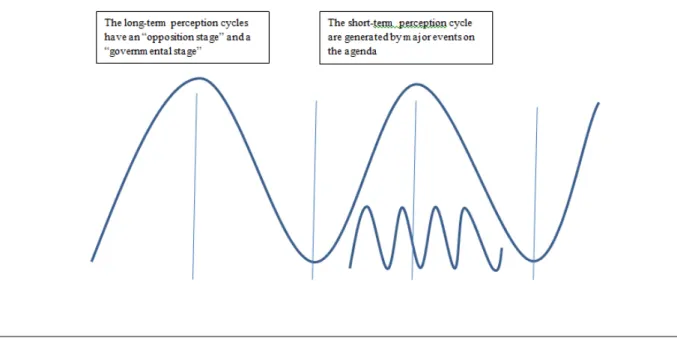
The first type is long-term cycle, of 8 to 12 years usually - consisting of an opposition stage, where the party/leader gathers support, which enables him to win elections, and a governmental stage where the popularity erodes and the party/leader loses ground.
The second type is short-term cycle, generally lasting several months. The cycle is generated by a positive or negative event/action which causes a spike/drastic downturn in public’s perception, followed by a slow “recovery” towards the general trend. Furthermore, I would argue that the amplitude of the perception cycles is greater than that of business cycles. It’s not unheard of spikes of 20-30 percentage points in popularity of Presidents in the space of weeks, a recent examples being that of French president Francois Hollande, after the Charlie Hebdo tragedy. These spikes are unheard of in business cycles.
One important difference between business cycles and electoral perception cycles is the variables used. On the one hand, we have „real-world” data, macro-economic variables such as GDP, level of unemployment, so on. On the other hand, we are measuring perceptions that public have, and we assume that not only we have a degree of uncertainty (an error margin), but that we also are talking of something that doesn’t have a correspondence in „real-world”.
I would argue that the results of the elections are the best correspondent in the real-world. Citizens will vote based on their perceptions and of the perception shared with the social group they belong to, much more than they vote based on economic numbers, statistics about unemployment or GDP. In political science, research was done showing people evaluate their economic situation more in „sociotropic” terms, than based on their individual case and their pocketbook (Abel Francois, 2011, p. 6).
So we have to take into account the measurement of the perception of political leaders and their economic actions. Of course, real economic data and the way the economy is going influence the voters, but the influence is just a part, albeit crucial one, of the perception they form and they use as base for their vote.
2.2. Testing the idea of cycles of perception. Explaining possible causes for the fluctuations
Political scientists overseas have tackled the issue of explaining the factors determining the popularity of U.S. Presidents. Their research provides a valuable perspective on the cyclical evolution of perception. There was a significant theoretical focus on the popularity gains U.S. Presidents register in their first months in office, followed by a gradual loss over the following months and years caused by the “coalition of minorities” (Mueller, 1970). In a famous study from the 70s "Presidential Popularity from Truman to Johnson," John E. Mueller introduced time as the main explanatory variable for the declining popularity of Presidents. In another recent study, Gerhard Peters examines changes in the job approval of U.S. presidents in the first 100 days in office (from the 50s, until 2009) and observed the same increase in popularity over the first months of a term, a sort of a “honeymoon” effect followed by a slow downward trend. This contraction phase usually hits the lowest point (the “trough”) after the President loses power, followed in most cases by a new recovery. There is a similar movement for political parties, which translates into an increase of popularity of a party that assumes the governance over the first weeks and, then, a phase of declining popularity in the following years that ultimately leads to the party going into opposition. Of course, there are other factors that can extend the electoral cycle over two terms, short term spikes that help the ruling party in the election year, but ultimately any leader/party will go into opposition.
Figure 2. Popularity of US Presidents George W. Bush and Barack Obama – job approval in percentage in the first 1500 days of their presidency
* The graph was done using Gallup data; source: http://www.gallup.com/poll/124922/Presidential-Job-Approval-Center.aspx
Gallup data confirms the theoretical perspective outlined above:
• Firstly, we should notice the repeated fluctuations in the public opinion’s perception of the two presidents. We can identify several "rally around the flag" effects - which can be treated as short-term cycles - i.e. periods of rapid ascent, followed by a slower decrease. The most dramatic is the one from 2001, after the attacks on the "Twin Towers" in September; an increase from 56-57% to 87% for George W. Bush, an increase that was cited in several analyses done of the most recent “rally aroud the flag” effects (Chatagnier, 2012). We note, however, other major short term fluctuations. On the one hand we have the "honeymoon" effect, both Presidents registering increases in top 100 days in office: 5-6 percentage points. On the other hand, we can link other short term fluctuations to the events on the domestic agenda; such is the case of the news and events of the President surrounding the early signs of economic recovery (job creation) in the second part of 2010. It’s interesting to link this to another hypothesis put forward by Samuel Kernell, who in Going Public argues that presidents can gather significant public support after big public communication events, such as presidential addresses so on and so forth (Kernell, 1986).
• Secondly, regarding the long term cycle, one sees a consistent decrease in popularity during the Presidents’ office - so the contraction phase of the electoral cycle perception overlaps the exercise of power. This contraction is even more pronounced if we ignore the election year. For instance, Barack Obama’s job approval decreases from around 60% to slightly above 40% at the beginning of the election year; George W. Bush’s job approval decreases slightly less, to around 46% in the election year. In both cases, the campaign effort ensures them a spike with a couple months before the elections.
Hollande’s popularity increased by 21 percentage points1. In another study conducted in 2012, Craig Stapley successfully tested the hypothesis of rapid growth of popularity following events on the domestic agenda at the state level, in United States (Stapley, 2012).
For exploring the hypothesis of perception cycle in Romania, we study the fluctuations in former President Traian Băsescu’s popularity during his two terms.
Figure 3. Timeseries. Favorable-unfavoravles for the two terms of President Basescu - figures in percentage points
Noi0 4 feb. 05 dec. 06 Mai 07 sep. 07 oct. 07 dec. 07 Mai 08 aug. 08 oct. 08 Iul 09 aug. 09 oct. 09 Ian 10 mar. 10 Noi 10 Ian 11 Iun 11 Noi 11 Ian 12 apr. 12 mar. 13 Mai 13 sep. 13 Ian 13 Mai 14 sep. 14
Fav 46 63 55 62 61 56 55 55 61 57 44 42 44 54 53 34 32 29 29 25 26 21 23 25 22 21 18
Nefav 46 30 36 32 30 35 37 38 38 39 46 51 52 42 43 62 64 67 67 68 70 77 74 71 73 75 82
55 44 29 10 30 50 70 90 Fav Nefav
* two data sources: CSOP surveys and INSCOP surveys (for the period from march 2013 to september 2014). Both research houses conducting national surveys, face to face, representative samples, about 3% margin of error; measuring comparable variables: favorability and trust.
The analysis is over the two presidential terms, which enables us to explore if there are similar fluctuations in public perception in Romania2:
• The first hypothesis is regarding the short term fluctuations, the "rally around the flag" effect. There are three key moments, major spikes linked with big events on the agenda, where the President was heavily involved: 1.
1
Fracios Hollande’s popularity increased from 19% in December to 40% in January, in a series of surveys done by Paris Match. Source: http://www.parismatch.com/Actu/Politique/Sondage-exclusif-Ifop-Fiducial-Francois-Hollande-21-points-Manuel-Valls-17-692692
2
The referendum for dismissal of the President in May 2007 – Traian Basescu’s favorability increasing by 7 pp (the parameters postulated by Mueller); 2. Summer-autumn of 2008, the promise of doubling teachers’ wages (the law passed in Parliament and was supported by the President in a series of public appearances) associated with an increase of 6 percentage points; 3. The referendum for unicameral parliament with 300 MPs in the fall of 2009; coupled with victory in the presidential election it lead to an increase of 10 percentage points. All these sharp increases were followed by contractions over time. I would point out another key moment, this time associated with a huge downturn: summer of 2010, the moment when the President announced the 25% cut in wages and the increase in VAT to 24%. This lead to a huge 19 percentage points drop. It’s important to point out that all these events that produced “rally around the flag effects” are around issues on the domestic agenda. None is linked with international crisis or events, which is an argument that this effect is linked not only to the international scene.
• A second hypothesis is the "honeymoon" effect and is also proved correct. The President’s favorability increased by 17 p.p. to 62% following the win in 2004 and by 10 p.p. following the win in the 2009 elections3. • A third hypothesis is the fact that the trend over the two terms is downward, consistent with John Mueller’s findings, the theory of “coalition of minorities”. One can see how over the 10 year terms President Basescu's favorability dropped from over 62% to 18%. The biggest part of the lost is over the second term and can attributed to the unpopular measures following the economic crisis that affected Romania. However, a decrease, albeit much smaller, can also be seen between 2004 and 2008 when Romania had economic growth. One question that needs answering, linked with the third hypothesis, is why after the last “rally around the flag effect” – the one in 2010 –President Băsescu’s popularity never recovered, continuing a downward trend. The hypothesis that I plan to test in a future paper is that of the “critical mass”; once the percentage of those unfavorable to a leader (especially those very unfavorable) gets to a certain point - well into the 60% - a high pressure builds on those who are still favorable. In this case, any recovery in popularity is small and short lived as any potentially critical event reactivates the critical mass that silences the minority4.
3. Conclusions
The approach I proposed in this paper is testing the hypothesis that popularity of political parties and leaders enjoy, follows a cyclical evolution from election to election. I propose the termelectoral perception cycles, to define this movement. There is a dynamic of the perception public opinion has on their leaders. Part of it is endogenous and cannot be attributed to specific policies, actions, messages of political leaders. This is what John Mueller names “coalition of minorities”. When they are exerting power, leaders tend to lose trust among citizens, while when they are in opposition, they tend to win back some of the trust lost. We must take into account the fact the politicians know of this trend and will not wait for the election year in trying to reverse it (as the classis political business cycle proposes).
Part of it is exogenous, meaning it is a result of important economic decisions, important events, changes in economic reality that influence the perception people have on their leaders. In this case the impact is not a slow, month-by-month change, but rather a sharp drop or gain. So, one should ask if leaders are “better of” and increase their election chances if they propose surprise economic moves in election years. In both cases, electoral perception cycles should be considered when analyzing "political business cycles", because it adds a dynamic element: electoral perception.
In building on the results of this paper I would focus on the impact short term perception cycles have on the strategy leaders have regarding handling the economic agenda. Going back to Anthony Downs and his thesis that "parties formulate public policies in order to win elections rather than win elections to formulate policies"; we have to ask ourselves if the causality advanced within the confines of the “business cycle theory” is such straight forward as it was proposed; meaning that leaders in power will try to impose a “business cycle” where the benefits for the public are seen near the elections and base their strategies on winning the elections on this.
However, we have to take into account on one hand the impact that other non- economic events have on the way people perceive the job done on economy by leaders and, on the other hand, the influence short term spikes have on the long term strategy outlined above. In other words, does it pay off for a leader in power to plan such a long term strategy on economy or is better to plan short term spikes.
Also, we have to take into account that perception “beats” sometimes the economic reality and that voters evaluate the economic results more from a sociotropic point of view, than the classic pocketbook approach. In a classic
3
As a side note, that can be pursued in future studies, the magnitude of the increase after elections victories in Romania, for first term presidents is much higher than in the United States. The new President, Klaus Johannis registered the same high increase of over 15 percentage points in the first months after winning the election. My hypothesis that could explain this jump is the lack of political knowledge of citizens, but also the lack of partisanship as is the case in the United States, where “a republican remains always a republican and a democrat always a democrat”.
4
paper, “Unequal democracy: the political economy of the new gilded age”, Larry Bartels raises questions on how the working class vote against their interest, based on the perception formed thru the public sphere, instead on economic facts (Bartels, 2008). Another telling discovery on how perception is stronger than reality when it comes to judging the economic policies/results of the leaders in power was made by John Mueller. He observed a significant influence of the handling of the Gulf War by President George Bush on the way public opinion evaluated his job on economic and fiscal issues. At the beginning of the war, job approval for President Bush jumped by 18 percentage points over a month and the percentage of those who said “they are better off economically, than a year ago” has risen by 10 p.p.. Moreover, after the end of the war, the percentage of people who agreed with the President’s fiscal policy has risen by 22 p.p., albeit the president did break his promises not to raise taxes (Mueller, 1994, p. 72). In other words, leaders can gain popularity and trust on economic front, without really influencing the economy. Perception and perception cycles are, as I have argued above, an integral part of analyzing political business cycles.
4. Bibliography:
[1] Alesina A., Roubini N., Cohen G.D., Political Cycles and the Macroeconomy , MIT Press, Cambridge – Massachusetts, London – England, 1997;
[2] Larry Bartels, Economic Inequality and Political Representation. Princeton University Press, 2005;
[3] Arthur, F. Burns., „The business cycle in a changing world”, source: National Bureau of Economic Research, sursă: http://www.nber.org/books/burn69-1, 1965;
[4] Michael J. Bronski, Christopher R. Way, „Does John Bull rally ’round the Union Jack? The nature of the rally ’round the flag effect in the United Kingdom,1950-2000”. Cornell University. Sursă:
http://falcon.arts.cornell.edu/crw12/documents/UK%20rally.pdf, (July 2003;
[5] J. Tyson Chatagnier, The effect of trust in government on rallies ’round the flag, Journal of Peace Research 49 (5) 631-645, p. 1, 2012;
[6] Anthony Downs, „An economic theory of democracy”. New York: Harper & Bros, 1957;
[7] Abel Francois, Mediatizing the economy and manufacturing french presidential popularity (2007-2010). Revue française de science politique, 2011/2 Vol. 61, p. 249-281. DOI : 10.3917/rfsp.612.0249, 2011;
[8] Robert Lucas, Understanding business cycles, Paper prepared for the Kiel Conference on Growth without Inflation, June 22-23, 1976;
[9] Robert Lucas, „Methods and problems in business cycles theory”, Journal of Money, Credit and Banking, vol. 12, No. 4, november 1980;
[10] Mugur Isarescu, „Ciclurile economice…”. Disertaţie cu ocazia decernării titlului de Doctor Honoris Causa al Universităţii Politehnice, Bucureşti, Octombrie 2013;
[11] Dorin Jula, Impact of political cycles – the relevance of European experiences for Romania”. Universite Pantheon-Sorbonne. Paris, France, July 2001;
[12] Samuel Kernell, „Explaining Presidential Popularity”, American Political Science Review, Volume 72, Issue 02, pp 506-522, June 1978;
[13] Samuel Kernell, Going Public: New Strategies of Presidential Leadership. Washington, D.C.: Congressional Quarterly Press, 1986;
[14] Angus Maddison, Business cycle, long Wave and phases of capitalism development, http://www.ggdc.net/maddison/ARTICLES/Business_Cycles.pdf, 1991;
[15] John E. Mueller, “Presidential Popularity from Truman to Johnson”, The American Political Science Review, Vol. 64, No. 1, pp. 18-34, March 1970;
[16] John E. Mueller, “Policy and Opinion in the Gulf War”, University of Chicago Press, 1994;
[17] Gerhard Peters, "Presidential Job Approval Ratings Following the First 100 Days." The American Presidency Project. Ed. John T. Woolley and Gerhard Peters. Santa Barbara, CA: University of California. 1999-2009. Sursă: http://www.presidency.ucsb.edu/data/100days_approval.php, 2009;
[18] Willliam Nordhaus, Alternative Models to Political Business C ycles, in Brookings Papers on Economic Activity, The Brookings Institution, 2: 1 -50, 1989;
[19] Craig S. Stapley, “The domestic rally effect and terrorism”. Global Security Studies. Colume 3. Issue 4; fall 2012; **** Banca Naţională a României, www.bnro.ro
**** INSCOP - http://www.inscop.ro/category/studii/