DOI: 10.2298/SAJ160328005K Professional paper
OBSERVATIONS AND LIGHT CURVE SOLUTIONS OF THE ECLIPSING
BINARIES USNO-B1.0 1395-0370184 AND USNO-B1.0 1395-0370731
D. Kjurkchieva1, V. A. Popov2, D. Vasileva1 and N. Petrov3
1Department of Physics, Shumen University, 115 Universitetska, 9700 Shumen, Bulgaria
E–mail: [email protected], [email protected]
2IRIDA Observatory, 67 Cherkovna Str., Sofia, Bulgaria
E–mail: [email protected]
3Institute of Astronomy and NAO, Bulgarian Academy of Sciences, Tsarigradsko shossee 72,
1784 Sofia, Bulgaria E–mail: [email protected]
(Received: March 28, 2016; Accepted: July 14, 2016)
SUMMARY: We present follow-up photometric observations in Sloan filtersg′
, i′
of the newly discovered eclipsing stars USNO-B1.0 1395-0370184 and USNO-B1.0 1395-0370731. Our data revealed that their orbital periods are considerably big-ger than the previous values. This result changed the classification of USNO-B1.0 1395-0370184 from the ultrashort-period binary (P=0.197 d) to short-period system (P=0.251 d). The light curve solutions of our observations revealed that USNO-B1.0 1395-0370184 and USNO-USNO-B1.0 1395-0370731 are overcontact binaries in which the components are K dwarfs, close in masses and radii. The light curve distortions
were reproduced by cool spots with angular radius of around 20◦.
Key words. binaries: close – binaries: eclipsing – methods: data analysis – stars: fundamental parameters – stars: individual: USNO-B1.0 1395-0370184, USNO-B1.0 1395-0370731
1. INTRODUCTION
The W UMa stars are recognized by their light curves with nearly equal minima and contin-uous light variation with typical periods of 0.25–1.0 days. They consist of two stars in contact with each other, surrounded by a common convective envelope lying between the inner and outer critical Roche sur-faces. As a result, their components possess almost identical surface brightness and temperature (Lucy 1968, 1976; Wilson 2001).
Table 1. Journal of our photometric observations.
Target Date Exposure (g′, i′) Number (g′, i′) Error (g′, i′)
[sec] [mag]
USNO-B1.0 1395-0370184 2015 Aug 08 180, 180 58, 55 0.031, 0.035 2015 Aug 11 180, 180 57, 58 0.027, 0.032 2015 Aug 12 180, 180 44, 42 0.031, 0.035 2015 Aug 13 180, 180 51, 51 0.029, 0.033 USNO-B1.0 1395-0370731 2015 Aug 08 180, 180 60, 60 0.019, 0.024 2015 Aug 11 180, 180 57, 58 0.014, 0.020 2015 Aug 12 180, 180 44, 42 0.017, 0.023 2015 Aug 13 180, 180 51, 51 0.016, 0.022
Table 2. List of standard stars.
Label Star ID RA Dec g′ i′
Target 1 USNO-B1.0 1395-0370184 20 47 15.15 +49 31 38.1 16.755 15.194 Target 2 USNO-B1.0 1395-0370731 20 47 46.21 +49 32 02.9 16.259 14.766 Chk UCAC4 698-084471 20 47 19.76 +49 32 45.69 14.098 12.968 C1 UCAC4 699-081452 20 47 14.32 +49 36 29.14 17.066 12.995 C2 UCAC4 698-084604 20 47 58.28 +49 34 34.26 14.407 13.213 C3 UCAC4 698-084486 20 47 24.64 +49 34 59.12 14.891 13.963 C4 UCAC4 698-084339 20 46 42.71 +49 34 44.37 14.673 13.180 C5 UCAC4 698-084367 20 46 51.21 +49 30 24.26 14.746 13.163 C6 UCAC4 698-084466 20 47 18.36 +49 29 09.15 14.671 13.577 C7 UCAC4 698-084551 20 47 43.50 +49 30 34.51 14.213 12.932 C8 UCAC4 698-084569 20 47 49.47 +49 30 10.41 15.155 13.620 C9 UCAC4 698-084549 20 47 42.29 +49 34 13.80 13.569 12.667
luminosity, smaller mass, larger mass ratio and shorter periods from 0.22 to 0.4 day. Their deeper primary minimum corresponds to the occultation eclipse of the smaller, less massive component while the secondary component has larger radius than the normal ZAMS star of the same mass.
The difference between the surface tempera-tures of the components of W UMa stars is usually less than several hundred kelvins. A new subclass B was introduced by Lucy and Wilson (1979) in which the components have larger surface temperature dif-ference. Moreover, Csizmadia and Klagyivik (2004) proposed the H (high-mass ratio) subclass withq≥
0.72 and extra angular momentum.
The W UMa-type binaries are a numerous family (Rucinski 2002) but are poorly studied due to the faintness of their late components. It is supposed that these components are in a similar evolutionary state, near or just above the main sequence, but there is still not a satisfactory theory for their origin, struc-ture, evolution and future fate (Van Hamme 1982a,b; Li et al. 2007).
This paper presents our follow-up photometric observations of two newly discovered short-period W UMa-type systems and the corresponding light curve solutions.
2. OBSERVATIONS
Our CCD photometric observations of USNO-B1.0 1395-0370184 and USNO-USNO-B1.0 1395-0370731 in Sloan g′, i′ bands were carried out with the
30-cm Ritchey Chretien Astrograph (located into the IRIDA South dome) using CCD camera ATIK 4000M. The two targets fall in the same field of view. Information about our observations is presented in Table 1.
The photometric data were reduced by AIP4WIN2.0(Berry and Burnell 2005). An
aper-ture ensemble photometry was performed with the softwareVPHOT using nine standard stars (Table 2) in the observed field whose coordinates were taken from the catalogue UCAC4 (Zacharias et al. 2013) and their magnitudes from the catalogue APASS DR9.
Table 3 contains the available information about USNO-B1.0 1395-0370184 and USNO-B1.0 1395-0370731 from the VSX database (Clark 2014): magnitude, amplitude, period, configuration type.
Table 3. Parameters of the targets from the VSX database.
Target CR amplitude P Type [mag] [mag] [days] USNO-B1.0 1395-0370184 14.7 0.35 0.1966 EW USNO-B1.0 1395-0370731 14.9 0.31 0.33445 EW
To determine the times of minima we used the software MINIMA (Nelson 2013) that allowed us to apply different methods (Ghedini, 1982): parabolic fit, digital tracing paper, bisectors of chords, Kwee and van Woerden (1956). The obtained times of min-ima (Table 4) lead to the following ephemerides:
HJD(M inI) = 2457243.53338(4) + + 0.251124(4)∗E (1)
for USNO-B1.0 1395-0370184 and
HJD(M inI) = 2457243.45895(3) + + 0.3512882(3)∗E (2)
for USNO-B1.0 1395-0370731.
-0.6 -0.4 -0.2 0.0 0.2 0.4 0.6
Phase 17.0
17.5
18.0 15.0
15.5
Magnitude
USNO-B1.0 1395-0370184
i'
g'
-0.6 -0.4 -0.2 0.0 0.2 0.4 0.6
Phase 16.4
16.8
17.2 14.8
15.2
Magnitude
USNO-B1.0 1395-0370731
i'
g'
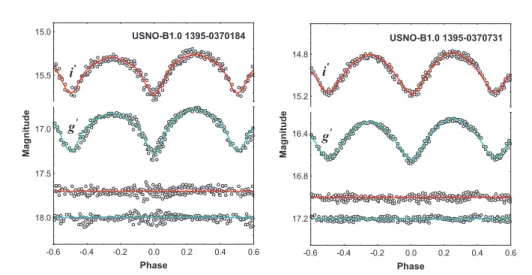
Fig. 1. Top: the folded light curves of USNO-B1.0 1395-0370184 and USNO-B1.0 1395-0370731 and their fits; Bottom: the corresponding residuals. The observational data are accessible in the form of tables (whose samples A1-A2 are shown in the Appendix) at www.irida-observatory.org/Observations/irida-4-SerAJ.zip.
Table 4. Times of the observed light minima at Rozhen.
Target Min I Min II
[HJD] [HJD]
USNO-B1.0 1395-0370184 - 2457243.40781(17) 2457243.53338(4)
-- 2457246.42121(19) 2457246.54687(7)
-- 2457247.42578(16) 2457247.55146(8) -2457248.55582(6) -USNO-B1.0 1395-0370731 2457243.45895(3)
-- 2457246.39694(7) 2457247.67449(4) -2457248.37689(5) 2457248.55283(6)
3. LIGHT CURVE SOLUTIONS
We carried out the modeling of our data by the packagePHOEBE(Prsa and Zwitter 2005). The ob-servational data (Fig. 1) show that our targets are nearly contact or overcontact systems and we mod-elled them using the corresponding modes ”Over-contact binary not in thermal ”Over-contact” and ”Semi-detached binary” of PHOEBE.
The light curve solution was carried out by the procedure described in Kjurkchieva et al. (2016). The free parameters were: secondary temperature T2, mass ratioq, orbital inclinationiand potentials
Ω1,2 (and simultaneously relative radii r1,2 and
fill-out factor f). In order to reproduce the O’Connell effect we used cool spots on the primary and varied their parameters (longitude λ, latitude β, angular sizeαand temperature factor κ).
In order to take into account the effect of the suspected correlation between the mass ratio and
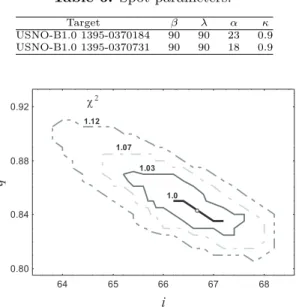
or-bital inclination we carried out q-search analysis as in Kjurkchieva et al. (2016). For this aim we fixed the component temperatures and radii as well as the spot parameters and calculated the normalized χ2
for a two-dimensional grid along i and q. Figs. 2 and 3 reveal the result from thisq-search procedure for the two targets.
The target parameters corresponding to our light curve solutions are given in Table 5 while Table 6 reveals the spot parameters reproducing the light curve distortions. The synthetic curves correspond-ing to the parameters of our light curve solutions are shown in Fig. 1 as continuous lines while Fig. 4 exhibits the 3D configurations.
71 72 73 74
i 0.94
0.96 0.98 1.00
q
c2
1.0 1.02 1.04 1.06
Fig. 2. Results of the q-search analysis for USNO-B1.0 1395-0370184: the different isolines circum-scribe the areas whose normalized χ2 are smaller
Table 5. Parameters of the light curve solutions: average temperatureTm; temperatures of componentsTi; relative radii of componentsri; mass ratioq; orbital inclinationi; fillout factorf; ratio of relative luminosities l2/l1. The parameter errors correspond to increasing of the χ2 value by 1 % (the formal PHOEBE errors
are smaller).
Target Tm T1 T2 r1 r2 q i f l2/l1
USNO-B1.0-1395-0370184 4725 4760±50 4690±50 0.385±0.004 0.377±0.004 0.968±0.005 72.1±0.5 0.014 0.904 USNO-B1.0-1395-0370731 5000 5030±60 4970±60 0.416±0.005 0.389±0.005 0.845±0.008 66.6±0.6 0.247 0.829
Table 6. Spot parameters.
Target β λ α κ
USNO-B1.0 1395-0370184 90 90 23 0.9 USNO-B1.0 1395-0370731 90 90 18 0.9
64 65 66 67 68
i 0.80
0.84 0.88 0.92
q
1.0
c2
1.03 1.07 1.12
Fig. 3. The same as Fig. 1 but for USNO-B1.0 1395-0370731.
Fig. 4. 3D configurations of USNO-B1.0 1395-0370184 and USNO-B1.0 1395-0370731.
4. RESULTS AND CONCLUSIONS
The main results from our study of the W UMa-type binaries USNO-B1.0 1395-0370184 and USNO-B1.0 1395-0370731 are as follows.
(1) Our observations revealed that their or-bital periods are considerably bigger than the previous values. This result was especially im-portant for USNO-B1.0 1395-0370184 because it changed its classification from ultrashort-period bi-nary (P=0.197 d) to short-period system (P=0.251 d).
(2) The components of USNO-B1.0 1395-0370184 and USNO-B1.0 1395-0370731 are K stars with almost equal temperatures which undergo par-tial eclipses.
(3) The components of the two binaries are close in masses and radii. The two targets belong to the H subclass of W UMa stars.
(4) USNO-B1.0 1395-0370184 is an almost contact system while USNO-B1.0 1395-0370731 is an overcontact binary with fillout factor around 0.25.
(5) The different light levels of USNO-B1.0 1395-0370184 and USNO-B1.0 1395-0370731 at the quadratures were reproduced by cool spots on the lateral side of their primaries with angular radius of around 20◦
. The photospheric activity is an expected characteristic for these cool stars.
This investigation not only added two new members to the small family of the studied short-period binaries with late components but also al-lowed us to determine the limit of possibilities of our equipment (30 cm telescope and CCD detector ATIK 4000M) to provide photometric data (at least in two colors) for a good light curve solution of eclips-ing stars with periods∼0.3 days and relatively deep eclipses. The photometry of our targets simultane-ously in two colors with exposures of 180 sec was accompanied with eligible errors of∼0.025 mag and an acceptable phase resolution of∼0.015. Thus, the limit magnitude for such a task isg′
∼17 mag.
Acknowledgements – The research was supported partly by funds of the project RD 08-81/03.02.16 of Shumen University. This publication makes use of data products from the Two Micron All Sky Survey, which is a joint project of the University of Mas-sachusetts and the Infrared Processing and Analysis Center/California Institute of Technology, funded by the National Aeronautics and Space Administration and the National Science Foundation. This research was made possible through the use of the AAVSO Photometric All-Sky Survey (APASS), funded by the Robert Martin Ayers Sciences Fund. The authors are grateful to the anonymous referee for the valu-able notes and propositions.
REFERENCES
Berry, R. and Burnell, J.: 2005, The Handbook of Astronomical Image Processing. 2nd ed., Willmann-Bell, Richmond, VA.
Binnendijk, L.: 1965, Veroeffentlichungen der Remeis-Sternwarte zu Bamberg,40, 36. Binnendijk, L.: 1970,Vistas in Astronomy,12, 217. Claret, A. and Bloemen, S.: 2011, Astron.
Clark, M.: 2014, The Journal of the American As-sociation of Variable Star Observers,42, 350. Csizmadia, Sz. and Klagyivik, P.: 2004,Astron.
As-trophys., 426, 1001.
Ghedini, S.: 1982, Software for Photometric Astron-omy, Willmann-Bell, Richmond, VA.
Kjurkchieva, D., Popov, V., Vasileva, D. and Petrov, N.: 2016,Serb. Astron. J.,192, 21.
Kwee, K. K. and van Woerden, H.: 1956,Bull. As-tron. Inst. Neth.,9, 252.
Li, L., Zhang, F., Han, Z. and Jiang, D.: 2007, As-trophys. J.,662, 596.
Lucy, L. B.: 1968,Astrophys. J.,151, 877. Lucy, L. B.: 1976,Astrophys. J.,205, 208.
Lucy, L. B. and Wilson, R. E.: 1979,Astrophys. J.,
231, 502.
Nelson, R.: 2013, http://members.shaw.ca/bob. nelson/software1.htm.
Prsa, A. and Zwitter T.: 2005,Astrophys. J. Suppl. Series,628, 426.
Rucinski, S. M.: 2002,Publ. Astron. Soc. Pacific,
114, 1124.
Van Hamme, W.: 1982a,Astron. Astrophys., 105, 389.
Van Hamme, W.: 1982b, Astron. Astrophys., 116, 27.
Wilson, R. E. and Devinney, E. J.: 1971,Astrophys. J., 166, 605.
Wilson, R. E.: 2001,Information Bulletin on Vari-able Stars, 5076.
Zacharias, N. et al.: 2013,Astron. J.,145, 44.
APPENDIX
Table A1. Photometric data of USNO-B1.0 1395-0370184
HJD g’ errorg’
2457243.299560 16.979 0.029 2457243.304140 16.934 0.029 2457243.308730 16.900 0.026 ... ... ... HJD i’ errori’
2457243.301850 15.461 0.035 2457243.306430 15.386 0.034 2457243.311010 15.378 0.034 ... ... ...
∗The complete table is available at http://saj.math.rs/
193/TableA1.dat.
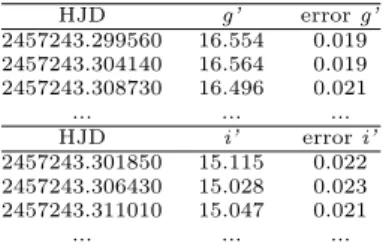
Table A2. Photometric data of USNO-B1.0 1395-0370731
HJD g’ errorg’
2457243.299560 16.554 0.019 2457243.304140 16.564 0.019 2457243.308730 16.496 0.021 ... ... ... HJD i’ errori’
2457243.301850 15.115 0.022 2457243.306430 15.028 0.023 2457243.311010 15.047 0.021 ... ... ...
∗The complete table is available at http://saj.math.rs/
POSMATRANjA I REXENjA ZA KRIVE SJAJA EKLIPSNO DVOJNIH SISTEMA
USNO-B1.0 1395-0370184I USNO-B1.0 1395-0370731
D. Kjurkchieva1, V. A. Popov2, D. Vasileva1 and N. Petrov3
1Department of Physics, Shumen University, 115 Universitetska, 9700 Shumen, Bulgaria
E–mail: [email protected], [email protected]
2IRIDA Observatory, 67 Cherkovna Str., Sofia, Bulgaria
E–mail: [email protected]
3Institute of Astronomy and NAO, Bulgarian Academy of Sciences, Tsarigradsko shossee 72,
1784 Sofia, Bulgaria E–mail: [email protected]
UDK524.386 + 524.387
Struqni qlanak
U ovom radu predstavljamo dodatna fo-tometrijska posmatranja novootkrivenih ek-lipsnih sistema USNO-B1.0 1395-0370184 i USNO-B1.0 1395-0370731 u Slounovim fil-terima g′, i′. Naxa posmatranja pokazala su da su orbitalni periodi znaqajno vei od prethodno dobijenih vrednosti. Dobi-jeni rezultati promenili su raniju klasi-fikaciju sistema USNO-B1.0 1395-0370184 iz