Knowledge Transfer in Multinational Companies: A Multiple Case Study Approach
Béla-Gergely RÁCZ1 Anca BORZA2
ABSTRACT
This study investigates how the absorptive capacity could be increased to improve internal and external knowledge transfer in subsidiaries of multinational companies. We look at the way in which the literature on absorptive capacity has evolved, and how it links the internal and external knowledge transfer. Based on 3 case studies conducted at Romanian subsidiaries of multinational companies, we find some patterns, which could explain how the successful knowledge flows should be managed within the multinational company and outside of it, in the supply chain network.
KEYWORDS: absorptive capacity, disseminative capacity, internal knowledge transfer, external knowledge transfer, manufacturing network, multinational company
JEL CLASSIFICATION: M11, M16
1. INTRODUCTION
Over the last few decades multinational companies (MNC) have recognized that there is a high value in their geographically dispersed production facilities, which can provide competitive advantage in the context of growing competition (Ferdows, 2006). Ghoshal and Bartlett (1990, p. 604) define the MNC as group of “geographically dispersed and goal -disparate organization that include its headquarters and the different national subsidiaries”. Such an entity can be conceptualized as an international network that is embedded in an external network formed of all other types of organizations (such as customers, suppliers, government, etc.).
For strengthening their market position, and for achieving a higher performance, MNCs are using the advantages of their internal network setting. Production (considering cost, proximity to market or labor advantages), R&D and sales decisions are taken with special attention to the internal network possibilities. These decisions have a measurable impact on performance, but there are other advantages as well. Despite the fact that the subsidiaries form the MNC, these plants, due to their geographical distance, operate like separate organizations, with their own culture and perhaps own suppliers and customers. Therefore, subsidiaries have the possibility of accumulating new knowledge, which shared with other plants could have further performance implications (which are however more difficult to measure). It is evident that MNC subsidiaries accumulate knowledge both from the headquarter and other plants (internal knowledge), and from the external supply chain partners (external knowledge). The
121
accumulated knowledge of a subsidiary could be shared further with other internal and external partners. During the subsidiary’s operation the accumulated knowledge is used for achieving a higher performance.
By reviewing the existing literature and conducting a multiple case study research, this paper aims to identify how the absorptive capacity could be increased to improve internal and external knowledge transfer in subsidiaries of multinational companies, and to shed more light on how the knowledge sharing process could be conducted in a more efficient manner.
2. LITERATURE REVIEW
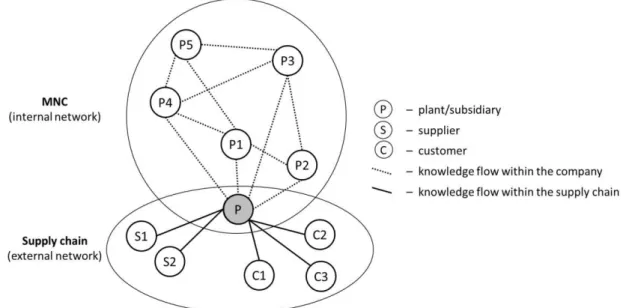
Grant (1996) claims, that firms have the ability to accumulate knowledge in the network, and convert this intellectual capital into performance. MNC subsidiaries have the same abilities, as they are operating as separate entities, which are part of different networks. Our unit of analysis is the subsidiary, which has different roles in the internal network of the MNC. The foundations of subsidiary role stream were laid in Ferdows’ (1997) article (Paterson & Brock, 2002), where he uses the ‘plant’ terminology, focusing on production plants. In his article he distinguishes six plant roles based on the strategic role and the competences of the plants. High competence plants are the source, lead and the contributor, and low competence plants are the offshore, outpost and server plants. Knowledge flows depend on the organizational context, therefore identifying plant roles is fundamental in researching knowledge transfer. Most of the researchers agree that distinguishing between a large set of knowledge assets is also important, but all the scholars agree that unused knowledge has no value, because it has no impact on performance (Cohen & Levinthal, 1990; Szulanski, 1996; Zaltman et al., 1973). To be valuable, knowledge needs to be transferred within the network (internal knowledge transfer) including the MNC’s headquarter and subsidiaries. Each subsidiary operates in its own environment, collaborating and exchanging knowledge with external partners (external knowledge transfer) as well (Tsai, 2001; Van Wijk et al., 2008). The possible knowledge flows a subsidiary could be part of is represented on Figure 1.
122
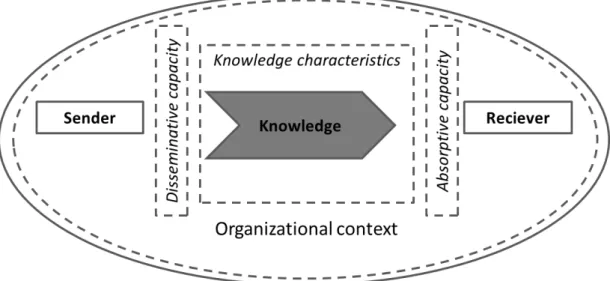
The knowledge transferred needs to be used within the subsidiary in order to create value for the company (Cheng et al., 2011). Furthermore, Michailova and Minbaeva (2012) claim that the very existence of the MNC is related to taking advantages of differences in knowledge and expertise around the world. Taking advantage of the knowledge repositories not only consists of using the knowledge, but also of combining it to create new knowledge, which can be further shared with other entities, thereby continuing the cycles of knowledge creation. This is in line with the modern knowledge management (KM) literature, which interprets the knowledge transfer (KT) as a dynamic process. Even if they are dynamic processes, knowledge flows are not started spontaneously without any triggers (Rácz & Borza, 2015). Minbaeva (2007) highlights the possible barriers of the KT, and claims that even if all the means of the communication process are present, the knowledge transfer will not start unless the sender has the willingness and necessary characteristics to share (disseminative capacity, DCAP), and the receiver the willingness and characteristics to absorb (absorptive capacity, ACAP) the new knowledge (Figure 2). There is a considerable amount of empirical evidence that MNCs, even the ones having a state-of-the-art knowledge sharing infrastructure, could have difficulties in the KT process (Hansen, 1999). While the KT research is burgeoning, there are relatively few papers focusing on the barriers of the KT process and the interconnectedness of internal and external knowledge transfers. Therefore, the main focus of the present paper is to investigate the impact of these barriers on internal and external knowledge flows.
Figure 2. Knowledge Transfer Process Source: Minbaeva (2007), p. 569
2.1. Absorptive and disseminative capacity
123
researched, while DCAP falls out of researchers’ focus. Despite this lack of focus on DCAP, in this paper we do not consider disseminative capacity as a research gap, because in the context of a multinational company, knowledge sending is a less challenging issue than absorbing and using the shared knowledge. Of course, the source’s capability, willingness and credibility are important aspects of the knowledge transfer and of the disseminative capacity (which is also termed as dissemination capacity), but these factors are mostly present when there is knowledge to share. Disseminative capacity could still be a barrier in knowledge sharing. Husted and Michailova (2002) claim that the behavior of knowledge senders could be expressed by their willingness to share knowledge with other organizational members on request. However, there are some reasons for a “not to share” behavior like (i) protection of individual competitive advantages, (ii) reluctance to spend time on knowledge sharing, (iii) fear of hosting “knowledge parasites”, (iv) avoidance of exposure, (v) uncertainty regarding how the knowledge receiver will perceive and interpret shared knowledge, or (vi) high respect for hierarchy and formal power (Husted & Michailova, 2002). In a similar manner, Bapuji and Crossan (2005) argue that DCAP is the ability of a firm to externalize organizational knowledge and acquire legitimacy for it.
On the other hand, the concept of absorptive capacity originates in the field of economic sciences, where it refers to an economy which is able to absorb external information and resources (Adler, 1965). Cohen and Levinthal (1990) were the firsts to introduce the term of absorptive capacity in management sciences, a paper which today has more than 30,000 citations, meaning a yearly average of 1,175 citations, and 1,540 citations received only in 2016 (based on Google Scholar, 10.09.2016). They define the ACAP as “the ability of the firm to recognize the new value of new, external information, assimilate it, and apply it to commercial ends” (Cohen & Levinthal, 1990, p. 128). The term has a lot of other definitions as well, depending on the management field and context. It can be defined separately for the individual level (Cohen & Levinthal, 1990), the business unit level (Szulanski, 1996), and the organizational level (Cohen & Levinthal, 1990).
2.2. Research questions and framework
124
performance implications, we have formulated the first research questions related to potential ACAP. The full research design is represented on Figure 3.
RQ1: How can subsidiaries improve the process of acquiring internal knowledge from their manufacturing network?
Answering this research question helps us exploring how the potential ACAP can be improved within a subsidiary.
The second research question refers to the realized ACAP: MNC subsidiaries operate also as part of the external supply chain network (Figure 1), and consequently beside internal knowledge sharing, they may share knowledge outside the network as well. Sharing knowledge with external supply chain partners can be considered from the subsidiaries’ point of view ACAP as well, because SC partners often share their product and process related needs with the plant they are purchasing from. Both internal and external knowledge transfer have a positive impact on performance, but there are relatively few papers considering the combination of internal and external knowledge sharing. Demeter et al. (2016, p. 75) based on survey research argue, that those subsidiaries which “have already implemented methods and systems for internal KT might find easier to involve their external supply chain partners into knowledge sharing activities than subsidiaries that have not yet implemented such systems or practices”. In the same paper they are not analyzing how the internal knowledge could be shared in the external network. Frohlich and Westbrook (2001) also highlight the fact that supply chain integration could lead to higher operational performance. None of the papers are analyzing how the internal knowledge could be shared in the external network. In line with this, our second research question is:
RQ2: How can the subsidiary share the internal knowledge with external supply chain partners?
Starting from the literature, and based on the previous research questions, we also believe that intra-network knowledge shared and recombined with the knowledge of supply chain partners has important performance benefits (Ho, 2014). Literature argues that both internal knowledge transfer (Andresson et al., 2001; Lane et al. 2001; Mahnke et al., 2005; Szász et al., 2016;) and external knowledge transfer could lead to higher operational performance (Caloghirou et al., 2004), but there is no case study based research supporting that the interdependence of internal and external knowledge transfer has performance implications. We wanted to bring some new evidence regarding the performance implications of the intra-network knowledge sharing with external partners. Following these arguments, our third research question is:
RQ3: What are the performance implications of acquiring and sharing the internal knowledge with external partners?
125
Figure 3. Research framework Source: own editing
3. RESEARCH METHODOLOGY
126
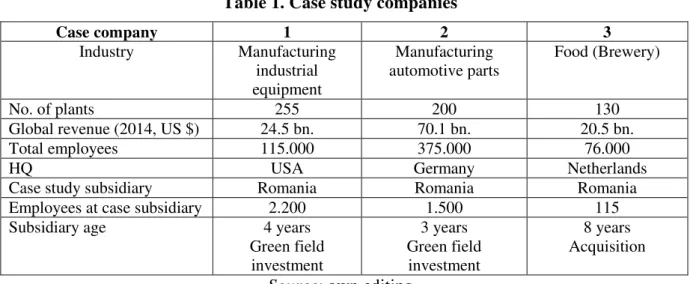
Table 1. Case study companies
Case company 1 2 3
Industry Manufacturing industrial equipment
Manufacturing automotive parts
Food (Brewery)
No. of plants 255 200 130
Global revenue (2014, US $) 24.5 bn. 70.1 bn. 20.5 bn.
Total employees 115.000 375.000 76.000
HQ USA Germany Netherlands
Case study subsidiary Romania Romania Romania
Employees at case subsidiary 2.200 1.500 115
Subsidiary age 4 years
Green field investment
3 years Green field
investment
8 years Acquisition
Source: own editing
We developed our case study interview protocol based on the literature to support our research questions. For a better understanding of the knowledge transfer process, a few questions are related to both a successful and an unsuccessful KT project, to have a clear notion which practices could be considered the best and the worst. We divided each open ended questions in two parts (successful and unsuccessful projects) as we wanted to understand what the best practices of knowledge transfer are, and we also wanted to give insights into how the worst practices can be omitted.
The interview protocol has 5 main chapters, as shown below (Table 2):
Table 2. Interview protocol framework
Chapter Main topics of the questions Related literature 1. Site’s strategy Types of knowledge exchanged in internal network
Involvement of the plant in knowledge exchange, innovation exchange, employee exchange activities Responsibilities and strategic goals
Vereecke et al., 2006; Ferdows, 1997
2. Network setup Involvement in different flows (goods, resources, knowledge, information, etc.)
Network coordination
Horn et al., 2014
3. Site’s absorptive
capacity
Sources of intra-network knowledge and the relationship of the receiver with the source (similarities and differences)
Relevance of intra-network knowledge
Project related questions about assimilating and exploiting the knowledge
Involvement of company-external suppliers and/or customers in knowledge sharing
Jensen et al., 2005; Minbaeva et al., 2003; Cohen & Levinthal 1990
4. Knowledge output
Project related questions about outputs of new knowledge
Volberda et al., 2010; Mahnke et al., 2005; 5. Commercial
output
Project related questions about commercial output Cohen and Levinthal, 1990
6. Firm
performance
Project related performance questions (cost savings and revenue growth)
HR performance
Network position improvement
Lane et al., 2001; Mahnke et al., 2005
127
4. ANALYSIS AND FINDINGS
In this section we analyze the data to answer the three research questions. We have stated our analysis by checking that all our priori set conditions were fulfilled by the sample, and the data has the designed validity. As the sample complied all our conditions, we have identified the context the plants are part of. After this step, we analyzed the data collected to answer our research questions.
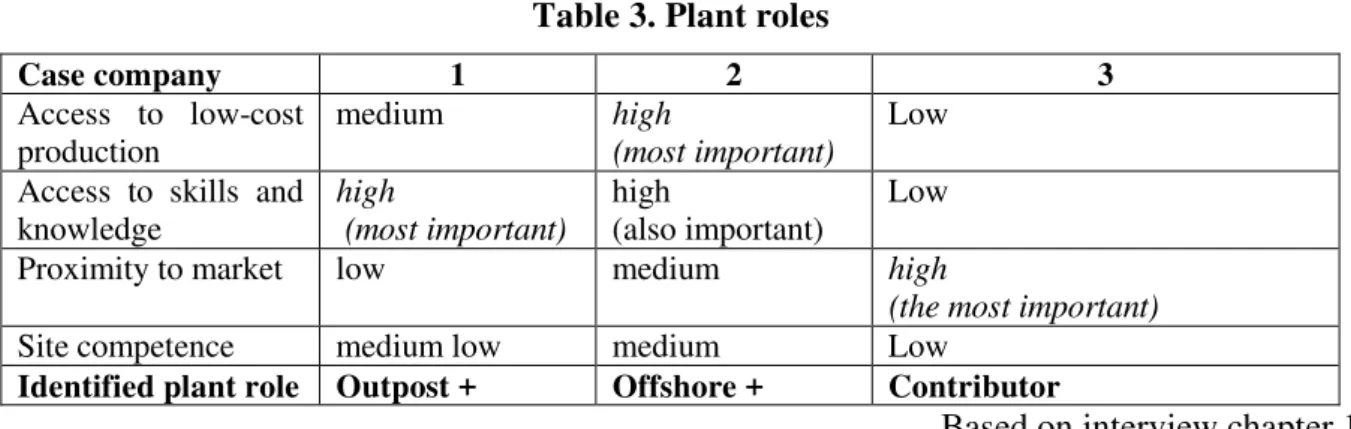
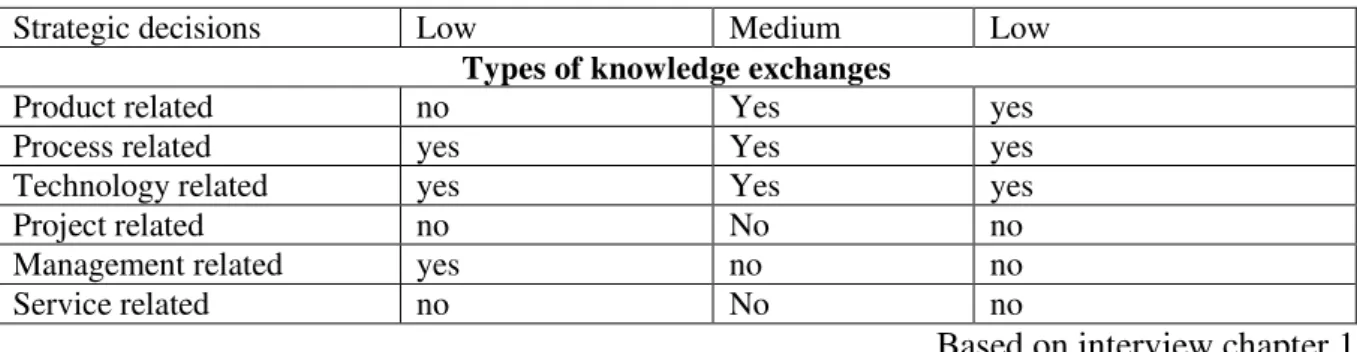
To place the plants in the MNC’s context, we have analyzed the plant roles based on Ferdows’ (1997) article (Table 3), then we identified the network and the knowledge exchange setup, to understand the basic similarities and differences between the analyzed plants (Table 4). As we showed above, the process of knowledge transfer depends on many factors, therefore our conclusions also depend on the characteristics of the plant, on the characteristics of knowledge, and knowledge transfer practices as well.
Table 3. Plant roles
Case company 1 2 3
Access to low-cost production
medium high
(most important)
Low
Access to skills and knowledge
high
(most important)
high
(also important)
Low
Proximity to market low medium high
(the most important)
Site competence medium low medium Low
Identified plant role Outpost + Offshore + Contributor
Based on interview chapter 1 Source: own editing, adapted from Ferdows (1997)
As we described in the previous chapter, for a greater validity, we intended to conduct our research at subsidiaries with different plant roles, a target which we managed to comply in our sample. As all of the plants are relatively young, and established in an emerging country, none of them had high competences yet, but – in concordance with the findings of Demeter and Szász (2016) – two out of three were trying to reach for a higher competence in the next few years. The manager of case company 2 explained their need for a continuous strategic role improvement: “By becoming a ‘competence center’ we will be able to choose and manage our suppliers and customers, and will be able to set up the whole production process, which offers us higher decision autonomy.” Decision autonomy seems to have a high correlation with plant roles, as none of the plants had high competences, nor high decision autonomy (Table 4). Some respondents also highlighted the fact that by achieving a higher strategic role (and consequently a higher decision autonomy), the future of the site could be more stable, which means more stable workplaces and future career possibilities in the local economy.
Table 4. Properties of the subsidiaries
Case company 1 2 3
Network coordination
Standardization High High High
Centralization Medium High High
Cooperation Low Medium Medium
Decision autonomy
128
Strategic decisions Low Medium Low
Types of knowledge exchanges
Product related no Yes yes
Process related yes Yes yes
Technology related yes Yes yes
Project related no No no
Management related yes no no
Service related no No no
Based on interview chapter 1 Source: own editing, based on Vereecke et al. (2006)
For a clear categorization of the plants it was also important to identify their involvement in different flows (Horn et al., 2014). We have found that all of the plants were involved in flows of goods, resources, information and knowledge (based on interview chapter 2), which we considered a necessary precondition (it was one of the sampling criteria) in answering our research questions. If the subsidiaries would have not been participating at least in the flows of goods, resources, information and knowledge, the embeddedness of the subsidiary in the internal network would have been weak (Garcia-Pont et al., 2009), consequently the knowledge transfer process would have been also weak and rare. The first and second research questions are connected to the concept of absorptive capacity (Figure 3), which is a plant specific characteristic. In analyzing a plant’s ACAP we differentiated between how a subsidiary could identify the intra-network source of knowledge (row 1 of Table 5), and how it could find the relevant knowledge from the identified source (row 2 of Table 5). We also linked back to the site characteristics described above.
Table 5. Absorptive capacity of the subsidiaries
Case
company 1 2 3
Identification of intra-network knowledge source
Trainings, easy knowledge
identification, due to the high standardization, training manual, social ties
Through ‘competence
centers’, “old boys network”, social ties
The country HQ helped finding the relevant knowledge source, intranet for easier issues, strategy similarities, social ties
Ability for relevant knowledge identification
Effective KT systems, intranet, frequent interactions with other plants: sales conferences, trainings, team buildings;
Collaborative projects, formal and informal interactions, intranet
Frequent interactions, plant visits, informal interactions
Based on interview chapter 3 Source: own editing, based on Jensen et al., 2005
129
For a better understanding of the knowledge transfer practices, and for conceptualizing the plant’s absorptive capacity, we asked the plant manager about two projects involving knowledge transfer: one that was a success, and another which was not successful. During the interview process we had some difficulties, as the plant managers did not want to admit that there were some failures. For getting a reliable answer, we reformulated our question regarding the unsuccessful project. We changed the term “unsuccessful” to “less successful”, this way we got useful information. We defined “less successful” as a project that had higher costs than planned, or was not implemented in time.
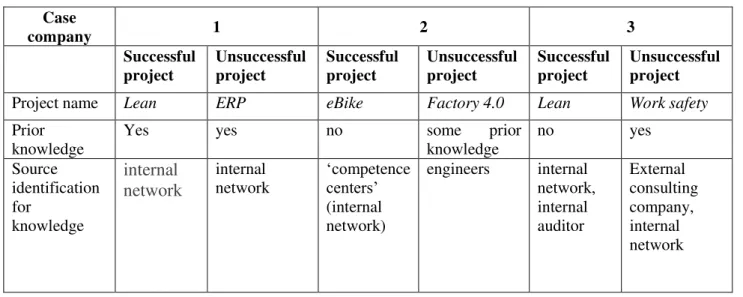
Case company 1 highlighted a lean implementation project as the most successful one, while they considered that the ERP implementation project was less successful, as the costs were higher than planned, and the implementation time took longer than predicted. The plant manager claimed that if there are some issues with some of the projects, they first try to solve the problem locally, then they seek for internal knowledge, and if the project cannot be solved with internal knowledge, they hire external consultants. Case company 2 also had difficulties implementing high tech projects, in their case it was an Industry 4.0 project, which was implemented with some serious delays, which lead to a more expensive implementation. Their successful project was an eBike project (a bicycle with an integrated electric motor which can be used for propulsion), which is a lifestyle product for bicycles. As this is a fast growing market, R&D, production, and delivering times are crucial. The Romanian plant delivers the ECUs (electronic control units) for the powertrain, while the Hungarian plant assembles the whole powertrain, including the ECU. This was an intensive knowledge exchange project, and the Romanian plant managed to deliver the ECUs in a shorter time than planned, which lead to a faster product release. In two years the focal plant delivered more than 21 million units, with no failures. The successful project of the third case company is also related to shorter implementation times: they implemented a lean management project, which was a success, and lead to more precise production, and lower costs. The less successful project was related to the implementation of the companies’ high standard work safety measures. The manager considered this mainly a HR problem, as the workers could not recognize in time that the state of the art work safety measures are important for them. This could have also been an issue related to the organizational culture, as the plant has been a local, private company with lower safety standards, prior to being brought by the multinational company. The interviewees claimed that in all their projects, bad habits are hard to be changed.
Table 6. Absorptive capacity of the subsidiaries based on projects
Case
company 1 2 3
Successful project
Unsuccessful project
Successful project
Unsuccessful project
Successful project
Unsuccessful project
Project name Lean ERP eBike Factory 4.0 Lean Work safety
Prior knowledge
Yes yes no some prior
knowledge
no yes
Source identification for
knowledge
internal network
internal network
‘competence
centers’
(internal network)
engineers internal network, internal auditor
130
Case
company 1 2 3
Successful project
Unsuccessful project
Successful project
Unsuccessful project
Successful project
Unsuccessful project
Enabler for assimilation of internal knowledge
job rotation, help desk ‘competence center’ job rotation, prior
professional relationships, cross functional interfaces
Exploitation
of new
knowledge
KPI Learning from failure, documented conclusions
Increased KPI
Increased KPI increased KPI, reduced costs, more effective production
participation in joint decision making and job rotation
Based on interview chapter 3 Source: own editing
In answering the first research question, regarding how internal knowledge acquisition can be improved, we have found some unexpected results, as internal knowledge acquisition does not necessarily depend on prior knowledge related to the project. In two out of the three successful projects, there was absolutely no prior local knowledge on how the project should be implemented, while in all the less successful projects the subsidiaries had some prior knowledge. Of course these results should be carefully interpreted. These findings can be explained with the need of effective knowledge transfer from the internal network. If a plant has no prior knowledge on a project, it is forced to absorb internal knowledge, which is an available and tested source for best practices. As the plant manager of the case company 3 explained, local bad habits and routines are hard to be changed, which can explain the fact that in all the cases of less successful projects there was prior local knowledge. We suppose that, if there was a similar project, plants would be less motivated to access the internal knowledge, they would better do it ‘as it was done before’, which is not necessarily the best practice, and leads to half successes. This is confirmed by the fact, that in all cases the primary source for knowledge identification is the internal network. It is indisputable that some useful knowledge resides in the internal network, the question is, if the plants are accessing it, and using it, or they want to invent the best practices by their own, which apparently doesn’t lead to great success. For accessing intra-network knowledge, the state of the art knowledge transfer systems are necessary, but not sufficient. In line with the previously reviewed literature, knowledge transfer is also a human-to-human process, consequently internal knowledge can be accessed easier if there are some formal or informal opportunities for personal meetings. Prior professional meetings or job rotation can help accessing internal knowledge.
131
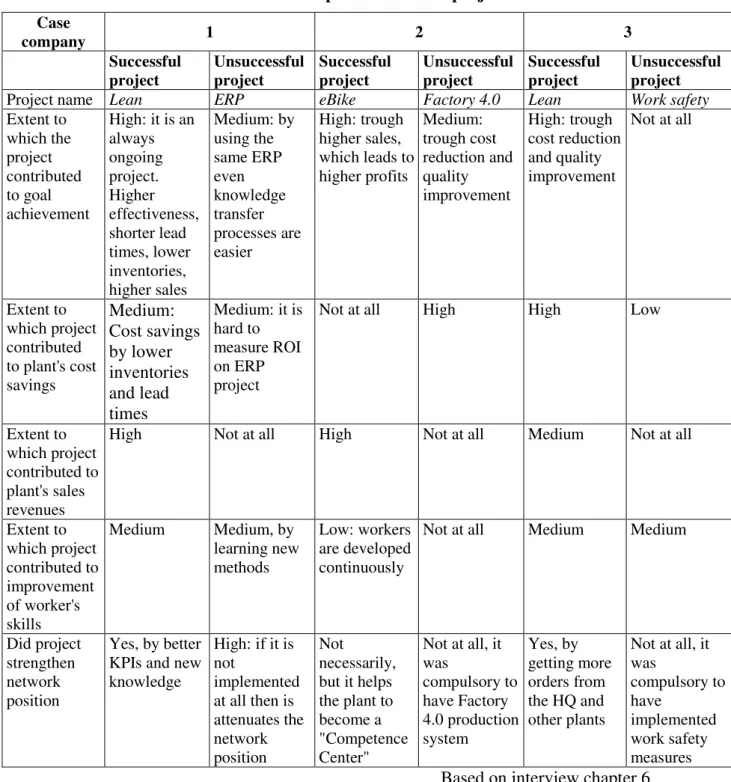
product to a new one with some new features. They know that the old one is working properly, it has been tested for a long time. This attitude can be changed, if customers are taking part of the new product development process (RQ2). Case company 1 had a similar experience with developing their own a new gas regulator, which was not purchased by the customers. They have decided to improve the product by involving the customers. This seemed to be a success, and they were able to sell the new product, which was a joint development with the customers and suppliers. This example shows, that if internal knowledge is shared with external partners, the possibility for a better sales performance is higher (Table 7, based on RQ3).
Table 7. Performance implications of the projects
Case
company 1 2 3
Successful project Unsuccessful project Successful project Unsuccessful project Successful project Unsuccessful project Project name Lean ERP eBike Factory 4.0 Lean Work safety
Extent to which the project contributed to goal achievement
High: it is an always ongoing project. Higher effectiveness, shorter lead times, lower inventories, higher sales Medium: by using the same ERP even knowledge transfer processes are easier High: trough higher sales, which leads to higher profits Medium: trough cost reduction and quality improvement High: trough cost reduction and quality improvement
Not at all
Extent to which project contributed to plant's cost savings Medium: Cost savings by lower inventories and lead times
Medium: it is hard to measure ROI on ERP project
Not at all High High Low
Extent to which project contributed to plant's sales revenues
High Not at all High Not at all Medium Not at all
Extent to which project contributed to improvement of worker's skills
Medium Medium, by learning new methods
Low: workers are developed continuously
Not at all Medium Medium
Did project strengthen network position
Yes, by better KPIs and new knowledge
High: if it is not
implemented at all then is attenuates the network position
Not
necessarily, but it helps the plant to become a "Competence Center"
Not at all, it was compulsory to have Factory 4.0 production system Yes, by getting more orders from the HQ and other plants
132
As we can see in Table 7, by internal knowledge transfer not only the sales performance can improve, but many other performance measures as well. It is also interesting to highlight the fact that the 3 successful projects improved a total of 12 operational performance indicators, while the less successful projects also improved, but “only” 7 operational performance measures.
5. DISCUSSION AND CONCLUSIONS
The main objective of this paper was to investigate how the absorptive capacity could be increased to improve internal and external knowledge transfer in subsidiaries of multinational companies and show their impact on the operational performance. In answering the research questions, we took into consideration that the plants operate in two different networks: internal and external. Internal knowledge flows between the subsidiaries and between HQ and subsidiaries, while the external knowledge flows in the supply chain network. We wanted to show through multiple case studies, that knowledge residing in the internal network could be shared in the external one for achieving a better operational performance. We also highlighted the best practices in designing an effective knowledge management, based on absorptive capacity.
The main finding of the paper is that subsidiaries need to access the internal knowledge, and for accessing it, it is not enough that all the MNCs have state-of-the-art knowledge transfer systems, human interaction is also compulsory for a successful knowledge transfer. All the interviewees claimed that job rotation, or prior professional relationships helped the transfer. Companies should consider this aspect as well, and invest in HR programs. Another finding, regarding the internal KT, was that subsidiaries had no prior knowledge, when they implemented successful projects, and they had some prior knowledge on the less successful projects. In our interpretation it means that some subsidiaries access intra-network knowledge when they have absolutely no information on the project. As the internal knowledge represents the best practices of the MNC, subsidiaries had success in realizing projects where they had no prior knowledge. We have found that carrying out a project where they had some prior knowledge was less successful. In these cases, subsidiaries used their routines, and perhaps relied less on the internal knowledge, which lead to weaker performance. Plant managers, and project managers should always access the intra-network knowledge when implementing a project.
We also want highlight the fact that internal knowledge, shared with the external partners could lead to higher performance. Our case studies bring evidence that, mainly in new product development, success can be reached if the customers and suppliers are involved in the process. This is only possible when the internal knowledge transfers are effective, then knowledge could be shared with external partners as well.
133
REFERENCES
Adler, J.H. (1965). Absorptive Capacity: The Concept and its Determinants, Brookings Institution, Washington
Andersson, U., Forsgren, M., Holm, U. (2001). Subsidiary embeddedness and competence development in MNCs – a multi-level analysis. Organizational Studies, 22 (6), 1013– 1034.
Bapuij, H., & Crossan, M. (2005). Co-evolution of social capital and knowledge: an extension of the Nahapiet and Ghoshal (1998) framework. Academy of Management Best Conference Paper.
Bartlett, A., & Ghoshal, S. (1989). Managing Across Borders–The Transnational Solution. Harvard Business School Press, Boston, MA.
Business Review 22 (2), 155–175.
Caloghirou, Y., Kastelli, I., & Tsakanikas, A. (2004). Internal capabilities and external knowledge sources: complements or substitutes for innovative performance?. Technovation, 24 (1), 29-39.
Cheng, Y., Farooq, S., & Johansen, J. (2011). Manufacturing network evolution: a manufacturing plant perspective. International Journal of Operations & Production Management, 31 (12), 1311-1331.
Cohen, W. M., & Levinthal, D. A. (1990). Absorptive capacity: a new perspective on learning and innovation. Administrative science quarterly, 128-152.
Demeter, K., & Szász, L. (2016). The diversity of European manufacturing plant roles in international manufacturing networks. Journal of East European Management Studies, 21 (2), 184-208.
Demeter, K., Szász, L., & Rácz, B.-G. (2016). The impact of subsidiaries’ internal and external integration on operational performance, International Journal of Production Economics, 182, 73-85.
Eisenhardt, K. M. (1989). Building theories from case study research. Academy of management review, 14 (4), 532-550.
Feldmann, A., & Olhager, J. (2013). Plant roles: site competence bundles and their relationships with site location factors and performance. International Journal of Operations & Production Management, 33 (6), 722-744.
Ferdows, K. (1997). Making the most of foreign factories. Harvard Business Review, 75, 73-91.
Ferdows, K. (2006). POM Forum: Transfer of Changing Production Know‐How. Production and Operations Management, 15 (1), 1-9.
Figueiredo, P.N., 2011. The role of dual embeddedness in the innovative performance of MNE subsidiaries: evidence from Brazil. Journal of Management Studies 48 (2), 417– 440.
Frohlich, M. T., & Westbrook, R. (2001). Arcs of integration: an international study of supply chain strategies. Journal of operations management, 19(2), 185-200.
Garcia‐Pont, C., Canales, J. I., & Noboa, F. (2009). Subsidiary strategy: The embeddedness component. Journal of Management Studies, 46 (2), 182-214.
Ghoshal, S., & Bartlett, C. A. (1990). The multinational corporation as an interorganizational network. Academy of management review, 15 (4), 603-626.
134
Gupta, A. K., & Govindarajan, V. (2000). Knowledge flows within multinational corporations. Strategic management journal, 21 (4), 473-496.
Hansen, M. T. (1999). The search-transfer problem: The role of weak ties in sharing knowledge across organization subunits. Administrative science quarterly, 44(1), 82-111. Ho, Y.C., 2014. Multilateral knowledge transfer and multiple embeddedness. Multinational Horn, P., Scheffler, P., Schiele, H., 2014. Internal integration as a pre-condition for external
integration in global sourcing: a social capital perspective. International Journal of Production Economics. 153, 54–65.
Husted, K., & Michailova, S. (2002). Knowledge sharing in Russian companies with Western participation. Management International, 6 (2), 17-31.
Jansen, J.J.P., Van den Bosch, F.A.J., Volberda, H.W., 2005. Managing potential and realized absorptive capacity: how do organizational antecedents matter? Academy of Management Journal. 48 (6), 999–1015.
Leonard-Barton, D. (1990). A dual methodology for case studies: Synergistic use of a longitudinal single site with replicated multiple sites. Organization science, 1 (3), 248-266.
Mahnke, V., Pedersen, T., & Venzin, M. (2005). The impact of knowledge management on MNC subsidiary performance: the role of absorptive capacity. MIR: Management International Review, 101-119.
Michailova, S., & Minbaeva, D. B. (2012). Organizational values and knowledge sharing in multinational corporations: The Danisco case. International Business Review, 21 (1), 59-70.
Minbaeva, D. B. (2007). Knowledge transfer in multinational corporations. Management International Review, 47 (4), 567-593.
Minbaeva, D., Pedersen, T., Björkman, I., Fey, C. F., & Park, H. J. (2003). MNC knowledge transfer, subsidiary absorptive capacity, and HRM. Journal of international business studies, 34 (6), 586-599.
Nonaka, I. (1994). A dynamic theory of organizational knowledge creation. Organization science, 5(1), 14-37.
Paterson, S. L., & Brock, D. M. (2002). The development of subsidiary-management research: review and theoretical analysis. International Business Review, 11 (2), 139-163. Rácz, B-G., Borza, A. (2015). An Interdisciplinary Perspective On Managing Knowledge In
Multinational Companies: Review And Theoretical Analysis. Proceedings Of The 9th International Management Conference Management And Innovation For Competitive Advantage, Bucharest, Romania
Stuart, I., McCutcheon, D., Handfield, R., McLachlin, R., & Samson, D. (2002). Effective case research in operations management: a process perspective. Journal of Operations Management, 20 (5), 419-433.
Szász, L., Scherrer-Rathje, M., & Deflorin, P. (2016). Benefits of internal manufacturing network integration: the moderating effect of country context. International Journal of Operations & Production Management, 36 (7), 757-780
Szulanski, G. (1996). Exploring internal stickiness: Impediments to the transfer of best practice within the firm. Strategic management journal, 17 (S2), 27-43.
Tsai, W. (2001). Knowledge transfer in intraorganizational networks: Effects of network position and absorptive capacity on business unit innovation and performance. Academy of management journal, 44 (5), 996-1004.
135
Vereecke, A., Van Dierdonck, R., & De Meyer, A. (2006). A typology of plants in global manufacturing networks. Management Science, 52 (11), 1737-1750.
Volberda, H. W., Foss, N. J., & Lyles, M. A. (2010). Perspective-absorbing the concept of absorptive capacity: how to realize its potential in the organization field. Organization science, 21(4), 931-951.
Zahra, S. A., & George, G. (2002). Absorptive capacity: A review, reconceptualization, and extension. Academy of management review, 27 (2), 185-203.