http://dx.doi.org/10.3345/kjp.2012.55.12.474 Korean J Pediatr 2012;55(12):474-480
eISSN 1738-1061 • pISSN 2092-7258
474
Evaluation of immunogenicity of the 2008–2009
seasonal influenza vaccines by microneutralization
test
Purpose: For evaluating the immunogenicity of an inluenza vaccine, the microneutralization (MN) test has a higher sensitivity and speciicity as compared to the hemagglutination inhibition (HI) test. However, the MN test is more time consuming and is difficult to standardize. We performed the MN test to determine its usefulness as an alternative or complementary test to the HI test for evaluating the immunogenicity of inluenza vaccines.
Methods: We compared the MN test with the HI test using 50 paired samples taken from a previous clinical study (2008–2009) in Korean children under 18 years of age.
Results: The linear correlation coeffi cients of the 2 tests for H3N2, H1N1, and influenza B were 0.69, 0.70, and 0.66, respectively. We identified a high index of coincidence between the 2 tests. For an influenza vaccine, the postvaccination sero protection rates and seroconversion rates determined by the MN test were 78.0% and 96.0%, 90% and 42.0%, and 42.0% and 48.0% for H3N2, H1N1, and inluenza B, respectively. Geometric mean titer fold increases of H3N2, H1N1, and inluenza B were 2.89, 5.04, and 4.29, respectively, and were 2.5-fold higher. We obtained good results in the evaluation of the immunogenicity of the 2008–2009 seasonal inluenza vaccines. Conclusion: We found that the MN test was as effective as the HI test. Therefore, we suggest that the MN test can be used as an alternative or complementary test to the HI test for evaluating the immunogenicity of inluenza vaccines.
Key words: Neutralization tests, Hemagglutination inhibition test, In-luenza vaccines, Child
Seung Youn Kim, MD1, Yun Kyung Kim, MD2, Byung Wook Eun, MD3, Nam Hee Kim, MD4,
Eun Kyeong Kang, MD5, Byong Sop Lee, MD6, Jung Sub Lim, MD1, Jun Ah Lee, MD1, Dong
Ho Kim, MD1
1Department of Pediatrics, Korean Cancer Center
Hospital, Seoul, 2Department of Pediatrics, Korea University College of Medicine, Seoul, 3Department
of Pediatrics, Graduate School of Medicine, Gachon University of Medicine and Science, Incheon,
4
Department of Pediatrics, Inje University Ilsan Paik Hospital, Inje University College of Medicine, Goyang,
5
Department of Pediatrics, Dongguk University Ilsan Hospital, Goyang, 6Department of Pediatrics, Asan
Medical Center Children’s Hospital, University of Ulsan College of Medicine, Seoul, Korea
Received: 16 August, 2012, Revised: 2 October, 2012 Accepted: 18 October, 2012
Corresponding author: Dong Ho Kim, MD
Department of Pediatrics, Korean Cancer Center Hospital, 75 Nowon-ro, Nowon-gu, Seoul 139-706, Korea
Tel: +82-2-970-1298, Fax: +82-2-970-1970 E-mail: [email protected]
Copyright © 2012 by The Korean Pediatric Society
his is an open-access article distributed under the terms of the Creative Commons Attribution Non-Commercial License (http://creativecommons.org/licenses/by-nc/3.0/) which permits unrestricted non-commercial use, distribution, and reproduction in any medium, provided the original work is properly cited.
Introduction
Influenza is caused by the influenza virus and is one of the most
frequently and protective immunity lasts only about half a year. Some insist on the necessity for annual evaluation of the immunogenicity of influenza vaccines. For example, immunogenicity of influenza vaccine has been evaluated annually in Europe5). If reasonable
correlation of immunogenicity of vaccine with prevention of a specific disease is established in a number of studies, we can begin evaluating immunogenicity of a vaccine instead of evaluating its efficacy6). Measuring serologic antibody titer is widely used because of its simplicity7). In particular, the standardized hemagglutination inhibition (HI) test is widely used because of its reliability, sensitivity, and speciicity in evaluating immunogenicity of inluenza vaccines8).
Neutralizing antibody (NAb) is another key factor for evaluating host immunity against influenza, but measuring NAb takes longer than other tests and is difficult to standardize for evaluating the immunogenicity of influenza vaccine9-11). Recently, with the development of an improved microneutralization (MN) assay, NAb measurement has been increasingly adopted in several countries, but not in Korea12,13). Here, we tried conventional MN test to identify
usefulness as an alternative or complementary test to the HI test. Though enzyme-linked immunosorbent assay (ELISA) based MN tests have become popularly used, we adopted conventional MN because we thought the classic methods were more valuable as the initial trial of MN test for evaluating the immunogenicity of inluenza vaccine in Korea than ELISA based MN test.
Materials and methods
1. Patient population and materials
We randomly selected 50 paired samples (25 paired samples in 153 split vaccine group and 25 paired samples in 158 subunit vaccine group) among 303 pairs of prevaccination and 30 days postvaccination human serum samples for analysis by MN test. he study protocol was approved by the Institutional Review Board of Korea Cancer Center Hospital. The samples were taken during a previous clinical study that evaluated the immunogenicity of split and subunit influenza vaccines with HI test. The influenza virus strains used in this study were A/Brisbane/59/2007(H1N1) strain (IVR-148), A/Uruguay/716/2007(H3N2) strain (NYMCX-175C), and B/ Florida/4/2006.
2. HI test and evaluation of immunogenicity
Chicken Red Blood Cells, 5%, were used for HI test. Seropro-tection rate, seroconversion rate, and geometric mean titer (GMT) were used for evaluating immunogenicity of vaccines. HI antibody titer 1:40 was defined as antiinfluenza protective antibody titer. Seroconversion was deined as a change from a baseline titer of <1:10
to a postvaccination titer of ≥1:40 or a 4-fold or greater rise in titer in samples with an initial HI titer ≥1:10. Seroprotection was deined by titers of ≥1:40.
3. Madin-Darby canine kidney (MDCK) cell preparation
We calculated cell concentration after incubating cells on a 96 well plate with 100 μL of MDCK (ATCC, Manassas, VA, USA) cells in each well seeded in medium at 1.5×10⁵ cells/mL. The plate was incubated for 24 hours at 37°C and 5% CO2.
4. Virus titration
If there was plaque formation or cytopathogenic effect (CPE) in MDCK cells, we considered them to be infected by inluenza virus.
We preferentially took 146 μL of virus culture medium and reserved it at 4°C for a period after thawing. Culture medium containing trypsin, 100 μL, was added in the 96 wells. he reserved 146-μL virus culture medium was added in the wells of irst row, and 46 μL of diluent was decanted serially in the next row. Afterwards, each well was prepared with culture medium attenuated gradually by 1/2 log10. After 48 hours incubation at 37°C in a 5% CO2 humidiied
atmosphere, we evaluated viral plaque formation in MCDK cells by optical microscopy. In order to account for any variability in the test procedure, each sample was tested in duplicate. When two results were mismatched, retests were done till matched.
After culture media of the wells with plaques were removed, the MDCK cells were stained by crystal violet dye, and the number of wells forming plaques was counted. he 50% tissue culture infecting dose (TCID50) was calculated using the method of Reed and
Muench, and 50-μL virus culture diluents containing 100 TCID50
virus were used in each well for MN test.
5. MN test and evaluation of immunogenicity
MDCK cells were added to each well of a 96 well plate. A diluent of 90 μL and 10 μL heat inactivated human sera was added to the irst well and 2-fold serial dilutions were performed in an equal volume of diluent in the plate, and 50 μL of diluent containing 100 TCID50 of
inluenza virus was added to each well.
After a 48 to 120 hours incubation at 37°C in a 5% CO2
humi-diied atmosphere, we examined viral plaque formation in the MCDK cells with optical microscopy. Culture luid with and without plaques was removed from the 96 wells and stained with crystal violet dye.
NAb titer was established at the maximal diluted concentration inhibiting plaque formation. When plaque formation was not inhibited in 1:10 sera, we set the NAb titer to 1:5.
vaccines by MN test.
NAb titer 1:40 was deined as an antiinluenza protective antibody titer. Seroconversion was defined as a change from a baseline titer <1:10 to a postvaccination titer ≥1:40 or a 4-fold or greater rise in titer in samples with an initial NAb titer ≥1:10. Seroprotection was deined as a titer of ≥1:40. MN test for H3N2, H1N1, and influenza B was duplicated for each serum sample.
6. Approval standard criteria for inluenza vaccine
Because there are no standard approval criteria in Korea for immunogenicity of inluenza vaccines, this study used the following standard authorization criteria from European Medicines Agency (EMEA): 1) seroconversion rate of NAb titer >40%, 2) NAb GMT fold increase >2.5, 3) percentage of subjects with NAb titer over 1:40 ≥70%.
7. Statistical analysis
All calculations were performed with SPSS ver. 14.0 (SPSS Inc., Chicago, IL, USA). To test for correlation between HI and MN test, the correlation coefficient square, R2, was calculated for correlation analysis and the kappa index was calculated for evaluation the index of coincidence.
A chi-square test was used to compare the seroprotection rate and seroconversion rate between the split inluenza vaccine group and the subunit influenza vaccine group. We analyzed the 95% confidence interval for GMT comparisons, and P<0.05 was considered statisti-cally signiicant.
Results
Paired samples of 50 subjects (age, 6.0 months to 18.0 years; mean age, 6.58±3.97 years) were analyzed. There were no statistical diferences in mean age, sex ratio, and prevaccination status between split vaccine group and subunit vaccine groups (Table 1).
The linear correlation coefficient squares, R2, of MN and HI test for H1N1, H3N2, and influenza B were 0.70, 0.69, and 0.66, respectively, and we observed a high index of coincidence between the two tests (Fig. 1).
A 1:40 titer on HI test is widely accepted as an effective anti-inluenza antibody titer, but no standard value for MN test has been
Table 1. Characteristics of the Subjects
Characteristic
Split vaccine group (n=25)
Subunit vaccine group (n=25)
Total
(n=50) P value
Age (yr)
0.5–2 5 (20) 5 (20) 10 (20) 3–8 13 (52) 13 (52) 26 (52) 9–18 7 (28) 7 (28) 14 (28) Mean age (yr) 6.37±3.66 6.79±4.32 6.58±3.97 0.25
Sex 0.39
Male 9 (36) 12 (48) 21 (42) Female 16 (54) 13 (52) 29 (58)
Prevaccination status 0.68
Unprimed 3 (12) 3 (12) 6 (12) Primed 22 (88) 22 (88) 44 (88) Duration* (day) 29.2±1.53 30.76±2.71 29.98±2.32 0.016 Values are presented as number (%) or mean±SD.
*Duration between vaccine last shot and postvaccination sampling.
y=0.8226x+22.26 R²=0.7047
0 200 400 600 800 1,000 1,200 1,400
0 200 400 600 800 1,000 1,200 1,400
Neu
tr
ali
zin
g
A
b
ti
te
r (
H1N
1)
Anti-hemagglutinating Ab titer (H1N1)
y=0.1466x+32.858 R²=0.6942
0 100 200 300 400 500 600 700 800 900
0 1,000 2,000 3,000 4,000 5,000 6,000
N
eu
tr
alizin
g
A
b
ti
te
r (
H3
N
2)
Anti-hemagglutinating Ab titer (H3N2)
(B)
y=1.4397x+98.904 R²=0.6631
0 500 1,000 1,500 2,000 2,500
0 200 400 600 800 1,000 1,200 1,400
Neu
tr
ali
zin
g
A
b
ti
te
r (
B
)
Anti-hemagglutinating Ab titer (B)
(C) (A)
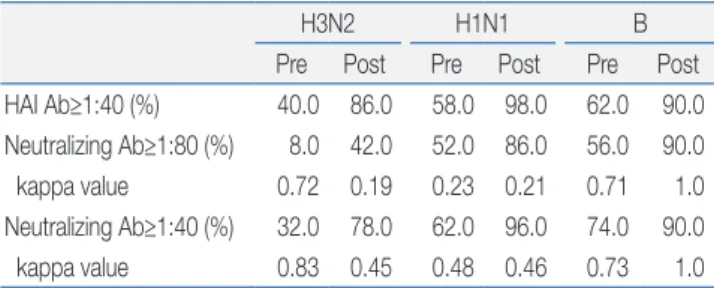
widely accepted. According to the results of this study, NAb titers of 1:40 rather than 1:80 were highly significantly coincident with HI test titers, as indicated by the higher kappa index (Table 2).
When we set a NAb titer of 1:40 for the antiinfluenza antibody titer, we observed 78.0%, 96.0%, and 90% seroprotection rates, all of which were greater than 70%, in the 30 day postvaccination specimens, compared with 32.0%, 62.0%, and 74.0% prevaccination rates for H3N2, H1N1, and inluenza B, respectively.
The seroconversion rates of MN test were 42.0%, 42.0%, and 48.0% for H3N2, H1N1, and inluenza B, and the GMTs were >2.5-fold (2.89, 5.04, and 4.29) (Fig. 2).
We divided the subjects into 2 groups, an inluenza subunit vaccine
group and a split vaccine group, and evaluated immunogenicity of each group using MN test. We found no significant difference between the groups for seroprotection rate. However, there was signiicant diference in the H3N2 seroconversion rates between the 2 groups (Table 3). he H3N2 seroconversion rate of the split vaccine group was higher than that of the subunit vaccine group (46.7% vs. 25.7%, P=0.018). here were also signiicant diferences between the 2 groups for NAb GMTs for H3N2 and inluenza B (Table 4).
Discussion
he neutralization test (NT) is one of the most trusted and highly sensitive and speciic methods currently employed for evaluating the immunogenicity of influenza vaccines. However, NT is a laborious and time-consuming procedure, making it less suitable for testing the large numbers of samples that are obtained in clinical trials.
The traditional method of measuring NAb activity is a plaque inhibition assay. The cytopathic effect of an influenza virus on infected MDCK cells is shown as a process of time; the influenza virus infected MDCK cells are detached from the cell layer because the adhesive strength between the cells and the surface adhesive strength are decreased, and plaque formation progresses at the site of detached cells. Conventional NT using the plaque inhibition Table 2. Comparison of the Hemagglutination Inhibition Test and
Microneutralization Test for Evaluating the Immunogenicity of Influenza Vaccines
H3N2 H1N1 B
Pre Post Pre Post Pre Post HAI Ab≥1:40 (%) 40.0 86.0 58.0 98.0 62.0 90.0 Neutralizing Ab≥1:80 (%) 8.0 42.0 52.0 86.0 56.0 90.0 kappa value 0.72 0.19 0.23 0.21 0.71 1.0 Neutralizing Ab≥1:40 (%) 32.0 78.0 62.0 96.0 74.0 90.0 kappa value 0.83 0.45 0.48 0.46 0.73 1.0 HAI Ab, hemagglutination inhibiting antibody.
(B) (A) 0.0
50.0 100.0 150.0 200.0 250.0 300.0
Seroprotection rate (%) GMT 62.0
41.7 96.0
160.0
78.0
61.5
32.0 21.4
74.0 90.0 62.3 282.5
H1N1 pre H1N1 post H3N2 pre H3N2 post B pre B post
35.0 40.0 45.0 50.0
H1N1 N3N2 B
42.0 42.0
48.0
Seroconversion rate (%)
H3N2
Seroprotection rate (%) and GMT
assay is based on the tendency for plaque formation to be inhibited in proportion to the neutralization of influenza virus by NAbs in human sera. If there is plaque formation or CPEs on MDCK cells, the cells are regarded as infected by the inluenza virus. he NAb titer is deined as maximal diluted concentration inhibiting a plaque14-16).
Many researchers have tried to develop a neutralization test that is effective for testing large numbers of samples in a short time.
Okuno et al.9) reported a rapid focus reduction neutralization test for influenza viruses in a microtiter system. The test revealed that influenza virus infected MDCK cells can be stained with the peroxidase-antiperoxidase complex staining technique, and the number of inluenza virus infected MDCK cells is decreased to some degree by neutralizing antibodies in human sera. his study described a neutralization test, compared its results with those obtained by other methods, examined the correlation of MN titers with other test titers, and reported shorter times than the conventional plaque reduction assay method9). Other studies have also reported that the
MN enzyme immunoassay can acquire results in a shorter time and from smaller serum samples. MN enzyme immunoassay identifies the amount of inluenza viral NP protein by ixing the infected cells after overnight incubation12).
Recently, MN tests and HI tests for A/New Caledonia/20/1999, A/Solomon Islands/3/2006, A/Brisbane/59/2007, and A/ California/04/2009 strains were performed by the Centers for Dis ease Control and Prevention (CDC) for 28 children and 30 adults according to standard MN and HI protocols. Although the estimated correlation between HI and MN titers was high (r=0.82) for the seasonal vaccine strains, the MN assay generally yielded higher titers and detected more seroconversions to A/California/04/2009 than the HI assay. A linear regression model was used to predict the MN titer for seasonal inluenza A (H1N1) viruses that corresponded to an HI titer of 40 and to measure titer achievement against the seasonal vaccine strain and the novel inluenza A (H1N1) virus. In the pediatric population, an HI titer of 40 corresponded to an MN titer of 40, whereas in the adult population the corresponding MN titer was ≥160. Our study in Korean children under 18 years was based on the CDC report, using the MN titer of 1:40 for the seroprotection antibody titer against inluenza infection17).
We examined NAb titers using the conventional MN. We observed a high index of coincidence between this MN test and the HI test. This study is the first in Korea to evaluate the immunogenicity of Table 3. Seroprotection/Seroconversion Rates Determined by the
Hemagglutination Inhibition Test and Microneutralization Test for Each Influenza Strain in Split and Subunit Vaccines
Subunit vaccine Split vaccine Total P value Seroprotection (%)
Hemagglutination inhibition
H1N1 pre 60.0 56.0 58.0 0.77 H1N1 post 96.0 100 98.0 0.31 H3N2 pre 40.0 40.0 40.0 1 H3N2 post 76.0 96.0 86.0 0.042 B pre 52.0 72.0 62.0 0.145 B post 84.0 96.0 90.0 0.157 Microneutralization
H1N1 pre 72.0 52.0 62.0 0.15 H1N1 post 96.0 96.0 96.0 1 H3N2 pre 36.0 28.0 32.0 0.544 H3N2 post 76.0 80.0 78.0 0.733 B pre 68.0 80.0 74.0 0.333 B post 84.0 96.0 90.0 0.157 Seroconversion (%)
Hemagglutination inhibition
H1N1 44.0 48.0 46.0 0.78
H3N2 52.0 84.0 64.0 0.015
B 40.0 52.0 46.0 0.395
Microneutralization
H1N1 36.0 48.0 42.0 0.39
H3N2 20.0 64.0 42.0 0.002
B 40.0 56.0 48.0 0.258
Table 4. Geometric Mean Titer (GMT) of Each Influenza Strain for Split and Subunit Vaccines Determined by the Hemagglutination Inhibition (HI) Test and Microneutralization Test (MN)
Subunit (n=25) Split (n=25) Total (n=50)
H1N1 H3N2 B H1N1 H3N2 B H1N1 H3N2 B
HI pre 35.80
(24.68–46.92) 18.40 (14.15–22.65) 23.62 (16.29–30.95) 45.95 (31.38–60.52) 18.40 (12.64–24.16) 48.57 (41.09–56.05) 40.56 (27.83–53.29) 18.40 (13.45–23.35) 33.87 (26.47–41.27)
HI post 124.67
(112.99–136.35) 84.56 (60.28–108.84) 114.72 (98.60–130.84) 199.73 (178.33–221.13) 229.43 (185.33–273.53) 211.12 (189.77–232.47) 157.80 (141.99–173.61) 139.29 (106.56–172.02) 155.62 (137.07–174.17)
MN pre 47.24
(35.33–59.15) 26.39 (25.67–27.11) 51.34 (40.14–62.54) 36.81 (25.79–47.83) 17.41 (15.53–19.29) 75.68 (52.62–98.74) 41.70 (30.24–53.16) 21.44 (20.28–22.60) 62.33 (46.26–78.40)
MN post 155.62
(137.28–173.96) 48.57 (40.29–56.85) 188.96 (145.35–232.57) 164.50 (144.89–184.11) 77.81 (63.18–92.44) 422.24 (367.29–477.19) 160.00 (141.04–178.96) 61.48 (50.47–72.49) 282.46 (233.51–331.41)
inluenza vaccines by MN test.
In our study, the immunogenicity of 2008–2009 seasonal influ-enza vaccines was evaluated with MN test, and the seroprotection rate and seroconversion rate of the vaccine fulilled all the criteria for inluenza vaccine in EMEA.
Comparing the HI and MN tests for inluenza A-H1N1, H3N2, and B, we found similarity between the tests for inluenza A-H1N1, but the HI test showed higher immunogenicity for H3N2 than the MN test, and MN test showed higher immunogenicity for inluenza B than the HI test. Recently, the MN test was reported to yield higher titers and detect more seroconversions to A/California/04/2009 than the HI test.
The sensitivity and specificity of the NT for evaluating the immunogenicity of influenza vaccines have been found superior to those of the HI test, because the NT can evaluate lower antibody titers than the HI test. However, it is diicult to standardize the NT, and it is diicult to compare the NT to the HI test directly.
he HI test was less sensitive for inluenza B than for inluenza A, and was shown to have lower immunogenicity for influenza B than inluenza A18). MN test was sensitive for inluenza B and inluenza A, and we concluded that MN test is a better method to evaluate human immunity against inluenza B viruses.
Two types of inactivated inluenza vaccine, a subunit vaccine and a split vaccine, are currently widely used. The subunit vaccine has puriied inluenza virus hemagglutinin and neuraminidase antigens, and the split vaccine has purified influenza virus hemagglutinin, neuraminidase antigens, and internal proteins of influenza virus. According to meta-analysis of the immunogenicity of influenza vaccines, there are no differences between the 2 types of vaccine, although some studies have reported diferences between the vaccine types19).
In our study, the split vaccine showed somewhat better immu-nogenicity in MN and HI tests. However, the result is in need of additional investigation, especially since there was a large increase of the GMT against inluenza B in postvaccination samples in the split vaccine group. We thought this inding resulted from a higher basal level of GMT against influenza B in the split vaccine group, which implies that there were many more subjects primed with previous influenza B in the split vaccine group. The antigen exposure after priming resulted in rapid production of antibodies20-22).
For this reason, a small diference of the basal GMT against a virus produced a large difference in postvaccine GMT, and we could not conclude that there was better immunogenicity of the split vaccine than the subunit vaccine against inluenza B. Subsequently, the result will need additional investigation.
Because there are no standard approval criteria in Korea for
immunogenicity of an influenza vaccine, the EMEA criteria have been informally adopted. The standard authorization criteria of the EMEA for immunogenicity of influenza vaccine include HI and single radial hemolysis techniques. The NAb test results can be evaluated with the authorization criteria from EMEA.
In our study, the immunogenicity of the seasonal 2008–2009 inluenza vaccines used in Korea was evaluated using a MN test, and the MN test showed results satisfying standard authorization criteria of the EMEA: seroconversion rate of NAb titer >40%; NAb GMT fold increase >2.5; and percentage of subjects with NAb titer over 1:40 ≥70%. As a result, 2 types of seasonal 2008–2009 inluenza vaccines used in Korea had an allowable immunogenicity.
In conclusion, we achieved a desirable result in evaluation of the immunogenicity of 2008–2009 seasonal influenza vaccines using a MN test. The linear correlation coefficient between MN and HI test for influenza vaccines were determined, and the MN test was as satisfactory as the HI test for evaluating the immunogenicity of influenza vaccines. Therefore, we recommend the MN test for an alternative or complementary test to HI test to evaluate the immunogenicity of inluenza vaccines.
Acknowledgment
This study was accomplished with the financial support of the KFDA (Korea Food and Drug Administration, 09122KFDA426).
References
1. Neuzil KM, Mellen BG, Wright PF, Mitchel EF Jr, Griffin MR. The effect of influenza on hospitalizations, outpatient visits, and courses of antibiotics in children. N Engl J Med 2000;342:225-31.
2. Izurieta HS, Thompson W W, Kramarz P, Shay DK, Davis RL, DeStefano F, et al. Inluenza and the rates of hospitalization for respiratory disease among infants and young children. N Engl J Med 2000;342:232-9.
3. Neuzil KM, Zhu Y, Griin MR, Edwards KM, hompson JM, Tollefson SJ, et al. Burden of interpandemic influenza in children younger than 5 years: a 25-year prospective study. J Infect Dis 2002;185:147-52.
4. Heikkinen T, Silvennoinen H, Peltola V, Ziegler T, Vainionpaa R, Vuorinen T, et al. Burden of influenza in children in the community. J Infect Dis 2004;190:1369-73.
5. European Medicines Agency. Committee for proprietary medicinal pro ducts (CPMP). CPMP/BWP/214/96. Note for guidance on har-monization of requirements for influenza vaccines. London: European Medicines Agency; c1995-2012 [cited 2004 Dec 2]. Available from: http://www.ema.europa.eu/docs/en_GB/document_library/Scientific_ guideline/2009/09/WC500003945.pdf.
6. Potter CW, Oxford JS. Determinants of immunity to inluenza infection in man. Br Med Bull 1979;35:69-75.
vaccine eicacy. Dev Biol Stand 1998;95:175-80.
8. Arizona Department of Health Services, Division of Public Health Services, Bureau of State Laboratory Services. Modern methods for influenza detection and subtyping [Internet]. Phoenix: Arizona Department of Health Services; c2009-2012 [cited 2012 Nov 22]. Available from: http://www.azdhs.gov/lab.
9. Okuno Y, Tanaka K, Baba K, Maeda A, Kunita N, Ueda S. Rapid focus reduction neutralization test of influenza A and B viruses in microtiter system. J Clin Microbiol 1990;28:1308-13.
10. Monto AS. Vaccines and antiviral drugs in pandemic preparedness. Emerg Infect Dis 2006;12:55-60.
11. Davenport FM, Hennessy AV, Francis T Jr. Epidemiologic and immunologic significance of age distribution of antibody to antigenic variants of inluenza virus. J Exp Med 1953;98:641-56.
12. World Health Organization, Department of Communicable Disease Surveillance and Response. WHO manual on animal inf luenza diagnosis and surveillance. 2002.5. Rev. 1 [Internet]. Geneva: World Health Organization; c2012 [cited 2012 Apr 12]. Available from: http://http://www.who.int/csr/resources/publications/influenza/en/ whocdscsrncs20025rev.pdf.
13. Hobson D, Curry RL, Beare AS, Ward-Gardner A. The role of serum haemagglutination-inhibiting antibody in protection against challenge infection with inluenza A2 and B viruses. J Hyg (Lond) 1972;70:767-77.
14. Benne CA, Harmsen M, De Jong JC, Kraaijeveld CA. Neutralization enzyme immunoassay for inluenza virus. J Clin Microbiol 1994;32:987-90.
15. Rowe T, Abernathy RA, Hu-Primmer J, Thompson WW, Lu X, Lim
W, et al. Detection of antibody to avian influenza A (H5N1) virus in human serum by using a combination of serologic assays. J Clin Microbiol 1999;37:937-43.
16. Tobita K, Sugiura A, Enomote C, Furuyama M. Plaque assay and primary isolation of influenza A viruses in an established line of canine kidney cells (MDCK) in the presence of trypsin. Med Microbiol Immunol 1975;162:9-14.
17. Centers for Disease Control and Prevention (CDC). Serum cross-reactive antibody response to a novel inluenza A (H1N1) virus after vaccination with seasonal influenza vaccine. MMWR Morb Mortal Wkly Rep 2009;58:521-4.
18. Gruber WC, Taber LH, Glezen WP, Clover RD, Abell TD, Demmler RW, et al. Live attenuated and inactivated inluenza vaccine in school-age children. Am J Dis Child 1990;144:595-600.
19. Beyer WE, Palache AM, Osterhaus AD. Comparison of serology and reactogenicity between inluenza subunit vaccines and whole virus or split vaccines: a review and meta-analysis of the literature. Clin Drug Investig 1998;15:1-12.
20. Murphy BR, Nelson DL, Wright PF, Tierney EL, Phelan MA, Chanock RM. Secretory and systemic immunological response in children infected with live attenuated influenza A virus vaccines. Infect Immun 1982;36:1102-8.
21. Murphy BR, Kasel JA, Chanock RM. Association of serum anti-neuramini dase antibody with resistance to influenza in man. N Engl J Med 1972;286:1329-32.