Economic Convergence in Context of
Knowledge Economies in Asia:
Instrumental Variable Estimation
Bilal Mehmood, Lecturer
Department of Economics
Government College University, Lahore, Pakistan
E-mail: digital.economist[at]gmail[dot]com
Dr. Parvez Azim, Professor
Department of Economics
Government College University, Faisalabad, Pakistan
E-mail: dr_azim[at]hotmail[dot]com
Dr. Sofia Anwar, Associate Professor
Department of Economics
Government College University, Faisalabad, Pakistan
Abstract: Traditional convergence empirics overlook the role of knowledge as a contributor to economic convergence. This paper incorporates knowledge as a factor contributing to-wards economic convergence in Asian countries. In addition to knowledge, capital formation, interaction effects of ter-tiary education with ICT and knowledge and finally electricity consumption are also used in the said regression. Instru-mental Variables estimation is used to test convergence hy-pothesis for sample Asian countries for data of time period 2001-2010. Empirical results are in favor of knowledge-augmented convergence, inferring that knowledge partici-pates in convergence process across sample Asian countries. Factors like capital accumulation and interaction effects of ICT and knowledge with human capital and electricity con-sumption show their positive role in contributing to income per capita. Recommendations are made to improve the ter-tiary education sector and to promote economically produc-tive research for advancing towards economic convergence in Asian region in particular and for UDCs in general.
Keywords: Convergence, Knowledge, Information and Communication Technology, Instrumental Variables, Human Capital.
Introduction
As documented in empirical literature, conditional beta convergence is a more realistic exercise because it reflects the convergence of coun-tries after controlling for differences in steady states. Conditional conver-gence is simply a confirmation of a result predicted by the neoclassical growth model: those countries with similar steady states exhibit conver-gence. This does not imply that all countries in the world would converge to the same steady state; rather they would converge to their own steady states.
Objective
This paper inquires the role of knowledge in achieving economic con-vergence among Asian countries. Ability of knowledge to become eco-nomically meaningful services and goods can directly contribute to in-come per capita and help in achieving economic convergence. Therefore, it is pertinent to investigate the role of knowledge in the economic con-vergence hypothesis. This paper empirically examines the role of knowledge in economic convergence after including technology and elec-tricity consumption as other determinants of economic convergence.
Literature Survey
In empirical literature, convergence regression has been estimated with a variety of explanatory variables. Dunaway et al. (2003) incorpo-rates federal transfers in the convergence regression to inquire its role in growth. However results do not imply convergence. In similar veins, Bou-vet (2010) attempts to explicate regional output inequality within 13 EU countries, and uses social transfers as an explanatory fiscal variable. Au-thor does find evidence of convergence using the social transfers in re-ducing output inequality.
European Union using knowledge as a determinant of convergence. His exercise of growth empirics on member states of European Union reveals that R&D expenditure initiated from abroad impacts GDP growth positive-ly and in a statisticalpositive-ly significant way. To augment the literature for Asian region, this paper is designed to quantitatively assess the role that knowledge play in convergence regressions for the sample countries. This paper also uses conventional determinants of growth (capital accumula-tion and electricity consumpaccumula-tion) and newer factors (informaaccumula-tion and communication technology).
Estimable Model for Knowledge Augmented
Conver-gence Hypothesis
This paper reposes on this literature and elaborates existing findings by using a rigorous methodological approach applied at a regional level panel dataset. Foundation for the analysis is provided by Barro and Sala-i -Martin (1992) in terms of conditional convergence. The growth equation by Barro and Sala-i-Martin (1992) in this paper is augmented with knowledge. Following is the estimable model:
YPCi,t = φ (YPCi,t-1, KMIi,t, ICTSERSi,t, p1564i,t, URBNPi,t, TRDi,t, ELT-KWi,t, YPCi,t(0)) …(1.1)
YPCi,t = αi,t + (YPCi,t-1) + i,t (KMIi,t) + i,t (ICTSERSi,t) + i,t (p1564i,t) + i,t (URBNPi,t) + i,t (TRDi,t) + i,t (ELTKWi,t) + i,t (YPCi,t (0)) + i + i,t…(1.2)
Bar-ro, Mankiw & Sala-i-Martin (1995). In lieu of „secondary school enroll-ment‟ (SERS), SERT is chosen because knowledge created at tertiary lev-els of education is economically more productive. In addition to knowledge, ICT is also used in an interaction term with SERT, to incorpo-rate the concurring effects of ICT and SERT in convergence empirics. Cette & Lopez (2008) also advocate the role of SERT in improving ICT diffusion in an economy and hence likely to be a reinforcing factor for ICT -productivity nexus. It reveals the interaction effects of ICT and school enrollment rate at tertiary level. ELTKW is the technology related deter-minant income growth by using the variable „electric power consumption in kWh‟. YPCi,t(0) is the initial condition of YPC included to test existence of the knowledge-augmented conditional convergence. In order to esti-mate the described scheme in panel data regressions, it is assumed that a higher level of initial per capita GDP reflects a greater stock of physical capital per capita following Barro and Sala-i-Martin (1995). Following So-to (2000), it is also assumed that the initial sSo-tock of human capital is re-flected in the lagged value of per capita output in the short-run. The Solow-Swan model predicts that, for given values of the control varia-bles, an equi-proportionate increase in the initial levels of state variables reduces the growth rate. Thus we can write the model of output per capi-ta growth rate for this panel dacapi-taset as:
(yi,t - yi,t-1) / yi,t-1 ≈ αyi,t-1 + Xi,t + i + τt + i,t …(1.2)
where, yi,t is per capita gross domestic income (GDI) in sample
country i (i = 1, …, 10) during the period „t‟ (t = 2001 ,…, 2010), yi,t-1 is
the initial per capita GDP in region „i‟ in period „t-1‟, „α<0’ reflecting the
convergence speed, Xi,t, is a row vector of control variables in region „i‟
during period „t‟ with associated parameters „ ’, ‘ i‟ is a country specific
effect and i,t is the error term. If we assume that
(yi,t - yi,t-1) / yi,t-1 ≈ ln(yi,t / yi,t-1) …(1.3)
ln(yi,t / yi,t-1) = α ln (yi,t-1) + ln Xi,t + i + τt + i,t …(1.4)
Moving ln(yi,t) from right-hand side to left-hand side, we obtain the dynamic panel data model:
lnyi,t = (α+1) ln (yi,t-1) + ln Xi,t + i + τt + i,t …(1.5)
Sampling and Estimation Techniques
The dimensions of dataset are 24 countries and 10 years (2001-2010) which are mostly dictated by the availability of data. Collection of data is done from World Development Indicators (WDI) and International Telecommunication Union (ITU) for selected Asian countries.
Panel data models with small samples produce biased coefficient es-timates using ordinary least squares „OLS‟, fixed effects „FE‟ and random effects „RE‟ (Baltagi, 2008). Moreover, endogeneity can be an issue for which following tests are employed. The statistical significance of the test statistic indicates presence of endogeneity.
In presence of endogeneity IV/2SLS regression should be estimated. But if heteroskedasticity is present then GMM is suitable. To check the same, following tests are conducted. These tests reveal absence of het-eroskedasticity making IV/2SLS a better estimator for this dataset.
Table 1: Tests for Endogeneity in Instrumental Variables (IVs) Durbin-Wu-Hausman Tests for Endogeneity in IV estimation
Null Hypothesis (Ho): Regressor is Exogenous
Test Notation Statistic p-value
Wu-Hausman F test F(1, 208) 7.26527 0.00799
Durbin-Wu-Hausman
χ2 test χ
2(1) 7.35984 0.00667
Interpretation
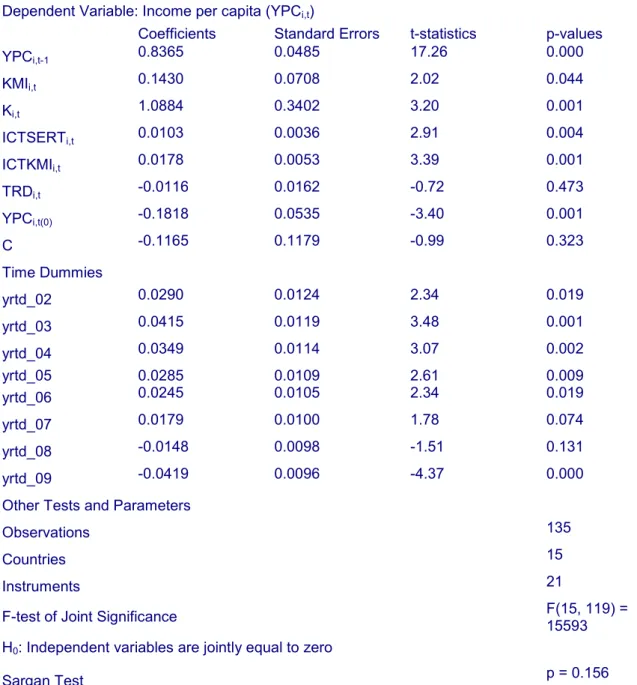
The estimated coefficient on the lagged dependent variable is 0.8365 which is less than 1, which means that the steady-state assumption holds. Moreover, the initial condition variable comes with a negative sign (-0.1818) and implies higher growth in response to lower starting YPC when other regressors are held constant. This coincides with the findings in Barro & Sala-i-Martin (2004) and Mankiw, Romer & Weil (1992).
KMI, K, ICTSERT, ICTKMI and ELTKW have positive relationship with economic growth as hypothesized while TRD has negative impact. ICTSERT (ICT×SERT) is also used in the regression which captures the interaction of ICT and school enrollment rate at tertiary level. SERT is used as higher levels of education invites greater „ICT diffusion‟ in the economy and augments ICT-income nexus (Cette & Lopez, 2008). ICTK-MI is the interaction term of ICT and KICTK-MI. It shows the complementary effects between ICT and knowledge. de Ferranti (2002) in his work, finds the association between ICT, knowledge and economic development.
Table 2: Tests for Heteroskedasticity in Presence of Instrumental Variables (IVs) IV Heteroskedasticity Tests using levels of IVs
Null Hypothesis (Ho): Disturbance is Homoskedastic
Test χ2(6) p
-values
Pagan-Hall General Test Sta- 4.475 0.7237
Pagan-Hall Test w/assumed 7.328 0.3955
White/Koenker n Test
Sta-4.866 0.6764
Breusch-Pagan/Godfrey/Cook
-Weisberg 8.356 0.3023
Notes:
1 – Sargan-Hansen test is for overidentifying restrictions. The joint
Table 3: Instrumental Variable (IV)/2SLS Regression Estimates (Role of Knowledge and ICT in Convergence)
Dependent Variable: Income per capita (YPCi,t)
Coefficients Standard Errors t-statistics p-values
YPCi,t-1 0.8365 0.0485 17.26 0.000
KMIi,t 0.1430 0.0708 2.02 0.044
Ki,t 1.0884 0.3402 3.20 0.001
ICTSERTi,t 0.0103 0.0036 2.91 0.004
ICTKMIi,t 0.0178 0.0053 3.39 0.001
TRDi,t -0.0116 0.0162 -0.72 0.473
YPCi,t(0) -0.1818 0.0535 -3.40 0.001
C -0.1165 0.1179 -0.99 0.323
Time Dummies
yrtd_02 0.0290 0.0124 2.34 0.019
yrtd_03 0.0415 0.0119 3.48 0.001
yrtd_04 0.0349 0.0114 3.07 0.002
yrtd_05 0.0285 0.0109 2.61 0.009
yrtd_06 0.0245 0.0105 2.34 0.019
yrtd_07 0.0179 0.0100 1.78 0.074
yrtd_08 -0.0148 0.0098 -1.51 0.131
yrtd_09 -0.0419 0.0096 -4.37 0.000
Other Tests and Parameters
Observations 135
Countries 15
Instruments 21
F-test of Joint Significance
H0: Independent variables are jointly equal to zero
F(15, 119) = 15593
Sargan Test
H0: Model is correctly specified & all over-identifying restrictions [all over
-p = 0.156
Ho: Instruments are valid instruments. “Instruments Zi are uncorrelated with the error term, and that the excluded instruments are correctly
ex-cluded from the estimated equation.” i.e. Cor(Zi, i,t) = 0.
2 – Sargan‟s statistic becomes consistent if disturbance is
homoske-dastic. For more, see Hayashi (2000).
Therefore, it is worthwhile to include this interaction term (ICTKMI) in the regression. (0.1430% increase in income per capita due to 1% crease in KMI, 1.0884% increase in income per capita due to 1% in-crease in K, 0.103% inin-crease in income per capita due to 10% inin-crease in ICTSERT, 0.178% increase in income per capita due to 10% increase in ICTKMI and -0.116% decrease in income per capita due to 10% in-crease in TRD). Coefficients of KMI, K, ICTSERT, ICTKMI and lagged and initial YPC are statistically significant at 1% level of significance.
Overall significance of the model is satisfactory (1%, 5% and 10% levels of significance) as revealed by F-test of joint significance. Sargan test of correct specification and over-identifying restrictions has a p-value of greater than 0.05. i.e. (p-value = 0.156 > 0.05) implying that all over-identified instruments are exogenous.
Discussion: Knowledge-Augmented Convergence
Hy-pothesis
research conducted in developing countries needs to be scrutinized on the basis of their social acceptability, direct relevance and responsiveness to the local environment. Only such research can suit the needs of the UDCs and positively contribute to UDCs.
Moreover, the tendency to commercialize new ideas (knowledge cre-ation) into innovative goods and services also determines the ability of knowledge to become economically meaningful. UDCs, in this regard, are laggards. In addition, most of the knowledge is transferred from DCs to the UDCs. Rather UDCs (most of Asian countries) are characterized by „knowledge transfer‟ from DCs. Such adopted knowledge might not be as suitable for UDCs as it is in innovating DCs.
Findings in this study coincide with that in Sveikauskas (2007) who believes that in UDCs, technology is adopted and modified from advanced countries. It can be attributed to poor allocation of R&D expenditure which is not generating economically productive results (innovations). R&D expenditures can become contributive to economic growth through innovation systems which are the sets of firms, universities and public la-boratories and their linkages.
Usually R&D expenditure is less effective in UDCs due to inability to select beneficial research projects, unneeded bureaucracy and barriers in importation of scientific material. R&D expenditure is a policy matter that is exogenously determined and requires the attention of policy makers. In majority of UDCs policy making is not free of vested interests. Such frictions usually render the R&D spending less efficient or some case counterproductive where the existing resources are very scarce and have high opportunity costs.
need for international assistance through the provision of fellowships, vis-iting scientists, and facilities for study at well-established centers. In the future many developing countries may need to develop co-operative gional projects, if they wish to participate in more costly advanced re-search areas.
Conclusions
Role of knowledge is also tested in achieving convergence. The mag-nitude of relationship is substantial form the point of view of UDCs. Since in UDCs, ICT and knowledge stock are at their infancy stage, a strong re-lationship is not expected. Lack of befitting proxy for knowledge has been a limiting factor. More apt proxies for knowledge stock can provide im-proved results. The role of knowledge in leading to economic conver-gence is affirmed but with a finding that the quality of knowledge stock in sample countries suffers due to which contribution of knowledge is low.
Some of the problems of scientific research in developing countries, such as creating an increased pool of trained people, providing more re-sources and strengthening the whole national infrastructure, can only be solved through time. Policy makers should focus more on designing the policy in considering ICT as a phenomenon, deeply embedded into every sector of the economy.
References
[1] Baltagi, B. H. (2008). Econometric analysis of panel data: econ-ometric theory. 4th Edition, John Wiley & Sons, Ltd Wiley.
[2] Barro, R., & Lee, J. W. (1994). Sources of economic growth. Carnegie Rochester Conference Series on Public Policy, 40(384), 1-46.
Political Economy, 100(2), 223-251.
[4] Barro, R. J., & Sala-i-Martin, X. (1992). Public finance in models of economic growth. The Review of Economic Studies, 59(4), 645-661.
[5] Barro, R. J., & Sala-i-Martin, X. (1995). Economic growth. Lon-don: The MIT Press.
[6] Barro, R. J., & Sala-i-Martin, X. (2004). Economic growth. Lon-don: The MIT Press.
[7] Baum, F. C. (2006). An introduction to modern econometrics using Stata, Texas: Stata Press.
[8] Baumol, W. J. (1986). Productivity growth, convergence, and welfare: What the long-run data show. American Economic Re-view, 76(5), 1072-1085.
[9] Bouvet, F. (2010). EMU and the dynamics of regional per capita income inequality in Europe, Journal of Economic Inequality, 8 (3), 323-344.
[10] Caselli, F., Esquivel, G., & Lefort, F. (1996). Reopening the con-vergence debate: a new look at cross-country growth empirics. Journal of Economic Growth, 1(3), 363-389.
[11] Cette, G. & Lopez, J. (2008). What explains the ICT diffusion gap between the major industrialized countries: An empirical analysis? International Productivity Monitor, 17: 28-39.
[12] de Ferranti, D. (2002). From natural resources to knowledge economy, World Bank.
[13] Dunaway, S. V., Kaufman, M. D., & Swagel, P. (2003). Regional convergence and the role of federal transfers in Canada. IMF Working Papers 03/97, International Monetary Fund.
[14] EMBO (2004). Building scientific capacity in developing coun-tries. Science & Society, 5(1), 7-11. Retrieved from http:// www.who.int/rpc/meetings/Harris_EMBO.pdf
[16] Karagiannis, S. (2007). Knowledge-based economy, conver-gence and economic growth: evidence from the European Un-ion. Journal of Economic Asymmetries, 4(2), 65-85.
[17] Mankiw, N. G., Romer, D., & Weil, D. N. (1992). A contribution to the empirics of economic growth. Quarterly Journal of Eco-nomics, 107(2), 407-437.
[18] Sala-I-Martin, X., Doppelhofer, G., & Miller, R. I. (2004). Deter-minants of long-term growth: a Bayesian averaging of classical estimates (BACE) Approach. American Economic Review, 94(4), 813-835.
[19] Solow, R. M. (1956). A contribution to the theory of economic growth, Quarterly Journal of Economics, 70 (1), 65-94.
[20] Solow, R. M. (1987). We‟d better watch out. New York Times Book Review, 12(7), 36. New York Review of Books. Retrieved from http://www.standupeconomist.com/pdf/misc/solow -computer-productivity.pdf
[21] Soto, M. (2000). Capital flows and growth in developing coun-tries: Recent empirical evidence, OECD Development Centre Technical Paper No.160, Paris 2000.
[22] Sveikauskas, L. (2007). R&D and productivity growth: A review of the literature, US Bureau of Labor Statistics Working Paper 408, BLS, Washington, DC. Retrieved from: http:// www.bls.gov/osmr/pdf/ec070070.pdf
[23] The jargon of Parachute science is referred to such research ac-tivities in which researchers in DCs conduct researches that have least relevance with the real life problems of people in UCSs. Such researches usually yield research papers for such researchers and benefit their research careers. Such researches might not even be useful for scientists in UDCs.