Vol-7, Special Issue-Number4, 2016, pp1039-1046 http://www.bipublication.com
Research Article
Interaction of parent- child schemas in different types
of personality disorders
1
Neda Ali Beigi and 2HamidehAskari
1
Ph.D Clinical Psychologist,Assisstant Professor, Psychiatry Department, University of social welfare and rehabilitation sciences, Tehran, Iran. 2
Ph.d student of psychology. Azad university, central branch, Tehran, Iran. Add: Psychiartry Department, Ebnesina,
University of social welfare and rehabilitation sciences,Koodakyar, Velenjak, Tehran, Iran.
Email: [email protected]: +989123019704+982188761317
ABSTRACT
Objective: In addition to Personality traits, cognitive theories emphasize on the role of cognitive errors in incidence of personality disorders. Schemas are one of the specific cognitive errors. The aim of present research was determining the role of parents' schemas in etiology of Childs' schemas in different types of personality disorders.
Methods: It was an expo-facto research in individuals with personality disorder. From a private clinic in Tehran we selected 50 ones with personality disorder which were welcome to enter to the project. In addition to diagnosis of the therapist, we used MCMI-III for diagnosis of personality disorder. We asked for completing questionnaires by clients and also their parents. YSQ-75 used for assessing schemas in children and parents which presents 15 schemas in 5 categories.
Results: Abandonment and unbalanced standards in cluster A, Unbalanced standards and entitlement in Cluster B and C were dominant. There were significant relations between child-parent schemas.
Discussion: Unbalanced Standards was not a specific schema for a specified personality disorder and it was the dominant schema in all cases. It shows a difficult parenting style in Iranian populations and Tehran dominant child rearing. The implicit message is idealized and high expectations of parents. It indicate the necessity of educating child rearing for modifying rearing styles of parents.
Keywords: Early maladaptive schema, personality disorder, Parent-child schema interaction
INTRODUCTION
Regarding that early maladaptive schemas are the mainpattern of most of the personality disorders, and since parental pattern seems to play a role in children's schemas development,
exploring early maladaptive schemas in
individuals with personality disorders and interactions of parent-child schemas can provide a strong support for psycho-pathology and
schema therapy(1). AsSempérteguiand
colleagues(2013)in their review studyaboutrole of schema on personality disorders,suggest focusing on early maladaptive schemas as an economical strategy with positive economic
consequences in treatment of personality
disorders (2). Nordahl, Holth and
Haugum(2005) concluded that intensity ofearly maladaptive schemas in individuals with
personality disorders and those without
personality disorder diagnosis, is significantly different(3).Young(1990-1999) believes that
some of these schemas-specially those
got blended with him/her pervasively and abstrusely across the individuals whole life(4). If parents taught the individual the wrong confronting strategies, theywould become a part of his/her schema, continuing in a cycle, within parents and children. An inefficient parent style is an internalization of parental symbols during early years of childhood. When the patients are within aninefficient parent style, they adopt a status similar to their father or mother and treat themselves as their parents treated them(1,5). Many studies have examined the correlation between parenting styles and parents function,
and psychological disorders
symptoms(6-8).Investigations suggest that early maladaptive schemascause specific vulnerability to different
psychological disorders and personality
pathology, and individuals with personality disorder,in comparison to healthy ones, have more maladaptive schemas(9, 3).
On the other hand, many studies have focused onthe effect of early maladaptive schemas in psychological disorders(10-12). but few studies have explored the role of parental schemas in children schemas,in psychological disorders. Wright and colleagues(2009) indicated that parental style has affected on schema's development manner and these schemas affect the next psychopathology (9). The present study aimed examining thecontribution ofparental schemas in child schemas and also the children personality disorder type, by considering parental schemas in form of Young fifteen early maladaptive schemas.On the other hand, on the basis of high prevalence of personality disorders in current population of Iran, considering the
parental schemas and their role
inpredisposingpersonality disorders, is
important.
METHODS
The present study was an ex post facto one. Thepopulation included all those who were suffering from Personality disorder and referred to psychologist and psychiatrist(at governmental and private centers), and their parents. In order to estimate the sample sizeregarding to the prevalence of personality disorders which has been reported 1% (13), the power of test of 0.80
and error estimationof 0.08, the sample size were estimated 54. By census on 2013 all patients were entered till we reach to 54. In order to conduct the study, samples were chosen from the individuals with personality disorders, who were tended to contribute, and to confirm the diagnosis, Millon clinical multi-axial inventory was applied. After all, the individuals and their parents were asked to reply to the Young Schema Questionnaire, separately. The present study was conducted on a 50-participant sample with personality disorder diagnosis, in three clusters. Forth of their questionnaires were not reliable. The classification of personality disorders in this study were as follows: the first cluster consists of schizoid, schizotypal and paranoid personality disorders. The second cluster includeshistrionic, narcissist, borderline and antisocial personality disorders. The third
cluster consists of obsessive-compulsive,
dependant and avoidant personality disorders. In general, 162 questionnaires were collected from the individuals and their parents. 150 of them were entered for analysis.
Tools
Millon clinical multi-axial Inventory(MCMI-III)
MCMI-III includes 175 short self-describe statements. Participants should answer, by marking "yes" or "no" in an answer sheet.The required time for filling out, is approximately 30 minutes. The age condition was at least 18, and the educational level should be at least 8 grades. This questionnaire has personality measures; 14 measures evaluate the clinical symptoms of
personality disorders(schizoid, avoidant,
depressive, dependent, histrionic, narcissist,
antisocial,aggressive-
sadistic,obsessive-compulsive, passive-aggressive, self-defeating, schizotypal, borderline, paranoid) and 10clinical symptoms measures which evaluate the anxiety, somatoform, bipolar, dysthymia, alcohol abuse, drug dependency, PTSD, thought disorder,
major depression, delusion disorders. 4
version in Tehran and Sharifi(1381) has normalized its third version in Isfahan. MCMI has been designed to assess personality traits and psychological pathology. Therefore it can be used for clinical decisions or diagnosing if an individual is suffering from a specific disorder or a special psychological trait(14).
Different studies indicated that the reliability of MCMI is relatively good. The mean correlations for measures of personality disorder have obtained from 58% to 93% with the mean of 78% (14).The mean reliability of measures in normalization studywith 5 to 14 dayinterval, has
been reported 90%,in the domain of
82%(debasement) to 96%(somatoform disorder) for all measures(14). In the study of sharifi(1381) in Iran, raw scores correlation of test- retest has been reported in the domain of 82%(delusional disorders) to 98%(schizoid personality disorder)(14).
Young Schema Questionnaire (YSQ)
Young schema questionnaire(Young and
brown,2001) is a self-report tool for evaluating schemas(15). It consists of 75 items tending to assess 15 early maladaptive schemas in 5 schematic areas. Patients assess themselves regarding that which schemas describe their situation, based on a six-point Likertscale(15). Rijkeboer, Van Den Berg & Van Dan Bout (2005) have conducted a study among Netherlands community, in order to determine the reliability and distinction power of this questionnaire. Split half reliability coefficients results, were between 0.68-0.87 and test- retest coefficient at a 6 weeks interval, was 0.83 (16). The investigations in Iran have used internal consistency coefficient and test-retest method,to measure the reliability. Cronbach'salfa was ideal
in 18 measures and was between 79% and 93%. The test-retest results, with 15 days interval , has been reported between 67% and 84% with respect to 18 schemas. This questionnaire has an ideal judgmental-face validity(quoted by the very references)(17).
Ethics considerations
Participating in this study was completely volunteer and accomplished with observance of moral principles. The individuals have declared their informed satisfaction to participate,and personal information was confidential.
FINDINGS
children consisted of 40 girls (80 percent) and 10 boys (20percent). The total mean age was 26. Most of the children were between 26 and 30. 7 children were lower than 20years, 18 of them were between 21- 25 and 18 of them were from 26 to 30. 7 participants also were between 31 and 35. Among all of the participants, 9 of them(13 percent) diagnosed first cluster of personality disorders(2schizoids, 2schizotypals and 5 paranoids), 33 of them(49 percent) were
affected by second clusterof personality
disorders(14 histrionics, 5 narcissists, 4
borderlines, and 10 anti-socials) and 25(37 percent) were suffering from third clusterof
personality disorders (8 dependents, 7
obsessive-compulsives, 7 avoidants, 2
depressed). Since the personality disorder's diagnosis was attained on the basis of MCMI test scores and clinical interview, sometimes more than one elevation has been observed in profiles, so that the first highest score were mentioned in statistics.
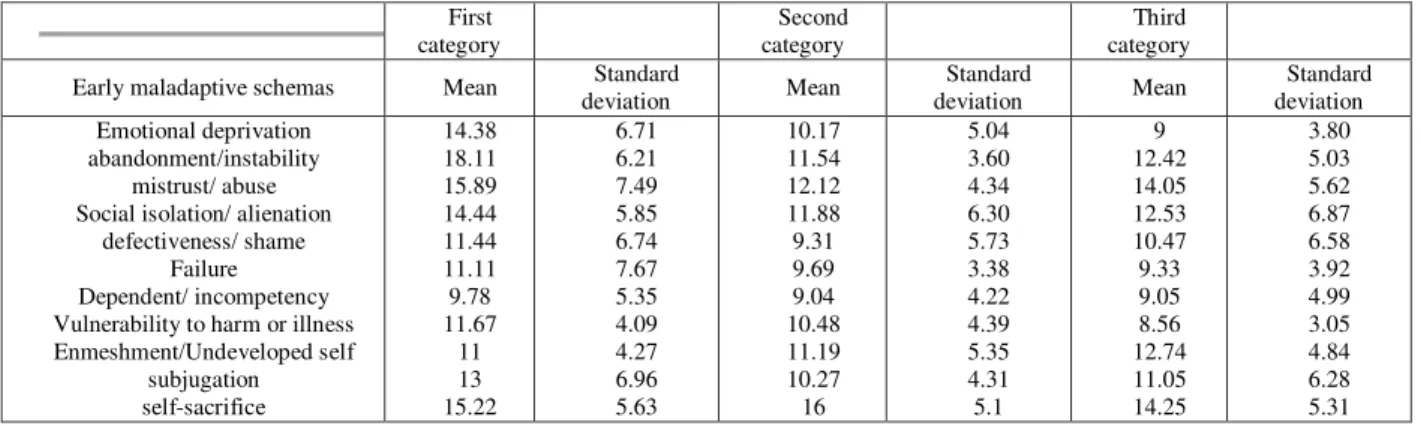
Table1. showsthe mean scores of each schema in three cluster of personality disorders.
Table 1: early maladaptive schemas in total sample of personality disorders First category Second category Third category
Early maladaptive schemas Mean deviation Standard Mean deviation Standard Mean deviation Standard
Emotional deprivation abandonment/instability
mistrust/ abuse Social isolation/ alienation
Emotional inhibition Unrelenting standards/ hyper
criticalness Entitlement/grandiosity insufficient control/
self-discipline
13 16.89
15.22 15.11
7.55 7.50
6.16 6.23
12.46 16.74
17.23 13.12
7 3.78
4.23 3.36
12.16 20.10
18.11 14.53
7.78 5.07
4.89 3.99
In order to assess the relation between parental and children schemas, Pearson correlation was applied. The correlations indicated that in all three clusters of personality disorder, there weresignificant correlations between maternal and paternal schemas. In first cluster, there was complete correlation between Vulnerability to harm or illness, and this schema in mother and also the defectiveness/ shame schemas in mother. The child Emotional deprivation schema correlated perfectly with Emotional deprivation in father.In second cluster, Vulnerability to illness and loss correlates with abandonment schema in mother and also deficit and shame, failure, and undeveloped self in mother. There was a perfect correlation between this schema in children and the similar one in mother. Entitlement andinsufficient self-discipline related to none of the mothers schemas. The child Emotional deprivation schema correlated perfectly with father's Emotional deprivation schema.Self-sacrifice and subjugationdid not relate to any of father's schemas. In third cluster of personality disorders the vulnerability in child has perfect correlation with mother's vulnerability. It also correlates with abandonment, mistrust, social isolation and defectiveness, significantly. The Emotional deprivation schema correlated perfectly with Emotional deprivation in father. In order to examine the prediction power of parental schemas in children personality disorder incidence, regression has been used.
Table2.regression model to predict the child schemas R
coefficient
R square
Adapted R square
0.94 0.87 0.52
Table3.parental early maladaptive schemas variance analysis in different personality disorders P Value F
Mean of square Freedom
degree Sum of
square
0.05 2.
53 0.66
0.26 30
11 41 19.62
2.81 22.47 Regressi
on Residual
Total
On the basis of F score obtained 2.34, and standardized beta coefficient, mistrust-abuse schemas in first area of disconnection and abandonment (rejection) in father were predictors of developing third cluster of personality disorders in child. social isolation schema, in first area of disconnection and abandonment schema in mother, was predictor of developing third cluster of personality disorders in child. Other schemas were not able to predict the personality disorder types in children.
In order to assess the child schema type in incidence of different personality disorders, the regression resultswere as follows:
Table4. regression model for different schemas in personality disorders Adapted R
square R
square R
coefficient
0.25 0.52
0.72
Table5.individual's early maladaptive schemas variance analysis in different personality disorders P value F
Mean of square Freedom
degree Sum of
square
0.06 1.
93 0.70
0.40 15
26 41 11.86
10.62 22.47 Regressi
on Residual
total
Vulnerability to harm or illness schema and subjugation are the only schemas which are able to predict the personality disorder type. subjugation and vulnerability to harm or illness schemas predict the third cluster of personality disorders.
DISCUSSION
The present findings demonstrated abandonment / instability and unrelenting / unbalanced standards schema incluster Aentitlement / self-
centeredness and unrelenting/ unbalanced
standards schema incluster B & Cobtained highest mean score. However, only the entitlement schema score was over cut-off point
(20) incluster C. unrelenting/unbalanced
standards were high in every clusters and could not distinct thecluster C from the B and A, while according to previous studies, a high score was expectedfor this schema incluster C. Patients, whose unrelenting/unbalanced standardsschema is dominant, had learned in childhood to always be alert and act stubbornly in regard to life events(12, 18). Regarding the high score of this schema in all samples, it seems the unrelenting parenting style in culture should not be neglected.Abandonment/instability schema is one of the dominant characters of cluster A. However, the mean score of patients suffering from cluster A personality disorders was not higher than cut-off point. Patients,whose schemas are in instability and disconnection domain, are not able to establish secure and satisfactory attachments with others. They believe that their need of stability, security, kindness, love and belonging will not be satisfied. Patients with abandonment/instability schema, believe that their relationships with the important individuals of their life, are not stable, and feel thatthey will not stay with them, because they are not emotionally predictable, they are present temporarily and will die or leave them alone(5).
Patients with entitlement schema have
expectations from themselves and environment which interfere with their ability for separating themselves from parent's symbols and attaining an independent function. It seems that overly supporting of children in patient's families with this schema as the most dominant one, leads to decrease of self-confidence in the children, and interfere with their self-regulation(19).
In the present study it was cleared up that an active unrelenting/unbalanced standards schema has the most influence on personality disorders and an active entitlement schema is on the second place.
In Noei and colleagues study (2010),the group with obsessive-compulsive personality disorder (OCPD) and the non-clinical group had significant difference just in entitlement schema and there was no significant difference between two subscales of Young parentingquestionnaire, in other schemas(18).
Vulnerability to harm or illness and
subjugationschema, are the only schemas that are able to predict the personality disorder type. The subjugation and vulnerability to harm or illness schema, are the predictors of clusterC of personality disorders.
Parental origins of early maladaptive schemas, shows the susceptible childhood environment in relation to a specific schema. This environment, play a role in developing schemas. The correlation of child-parent schemas in all groups, indicated the significant relations among schemas. In spite of significant relations of child-parent schemas and interactions among them, only the abuse/mistrust schema in first domain (instability & disconnection) in father were the predictors of developingcluster C of
personality disorders in children. Social
isolation in first domain of instability &
disconnection in mother predicted
child extremely and brings up a dependent child. This pattern also will reinforce in child and develop an avoidant personality. The mother supposes that she is different from others or do not belong to any part of the community, and
therefore a depressive personality is
developed(5).
These findings are compatible with the studies which support the relation between parental deficient styles and personality disorders. For instance Nordahl&Nysæter(2005)Gilbert and Daffern(2013), Amini and colleagues(1393) and Noie and colleages(2010) have shown that parents improper behaviorduring child nurturing years, is accompanied by high risk of
developing personality disorders in
adolescence(9, 18,20,21 ). This viewpoint has been approved in most of the investigations.
Parent'sInadequate kindness and
attention,accompanying by violent punishment, is known to be companion with the high risk of personality disorders. The investigators,Parker and colleagues(1999) also indicated a strong relation between inefficient parental behavior and the histrionic(B) and anxiety(C) cluster of
personality disorders, rather than
(A)cluster(22).The results indicated that parent's early maladaptive schemas predict 52% of child maladaptive schema's variance. Vulnerability to harm or illness and subjugation schema are the only schemas having the ability to predict the personality disorder types. Subjugationschema and vulnerability to harm or illness are predictors ofcluster C ofpersonality disorder. Patients with vulnerability to harm or illness, are intensely afraid of ever getting involved in a disaster, unable to confront with(1); exactly like the situation in avoidant and dependent personality disorder in which the individual is not able to separate from the family and acting independently. Their parents often do anything for them, support them excessively, harm their child's self-confidence and are not successful in strengthening his/herskillful functioning outside the house. Consequently, in adolescence, they act like a young child(1). Subjugation schema also shows that they give the control of their life to others and surrenders. The function of subjugation is avoidance of annoyance, revenge
or being abandoned. Subjugation usually leads to gradual increase of annoyance, and emerges as passive-aggressive personality disorder (1). Amini and colleagues (1393) demonstrated a significant difference between patients with avoidant personality disorder mean score and normal individuals, in disconnection and instabilityschema. That is, the mean score of patients with avoidant personality disorder was higher than normal individuals. Emotional deprivation schema is also in disconnection and instability domain(21). The study of McGinn, Cukor and Sanderson(2009) is also compatible with this study results(23).
One of the characteristics of patient's families, in which this schema is dominant, is instability. It seems that instability in patient's families, causes an unstable mood and behavior in patients with clusterC personality disorder as their dominant characteristic, so that the patients become isolated and avoid to interact with others, whereas this situation is not true of normal individuals. Thecluster C patients are very sensitive in interpersonal situations, avoid interpersonal relationships and always are
thinking of others thought about
themselves(24). Given these characteristics, it can be said that the dominancy of disconnection and instability schema in these patients seems normal.
CONCLUSION
Unrelentingstandards schema in cluster
Apersonality disorder, entitlement and
unrelenting standards in clusters B&C of personality disorder, are dominant. Unrelenting standards schema is not specific to a particular personality disorder and is high in all of the sample's participants, suggesting the stubborn parenting pattern in Iranian community and Tehran. These findings include the implication that parents in Tehran tend to inaccessible and difficult expectations from their children and the necessity of educating parents in order to deliberate the educational methods, is tangible. Moreover, by identifying theschemas before
affecting by personality disorders, and
group, proper intervention strategies can be developed in order to decrease the destructive effects of these schemas.
Limitations
The cross-sectional design, limited number of the individuals participated in the study, difficulty in attracting the contribution of parents to participate in the study, and the self-report method, are some cases which demand more caution in concluding the results.
SUGGESTIONS
Using parenting style questionnaire in addition
to schema questionnaire leads to an
accurateexamination. In order to prevention of result's flaw, it is better to have justone personality diagnosis for each individual. Moreover, examining individuals with mixed personality disorder diagnosis and comparing them to individuals with single peak,is important. A higher sample size can contribute in next studies.
ACKNOWLEDGEMENTS
We want to express thanks to university of social welfare and rehabilitation sciences for funding to carry out the research.
Conflict of Interest
The authors declare no conflict of interest in this study.
REFERENCES
1. Young, J. E. ,Klosko J.S. & Weishaar M.E. (2010). Schema Therapy; A Practitioner’s guide. New York:Guilford Press
2. Sempértegui, GA, Karreman, A, Arntz, A,
Bekker, MHJ.(2013). Schema therapy for
borderline personality disorder: A
comprehensive review of its empirical
foundations, effectiveness and
implementation possibilities. Clinical
Psychology Review; 33(3): 426-47.
3. Nordahl, HM, Holth, H, Haugum, JA.(2005).
Early maladaptive schemas in patients with or without personality disorders: Does schema modification predict symptomatic
relief? Clinical Psycholology Psychotherapy; 12: 142-9.
4. Young, J. E., & Lindemann, M.(2002). An
integrative schema-focused model for
personality disorders. In: R. L. Leahy & E. T. Dowd(Eds.), Clinical advances in cognitive psychotherapy: theory and application(pp. 93-109). New York: Springer Publishing.
5. Young, J.E.(1999). Cognitive therapy for
personality disorders: A schema focused approach. Florida: Professional Resources Press.
6. Shahamat, F., Sabeti, A.R., Rezvani,
S.(2011). Study of correlation between child rearing style and early maladaptive schemas. Educational and Psychological Studies, 11,2,239-254.
7. Monirpoor, N., Gholamizarch, M.,
Tamadonfard, M. Khoosfi, H., Ganjali, A.R. (2012). Role of Father- Child Relational Quality in Early maladaptive schemas. Int J High Risk Behaviors and Addiction, 1,2,50-54.
8. Wright & et al (2009). Childhood Emotional Maltreatment and Later Psychological
9. Distress among College Student: The
Mediating Role of maladaptive Schemas. Child
10.Abuse & Neglect: The International Journal of Psychology, 33 ,1,59-68.
11.Gilbert F, Daffern M. (2013). The
association between early maladaptive
schema and personality disorder traits in an offender population. Psychology, Crime & Law; 19:10: 933-46.
12.Askari, H., Alibeigi,N., Rezaie, O. (2013). Comparison of cognitive and emotional
schemas between depressed and non
depressed patients. Journal of Behavioral sciences in Asia,4 (1), 11-21.
13.Sardarzadeh, S., Alibeigi, N., Ebrahimi, S. (2014). Evaluation of Emotional Schemas in Individuals with Anxiety Disorders. Journal of Social Issues & Humanities, 2, 4:25-28.
14.Harris, AE, Curtin, L.(2002) Parental
15.Sadock, B.J. & Sadock, V.A. (2009).
Synopsis of Psychiatry. New Yourk:
Lippincott Williams & Wilkins.
16. Sharifi, A.A. (2009). MCMI-III Guideline. Tehran; Psychometry publication.
17.Young, J. E. & Brown, G. (2001). Young Schema Questionnaire: Special Edition. New York: Schema Therapy Institute.
18.Rijkeboer, M.M., Van Den Berg, H., & Van Dan Bout, J. (2005). Stability & discriminative power of young schema questionnaire in Dutch clinical versus non – clinical population. Journal of Behavior Therapy & experimental Psychiatry, 36,129-144.
19.Salavati, M. (1386). Dominant schemas and effectiveness of schema therapy in women with borderline personality disorder. Ph.D Thesis in clinical psychology. Iran, Iran Medical Sciences University.
20.Noie,Z., Asgharnezhad, A. A., Fata.L.,
Ashoori.A. (2010 ). Comparison of Early Maladaptive Schemas and Their Parental Origins in OCD Patients and Non-Clinical Individuals. Advances in Cognitive Science, Vol. 12, No. 1,59-69.
21.Clum, G.A, Cooper, L.D, Scarpa, A.(2002). Psychosocial Factors, Maladaptive Cognitive Schemas, and Depression in Young Adults: An Integration Banu Cankaya. Master [MsC Thesis]. Virginia :The Faculty of Virginia Polytechnic Institute, Blacksburg.
22.Nordahl HM, Nysæter TE. (2005). Schema
therapy for patients with borderline
personality disorder: a single case series.
Journal of Behavior Therapy and
Experimental Psychiatry, 36(3): 254–64.
23.Amini. M.M., Najimi.A.,
Abolghasemi.A.,Meftagh.D.(2014). A
comparison on early maladaptive schemas in avoidant personality disorders paintes & normale individuals. J Res Behave Sci; 12(1): 58-66.
24.Parker, G., Roy, K., Wilhelm, K., Mitchell, P., Austin, M. P., & Hadzi-Pavlovic, D. (1999). An exploration of links between early parenting experiences and personality disorder type and disordered personality
functioning. Journal of personality disorders, 13(4), 361-374.
25.McGinn LK, Cukor D, Sanderson
WC.(2009). The relationship between
parenting style, cognitive style, and anxiety and depression: Does increased early
adversity influence symptom severity
through the mediating role of cognitive style? Cognitive Therapy Research, 29(2):219-42.
26.Sanislow CA, da Cruz K, Gianoli MO,