1227 Semina: Ciências Agrárias, Londrina, v. 34, n. 3, p. 1227-1238, maio/jun. 2013
Recebido para publicação 14/06/12 Aprovado em 11/04/13
Supplementation with protected fat to manage gastro-intestinal
nematode infections in Santa Ines sheep
Suplementação com gordura protegida na infecção por nematódeos
gastrintestinais em ovelhas Santa Inês
Vivian Alves Costa Afonso
1; Ricardo Lopes Dias Costa
2*;
Cecílio Viega Soares Filho
3; Eduardo Antonio da Cunha
2;
Silvia Helena Venturoli Perri
3; Fábio Luiz Bonello
4Abstract
This experiment aimed to determine the inluence of supplementation with protected fat on nematode infections in periparturient sheep or sheep in their inal stage of pregnancy. Fifty Santa Ines ewes received 200 g of concentrate/animal/day, mineral salt and water and were grouped according to their weight, hematocrit and the number of eggs per gram of feces (EPG). Two diets were used: a control treatment and a treatment consisting of supplementation with 30 g/animal/day of protected fat in the concentrate. Three monthly evaluations were performed over a total of 84 days of testing. The variables analyzed were weight, body condition, EPG and coprocultures; blood tests were performed for the determination of packed cell volume, hemoglobin concentration and total plasma protein, and leukograms and eosinophil counts were performed. For weight and hemoglobin concentrations, interactions were observed between diet and collection date (P<0.05); body condition, total plasma protein, packed cell volume and total leukocytes did not differ statistically among treatments (P> 0. 05) but did differ by collection day (P <0.05). The EPG and eosinophil counts did not differ statistically by either diet or collection date (P>0.05). The genus Haemonchus was predominant, followed by the
genera Cooperia, Trichostrongylus and Oesophagostomum. The protected fat did not decrease EPG and
did not improve the blood parameters of infected sheep.
Key words: Polyunsaturated fatty acids, nutrition, sheep, Haemonchus
Resumo
O objetivo do experimento foi veriicar a inluência da suplementação com gordura protegida na infecção por nematódeos gastrintestinais em ovelhas Santa Ines no periparto ou terço inal de gestação. Cinquenta ovelhas Santa Inês receberam 200 g de concentrado/animal/dia, sal mineral e água, sendo divididas de acordo com peso, número de ovos por grama de fezes (OPG) e porcentagem do hematócrito em duas dietas, consideradas como tratamento controle e tratamento com suplementação de 30g/dia/animal de gordura protegida no concentrado. Duas avaliações mensais foram realizadas durante três meses, totalizando 84 dias de experimentação. As variáveis analisadas foram peso e condição corporal, OPG e coprocultura, contagem de leucócitos e eosinóilos, veriicação do volume globular, concentração de
1 Profª do Centro Paula Souza, Rio das Pedras, SP. E-mail: [email protected]
2 Pesquisadores Cientíico(s), Instituto de Zootecnia, IZ/APTA/SAA, R. Heitor Penteado, 56, CEP 13460-000, Nova Odessa, SP.
E-mail: [email protected]; [email protected]
3 Profs. Assistente Drs. do Deptº de Apoio, Produção e Saúde Animal, Curso de Medicina Veterinária, UNESP/FOA, Araçatuba,
16050-680, Araçatuba, SP. E-mail: [email protected]; [email protected]
4 Médico Veterinário, M.e. em Ciência Animal, R. Capitão Bernardes, 857, CEP: 13480-790, Limeira, SP. E-mail: bonellol@
yahoo.com.br
1228
Semina: Ciências Agrárias, Londrina, v. 34, n. 3, p. 1227-1238, maio/jun. 2013
hemoglobina e dosagem de proteína plasmática total. Em relação as variáveis peso e hemoglobina, houve interação entre as dietas e as coletas (P<0,05); as variáveis condição corporal,proteína plasmática total, volume globular e leucócitos totais não apresentaram diferença estatística entre as dietas (P>0,05) mas sim durante as coletas (P<0,05). As variáveis OPG e eosinóilos não apresentaram diferença estatística (P>0,05). O gênero Haemonchus foi predominante, seguidopelos gêneros Cooperia, Trichostrongylus
and Oesophagostomum A suplementação com gordura protegida na quantidade de 30g/animal/dia, não
interferiu na diminuição do OPG ou melhora dos parâmetros sanguíneos em infecção parasitária nas ovelhas deste estudo.
Palavras-chave: Ácidos graxos poliinsaturados, nutrição, ovinos, Haemonchus
Introduction
Resistance to anthelmintic drugs represents an
obstacle to sheep breeding. Alternative measures
for the control of helminths include improved
nutrition (BRICARELLO et al., 2005; HOUDIJK et al., 2005), homeopathy (CAVALCANTI; ALMEIDA; DIAS, 2007; ZACHARIAS et al., 2007), phytotherapy (CHANDRAWATHANI et al., 2006; CHAGAS et al., 2008), treatment with plant tannins (CENCI et al., 2007; MINHO et al., 2008, 2010), supplementation with minerals (GONCALVES; ECHEVARRIA, 2004) and the use of nematophagous fungi (GRAMINHA et al., 2001, 2005; ROCHA; ARAÚJO; AMARANTE, 2007).
Haemonchus contortus is a major threat to
sheep breeding, and pathogenicity and resistance to many anthelmintic drugs has developed in many places (AMARANTE et al., 1997). However, other gastrointestinal parasites of lower pathogenicity,
such as Trichostrongyloidea (Trichostrongylus, Cooperia and Oesophagostomum), Strongyloides
spp., Eimeria spp. and Moniezia spp., are also
problematic and should be considered.
Many studies on the interaction between protein and infections with ovine nematodes have been conducted (STEEL, 2003; LOUVANDINI et al., 2006); however, studies of the inluence of dietary energy on the control of worms, particularly in tropical conditions, are necessary (HOSTE et al., 2005).
Supplementation with oil or protected fat sources containing fatty acids of the n-3 and n-6 families (which are essential to ruminants) represents an
interesting strategy for helminth control, as these fats can inluence the regulation of the immune expression and the inlammatory response of eicosanoid-mediated immune-effectors (HWANG, 2000). Muturi et al. (2005) describe the actions of polyunsaturated fatty acids on the nematode burden of ruminants.
The goal of this experiment was to determine the inluence of supplementation with protected
fat on gastrointestinal nematode infections in
periparturient sheep or sheep in their inal stage of pregnancy.
Materials and Methods
Experimental site, animals and feed management
The experiment was conducted in Andradina, São Paulo State, Brazil. In August, September and October of 2007, the average rainfall was 0, 0 and 56 mm, respectively. The average maximum and minimum temperatures were 35.3ºC and 14.4ºC, respectively, and the average temperature was 25.1ºC during the trial (Source: Meteorological Station of APTA – Agência Paulista de Tecnologia dos Agronegócios).
A total of 50 Santa Ines ewes between one and three years old were placed on 2.5 hectares of pasture; the pasture was divided into four paddocks, two with Panicum maximum cv. Aruana grass (28%
1229 Semina: Ciências Agrárias, Londrina, v. 34, n. 3, p. 1227-1238, maio/jun. 2013
The animals were rotated between the four paddocks and provided with free access to water and mineral salt for fourteen days before the start of the experiment.
Experimental design
According to their packed cell volume, number of eggs per gram of feces and live weight, sheep were assigned to either a control or a treatment diet consisting of supplementation with 30 g/animal/day of protected fat (Megalac E®*); diets were otherwise
isonitrogenous and isocaloric. The animals were
fed twice a day (100 g at 08:00 and 100 g at 16:00) with a concentrate mixture containing corn grain, soybean meal, mineral mix and lime (18% crude protein and 6% ether extract).
Seventy-eight percent of the ewes lambed during the experiment; 48%, 8% and 16% of the control group (20 lambs) and 64%, 12% and 8% of the treatment group (25 lambs), lambed in August, September and October, respectively.
Twice a month, the sheep were individually weighed and assigned a body condition score;
stool and blood samples for coprological and
hematological laboratory tests, respectively, were collected twice a month over the 84 days of testing.
Measurements
Weights were measured with a mechanical balance. Body condition (CC) was determined by palpation of the lumbar region to assess the coverage of fat; a score of 1 to 5 was assigned, where 1 represents cachectic, 2 thin, 3 satisfactory, 4 fat and 5 obese (SAÑUDO; SIERRA, 1986). Half points could be assigned, as recommended by Pugh (2004). The fecal samples were processed with
Gordon and Whitlock´s modiied technique (1939); coprocultures were also performed (ROBERTS; O’SULLIVAN, 1950). Analyses of the packed cell volume (PCV), hemoglobin concentration (Hb), and total plasma protein (TPP) were performed; total leukocytes and eosinophils were also counted (SCHALM; CARROL, 1986).
Treatment with anthelmintics
Treatments were administered when the sheep had a PCV less than or equal to 20%. Levamisole phosphate (0.1 ml / kg of Ripercol ® L 150 F, Fort Dodge) was administered subcutaneously. The choice of anthelmintic was based on the fact that
a fecal egg count reduction test performed prior to
the experiment (2006) found that this drug had 85% effectiveness. The fecal egg count reduction test is
a practical and inexpensive test appropriate for all
anthelmintic drugs and only requires the technician to be able to perform egg per gram counts (COLES, 2005).
Statistical analysis
The variables analyzed were individual weight, body condition, packed cell volume, total plasma protein, hemoglobin, total leukocytes, eosinophils and number of eggs per gram of feces (EPG). We assessed the normality of the data using the Proc Univariate command of the SAS program (version 8.2); EPG data and number of eosinophils were log10 (x + 1) transformed. The data from the two diets were compared using analysis of variance (PROC GLM). The Student-Newman-Keuls (SNK) test at 5% probability (SAS, 1999) was used to compare the means.
* Calcium salts of soybean oil - linoleic acid 40-42%, linolenic acid 2,7-3%, oleic acid 32.3%, palmitic acid 16.3% and stearic acid
1230
Semina: Ciências Agrárias, Londrina, v. 34, n. 3, p. 1227-1238, maio/jun. 2013
Results
Treatment with anthelmintics
Twenty-three and 21 treatments were
administered in the control diet and treatment
diet, respectively. In the control diet (15 sheep), one sheep needed four treatments, one was treated three times, three sheep were treated twice, ten sheep were treated once and ten sheep did not need anthelmintics (40%); in the protected fat diet (14 sheep), two sheep were treated three times, three sheep were treated twice, nine sheep were treated once, and 11 did not need treatment (44%).
Parasitological analysis
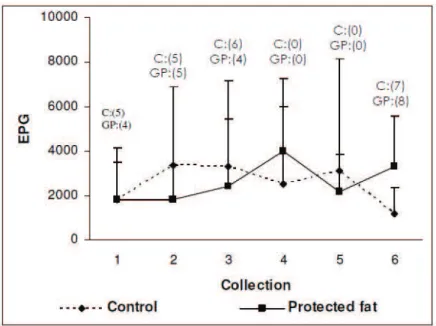
At the beginning of the experiment (collection 1), feces from all sheep were examined for eggs (control diet 1808 ± 2372 x 1813 ± 1694 protected fat diet, P> 0.05). The mean number of eggs did not differ statistically by treatment (P> 0.05). The mean EPG counts of animals in the control diet and in the
treatment diet and the number of sheep treated with
anthelmintics according to their packed cell volume
are shown in Figure 1.
In this work, the nematode burdens were high. The average numbers of eggs per gram were 2546±3501 and 2549±2436 in the control diet and treatment diet, respectively; maximum values were 3355±3571 (control diet collection 2) and 4026±3242 (protected fat diet collection 4), respectively. Figure 2 shows the frequency distribution of eggs per gram of feces of sheep by diet.
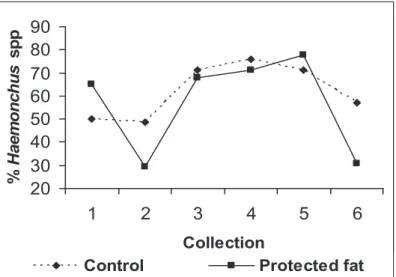
The genus Haemonchus was the most abundant
larva identiied, with an average prevalence of 62% in animals of the control diet and 57% in animals of the protected fat diet (Figure 3); the genera
Cooperia, Trichostrongylus and Oesophagostomum
were second in abundance to Haemonchus. Trichostrongylus and Cooperia were most
abundant in fecal samples from collections 2 and 6, respectively, in animals on the treatment diet.
Figure 1. Mean and standard deviation of eggs per gram of faeces (EPG) and the number of sheep treated individually
with anti-helminthes, according to the control diet (C) or protected fat (PF) in each collection.
Source: Elaboration of the authors.
Tabelas 1, 2 e 3 – formatar o que está abaixo da tabela pois as tabelas foram esticadas.
1231 Semina: Ciências Agrárias, Londrina, v. 34, n. 3, p. 1227-1238, maio/jun. 2013
Figure 2. Frequency distribution of eggs per gram of feces (EPG) of sheep, according to the control or protected fat
diets.
0 5 10 15 20 25 30 35 40 45
1 01
-5 00
5 01
-1 00
0 1
00 1
-2 00
0 2
00 1
-3 00
0 3
00 1
-5 00
0 5
00 1
-10 00
0
EPG
%
S
h
eep
s
Control Protected fat
Source: Elaboration of the authors.
Figure 3. Frequency distribution of the genus Haemonchus spp, according to the control or protected fat diets.
20 30 40 50 60 70 80 90
1 2 3 4 5 6
Collection
%
H
ae
m
o
n
ch
u
s
sp
p
Control Protected fat
Source: Elaboration of the authors.
The prevalence of Haemonchus spp, in the
treatment diet was 19%, 3%, 5% and 26% lower than in the control diet at collections 2, 3, 4 and 6, respectively.
Hematological analysis
1232
Semina: Ciências Agrárias, Londrina, v. 34, n. 3, p. 1227-1238, maio/jun. 2013 values of total plasma protein, packed cell volume
and total leukocytes were signiicantly different between collection dates (P <0.05), while the mean number of eosinophils did not differ. The highest mean values (P <0.05) of total plasma protein and packed cell volume, which were statistically similar, were found in samples 4 and 5, respectively.
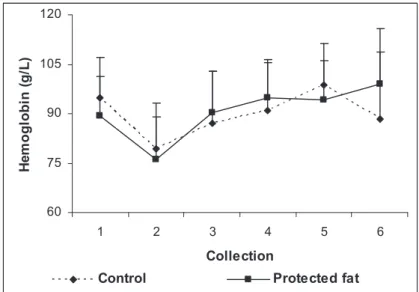
As shown in Figure 4, there was an interaction between collection date and diet for hemoglobin, which ranged from 79.44 ±13.73 g/L (control diet / collection 2) to 98.98 ±16.79 g/L (protected fat diet/ collection 6).
Table 1. Means and standard desviation of hematological variables of Santa Ines sheep of control and protected fat
diet.
Diets TPP (g/L) PCV (%) Leuc (x109/L) Eosin (x109/L)
Control 62.50±4.80a 25.39±4.42a 8.37±2.47a 0.51±0.47a
Protected fat 62.46±4.41a 25.06±4.27a 7.79±1.81a 0.57±0.75a Collections
1 60.5±3.45b 24.4±3.28b 9.4±2.24a 0.5±0.48a
2 59.8±5.07c 23.6±3.77bc 7.8±1.81b 0.4±0.45a
3 62.0±3.85c 23.4±3.81bc 7.6±1.91b 0.5±0.95a
4 66.0±3.72a 28.6±3.48a 7.6±2.53b 0.6±0.67a
5 64.6±3.85a 28.7±3.40a 7.3±1.52b 0.5±0.51a
6 61.9±4.28b 22.6±3.83c 8.9±2.16a 0.7±0.59a
Means in the same row with different letters are statistically different by SNK test (P <0.05). TPP = total plasma protein; PCV = packet cell volume; Leuc = total leukocytes; Eosin = eosinophils.
Source: Elaboration of the authors.
Figure 4. Mean and standard deviation of hemoglobin variable (g / L) of Santa Ines sheep, according to the control
or protected fat diet.
Source: Elaboration of the authors. 60
75 90 105 120
1 2 3 4 5 6
Collection
H
e
m
o
gl
obi
n
(g/
L)
Control Protected fat
Source: Elaboration of the authors.
A bA
bA bA
bA A
bA B
bA bB
A B
1233 Semina: Ciências Agrárias, Londrina, v. 34, n. 3, p. 1227-1238, maio/jun. 2013
Weight and body condition
An interaction between diet and collection was observed for weight. The weights increased from collection 1 to collection 4 in the control diet, then decreased at collection 6 while remaining statistically similar to weights from previous collections and different from others (P <0.05). In the protected fat diet, the mean weights of the 6
collection periods were less than those of all other samples (P <0.05). The weights of the animals on the control diet at collections 4, 5 and 6 were higher than those of the animals on the protected fat diet (P <0.05) (Table 2).
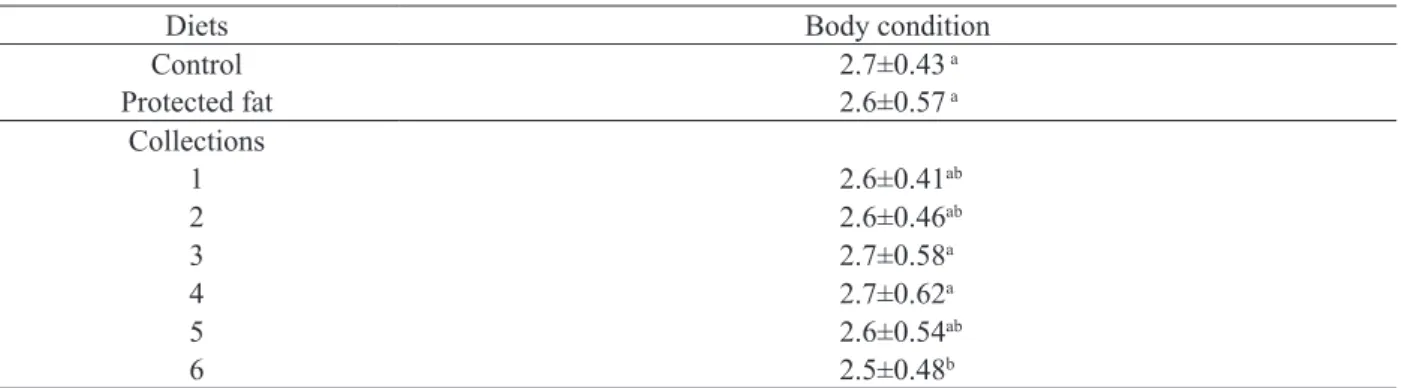
The mean values of body condition scores showed no statistically signiicant differences (P> 0.05) among diets (Table 3).
Table 2. Means and standard deviation of variable weight (kg)of sheep Santa Ines, according to the diets and collections.
Collections
Diets
Control Protected fat
1 40.6±4.90 aA 41.9±4.09 abA
2 42.6±5.87 bA 41.0±4.50 abA
3 43.1±5.43 bA 42.6±5.23 aA
4 44.2±5.80 bA 42.4±5.45 aB
5 43.4±6.30 bA 40.6±4.27 bB
6 41.0±6.06 aA 38.3±4.62 cB
Means followed by different superscript letters lowercase in row and capitals in line are statistically different by SNK test (P <0.05). Source: Elaboration of the authors.
Table 3. Means and standard deviation of body condition variable of ewes Santa Ines of control diet and protected fat.
Diets Body condition
Control 2.7±0.43 a
Protected fat 2.6±0.57 a
Collections
1 2.6±0.41ab
2 2.6±0.46ab
3 2.7±0.58a
4 2.7±0.62a
5 2.6±0.54ab
6 2.5±0.48b
Means followed by different superscript letters lowercase in row are statistically different by SNK test (P <0.05). Source: Elaboration of the authors.
Discussion
The animals of the experiment had high mean
values of EPG despite the fact that the Santa Ines
breed is considered more resistant to nematodes than
other breeds (BRICARELLO et al., 2005; COSTA et al. 2007). Rocha, Amarante e Bricarello (2004)
reported that Santa Ines sheep in the irst months of lactation had a maximum of 647 eggs per gram of feces, which was far below the values encountered in this work (2547 EPG).
1234
Semina: Ciências Agrárias, Londrina, v. 34, n. 3, p. 1227-1238, maio/jun. 2013 (AMARANTE et al., 2004; ROCHA; AMARANTE;
RICARELLO, 2004). Although 78% of the sheep lambed during the experiment, the high EPG did
not appear to be related to the periparturient status
of the sheep, and no signiicant differences in the number of eggs were found between the diets.
Donaldson et al. (1998) reported a greater immunity against parasitic infections in sheep supplemented with ish oil. The ish oil, unlike the supplements used in this experiment, is a source of linoleic acid; when offered directly in the diet, this fat is subject to biohydrogenation which could diminish its beneicial effects.
Amarante (2002) reported that the immune response of sheep is not the same in a herd where
most of the sheep harbor a small proportion of the
worms. In this work, as shown in Figure 2, a low percentage of ewes had either few (4% and 0% of the sheep on the control and protected fat diet, respectively, had <500) or many eggs (12% and 8% of the sheep on the control and protected fat diet, respectively, had >5000).
Despite the high EPGs encountered in sheep of this experiment, 42% of the sheep did not need anthelmintics throughout the experiment, while ten sheep (20%) received more than one application. The expression of immunity against gastrointestinal nematodes, which makes the animals resistant or resilient, can vary widely among animals of the same lock (STEAR; MURRAY, 1994); this observation conirms the unexpected inding that certain animals required more deworming than others, as all animals were raised in the same environment with the same management conditions.
Several authors have described the prevalence of Haemonchus contortus in sheep (ROCHA;
PACHECO; AMARANTE, 2007). Amarante et al. (1999) observed increases in the percentage of
Cooperia spp. and Trichostrongylus spp in cultures
of samples with low counts of EPG.
The decrease in the occurrence of Haemonchus
(KAPLAN et al., 2004) suggests a smaller proportion
of this type of parasite, which could lead to a lower rate of oviposition and a consequent reduction in the contamination of pastures (MORTENSEN et al., 2003).
Infection with H. contortus can cause severe
anemia and hypoproteinemia (FARIA JUNIOR et al., 2002), depression, loss of body condition, reduced productivity and eventual death (KAPLAN et al., 2004). In this experiment, no animal died; this was most likely due to periodic evaluations and interventions with anthelmintics when necessary. The protected fat was not effective in reducing the number of animals that needed to be dewormed or in improving the mean values of PCV, TPP, Hb, total leukocytes, eosinophils and body condition score.
Results showed that, in the early stages of infection, the evaluation of hematocrit parameters was not sensitive enough to show changes induced by hemonchosis; in general, the hemoglobin concentration is the best parameter with which to evaluate the degree of anemia (ZACHARIAS et al., 2007).
In sheep, gastrointestinal parasitic infections are generally accompanied by eosinophilia (HUNTLEY et al., 1998). In this experiment, no eosinophilia was observed, most likely because the animals were already infected before the experiment (collection 1> 1800 OPG); a similar observation was made by Amarante (2002).
Body weight is an indirect and fairly insensitive measure for assessing the nutritional status of sheep. More practical and accurate direct assessments of the nutritional status of a lock have been performed in several works (GUNN et al., 1991). The fact that many of the sheep lambed during the experiment is also noteworthy, as the variation in mean weight among the animals could be due to their physiological status. The lowest mean value was found at the last
collection in animals on the protected fat diet; this is
1235 Semina: Ciências Agrárias, Londrina, v. 34, n. 3, p. 1227-1238, maio/jun. 2013
the diets were isocaloric and isonitrogenous, the mean body condition score of animals was the same in both diets. Several studies reported an inverse relationship between supplementation with protected fat and voluntary consumption of cow milk, even leading to a decrease in body condition (EZEQUIEL, 2001).
According to Coop and Kyriazakis (1999, 2001) and Costa et al. (2007), protein supplementation decreases parasitism in sheep. The diets used in this study provided only 82% and 91% of the daily requirements for protein and energy (TDN), respectively, to prevent a possible effect of the supplemental protected fat.
Timing the immune response to the stage
of infection and enriching the intestine with polyunsaturated fatty acids in the beginning of life may promote a good immune response against gastrointestinal parasites (MUTURI et al., 2005); providing the protected fat in the creep-feeding of lambs in the pre-weaning stage may yield better results.
In conclusion, the supplementation with protected fat yielded no decrease in EPG and no
improvement in blood parameters in infected Santa
Ines sheep.
Acknowledgments
To Recanto Sereno Ranch by the animals loan.
References
AMARANTE, A. F. T. Resistência de cordeiros das raças Santa Ines, Suffolk e Ile de France as infecções naturais por nematódeos gastrintestinais. 2002. Tese (Livre
Docência) - Universidade Estadual Paulista, Botucatu. AMARANTE, A. F. T.; BAGNOLA JUNIOR, J.; AMARANTE, M. R. V.; BARBOSA, M. A. Host speciicity of sheep and cattle nematodes in São Paulo state. Brazil. Veterinary Parasitology, Amsterdam, v. 73,
n. 1-2, p. 89-104, 1997.
AMARANTE, A. F. T.; CRAIG, T. M.; EL-SAYDE, N. M.; DESOUKI, A. Y.; RAMSEY, W. S.; BAZER, F. W. Comparison of naturally acquired parasite burdens among Florida Native, Rambouillet and crossbreed ewes.
Veterinary Parasitology, Amsterdam, v. 85, n. 1, p.
61-69, 1999.
AMARANTE, A. F. T.; BRICARELLO, P. A.; ROCHA, R. A.; GENNARI, S. M. Resistance of Santa Ines, Suffolk and Ile de France sheep to naturally acquired gastrointestinal nematode infections. Veterinary Parasitology, Amsterdam, v. 120, n. 1-2, p. 91-106, 2004.
BRICARELLO, P. A.; AMARANTE, A. F. T.; ROCHA, R. A.; CABRAL FILHO, S. L.; HUNTLEY, J. F.; HOUDIJK, J. G. M.; ABDALLA, A. L.; GENNARI, S. M. Inluence of dietary protein supply on resistance to experimental infections with Haemonchus contortus in Ile
de France and Santa Ines lambs. Veterinary Parasitology,
Amsterdam, v. 134, n. 1-2, p. 99-109, 2005.
CAVALCANTI, A. S. R.; ALMEIDA, M. A. O.; DIAS, A. V. S. Efeito de medicamentos homeopáticos no número de ovos de nematódeos nas fezes (OPG) e no ganho de peso em ovinos. Revista Brasileira de Saúde e Produção Animal, Salvador, v. 8, n. 3, p. 162-169, 2007.
CENCI, F. B.; LOUVANDINNI, H.; MCMANUS, C. M.; DELL’PORTO, A.; COSTA, D. M.; ARAÚJO, S. C.; MINHO, A. P.; ABDALLA, A. L. Effects of condensed tannin from Acacia mearnsii on sheep infected naturally
with gastrointestinal helmintes. Veterinary Parasitology,
Amsterdam, v. 144, n. 1-2, p. 132-137, 2007.
CHAGAS, A. C. S.; VIEIRA, L. S.; FREITAS, A. R.; ARAÚJO, M. R. A.; ARAÚJO-FILHO, J. A.; ARAGUÃO, W. R.; NAVARRO, A. M. C. Anthelmintic eficacy of neem (Azadirachta indica a. juss) and the
homeopathic product Fator Vermes® in Morada Nova
sheep. Veterinary Parasitology, Amsterdam, v. 151, n. 1,
p. 68-73, 2008.
CHANDRAWATHANI, P.; CHANG, K. W.; NURULAINE, R.; WALLER, P. J.; ADNAN, M.; ZAINI, C. M.; JAMNAH, O.; KHADIJAH, S.; VINCENT, N. Daily feeding of fresh Neem leaves (Azadirachta indica) for worm control in sheep. Tropical Biomedicine,
Malasia, v. 23, n. 1, p. 23-30, 2006.
COLES, G. C. Anthelmintic resistnace - looking to the future: a UK perspective. Research Veterinary Science,
Rome, Italy, v. 78, n. 2, p. 99-108, 2005.
COOP, R. L.; KYRIAZAKIS, I. Inluence of host nutrition on the development and consequences of nematode parasitism in ruminants. Trends Parasitology,
1236
Semina: Ciências Agrárias, Londrina, v. 34, n. 3, p. 1227-1238, maio/jun. 2013 ______. Nutrition-parasite interaction. Veterinary
Parasitology, Amsterdam, v. 84, n. 3-4, p. 187-204, 1999.
COSTA, R. L. D.; BUENO, M. S.; VERISSIMO, C. J.; CUNHA, E. A.; SANTOS, L. E.; OLIVEIRA, S. M.; SPOSITO FILHA, E.; OTSUK, I. P. Performance and nematode infection of ewe lambs on intensive rotational grazing with two different cultivars of Panicum maximum. Tropical Animal Health Production, Netherlands, v. 39,
n. 4, p. 255-263, 2007.
DONALDSON, J.; VAN HOUTERT, M. F. J.; SYKES, A. R. The effect of nutrition on the periparturient parasite status of mature ewes. Journal of Animal Science,
Champaign, v. 67, n. 3, p. 523-533, 1998.
EZEQUIEL, J. M. B. Uso de caroço de algodão na alimentação animal. In: SIMPÓSIO GOIANO SOBRE MANEJO E NUTRIÇÃO DE BOVINOS, 3., 2001. Goiânia. Anais... Goiânia: CBNA, 2001. p. 307-328.
FARIA JUNIOR, S. P.; SILVA, M. M.; SCHEIBEL, M.; MARTINS, M. F.; RABELLO, P.; BERTAGNON, H. G.; GARCIA, M. Uso da contagem fecal de ovos de nematoides (OPG) para estimar a condição clínica em caprinos. Ciências Veterinárias nos Trópicos, Recife, v.
5, p. 86-92, 2002.
GONÇALVES, G. I.; ECHEVARRIA, F. A. M. Cobre no controle da verminose gastrintestinal em ovinos. Ciência Rural, Santa Maria, v. 34, n. 1, p. 183-188, 2004.
GORDON, H. M. C. L.; WHITLOCK, H. V. A new technique for counting nematode eggs in sheep faeces.
Journal of the Council for Scientiic and Industrial
Research, v. 12, p. 50-52, 1939.
GRAMINHA, E. B. N.; COSTA, A. J.; OLIVEIRA, G. P.; MONTEIRO, A. C.; PALMEIRA, S. B. S. Biological control of sheep parasite nematodes by nematode-trapping fungi: in vitro activity and after passage through the gastrointestinal tract. World Journal of Microbiology & Biothecnology, Netherlands, v. 21, n. 5, p. 710-722,
2005.
GRAMINHA, E. B. N.; MAIA, A. S.; SANTOS, J. M.; CANDIDO, R. C.; SILVA, G. S.; COSTA, A. J. Avaliação in vitro da patogenicidade de fungos predadores de nematóides parasitos de animais domésticos. Semina: Ciencias Agrarias, Londrina, v. 22, n. 1, p. 1-16, 2001.
GUNN, R. G.; MAXWELL, T. J.; SIM, D. A.; JONES, J. R.; JAMES, M. E. The effect of level of nutrition prior to mating on the reproductive performance of ewes of two Welsh breeds in different levels of body condition.
Animal Production, Cambridge, v. 52, n. 1, p. 157-163,
1991.
HOSTE, H.; TORRES-ACOSTA, J. F.; PAOLINI, V.; AGUILAR-CABALLERO, A.; ETTER, E.; LEFRILEUX, Y.; CHARTIER, C.; BROQUA, C. Interactions between nutrition and gastrointestinal infections with parasitic nematodes in goats. Small Ruminant Research, Amsterdan, v. 60, n. 1-2, p. 141-151,
2005.
HOUDIJK, J. G. M.; KYRIAZAKIS, I.; JACKSON, F.; HUNTLEY, J. F.; COOP, R. L. Effects of protein supply and reproductive status on local and systemic immune responses to Teladorsagia circumcincta in sheep. Veterinary Parasitology, Amsterdam, v. 129, n. 1-2, p.
105-117, 2005.
HUNTLEY, J. F.; SCHALLIG, H. D. F. H.; KOOYMAN, F. N. J.; MACKELLAR, A.; JACKSON, F.; SMITH, W. D. IgE antibody during infection with the ovine abomasal nematode, Teladorsagia circumcincta, primary
and secondary responses in serum and gastric lymph of sheep. Parasite Immunology, Oxford, v. 20, n. 11, p.
565-571, 1998.
HWANG, D. Fatty acids and immune responses - a newperspective in searching for clues to mechanism.
Annual Review of Nutrition, Califórnia, v. 20, n. 1, p.
431-456, 2000.
KAPLAN, R. M.; BURKE, J. M.; TERRILL, T. H.; MILLER, J. E.; GETZ, W. R.; MOBINI, S.; VALENCIA, E.; WILLIAMS, M. J.; WILLIAMSOM, L. H.; LARSEN, M.; VATTA, A. F. Validation of the FAMACHA eye color chart for detecting clinical anemia in sheep and goats on farms in the southern United States. Veterinary Parasitology, Amsterdam, v. 123, n. 1-2, p. 105-120,
2004.
LOUVANDINI, H.; VELOSO, C. F. M.; PALUDO, G. R.; DELL’PORTO, A.; GENNARI, S. M.; MCMANUS, C. M. Inluence of protein supplementation on the resistence and resilience on young hair sheep naturally infected with gastrointestinal nematodes during rainy and dry seasons. Veterinary Parasitology, Amsterdam, v.
137, n. 1-2, p. 103-111, 2006.
MINHO, A. P.; BUENO, I. C. S.; LOUVANDINNI, H.; JACKSON, F.; GENNARI, S. M.; ABDALLA, A. L. Effect of Acacia molissima tannin extract on the control of gastrointestinal parasites in sheep. Animal Feed Science and Technology, Amsterdam, v. 147, n. 1-3, p.
172-181, 2008.
1237 Semina: Ciências Agrárias, Londrina, v. 34, n. 3, p. 1227-1238, maio/jun. 2013
MORTENSEN, L. L.; WILLIAMSON, L. H.; TERRILL, T. H.; KIRCHER, R.; LARSEN, R.; KAPLAN, R. M. Evaluation of prevalence and clinical implications of anthelmintic resistance in gastrointestinal nematodes of goats. Journal of the American Veterinary Medical Association, New York, v. 23, n. 4, p. 495-500, 2003.
MUTURI, K. N.; SCAIFE, J. R.; LOMAX, M. A.; JACKSON, F.; HUNTLEY, J.; COOP, R. L. The effect of dietary polyunsaturated fatty acids (PUFA) on infection with the nematodes Ostertagia ostertagi and
Cooperia oncophora in calves. Veterinary Parasitology,
Amsterdam, v. 129, n. 3-4, p. 273-283, 2005.
PUGH, D. G. Clínica de ovinos e caprinos. São Paulo:
Roca, 2004.
ROBERTS, F. H. S.; O´SULLIVAN, S. P. Methods for egg counts and larval cultures for strongyles ingesting the gastrointestinal tract of cattle. Australian Journal of Experimental Agriculture, Austrália, v. 1, n. 1, p. 99-102,
1950.
ROCHA, R. A.; AMARANTE, A. F. T.; BRICARELLO, P. A. Comparison of the susceptibility of Santa Ines and Ile de France ewes to nematode parasitism around parturition and during lactation. Small Ruminant Research, Amsterdan, v. 55, n. 1, p. 65-75, 2004.
ROCHA, R. A.; ARAÚJO, J. V.; AMARANTE, A. F. T. Eficacy of the nematode-trapping fungus Duddingtonia
lagrans against infections by Haemonchus and
Trichostrongylus species in lambs at pasture. Journal Helminthology, Cambridge, v. 81, n. 4, p. 387-392, 2007.
ROCHA, R. A.; PACHECO, R. D. L.; AMARANTE, A. F. T. Eficacy of homeopathic treatment against natural infection of sheep by gastrointestinal nematodes.
Brazilian Journal Veterinary Parasitology, Jaboticabal,
v. 15, n. 1, p. 23-27, 2006.
SAÑUDO, C.; SIERRA, I. Calidad de la carnal em la especie ovina. Ovino, Barcelona, v. 1, n. 1, p. 127-153,
1986.
SAS, Statistical Analysis Systems Institute, SAS OnlineDoc®, Version 8, Cary, SAS Institute Inc., NC,
1999.
SCHALM, O. W.; CARROL, E. J. Veterinary hematology.
Philadelphia: Lea & Febiger, 1986.
STEAR, M. J.; MURRAY, M. Genetic resistance to parasitic disease: particularly of resistance in ruminants to gastrointestinal nematodes. Veterinary Parasitology,
Amsterdam, v. 54, n. 1, p. 161-176, 1994.
STEEL, J. W. Effects of protein supplementation of young sheep on resistance development and resilience to parasite nematode. Australian Journal of Experimental Agriculture, Australian, v. 43, n. 12, p. 1469-1476, 2003.
ZACHARIAS, F.; GUIMARÃES, J. E.; ARAUJO, R.; ALMEIDA, M. A. O.; DIAS, A. V. S.; AYRES, M. C. C.; BAVIA, M. E.; MENDONÇA-LIMA, F. W. Alternative approach to control of Haemonchus contortus in sheep: evaluation of homeopathic treatment. 2007. Disponível