ISSN: 0976-3325
National Journal of Community Medicine 2010, Vol. 1, Issue 2 68 Original Article
SEXUAL BEHAVIOR AMONG INJECTION DRUG USERS AND POTENTIAL FOR HIV SPREAD TO NON-INJECTORS IN A WESTERN INDIAN CITY
Chavan LB1, Patel Prakash2,Bhavesh Modi3, Undhad Ashwin4
1State Epidemiologist, Gujarat State AIDS Control Society, Ahmedabad 2Assistant Professor, Department
of Community Medicine, Surat Municipal Institute of Medical Education and Research, Surat 3Assistant Professor, Department of Community Medicine, PDU Medical College, Rajkot 4Intern, Department of Community Medicine, SMIMER, Surat
Correspondence: [email protected]
ABSTRACT
Objective: To examine the risk of sexual transmission of HIV from IDUs to noninjecting populations in Surat city. Methods: In late 2008, 157 IDUs were recruited using snow ball sampling originating from injecting sites. Trained interviewers administered a questionnaire focusing on sexual behavior, and HIV-related knowledge. Results: Over 97 percent of IDUs were sexually active, 48% reported multiple partners, and 29% had bought sex from a female sex worker in the preceding 3 months. Proportion of IDUs who had never used condom was 69%. Conclusions: The potential for the sexual spread of HIV from IDUs to noninjectors is extremely high in the city. Interventions are urgently needed to increase condom use among IDUs.
Key Words: HIV, injection drug use, sexual behavior, commercial sex
INTRODUCTION
Of all the epidemics of HIV among the different groups in the community whose behaviours put them at risk, none is more rapid or devastating than epidemics among people who inject drugs (IDUs). For IDUs, there are two enemies, one is the HIV virus itself and the other is ignorance, fear and prejudice which support and fuel HIV
epidemics.1
It has been estimated that by the end of 2000, 36.1 million people worldwide were living with HIV/AIDS and of these the vast majority (90%)
are residing in the developing countries’.2 Ten
percent of all of the HIV/AIDS cases worldwide
are attributed to injecting drug use (IDU).3 It has
been estimated that up to 10 million people worldwide inject drugs and by the end of 1999 IDU had been reported by 136 countries and 114 have reported HIV infections associated with
IDU.4 The importance of IDU in different regions
in contributing to HIV epidemics is well documented.4,5
In the past two decades, the HIV epidemic in India has continued to expand and by 2007, every state in the country has reported a case of HIV infection. Between 1999 and 2003, the national sentinel surveillance system has recorded sharp rises in HIV infection in several subpopulations. The sharpest rise has been among IDUs. In 2006, 6.51% of injectors in anonymous sentinel surveillance were infected with the virus. That proportion was 4.31% in 2004 and 4.47% in 2005.6
Very rapid rises in HIV prevalence among IDU communities have been documented in many parts
of Asia and the world.7,8 There has been considerable debate over the extent to which these epidemics might fuel the spread of HIV in other noninjecting populations through sexual contact between injectors and noninjectors. Some assert that HIV among IDUs tends to remain largely separate from sexually driven epidemics, because drug injectors have low levels of sexual activity.9 Data from Asia, however, suggest that there may be extensive interaction between drug injection and commercial sex.10 This article aims to highlight the potential for HIV to spread sexually from IDU to non-IDU populations.
AIM AND OBJECTIVES
The present study explores the prevailing sexual practices among the IDUs in Surat city so that the magnitude of this problem can be determined and appropriate interventional programmes can be planned.
METHODS
Cross-sectional surveys were conducted among drug injectors in the city in late 2008 and early 2009. Members of trained survey teams, who were mostly former drug injectors, worked with current injectors and drug dealers to map the areas where injectors gather to buy or use drugs. The teams visited each of these sites, listed the number of IDUs commonly associated with each site, and identified an individual who frequented that site as an “entry point.”
ISSN: 0976-3325
National Journal of Community Medicine 2010, Vol. 1, Issue 2 69
on number of referrals was used. In such way 352 IDUs were contacted. A trained interviewer explained the purposes of the survey and asked for oral consent. Only 157 (44.6 percent) gave informed consent. The fear of disclosure and police action emerged as the predominant reason for the refusal by the IDUs to consent to participate in the study.
The interviewer then administered an anonymous structured questionnaire with precoded responses. The questionnaire covered sociodemographic characteristics, injection practices, sexual behavior, and HIV-related knowledge.
Data were entered using Epi-Info and analyzed. Descriptive variables and associations between sociodemographic variables and injecting and sexual risk were analyzed separately for each city.
RESULTS
A total of 157 IDUs were interviewed. Overall, the population interviewed was middle aged, with a median age of 33 years. Fewer than 10% were older than 50 years of age. The majority of respondents lived with their parents or other family members.
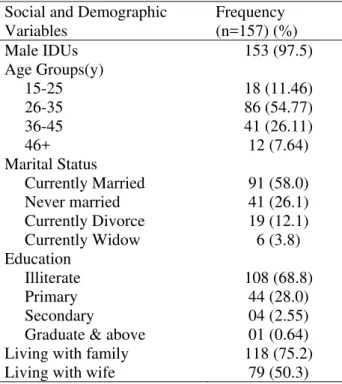
More than 60% have some misconceptions about HIV transmission, but few are in doubt about the risk of injection: 97.7% of respondents knew that HIV could be transmitted by sharing needles and injecting equipment. The sociodemographic characteristics are as shown in Table 1.
Table 1: Social and Demographic Variables among Injecting Drug Users in Surat City, 2009
Social and Demographic Variables
Frequency (n=157) (%)
Male IDUs 153 (97.5)
Age Groups(y)
15-25 18 (11.46)
26-35 86 (54.77)
36-45 41 (26.11)
46+ 12 (7.64)
Marital Status
Currently Married 91 (58.0)
Never married 41 (26.1)
Currently Divorce 19 (12.1)
Currently Widow 6 (3.8)
Education
Illiterate 108 (68.8)
Primary 44 (28.0)
Secondary 04 (2.55)
Graduate & above 01 (0.64)
Living with family 118 (75.2)
Living with wife 79 (50.3)
Table 2 shows sexual risk behavior. Over 97 percent respondents had had sex in the 3 months before the survey, and 43% of them had multiple partners in that time. For those who were sexually active, the mean number of sex partners in the last year was 1.6. Consistent condom use with wives, girlfriends, and casual partners was below 10%. Some 29% of all IDUs surveyed reported buying sex from a sex worker in the last 3 month and 14% had sex with other non regular partner during the same period. Three 3 IDUs all male, reported having sex with same sex partner during past 3 months. 69% had never used never used condom. Information on the injecting status of sex partners was available for wives. Only 3.5% of married injectors reported that their wives also injected drugs. There was no significant association between length of time injecting drugs or frequency of injection and any measure of sexual activity, including multiple partnerships and commercial sex.
DISCUSSION
It has been estimated that there were approximately 1 to 2 lakh IDUs and 8 to 12Lakh sex workers in India in 2006, with the latter serving several million men every year.11 Although HIV testing was not performed as part of this survey, HIV surveillance among drug injectors in India indicates very rapid rises in HIV infection among IDUs.6 Significant interaction between sex workers and drug users may adversely affect the prevalence in both the group. Surat IDUs report high levels of sexual activity with different types of partners, and they rarely use condoms. There is no evidence that length or frequency of injection is inhibiting sexual activity among these young drug users. Of particular concern are the high levels of commercial sex reported.
If a sex worker is infected with HIV by a drug-injecting client, she has the potential to spread the virus to a large number of other people. For IDUs, the risk of acquiring HIV sexually is smaller relative to the risk of infection through shared injecting equipment. Unprotected commercial sex does, however, increase their risk of infection even further.
ISSN: 0976-3325
National Journal of Community Medicine 2010, Vol. 1, Issue 2 70
Anecdotal reports from IDUs released from jail indicate very high levels of needle sharing in jail. These data have important implications in context of HIV epidemic in the city. There is a urgent need of large scale intervention programme. Along with the availability of clean needles and syringes, these intervention programmes must focus actively
on reducing unprotected sex between IDUs and noninjecting partners by encouraging IDUs to use condoms consistently with all their sex partners (particularly with commercial partners) and by ensuring that condoms are always easily available to injectors.
Table 2: Sexual Beahaviour among Injecting Drug Users during the last 3 months in Surat City, 2009
Sexual Beahaviour Frequency (n=157) (%)
Sexually active 153 (97.45)
Sex with wife or regular partner 127 (80.89)
Sex with female sex worker (paid) 46 (29.30)
Sex with casual female partner (non paid) 22 (14.01)
Sex with same sex partner (MSM) 3 (1.91)
Sex with multiple partners 68 (43.31)
Never used condom 108 (68.79)
ACKNOWLEDGMENTS
The authors thank the staff of the Gujarat State AIDS Control Society, Ahmedabad who supported this survey. Special thanks are due to respondents and to the former drug users who worked with the field staff.
REFERENCES
1. Costigan G, Crofts N and Reid G. The Manual for
Reducing Drug Related Harm in Asia. Melbourne. The Centre for Harm Reduction 2003; (7): 28.
2. United Nations Declaration of Commitment on
HIV/AIDS. United Nations General Assembly Special Session on HIV/AIDS. Geneva: United Nations. 2001; 25–27.
3. UNAIDS, Health Canada, The Open Society
Institute & The Canadian International Development Agency. The Warsaw Declaration: A Framework for Effective Action on HIV/AIDS and Injecting Drug Use. Second International Policy Dialogue on HIV/AIDS. Warsaw (Poland): UNAIDS. 2003; 12-14.
4. UNAIDS. Report on the Global HIV/AIDS
epidemic. Geneva: UNAIDS. 2002.
5. UNAIDS. AIDS Epidemic Update. Geneva:
UNAIDS. 2003.
6. National Institute of Health & Family Welfare,
National AIDS Control Organisation. Annual HIV Sentinel Surveillance Country Report 2006, New Delhi: NACO; 2007.
7. Rhodes T, Lowndes C, Judd A, et al. Explosive
spread and high prevalence of HIV infection among injecting drug users in Togliatti City, Russia. AIDS. 2002;16(Suppl):F25–F31.
8. Crofts N, Reid G, Deany P. Injecting drug use and
HIV infection in Asia. AIDS. 1998;12(Suppl B):S69–S78.
9. World Health Organization. HIV/AIDS in Asia and
the Pacific Region. Manila: Regional Office for the Western Pacific Region; 2001.
10. Pisani E, Winnithana B. What Drives AIDS in
Asia? A Summary of Trends in Sexual and Drug-Taking Behaviour. Bangkok: Family Health International; 2001