International Journal of Advanced Biotechnology and Research (IJBR) ISSN 0976-2612, Online ISSN 2278–599X,
Vol-7, Issue-3, 2016, pp1115-1118 http://www.bipublication.com Research Article
The compounds of phenolic nature - new opportunities for pharmacological
correction of endothelial dysfunction.
Mikhail V. Korokin, Vladimir V. Gureev,
Mikhail V. Pokrovskii, Konstantin V. Kudryavtsev,
Oleg S. Gudyrev, Liliya V. Korokina, Tatyana G. Pokrovskaia,
Belgorod State National Research University, 85, Pobedy St., Belgorod, 308015, Russia.
+7(4722) 30-10-12, http://www.bsu.edu.ru/bsu/
ABSRACT:
Investigation of endotelioprotective effects of phenolic compounds containing directly related heteroatom, and heterocyclic structural fragments under laboratory code KUD259, KUD970, KUD971, KUD972, KUD973, KUD974, KUD975 and KUD976 in modeling L-NAME induced endothelial dysfunction.
Keywords: endothelial dysfunction, L-NAME, phenolic compounds, L-arginine, L-norvaline.
INTRODUCTION:
Previous studies of the metabolism of L-arginine by activated macrophages was found that most of the arginine to urea production is consumed rather than NO, and inhibition of arginase or supplement the culture media with L-arginine led to an increase in nitric oxide synthesis. Furthermore, inhibition of arginase stimulates NO synthesis in endothelial cells. Interestingly, pharmacological inhibition of arginase activity corrects a defect in the NO production in the tissues in diabetes and erectile dysfunction. Therefore, the opportunity is seen preventing conditions data, that is, correction of endothelial dysfunction, underlying, by inhibiting the arginase activity [1, 2, 3]. In recent years, it has been developed and successfully applied the so-called arginase inhibitors - substances of natural origin that can suppress the activity of this enzyme. Furthermore arginase urea production is also involved in the biosynthesis of polyamines, amino acids, ornithine, proline, glutamate. The aim of this study was to conduct a comparative evaluation of pharmacological
correction of nitric oxide metabolism using phenolic compounds, arhinase inhibitors, containing directly related heteroatom, and heterocyclic structural fragments under laboratory code KUD259, KUD970, KUD971, KUD972, KUD973, KUD974, KUD975 and KUD976 in modeling L-NAME induced endothelial dysfunction.
PROCEDURE
The experiments were performed on the white male Wistar rats weighing 200-250 g.
NO-synthase blocker N-nitro-L-arginine methyl aether (L-NAME) was inducted intraperitoneally (i.p.) in a dose of 25 mg/kg/day, once a day within 7 days [4].
The compounds of phenolic nature - new opportunities for pharmacological correction of endothelial dysfunction.
Mikhail V. Korokin, et al. 1116
intragastrically 1% starch solution at a dose of 10 ml / kg.
On the day 8 from an initiation of experiments under anaesthetic (chloral hydrate 300 mg/kg) a catheter in the left carotid artery for recording of indexes of blood pressure (BP) was entered. Bolus introduction of pharmacological agents was made into a femoral vein. Hemodynamic indexes: the systolic arterial pressure (SAP), a diastolic arterial pressure (DAP) and cardiac contractions rate metered continuously with a hardware-software complex «Biopac». Besides BP measuring a series of the functional trials was led in introduced succession: 1. endothelium dependent vasorelaxation test (intravenous entering of a solution of acetylcholinum (AH) in a dose of 40 mkg/kg); 2. endothelium independent vasorelaxation test
(intravenous entering of a solution of sodium nitroprussidum (NP) in a dose of 30 mkg/kg) [4, 5, 6].
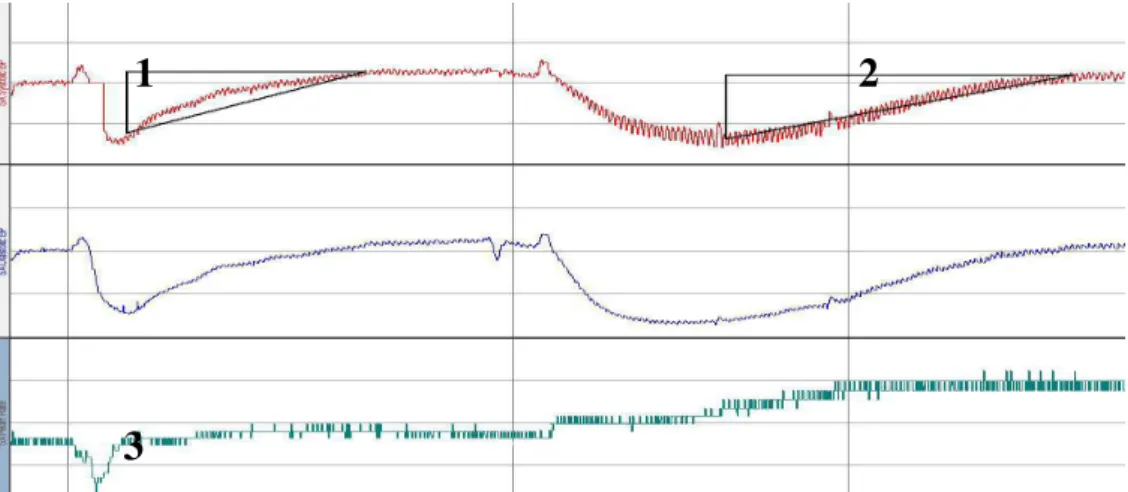
Level of endothelial dysfunction at the experimental animals, and also a level of its correction by researched drugs valued on coefficient of endothelial dysfunction (CED). This coefficient settled up by formula: CED = SBPNP/SBPAH where SBPNP – the area of
triangle above a BP recovery curve at a functional test with NP entering, SBPAH – the
area of triangle above a BP recovery curve at a functional test with AH entering. Points of a smaller cathetus of this triangle are the points of BP before the test and a point of maximum reduction of a BP, and the bigger cathetus is a time of BP restoration [6, 7, 8] (figure 1).
Figure 1. The dynamics of systolic and diastolic blood pressure and heart rate during the functional vascular trial with intravenous solutions of acetylcholine and sodium nitroprusside.
Note. 1 - Triangle of recovery curve in blood pressure in response to acetylcholine; 2 - triangle on the recovery curve of blood pressure in response to sodium nitroprusside; 3 - the end of the cardiac component and stabilization of heart rate. The results were expressed as the mean (M) ± the standard error of mean (m). Differences were considered significant at p <0.05.
FINDINGS OF THE STUDY
It has been found that the compounds of KUD-259, KUD-970, KUD-971, KUD-972, KUD-973 and KUD-976 had no effect on baseline hemodynamics and the values of systolic and diastolic blood pressure were not significantly
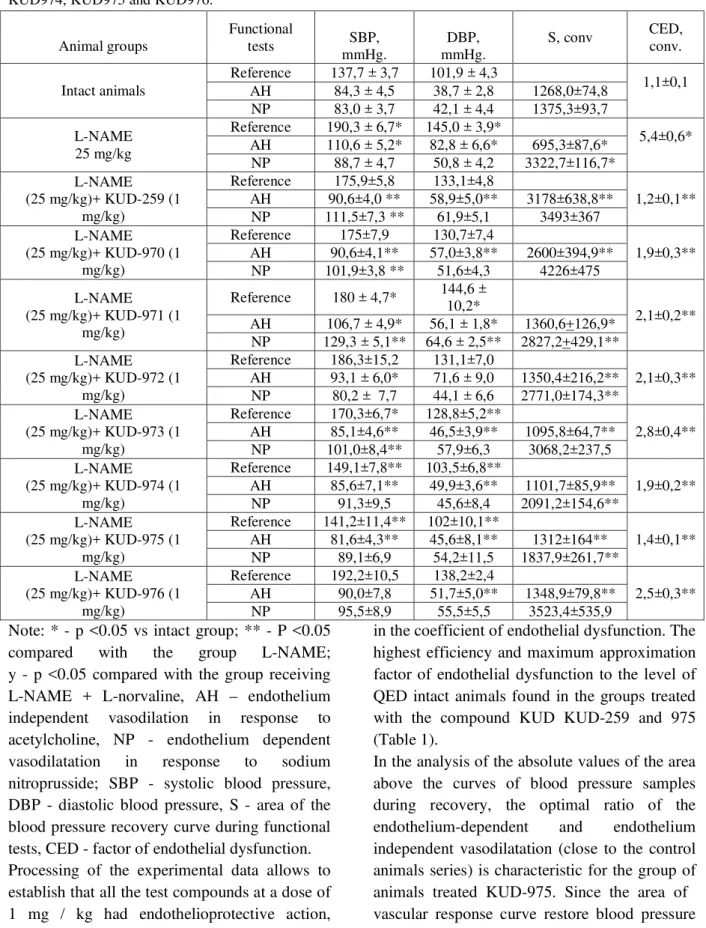
different from those values in the group of animals with simulation L-NAME induced nitric oxide deficiency (Table. 1). Compounds of KUD-974 and KUD-975 statistically different from reduced the initial blood pressure is on the background of simulation L-NAME-induced endothelial dysfunction. Table 1 shows the results of functional assays on the endothelium (acetylcholine, 40 mg/kg) and endothelium (nitroprusside 30 mg/kg) vascular relaxation in animals with L-NAME induced pathology studied with treatment agents. Processing of the experimental data allows to establish that all the test compounds at a dose of 1 mg / kg had endotelioprotektivnym action, expressed in a statistically significant reduction in the
1 2
The compounds of phenolic nature - new opportunities for pharmacological correction of endothelial dysfunction.
Mikhail V. Korokin, et al. 1117
coefficient of endothelial dysfunction. The highest efficiency and maximum approximation factor of endothelial dysfunction to the level of
CED intact animals found in the groups treated with the compound KUD-259 and KUD 975 (Table 1).
Table 1 Dynamics of indicators of blood pressure and heart rate in the simulation of nitric oxide deficiency and correction of the deficiency of nitric oxide compounds KUD259, KUD970, KUD971, KUD972, KUD973, KUD974, KUD975 and KUD976.
Animal groups
Functional
tests SBP,
mmHg.
DBP, mmHg.
S, conv CED, conv.
Intact animals
Reference 137,7 ± 3,7 101,9 ± 4,3
1,1±0,1 AH 84,3 ± 4,5 38,7 ± 2,8 1268,0±74,8
NP 83,0 ± 3,7 42,1 ± 4,4 1375,3±93,7 L-NAME
25 mg/kg
Reference 190,3 ± 6,7* 145,0 ± 3,9*
5,4±0,6* AH 110,6 ± 5,2* 82,8 ± 6,6* 695,3±87,6*
NP 88,7 ± 4,7 50,8 ± 4,2 3322,7±116,7* L-NAME
(25 mg/kg)+ KUD-259 (1 mg/kg)
Reference 175,9±5,8 133,1±4,8
1,2±0,1** AH 90,6±4,0 ** 58,9±5,0** 3178±638,8**
NP 111,5±7,3 ** 61,9±5,1 3493±367 L-NAME
(25 mg/kg)+ KUD-970 (1 mg/kg)
Reference 175±7,9 130,7±7,4
1,9±0,3** AH 90,6±4,1** 57,0±3,8** 2600±394,9**
NP 101,9±3,8 ** 51,6±4,3 4226±475 L-NAME
(25 mg/kg)+ KUD-971 (1 mg/kg)
Reference 180 ± 4,7* 144,6 ± 10,2*
2,1±0,2** AH 106,7 ± 4,9* 56,1 ± 1,8* 1360,6+126,9*
NP 129,3 ± 5,1** 64,6 ± 2,5** 2827,2+429,1** L-NAME
(25 mg/kg)+ KUD-972 (1 mg/kg)
Reference 186,3±15,2 131,1±7,0
2,1±0,3** AH 93,1 ± 6,0* 71,6 ± 9,0 1350,4±216,2**
NP 80,2 ± 7,7 44,1 ± 6,6 2771,0±174,3** L-NAME
(25 mg/kg)+ KUD-973 (1 mg/kg)
Reference 170,3±6,7* 128,8±5,2**
2,8±0,4** AH 85,1±4,6** 46,5±3,9** 1095,8±64,7**
NP 101,0±8,4** 57,9±6,3 3068,2±237,5 L-NAME
(25 mg/kg)+ KUD-974 (1 mg/kg)
Reference 149,1±7,8** 103,5±6,8**
1,9±0,2** AH 85,6±7,1** 49,9±3,6** 1101,7±85,9**
NP 91,3±9,5 45,6±8,4 2091,2±154,6** L-NAME
(25 mg/kg)+ KUD-975 (1 mg/kg)
Reference 141,2±11,4** 102±10,1**
1,4±0,1** AH 81,6±4,3** 45,6±8,1** 1312±164**
NP 89,1±6,9 54,2±11,5 1837,9±261,7** L-NAME
(25 mg/kg)+ KUD-976 (1 mg/kg)
Reference 192,2±10,5 138,2±2,4
2,5±0,3** AH 90,0±7,8 51,7±5,0** 1348,9±79,8**
NP 95,5±8,9 55,5±5,5 3523,4±535,9 Note: * - p <0.05 vs intact group; ** - P <0.05
compared with the group L-NAME; y - p <0.05 compared with the group receiving L-NAME + L-norvaline, AH – endothelium independent vasodilation in response to acetylcholine, NP - endothelium dependent vasodilatation in response to sodium nitroprusside; SBP - systolic blood pressure, DBP - diastolic blood pressure, S - area of the blood pressure recovery curve during functional tests, CED - factor of endothelial dysfunction. Processing of the experimental data allows to establish that all the test compounds at a dose of 1 mg / kg had endothelioprotective action, expressed in a statistically significant reduction
in the coefficient of endothelial dysfunction. The highest efficiency and maximum approximation factor of endothelial dysfunction to the level of QED intact animals found in the groups treated with the compound KUD KUD-259 and 975 (Table 1).
The compounds of phenolic nature - new opportunities for pharmacological correction of endothelial dysfunction.
Mikhail V. Korokin, et al. 1118
animals treated with KUD-group was 1312 ± 975 164 (in the control ± 74.8 1268.0), in response to the intravenous injection of sodium nitroprusside - 1837.9 ± 261.7 cond. u (In the control - 1375,3 ± 93,7). This fact indicates a pronounced effect KUD-975 connection on the endothelial cells and nitric oxide synthesis system.
CONCLUSION
The compounds of phenolic nature KUD259, KUD970, KUD971, KUD972, KUD973, KUD974, KUD975 and KUD976, showed a pronounced effect in the simulation of endothelioprotektive action in animals with L-NAME-induced endothelial dysfunction, which was reflected in the predominance of endothelium-dependent relaxation of blood vessels and reducing the rate of endothelial dysfunction QED. The most efficient reduction QED found in the groups of animals treated with compounds KUD-KUD 259 and 975.
ACKNOWLEDGEMENTS
The research was partially supported by the Ministry of Education and Science of the Russian Federation (grant agreement No. 14.578.21.0012, unique identifier Agreement RFMEFI57814X0012.).
REFERENCES
1. The vascular effects of different arginase inhibitors in rat isolated aorta and mesenteric arteries / N.N. Huynh, E.E. Harris, J.F.Chin-Dusting, K.L. Andrews//British Journal of Pharmacology. - 2009. - №156. – P. 84-93. 2. Inhibition of S6K1 accounts partially for the
anti-inflammatory effects of the arginase inhibitor L-norvaline / X.F. Ming, A.G. Pajapakse, J.M. Carvas et al.//BMC Cardiovascular Disorders. - 2009. - Vol. 9,
№ 12. - P. 1147-1203.
3. Miller, A.L. The effects of sustained-release-L-arginine formulation on blood pressure and vascular compliance in 29 healthy individuals / A.L. Miller//Altern. Med. Rev. – 2006. V. 11 (1). – P. 23-29.
4. Methods of Experimental Modeling of Endothelial Dysfunction / M.V. Pokrovskiy,
E.B. Artyushkova, T.G. Pokrovskaya // Allergology and Immunology. – 2008. – Vol. 9(3). – P. 327.
5. Pharmacological Correction of ADMA-ENOS-associated Targets in Preeclampsia / M.V. Pokrovsky, T.G. Pokrovskaya, V.V. Gureev et al. // Obstetrics and Gynecology. – 2011. – Vol. 2. – P. 16-20.
6. Endothelio- and Cardioprotective Effects of Meldonium and Trimetazidine in the Model of L-NAME-induced Endothelial Dysfunction in Experiment / E.V. Artyushkova, M.V. Pokrovskiy, E.B. Artyushkova et al. // Kursk Scientific and Practical Bulletin «Man and his Health». – 2010. – Vol. 3. – P. 5-10.
7. Кардио- и эндотелиопротективные
эффекты ингибитора аргиназы
L-норвалина при моделировании L-NAME
индуцированного дефицита оксида азота / Цепелева С.А., Покровский М.В., Покровская Т.Г. и др. // Кубанский
научный медицинский вестник. – 2011. –
№ 4. – С. 185-188.
8. Исследование эндотелиопротективных
эффектов препарата кардионат на
ADMA-подобной модели дефицита азота при
специфической блокаде NO-синтазы /
Артюшкова Е.В., Покровский М.В.,
Гуреев В.В. и др. // International Journal on
Immunorehabilitation. – 2009. – № 11. – С. 66.
9. Effect of antioxidants pQ510 and resveratrol on regulatory function of the endothelium in rats with modeled arterial hypertension / N.G. Gumanova, E.B. Artyushkova, V.A. Metel'skaya et al. // Bulletin of Experimental Biology and Medicine. – 2007. – Vol. 143 (6). – P. 678-681.