ISSN: 0976-3325
National Journal of Community Medicine 2010, Vol. 1, Issue 2 132 Original Article
EVALUATION OF INTENSIVE PULSE POLIO IMMUNIZATION IN DISTRICT DANG DURING 2008
Bipin Vasava1, Goti Pravin2, Rupani Mihir3, Mandaviya Vipul3, Chudasma Rajesh4
1
Assistant Professor, 2Intern,3Resident, Department of Community Medicine, SMIMER Medical College, Surat,5Associate Professor, MP Shah Medical College, Jamnagar
Correspondence: [email protected]
ABSTRACT
Two rounds of pulse polio immunization in January and February 2008 were evaluated in rural areas of Dang district. Randomly selected team members of 24% booths and teams working during house to house activity were interviewed. Approximately 78% of eligible children were immunized on booths whereas remaining eligible were covered during house to house activity. In January & February 2008 round, tOPV was used for immunization purpose. Utilizers of booth services received information about these rounds mainly from health worker/anganwadi worker and television. During house to house activity, few unimmunized children were found. Adequate manpower with proper training and community mobilization can improve the coverage.
Keywords: India, Pulse polio immunization, Vaccine vial monitor, Dang district, tOPV.
INTRODUCTION
Since 1988 the world has come very close to eradicating polio through the Global Polio Eradication Initiative, an Initiative which cut the number of polio cases from about 350 000 in 1988 to 1643 by January 2009 through mass vaccination
campaigns.1,2 The impact of routine polio
immunization and Intensive Pulse Polio Immunization (IPPI) on the incidence of
poliomyelitis is well known.3 An important
improvement in IPPI during 1998 has been the use
of Vaccine Vial Monitor (VVM).4 This
mechanism has been mandatory in all vaccine procurements since 1998. VVM is available for all vaccines used in immunization programs in developing countries, and UNICEF requires them on all vaccines they purchase.5,6 This study was conducted to evaluate various aspects relating to booth activity and house to house activity in Intensive Pulse Polio Immunization program in Dang district, Gujarat.
METHODS
In Dang district of Gujarat, two consecutive rounds of IPPI in January & February 2008 were evaluated. Evaluation was done on booth activity day and also for the house to house activity days in rural areas of Dang district. There are 182 booths in Dang district. Twenty-four percent of booths were visited in Dang district during the two rounds. Assessment of booth activity, interview of booth workers, and to know the source of information about IPPI round, interview of parents or guardians who brought children to the booth was made. P and X marking of houses, X to P conversion at the end of the day, false P marking
were also analyzed during the two rounds. Availability of type of vaccine whether tOPV or mOPV type 1 was also checked.
RESULTS
More than 75 percent children were vaccinated at booth during the two rounds of IPPI in rural areas of Dang district (Table I). Almost all the booths were easily visible with displayed IEC material (80%). Booth workers attended last vaccinator training more than 90%. Participation from community members like social worker, local leader or college students was about 74%. Good part observed was ‘mobilization of children to booth by booth worker’ (average 75%). VVM in stage 3 or 4 was not found on any booth. In any round, complete knowledge regarding VVM was not found in Dang district. Trivalent Oral Polio Vaccine (tOPV) was used in both January & February 2008 rounds of IPPI in Dang.
Among the booth service utilizers, 72.8% of them received information about these rounds from health workers/anganwadi workers, while 14.04% received information from television. Some non utilizers of booth services were sure that the vaccinators will come to their house for polio immunization. Some of these non utilizers forgot about visiting the booths on round day.
While evaluating the teams during both the rounds in Dang, the teams were found in the field during house to house activity and were immunizing the children but not proactively as a few children were missed playing on street or on road side.
ISSN: 0976-3325
National Journal of Community Medicine 2010, Vol. 1, Issue 2 133
immunized who were born after the previous round of vaccination.
Table 1: Observations on the Booth Activity Day During Pulse Polio Immunization at Dang
Observations Jan, 2008(%) Feb, 2008(%)
No. of target children 34000 34155
No. of children immunized 25372(76) 26983(79)
No. of booths visited 20(10.98) 24(13.18)
Two booth workers attended last training 20(100) 22(91.67)
One community member 18(90) 14(58.33)
Workers mobilizing children to the booth 16(80) 17(70.83)
Correct finger marking of children 20(100) 24(100)
Team having correct knowledge of VVM 17(85) 22(91.67)
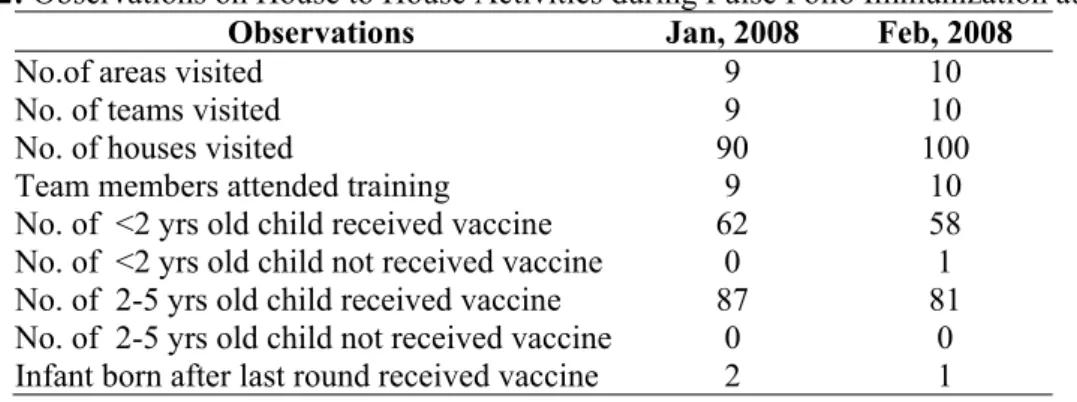
In February round, 1 newborn infant was immunized who was born after the January round. In both the rounds, among those areas visited
during house to house activity, none of the areas had missed houses in the district. (Table II).
Table 2: Observations on House to House Activities during Pulse Polio Immunization at Dang
Observations Jan, 2008 Feb, 2008
No.of areas visited 9 10
No. of teams visited 9 10
No. of houses visited 90 100
Team members attended training 9 10
No. of <2 yrs old child received vaccine 62 58
No. of <2 yrs old child not received vaccine 0 1
No. of 2-5 yrs old child received vaccine 87 81
No. of 2-5 yrs old child not received vaccine 0 0
Infant born after last round received vaccine 2 1
DISCUSSION
This evaluation study was done in rural areas of Dang district. Evaluation of the two consecutive rounds of pulse polio immunization revealed that the booth coverage is still not much high and it is about 78% only, which really needs to be improved. Saha, et al.7 observed 84.1% booth coverage in two rounds of immunization in 1995-96 in West Bengal. They also observed that some of the major reasons for non-acceptance of PPI were lack of information, illness of the child, absence of the child on the "PPI day", lack of faith in immunization and fear of adverse reaction.
Similarly, Aggarwal, et al.8 observed that
manpower shortage in form of volunteers from community were responsible for lower coverage at booths in eastern part of Delhi. Lack of community participation, poor community mobilization and untrained vaccinators were responsible for low coverage.
Weekly Epidemiological Record of 2006 from WHO suggested that to improve the quality of Supplementary Immunization Activities in high risk areas of Uttar Pradesh and Bihar, a few recommendations made from India Expert Advisory Group (IEAG) on polio eradication like, deployment of additional personnel to high risk areas, enhanced social mobilization efforts
targeted at reaching population groups missed during previous rounds, use of mobile teams to vaccinate children at transit points and on moving trains, and increased engagement and accountability of political leaders and of health staff at all levels required to be implemented.9 Communities where social mobilization activities are conducted are consistently less likely to refuse OPV, more likely to attend booths and more likely to report positive attitudes towards OPV and higher perception of polio risk, compared with families in communities without these activities, hence contributing to lower incidence. In four high-risk districts of Uttar Pradesh where social mobilization activities were conducted, the number of wild poliovirus cases dropped from 116 to 49 and there was a significant increase in booth coverage between 50 and 57%, compared with 19– 35% at district level.10
ISSN: 0976-3325
National Journal of Community Medicine 2010, Vol. 1, Issue 2 134
There are ways in which we can increase the booth attendance. Puppet/theatre shows, video vans and other folk media activities held in more than 3500 villages in Uttar Pradesh, contributed to a 20% increase in booth attendance.12,13
In Gujarat, mOPV type 1 was first time introduced in February, 2007 round. In few districts of UP, Bihar, Mumbai, Thane during Intensified Pulse Polio Immunization in April, 2005 round, mOPV type 1 was introduced for the first time.14 Dobe, et al.15 have reported in their study that television and miking are the main source of information for polio round. In present study among booth service utilizers, health worker/anganwadi worker and television were main source of information for pulse polio round. The principal agency responsible for disseminating information about PPI was identified to be the multipurpose health workers in a study in West Bengal by Saha, et al.7 Similar findings are also observed by Chincholikar and Prayag16 in their study in rural areas of Maharashtra and in our study also.
During house to house activity, few unimmunised children were found. The reasons are children not at home at time of visit of health team, parents were not at home, not aware of polio round or they were too busy. Similar observations were made by Bandyopadhyay, et al.17 in their study at Delhi. X to P conversion was not observed at all at the end of day in all three rounds. The reason was large number of houses to be covered by each team per day. In Moradabad district of Uttar Pradesh, X marking was improved from 4% in early 2005 to 10% by mid 2005.18
Polio eradication activities in India have provided successful operational models for elimination of transmission in many other areas of the world. Elimination of Wild Polio Virus (WPV) circulation in India would further serve as a stimulus for the remaining countries with WPV transmission, and ultimately lead to global eradication.
Study results reveal the deficits in pulse polio program implementation even after many years of campaigning.
REFERENCES
1. Global Polio Eradication Initiative [home page].
Available from: http://www.polioeradication.org/ [accessed on 21 May 2009].
2. Levine R, What Works Working Group. Millions
saved: proven successes in global health. Washington, DC: Center for Global Development; 2004.
3. Soudarssanana MB. Pulse Polio
Immunisation-evolution of the poliomyelitis programme in India
using the oral polio vaccine. Indian J Comm Med 1997; 22: 178-83.
4. Park K. Textbook of Preventive and Social
Medicine. 18th edition. Jabalpur: Banarasidas Bhanot Publishers; 2004. p 161-7.
5. World’s smallest sticker : Vaccine Vial Monitor.
Available from: http://www.path.org/projects/ vaccine_vial_monitor.php[accessed on 10 December 2010].
6. WHO-UNICEF policy statement on the use of
vaccine vial monitors in immunization services. Available on https://apps.who.int/vaccines-access/vacman/vvm/vvmmainpage.htm. [Accessed and downloaded from https://apps.who.int/ vaccines-access/vacman/vvm/qualityofcoldchain_ eng.pdf on 10 December 2010]
7. Saha I, Dasgupta S, Mandal AK. Pulse polio
immunisation, 1995-96: an evaluation in West Bengal. J Indian Med Assoc. 1999 Jan;97(1):8-10.
8. Aggarwal K, Kannan AT, Neelam S, Kumar P.
Study of operational aspect of pulse polio booths during Intensified Pulse Polio Immunization Campaign in assembly segments of East Delhi. J Comm Dis 2002; 34: 215-20.
9. WHO. Progress towards poliomyelitis eradication
in India, January 2005 to June 2006. http://www.who.int/wer. 2006; 81: 285-92.
10. A critical leap to polio eradication in India [working paper]. New Delhi: United Nations Children’s Fund Regional Office for South Asia; 2003.
11. Athar Ansari M, Khan Z, Khan I. Reducing resistance against polio drops. Perspectives in Public Health 2007;127:276-9.
12. Galway M. Communication for polio eradication: India update. In: Technical Advisory Group Meeting, Communication for polio eradication, Cameroon, 2005.
13. Cheng W. Polio eradication India: reaching the last child. New Delhi: United Nations Children’s Fund Regional Office for South Asia; 2004.
14. Bahl S, Biswal P, Sarkar S, Jenks J, Petersen T, Wenger J. Polio eradication in India: current status. J Indian Med Assoc 2005; 103: 669-70, 678. 15. Dobe M, Ray SK, Biswas R, Mandal A, Mehta P,
Baishya AC. Evaluation of pulse polio immuniza-tion in some districts of West Bengal & Assam. Indian J Pub Health 2004; 48: 88-95.
16. Chincholikar SV, Prayag RD. Evaluation of pulse polio immunization in rural areas of Maharashtra. Indian J Pediatr. 2000; 67: 647-9.
17. Bandyopadhyay S, Banerjee K, Datta KK, Atwood SJ, Langmire CM, Andrus JK. Evaluation of mass pulse immunization with oral polio vaccine in Delhi: is pre-registration of children necessary? Indian J Pediatr 1996; 63: 133-7.