Association between
MTHFD1
G1958A Polymorphism
and Neural Tube Defects Susceptibility: A Meta-Analysis
Jianxin Jiang1,2, Yanfei Zhang2, Liang Wei2, Zhiyang Sun2*, Zhongmin Liu1,2*
1Research Center for Translational Medicine, East Hospital, Tongji University School of Medicine, Shanghai, China,2Department of Neurosurgery, East Hospital, Tongji University School of Medicine, Shanghai, China
Abstract
Objectives:The methylenetetrahydrofolate dehydrogenase (MTHFD1) gene, as one of the key genes involved in the folate pathway, has been reported to play a critical role in the pathogenesis of neural tube defects (NTDs). However, the results of published studies are contradictory and inconclusive. Thus, this meta-analysis aimed to evaluate the effect of the common polymorphism in theMTHFD1gene, the G1958A (R653Q, dbSNP ID: rs2236225) variant, on the risk of NTDs in all eligible studies.
Methods:Relevant literature published before January 3, 2014 was retrieved from the MEDLINE, EMBASE, Cochrane Library, and CBM databases. Pooled crude odds ratios (ORs) and their corresponding 95% confidence intervals (CIs) were calculated to evaluate the association between theMTHFD1G1958A polymorphism and NTDs risk.
Results:We performed a meta-analysis of nine studies with a total of 4,302 NTDs patients and 4,238 healthy controls. Our results demonstrated a significant correlation between theMTHFD1G1958A polymorphism and NTDs in an overall meta-analysis. For family-based studies, the study subjects were classified as NTD cases, mothers with NTDs offspring, and fathers with NTDs offspring. We found no association between any of the fathers’ genotypes and NTDs, whereas there was a clear excess of the 1958A allele in the mothers of children with NTDs compared with controls individuals.
Conclusions:In summary, our meta-analysis strongly suggests that theMTHFD1G1958A polymorphism might be associated with maternal risk for NTDs in Caucasian populations. However, the evidence of this association should be interpreted with caution due to the selective nature of publication of genetic association studies.
Citation:Jiang J, Zhang Y, Wei L, Sun Z, Liu Z (2014) Association betweenMTHFD1G1958A Polymorphism and Neural Tube Defects Susceptibility: A Meta-Analysis. PLoS ONE 9(6): e101169. doi:10.1371/journal.pone.0101169
Editor:Masaru Katoh, National Cancer Center, Japan
ReceivedMarch 4, 2014;AcceptedJune 3, 2014;PublishedJune 30, 2014
Copyright:ß2014 Jiang et al. This is an open-access article distributed under the terms of the Creative Commons Attribution License, which permits unrestricted use, distribution, and reproduction in any medium, provided the original author and source are credited.
Funding:The authors have no support or funding to report.
Competing Interests:The authors have declared that no competing interests exist. * Email: [email protected] (ZS); [email protected] (ZL)
Introduction
Neural tube defects (NTDs) are among the most common congenital malformations at birth and present as a wide range of phenotypes, primarily including anencephaly, spina bifida and encephalocele [1]. Approximately 1–2 in 1000 pregnancies worldwide are affected by NTD, but this rate varies between different populations and socio-economic groups [2]. The aetiology of NTDs is assumed to be multifactorial, with a large number of unclear genetic components, environmental conditions, and their interactions playing critical roles [3]. Epidemiological studies have revealed that periconceptional vitamin supplementa-tion with folic acid substantially lowers the percentage of women with NTD-affected pregnancies [4,5], which has led to intense research on the genetic variants of enzymes involved in the folate metabolic pathway. It is hypothesized that polymorphisms within folate-dependent enzymes might have an impact on NTDs risk, although the exact mechanism of these genetic factors has not been completely elucidated.
Numerous investigations of genes that are specifically involved in folate metabolism have identified at least one polymorphism, C677T (A222V; dbSNP ID: rs1801133) in the 5,
10-methylenete-trahydrofolate reductase (MTHFR) gene, that may be associated
with an approximately doubled risk of NTDs [6–10]. Recently, a meta-analysis involving 25 case-control studies on the association
between NTDs risk and theMTHFR677TT genotype arrived at a
pooled OR of 2.02 (95% CI 1.51–2.71) [11]. Nevertheless, the
presence of this principal MTHFR variant does not appear to
account for a large proportion of the etiologic factors for NTDs
[12], indicating that besides MTHFR, additional folate-related
genes are likely to also be involved.
Another folate-dependent enzyme, 5,
10-methylenetetrahydro-folate dehydrogenase (MTHFD1), given its central role in folate
metabolism, is an attractive candidate gene in NTDs aetiology.
MTHFD1 is a nicotinamide adenine dinucleotide phosphate (NADP)-dependent trifunctional cytoplasmic enzyme (often
re-ferred to as ‘‘C1-THF synthase’’), acting as formyl, 5,
10-methenyl, and 5, 10-methylene derivatives [13], which plays an important role in folate metabolism. In addition to its enzymatic
activity, biochemical evidence also demonstrates that MTHFD1
plays a critical role as a structural component in methionine synthesis andde novopurine and pyrimidine synthesis [14]. Several
gene were identified from public databases. Among them, a SNP
at nucleotide 1958 of theMTHFD1gene, which causes a G to A
transition (G1958A; dbSNP ID: rs2236225) that results in replacement of the arginine residue at position 653 by glutamine (R653Q), is one of the most attractive and frequently studied polymorphisms.
Initially, Hol et al. first investigated the association between
MTHFD1 1958G.A and susceptibility to familial and sporadic NTDs in a Dutch population but failed to provide evidence for a major role of this alteration in NTDs etiology [15]. However, in subsequent studies conducted in an Irish population, both Brody
et al. and Parle-McDermott et al. concluded that the MTHFD1
G1958A polymorphism is associated with an increase in the genetically determined risk that a woman will bear a child with NTDs [16,17]. De Marco et al. also observed a significant effect of the G1958A polymorphism on susceptibility to NTDs in an Italy population [18], whereas van der Linden et al. found no major risk associated with spina bifida in a Dutch population [19]. Considering the limited power of individual studies with small
sample sizes, the association of theMTHFD1G1958A
polymor-phism with NTDs remains controversial and needs to be fully validated. To solve the problem of inadequate statistical power and controversial results, we performed a meta-analysis using published data from observational studies to provide empirical evidence on the association. To the best of our knowledge, this is
the first meta-analysis to assess the association of the MTHFD1
G1958A polymorphism with NTDs risk.
Materials and Methods
To ensure the rigour of this meta-analysis, we designed and conducted it according to the guidelines of the Preferred Reporting Items for Systematic Reviews and Meta-analyses (PRISMA) (Supplement S1).
Publication search
A comprehensive literature search for studies reporting on the
association of theMTHFD1G1958A polymorphism with
suscep-Figure 1. Flow diagram of studies with specific reasons for inclusion/exclusion in the present meta-analysis. doi:10.1371/journal.pone.0101169.g001
MTHFD1G1958A Polymorphism and NTDs Risk
tibility to NTDs was conducted in the MEDLINE, EMBASE, Cochrane Library, CBM (Chinese Biomedical Literature) and CNKI (China National Knowledge Infrastructure) databases. The following combinations of MeSH terms and keywords were used: (‘neural tube defects’ or ‘anencephaly’ or ‘encephalocele’ or ‘meningomyelocele’ or ‘spinal dysraphism’ or ‘spina bifida occulta’ or ‘spina bifida cystica’) and (‘polymorphism’ or ‘single nucleotide polymorphisms’ or ‘polymorphism, genetic’) and (‘methylenete-trahydrofolate dehydrogenase’ or ‘MTHFD1’ or ‘G1958A’ or ‘rs2236225’ or ‘R653Q’). A manual search was also carried out to find additional potential studies in the references lists of reviews. The latest search was performed on January 3, 2014 without any limitation on language.
Validity assessment
The following inclusion criteria were used to select potential studies for this meta-analysis: (1) evaluated the relationship
between theMTHFD1G1958A polymorphism and susceptibility
to NTDs; (2) all patients in the candidate studies met the diagnostic criteria for NTDs and controls were without NTDs; and (3) sufficient available genotype data for estimating ORs with their corresponding 95%CIs. The major reasons for the exclusion of studies are as follows: (1) not related to the G1958A polymorphism and NTDs; (2) repeated or duplicate studies; (3) studies only examining case populations; and (4) no usable data reported. When there were multiple studies with the same or overlapping data, only the most recent one with the most subjects was selected for this meta-analysis.
Data extraction and quality assessment
Following the PRISMA guide, two investigators independently reviewed and checked all full-text reports and extracted relevant information, including trial features (e.g., surname of first author, year of publication and country of origin), participants’ general features (e.g., ethnicity, definition and number of case/control subjects), genotyping methods, data needed for meta-analysis (e.g., the frequencies of the alleles and the genotypic distributions for both the cases and controls), evidence of Hardy-Weinberg equilibrium (HWE) in controls, etc. Discrepancies were solved through discussion until consensus was reached. When crucial data was not reported in the original publication, required information was obtained by contacting the authors when possible.
The methodological quality of all included studies was assessed by the Newcastle-Ottawa Scale (NOS) criteria (Supplement S2) [20]. The NOS criteria is used to analyze the study quality with regard to selection, comparability, and exposure. Scores range from 0 stars (worst) to 9 stars (best), with a score of 5 or higher indicating a moderate-high methodological quality. Any disagree-ments over quality scores were resolved by discussion and subsequent consensus.
Statistical analysis
All statistical analyses were performed using the STATA software (version 12.0, Stata Corp., College Station, TX, USA).
And two-tailed P,0.05 was considered statistically significant.
Genotype frequencies of theMTHFD1G1958A polymorphism in
the control groups were tested for conformation to HWE using the chi-square test. The strength of the association between the
MTHFD1G1958A polymorphism and susceptibility to NTDs was assessed by the pooled ORs, whereas a sense of the precision of the estimate was provided by their corresponding 95% CIs. We
examinedMTHFD1G1958A genotypes using five genetic models,
including allele (A allele vs. G allele), dominant (AA+AG vs. GG),
recessive (AA vs. AG+GG), homozygous (AA vs. GG), and
Table 1. Main characteristics of the studies included in the meta-analysis. Included studies Country Ethnicity Sample size Type of case/control subjects Detection method P HWE for controls NOS star Case Control Hol FA, 1998 N etherlands Caucasian 103 335 Familial and sporadic NTD cases, healthy controls PCR-SSCP 0.469 7 /9 Brody LC, 2002 Ireland C aucasian 1056 997 N TD children, N TD fathers, NTD mothers, female controls PCR-RFLP 0.051 8 /9 De Marco P, 2006 Italy Caucasian 375 523 NTD children, N TD fathers, NTD mothers, healthy controls PCR-RFLP 0.367 7 /9 Parle-McDermott A , 2 006 Ireland C aucasian 548 770 NTD children, N TD fathers, NTD mothers, healthy controls PCR-RFLP 0.040 6 /9 van der Linden IJ, 2007 N etherlands Caucasian 216 360 NTD cases, NTD mothers, pediatric controls, female controls PCR-RFLP 0.985 7 /9 Carroll N, 2009 Ireland C aucasian 1391 446 N TD cases, NTD mothers, pediatric controls, female controls PCR-RFLP 0.027 8 /9 Shaw GM, 2009 USA C aucasian 359 259 NTD cases, healthy controls PCR-RFLP 0.688 8 /9 Marini N J, 2011 USA C aucasian 241 239 NTD cases, healthy controls PCR-RFLP 0.587 8 /9 Fisk Green R , 2 013 Ireland C aucasian 13 309 N TD cases, healthy controls PCR-RFLP 0.968 7 /9 PCR-RFLP, Polymerase chain reaction-restriction fragment length polymorphism; PCR-SSCP, PCR-single strand conformation polymorphism; NOS, Ne wcastle-Ottawa scale. doi:10.1371/journal.pone. 0101169.t001
heterozygous (AA vs. AG) comparisons. The significance of the pooled ORs was determined by theZ-test with aP-value less than 0.05 indicating statistical significance.
Taking into consideration possible heterogeneity
between-studies, Cochran’s Q statistic and the I2metric were conducted
[21,22]. Values of Pless than 0.10 and I2exceeding 50% were
considered to indicate the presence of significant heterogeneity. Either a random-effects (DerSimonian-Laird method) or fixed-effects model (Mantel-Haenszel method) was applied to calculate pooled effect estimates in the presence or absence of heterogeneity, respectively. In addition, to assess possible publication bias, the Begg’s funnel plot and Egger’s liner regression test were conducted [23,24]. Sensitivity analyses were performed by omitting individ-ual studies in turn to determine if any studies significantly affected the original results [25]. A subgroup analysis of the family-based studies on different populations (NTDs children, mothers with NTDs offspring, and fathers with NTDs offspring) was also performed.
Results
Study characteristics
Figure 1 presents a flow chart for the process of study retrieval and exclusion. Based on the pre-specified search strategy and inclusion criteria, a total of 148 potentially references were preliminarily identified. After removing duplicate records (n = 23) and articles without full texts (n = 10), 115 titles and abstract were reviewed; of these, 99 articles were excluded for the following reasons: 55 were not case-control studies, 16 were not relevant to
NTDs, and 28 were not relevant to the MTHFD1 G1958A
polymorphism. Thus, 16 articles were retained for a full text evaluation. Among them, 4 articles were excluded for including irrelevant genotypic and allelic frequency data (Supplement S3). Finally, 12 studies included in qualitative synthesis [15–19,26–32], and nine studies were included in quantitative analysis (meta-analysis) [15–19,29–32], providing data on a total of 8,360 Caucasians (4,302 NTDs patients and 4,328 healthy controls). Of the included studies, five studies investigated the association of the
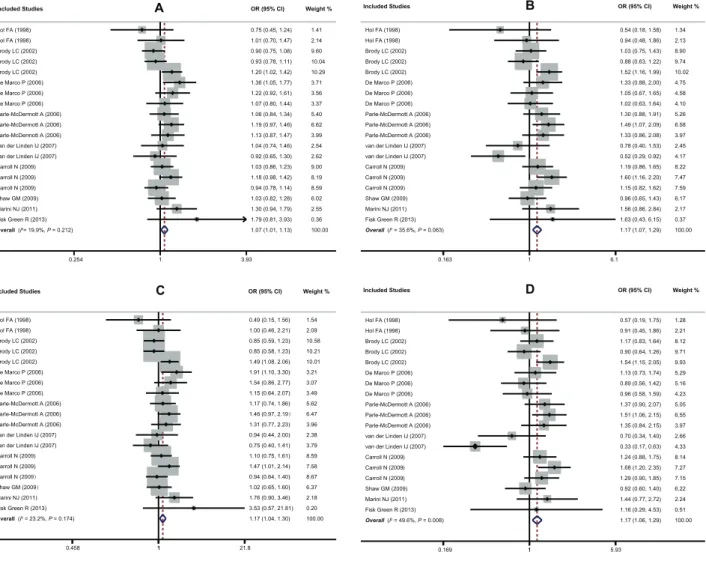
MTHFD1G1958A polymorphism in NTDs cases [16–19,29], five in mothers with NTDs offspring [16–19,29] and four in fathers with NTDs offspring [16–18,29]. NTDs cases with a wide range of severity (e.g. spina bifida, anencephaly, and encephalocele) were Figure 2. Forest plots of ORs for the association between theMTHFD1G1958A polymorphism and susceptibility to NTDs (A: A allele vs. G allele; B: AA vs. AG+GG; C: AA vs. GG; D: AA vs. AG).
doi:10.1371/journal.pone.0101169.g002
MTHFD1G1958A Polymorphism and NTDs Risk
Table 2.Summary ors of the association betweenMTHFD1G1958A polymorphism and risk for NTDs.
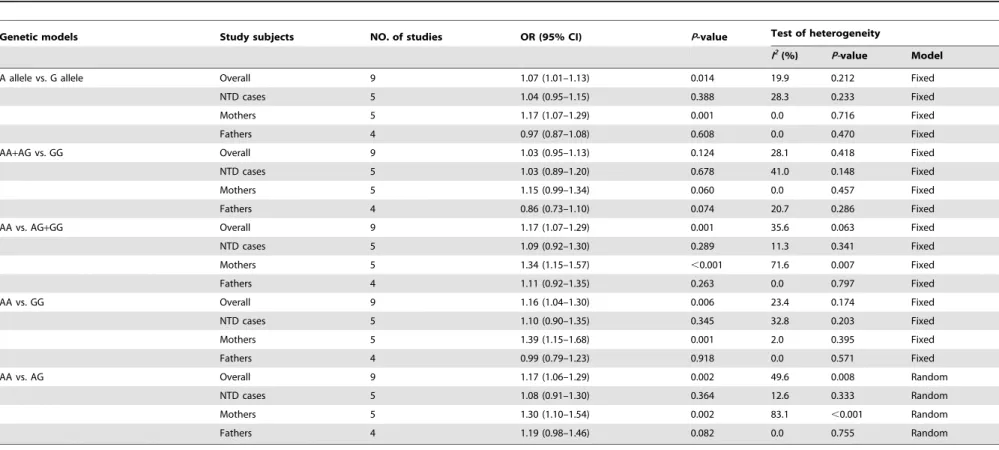
Genetic models Study subjects NO. of studies OR (95% CI) P-value Test of heterogeneity
I2(%) P-value Model
A allele vs. G allele Overall 9 1.07 (1.01–1.13) 0.014 19.9 0.212 Fixed
NTD cases 5 1.04 (0.95–1.15) 0.388 28.3 0.233 Fixed
Mothers 5 1.17 (1.07–1.29) 0.001 0.0 0.716 Fixed
Fathers 4 0.97 (0.87–1.08) 0.608 0.0 0.470 Fixed
AA+AG vs. GG Overall 9 1.03 (0.95–1.13) 0.124 28.1 0.418 Fixed
NTD cases 5 1.03 (0.89–1.20) 0.678 41.0 0.148 Fixed
Mothers 5 1.15 (0.99–1.34) 0.060 0.0 0.457 Fixed
Fathers 4 0.86 (0.73–1.10) 0.074 20.7 0.286 Fixed
AA vs. AG+GG Overall 9 1.17 (1.07–1.29) 0.001 35.6 0.063 Fixed
NTD cases 5 1.09 (0.92–1.30) 0.289 11.3 0.341 Fixed
Mothers 5 1.34 (1.15–1.57) ,0.001 71.6 0.007 Fixed
Fathers 4 1.11 (0.92–1.35) 0.263 0.0 0.797 Fixed
AA vs. GG Overall 9 1.16 (1.04–1.30) 0.006 23.4 0.174 Fixed
NTD cases 5 1.10 (0.90–1.35) 0.345 32.8 0.203 Fixed
Mothers 5 1.39 (1.15–1.68) 0.001 2.0 0.395 Fixed
Fathers 4 0.99 (0.79–1.23) 0.918 0.0 0.571 Fixed
AA vs. AG Overall 9 1.17 (1.06–1.29) 0.002 49.6 0.008 Random
NTD cases 5 1.08 (0.91–1.30) 0.364 12.6 0.333 Random
Mothers 5 1.30 (1.10–1.54) 0.002 83.1 ,0.001 Random
Fathers 4 1.19 (0.98–1.46) 0.082 0.0 0.755 Random
OR, odd ratio; CI; confidence interval.
doi:10.1371/journal.pone.0101169.t002 MTHFD1
G1958A
Polymorphism
and
NTDs
Risk
PLOS
ONE
|
www.ploson
e.org
5
June
2014
|
Volume
9
|
Issue
6
|
included in four studies, whereas only spina bifida cases were selected by van der Linden et al. [19], Carroll et al. [29], Shaw et al. [30], and Marini et al [31]. All studies in this meta-analysis were in HWE, except for two studies [17,29]. The polymerase chain reaction (PCR) followed by restriction fragment length polymorphism (RFLP) analysis was the genotyping method used in all studies, besides Hol et al.’s study, which used the selected PCR-single strand conformation polymorphism (SSCP) method [15]. The main characteristics of all included studies are shown in Table 1.
Results of the overall meta-analysis
Our main results on the association between the MTHFD1
G1958A polymorphism and NTDs are listed in Table 2. Since no heterogeneity between study-specific effects was observed, the fixed-effect model was conducted in all genetic models except for recessive and heterozygous comparisons, which showed significant heterogeneity (P,0.1) When the data from all eligible studies, with a total of 4,302 NTDs cases and 4,238 controls, were pooled
together, a borderline significant overall association was found under four genetic models (A allele vs. G allele: OR = 1.07,
95%CI: 1.01–1.13, P= 0.014; AA vs. AG+GG: OR = 1.17,
95%CI: 1.07–1.29, P= 0.001; AA vs. GG: OR = 1.16, 95%CI:
1.04–1.30,P= 0.006; AA vs. AG: OR = 1.17, 95%CI: 1.06–1.29,
P= 0.002, Figure 2). Sequential removal of each eligible study did not result in movement of the point estimate outside the pooled 95%CIs, indicating no single study had excessive influence on the results of this meta-analysis (data not shown). However, for publication bias, the shape of the Begg’s funnel plot did reveal evidence of obvious asymmetry and Egger’s linear regression test
also showed significant publication bias (t =22.57, P= 0.02),
indicating that there might be a differential magnitude of effect between large and small studies.
Results of the stratified analysis
The comparisons of the subgroups in family-based studies are also summarized in Table 2. The fixed-effect model was conducted in all genetic models with the exception of heterozygous Figure 3. Forest plots of ORs for the association between theMTHFD1G1958A polymorphism and susceptibility to NTDs in family-based studies for each subgroup under (A: A allele vs. G allele; B: AA vs. AG+GG; C: AA vs. GG; D: AA vs. AG).
doi:10.1371/journal.pone.0101169.g003
MTHFD1G1958A Polymorphism and NTDs Risk
comparison. Interestingly, in the stratified analysis, we found that the MTHFD1 G1958A polymorphism played different roles in different populations. The sample sizes were 1,257/2,939 in NTDs children and controls, 1,356/2,893 in mothers with NTDs offspring and controls, and 962/2,736 in fathers with NTDs offspring and controls. For mothers with NTDs offspring, subjects harboring the 1958A variant are approximately 15–30% more likely to have NTDs when compared to subjects with the 1958G allele (A allele vs. G allele: OR = 1. 17, 95%CI: 1.07–1.29,
P= 0.001; AA vs. AG+GG: OR = 1. 34, 95%CI: 1.15–1.57,P=,
0.001; AA vs. GG: OR = 1. 39, 95%CI: 1.15–1.68,P= 0.001; AA
vs. AG: OR = 1. 30, 95%CI: 1.10–1.54, P= 0.002). However,
there emerged no evidence of a significant association between the
MTHFD1G1958A polymorphism and NTDs risk in children and
fathers with NTDs offspring under either genetic model (allP.
0.05) (Figure 3). Since the populations of individual studies were entirely composed of Caucasians, subgroup analysis based on ethnicity was not performed in this meta-analysis.
Discussion
Neural tube defects (NTDs) are one of the most prevalent and most severe congenital malformations with a high mortality rate. It is widely known and accepted that the pathogenesis of NTDs is unlikely to be ascribed to any single factor, either genetic or environmental. Previous research has revealed that folic acid or folic acid containing multivitamin supplementation in early pregnancy can prevent not only NTDs [4,33] but also several other congenital anomalies, including orofacial clefts and selected heart defects [34–36], to a large extent. Mechanisms underlying these protective effects have not completely been elucidated, but it has been speculated that supplementation with vitamins contain-ing folic acid can overcome disruptions in folate metabolism, which are partially caused by underlying genetic variants involved in the folate metabolic pathway. Therefore, folate-related genes widely investigated for their potential involvement in pathogenesis of NTDs. To date, several meta-analyses have been conducted to investigate the association between NTDs and SNPs for candidate genes involved in the folate pathway, including C677T and
A1298C in the MTHFR (methylenetetrahydrofolate reductase)
gene [37–39], A66G in the MTRR (methionine synthase
reductase) gene [1,39], A2756G in theMTR(methionine synthase)
gene [39–41], and A80G in the RFC-1 (reduced folate carrier)
gene [39,42]. However, no meta-analysis has been conducted on
the effect of theMTHFD1genetic polymorphism on susceptibility
to NTDs.
The first report evaluating the use of theMTHFD1G1958A
polymorphism for predicting NTDs risk was conducted by Hol et al. and proved no evidence for involvement of the G1958A alteration in NTDs etiology [15]. In contrast, several follow-up genetic association studies indicated an association between the G1958A polymorphism and NTDs risk [16–18]. These conflicting conclusions might be partly due to relatively limited sample sizes, which can greatly enhance the rate of negative and false-positive results. Moreover, the discrepancies between these studies might be the consequence of their use of different selection criteria for NTDs cases and controls. While some only focused on familial and sporadic NTD cases, others concentrated on NTDs cases and parents with NTDs offspring compared with the same controls or different controls in different groups, making their results difficult to interpret. Thus, in the present study, we conducted a comprehen-sive meta-analysis integrating data from previous publications to derive a more precise assessment of the relationship between the
MTHFD1G1958A polymorphism and susceptibility to NTDs, which
may be helpful in identifying which part of the complex folate metabolism is related to NTDs. To the best of our knowledge, this study is the first meta-analysis to comprehensively assess the association of the G1958A polymorphism with susceptibility to NTDs. Our results demonstrated a significant correlation between the
MTHFD1G1958A polymorphism and NTDs in an overall meta-analysis of seven studies. The rationale for the possible association
is based on the enzyme activities ofMTHFD1that play a central
role in folate pool maintenance. It is also possible that this mutation may be in linkage disequilibrium with another, as yet undescribed, variant that alters function. In this meta-analysis, we also performed a stratified analysis for the five family-based studies by classifying study subjects as NTD cases, mothers with NTDs offspring, and fathers with NTDs offspring. As for the NTDs cases subgroup, no significant allelic or genotypic association between this polymorphism and NTDs could be observed. However, for the parents with NTDs offspring subgroups, a comparison between groups yielded significant evidence for the overrepresen-tation of the 1958A allele and AA homozygote among the case mothers, compared with control individuals, suggesting that the AA genotype may have a different effect in the embryo and may have a maternal effect only. It is noteworthy that women who
harbor the AA homozygote for theMTHFD1G1958A
polymor-phism are almost three times more likely to develop severe abruptio placentae during their pregnancy than women who are ‘GA’ or ‘GG’ [43]. In addition, Parle-McDermott et al. also
reported that MTHFD1 1958AA homozygote have a 1.64-fold
increased risk of having an unexplained second trimester loss,
which suggests that theMTHFD11958AA genotype may be an
important maternal risk factor to consider during pregnancy [44]. Thus, it can be hypothesized that the AA genotype of the G1958A polymorphism may produce more severely affected NTDs embryos that do not survive to birth. Since the family-based studies were less powerful than the case-control studies, these results should be interpreted with caution and need to be confirmed in further studies. Meta-analysis is a useful method in synthesizing data from all the eligible studies to obtain greater statistical power. However, several specific issues in this meta-analysis should be considered. First, our study was based on single-factor estimates without adjustment for other risk factors since no information on potential confounders was obtained, a fact that might have caused bias. Second, all the study populations included in our meta-analysis were Caucasian and thus we couldn’t perform stratified analyses based on ethnicity. Hence, for Asian and African populations, the
association of theMTHFD1G1958A polymorphism with
suscep-tibility to NTDs should be interpreted in caution, and more large-scale studies on other ethnicities are warranted to support our findings. Third, NTD defects cover a continuum of differing severity and the outcome of an NTD patient varies from livebirth to stillbirth, and thus the effects of genetic variants on risk of NTDs may be underestimated if studies only collect livebirths and less severity cases. Last, given that the significant publication bias was found in this meta-analysis and the nature of publication of genetic association studies, our results should be interpreted with caution. However, notwithstanding the preceding limitations, our meta-analysis also had some strengths: (1) we analyzed the association
between theMTHFD1G1958A polymorphism and the NTDs risk
in three groups (NTDs patients, mothers, and fathers), which minimized the influence of confounding factors; (2) sensitivity analysis did not show any single study strongly affecting the combined results, suggesting sufficient reliability and stability of the pooled results; (3) this is the first meta-analysis to combine data
from previous studies on relationship between the MTHFD1
G1958A polymorphism and NTDs pathogenesis.
In summary, the current meta-analysis demonstrated a significant
correlation between theMTHFD1G1958A and an increased risk of
NTDs, especially in mothers of children with NTDs. However, due to the limitations of this study and the low edge of 95%CI, which nearly touched the null value, these results should be viewed with caution. Further large-scale studies will be needed to provide more conclusive and accurate evidence regarding relationships between SNPs in the folate pathway genes and NTDs and how these relationships impact women during the crucial period of pregnancy.
Supporting Information
Supplement S1 PRISMA 2009 Checklist. (DOC)
Supplement S2 Newcastle-Ottawa Quality Assessment Scale. (DOC)
Supplement S3 Full-text articles excluded (a); Studies only included in qualitative synthesis (b).
(DOC)
Author Contributions
Conceived and designed the experiments: ZS ZL. Performed the experiments: JJ YZ LW. Analyzed the data: JJ YZ. Contributed reagents/materials/analysis tools: JJ YZ LW. Wrote the paper: JJ YZ LW. Proof read and revised the manuscript: ZS ZL.
References
1. Ouyang S, Liu Z, Li Y, Ma F, Wu J (2014) Cystathionine beta-synthase 844ins68 polymorphism is unrelated to susceptibility to neural tube defects. Gene 535: 119–123.
2. Busby A, Abramsky L, Dolk H, Armstrong B, Addor MC, et al. (2005) Preventing neural tube defects in Europe: a missed opportunity. Reprod Toxicol 20: 393–402.
3. Chen X, Guo J, Lei Y, Zou J, Lu X, et al. (2010) Global DNA hypomethylation is associated with NTD-affected pregnancy: A case-control study. Birth Defects Res A Clin Mol Teratol 88: 575–581.
4. Smithells RW, Sheppard S, Schorah CJ (1976) Vitamin dificiencies and neural tube defects. Arch Dis Child 51: 944–950.
5. Czeizel AE, Dudas I (1992) Prevention of the first occurrence of neural-tube defects by periconceptional vitamin supplementation. N Engl J Med 327: 1832– 1835.
6. van der Put NM, Steegers-Theunissen RP, Frosst P, Trijbels FJ, Eskes TK, et al. (1995) Mutated methylenetetrahydrofolate reductase as a risk factor for spina bifida. Lancet 346: 1070–1071.
7. Botto LD, Yang Q (2000) 5,10-Methylenetetrahydrofolate reductase gene variants and congenital anomalies: a HuGE review. Am J Epidemiol 151: 862– 877.
8. Junker R, Kotthoff S, Vielhaber H, Halimeh S, Kosch A, et al. (2001) Infant methylenetetrahydrofolate reductase 677TT genotype is a risk factor for congenital heart disease. Cardiovasc Res 51: 251–254.
9. Houcher B, Bourouba R, Djabi F, Yilmaz E, Egin Y, et al. (2009) Polymorphisms of 5,10-methylenetetrahydrofolate reductase and cystathionine beta-synthase genes as a risk factor for neural tube defects in Setif, Algeria. Pediatr Neurosurg 45: 472–477.
10. Deb R, Arora J, Meitei SY, Gupta S, Verma V, et al. (2011) Folate supplementation, MTHFR gene polymorphism and neural tube defects: a community based case control study in North India. Metab Brain Dis 26: 241– 246.
11. Yan L, Zhao L, Long Y, Zou P, Ji G, et al. (2012) Association of the maternal MTHFR C677T polymorphism with susceptibility to neural tube defects in offsprings: evidence from 25 case-control studies. PLoS One 7: e41689. 12. Shields DC, Kirke PN, Mills JL, Ramsbottom D, Molloy AM, et al. (1999) The
‘‘thermolabile’’ variant of methylenetetrahydrofolate reductase and neural tube defects: An evaluation of genetic risk and the relative importance of the genotypes of the embryo and the mother. Am J Hum Genet 64: 1045–1055. 13. Hum DW, Bell AW, Rozen R, MacKenzie RE (1988) Primary structure of a
human trifunctional enzyme. Isolation of a cDNA encoding methylenetetrahy-drofolate dehydrogenase-methenyltetrahymethylenetetrahy-drofolate cyclohydrolase-formyltetra-hydrofolate synthetase. J Biol Chem 263: 15946–15950.
14. Barlowe CK, Appling DR (1990) Molecular genetic analysis of Saccharomyces cerevisiae C1-tetrahydrofolate synthase mutants reveals a noncatalytic function of the ADE3 gene product and an additional folate-dependent enzyme. Mol Cell Biol 10: 5679–5687.
15. Hol FA, van der Put NM, Geurds MP, Heil SG, Trijbels FJ, et al. (1998) Molecular genetic analysis of the gene encoding the trifunctional enzyme MTHFD (methylenetetrahydrofolate-dehydrogenase, methenyltetrahydrofolate-cyclohydrolase, formyltetrahydrofolate synthetase) in patients with neural tube defects. Clin Genet 53: 119–125.
16. Brody LC, Conley M, Cox C, Kirke PN, McKeever MP, et al. (2002) A polymorphism, R653Q, in the trifunctional enzyme methylenetetrahydrofolate dehydrogenase/methenyltetrahydrofolate cyclohydrolase/formyltetrahydrofo-late synthetase is a maternal genetic risk factor for neural tube defects: report of the Birth Defects Research Group. Am J Hum Genet 71: 1207–1215. 17. Parle-McDermott A, Kirke PN, Mills JL, Molloy AM, Cox C, et al. (2006)
Confirmation of the R653Q polymorphism of the trifunctional C1-synthase enzyme as a maternal risk for neural tube defects in the Irish population. Eur J Hum Genet 14: 768–772.
18. De Marco P, Merello E, Calevo MG, Mascelli S, Raso A, et al. (2006) Evaluation of a methylenetetrahydrofolate-dehydrogenase 1958G.A polymor-phism for neural tube defect risk. J Hum Genet 51: 98–103.
19. van der Linden IJ, Heil SG, Kouwenberg IC, den Heijer M, Blom HJ (2007) The methylenetetrahydrofolate dehydrogenase (MTHFD1) 1958G.A variant is not associated with spina bifida risk in the Dutch population. Clin Genet 72: 599–600.
20. Stang A (2010) Critical evaluation of the Newcastle-Ottawa scale for the assessment of the quality of nonrandomized studies in meta-analyses. Eur J Epidemiol 25: 603–605.
21. Higgins JP, Thompson SG (2002) Quantifying heterogeneity in a meta-analysis. Stat Med 21: 1539–1558.
22. Jackson D, White IR, Riley RD (2012) Quantifying the impact of between-study heterogeneity in multivariate meta-analyses. Stat Med 31: 3805–3820. 23. Egger M, Davey Smith G, Schneider M, Minder C (1997) Bias in meta-analysis
detected by a simple, graphical test. BMJ 315: 629–634.
24. Peters JL, Sutton AJ, Jones DR, Abrams KR, Rushton L (2006) Comparison of two methods to detect publication bias in meta-analysis. JAMA 295: 676–680. 25. Sacks HS, Berrier J, Reitman D, Ancona-Berk VA, Chalmers TC (1987)
Meta-analyses of randomized controlled trials. N Engl J Med 316: 450–455. 26. Etheredge AJ, Finnell RH, Carmichael SL, Lammer EJ, Zhu H, et al. (2012)
Maternal and infant gene-folate interactions and the risk of neural tube defects. Am J Med Genet A 158A: 2439–2446.
27. Pangilinan F, Molloy AM, Mills JL, Troendle JF, Parle-McDermott A, et al. (2012) Evaluation of common genetic variants in 82 candidate genes as risk factors for neural tube defects. BMC Med Genet 13: 62.
28. Liu J, Qi J, Yu X, Zhu J, Zhang L, et al. (2014) Investigations of single nucleotide polymorphisms in folate pathway genes in Chinese families with neural tube defects. J Neurol Sci 337: 61–66.
29. Carroll N, Pangilinan F, Molloy AM, Troendle J, Mills JL, et al. (2009) Analysis of the MTHFD1 promoter and risk of neural tube defects. Hum Genet 125: 247–256.
30. Shaw GM, Lu W, Zhu H, Yang W, Briggs FB, et al. (2009) 118 SNPs of folate-related genes and risks of spina bifida and conotruncal heart defects. BMC Med Genet 10: 49.
31. Marini NJ, Hoffmann TJ, Lammer EJ, Hardin J, Lazaruk K, et al. (2011) A genetic signature of spina bifida risk from pathway-informed comprehensive gene-variant analysis. PLoS One 6: e28408.
32. Fisk Green R, Byrne J, Crider KS, Gallagher M, Koontz D, et al. (2013) Folate-related gene variants in Irish families affected by neural tube defects. Front Genet 4: 223.
33. Wolff T, Witkop CT, Miller T, Syed SB (2009) Folic acid supplementation for the prevention of neural tube defects: an update of the evidence for the U.S. Preventive Services Task Force. Ann Intern Med 150: 632–639.
34. Christensen KE, Rohlicek CV, Andelfinger GU, Michaud J, Bigras JL, et al. (2009) The MTHFD1 p.Arg653Gln variant alters enzyme function and increases risk for congenital heart defects. Hum Mutat 30: 212–220. 35. Mostowska A, Hozyasz KK, Wojcicki P, Dziegelewska M, Jagodzinski PP (2010)
Associations of folate and choline metabolism gene polymorphisms with orofacial clefts. J Med Genet 47: 809–815.
36. Bhaskar LV, Murthy J, Venkatesh Babu G (2011) Polymorphisms in genes involved in folate metabolism and orofacial clefts. Arch Oral Biol 56: 723–737. 37. Amorim MR, Lima MA, Castilla EE, Orioli IM (2007) Non-Latin European descent could be a requirement for association of NTDs and MTHFR variant 677C.T: a meta-analysis. Am J Med Genet A 143A: 1726–1732.
38. Wang XW, Luo YL, Wang W, Zhang Y, Chen Q, et al. (2012) Association between MTHFR A1298C polymorphism and neural tube defect susceptibility: a metaanalysis. Am J Obstet Gynecol 206: 251 e251–257.
MTHFD1G1958A Polymorphism and NTDs Risk
39. Zhang T, Lou J, Zhong R, Wu J, Zou L, et al. (2013) Genetic variants in the folate pathway and the risk of neural tube defects: a meta-analysis of the published literature. PLoS One 8: e59570.
40. van der Linden IJ, den Heijer M, Afman LA, Gellekink H, Vermeulen SH, et al. (2006) The methionine synthase reductase 66A.G polymorphism is a maternal risk factor for spina bifida. J Mol Med (Berl) 84: 1047–1054.
41. Yang M, Yang L, Qi L, Guo Y, Lin X, et al. (2013) Association between the methionine synthase A2756G polymorphism and neural tube defect risk: a meta-analysis. Gene 520: 7–13.
42. Wang HG, Wang JL, Zhang J, Zhao LX, Zhai GX, et al. (2012) Reduced folate carrier A80G polymorphism and susceptibility to neural tube defects: a meta-analysis. Gene 510: 180–184.
43. Parle-McDermott A, Mills JL, Kirke PN, Cox C, Signore CC, et al. (2005) MTHFD1 R653Q polymorphism is a maternal genetic risk factor for severe abruptio placentae. Am J Med Genet A 132: 365–368.
44. Parle-McDermott A, Pangilinan F, Mills JL, Signore CC, Molloy AM, et al. (2005) A polymorphism in the MTHFD1 gene increases a mother’s risk of having an unexplained second trimester pregnancy loss. Mol Hum Reprod 11: 477–480.