Abstract—The efficiency of a cryptographic algorithm is based on its time taken for encryption / decryption and the way it produces different cipher text from a clear text. The RSA, the widely used public key algorithm and other public key algorithms may not guarantee that the cipher text is fully secured. As an alternative approach to handling ASCII characters in the cryptosystems, a magic square implementation is thought of in this work. It attempts to enhance the efficiency by providing add-on security to the cryptosystem. This approach will increase the security due to its complexity in encryption because it deals with the magic square formation with seed number, start number and sum that cannot be easily traced. Here, encryption / decryption is based on numerals generated by magic square rather than ASCII values. This proposed work provides another layer of security to any public key algorithms such as RSA, ElGamal etc., Since, this model is acting as a wrapper to a public key algorithm, it ensures that the security is enhanced. Further, this approach is experimented in a simulated environment with 2, 4, 8, and 16 processor model using Maui scheduler which is based on back filling philosophy.
Index Terms —Magic Square, Public Key Cryptosystem, RSA, Security.
I. INTRODUCTION
Cryptography is the study of mathematical techniques related to aspects of information security such as confidentiality, data integrity, entity authentication, and data origin authentication. Cryptographic algorithms are divided into public-key and secret-key algorithms. In public-key algorithms both public and private keys are used, with the private key computed from the public key. Secret-key algorithms rely on secure distribution and management of the session key, which is used for encrypting and decrypting all messages. Though, public-key encryption is slower than symmetric-key encryption, it is used for bulk-data encryption. This is also due to encryption/decryption processes. Hence, in practice cryptosystems are a mixture of both [1], [12].
There are two basic approaches used to speed up the cryptographic transformations. The first approach is to
Manuscript received July 15, 2009.
Dr. Gopinath Ganapathy, Professor and Head with the computer Science
Department, University of Bharthidasan, Trichy, India – 620 024. (Phone : +91 9842407008; email: [email protected]).
K. Mani is with the computer Science Department of Nehru Memorial College, Puthanapatti, University of Bharthidasan, Trichy, India – 621 007. (Phone : +91 9443598804; email: [email protected]).
design faster (symmetric or asymmetric) cryptographic algorithms. This approach is not available most of the time. The speed of cryptographic algorithm is typically determined by the number of rounds (in private-key) or by the size of messages (in public-key case). The second approach is the parallel cryptographic system. The main idea is to take a large message block, divide it into blocks of equal sizes and each block can be assigned to one processor [7]. To perform the operations in parallel, effective scheduling is very important so that it can reduce the waiting time of message for processing. The back filling is one such approach.
The security of many cryptographic systems depends upon the generation of unpredictable components such as the key stream in the one-time pad, the secret key in the DES algorithms, the prime p, and q in the RSA encryption etc. In all these cases, the quantities generated must be sufficient in size and the random in the sense that the probability of any particular value being selected must be sufficiently small. However, RSA is not semantically secure or secure against chosen cipher text attacks even if all parameters are chosen in such a way that it is infeasible to compute the secret key d from the public key (n, e), choosing p, q are very large etc. Even if the above said parameters are taken carefully, none of the computational problems are fully secured enough [8]. Because to encrypt the plaintext characters, their ASCII values are taken and if a character occurs in several places in a plaintext there is a possibility of same the cipher text is produced. To overcome the problem, this paper attempts to develop a method with different doubly even magic squares
of order 16 and each magic square is considered as one
ASCII table. Thus, instead of taking ASCII values for the characters to encrypt, preferably different numerals representing the position of ASCII values are taken from magic square and encryption is performed using RSA cryptosystem.
II. METHODOLOGY
The working methodology of the proposed add-on security model is discussed stepwise.
• Construct different doubly even magic square of order 16 as far as possible and each magic square
corresponds to one ASCII set.
• To encrypt the character, use the ASCII value of the character to determine the numeral in the magic square
by considering the position in it. Let NP and NC denote
the numeral of the plaintext and cipher text respectively. Based on NP and NC values, all plaintext and cipher text
characters are encrypted and decrypted respectively using RSA algorithm.
Add-On Security Model for Public-Key
Cryptosystem Based on Magic Square
Implementation
(a) Encryption process
(b) Decryption process Fig. 1. Add-On Wrapper Model • To speed up the operations, perform them in parallel in a
simulated environment. For that, use Maui scheduler with back filling philosophy.
The methodology of Add-on Security Model is shown in Fig. 1.
A. Magic Squares and their construction
Definition 1: A magic square of order n is an arrangement of integers in an n*n matrix such that the sums of all the elements in every row, column and along the two main diagonals are equal.
A normal magic square contains the integers from 1 to n2.
It exists for all orders n ≥ 1 except n = 2, although the case n = 1 is trivial as it consists of a single cell containing the
number. The constant sum in every row, column and diagonal is called the magic constant or magic sum, M [6]. The magic constant of a normal magic square depends only on n and has the value
2 1) 2 n(n
M(n)= + (1) For normal magic squares of order n = 3, 4, 5, 6, 7, 8 … the magic constants are 15, 34, 65, 111, 175, 265… respectively. Though there is only one magic square of order 3 apart from trivial notations and reflections, the number of squares per order quickly sky rockets. There are 880 distinct order 4 squares, and 275,305,234 distinct order 5 magic squares [2], [4]. Magic squares can be classified into three types: odd, doubly even (n divisible by four) and singly even [3] (n even but not divisible by four). This paper focuses only on doubly even magic square implementation and their usefulness for public-key cryptosystem
A.1. Construction of Doubly Even Magic Square
In this work, to generate the doubly even magic square, any seed number, starting number, and magic sum may be used and the numbers generated will not be in consecutive order.
The algorithm (A.2) starts with building 4 x 4 magic square. Incrementally 8 x 8 and 16 x 16 magic squares are built using 4 x 4 magic squares as building blocks. While constructing the doubly even magic squares the following
notations are used.
MS : Magic Square
n : Order of MS where n = 4m, where
m = 1, 2, 3 and 4
MSn : MS of order n
MSB4 : Base MS of order 4
MSstart : Starting number of MS
MSTnsum : Total sum of MS of order n
MSDn sum : Diagonal sum of MS of order n
T_No_MS : Total Number of MS
S1, S2 S3, S4 : First, Second, Third and Fourth
digit of 4 digits seed number. Each digit has a value from 0 to 7. If S1 = S2 = S3 = S4 = 0, i.e 0000 then it is MSB4. The
values in the MSB4 are filled as shown in Fig. 2. Call it as MS4_fill_order (Min start , Max start)
-4 MS start -8 +12
-10 +14 -6 +2
+8 -12 +4 MST4sum
+6 -2 +10 -14 Fig. 2. Magic Square Filling Order
where –int represents the places to fill the values in MS, starting from MST4sum and decremented by 2 each time to get
the next number and +int represents the places to fill the values in MS, starting from MSstart and incremented by 2 to
get the next number.
MS4_min_start_value : Minimum starting value of MS MS4_fill_order (MSstart, MST4sum)
: function used to fill the values in MS in the order shown in Fig. 2 MSn_base i : ith nth order base MS
Encryption Algorithm Numeral
Text Clear the of value
ASCII
Sum Square
Magic and
No., Seed
No., Starting
Generate Doubly Even Magic Square
Clear Text
Determine the numeral value from
the Magic Square that corresponds to
the position of ASCII value
Cipher Text
ASCII value of the
Clear text Determine the
position of the numeral value in the Magic
Square Cipher Text Decryption Algorithm
Numeral
MS4_sub i : ith 4th order MS obtained from MSB4 by using suitable
transformation based on S i , where
i= 1,2,3,4
i, j, count : Index variables for loop
|| : Concatenation
A.2. Algorithm
Input : 4 digit Seed number, Starting Number and
Magic Square Sum
Output: Doubly Even Magic Square of order 16.
1. Read MSstart ; Si, i = 1,2,3,4 ;MST16sum and T_No_MS
2. MST4sum ←⎡ MST16sum / 8⎤
3. MST8sum ←⎡MST16sum / 4⎤
4. Count ← 1
5. While Count ≤ T_No_MS do // to generate MS16
5.a. prev← 1
5. b. for j ← 1 to 4 // to generate four MS8 5.b.1 for i ← 1 to 4 // to generate four MS4
5.b.1.1 if ((j=2)&&(i = 3)) || ((j = 3) &&(i =2)) MS4_min_start_value
← MS4start + 16 *( iprev-1) +1
else
MS4_min_start_value
← MSstart + 16* (prev-1 )
end if
5.b.1.2 MS4_max_start_value
← MST4sum – 16* (prev- 1) - MSstart
5.b.1.3 MS4_base i ← call MS4_fill_order (MS4_min_start_value, MS4_max_ start_value) 5.b.1.4 Case Si in 0,1,2,3,4,5,6,7
0: MS4_sub i ← MS4_base i
1: MS4_sub i ← rotate MS4 _base i by 90°
2: MS4_sub i ← rotate MS4_base i by 180°
3: MS4_sub i ← rotate MS4_base i by 270°
4: MS4_sub i ← rotate MS4_base i by 180°
along vertical axis
5: MS4_sub i ← rotate MS4_base i by 90°
through anticlock wise
6: MS4_sub i ← rotate MS4_base i by 180°
along horizontal axis
7: MS4_sub i ← rotate MS4_base i by 180°
diagonally
end case Si
5.b.1.5 prev← prev+1 end for i
5.b.2 MS8_sub j ←MS4_sub 1|| MS4_sub 2 || MS4_sub 3 || MS4_sub 4 5.b.3 case j in 2,3,4
2: S1 ← S2 ; S2 ← S3 ; S3 ← S1 ; S4 ← S4
3: S1 ← S3 ; S2 ← S1 ; S3 ← S4 ; S4 ← S2
4: S1 ← S4 ; S2 ← S1 ; S3 ← S3 ; S4 ← S2
end case j
5.b.4 Si ← S1 || S2 || S3 || S4 , i ← 1,2,3,4
end for j 5.c MS16_count ←
MS8_sub1|| MS8_sub2 ||MS8_sub3||MS8_sub4 5.d Si ←(Si + rnd(10)) mod 8 , i = 1,2,3,4
5.e count ← count + 1
end while count
A.3. Magic Square Construction - Example 1. Let MS start = 4 ;S1= 0, S2= 1, S3= 0, S4= 0;
MST16 sum = 12345 and T_No_MS =4
2. MST4sum = ⎡ 12345/ 8⎤ = ⎡ 1543.13⎤ = 1543
3. MST8sum = ⎡ 12345/ 4⎤ = ⎡ 3086.25⎤ = 3086
4. Count =1 5. While count ≤ 4 5.a prev=1 5.b j = 1
5.b.1 i = 1
5.b.1.1 MS4_min _start –value= 4+16(0)= 4
5.b.1.2 MS4_max _start –value =
1543–16(0)–4=1539
5.b.1.3 MS4_base 1 = call fill_order(4,1539)
1535 4 1531 16 1529 18 1533 6
12 1527 8 1539 10 1537 14 1525
Fig. 3. MS4_sub1 with (4, 1539)
5.b.1.4 since S1 = 0 MS4_sub 1 = MS4_base 1
5.b.1.5 prev=2 5.b.1 i = 2
5.b.1.1 MS4_min _start –value = 4+ 16(1)=20
5.b.1.2 MS4_max _start –value =1543–16(1)–4=1523
5.b.1.3 MS4_base 2 = call fill_order (20,1523) 1519 20 1515 32 1513 34 1517 22 28 1511 24 1523 26 1521 30 1509
Fig. (a). MS4_base 2 with (20, 1523)
5.b.1.4 since S2 = 1
MS4_sub 2 = 90° rotation of MS4_base 2
26 28 1513 1519
1521 1511 34 20
30 24 1517 1515
1509 1523 22 32
Fig. (b). 90° rotation of Fig. (a) Fig. 4. MS4_sub2 with (20, 1523)
5.b.1.5 prev= 3 5.b .1 i = 3
5.b.1.1 MS4_min _start –value = 4+ 16(2) = 36
5.b.1.2 MS4_max _start –value =1543–16(2)–4
=1507
5.b.1.3 MS4_base 3 = call fill_order (36,1507)
1503 36 1499 48 1417 50 1501 38 44 1495 40 1507 42 1505 46 1493
Fig. 5. MS4_sub3 with (36, 1507)
5.b.1.4 since S3 = 0 MS4_sub 3 = MS4_base 3
5.b.1.1 MS4_min _start –value = 4+ 16(3) = 52
5.b.1.2 MS4_max _start –value =1543–16(3)–4
= 1491
5.b.1.3 MS4_base 4 = call fill_order(52,1491)
1487 52 1483 64 1481 66 1485 54 60 1479 56 1491 58 1489 62 1477
Fig. 6. MS4_sub4 with (52, 1491)
5.b.1.4 since S4 = 0 MS4_sub 4 = MS4_base 4
5.b.2 MS8_sub 1 =
MS4_sub1 || MS4_sub2 || MS4_sub3 || MS4_sub4
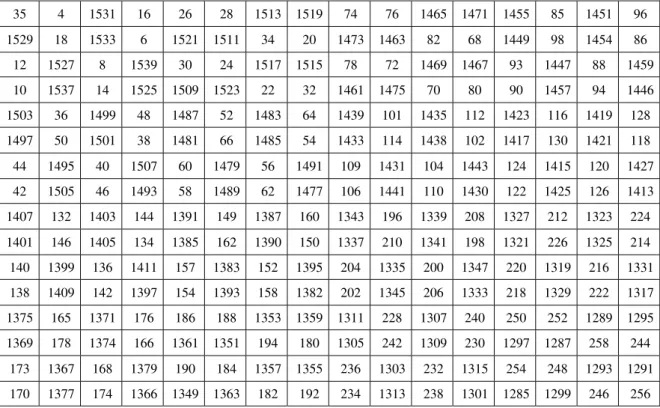
Other matrices MS8_sub2, MS8_sub3 and MS4_sub4 are generated in this manner and they are concatenated so that they form MS16 which is shown in Fig. 7. Similarly other MS16 matrices are generated by using suitable transformations of the seed number. In this paper, only four MS16 matrices are generated.
B. Encryption / Decryption of message using RSA cryptosystem with Magic Square
To show the relevance of this work to the security of public-key encryption schemes, a public-key cryptosystem RSA is taken. RSA was proposed by Rivest et al [10], [11]. The private key of a user consists of two prime p and q and an exponent (decryption key) d.
The public-key consists of the modulus n = pq, and an exponent e such that d = e-1 mod (p-1) (q-1). To encrypt a plaintext M the user computes C = Me mod n and decryption is done by calculating M = Cd mod n. In order to thwart currently known attacks, the modulus n and thus M and C should have a length of 512-1024 bits in this paper.
B.1. Wrapper implementation – Example
In order to get a proper understanding of the subject matter
of this paper, let p = 11, q = 17 and e = 7, then n = 11(17) = 187, (p-1)(q-1) = 10(16) = 160. Now d = 23. To encrypt, C = M7 mod 187 and to decrypt M = C23 mod 187. Suppose
the message is to be encrypted is “BABA”. The ASCII values for A and B are 65 and 66 respectively. To encrypt B, the numerals which occur at 66th position in first (Fig.7) and third MS16(not shown here) are taken because B occurs in first and third position in the clear text. Similarly, to encrypt A, the numerals at 65th position in second and fourth MS16(not shown here) are taken. Thus NP(A) = 42 and 48, NP(B) = 36
and 44. Hence C(B) = 367mod 187 = 9, C(A) = 427 mod 187 = 15, C(B) = 447 mod 187 = 22, C(A) = 487 mod 187 = 157. Thus, for same A and B which occur more than once, different cipher texts are produced for the same.
C. Parallel Cryptography
To speed up cryptographic transformation, the parallel cryptography is used. Effective scheduling is important to improve the performance of crypto system in parallel [13]. The scheduling algorithms are divided into two classes: time sharing and space sharing. Backfilling is the space sharing optimization technique.
Maui is a job scheduler specifically designed to optimize system utilization in policy driver, heterogeneous high performance cluster (HPC) environment. The philosophy behind it is essentially schedule jobs in priority order, and then backfill in the holes [9]. Maui has a two-phase scheduling algorithm. In the first phase, the high priority jobs are scheduled using advanced reservation. A backfill algorithm is used in the second phase to schedule low-priority jobs between previously selected jobs [5]. In our study the Maui Scheduler with back filling scheduling technique is used to calculate the encryption/decryption time of given message in simulated environment.
35 4 1531 16 26 28 1513 1519 74 76 1465 1471 1455 85 1451 96
1529 18 1533 6 1521 1511 34 20 1473 1463 82 68 1449 98 1454 86
12 1527 8 1539 30 24 1517 1515 78 72 1469 1467 93 1447 88 1459
10 1537 14 1525 1509 1523 22 32 1461 1475 70 80 90 1457 94 1446
1503 36 1499 48 1487 52 1483 64 1439 101 1435 112 1423 116 1419 128
1497 50 1501 38 1481 66 1485 54 1433 114 1438 102 1417 130 1421 118
44 1495 40 1507 60 1479 56 1491 109 1431 104 1443 124 1415 120 1427
42 1505 46 1493 58 1489 62 1477 106 1441 110 1430 122 1425 126 1413
1407 132 1403 144 1391 149 1387 160 1343 196 1339 208 1327 212 1323 224
1401 146 1405 134 1385 162 1390 150 1337 210 1341 198 1321 226 1325 214
140 1399 136 1411 157 1383 152 1395 204 1335 200 1347 220 1319 216 1331
138 1409 142 1397 154 1393 158 1382 202 1345 206 1333 218 1329 222 1317
1375 165 1371 176 186 188 1353 1359 1311 228 1307 240 250 252 1289 1295
1369 178 1374 166 1361 1351 194 180 1305 242 1309 230 1297 1287 258 244
173 1367 168 1379 190 184 1357 1355 236 1303 232 1315 254 248 1293 1291
170 1377 174 1366 1349 1363 182 192 234 1313 238 1301 1285 1299 246 256
No. of Processors
1 2 4 8 16 File
Size (MB) E
ms D ms
T ms
E ms
D ms
T ms
E ms
D ms
T ms
E ms
D ms
T ms
E ms
D ms
T ms
1 328 361 689 518 540 1058 440 462 902 401 420 821 381 392 773
2 640 641 1281 682 690 1372 518 528 1046 440 455 895 402 404 806
4 1250 1297 2547 994 1010 2004 678 682 1360 520 522 1042 441 443 884
8 2515 2578 5093 1627 1651 3278 994 1006 2000 680 686 1366 520 524 1044
E- Encryption time, D-Decryption time, T- Total Time, and ms- milliseconds
Fig. 8. Encryption and Decryption time using RSA on a Pentium Processor
III. EXPERIMENTAL RESULT
The methodology proposed is implemented in visual C++ version 6.0. The time taken for encryption and decryption of various file sized message in simulated parallel environment using RSA public key crypto system with magic square are shown in Fig. 8. The simulation scenario configured in our implementation consisting of 2, 4, 8, and 16 processors.
From Fig. 8, we observe that as the file size is increased in double, encryption and decryption time is also increased in double for single processor. Moreover, the time taken for encryption and decryption is almost same. Parallel encryption and decryption have more effect if the file size is increased.
IV. CONCLUSION
An alternative approach to existing ASCII based cryptosystem a number based approach is thought of and implemented. This methodology will add-on one more layer of security, it adds numerals for the text even before feeding into public-key algorithm for encryption. This add-on security is built using magic square position equivalent to the character to be encrypted.
Further efficiency of cryptographic operation depends on performing them in parallel. Simulation using different number of processors for encryption /decryption has shown that the time taken for decryption is approximately 1.2 times larger than the corresponding time for encryption.
REFERENCES
[1] Antti Hamalainenn, Matti Tommiska, and Jorma Skytta, “6.78 Gigabits per Second Implementation of the IDEA Cryptographic Algorithm LNCS 2438”, Springer-Verlag, 2002, pp. 760-769.
[2] Adam Rogers, and Peter Loly, “The Inertial Properties of Magic Squares and Cubes”, Nov. 2004, pp. 1-3.
[3] Clifford A. Pickover, “The Zen of Magic Squares, Circles and Stars”, Universities Press, Hyderabad, India, 2002.
[4] Dan Thomasson. Knights Templar Ciphers. March 2004, Available: http://www.borderschess.org/ KTcipher.html
[5] Daniel Page, and Nigel P.Smart. “Parallel Cryptographic Arithmetic using a redundant Montegomery Representation”. IEEE Transactions on Computers Vol. 53, No.9, November 2004.
[6] http://en.wikipedia.org/wiki/Magic_ squares , pp. 1-3.
[7] Josef Piepryk, and David Pointcheval, “Parallel Authentication and Public-Key Encryption”, The Eigth Australasian Conference on Information Security and Privacy, Springer-Verlag, Jul. 2003, pp. 383-401.
[8] A. J. Menezes, P.C. Van Oorschot, and S. Vanstone, “Handbook of Applied Cryptography”, CRC Press, Boca Ration, Florida, USA, 1997.
[9] Sayeed Iqbal, Rinku Gupta and Yung-Chin Lang, “Job Scheduling in HPC Clusters”, Power Solutions, Feb. 2005, pp. 133-135.
[10] B.Schneier, “Applied Cryptography”, John Wiley & Sons Inc., New York, Second Edition, 1996.
[11] Stallings,“Cryptography and Network Security”, Prentice Hall, Upper Saddle River, New Jersey, USA, Second Edition, 1997.
[12] Thomas Wollinger, Jorge Guajardo, and Chirst of Paar, “Cryptography in Embedded Systems: An overview. In Proc. of the Embedded World 2003 Exhibition and Conference”, Feb. 18-20, 2003, pp. 735-744,. [13] Y.Zhang, H. Franke, J. E. Moreira and A. Sivasubramanian, “An