Comparison of Immunization in Iran and Turkey in 1980- 2013
Seyed Amirhosein Ghazizade Hashemi1, Saeed Bayyenat2,
Abbasali Purbafrani3, *Habibolah Taghizade Moghaddam4, 1Masumeh Saeidi5
1
Assistant Professor of Otorhinolaryngology, Shahid Beheshti University of Medical Sciences, Tehran, Iran.
2
Assistant Professor of Anesthesiology , Department of Anesthesiology, Baqiyatallah University of Medical Sciences, Tehran, Iran.
3Medical Education, Ministry of Health and Medical Education, Tehran, Iran. 4
Faculty of Medicine, Mashhad University of Medical Sciences, Mashhad, Iran.
5
Students Research Committee, Faculty of Medicine, Mashhad University of Medical Sciences, Mashhad, Iran.
Abstract
Immunization is today one of the safest, most cost-effective, and powerful means of preventing deaths and improving lives. Over the years, all countries of the world have incorporated an increasingly broad immunization agenda in their public health interventions. Immunization programmes are now routinely reaching over 80 percent of children under one year of age. Iran and Turkey with a population of nearly the same, are in the neighborhood and the aim of this study is to compare the vaccination situation in the two countries from 1980 to 2013.
Key words: Immunization, Iran, Turkey, Vaccination.
*
Corresponding Author:
Habibolah Taghizade Moghaddam, Mashhad University of Medical Sciences, Mashhad, Iran. Email: [email protected]
Introduction
Forty years ago, in May 1974, the 27th World Health Assembly resolved to build on the success of the smallpox eradication programme and established the Expanded Programme on Immunization (EPI) to ensure that all children, in all countries, benefited from life-saving vaccine.
The EPI launched at that time recommended the use of vaccines to protect against six diseases: tuberculosis (BCG), diphtheria, tetanus, pertussis (DTP vaccine), measles and poliomyelitis.
Thanks to the progress accomplished by countries, immunization is today one of the safest, most cost-effective, and powerful means of preventing deaths and improving lives. Over the years, all countries of the world have incorporated an increasingly broad immunization agenda in their public health interventions. Immunization programmes are now routinely reaching over 80 percent of children under one year of age.
The continued discovery, research and development of new and improved vaccines has made immunization even more effective in combating major causes of childhood illness and death. Indeed, the number of vaccines available today to protect infants, children and also now adolescents and adults against infectious diseases has increased substantially.
The push for universal childhood immunization in the 1980s, the last stages of the polio eradication effort and the intensified efforts launched in all regions to introduce new vaccines, eliminate measles and rubella, eliminate maternal and neonatal tetanus have acted as a catalyst to bring other health services to previously unreached children.
The public and private sectors are entering a new era of cooperation where the contribution of all partners is important (1).
Babies are born with protection against certain diseases because antibodies from their mothers were passed to them through the placenta. After birth, breastfed babies get the continued benefits of additional antibodies in breast milk. But in both cases, the protection is temporary. Immunization (vaccination) is a way of creating immunity to certain diseases by using small amounts of a killed or weakened microorganism that causes the particular disease.
Microorganisms can be viruses (such as the measles virus) or they can be bacteria (such as pneumococcus). Vaccines stimulate the immune system to react as if there were a real infection — it fends off the "infection" and remembers the organism so that it can fight it quickly should it enter the body later.
History of Vaccination
The first human vaccines against viruses were based using weaker or attenuated viruses to generate immunity. The smallpox vaccine used cowpox, a poxvirus that was similar enough to smallpox to protect against it but usually didn’t serious illness. Rabies was the first virus attenuated in a lab to create a vaccine for humans.
the bacteria, and not the bacteria themselves, cause illness); or merely segments of the pathogen (this includes both subunit and conjugate vaccines) (1-4).
Immunization against vaccine-preventable diseases is essential to reaching Millennium Development Goal 4 on reducing under-five mortality by two thirds by 2015. This is because millions of children die from diseases that can be prevented through vaccines. Progress is being made. For example, in 2010 an estimated 109 million children under the age of one were vaccinated with three doses of diphtheria-tetanus-pertussis (DTP3) vaccine.
Immunization is also a key strategy to ensure global health and to respond to the threat of emerging infections such as pandemic influenza (Table.1).
Fig.1: WHO via Images from the History of
Medicine (NLM),Preparation of measles vaccine
Tabale 1: Types of vaccines
Vaccine type Vaccines of this type on U.S. Recommended Childhood (ages 0-6) Immunization Schedule
Live, attenuated
Measles, mumps, rubella (MMR combined vaccine) Varicella (chickenpox)
Influenza (nasal spray) Rotavirus
Inactivated/Killed Polio (IPV)
Hepatitis A
Toxoid (inactivated toxin) Diphtheria, tetanus (part of DTaP combined immunization)
Subunit/conjugate
Hepatitis B
Influenza (injection)
Haemophilus influenza type b (Hib)
Pertussis (part of DTaP combined immunization) Pneumococcal
Meningococcal
Vaccine type Other available vaccines
Live, attenuated Zoster (shingles)
Yellow fever
Inactivated/Killed Rabies
Subunit/conjugate Human papillomavirus (HPV)
Read 10 facts on immunization
- Immunization prevents between 2-3 million deaths every year.
pertussis (whooping cough), and measles. It is one of the most successful and cost-effective public health interventions.
-More children than ever are being reached with immunization.
In 2010, an estimated 109 million children under the age of one were vaccinated with three doses of diphtheria-tetanus-pertussis (DTP3) vaccine. These children are protected against infectious diseases that can have serious consequences like illness, disability or death.
-An estimated 19.3 million children under the age of one did not receive DTP3 vaccine.
Seventy percent of these children live in ten countries, and more than half of them live in WHO’s Africa and South-East Asia regions.
- Over 1 million infants and young children die every year from pneumococcal disease and rotavirus diarrhoea
- A large number of these deaths can be prevented through vaccination.
- Public-private partnerships facilitate the development and introduction of vaccines.
For example, a new vaccine which prevents the primary cause of epidemic meningitis in sub-Saharan Africa, meningococcal A, MenafriVac, was introduced in Burkina Faso, Mali and Niger last year. At the end of 2011. Cameroon, Chad and Nigeria are vaccinating more than 22 million individuals with the vaccine which has the potential to eliminate the leading cause of meningitis epidemics in Africa.
-The supply of influenza vaccines has been significantly expanded.
The expansion has been possible as a result of WHO supporting the efforts of vaccine manufacturers to produce and license influenza vaccines in 11 developing countries.
- Global measles mortality has declined by 74%.
Global measles mortality has been reduced from an estimated 535 300 deaths in 2000 to 139 300 in 2010, thanks to intensified vaccination campaigns.
- Polio cases have decreased by over 99%.
- Annual deaths from neonatal tetanus have fallen.
Neonatal tetanus deaths have declined to an estimated 59 000, down from 790 000 deaths in 1988.
- Immunization provides an opportunity to deliver other life-saving measures.
Immunization not only protects children from vaccine-preventable diseases. It also serves as an opportunity to deliver other life-saving measures, such as vitamin A supplements to prevent malnutrition, insecticide-treated nets for protection against malaria and deworming medicine for intestinal worms. In addition, the benefits of immunization are increasingly being extended across the life course to include adolescents and adults, providing protection against life-threatening diseases such as influenza, meningitis, and cancers that occur in adulthood.
General information about Iran
Iran, a Middle Eastern country south of the Caspian Sea and north of the Persian Gulf, is three times the size of Arizona. It shares borders with Iraq, Turkey, Azerbaijan,
Turkmenistan, Armenia, Afghanistan, and Pakistan. Capital is Tehran and total population in 2013 was 77'447'000 .
General information about Turkey
Turkey is considered to be the gateway between Europe and Asia; it is an Eurasian country located on the Mediterranean stretching across the Anatolian peninsula in southwest Asia and the Balkan region of southeastern Europe. It is bordered by the Black Sea, the Marmara Sea, the Aegean Sea and Mediterranean Sea and Capital is Ankara. Total population in 2013 was 74'933' 000.
Results
Table 2: Development status in Iran and Turkey in 2013 Development status:
(Iran)
Developing GNI / capita (US$):
5'780 Infant (under 12 months) mortality rate:
15 GDP / capita
(US$):
15'586 Child (under 5 years) mortality rate:
18 Development status:
(Turkey)
Developing GNI / capita (US$):
10'950 Infant (under 12 months) mortality rate:
12 GDP / capita
(US$):
18'975 Child (under 5 years) mortality rate:
14
Population data in thousands shown at (Table.3) (1). Results shows Iran's birth rate and Surviving infants rate is higher than Turkey.
Table 3: Population data in Iran and Turkey at 1980-2013
Iran-Population data in thousands
2013 2012 2011 2010 2009 2000 1990 1980
Total population 77'447 76'424 75'424 74'462 73'543 65'911 56'362 38'890
Births 1'455 1'454 1'445 1'427 1'401 1'228 1'839 1'748
Surviving infants 1'433 1'431 1'420 1'401 1'375 1'191 1'751 1'604 Pop. less than 5 years 7'090 7'003 6'833 6'556 6'339 6'317 9'313 6'927 Pop. less than 15 years 18'440 18'120 17'834 17'586 17'489 22'850 25'543 16'988 Female 15-49 years 22'950 22'832 22'682 22'507 22'268 17'571 12'228 8'518
Turkey-Population data in thousands
2013 2012 2011 2010 2009 2000 1990 1980
Total population 74'933 73'997 73'059 72'138 71'241 63'174 53'995 43'906
Births 1'261 1'268 1'275 1'282 1'288 1'356 1'407 1'551
Surviving infants 1'246 1'253 1'259 1'264 1'269 1'315 1'316 1'385 Pop. less than 5 years 6'355 6'362 6'363 6'359 6'366 6'571 6'648 6'641 Pop. less than 15 years 19'224 19'249 19'261 19'262 19'278 19'364 19'575 17'588 Female 15-49 years 20'288 20'075 19'859 19'647 19'442 17'275 13'675 10'403
The number of reported case at 1980 to 2013 shown at (Table.4) (1).
Table 4: Number of reported cases in Iran and Turkey at 1980-2013
Iran- Number of reported case
Diseases
Diphtheria 190 150 132 106 58 18 373 139
Japanese encephalitis
_ _ _ _ _ _ _ _
Measles 189 332 73 538 262 11'874 5'341 31'130
Mumps _ _ _ _ _ 10'417 _ _
Pertussis 1'415 1'329 650 464 590 94 1'230 20'395
Polio* 0 0 0 0 0 3 15 80
Rubella 32 30 20 24 11 1'154 _ _
Rubella (CRS) 0 0 0 0 49 _ _ _
Tetanus (neonatal) 3 2 3 2 3 13 26 _
Tetanus (total) 10 13 18 14 8 27 30 86
Yellow fever _ _ _ _ _ 0 _ _
Turkey-Number of reported case
Diseases
Diphtheria 0 0 1 0 0 4 20 86
Japanese encephalitis
Measles 7'405 349 111 7 4 16'244 11'372 8'618
Mumps 597 834 1'609 1'525 2'180 _ _ _
Pertussis 33 18 242 48 11 510 454 1'520
Polio* 0 _ 0 0 0 0 24 182
Rubella 81 43 1'734 64 97 _ _ _
Rubella (CRS) 0 0 1 0 1 _ _ _
Tetanus (neonatal) 0 0 0 2 0 26 67 _
Tetanus (total) 15 11 24 25 12 38 123 48
Yellow fever _ _ 0 0 0 _ _ _
* Polio refers to all polio cases (indigenous or imported), including polio cases caused by Vaccine derived polio viruses (VDPV);"
"it does not include cases of Vaccine-associated paralytic polio (VAPP) and cases of non polio acute flaccid paralysis [AFP]).
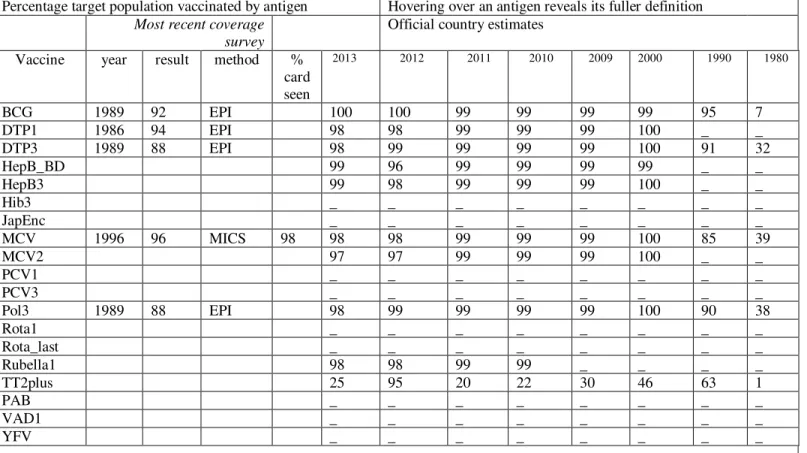
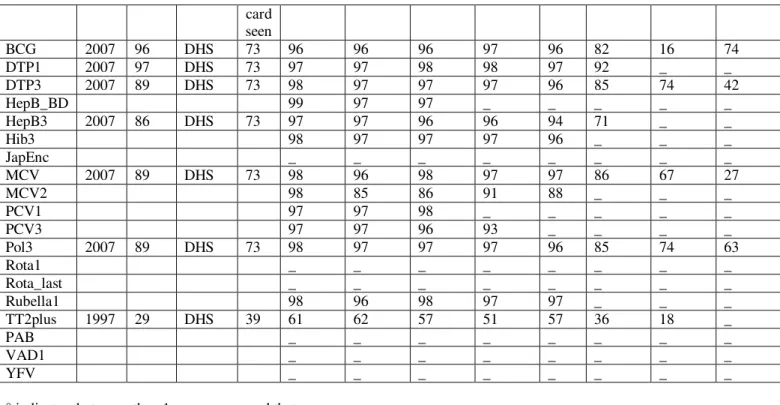
Percentage target population vaccinated by antigen in Iran and Turkey betwen 1980 to 2013 is showed at (Tables 4,5) (1). Results shows vaccination status in Iran in these years is better than the Turkey.
Table 4: Percentage target population vaccinated by antigen in Iran
Percentage target population vaccinated by antigen Hovering over an antigen reveals its fuller definition
Most recent coverage
survey
Official country estimates Vaccine year result method %
card seen
2013 2012 2011 2010 2009 2000 1990
1980
BCG 1989 92 EPI 100 100 99 99 99 99 95 7
DTP1 1986 94 EPI 98 98 99 99 99 100 _ _
DTP3 1989 88 EPI 98 99 99 99 99 100 91 32
HepB_BD 99 96 99 99 99 99 _ _
HepB3 99 98 99 99 99 100 _ _
Hib3 _ _ _ _ _ _ _ _
JapEnc _ _ _ _ _ _ _ _
MCV 1996 96 MICS 98 98 98 99 99 99 100 85 39
MCV2 97 97 99 99 99 100 _ _
PCV1 _ _ _ _ _ _ _ _
PCV3 _ _ _ _ _ _ _ _
Pol3 1989 88 EPI 98 99 99 99 99 100 90 38
Rota1 _ _ _ _ _ _ _ _
Rota_last _ _ _ _ _ _ _ _
Rubella1 98 98 99 99 _ _ _ _
TT2plus 25 95 20 22 30 46 63 1
PAB _ _ _ _ _ _ _ _
VAD1 _ _ _ _ _ _ _ _
YFV _ _ _ _ _ _ _ _
° indicates that more than 1 survey occurred that year
Table 5: Percentage target population vaccinated by antigen in Turkey
Percentage target population vaccinated by antigen Hovering over an antigen reveals its fuller definition
Most recent coverage
survey
Official country estimates
card seen
BCG 2007 96 DHS 73 96 96 96 97 96 82 16 74
DTP1 2007 97 DHS 73 97 97 98 98 97 92 _ _
DTP3 2007 89 DHS 73 98 97 97 97 96 85 74 42
HepB_BD 99 97 97 _ _ _ _ _
HepB3 2007 86 DHS 73 97 97 96 96 94 71 _ _
Hib3 98 97 97 97 96 _ _ _
JapEnc _ _ _ _ _ _ _ _
MCV 2007 89 DHS 73 98 96 98 97 97 86 67 27
MCV2 98 85 86 91 88 _ _ _
PCV1 97 97 98 _ _ _ _ _
PCV3 97 97 96 93 _ _ _ _
Pol3 2007 89 DHS 73 98 97 97 97 96 85 74 63
Rota1 _ _ _ _ _ _ _ _
Rota_last _ _ _ _ _ _ _ _
Rubella1 98 96 98 97 97 _ _ _
TT2plus 1997 29 DHS 39 61 62 57 51 57 36 18 _
PAB _ _ _ _ _ _ _ _
VAD1 _ _ _ _ _ _ _ _
YFV _ _ _ _ _ _ _ _
° indicates that more than 1 survey occurred that year
Immunization Schedules in Iran and Turkey has shown at (Tables 6,7) (1). The program planning shown two countries according to their regional conditions, have immunization programs for children and adults.
Table 6: Immunization Schedule in Iran,2013
Immunization Schedule
Vaccine Schedule Entire
country
Comment
BCG birth; Yes
DT 2, 4, 6, 18 months; 6 years; Yes DTwP 2, 4, 6, 18 months; 6 years; Yes
HepB birth; 2, 6 months; Yes also specified high risk group, HCWs, Medical students Influenza > 65 years; Yes pregnant women, healthcare workers and persons with
chronic disease
MMR 12, 18 months; Yes
Measles Yes Measles outbreak response
MenAC Yes military
OPV birth; 2, 4, 6, 18 months; 6 years;
Yes
Td Yes repeated every 10 years - military and pregnant women
Varicella Yes Children with lymphatic and hematologic malignancies
and their siblings
YF Yes travelers
Table 7: Immunization Schedule in Turkey, 2013
Immunization Schedule
Vaccine Schedule Entire country Comment
BCG 2 months; Yes
DTaPIPV 6 years; Yes
HepA 18, 24 months; Yes
HepB birth; 1, 6 months; Yes
MMR 12 months; 6 years; Yes
OPV 6, 18 months; Yes
Pneumo_conj 2, 4, 6, 12 months; Yes
Td 1st contact; +1, +6 months; +1, +1 years; Yes
Varicella 12 months; Yes
Conclusion
New data released show that under five mortality rates have dropped by 49% between 1990 and 2013 thanks to affordable interventions such as immunization. But overall progress is still short of meeting the global target of a two-thirds decrease in under five mortality by 2015. In 2013, 2.8 million babies died within the first month of life, which represents about 44% of all under five deaths. Compared results of immunization during the 1980 to 2013 between two country (Iran and Turkey), represents a better immunization status in Iran compared to Turkey; despite the fact that the Turkish population was lower than the Iran, and development indicators in Turkey, was better than of Iran (1-12).
References
1. World Health Organization (WHO) The global vaccine safety. Availabe at:
http://www.who.int/immunization/monitoring_s urveillance/resources/en/.[assessed 12/07/2014] 2. Plotkin SA, Mortimer E. Vaccines. New
York: Harper Perennial; 1988.
3. Plotkin SA, Orenstein WA, Offit PA, eds.
Vaccines. Philadelphia: Saunders; 2008.
4. Immunization Schedules. Available at: http://www.cdc.gov/vaccines/schedules/index .html. [assessed 12/05/2014]
5. Chang Y, Brewer NT, Rinas AC, Schmitt K, Smith JS . "Evaluating the impact of human papillomavirus vaccines". Vaccine 2009;27 (32): 4355–62.
6. World Health Organization, Global Vaccine Action Plan 2011-2020. Geneva, 2012. 7. Lombard M, Pastoret PP, Moulin AM . "A
brief history of vaccines and vaccination". Rev. - Off. Int. Epizoot2007; 26 (1): 29–48. 8. Wolfe R, Sharp L. "Anti-vaccinationists past
and present". BMJ 2002;325 (7361): 430–2. . 9. "The 2013 World Bank Development
Indicators Online", GDP per capita is PPP adjusted.
10. "United Nations, Population Division. The World Population Prospects - the 2012 revision". New York, 2013.