Albanian j. agric. sci. 2014 (Special edition) Agricultural University of Tirana
RESEARCH ARTICLE
(Open Access)
Albanian consumer’s perception towards animal welfare
KASTRIOT BELEGU*, PЁLLUMB ZALLA, MAJLINDA BELEGU, DRITAN LAÇI, ENKELEDA OZUNI, EGON ANDONI
Agricultural University of Tirana, ALBANIA
* corresponding author email: [email protected]; Abstract
This study is the result of subsequent of previous survey conducted by the author regarding animal welfare during transportation and destined for meat consumption or to be breed for milk. The strategy of European Union for Animal Protection and Welfare 2012-2015 focusing on animal’s breed for economic purposes aims to increase or guarantee animal welfare during breeding, transportation and to the butchery. Thus, its purpose is to guarantee the welfare of agricultural and domestic animals, whose final destination is the consumption of their meat in all chains until they get to the ultimate consumer. The purpose of this study is to assess the level of knowledge that consumers have in relation to animal welfare as well as their perception on the current situation of animal welfare in Albania. At the same time, the results of this survey will also serve as indicators to give its contribution to the strategy for increasing consumer’s level of awareness on animal welfare and the impact of animal welfare on human life.The process of interviweing was realised with 166 occasional people belonging to different ages, different educational levels who are rezidents in different areas of Albania, so that the survey can be as representative as possible.Based on the analyses of the responses given by the interviewed results that the Albanian consumer is partially informed and the rest of them uninformed. What is worth mentioning here is the fact that mostly of the interviewed are really concerned about animal welfare during breeding, transportation and butchery’s conditions.
Keywords:Animal welfare, consumer health, animal health, stress of transport, transport of animal
Introduction
Broom [2] defines that the welfare of an animal is its state as regards its attempts to cope with its environment. Welfare therefore includes the extent of failure to cope, which may lead to disease and injury, but also ease of coping or difficulty of coping [16]. One important part of the animal’s state is that which involves attempts to cope with pathology (i.e., the health of the animal); so, health is part of welfare [15]. Many studies have proved that there is a direct connection between the health of animal and consumers.
This survey is the result of a previous survey conducted by the author regarding animal welfare during transportation and destined for meat consumption or to be breed for milk. The strategy of European Union for Animal Protection and Welfare 2012-2015 focusing on animal’s breed for economic purposes aims to increase or guarantee animal welfare during breeding, transportation and to the butchery. Thus, its purpose is to guarantee the welfare of agricultural and domestic animals, whose final destination is the consumption of their meat in all rings until they get to the ultimate consumer.
Considering the experience of European Union member states, the orientation of livestock farms is leading toward the industralization of livestock production which in turn adds to the risk of not taking into account the needs of animals or poultry in order to provide similiar natural conditions.
Currently there is an increase of the average size of farms in Albania. A part of these familial livestock farms are oriented in increasing the number of heads, as well as creating new farms focusing on market production. There are a lot of milk and meat oriented farms at the moment. Moreover there are also poultry farms oriented in producing brojlers or eggs dominated by the intensive way of breeding. Based on 2011 statistics, it results that there are about 3372 farms of calves and caws, of which 1317 have got over 10 heads. In addition, it results that there are 65 poultry farms, where about 38 breed over 5000 heads each.
In addition, another study conducted by the author concluded that local transportation conditions of animals in Albania are far away from those determined in the regulation of European Union for transport conditions which would guarantee welfare during transportation.
Also, based on the previous study the author has noticed that a big number of animals surpass authority control competent for guaranteeing animal welfare in the various rings from breeding to butchery.
In order to guarantee animal welfare it is important to coordinate the work of breeders, transporter or animal companions, butchery workers, various responsible monitoring institutions and the most important, consummers.
Currently there is a law on Veterinary Service in Albania which is approved on 29.09.2011, as well as the “Regulation on Animal Protection during Transportation” approved on 21.12.2011. Considering the fact that this law is only recently approved and based on the author’s assessments (from the previous survey) as a result of several discussions with different specialists of the veterinary field, it is unknwon to the majority. Thus, in order to enforce its application, it is important to make consumers aware that during the proces of decision making they should also consider in advance the application of practices that guarantee animal welfare.
For this reason the survey was undertaken to provide an overview of how animal welfare is perceived from consumers and how sensitive they are toward this situation on the level of animal breeding in farms as well as during transportation and their slaughtery in the butchery.
In order for the study to be as representative as possible, it included consummers of different areas of Albania. The total number of the interviwed included in the study is 166.
Main objective
The purpose of this study is to assess the level of knowledge that consumers have in relation to animal welfar as well as their perception on the current situation of animal welfare in Albania. At the same time, the results of this survey will also serve as indicators to determine the strategy for increasing consumer’s level of awareness on animal welfare and the impact of animal welfare on human life.
Methodology
This research has been done in order to assess, on a national scale, the consumers concern about animal welfare, and the derived and perceived impact on consumer health. The primary objective of this study was to find out how the individual concerns about the animal welfare has an effect on the consumer health in Albania.
Following the best practice for conducting surveys, the selection of the survey sample was done by first geographically clustering the consumers. It is revealed that geographical differentiation (rural, urban and peri-urban) was the most appropriate form of clustering for this survey. The final sampled numbers closely approximated the proportions of clients in terms of gender and percentage of population.
It is really important to highlight the fact that the choices were occasional and the interviwed consumers are rezidents of different areas of Albania, what makes the study even more representative regarding its territorial coverage all around the country.
The process of interviweing was realised with 166 ocasional individuals belonging to different ages, gender, background, and educational levels who are rezidents in different areas of Albania, so that the survey can be as much representative as possible.
The study combined the application of both
quantitative and qualitative tools including
questionnaire on different indicators related to consumer perceptions on animal welfare and the consumer affects addressed to different target groups of population in Albania. The questionnaire used is an open-closed type, that is, a kind of offering many ways and possibilities to respond, even outside the given options. Qualitative information was collected through Focus Group Interviews and Semi-structured interviews to understand the situations that people face on how they perceive animal welfare, and how do they expect this to have an impact on consumer welfare and their wellbeing in Albania. The questionnaire used belongs to the open-closed type, that is, there are many ways and possibilities to reply, even outside the given options.
Results and Discusions
Albanian consumer’s perception towards animal welfare
Figure 1 Have you heard about Animal
welfare?
36.3% of the interviewed are really concerned about animal protection, while 53.3% are very little concerned. 10.4% of them are not concerned at all.
32.5% of the interviewed are really concerned about animal welfare during breeding, transportation and butchery’s conditions, whereas about 44.5% are
very little concerned about it. 1.8% of the interviewed are not concerned at all while the rest of about 21.2% do not have information.
What is worth mentioning here is the fact that 61.8% of the interviewed think that meat is possible to produce also by guaranteeing animal welfare. 37.5% of the interviewed do not have information about this. Only one of the interviewed thinks that it is impossible to produce meat and guarantee animal welfare at the same time.
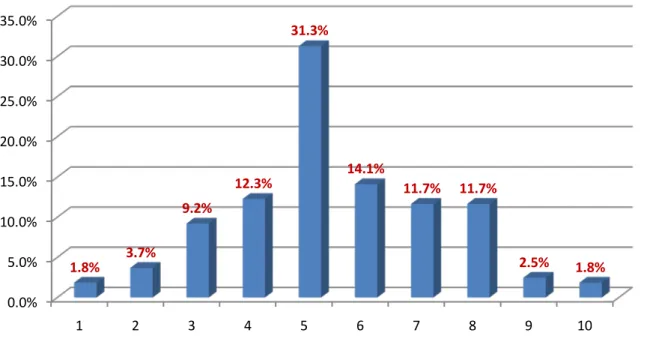
Regarding the question, if current animal breeding conditions in farms guarantee welfare or not, it was asked to be assessed with 1-10 points. The results show that the majority of the interviewed or 31.3% assess it with 5 points. 27 % of the interviewed assess it with 1-4 points. 37.5 % of them assess breeding conditions in farms with 6-8 points while 4.3% of the interviewed assess it with 9-10 points, so this is a percentage which shows that breeding conditions in farms have a low assessment in relation to animal welfare (Figure 2).
Figure 2 How suitable do you assess animal breeding conditions in farms in relation to guaranteeing animal
welfare?
In relation to guaranteeing animal welfare during transportation 91.5 % of the interviewed assess transport conditions with 1-7 points and only 8.5 % assess transport conditions with of 8-10 points (Figure 3).Obviously there is a low perception of consumers regarding conditions of animal transportation.
Regarding interviewee’s perceptions on slaughter conditions in the butcheries it results that about 53.7 % of them assess it with 1-3 points. Then, there is a rapid fall on the number of the interviewed
which goes parallel with the increase of points in the assessment of butcheries conditions. Thus, 34 % of the interviewed assess butcheries conditions with 4-7 points. Then the number of interviewed that have a positive assessment goes down drastically and only 12.3% assess butcheries conditions with 8-10 points (Figure 4).What is worth mentioning is that 1.25% of the interviewed have assessed butcheries conditions with 0 point which is something unforeseen 0.0%
5.0% 10.0% 15.0% 20.0% 25.0% 30.0% 35.0%
1 2 3 4 5 6 7 8 9 10
1.8%
3.7%
9.2%
12.3%
31.3%
14.1%
11.7% 11.7%
2.5% 1.8%
92.7
Figure 3 How suitable do you assess animal local transport conditions in relation to guarantee animal welfare?
Figure 4 How suitable do you assess slaughter conditions in the butcheries in relation to guarantee animal
welfare?
Regarding the impact on consumer’s health, 85.7% of the interviewed quote it at the level of 8-10 points. Then this trend goes down and about 14.3% of the interviewed quote this bond with 3-7 points. Thus, it is noticed that the majority of the interviewed not only consider this bond but also think that it is very important.
As for the readiness of paying more for the meat that comes from animals whose welfare is guaranteed, it is noticeable that there is a variation of the added % compared to the current price. What is important to mention here is the fact that only 7.9% of the interviewed are not ready to pay more per unit despite guaranteeing the welfare of the animal whose meat they are buying. 16.4% responded that they do not 0.0%
5.0% 10.0% 15.0% 20.0% 25.0%
1 2 3 4 5 6 7 8 9 10
9.1%
12.2% 12.8%
20.1%
17.7%
9.1%
10.4%
4.9%
1.8% 1.8%
0.0% 5.0% 10.0% 15.0% 20.0% 25.0%
1 2 3 4 5 6 7 8 9 10
16.0%
14.2%
23.5%
9.9%
11.7%
6.8%
5.6%
4.9%
Albanian consumer’s perception towards animal welfare know what is the % they would be ready to pay more
in order to consume meat from animals whose welfare is guaranteed. .
Only 20.1% of the interviewed condition their decision-making on buying meat based on the initial information on guaranteeing of animal welfare. 76.8% of the interviewed people declared that they are very little influenced in their decisions for buying meat if animal welfare is guaranteed in advance or not. Only 3% of the interviewed declared that their decisions on buying meat are not at all influenced if animal welfare is guaranteed in advance or not.
Conclusions
Based on the analyses of the responses given by the interviewed results that the Albanian consumer is partially informed and the rest of them uninformed. Also the majority of the interviewed assess that animal breeding in farms guarantees welfare. Regarding animal transport conditions, their assessment is not at the right level. As for animal slaughtering the assessment is very low.
References
1. Baltussen W, Gebrensbet.G, Roest D K.: Study on the impact of Regulationb (EC) No1/2005 on the protection of animals during transport, Draft Final Report. 2001
2. Broom D M.: Does Present Legislation Help
Animal Welfare? 2001. available at www.agriculture.de
3. Broom D M.: The effects of land transport on animal welfare2005.
4. Croney C C, Millman S T: BOARD-INVITED
REVIEW: The ethical and behavioral bases for farm animal welfare legislation: Journal of Animal Science 2007, 85:556-565.
5. Communication from the Commission to the
European Parliament, the Council and the European Economic and Social Committee on the European UnionStrategy for the Protection and Welfare of Animals 2012-2015.
6. Borell E, Schäfferb D: Legal requirements and assessment of stress and welfare during transportation and pre-slaughter handling of pigs. Livestock Production Science 2005, 97 81 – 87.
7. Borell E: The biology of stress and its
application to livestock housing and transportation assessment Journal of Animal Science 2001, 79: E260-E267.
8. European Commission Health & Consumer
Protection Directoreate-General Directorate
C-Scientific Opinion C2 - Management of
scientific committees; scientific co-operation and networks The welfare of animals during transport (details for horses, pigs, sheep and cattle) Report of the Scientific Committee on Animal Health and Animal Welfare 2002.
9. Smith C G, Grandin T, Friend T H, Jr L D,
Swanson J C: Effect of Transport on Meat
Quality and Animal Welfare of Cattle, Pigs, Sheep, Horses, Deer, and Poultry. 2004
10. Ligji No. 10465, 29.09.2011, per Sherbimin
Veterinar ne Republiken e Shqiperise.
11. Möstl E, Palme R: Hormones as indicators of stressDomestic Animal Endocrinology 2002, 23: 67–74.
12. OIE. Legislative and regulatory options for animal welfare,2007.
13. Palme R, Robia C, Baumgartner W and Möstl E : Transport stress in cattle as reflected by an increase in faecal cortisol metabolites.
Veterinary Record 2000,146: 108-109.
14. Regulation (EC) No 1/2005: On the protection of animals during transport.
15. Scientific Opinion : Scientific Opinion
Concerning the Welfare of Animals during Transport EFSA Panel on Animal Health and Welfare (AHAW) European Food Safety Authority (EFSA), Parma, Italy This scientific opinion replaces the previous version published on 12 January 2011.