PONTIFÍCIA UNIVERSIDADE CATÓLICA DO RIO GRANDE DO SUL FACULDADE DE LETRAS
PROGRAMA DE PÓS-GRADUAÇÃO EM LETRAS
RITA DE CASSIA GLAESER STEIN
CROSS-LINGUISTIC INTERACTION IN L3 PRODUCTION: PORTUGUESE AS A THIRD LANGUAGE IN A BILINGUAL CONTEXT.
RITA DE CASSIA GLAESER STEIN
CROSS-LINGUISTIC INTERACTION IN L3 PRODUCTION: PORTUGUESE AS A THIRD LANGUAGE IN A BILINGUAL CONTEXT.
Dissertação apresentada como requisito parcial para obtenção do grau de Mestre em Letras na área de Linguística ao Programa de Pós-Graduação da Faculdade de Letras da Pontifícia Universidade Católica do Rio Grande do Sul.
Orientador: Dr. Augusto Buchweitz
ACKNOWLEDGMENTS
Along the journey of this thesis, several people must be acknowledged and thanked:
My advisor, Dr. Augusto Buchweitz, for his guidance and support during the writing process, helping me even overseas.
Dr. Jill P. Morford for her mentorship during the initial steps of this research paper and for all the theory provided in her classes.
Dr. Margo Milleret for allowing me to carry out this research during my stay as her Teaching Assistant of Portuguese. For hosting me in her house and taking me around lovely New Mexico. All the participants who gladly volunteered in taking part in the study.
Professor Sergio Kakuta Kato, from the Mathematics School, who helped me with the statistics tests.
Dr. Lilian Scherer for her thoughtful remarks on my initial project.
Dr. Ana Maria Lisboa de Mello, for her comprehension and encouragement when the doubts almost made me give up taking the scholarship abroad.
Vera Galante from the U.S. Embassy Educational Affairs for giving me the first opportunity to study in the United States and who has supported me to take the second one.
André Nogueira Xavier, the best Brazilian I could find in New Mexico and who is now the brother I never had. For all the laughs and insights he has been sharing with me even through distance.
My M.A. peers, for listening me to complain, sometimes excessively, sharing anxieties and also great tips and making this journey more fun: Natali Scolari, Marcos Araújo, Bernardo Limberger, Fernanda De Marchi, Aline Fay.
My aunt for receiving me in her house during the last couple of months and making my life easier when I needed most.
My boyfriend, Rafael, for all the support, patience and love, above all.
ABSTRACT
Extensive research on Bilingualism and Multilingualism has found evidence that different languages compete for activation in the bilinguals and multilinguals‟ mind (Dijkstra, Van Heuven, 2002; Dijkstra, 2003, Green, 1998.) The present study investigates crosslinguistic interaction in the
oral productions of Portuguese by English-Spanish and Spanish-English bilinguals. For the study,
twelve participants – all learners of Portuguese as a third language – were divided in two groups according to their first language (either English or Spanish). For the data collection, participants narrated the picture story “Frog, where are you?” by Mercer Mayer (1969). Participants also filled out the Language Experience And Proficiency Questionnaire (LEAP-Q) (Marian, Blumenfeld, and
Kaushanskaya, 2007.) The instances of language interaction were coded as „syntactic‟, „morphological‟, and „vocabulary‟. Statistics tests were run in order to determine which of the linguistic levels were highly present in the tokens and from which source language: English or
Spanish. According to Hammarberg (2001), factors such as typology, second language (L2) status,
proficiency, and language mode can predict the interactions among different languages in
multilinguals. Based on the factors for interaction, two research questions were asked: 1) Which
factors exert more influence in third language oral production: the typological distance or the L2
status?; 2) Which linguistic features in the target language (Portuguese) will be more influenced by
the two previously acquired languages (English and Spanish): vocabulary, morphology or syntax?
Based on these questions, two mutually exclusive hypotheses were formulated: 1) There will be more
language interaction from Spanish than English due to the closest typological distance of Spanish in
relation to Portuguese, if compared to English (Carvalho and Silva, 2006; Rothman, 2010;) 2) When English is the speakers‟ second language, it will generate more language interaction to Portuguese as L3 due to the foreign language status shared by the L2 and the L3 (Hammarberg, 2001.) The results
show that the typology factor seems to play a more important role in the types of interaction found in
the sample researched. When Spanish as L2 was a more recurrent source of language interaction, it
coincided with its closest typological distance in relation to Portuguese. Vocabulary interaction
occurred more frequently than syntactic or morphological interaction. English as L2 did not show
significance in the interaction of items with Portuguese.
RESUMO
Pesquisas sobre Bilinguismo e Multilinguismo encontraram evidência de que diferentes
línguas competem entre si por ativação na mente de bilíngues e multilíngues (Dijkstra, Van Heuven,
2002; Dijkstra, 2003, Green, 1998). O presente estudo busca investigar a interação crosslinguística na
produção oral de Português por bilíngues Inglês-Espanhol e Espanhol-Inglês – todos alunos de Português como terceira língua (L3). Para o estudo, doze participantes foram divididos em dois
grupos de acordo com a sua primeira língua. Para a coleta de dados, os participantes narraram a
história em imagens "Frog, where are you?" de Mercer Mayer (1969). Os participantes também
preencheram o Questionário de Experiência Linguística e Proficiência (LEAP-Q na sigla em inglês)
(Marian, Blumenfeld e Kaushanskaya, 2007.) As interações crosslinguísticas foram codificadas de
acordo com os níveis linguísticos em: sintáticas, morfológicas e de vocabulário. Testes estatísticos
foram realizados para se determinar os níveis linguísticos mais transferidos e de qual língua fonte
partiram: se do Inglês ou do Espanhol. De acordo com Hammarberg (2001), fatores como a tipologia,
o status de língua estrangeira da segunda língua (L2), a proficiência e o modo de linguagem podem
prever as interações entre os diferentes idiomas em multilíngues. Com base nos fatores para interação
linguística, duas questões de pesquisa foram feitas: 1) Quais os fatores que exercem maior influência
na produção oral de uma terceira língua: a distância tipológica ou o status de língua estrangeira da
L2?; 2) Quais níveis linguísticos da língua-alvo (Português) serão mais influenciados pelas duas
línguas previamente adquiridas (o Inglês e o Espanhol): o vocabulário, a morfologia ou a sintaxe?
Baseando-se nessas questões teóricas, duas hipóteses mutuamente excludentes foram feitas: 1)
Haverá maior interação crosslinguística partindo do Espanhol do que do Inglês devido à menor
distância tipológica do Espanhol em relação ao Português, se comparado ao Inglês (Carvalho e Silva,
2006; Rothman, 2010); 2) Quando o Inglês for a segunda língua dos falantes, ele gerará mais
interação com o Português como L3 devido ao status de língua estrangeira compartilhado entre a L2 e
a L3 (Hammarberg, 2001.) Os resultados mostram que o fator tipologia parece desempenhar um papel
mais importante no tipo de interação encontrada na amostra pesquisada. Quando o Espanhol como L2
revelou-se fonte mais recorrente de interações, isso coincidiu com a sua distância tipológica ser mais
próxima ao Português do que o Inglês. A transferência de vocabulário ocorreu com maior frequência
do que a gramatical (morfológica e sintática). O Inglês como L2 não mostrou taxa significativa de
interação com o Português.
LIST OF FIGURES
Figure 1 – Language typologies 22
Figure 2 –Levelt‟s monolingual speech production model 28
LIST OF TABLES
Table 1 –Participants‟ profile 43
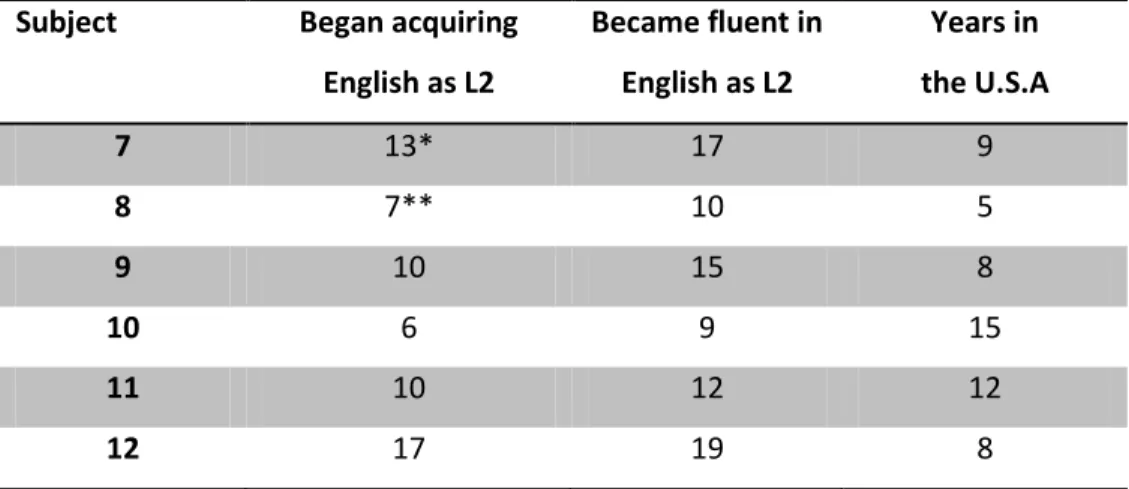
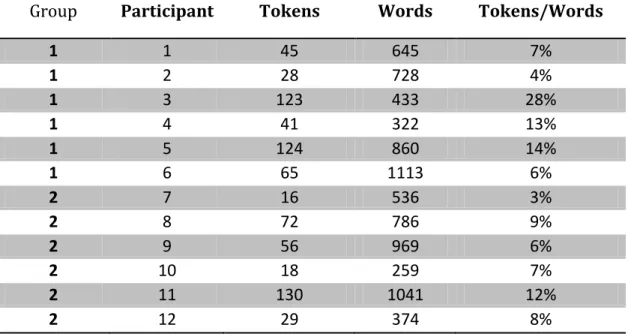
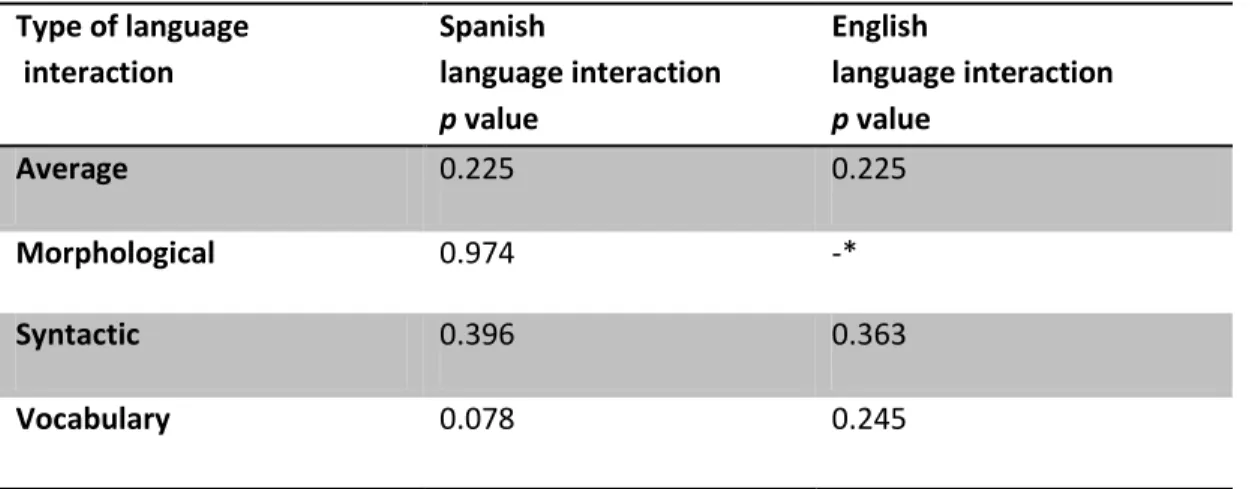
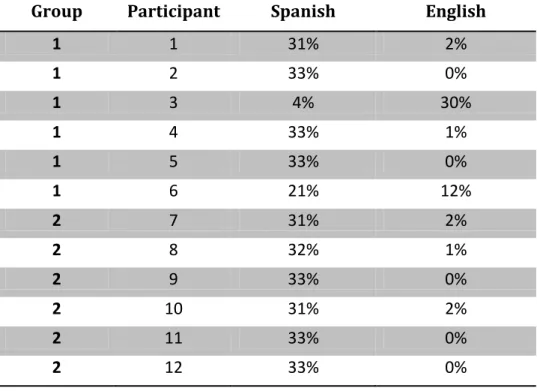
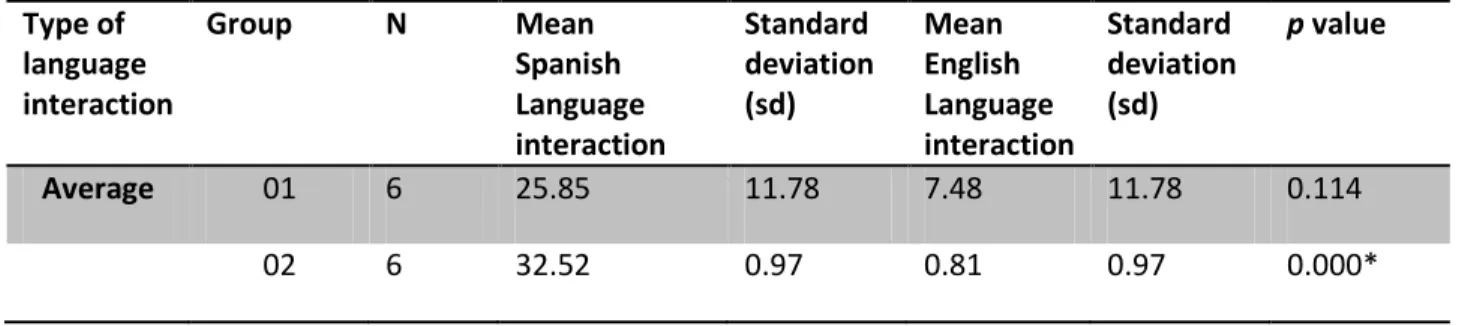
Table 2 – Information about the subjects‟ second language in group 2 44 Table 3 – Ratio of occurrences of language interaction and total words produced 46 Table 4 – Statistical analysis of all types of interaction and source languages 47 Table 5 – Average of all instances of interaction per source language 48 Table 6 – Statistic analysis of the average of all instances of language interaction 49
Table 7 – Morphological interaction in percentage 50
Table 8 – Statistical analysis of morphological interactions 50
Table 9 – Syntactic interaction in percentage 52
Table 10 – Statistical analysis of syntactic interactions 52
Table 11 – Vocabulary interaction in percentage 55
Table 12 – Statistical analysis of vocabulary interaction 56
LIST OF ABBREVIATIONS
First Language L1
Second Language L2
Third Language L3
Second Language Acquisition SLA
Third Language Acquisition TLA
The University of New Mexico UNM
Contrastive Analysis CA
Crosslinguistic Influence CLI
Crosslinguistic Interaction CLIN
Dynamic Model of Multilingualism DMM
TABLE OF CONTENTS
ABSTRACT ... 3
RESUMO ... 4
LIST OF FIGURES ... 5
LIST OF TABLES ... 6
LIST OF ABBREVIATIONS ... 7
INTRODUCTION ... 10
1.1 Preliminaries………..………...10
1.2The study………...11
1.3 Significance and objectives………...12
1.4 Organization of the thesis……….14
2 REVIEW OF LITERATURE ... 15
2.1 Bilingualism: definition, scientific studies and advantages………..15
2.2 Third Language Acquisition (TLA) and Multilingualism………18
2.3 Language interaction: a historical overview……….20
2.4 Factors related to Crosslinguistic Interaction (CLIN)………..23
2.4.1 Linguistic factors for Crosslinguistic Interaction………..23
2.4.1.1 Linguistic Typology / Psychotypology ...23
2.4.1.2 Foreign language or L2 status ...26
2.5 From Monolingual to Multilingual language production models……….28
2.5.1 Monolingual language production model ...28
2.5.2 Bilingual language model ...30
2.5.3 Multilingual language models ...32
2.6 Vocabulary, morphological and syntactic interaction………..34
2.7 Portuguese as a Third Language………...36
3 METHOD ... 40
3.1 Materials and Procedures of Data Collection………...40
3.2 Participants………42
4 RESULTS AND DISCUSSION ... 46
4.1 Average of language interaction………...48
4.2 Morphological interaction……….49
4.3 Syntactic interaction………..52
4.4 Vocabulary interaction………..54
5 CONCLUSION ... 58
6 REFERENCES ... 61
INTRODUCTION
1.1Preliminaries
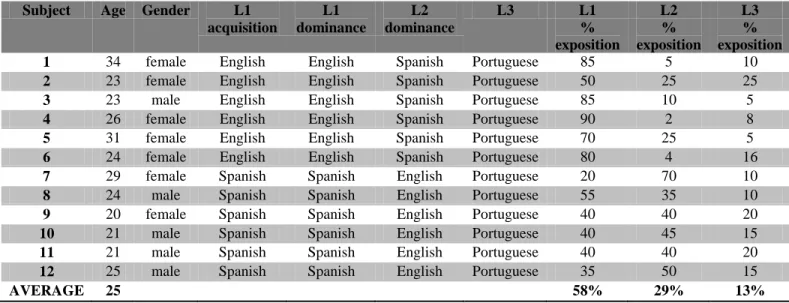
The present study investigates language interaction in the oral production of six English-Spanish and six English-Spanish-English bilinguals, learners of Portuguese as a third language. The goal of the study is to describe the patterns of language interaction and identify which factors exert more influence on third language oral production: the typological factor or the foreign language status of the second language (L2.) In the present study, we address typology as the structural similarity between languages (Greenberg, 1960.) Spanish and Portuguese, for example, are Romance languages, while English is a Germanic language. Hammarberg (2001, p. 37) defines the L2 status factor as “the general tendency to activate an earlier secondary language in L3 performance than an L1.” Both language typology and the foreign language status of the L2 (also L2 status) have already been described in Multilingualism studies (Cenoz, 2003; Carvalho and Silva, 2006; Rothman, 2010.)
The present study also aimed to investigate which linguistic features in the target language (Portuguese) will be greater influenced by the two previously acquired languages (English and Spanish): vocabulary, morphology or syntax. The study originated from my interest in Bilingualism and Multilingualism and in understanding the mechanisms of interaction among multiple languages. In 2012, I received a Fulbright scholarship to teach Portuguese in New Mexico, United States. In the classes of Portuguese as a foreign language, there was a characteristic that immediately called my attention: the fact that students were fluent English and Spanish speakers in their majority. During the class activities, I informally observed that the learners of Portuguese would use both Spanish and English language forms when speaking Portuguese; most times, the speakers would use the different forms without noticing the difference between the languages.
inserted on purpose in a sentence when two bilinguals are conversing, as it happens between English and Spanish in the state of New Mexico, an officially bilingual state. From a Second Language Acquisition (SLA) point of view, transfer is defined as “the influence resulting from the similarities and differences between the target language and any other language that has been previously (and perhaps imperfectly) acquired” (Odlin, 1989, p. 27.) By the use of the term “imperfectly”, it is possible to infer the negative view of language interaction present in SLA studies.
Although language selectivity is still controversial, the phenomenon of linguistic interaction between different languages in bilinguals and multilinguals is very well-defined (Odlin, 2005.) Words can compete either phonologically (Portuguese: fraco (weak), Spanish: flaco (thin)); orthographically (Spanish: red (net), English: red (the color)); or semantically (Spanish: perro, English: dog, Portuguese: cachorro). According to Bialystok et al (2009, p. 93), the joint activation of the two languages makes it necessary for bilinguals “to resolve competition not only from within-language alternatives – as monolinguals do to select among close semantic neighbors – but also from between-language alternatives for the same concepts.”
The observation of bilingual language production in the classroom, and my own research on the literature on Multilingualism and types of crosslinguistic interaction, suggest that this phenomenon is quite common in multilinguals. Crosslinguistic interaction might not be random; it may be motivated by linguistic factors, such as typology and L2 status, or non-linguistic factors1, such as proficiency and language mode2 (Hammarberg, 2001). For the present study, only the linguistic factors (typology and L2 status) were controlled. These factors are further discussed in section 2.4. The role of language typology and L2 status in the interaction of two previously acquired languages in relation to a third language being acquired is investigated.
1.2The study
The present study draws on Carvalho and Silva (2006) and Rothman (2010), who found evidence for the highest influence of typology in comparison with order of acquisition in L3 production. Carvalho and Silva (2006) focused on the controlled production of sentences in the
present and future subjunctive, which are structurally similar between Spanish and Portuguese. Rothman, in turn, studied syntactic interaction, such as word order and Subject-Verb-Object order in grammatical judgment tasks involving English, Spanish and Portuguese.
Based on those previous studies, two research questions were proposed:
1) Based on Carvalho and Silva (2006) and Rothman (2010), who found typology to be the most influential factor for linguistic interaction: Which factors exert more influence in third language oral production: typological distance or the order of acquisition of previous languages?
2) Which linguistic levels in the target language (Portuguese) would be highly influenced by the two previously acquired languages (English and Spanish): the vocabulary, the morphology or the syntax?
Question number two takes the previous studies a step further in the investigation of crosslinguistic interaction.
Based on the 2 questions, two hypotheses mutually exclusive hypotheses were generated: 1) There will be more language interaction from Spanish than English due to the closest typological distance of Spanish in relation to Portuguese, if compared to English (Carvalho and Silva, 2006; Rothman, 2010);
2) When English is the speakers‟ second language (as in group 2), it will generate more instances of language interaction to Portuguese as L3 due to the same foreign language status shared by the L2 and the L3 (Hammarberg, 2001).
The hypotheses were mutually exclusive intentionally, since in case one was verified, the other could not happen under the same circumstances.
Phonological interferences also occurred but they were not analyzed as part of the scope of the present study.
1.3 Significance and objectives
languages offers the opportunity to observe the complexity of multilingualism. Therefore, the study has drawn on the literature and the unique opportunity of interacting with a multilingual population to try to identify patterns of crosslinguistic interaction.
As Schönpflug states (2003, p.28):
The larger the number of linguistic systems at work, the more interactions between the various levels of the system are to be expected. Hence, trilingual language processing is more complex than just the doubling of the interactions of a bilingual system. In a trilingual system, one or two language systems may be dominant, thus offering the unique opportunity to observe two dominant and one weak system.
Increasing attention is being paid to multilingual acquisition and multilinguals‟ language production (Carvalho and Silva, 2006; Cenoz, 2000, 2003, 2011, 2013; Cenoz, Hufeisen, Jessner, 2001, 2003; Dewaele, 2001; Dijkstra, 2003; Hammarberg, 2001; Jessner, 2001, 2003, 2008; Rothman, 2010; Rothman and Amaro, 2009.)
However, more natural, less-controlled speech production tasks (such as narratives) are infrequently used in multilingual studies, especially in studies that investigate crosslinguistic interaction (Cenoz, 2001; Hammarberg, 2001; De Angelis and Selinker, 2001; Dewaele, 2001).
Therefore, the mechanisms of speech production in trilinguals and the factors relevant for interaction among different languages in this population have yet to be investigated. The gap in research on language production supports our choice of a speech production task for investigating the result of the interactions of previous languages on a third language still in process of acquisition. The English-Spanish bilingual context at the University of New Mexico (UNM), where data was collected, and the large enrollment in Portuguese courses are ideal for a study on Multilingualism. As trilingual linguistic systems are not merely extensions of bilingual systems (Jessner, 2003), the study of the influence of two previously acquired languages on a third one may increase the understanding of third language acquisition.
state that language interaction exists or criticize instances of language interaction as situations in which a speaker may lack vocabulary or proficiency. Rather, instances of language interaction are understood as a recurrent phenomenon in multilinguals.
1.4 Organization of the thesis
2 REVIEW OF LITERATURE
2.1 Bilingualism: definition, scientific studies and advantages
In this section, literature on Bilingualism is reviewed. The definition of what being a bilingual means has been discussed along the studies on language acquisition and use. According to Grosjean (1998, p.132), “bilinguals are those who use two or more languages (or dialects) in their everyday lives.” The definition excludes the idea that to be bilingual a person should master all language components equally and use them with the same frequency. This holistic view (Grosjean, 1985, 1998, 2008) rejects the monolingual view of Bilingualism, which implies that bilinguals should master two languages as if they were two monolinguals in one person.
The holistic view states that a bilingual cannot be compared to an ideal speaker-hearer in monolingual standards (Grosjean, 2008). It also takes into consideration the interaction between the different languages learned, by debunking the (outdated) notion that a bilingual speaker is two monolingual speakers in one. Yet, the notion of perfectly mastering of two languages persists. Anecdotal evidence shows that proficient bilinguals do not consider themselves fluent enough if they have acquired a second language later in life. Speakers of two languages judge problems in pronunciation or lack of vocabulary as signs of not being „real bilinguals‟.
Despite those issues of self-perception, there is current evidence that there are cognitive advantages associated with being bilingual (Lauchlan, Parisi and Fadda, 2012; Bialystok, Craik and Luk, 2008; Bialystok et al, 2009). These advantages carry over to other – domain-general and non-linguistic – abilities, such as problem-solving abilities and attentional control. Moreover, bilinguals, in comparison to monolinguals, are protected by some sort of “cognitive reserve” and there seems to be protective effects against the dissolution of cognitive abilities in bilinguals (Bialystok, 1998; 1999; 2001; 2006; Bialystok et al., 2004).
(Bialystok et al, 2009). On the contrary, early researchers constantly argued that being bilingual would bring negative cognitive effects (Peal and Lambert, 1962).
One example of the negative view on Bilingualism is seen in “The problems of the hybrid language”. In the work, Roberts (1939, p.23) wrote about the “bizarre and mysterious works of Bilingualism”. Roberts (1939) was not discussing the cognition involved in Bilingualism; rather the goal was to explain how languages would disappear and originate new ones because of interlinguistic contact. Nonetheless, the negative tone about Bilingualism is evident:
When two languages come to be spoken by the same society for the same purposes, both of these languages are certain to deteriorate. The sense of conflict disturbs in both of them the basis of articulation, deranges the procedure of grammar, and imperils the integrity of thought. The representation of the mind is divided into incongruous halves; and the average speaker, being no linguistic expert, finds it difficult to keep the two media apart. Confusion follows. (Roberts, 1939, p.23).
Only in the 1960s did science debunk negative notions about Bilingualism and found a positive influence of Bilingualism on cognition. Peal and Lambert (1962) changed the perspective on the issue with a study about the positive effects of Bilingualism on general intelligence. In the study with English-French children in Montreal, the authors found that bilinguals have a striking advantage over monolinguals in verbal and non-verbal tasks. The authors claimed that “the studies finding no difference or a deficit for bilinguals were simply using inappropriate measures” (Peal and Lambert, 1962, p. 6). The authors of the pioneer study explained the results stating that:
The experience with two languages leaves the bilinguals with a mental flexibility, a superiority in concept formation, and a more diversified set of mental abilities (…) there is no question about the fact that he [the bilingual] is superior intellectually (Peal and Lambert, 962, p.20.)
The approximately 7,000 different languages and dialects, according to the Ethnologue3 in the world, the proximity of borders and the varied and distinct cultures that coexist in a same continent make language contact – and consequently Bilingualism – a reality of the modern world (Cenoz, Hufeisen, Jessner, 2003.)
Language policies also play an important role in the language status of a community. When more than one language is considered official (as in Canada, Spain, and Belgium) the different language groups must become bilinguals (or even multilinguals) in order to communicate in the different linguistic situations. Bilingualism remains because the official languages have equal status and are taught at school, used in the media, and used in official communication.
Immigration can also contribute to the development of multiple languages. Depending on the social context of the immigrants and the country they immigrated to, a person may use a language at home with their family and another at work or school. Bilingualism can also be a reality when: family speaks a heritage language4 at home, while living in a foreign country, when one receives formal education in a foreign language, and when a person moves temporarily to another country for business or educational reasons (Bialystok et al., 2009.)
Bialystok et al. (2009, p. 90) state that “bilingual language acquisition is as effortless, efficient, and successful as monolingual acquisition” while stressing the similarities of monolingual and multilingual acquisition. So, according to the author, both monolingual and multilingual language acquisition processes are similar and are shaped by the individual‟s environment, attention, perception, cognition and conceptual abilities:
It is now clear that language acquisition is not a simple matter of biological unfolding, as some had previously believed, but rather a process that is finely tuned to features of the environmental input, the child‟s attentional and perceptual abilities, and the development of cognitive and conceptual competencies. All of these factors conspire as well to shape the process of acquiring two languages. Moreover, the major milestones concerning competence in sounds, words, and sentences that are the foundation of acquiring language are passed at equivalent times for children growing up with one language in the home and those growing up in a multilingual home (Bialystok et al, 2009, p. 90.)
3 http://www.ethnologue.com/
It is usually assumed that being bilingual means developing perfectly balanced and equivalent skills in two (or more) languages. Most people who are able to communicate in more than one language would not be considered bilingual according to this notion. But if Bilingualism is understood as a dimensional human phenomenon, that is, along a continuum of skill development – rather than a definition that depends on all-or-none achievement of linguistic skills – Bilingualism becomes more of a rule than the exception. Most bilingual people use different languages for different purposes, in different situations and with different people. In this thesis, as stated, we will adopt the practical and up-to-date definition put forth by Grosjean (2008; 2010): Bilingualism is the regular use of more than one language; bilinguals are people who need and use more than one language in their everyday lives.
2.2 Third Language Acquisition (TLA) and Multilingualism
Multilingualism, much like Bilingualism, is increasing worldwide. The European Commission (2012) shows that just over half of Europeans can hold a conversation in at least one foreign language; approximately a quarter are able to speak at least two additional languages, and almost half say they can read a newspaper or magazine article in a foreign language 5.
With the cooperation of Google, the Endangered Languages Project6 is an organization that acknowledges the existence and the importance of Multilingualism in the world. Foreseeing the necessity of language documentation for preservation, it holds a website where people from all over the world can upload videos featuring speakers of languages that are about to become extinct. The project also shows a map of the world pointing the languages which have a higher risk of becoming extinct.
But research on Multilingualism is relatively new in Psycholinguistics. Even though Multilingualism has developed from SLA and Bilingualism research, it has become an independent field of study, with its own characteristics and goals (Jessner, 2003). Because of the incipient status of Multilingualism research, the terminology is still being discussed and the definitions are also problematic. Multilingualism is sometimes seen as synonymous of third language acquisition, and sometimes as a general term encompassing the knowledge of more
5 http://ec.europa.eu/index_en.htm
additional language(s). Also, due to higher complexity, Multilingualism cannot be simply labeled an extension of SLA and Bilingualism and must develop as an independent field of study:
Bilingualism is a phenomenon that may have a lot in common with Multilingualism, but research on the acquisition and processing of two languages cannot explain the specific processes resulting from the interaction between the languages that may result from the simultaneous presence of more than two languages in the multilingual person‟s mind (Cenoz, Hufeisen, Jessner 2003, p.2.)
Grosjean (1998) does not differentiate the term „bilingual‟ from „multilingual‟ while Cenoz (1997, 2003) does. In the present study, the same view of Cenoz (1997, 2003) is adopted to make such distinction. This is because the present study will investigate bilingual subjects learning a third language and the influence of the first and/or second language (Spanish, English) on the third one (Portuguese); clearly a multilingual environment.
According to Herdina and Jessner (2002), Multilingualism research bridges the gap between Bilingualism and SLA. This is because, in SLA, any language learned after the first is considered the speaker‟s second language, even if it is the third or fourth one. Also, linguistic interaction phenomena are more likely to occur in one direction: from the L1 into the L2, as below:
L1
L2
Adapted from Jessner, 2003, p. 44
Being bilingual, however, means that language interaction can happen. Bilingualism research will focus then on finding evidence for the bidirectional relationship between languages, the L1 and L2 mutually providing the possibility of language interaction, as below, and not in a one-hand basis only:
L1
L2
In TLA or Multilingualism, however, language interaction is multifaceted and involves more than a bidirectional relationship. The L1 and the L2 can mutually exchange language items, as well as the L2 and the L3 or other additional languages (Lx). Also, the L1 can interact with the L3 in a reciprocal and more complex configuration. The schema below attempts to show those interactions:
L1 L2
L3
Lx
Adapted from Jessner, 2003, p. 45
According to Jessner (2003), “as multilinguals cannot be measured by monolingual standards, Multilingualism cannot simply be explained by extended monolingual acquisition models” (Jessner, 2003, p.48.) Due to the highest complexity involved, Multilingualism opens a vast field of study, ranging from: the effects of Bilingualism on third language acquisition (Cenoz, 2013; 2003; 1997), multilingual language acquisition (Cenoz, 2000), cognitive effects of Multilingualism (Perquin et al, 2013), language interaction in L3 production (Cenoz and Gorter, 2011; Romualdo Jr, 2005), lexical access in multilinguals (Lemhöfer et al, 2004), the role of L1 and L2 in the learning of an L3 (Hammarberg, 2001; Cenoz, 1997), crosslinguistic interaction of multiple languages (De Angelis & Selinker, 2001), and factors of language interaction (Cenoz, 1997, 2000, 2003; Carvalho and Silva, 2006; Rothman, 2010.)
2.3 Language interaction: a historical overview
framework, speaking consists of mimicking and analogizing.” Since childhood, people would establish a set of behavioral habits and continue linguistic growth by analogizing previous knowledge and mimicking others‟ speech in order to learn.
According to James (1980), modern CA starts with Robert Lado (1957), in the book Linguistics Across Cultures. The author brings on the notion of „interference,‟ stating that L2 learners rely on their native language for learning the second language (Gass and Selinker, 2008.) Rooted in Behaviorist and Structuralist concepts, the Contrastive Analysis Hypothesis stated that, by contrasting language structures, language specialists would be able to predict the difficulties a learner of a determined linguistic background would have when learning a structurally distinct language (Brown, 2007). Still according to Brown (2007, p. 248), in CA, “the principal barrier to Second Language Acquisition is the interference of the first language system in the second language system”.
„Transfer‟ has also been described as „interference,‟ which dates back in time a little further than Lado‟s 1957‟s work. Weinreich (1953, p.1) defined interference as “instances of deviation from the norms,” occurring frequently in bilinguals “as a result of the familiarity with more than one language.” In those quotations, the negative view of the word „interference‟ is clear, since it is a „deviation‟ from pre-established norms.
As noted by Gass and Selinker (2008), a distinction between positive (also called “facilitation”) and negative transfer (interference) is commonly made in Second Language Acquisition studies. It is as if transfer could be split in terms of „correct‟ and „incorrect‟ (meaning „positive‟ and „negative‟ respectively) types of transfer. The „positive‟ type would facilitate language acquisition, while the „negative‟ type would inhibit the language acquisition process, making it „imperfect‟. But the authors disagree that there is positive or negative transfer, stating that “there is a process of transfer; there is not a process of negative or positive transfer” (Gass and Selinker, 2008, p. 90.)
According to Odlin (1989, p. 27), “transfer is the influence resulting from the similarities and differences between the target language and any other language that has been previously (and perhaps imperfectly) acquired.” Here, a contrastive view (“similarities and differences”) is also present.
In Multilingualism studies, „interference,‟ according to Herdina and Jessner (2002), is generally used to describe the unconscious transfer of structures from L1 to L2. For the authors, the term „interference‟ should be applied only to the phenomenon described in CA that is “one language system interfering with the other without resulting in the transfer of structures” (Herdina and Jessner, 2002, p. 10.) This shows that the notion of interference is much more linked to the areas of CA and SLA than with Bilingualism and Multilingualism areas. Also because the terminology on language transfer goes a little further. In the Linguistics revolution of the 60s and 70s, after Behaviorism was supplanted by Cognitive psychology, the notion of transfer also changed (James, 1980.)
Another term referring to language transfer between different languages was brought up. It was Crosslinguistic Influence (CLI), coined by Kellerman and Sharwood Smith (1986), cited by Jessner (2003). Kellerman (2001) points that CLI theory clearly differentiates second and third language acquisition. So, these influences between multiple languages must be acknowledged for better understanding second and third language processing and production.
Facing the new dynamic interactions in multilingual systems and aware of the negative notion brought by the term „influence‟ across languages, Herdina and Jessner (2002) coined the term Crosslinguistic Interaction (CLIN), although the term „influence‟ is still used in multilingualism research. According to the authors, the term offers new perspectives to the study of language systems interaction, “including transfer, interference, code-switching and borrowing, as an umbrella term for all transfer phenomena” (Jessner, 2003, p.49.)
In the present work, the term interaction is preferred over transfer, interference and influence. Also, the interaction of multiple languages – or Crosslinguistic Interaction – is understood neither as positive nor negative. It is rather a recurrent phenomenon which can help linguists to understand the mechanisms of language interaction involving three languages: Spanish, English, and Portuguese.
2.4 Factors related to Crosslinguistic Interaction (CLIN)
As discussed in the previous section, the term Crosslinguistic Interaction (CLIN) has been used in the area of third language acquisition for embracing all phenomena related to the instances of interaction of a native language with one or more non-native languages (Herdina and Jessner, 2002).
Because of the higher complexity of Multilingualism, several linguistic and non-linguistic factors are involved in CLIN. Hammarberg (2001) highlights linguistic and extra-linguistic factors. The linguistic factors include: the linguistic typology (or psychotypology), and the L2 status (or foreign language status). The extralinguistic or user-related factors include: the speaker‟s proficiency, the language mode, the frequency and recency of language use (Hammarberg, 2001). All of the referred factors can be addressed as predictors of the interaction between all the languages known by the speaker in the moment of language production. However, for methodological issues, in the present study, only the linguistic factors will be investigated: the language typology and the L2 (or foreign language status). In this section, the linguistic factors which can motivate CLIN are discussed and related to the present study.
2.4.1 Linguistic factors for Crosslinguistic Interaction 2.4.1.1 Linguistic Typology / Psychotypology7
Among all factors, Linguistic Typology has been proved as one influential factor for CLIN. It can be viewed from two perspectives: a diachronic perspective and a synchronic
perspective (James, 1980). Diachronically speaking, typology refers to the structural similarity between languages which have a common origin, according to the genetic historical classification of languages into families (Greenberg, 1960.) Spanish and Portuguese, for example, have the same origin as Romance languages. English, however, has its origins in Germanic languages, such as German and Dutch. The diachronic parallel to typology is also known as Philology (James, 1980.)
Figure 1 below8 shows the similar typologies among the major European languages and how they can be organized according to those similarities:
Figure 1: Language typologies
The size of each circle represents the number of speakers for that language. Circles of the same color belong to the same language group. English is a member of the Germanic group (blue) within the Indo-European family, while Spanish and Portuguese belong to the Romance group, what make the two languages clearly closer in terms of structure and vocabulary.
Synchronically, according to James (1980), Linguistic Typology is rooted in Contrastive Linguistics, which views the languages of the world as comparable and classifiable into different types. Linguistic Typology has established a classificatory system for the languages of the world into which individual languages can be grouped according to their present-day grammatical features: synthetic, analytic, inflectional, agglutinating, and tone languages (James, 1980.)
Typology is also related to Language Universals. Croft (2003) states that, by comparing diverse languages and discovering universal grammatical patterns, it is possible to distinguish what is universal from what is peculiar in each of the language grammars analyzed by the linguist. Also according to Croft (2003, p. 340) “the field of linguistic typology explores the diversity of human language in an effort to understand it (…) Typology uses a fundamentally empirical, comparative, and inductive method in the study of language.” Real languages of the world are studied and compared in order to find what is universal in terms of grammatical patterns. It is not an abstract (theoretical) grammar of universals, but an empirical field of investigation (Croft, 2003.)
Croft splits the work of the typologist, who aims to find typological similarity or differences, in three steps: first of all, the linguist must examine a sample of languages and infer patterns in their grammars, looking at the range of grammatical diversity; second, phenomena from one language must be identified as comparable with the ones from the other languages in the sample; finally, the typologist must identify a range of grammatical patterns or types used to express the meaning under question, and classify languages according to those types used in them (Croft, 2003).
The conclusion was that the typological distance between Spanish (L1) and English (L3), both Indo-European languages, favored the cases of language interactions, while Basque, as a non-Indo-European language, interfered less. Cenoz (2001, p. 18) found that “student‟s awareness of linguistic distance in crosslinguistic influence is confirmed by the fact that they foreignise only terms from Spanish and not from Basque”.
Carvalho and Silva (2006) also found evidence for the highest influence of typology in comparison with the foreign language status of the L2 in L3 production. The authors focused on a controlled task: the production of sentences in the present and future subjunctive. In the study, it was observed a higher interference from Spanish instead of English in the production of sentences in Portuguese.
Along with typology, the notion of psychotypology is also relevant in Crosslinguistic Interaction studies. Kellerman (1983) coined the concept of psychotypology to refer to the perception that speakers have about language similarities.
For Rothman and Amaro (2009, p.10), “psychotypology is assessed not at a parameter -to-parameter level, but based on a holistic impression of the two languages‟ grammatical proximity”.
The notions of typology and psychotypology are important in the present study. Besides the structural/typological similarities between Spanish and Portuguese, there are also the similarities perceived by the language learners. In the next section, the second linguistic factor for CLIN is presented.
2.4.1.2 Foreign language or L2 status
Hammarberg (2001, p. 37) defines the L2 status factor as “a desire to suppress L1 as being „non-foreign‟ and to rely rather on an orientation towards a prior L2 as a strategy to approach the L3”, and also as “the general tendency to activate an earlier secondary language in L3 performance than an L1” (Hammarberg, 2001, p.23.) The author explains the roles of L1 and L2 as instrumental and supplier, respectively.
L2 type mechanism in L3 acquisition; b) the L1 would be suppressed for its “non-foreign” status and the learner would rely rather on a prior L2 as a strategy to learn an L3 (Hammarberg, 2001.) This factor is also related to the present study, since the speakers have already acquired two previous languages when started learning the L3.
Sarah Williams and Björn Hammarberg started a longitudinal case study in the 1990‟s having Sarah herself as the research subject. Sarah was born and raised in England, studied German and French at University and lived for 6 years in Germany where she “acquired near -native German competence” (Hammarberg, 2001, p. 24.) In 1990 Sarah moved to Sweden and, in order to document her evolution in learning Swedish without being in any formal learning environment, such as a language course, the researchers recorded their conversations every two weeks for about two years.
The recordings did not have a specific purpose, that is, the researchers were not looking for a specific linguistic feature. The recordings were compiled into a language corpus “without preconceived notions of any particular aspect of language development” (Hammarberg, 2001, p. 25.) Even without any hypothesis in mind, the researchers soon noticed that the role of the previous languages (English as L1, and German and French both as L2) influenced the oral productions of Swedish as L3. In analyzing the instances of L1 and L2 interaction separately, they noticed that both previous languages played different roles in the initial stages of learning: L1 supported the interaction with pragmatic functions – such as asking for clarification or meanings; the authors called it „the external instrumental language‟. On the other hand, the L2 had the role of a „supplier‟ in the construction of new words in the L3. These two different roles show that the nature of crosslinguistic interaction is different in nature. For the authors, the factor that seems to be decisive in favoring German as a supplier language is the L2 status, “the fact that German, as Swedish, is a foreign language” tending to „win‟ each time in the competition for activation (Hammarberg, 2001, p. 36-38.)
language will generate more interaction with Portuguese, due to the foreign language status of the L2. This notion is present in the second hypothesis: When English is the speakers‟ second language, it will generate more interaction with Portuguese as L3 due to the foreign language status shared by the L2 and the L3 (Hammarberg, 2001.)
Next, language production models, involving Monolingualism, Bilingualism and Multilingualism are presented. Each model will describe oral language production taking in consideration the number of languages involved.
2.5 From Monolingual to Multilingual language production models
Research on Crosslinguistic Influence in TLA is grounded on Psycholinguistic theories of speech processing and production in monolinguals and bilinguals (Cenoz, Hufeisen, Jessner, 2003.) Models of language production changed over the years to adapt evidence found for crosslinguistic interaction between languages in bilinguals and multilinguals.
Starting at monolingual production, models were extended to bilingual models and, more recently, adapted to include multilingual systems. In this section, some models of language speech production used in language studies are described since the focus of this investigation is on language production and not comprehension.
2.5.1 Monolingual language production model
Speech production‟s theory attempts to describe the mental processes since its non -linguistic form in the brain, until the final physical action of production of sounds. As stated by Hartsuiker and Pickering (2007, p. 479), “to produce a sentence, a speaker needs to engage in two sets of processes. One set is concerned with retrieving words from the speaker‟s mental lexicon. The other set places these words in a sentence structure, so that the sentence conforms to the rules of grammar.” This means that language production involves both the retrieval of vocabulary (or words) and of grammar rules in the speaker language.
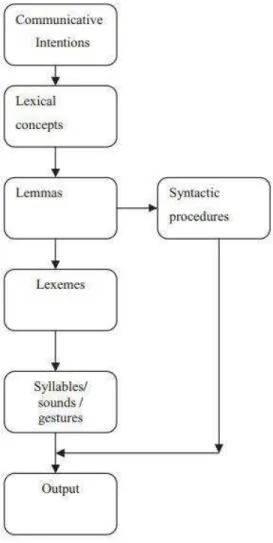
1989): conceptualization (thinking of what to say), formulation (finding the words in your language to convey your ideas) and articulation (moving your muscles and produce physically and semantically meaningful perceived sounds). The model encompasses all mental steps of language production in systematic and serial steps, each dependable on the preceding level to advance to the next one, in a serial, feed-forward and incremental process (Traxler, 2012.)
According to Levelt‟s model, the conceptualizer is the module which structures the ideas being conveyed into a formal grammar. The result of this initial process is passed to the formulator, which has a grammatical encoder and a phonological encoder. The grammatical encoder creates the sentence pattern and the phonological encoder generates the phonetic output (Levelt, 1989.)
Figure 2 - Levelt’s monolingual speech production model9
2.5.2 Bilingual language model
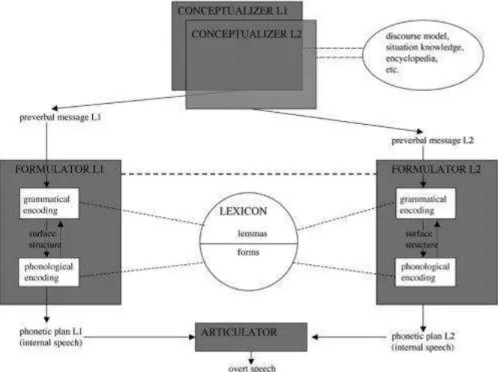
De Bot (1992) extended Levelt‟s monolingual production model to bilinguals‟ language production. This model also assumes the same modules of Levelt‟s model (conceptualizer, formulator and articulator). The new feature proposed by De Bot is that the lexicon is shared between the bilingual‟s two languages. Words would be connected in networks and two separate formulators (one for each language) could interact with each other. The degree of interaction could vary according to linguistic distance and proficiency. Closely related languages would
share the formulator, and balanced bilinguals would have a greater degree of separation between languages (Hartsuiker and Pickering, 2007.)
The idea of bilinguals sharing the lexicon is important to highlight since in this thesis we are investigating transfer and crosslinguistic effects. Because the two formulators can interact with each other in the bilingual model, linguistic items from the non-target language can be inserted in the target language formulation and in its articulation, later. As the linguistic distance is one of the controlled variables, it will be possible to see whether English or Spanish (more closely related to Portuguese) will interact highly with Portuguese, the speakers‟ weakest language.
Below there is an illustration of De Bot‟s model for bilingual language production. Note that the two conceptualizers are overlapping and that there are also two formulators, one for each language, but the lexicon (made of lemmas and forms as in Levelt‟s model) is shared between both languages:
Figure 3 – Bilingual language production model10
10
2.5.3 Multilingual language models
Multilingual language models show the evolution and the ultimate step in language acquisition studies. In this section, this evolution is shows in a model which encompasses SLA and Bilingualism studies, becoming a more complete model to explain the differences in both areas: it is the Dynamic Model of Multilingualism (DMM).
The DMM assumes the holistic approach to Multilingualism as Grosjean (1985) did for Bilingualism. In the DMM, language interaction phenomenon is a significant characteristic of multilingual systems, constituting the primary object of investigation.
The most important assumption of the DMM is the fact that languages are dynamic systems which are able to interact when sharing a same locus and timeframe. Herdina and Jessner (2002) stress the fact that languages are dynamic and a continuous moving in time on the individual level. Language proficiency then is not seen as fixed for all the individual's languages, but more as transient stages and based on individual's differences. Neither the order of acquisition is as immutable as seen in SLA theories. "Multilingual proficiency is, therefore, to be considered as consisting of dynamically interacting linguistic subsystems which themselves do not necessarily represent any kind of constant but are subject to variation” (Herdina and Jessner, 2002, p.75.)
Another important insight of the DMM is the link made with the Dynamic Systems (or Chaos) Theory, which aims at understanding the behavior of living organisms as dynamic systems. Since languages are systems which can be born, change, and die throughout time, they can also be included in the theory of dynamic systems. Even in crosslinguistic interaction phenomenon, in which the language interaction of items might apparently seem chaotic, there seems to be rules and a certain pattern of interaction present. And this is what the present study has attempted to demonstrate.
As stated below:
The most appealing idea of the DMM is that it is learner-oriented and it "tries to explain individual differences in language-acquisition" (Herdina and Jessner, 2002, p.75.) The authors refute the notion of a general competence of language but argue for a linguistic competence in one or another of the multilinguals‟ languages. As we can see, the focus on the learner and on the individual differences in multilingual language acquisition and production are taken into account in this multilingual language model.
Therefore, the DMM model can provide insights for the final analysis and for the explanation of the kinds of language interaction found in the oral production of multilinguals in this study, since the multiple interactions among three languages with different typologies and different statuses are investigated. Also, the apparent chaos will be demystified when patterns involved in the language interactions are unveiled.
SLA research has focused, among other phenomenon, on the language interaction of items from the native into the newly learned language. Bilingualism models have provided great understanding of the interaction between two different languages. However, more research is necessary to account for the complexity of the interactions of three or more languages. The DMM may bridge these gaps and serve as a guide for the investigation of multiple language acquisition and production.
As stated by Jessner (2003):
We have therefore argued that the interaction phenomena occurring in L3 production should be viewed from a multilingual standpoint and phenomena of language interaction and interference, mostly studied in SLA, and code-switching and borrowing, mostly studied in Bilingualism, should be discussed within a common framework. Such framework could be offered by DMM which focuses in systems in different stages of development, and thus provides a bridge between SLA and Bilingualism research (Jessner, 2003, p.48.)
2.6 Vocabulary, morphological and syntactic interaction
According to Paradis (2009) verbal capacity includes: 1) Linguistic competence in the levels of phonology, morphology, syntax and lexicon; 2) Metalinguistic knowledge, which is related to the conscious knowledge of language components; 3) Pragmatic competence (the ability to infer meaning from context); and 4) Motivation to learn a language.
As already mentioned, one of the goals of the present study is to identify the most common types of crosslinguistic interaction involving languages with different typological distances and order of acquisition (the status as L2). So, in order to narrow the scope of observation, the aspect of verbal capacity chosen to be analyzed here are only three: morphology, syntax and vocabulary competence.
When referring to vocabulary, instead of lexicon (a term frequently used in language acquisition studies) I choose to follow Paradis‟ indication of the crucial distinction between lexicon and vocabulary. According to the author:
The distinction between lexicon and vocabulary “was prompted by the need to distinguish between the mere sound-meaning pairings of words, as memorized in traditional second language vocabulary learning, which is a portion of the declarative memory system, and the grammatical properties of words which, independently of their lexical semantic meaning constraints and phonological form, may differ from one language to the next (Paradis, 2009, p. 14).
For Paradis (2009), vocabulary is related to the explicit word-sound-meaning (and word- grapheme-meaning) pairings, which are aspects of language that can be observed consciously. Lexicon in its turn refers to the implicit morphological and syntactic properties – subserved by procedural memory and implicit linguistic competence – such as whether a verb is intransitive or transitive. “Words, or the vocabulary, are sustained by the declarative memory. So are their corresponding conceptual representations (usually referred as semantics)” (Paradis, 2009, p.21, 22). Here, vocabulary refers to the words used by the speaker, either verbs or nouns. „Vocabulary interaction‟ will refer to the use of non-target words (Portuguese) in the oral productions of multilinguals. Therefore, the grammatical interaction will be named as syntactic or morphological and not as „lexicon‟ for avoiding confusion.
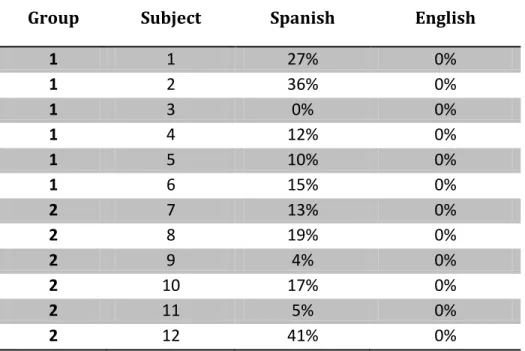
with a masculine gender marker influenced by Spanish, instead of the feminine marker used in Portuguese.
The investigation of morphological language interaction must consider both free and bound morphemes. De Angelis and Selinker (2001) show examples of non-target bound morphemes used with target stems or even target stems combined with non-target bound morphemes in L3 production (Italian target: aiutarono; Spanish: ayudaron; English: helped; Subject‟s production: aiudarono). De Angelis and Selinker (2001) also mention that the subjects in the research used more Spanish morphemes than English or French when speaking Italian. Spanish is typologically closer to Italian than the other two languages and it was also the subjects‟ L2.
According to Paradis (2009, p. 16-17) “bound morphemes can be made explicitly known and are automatically processed within implicit competence”. Morphemes would be stored in the lexicon and are consequently subserved by procedural memory, differently from the explicit vocabulary, which is stored in the declarative memory. “The implicit grammatical features of the lexicon are not part of the vocabulary.
Examples of syntactic interaction were counted whenever a verb clause was produced according to syntactic rules of Spanish or English. For example, a Spanish syntactic structure would be using a reflexive verb, as in: „Ele se caiu’ (He fell „himself‟) or the verb „dormir’ (to sleep) as an indirect object, as in ‘Ele se vai a dormir’ (He goes „himself‟ to sleep). In this example, in Portuguese, the preposition before the verb is not necessary, so those syntactic constructions are not as productive as they are in Spanish. In English, a syntactic structure language interaction would be using a present perfect construction when it would rarely occur in Portuguese for an action done in the past. This example was taken from one participant: „Eles tem encontrado o sapo’ (They have found the frog).11
Examples of vocabulary interaction from English or Spanish into Portuguese are: producing „perro’ or „dog’ for „cachorro’; or producing „boy‟ or niño’ for „menino’. Entire verb forms in English or Spanish will be also considered examples of vocabulary language interaction. According to Paradis (2009, p.18) “grammatical words tend to be treated as open class words by late L2 speakers who use declarative memory to process the morphosyntactic constructions they have not internalized”.
The higher incidence vocabulary interaction might suggest then that the learners relied on the explicit determinants of language learning when producing the target language (Paradis, 2009). As vocabulary learning is affected by declarative memory in both native and foreign language(s), the same memory mechanisms are used. Paradis (2009) writes that divided attention interferes in the performance of explicit tasks. Thus, for a native speaker, it is not difficult to process different language components (phonological, morphological, and syntactic) during lexical retrieval. However, in L2 processing (here extended to L3), different mechanisms seem to be at work. So, declarative memory is used to compensate for the gaps in L2 implicit linguistic competence.
The use of the declarative memory might explain the preference for using non-target vocabulary in L3 production over morphology and syntactic features. Extending this notion to L3 speakers, verbs would be treated by them as open class words. So producing „cayó’ for the verb „caiu’ or using the verb „be‟ indiscriminately for both meanings it has in Portuguese (ser/estar) will be considered an item of vocabulary interaction from English, which does not differentiate the two meanings.
2.7 Portuguese as a Third Language
Portuguese is spoken in 8 countries in all continents of the world: Brazil, Portugal, East Timor, Angola, Cape Verde, São Tomé and Príncipe, Mozambique, Guinea-Bissau. It is also spoken in small parts of India (as Goa), and China (as Macau), having a total of 205 million of speakers. Moreover, it is first or heritage language of immigrants in France, Germany, Luxembourg, Canada, United States, Venezuela and South Africa. Portuguese is the fourth language in number of speakers, being the third one in Europe and the sixth in the world rank of languages.12
The British newspaper „The Economist‟ featured an article in March 2013 stating that Portuguese is the best language if one looks for the best ratio between costs and benefits. 13
In American Universities, the teaching of Portuguese is increasing over the years. According to Milleret (2012, p.138), in the United States “since 1998, the number of students
12 http://observatorio-lp.sapo.pt/pt/dados-estatisticos/as-linguas-mais-faladas/as
enrolling in Portuguese has grown much faster than in the previous years and it has been greater than overall enrollment growth in all foreign languages combined”. Harvard University in Cambridge, Massachusetts, has offered Portuguese courses since 1831. There, students may combine a concentration in Portuguese and Brazilian Studies. The reasons for the increasing of students would be their interest in living and working in Brazil as well as genuine interest for the culture and language.14
New Mexico, in the United States, is a bilingual state having English and Spanish as official languages. The University of New Mexico (UNM) offers three basic language programs: Spanish as a Second Language, Spanish as a Heritage Language, and Brazilian Portuguese Studies. The Portuguese program began in the 1940‟s and it plays a strategic role in the Hispanic serving mission of UNM. 15 The latest UNM census showed a steady growth in enrollment and student credit hours from 2006 to 2010.16
There are 3 language courses of Portuguese at UNM, of one semester each. At the beginning level: Portuguese 101 and 275 (intensive); at the intermediate level: Portuguese 276 (intensive) or 277 (for Spanish speakers only); the third level is “Conversation and Pronunciation” and it was the course in which students were recruited. In order to pass to an upper level, students must take tests and oral evaluations, as in any other subject they take at the University. In 2013/1, when data were collected at UNM, there were 16 students in Portuguese III with mixed first and second languages.
So, the English-Spanish and Spanish-English bilingual context at UNM and the large enrollment in Portuguese courses are ideal for a study on Multilingualism. Only third-level students were recruited for this study, for having the proficiency necessary to narrate a story in Portuguese. Any eventual cases of interaction between languages produced by the participants will be the focus of our investigation. A group of beginners would produce tokens of language interaction with previous languages just for its low proficiency and lack of familiarity with Portuguese. And looking at acquisition in the very initial stage is not our objective here.
14 http://www.comunidadenews.com/educacao/professora-da-harvard-fala-de-sucesso-do-ensino-do-portugues-na-entidade-8313
15 http://spanport.unm.edu/
Previous studies in Portuguese as a second and third language point to inconsistent results. Romualdo Jr. (2005), Carvalho and Silva (2006), Silveira (2010)17 studied the interaction between Spanish, English and Portuguese in production (first two studies: writing, speaking) and comprehension (last study: lexical decision task). The studies used different tasks and controlled for different variables reporting the presence of language interaction between Spanish and English (acquired earlier) and Portuguese (still in process of acquisition) in multilinguals.
Romualdo Jr. (2005) analyzed written productions of Portuguese as a third language in the University of New Mexico and Kansas University-USA. The author categorized Spanish and English grammatical examples of language interaction. Whenever Spanish was the source language of interaction, the author called the instances of interaction and „facilitative‟. However instances of interaction having English as source language were treated as „negative interference‟. In the conclusion, the author pointed to the role of explicit instruction in the language classroom for trilinguals, however, he did not discuss the broader psycholinguistic implications of this study nor any factor that might be possibly acting on the cases of crosslinguistic interaction, such as the typology factor.
Carvalho and Silva (2006), University of Arizona, USA, instead, have discussed their results under a more psycholinguistic view. The authors have found that typological distance played a more important role in language interaction as compared to the status of the L2. In the study, Portuguese as L3 learners produced sentences using the present and future subjunctive. The results showed a positive interaction of Portuguese with Spanish instead of English. However, the authors focused on the production of sentences in verb tenses that are very similar between Spanish and Portuguese, and this might explain the great amount of language interaction. Both Romualdo Jr (2005) and Carvalho and Silva (2006) pointed to a higher influence of typology in the interactions between the three languages. However, the latter did not control for the order of acquisition of languages as the former did.
Rothman (2010) and Rothman and Amaro (2009) also investigated the role of typology and psychotypology and the L2 status on the L3 learning of syntax. Through a more generative view of language, the authors also found a higher influence of typology for motivating language
interaction. With the evidence found, the author created the Typological Primacy Model for multilingual language interaction.
Silveira (2010)18 studied lexical language interaction from Spanish speakers who were studying Portuguese as a third language at UNM. The author found negative influence of Spanish cognates in the recognition of Portuguese words in a semantic priming task. The study showed that the similarity in word forms slowed the responses for Spanish speakers. Although the participants were English and Spanish bilinguals, English status was not controlled. Therefore, the author did not discuss the influence that the knowledge of both English and Spanish might exert on the learning of Portuguese. The study cannot contribute to explain language interaction in multilinguals.
Because Portuguese is gaining visibility as an international language more people are studying it as an additional language, especially if they are speakers of Spanish. So, more studies involving Portuguese as a third language, especially in a bilingual and multilingual context are important in the fields of Linguistics and Psycholinguistics.
The present study differs in its approach to the oral capacity of the multilingual speakers. Other studies have not used more free language production tasks, such as a narrative of a story. It also used quantitative and qualitative measures of analysis for finding the patterns of interaction among three different languages. As discussed above, other studies dealt with the typological factor, however they did not put into question the foreign language status of the L2 as a possible factor for language interaction involving languages with different typologies, such as English and Portuguese. The comparison between two groups, even with a small number of participants, was also innovative and necessary for validating only one of the two hypotheses, since they were mutually exclusive.
In the next section, the method of the study, the material and procedures for data collection, the participants and the procedures for the analysis are explained.