ContentslistsavailableatSciVerseScienceDirect
Carbohydrate
Polymers
j our na l h o me p ag e : w w w . e l s e v i e r . c o m / l o c a t e / c a r b p o l
Blends
of
cross-linked
high
amylose
starch/pectin
loaded
with
diclofenac
Grazielle
Arantes
Soares, Ana
Dóris
de
Castro, Beatriz
S.F.
Cury, Raul
C.
Evangelista
∗FaculdadedeCiênciasFarmacêuticas,DepartamentodeFármacoseMedicamentos,UniversidadeEstadualPaulista– UNESP,RodoviaAraraquara-Jaú,km1,CEP14801-902, Araraquara,SP,Brazil
a
r
t
i
c
l
e
i
n
f
o
Articlehistory: Received14March2012
Receivedinrevisedform3July2012 Accepted3August2012
Available online 10 August 2012
Keywords: Pectin
Highamylosestarch Polymerblends Rheology Thermalanalysis X-raydiffraction
a
b
s
t
r
a
c
t
Polymersblendsrepresentanimportantapproachtoobtainmaterialswithmodulatedpropertiesto reachdifferentanddesiredpropertiesindesigningdrugdeliverysystemsinordertofulfilltherapeutic needs.Theaimofthisworkwastoevaluatetheinfluenceofdrugloadingandpolymerratioonthe physicochemicalpropertiesofmicroparticlesofcross-linkedhighamylosestarch–pectinblendsloaded withdiclofenacforfurtherapplicationincontrolleddrugdeliverysystems.ThermalanalysisandX-ray diffractogramsevidencedtheoccurrenceofdrug–polymerinteractionsandtheformerpointedalsoto anincreaseinthermalstabilityduetodrugloading.Therheologicalpropertiesdemonstratedthatdrug loadingresultedinformationofweakergelswhiletheincreaseofpectinratiocontributestoorigin strongerstructures.
© 2012 Elsevier Ltd. All rights reserved.
1. Introduction
Drug delivery is a broad field of research in the pharma-ceuticalsciences, forwhichthedevelopmentofnovelmaterials suitabletoaidincontrollingthedrugreleaseaccordingto ther-apeutic needsplays an importantrole. In this sense,blends of alreadyknownpolymersrepresentarationalapproachtoobtain materials with differentand modulated properties that enable theirusefor specificgoals(Carbinatto,Castro,Cury,Magalhães, &Evangelista, 2012; Ebube &Jones, 2004; Lecomte, Siepmann, Walther,MacRae,&Bodmeier,2005;Patel&Patel,2007;Prezotti, Meneguin,Evangelista,&Cury,2012;Wang,Hu,Du,&Kennedy, 2010). This approach can be advantageous, since apart from workingwithwellknownsubstances, itavoidsthehighcostof synthesizingnewmaterials.Additionally,thechangesinpolymer ratiocanresultinawiderangeofphysicochemicalpropertiesthat shouldprovidedifferent drugdeliverypatterns(Lecomte etal., 2005).Starchisoneofthemostabundantavailablepolymersand can beobtained froma variety of sources. It is constituted by amylose,representingthelinearfractionof themacromolecule, whileamylopectinisthehighlybranchedfraction.Highamylose, amodifiedstarchcontaining70%ofamylose,hasbeenreported as possessing improvedproperties for controlled drug delivery purposes in relationto conventional starch (Onofre, Wanga, &
∗Correspondingauthor.Tel.:+551633016976;fax:+551633016960. E-mailaddresses:[email protected],
[email protected](R.C.Evangelista).
Mauromoustkos,2009;Rioux,Ispas-Szabo,Aït-Kadi,Mateescu,& Juhász,2002).Moreover,chemicalreactions(esterification, ether-ification,oxidation)ofhydroxylgroupsofhighamylosestarchcan beusefultomodulatesomeofitscharacteristics,suchassolubility, swelling,rheologicalproperties,filmformationandbiodegradation rate(Riouxetal.,2002).
Cross-linking has been shown to be a key technique for modifying the properties of starches and can be achieved by addingintra-andintermolecularbonds(Singh,Kaur,&McCarthy, 2007).Sodiumtrimetaphosphate(STMP),monosodiumphosphate, sodium tripolyphosphate,epichlorohydrin, phosphorylchloride, a mixtureof adipicacid and acetic anhydride, and vinyl chlo-ridearethemainagents usedtocross-linkfoodgradestarches (Wattanchant,Muhammad,Hashim,&Rahman,2003;Woo&Seib, 1997;Yeh&Yeh,1993).Highamylosecontentscombinedto physi-calandchemicalmodificationsofthismaterialresult,forexample, inproductswithhigherviscosityandingranulesthataremore resistantagainstswelling(Richardson,Jeffcoat,&Shi,2000;Van Hung,Maeda,&Morita,2006).
Many researchers have demonstrated the successful use of highamylosestarchescross-linked bydifferentchemicals,such asepichlorohydrin andSTMP,in thedevelopmentof controlled drugdeliverysystems(Cury,Castro,Klein,&Evangelista,2009a; Cury,Castro,Klein,&Evangelista,2009b;Fangetal.,2008;Lenaerts, Dumoulin,&Mateescu,1991;Lietal.,2009;O’Brien,Wang,Vervaet, &Remon,2009).
Pectins are a family of complex polysaccharides constituted mainlyoflinearlyconnected␣-(1-4)-d-galacturonicacidresidues partiallyesterifiedwithmethanol.Thedegreeofmethoxylation
136 91 (2013) 135–142
(DM)isusedtoclassifypectinsashighmethoxylpectins(DM>50) and low methoxylpectins (DM<50) (Ghaffari, Navaee,Oskoui, BayatiI, & Rafiee-Tehrani, 2007; Lutz, Aserin, Wicker, & Garti, 2009).They are widelyused in thepharmaceuticalindustry to composehydrophilic matrices inoral controlledrelease dosage forms (Sungthongieen,Sriamornsak, Pitaksuteepong, Somsiri, & Puttipipatkhachorn,2004;Wei,Sun,Wu,Yin,&Wu,2006).
In this work, two polymers with different properties were blendedandsubmittedtocross-linkingprocessinordertoprepare materialswithdistinctproperties.Theinfluenceofdrug incorpora-tiononthesepropertieswasevaluatedbyincorporatingdiclofenac inthepolymermicroparticles.
2. Materialsandmethods
2.1. Materials
Pectin(typeLM-506CS,lot:S74431)wasprovidedbyCPKelko (Copenhagen, Denmark), high amylose starch (Hylon VII, lot: HA9140)was obtained fromNational Starch & Chemical (New Jersey,EUA),sodiumtrimetaphosphate(lot:112K1365)was pur-chasedfromSigma–AldrichCo.(St.Louis,USA),sodiumhydroxide (lot: 611648)was suppliedby GrupoQuímica (Riode Janeiro, Brazil),37%hydrochloricacid(lot:29957)wasprovidedbyQuimis (Diadema,Brazil),ethylalcohol(lot:127698)wasobtainedfrom Synth(Diadema,Brazil),andsodiumdiclofenac(lot:061117-1)was providedbyHenrifarma(SãoPaulo,Brazil).
2.2. Cross-linkingreaction
Thecross-linkingreactionofpolymersblendsatdifferentratios (4:1,1:1and1:4)wasperformedinalkalineaqueousmediaand STMPwasusedascross-linker,basedonproceduredescribedby Carbinattoetal.(2012)withminormodifications.Briefly,the poly-mersblends(5%)weredispersedinpre-heatedwaterat80◦Cby mechanicalstirringuntiltoreachroomtemperature.Thebase(4% ofNaOHpellets)wasthenaddedtothedispersionandcompletely dissolvedpriortheadditionofthesolidcross-linker(30%of poly-mermass).Afterthedispersionwaskeptunderstirringfor2h, 3molL−1HCl(about2%,v/v)wasaddedinordertoadjustthepHto 6andtostopthereaction.Thesampleswerewashedoncewith85% ethanol,theneighttimeswith65%ethanolandfinallyoncewith absoluteethanolandfilteredundervacuum.
ThesampleswerelabeledaccordingtopolymersnamesHA–P (highamylose–pectin)followedbytheirrespectiveratiosinthe mixture.Thephysicalmixtures wereindicatedbytheprefixPM whilethesuffixWDandCDdescribethesampleswithout cross-linkerandthesamplescontainingdiclofenac(SD),respectively.
2.3. Drugloading/effectofSDconcentrationondrugloading
Diclofenac was incorporated into the cross-linked samples bysoakingthemintodrugsolutions atdifferentconcentrations (3mg/mL,6mg/mL,9mg/mL),understirringfor30minatroom temperature.After that,the sampleswere frozenand dried by lyophilizationovernight(−30◦C),since,accordingtoprevioustests, theoven-dryingwasnotabletoyieldpowderyproduct.Thedrug contentandefficiencyofincorporationwerecalculatedaccording toEqs.(1)–(3).Thesamplespreparedfrom9mg/mLdrugsolutions wereselectedforthisstudybecausetheyledtohigherefficiencyof incorporation.
2.4. DeterminationofSDcontentofthemicroparticles
Anaccuratelyweighedmassofmicroparticles(about1g)was addedto50mLofwater and thedispersionwasstirredduring
48h.Theproductswerethencentrifugedat3500rpmfor70min and theSD concentrationin thesupernatantwasquantifiedby UVabsorptionat276nmonspectrophotometer(HewlettPackard, Mod.8453).Theanalyseswereperformedintriplicateandthedrug contentwascalculatedaccordingtothefollowingequation.
DC(%)=Aq
Ai ×100 (1)
whereDC(%)is thedrugcontent(%);Aq istheamountofdrug quantifiedinthesampleandAiistheinitialamountofdrugadded tothesample.
2.5. Efficiencyofincorporation
ForthedeterminationoftheamountofSDentrappedintothe particles,10mLofethanolwereaddedtoanaccuratelyweighed massofdrug-containingmicroparticles(about1g),stirredfor5min andfiltered.Thedrugalcoholicsolutionwasevaporatedatroom temperaturetodrynessandtheresiduewasredispersedin25mL ofpurifiedwater.Thisdispersionwaskeptundermagnetic stir-ring(30min)forcompletedrugdissolution.Thedrugconcentration inthesupernatantwasquantifiedbyUVabsorptionat276nmon spectrophotometer(HewlettPackard,Mod.8453)andassumedas freedrug.Thetestswereperformedintriplicateandtheefficiency ofincorporationwascalculatedaccordingtoEqs.(2)and(3).
FD(%)= Aq Ai ×
100 (2)
EI(%)=100−FD (3)
FD(%)isthefreedrug(%),Aqistheamountofdrugquantifiedin thesampleandAiinitialamountofdrugaddedtothesample.EI (%)istheefficiencyofincorporation.
2.6. Sizeandshapeproperties
Particlesizedistributionandshapeofsampleswereanalyzed withaMoticImagesAdvance3.2imageanalyzercoupledtoaLeica MZAPOTMstereoscope,bymeasuringFeret’sdiametersat0◦and circularityofatleast300particlesat32-foldmagnification.
2.7. Thermoanalysis
2.7.1. Thermogravimetricanalysis(TG)anddifferential thermogravimetricanalysis(DTG)
TGandDTGcurvesofsamplesSD,HA-P4:1WD,HA-P4:1CD, HA-P1:1WD,HA-P1:1CD,HA-P1:4WDandHA-P1:4CDwere recordedwithaTAInstruments(SDT600)undernitrogen atmo-sphereatheating rateof10◦C/minbetween25and 1200◦Cfor 5mgofsamplessealedinaluminapans.
2.7.2. Differentialscanningcalorimetry(DSC)
DSCcurvesofsamplesSD,HA-P4:1WD,HA-P4:1CD,HA-P 1:1WD,HA-P1:1CD,HA-P1:4WD,HA-P1:4CD,PMHA-P4:1 WDandPMHA-P1:4WDwereregisteredinaTAInstrumentsDSC 2910atheatingrateof10◦C/minbetween25and600◦C,under nitrogenatmosphere(100mL/min).About5mgofsamplessealed inaluminapanwasusedforeachmeasure.
2.8. X-raydiffraction
91 (2013) 135–142 137
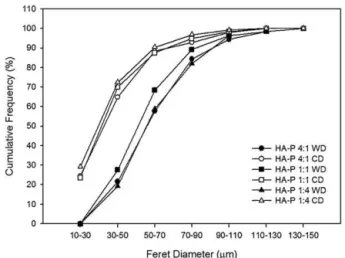
Fig.1. Sizedistributionofsamples.
at40kVand30mA).Thescanningregionswerecollectedfrom4◦ to60◦(2)instepsizeof0.05(2).
2.9. Rheologicalmeasurements
Polymersaqueousdispersions(10%)werepreparedandtheir dynamicviscoelasticpropertiesweremeasuredbyusinga con-trolledstressrheometer(Haake Rheostress1)(GebruderHaake, Germany)equippedwithcone-plate(C35/2Ti)of35mm diame-terandagapof105m.Acirculatingwaterbath(HAAKEC25P) forsampletemperaturecontrol andasoftware (Rheowin3)for dataacquisitionwereused.Allmeasurementswere carriedout intriplicate,withinthelinearviscoelasticrange,at37◦C.Inorder todeterminethelinearviscoelasticregion,stresssweepsbetween 0.1and100Pawereperformed,atalowfrequency(1Hz).Small deformationoscillatoryexperimentswereconductedbyusingtwo stepsofrheologicalmeasurements:(1)frequencysweepsata con-stantstress(1Pa)andangularvelocityrangeof0.6to623rad/sto obtainmechanicalspectrabyrecordingthedynamicmoduliG′and
G′′and(2)creep/recoverytestswerecarriedoutatconstantstress (1Pa).Inthisassaythestresswasappliedinstantlyandmaintained foraperiodof150s.Afterremovingthestress,compliancewas measuredduringfurther150s.
3. Resultsanddiscussion
3.1. Drugloadingandefficiencyofincorporation
Thedrugloadingwasnotsignificantlyinfluencedbyboth poly-merratio and drugconcentrationinsolution,since allsamples presentinghighdruglevel(92–98%).However,thehighest effi-ciencyofincorporationofSDintomicroparticleswasobtainedfrom 9mg/mLSDsolutions,whichwerethenselectedforthepreparation ofsamplesforfurtheranalysis.
3.2. Sizeandshapeproperties
Drugincorporation ledtoa decreasingofparticlesize,since CDsamplespresentedahighestpercentageofparticlesin small-estsizeranges,ascanbeseeninsizedistributionprofiles(Fig.1). Thisbehaviorindicatesthatdrugincorporationresultedinamore packed network due to drug–polymer interactions. The Feret’s diameterestablishesaquantitativeanalysisofparticlesizeandis definedasthedistancebetweentwoparalleltangentsofthe parti-cleatanarbitraryangle(Boschetto&Giordano,2012).Theiraverage values(Table1)confirmedthetendencyofdecreaseofsizedueto thedrugaddition.
Table1
AverageFeretdiameter,circularityandresidualmass(%)ofsamples.
Samples Diameter(m) Circularity Residualmass(%)
HA-P4:1WD 69.16±21.353 0.730±0.0524 45.76 HA-P4:1CD 45.78±21.387 0.716±0.0625 53.74 HA-P1:1WD 61.92±19.788 0.756±0.0426 45.50 HA-P1:1CD 45.03±20.902 0.704±0.0552 47.27 HA-P1:4WD 69.41±21.069 0.742±0.0471 35.19 HA-P1:4CD 42.61±18.558 0.720±0.0539 35.52
Circularityisatwo-dimensionalgeometrictolerancethat con-trolshowmuchafeaturecandeviatefromaperfectcircledefined bythevalue1(Jonesetal.,2008).Thehighcircularityofthe sam-ples,0.704and0.756(Table1),andthenarrowvariationbetween thevaluesdemonstratetheirshaperegularity(Goyanes,Souto,& Martínez-Pacheco,2011;Tunón,Börjesson,Frenning,&Alderborn, 2003).
3.3. Thermoanalyses
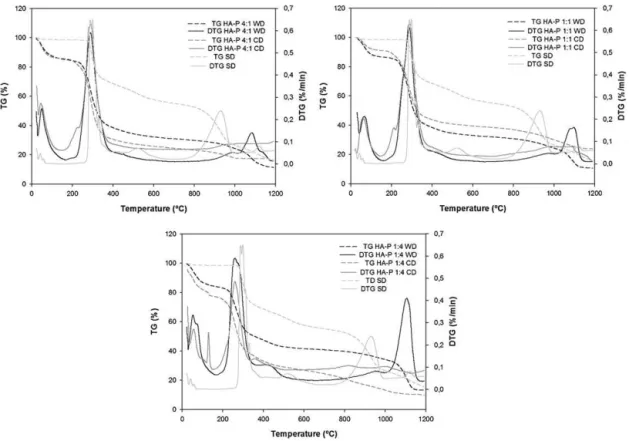
TGandDTGcurvesofSD(Fig.2)showaninitialpeakat65◦C, which should be related to moisture evaporation (Bartolomei, Rodomonte,Antoniella,Minelli,&Bertocchi,2007).Asecondand mainpeak(about30%ofmassloss)occursinthreestepsamong 270–375◦C andit can beattributedtoSD melting and decom-position (Sipos, Szücs, Szabó, Er ˝os, & Szabó-Révész,2008).The TG/DTGcurvesofsamplesHA-P4:1WD,HA-P4:1CD,HA-P1:1 WD, HA-P1:1CD, HA-P1:4 WD,HA-P 1:4CD (Fig.2)show a first peak about 40–110◦C attributed to moisture evaporation, asithasbeenreportedforotherspolysaccharides(Einhorn-Stoll, Kunzek,&Dongowski,2007;Godeck,Kunzek,&Kabbert,2001;Shi &Gunasekaran,2008).Themainpeakwasobservedbetween180 and400◦Candtherelativeintensityofthispeakwashigherfor samplesCDthanforsamplesWD,suggestingtheoccurrenceofboth polymerdegradationanddrugmelting,sincetheseeventsoccurin thesametemperaturerangeandprobablyareintegrated.TheCD thermogramsshowedadiscreteshoulderbetween210and220◦C thatindicatesthedecompositionofmorethanonesubstance.The presenceofthisshoulderunchangedinthethermoanalyticalprofile onceagainsuggestsphysicochemicalinteractions betweendrug andpolymer(Mora,Longhi,&Granero,2010).
Sample1:4WD(Fig.2)showsapeakat134◦C,whichcanresult fromlossofchemical bondedwater(Shi&Gunasekaran,2008). Thepresenceofthiseventonlyinthissamplecanbeattributedto thehigherproportionofpectin,whichisthemostcrystalline poly-mer.Anotherpeakabove900◦Ccanbeobservedinthermograms ofsamplesWD,indicatingthatthedrugincorporationpromoted theincreaseofthermalstability,afactthatisconfirmedbyhigher residualmass(%)ofsamplesCD(Table1).Thedrug–polymer inter-actionshouldhavealsoimprovedthermalstabilityofSD,sinceits decompositionpeak at800◦Cisnot presentinthermogramsof CDsamples.Theoverallmodificationsinthermalbehaviorof sam-plesWDandCDshouldbeattributedtothestructuraldifferences promotedbydrug–polymerinteractions.
138 91 (2013) 135–142
Fig.2.Thermogravimetricanalysis(TG/DTG)ofsamples.
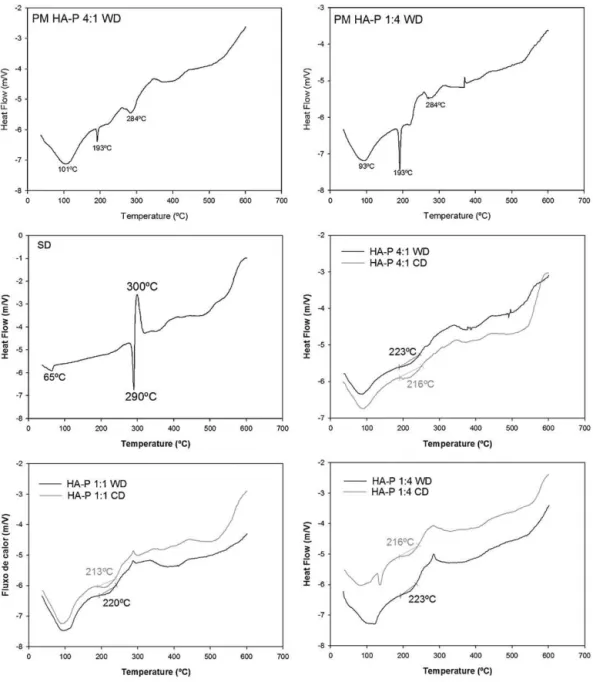
200◦C,shouldbeattributedtodepolymerizationofpectinchains, whichis confirmedbythehighest intensityofthis peak inthe samplewiththegreatestpectinamount(PMHA-P1:4)( Einhorn-Stoll et al., 2007; Shi & Gunasekaran, 2008). The third peak above244◦Cisattributedtothehighamylosestarchdegradation (Massicotte,Baille,&Mateescu,2008).
TheDSCcurvesofsamplesWDandCD(Fig.3)showed simi-larprofiles;nevertheless,samplesCDshowedadecreaseofTmof polymerinrelationtosamplesWD.Inaddition,theendothermic andexothermicpeaksofdiclofenacareabsentinCDsamples.Both eventsindicatethatSDismolecularlydispersedwithinthepolymer matrix,buildingasolidsolution(Siposetal.,2008).
ThechangeintheTmofthepolymershouldalsobeattributed tomorphological modificationsexperiencedbypolymer matrix, suchasthesizeofcrystallitesandthecrystallinitydegreedueto drug–polymerinteractions(Devineetal.,2006).
3.4. X-raydiffraction
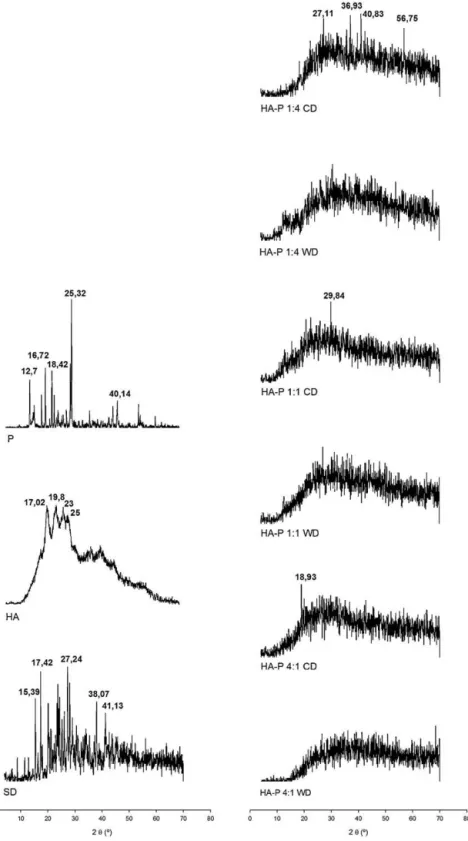
Thediffractogrampatternsofsamples(SD,HA,P,HA-P4:1WD, HA-P4:1CD,HA-P1:1WD,HA-P1:1CD,HA-P1:4WD,HA-P1:4 CD)areexhibitedinFig.4.Thehighamylosestarch(HYLONVII®) diffractogramshowscharacteristicpeaksofBstructurearound17◦, 19◦,23◦and25◦(2)(Freire,Fertig,Podczeck,Veiga,&Sousa,2009; Mishra,Datt,&Banthia,2008).Thepectindiffractogrampresents intenseandwelldefinedpeaksat12.7◦,18.42◦,25.32◦and40.14◦ (2),showingitscrystallinestructure(Mishraetal.,2008).
ForallHA–PmixingratiosinWDmicroparticles,the character-isticpeaksofhighamylosestarchandpectinareabsent,behavior that canbe attributedtothe amorphization of samplesdue to thelyophilization process(Mora etal., 2010)and tothe struc-turalreorganizationpromotedbythecross-linkingreaction.The SDdiffractogram exhibitssignificantpeakscharacteristicof this drugaround15.39◦,17.42◦and27.24◦ (2)(Fini,Moyano,Ginés,
Martinez-Perez,&Rabasco,2005).ThedisappearanceofSDpeaksin CDmicroparticles,mainlyatlowvaluesof2,shouldberesultfrom thedestructionofthecrystallinestructure,whichinvolveschanges inbothcrystallitessizeandcrystallinitydegree(Devineetal.,2006). Thesemorphologicalchangescanoccurduetoprogressive amor-phizationand/ordissolutionofthedruginsidethepolymermatrix, sincedrugmoleculesinteractwithpolymeranditsoriginal crys-tallinestructurebecomesdeformed(Finietal.,2005).Thesetof X-raydiffractionresultsreinforcetheoccurrenceofdrug–polymer interactions,asindicatedbythermalanalysisdata.
3.5. Rheologicalproperties
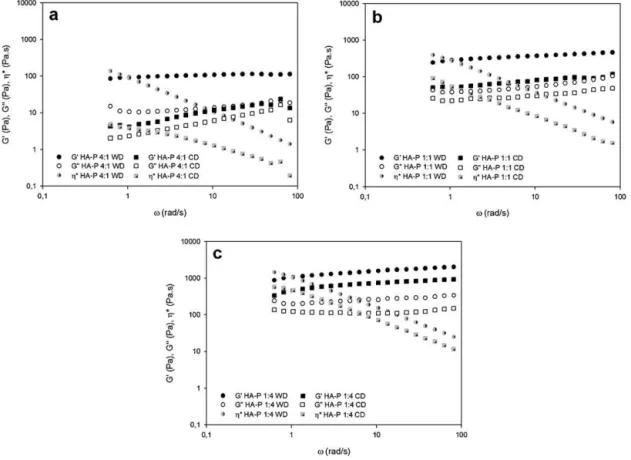
Themechanicalspectradatacanbeusedtoclassifythestructure ofgelsasweakorstrong(Martínez-Ruvalcaba,Chornet,&Rodrigue, 2007).ThemechanicalspectraofWDandCDmicroparticlesare showninFig.5,inwhichitcanbeobservedthatG′valuesremained higherthanG′′valueswithinthewholefrequencyrangeexplored andthevalueswerequasiparallel,displayingtheelasticgel behav-iorofallmaterials.Inaddition,bothsamplesWDandCDbehaved asstrongortruegel,characteristicofcovalentlycross-linked net-works,sinceG′valueswerenearlyfrequencyindependent(Grassi, Lapasin,Grassi,&Colombo,2006;Martínez-Ruvalcabaetal.,2007; Rosalina&Bhattacharya,2002;Szütsetal.,2010;Yoneya,Ishibashi, Hironaka,&Yamamoto,2003).
91 (2013) 135–142 139
Fig.3. DSCcurvesofsamples.
the original H bond formation between them. Similar behav-ior was related for PAA/PVA hydrogel containing aspirin (Mac Gann, Higginbotham, Geever, & Nugent, 2009) and protein-polysaccharidesystemscontainingsalbutamol(Saxena,Kaloti,& Bohidar,2011).Thisweakeningofnetworkbydrugincorporation isrelatedtoa“plasticizingeffect”ofthedrugthatdisturbs macro-molecularinteractionsofgelnetwork(Franc¸ois,Rojas,Daraio,& Bernik,2003).
Thevariationofstoragemodulus(G′)atlowfrequenciesina log–logplotofG′ versusωfollowsthepowerlaw(Saxenaetal., 2011),givenby:
G′=Sωn (4)
whereG′isthestoragemodulus;Sthegelstrength;ωtheoscillation frequencyandnistheviscoelasticexponent.
The n and S values have shown to be sensitive to the cross-linking density within the polymer network, allowing a quantitative estimation of strength of gel structures (Nyström, Walderhaug,Hansen,&Lindman,1995; Scalan&Winter, 1991;
Watase, Nishinari,&Clark,1989).In thissense,thedecreaseof distanceisrepresentedbyhigherSvaluesandanincreaseofthe cross-linkingdensity,botheventsrelatedtostrongergelstructures. Inversely, thedecreaseofn exponentvalues withincreasingof cross-linkingdensitywasreportedinastudywithPVAgels(Morris, Rees,Thom,&Welsh,1977).
Analogously,samplesWDbuiltstrongergels,accordingtotheir lowvaluesofnandhighestvaluesofS(Table2),whilesamples CD shouldresultin alooser andweaker structure. Besides,the
Table2
G′,R(%),nexponentandSvaluesofsamples.
Samples G′(Pa) %R n S
HA-P4:1WD 105.21 48.15 0.058 92.94
HA-P4:1CD 9.67 11.77 0.358 4.75
HA-P1:1WD 353.36 41.75 0.154 282.47
HA-P1:1CD 72.74 30.50 0.185 51.10
HA-P1:4WD 1467.00 73.52 0.142 1095.97
140 91 (2013) 135–142
Fig.4. X-raydiffractionpatternsofsamples.
sample1:4HA-PWDexhibitedthehighestSvalues,whichmust beattributedtothestrongeststructuresthatareclosesttocovalent gels.
Thesefindingsareinagreementwithmechanicalspectradata thatindicatethatthedrugincorporationresultedintheweakening ofpolymernetworkduetofactorspreviouslydiscussed.
Thecreep-recoverytestswereperformedtoassistthe under-standingoftheinternalstructuresofthesesystemsthatpresented an important elastic behavior as showed by mechanical spec-tra. The recovery(%) was calculated from Jmax and Jmin values
(Table 2), according to an equation proposed by Ghannam (2004):
R(%)=
Jmax−J min Jmax×100 (5)
91 (2013) 135–142 141
Fig.5.Mechanicalspectraofsamples.
forsamplesWDandCDshowthatinternalstructuresaredifferent (Dolz,Hernandez,&Delegido,2008),whichalsoshouldberelated todrug–polymerinteractions.
4. Conclusions
The influence of both drug loading and polymer propor-tion on microparticles properties was demonstrated and the drug–polymerinteractionswereevidencedbytheanalyticalresults presentedinthiswork.Inaddition,itwasdemonstratedthatthe drugloadingresultedinanincreaseofboththermalstabilityand crystallinitydegree,butwithadecreaseofmechanicalstrengthof thestructures.Likewise,themicroparticlespropertieswere sensi-tivetopolymerproportion,sincetheblendswithhigherlevelsof pectinresultedinhigherthermal stability,whiletherheological properties,generally,pointedtothestrengtheningof the struc-tures.
Acknowledgments
The financial support provided by Coordenac¸ão de Aperfeic¸oamento de Pessoal de Nível Superior (CAPES) and Fundac¸ãodeAmparoàPesquisadoEstadodeSãoPaulo(FAPESP) isacknowledged.
References
Bartolomei,M.,Rodomonte,A.,Antoniella,E.,Minelli,G.,&Bertocchi,P.(2007). Hydratemodificationsofthenon-steroidalanti-inflammatorydrugdiclofenac sodium:Solidstatecharacterizationofthetrihydrateform.Journalof Pharma-ceuticalandBiomedicalAnalysis,45,443–449.
Boschetto,A.,&Giordano,V.(2012).Powdersamplingandcharacterizationbydigital imageanalysis.Measurement,45,1023–1038.
Carbinatto,F.M.,Castro,A.D.,Cury,B.S.F.,Magalhães,A.,&Evangelista,R.C.(2012). Physicalpropertiesofpectin–highamylosestarchmixturescross-linkedwith sodiumtrimetaphosphate.InternationalJournalofPharmaceutics,423,281–288.
Cury,B.S.F.,Castro,A.D.,Klein,S.I.,&Evangelista,R.C.(2009a).Influenceof phosphatedcross-linkedhighamyloseoninvitroreleaseofdifferentdrugs. CarbohydratePolymer,78,789–793.
Cury,B.S.F.,Castro,A.D.,Klein,S.I.,&Evangelista,R.C.(2009b).Modelinga sys-temofphosphatedcross-linkedhighamyloseforcontrolleddrugrelease.Part 2:Physicalparameters,cross-linkingdegreesanddrugdeliveryrelationships. InternationalJournalofPharmaceutics,371,8–15.
Devine,D.M.,Devery,S.M.,Lyons,J.G.,Geever,L.M.,Kennedy,J.E.,&Higginbotham, C.L.(2006).Multifunctionalpolyvinylpyrrolidinone–polyacrylicacidcopolymer hydrogelsforbiomedicalapplications.InternationalJournalofPharmaceutics, 326,50–59.
Dolz,M.,Hernandez,M.J.,&Delegido,J.(2008).Creepandrecovery experimen-talinvestigationoflowoilcontentfoodemulsions.FoodHydrocolloids,22, 421–427.
Ebube,N.K.,&Jones,A.B.(2004).Sustainedreleaseofacetaminophenfroma heterogeneousmixtureoftwohydrophilicnon-ioniccelluloseetherpolymers. InternationalJournalofPharmaceutics,272,19–27.
Einhorn-Stoll,U.,Kunzek,H.,&Dongowski,G.(2007).Thermalanalysisofchemically andmechanicallymodifiedpectins.FoodHydrocolloids,21,1101–1112. Fang,Y-Y.,Wang,L-J.,Li,D.,Li,B-Z.,Bhandari,B.,Chen,X.D.,etal.(2008).
Prepa-rationofcrosslinkedstarchmicrospheresandtheirdrugloadingandreleasing properties.CarbohydratePolymers,74,379–384.
Fini,A.,Moyano,J.R.,Ginés,J.M.,Martinez-Perez,J.I.,&Rabasco,A.M.(2005). Diclofenacsalts,II.SoliddispersionsinPEG6000andGelucire50/13.European JournalofPharmaceuticsandBiopharmaceutics,60,99–111.
Franc¸ois,N.J.,Rojas,A.M.,Daraio,M.E.,&Bernik,D.L.(2003).Dynamic rheologi-calmeasurementsanddrugreleasekineticsinswollenscleroglucanmatrices. JournalofControlledRelease,90,355–362.
Freire,A.C.,Fertig,C.C.,Podczeck,F.,Veiga,F.,&Sousa,J.(2009).Starch-based coatingsforcolon-specificdrugdelivery.PartI:Theinfluenceofheattreatment onthephysico-chemicalpropertiesofhighamylosemaizestarches.European JournalofPharmaceuticsandBiopharmaceutics,72,574–586.
Ghaffari,A.,Navaee,K.,Oskoui,M.,BayatiI,K.,&Rafiee-Tehrani,M.(2007). Prepa-rationandcharacterizationoffreemixed-filmofpectin/chitosan/Eudragit®RS intendedforsigmoidaldrugdelivery.EuropeanJournalofPharmaceuticsand Biopharmaceutics,67,175–186.
Ghannam, M. T. (2004). Creep-recovery experimental investigation of crude oil–polymer emulsions. Journal of Applied Polymer Science, 92, 226–237.
Godeck,R.,Kunzek,H.,&Kabbert,R.(2001).Thermalanalysisofplantcellwall mate-rialsdependingonthechemicalstructureandpre-treatmentpriortodrying. EuropeanFoodResearchandTechnology,213,395–404.
142 91 (2013) 135–142
Grassi,M.,Lapasin,R.,Grassi,M.,&Colombo,I.(2006).Understandingdrugrelease andabsorptionmechanisms:Aphysicalandmathematicalapproach– Chapter3: Rheology.BocaRaton:CRCpress.
Jones,M.D.,Harris,H.,Hooton,J.C.,Shur,J.,King,G.S.,Mathoulin,C.A.,etal.(2008). Aninvestigationintotherelationshipbetweencarrier-baseddrypowder inhala-tionperformanceandformulationcohesive–adhesiveforcebalances.European JournalofPharmaceuticsandBiopharmaceutics,69,496–507.
Lecomte,F.,Siepmann,J.,Walther,M.,MacRae,R.J.,&Bodmeier,R.(2005).pH sen-sitivepolymerblendsusedascoatingmaterialstocontroldrugreleasefrom sphericalbeads:Elucidationoftheunderlyingmasstransportmechanisms. PharmaceuticalResearch,22,1129–1141.
Lenaerts,V.,Dumoulin,Y.,&Mateescu,M.A.(1991).Controlledreleaseof theo-phyllinefromcross-linkedamylosetablets.JournalofControlledRelease,15, 39–45.
Li,B.-Z.,Wang,L.-J.,Li,D.,Chiu,Y.L.,Zhang,Z.-J.,Shi,J.,etal.(2009).Physical propertiesandloadingcapacityofstarch-basedmicroparticlescrosslinkedwith trisodiumtrimetaphosphate.JournalofFoodEngineering,92,255–260. Lutz,R.,Aserin,A.,Wicker,L.,&Garti,N.(2009).Structureandphysicalproperties
ofpectinswithblock-wisedistributionofcarboxylicacidgroups.Food Hydro-colloids,23,786–794.
MacGann,M.J.,Higginbotham,C.L.,Geever,L.M.,&Nugent,M.J.D.(2009).The synthesisofnovelpH-sensitivepoly(vinylalcohol)compositehydrogelsusing afreeze/thawprocessforbiomedicalapplications.InternationalJournalof Phar-maceutics,372,154–161.
Martínez-Ruvalcaba,A.,Chornet,E.,&Rodrigue,D.(2007).Viscoelasticproperties ofdispersedchitosan/xanthanhydrogels.CarbohydratePolymers,67,586–595. Massicotte,L.P.,Baille,W.E.,&Mateescu,M.A.(2008).Carboxylatedhigh
amy-losestarchaspharmaceuticalexcipient.Structuralinsightsandformulationof pancreaticenzymes.InternationalJournalofPharmaceutics,356,212–223. Mishra,R.K.,Datt,M.,&Banthia,A.K.(2008).Synthesisandcharacterizationof
pectin/PVPhydrogelmembranesfordrugdeliverysystem.AAPSPharmSciTech, 9,395–403.
Mora,M.J.,Longhi,M.R.,&Granero,G.E.(2010).Synthesisand characteriza-tionofbinaryandternarycomplexesofdiclofenacwithamethyl--CDand monoethanolamineandinvitrotransdermalevaluation.EuropeanJournalof MedicalChemistry,45,4079–4088.
Morris,E.R.,Rees,D.A.,Thom,D.E.,&Welsh,J.(1977).Conformationand intermolec-ularinteractionsofcarbohydratechains.JournalofSupramolecularStructureand CellularBiochemistry,6,259–274.
Nyström, B.,Walderhaug, H.,Hansen, F. K., & Lindman,B. (1995). Rheologi-calbehaviorduringthermoreversiblegelationofaqueousmixturesofethyl (hydroxyethyl)celluloseandsurfactants.Langmuir,11,750–757.
O’Brien,S.,Wang,Y.,Vervaet,C.,&Remon,J.P.(2009).Starchphosphatesprepared byreactiveextrusionasasustainedreleaseagent.CarbohydratePolymers,76, 557–566.
Onofre,F.,Wanga,Y.J.,&Mauromoustkos,A.(2009).Effectsofstructureand mod-ificationonsustainedreleasepropertiesofstarches.CarbohydratePolymers,76, 541–547.
Patel,V.F.,&Patel,N.M.(2007).Statisticalevaluationofinfluenceofxanthangum andguargumblendsondipyridamolereleasefromfloatingmatrixtablets.Drug DevelopmentIndustrialPharmacy,33,327–334.
Prezotti,F.G.,Meneguin,A.B.,Evangelista,R.C.,&Cury,B.S.F.(2012).Preparation andcharacterizationoffreefilmsofhighamylose/pectinmixturescross-linked withsodiumtrimetaphosphate.DrugDevelopmentIndustrialPharmacy,1–6. http://dx.doi.org/10.3109/03639045.2011.650863
Puttipipatkhachorn,S.,Pongjanyakul,T.,&Priprem,A.(2005).Molecular interac-tioninalginatebeadsreinforcedwithsodiumstarchglycolateormagnesium
aluminumsilicate,andtheirphysicalcharacteristic.InternationalJournalof Phar-maceutics,293,51–62.
Richardson,P.H.,Jeffcoat,R.,&Shi,Y.(2000).High-amylosestarches:From biosyn-thesistotheiruseasfoodingredients.MRSBulletin,25,20–24.
Rioux, B., Ispas-Szabo, P., Aït-Kadi, A., Mateescu, M., & Juhász, J. (2002). Structure–propertiesrelationshipincross-linkedhighamylosestarchcastfilm. CarbohydratePolymers,50,371–378.
Rosalina,I.,&Bhattacharya,M.(2002).Dynamicrheologicalmeasurementsand analysisofstarchgels.CarbohydratePolymers,48,191–202.
Saxena,A.,Kaloti,M.,&Bohidar,H.B.(2011).Rheologicalpropertiesofbinaryand ternaryprotein–polysaccharideco-hydrogelsandcomparativereleasekinetics ofsalbutamolsulphatefromtheirmatrices.InternationalJournalofBiological Macromolecules,48,263–270.
Scalan,J.C.,&Winter,H.H.(1991).Compositiondependenceofthe viscoelastic-ityofend-linkedpoly(dimethylsiloxane)atthegelpoint.Macromolecules,24, 47–54.
Shi,L.,&Gunasekaran,S.(2008).Preparationofpectin–ZnOnanocomposite.Nano Express,3,491–495.
Singh,J.,Kaur,L.,&McCarthy,O.J.(2007).Factorsinfluencingthephysico-chemical, morphological,thermalandrheologicalpropertiesofsomechemicallymodified starchesforfoodapplications– areview.FoodHydrocolloids,21,1–22. Sipos,P.,Szücs,M.,Szabó,A.,Er ˝os,I.,&Szabó-Révész,P.(2008).Anassessmentofthe
interctionsbetweendiclofenacsodiumandammoniomethacrylatecopolymer usingtermalanalysisandRamanspectroscopy.JournalofPharmaceuticaland BiomedicalAnalysis,46,288–294.
Sungthongieen,S.,Sriamornsak,P.,Pitaksuteepong,T.,Somsiri,A.,& Puttipipatkha-chorn, S.(2004). Effectof degree of esterification of pectinand calcium amountondrugreleasefrompectin-basedmatrixtablets.AAPSPharmSciTech,5, 50–57.
Szüts,A.,Budai-Szücs,M.,Erõs,I.,Otomo,N.,&Szabó-Révésza,P.(2010).Studyof gel-formingpropertiesofsucroseestersforthermosensitivedrug.International JournalofPharmaceutics,383,132–137.
Tunón,A.,Börjesson,E.,Frenning,G.,&Alderborn,G.(2003).Drugreleasefrom reser-voirpelletscompactedwithsomeexcipientsofdifferentphysicalproperties. EuropeanJournalofPharmaceuticalSciences,20,469–479.
VanHung,P.,Maeda,T.,&Morita,N.(2006).Waxyandhigh-amylosewheatstarches andflourscharacteristics,functionalityandapplication.TrendsinFoodScience andTechnology,17,448–456.
Wang,Q.,Hu,X.,Du,Y.,&Kennedy,J.F.(2010).Alginate/starchblendfibersandtheir propertiesfordrugcontrolledrelease.CarbohydratePolymers,82,842–847. Watase,K.M.,Nishinari,A.H.,&Clark,S.B.(1989).Differentialscanningcalorimetry,
rheology,X-ray,andNMRofveryconcentratedagarosegels.Macromolecules,22, 1196–1201.
Wattanchant,S.,Muhammad,K.,Hashim,D.,&Rahman,R.A.(2003).Effectof crosslinkingreagentsandhydroxypropylationlevelsondual-modifiedsago starchproperties.FoodChemistry,80,463–471.
Wei,X.,Sun,N.,Wu,B.,Yin,C.,&Wu,W.(2006).Sigmoidalreleaseofindomethacin frompectinmatrixtablets:Effectofinsitucrosslinkingbycalciumcations. InternationalJournalofPharmaceutics,318,132–138.
Woo,K.,&Seib,P.A.(1997).Cross-linkingofwheatstarchandhydroxypropylated wheatstarchinalkalineslurrywithsodiumtrimetaphosphate.Carbohydrate Polymers,33,263–271.
Yeh,An-I.,&Yeh,Su-Lan.(1993).Somecharacteristicsofhydroxypropylatedand cross-linkedricestarch.CerealChemistry,70,596–601.
Yoneya,T.,Ishibashi,K.,Hironaka,K.,&Yamamoto,K.(2003).Influenceof cross-linkedpotatostarchtreatedwithPOCl3onDSC,rheologicalpropertiesand