Chanan Naveh
The Role of the Media in Establishing International Security Regimes
Kurzfassung: In diesem Aufsatz wird der Einfluss der Medien auf internationale Sicherheitsregime untersucht: Wie beeinflussen die Medien den Lebenszyklus internationaler Regime von ihrem Entstehen über die Phase ihrer Etablierung, Konsolidierung und Stabilisierung bis hin zu ihrem Niedergang? Obwohl der Beitrag besonders auf die Rolle der Medien bei der Entwicklung von abhebt, steht außer Frage, dass die Medien den Lebenszyklus aller internationalen Regime beeinflussen, wie auch immer diese beschaffen sind.
Die Analyse sowohl der Beziehungen zwischen Medien und Sicherheitsregimen im Allgemeinen als auch des spezifischen Beitrags der Me-dien zu jeder einzelnen Entwicklungsstufe der Sicherheitsregime erfolgt mit kommunikationswissenschaftlichen Methoden. Untersucht werden die Medienagenda, die "Nachrichtenwerte" der Medien und deren verschiedene Funktionen sowie die Fähigkeit der Medien, öf-fentliche Unterstützung für das jeweilige Anliegen des Regimes zu mobilisieren.
Die meisten bisherigen Studien haben die Wechselbeziehungen zwischen Mustern der Medienkommunikation und globalen Entwicklungen auf der Ebene von Staaten bzw. hinsichtlich der Formulierung der Außenpolitik dieser Staaten untersucht. Die internationale Dimension dieser Beziehungen dagegen wurde weitgehend ignoriert. Anliegen des vorliegenden Beitrags ist es, dieses Desiderat zu beseitigen. Die entsprechenden Prozesse werden anhand der Fallstudie des internationalen Anti-Irak-Sicherheitsregimes dargestellt. Auch wenn sich der Beitrag auf das spezifische Anti-Irak-Regime konzentriert, muss dabei beachtet werden, dass dieses wiederum Teil eines allgemeineren Anti-Schurken-Regimes ist, das den Krieg gegen den weltweiten Terrorismus führt.
Die Untersuchung der Entwicklung der Medien in Wechselwirkung mit dem Anti-Irak-Sicherheitsregime lehrt uns, dass die Medien in in-ternationalen Krisen einhellig das Regime unterstützen, das "die Bösen" bekämpft. Wenn das Regime sich jedoch weiter entwickelt, sich auf umstrittenes Terrain begibt und an Legitimität verliert, verringert sich auch die Unterstützung durch die Medien. Die Medien können sich dann sogar in eine oppositionelle Kraft verwandeln und mit denjenigen verbünden, die sich dem Regime widersetzen.
Die Untersuchung des Falles Irak zeigt, dass die Akteure, die ein internationales Regime forcieren und befördern (unabhängig davon, ob es sich dabei um eine Sicherheitsregime oder ein anderes Regime handelt), sich auch auf die richtige Handhabung der internationalen Medien vorbereiten müssen. Sie müssen geeignete Medienstrategien ausarbeiten und Instrumente der Public Relations entwickeln, mit denen die Medien dazu befähigt werden, diejenigen Kräfte zu unterstützen, die das Regime und dessen Normen repräsentieren.
Abstract: This article focuses primarily on the media’s impact on international security regimes. It explores the ways in which the media affect the lifecycles of international regimes, from the time they are first conceived of, through their establishment, consolidation and stabilization, up until their ultimate demise. Although this paper highlights the media’s role in the evolution of security regimes, it is clear that, regardless of the regime in question, media play a role throughout the lifecycle of all international regimes, whatever their character. In order to analyze the relationships of the media with security regimes in general, and specifically their contribution to each stage in their development, the article utilizes methodologies from the field of communication studies. It examines the media’s agenda, "news values" and various functions, and their ability to mobilize public support for the particular issue of the regime.
To date, most studies have explored the interaction between media communication patterns and global developments at the state level, or in relation to the formulation of foreign policy, while largely ignoring the international dimension of the relationship. This article attempts to remedy this situation, and the relevant processes are analysed in a case study of the anti-Iraq international security regime. It should be noted that although the paper focuses on the specific anti-Iraq regime, it is part of a more general anti-Rogue actors regime which includes the war against global terrorism.
1. Introduction
"Ladies and gentlemen, this is a difficult moment for America. I, unfortunately, will be going back to Washington after my remarks. Sec-retary Rod Paige and the Lt. Governor will take the podium and discuss education. I do want to thank the folks here at Booker Elementary School for their hospitality.
Today we’ve had a national tragedy. Two airplanes have crashed into the World Trade Center in an apparent terrorist attack on our coun-try. I have spoken to the Vice President, to the Governor of New York, to the Director of the FBI, and have ordered that the full resources of the federal government go to help the victims and their families, and to conduct a full-scale investigation to hunt down and to find those folks who committed this act.
Terrorism against our nation will not stand.
And now if you would join me in a moment of silence. May God bless the victims, their families, and America. Thank you very much." (President Bush at the Emma Booker Elementary School, Sarasota, Florida – September 11, 2001, 9:30 a.m.1).
With these words, US President George Bush set the stage for the founding of a global regime whose declared aim is to fight terrorism. Born on 11 September 2001 and led by the United States, it developed into the celebrated War against TerrorismRegime. This up-and-coming regime soon gave rise to a second regime designed to secure the compliance and/ or capitulation of rogue states.
These developments served to highlight, yet again, the close links between international processes and the media. They pointed to the significant contribution of one branch of the political media – the global news media – to the shaping of diplomatic – military cum security processes.
In recent years, academics in the field of international relations, along with experts from the field of communication studies, have examined the media’s effect on international developments, and, more specifically, their bearing on the making of foreign policy. However, most these studies tended to overlook the fact that contemporary technical innovations have transformed the media, in their various guises, written, visual and audio, into a global phenomenon capable of influencing global processes. In recent years, the media have played a significant part in molding various international regimes, includ-ing security regimes. How the global news media affect the evolution of security regimes is the focus of this article.
Current writings on international relations define international regimes as a phenomenon in which international actors (usu-ally states) form an association and co-operate with one another in order to: tackle a particularly taxing problem, realize a joint interest or confront a common challenge. International regimes address a wide range of issues, most commonly eco-nomic and security problems. But they also touch on human rights and environmental issues, and even on questions of communication and technology.
The present paper will highlight the multiplex links between international regimes and the global news media. It will focus primarily on the way in which the global news media help to shape international regimes, in general, and security regimes, in particular. To this end, it will put forward and analyze various patterns characteristic of the relationship between the global news media (and when necessary national news media) and security regimes. It will explore the nature of that re-lationship as it develops throughout the lifespan of the regime. It will start with a breakdown of the security regime’s in-cipient beginnings, when the problem at stake is first identified; a stage in which it would appear that the media play a crucial role in both pinpointing the problem and proposing ways of dealing with it. It will then consider the media’s contri-bution to a security regime’s crystallization and consolidation processes, when regime expectations, as well as the norms defining its character and governing its behavior, are formed.
International security regimes need the global news media in order to secure and maintain public legitimacy and status. Furthermore, by identifying the international actors who have strayed from the regime’s norms, the media also assists the regime to function on a daily basis. Spelling out the price the guilty parties will have to pay should they continue to break the regime’s rules, or worse dispense with them altogether, the media helps bring the offenders into line. And, should the latter willfully ignore the regime and the media’s warnings, the media may, on occasion, help to apply sanctions against them. These processes owe much, among other things, to the existence of technologically extremely sophisticated global news media. Examining them requires a detailed study of the media’s various functions. These include: the way they cover stories and comment upon them, but also their ability to mobilize public support for a particular issue. In order to gain a full picture of the global news media’s effects on a regime, the links among these various functions must also be taken into account. All these functions have a strong influence on the establishment and consolidation of security regimes. The same holds true of the global news media’s agenda. By setting its own news agenda, the global media will not only single out and underscore the security problem at stake, but also suggest ways of tackling it, suggestions which will probably filter back into the regime. The media’s "news value" judgments, its estimate of the newsworthiness of certain issues, may also push forward, or retard, the development of a security regime.
Though the focus of this article is theoretical, it is worth pointing out that the global news media helped bring into being the global security regime born in the aftermath of the devastating attack on the World Trade Center. The media, among others, dubbed that attack "9/11," a term now embedded in the public mind. Encapsulating the entire affair, factually as well as emotionally, the term has since become an integral part of international discourse. But the expression "9/11" cap-tured more than the emotions of that day, it also served to denote its various political, military, social and ethical conse-quences, some of which the world is still living with today.
"9/11," the Twin Tower attack, President Bush’s speech, and the subsequent steps taken by the United States and the international community, especially the United Nations, to combat terrorism, marked the advent of a new international re-gime designed to wage war on terrorism. It was followed by a second rere-gime charged with confronting rogue states; states which by supporting terrorism and/or seeking to develop weapons of mass destruction, struck at the very heart of two of the first regime’s most basic norms. Both regimes spawned a number of sub-regimes. The first was to embark upon a war against the Taliban in Afghanistan. The second was the Pro-War in Iraq Regime, formed just a year later, and following it the Anti-War in Iraq Regime. The role played by the global news media in the life of these complex, multifaceted and still existent, albeit in new guises, security regimes, deserves a more detailed and extensive analysis in the form of a separate article.
2. The Relevant Fields of Study and Research
Inevitably, any comprehensive appraisal of the global news media’s variegated contribution to the evolution of security regimes must draw upon the findings of a wide range of academic fields. One pertinent field of study is the analysis of international processes, which encompasses among other things both security issues and communications processes. An-other focuses upon the key processes characteristic of the political media, while a third explores the nature of international regimes, and in this context of security regimes, as well. Together they combine to create a multiplex, theoretical frame-work upon which to hang the analysis of the relationship between the media and international security regimes.
2.1 International Regimes
An international regime consists of ‘sets of implicit or explicit principles, norms, rules, and decision-making procedures around which actors’ expectations converge in a given area of international relations’ (Krasner, 1983:2). Another slightly less vague, more rigorous and so perhaps more practical definition characterizes international regimes as a phenomenon in the course of which international actors, adopting clearly defined patterns of behavior, co-operate with one another in order to tackle a problem of common concern. International regimes do not, it must to be said, arise in periods of total harmony or conversely, at times of acute and bitter conflict. Of no relevance in zero sum situations (Krasner, 1991:337), these regimes usually come into being when actors find themselves facing a common dilemma, sharing a joint interest or conversely a mutual aversion. Whatever the motive behind the regime’s establishment, it is a phenomenon, event or pro-cess which, taking place beyond state level, addresses a range of international issues in a comparatively orderly manner and which can, therefore, be rigorously scrutinized, studied and assessed (Levy, Young and Zuern, 1995). But, if interna-tional regimes are organized, they are not an instituinterna-tionalized phenomenon, since they lack official organizations or insti-tutions. Once an international regime institutes a formal organization, it is no longer an international regime, but rather an international organization, and so belongs to a different field of study altogether.
One of the key questions in the study of international regimes is that of the conditions under which such regimes appear. Why, scholars ask themselves, do countries seek to co-operate in order to tackle tricky or tough problems (Young, 1986; Haggard and Simmons, 1987). The answer given often depends on which of the two primary schools of thought in the field of international relations the respondent belongs to: the Realist or Liberal school. Realists argue that regimes come into being in one of two ways: either the dominant, hegemonic power imposes the regime on the other actors, or the actors themselves conclude that the alternative to co-operation – severe conflict – is infinitely worse. In other words, an interna-tional regime is a product of cost-benefit calculations. By contrast, adherents of the Liberal school of thought believe that actors co-operate instinctively out of a genuine desire to tackle common problems together. They honestly believe that collaboration is the best, most ethical response to their problems. But, whatever the answer, moral or utilitarian, both in-terpretations, throw some light on the global news media’s influence on international regimes.
2.1.1 The Dynamics of International Regimes
One of the more interesting fields of inquiry in the context of international regimes studies focuses on the processes wheby such regimes appear, consolidate, stabilize and eventually disappear. Some academics have concentrated on the re-gimes’ birth cycle, whilst others have studied their development and eventual consolidation. But, only a few have bothered to examine their disappearance. The table and figure (Table 1) below depict the dynamics of international regimes, a dy-namic in which, as will be seen, the global news media play an important part:
Table 1: The dynamics of international regimes
This dynamic, applicable to security regimes as well, will prove of the utmost significance, particularly once the global news media’s contribution to the evolution of international regimes is added to the mix.
Birth of International Regimes. Oren Young argues that international regimes come into being in one of several ways. Of these, some are rooted in the Liberal persuasion, while others stem from the Realist school of thought (Young, 1994: 44– 45). In some cases, he suggests, a powerful state may impose a regime on its fellow actors. Others regimes are the product of negotiations between actors with a common interest. But, there are also, he admits, regimes that appear spontaneously. A closer look at the process of setting up an international regime reveals that the procedure is far from simple and can be broken down into several key stages (Young and Oshrenko, 1993; Young, 1994; Levy, Young and Zuern, 1995).
During the first stage, the problem addressed is identified. Someone, be it a state, international organization, national in-terest group, public figure or even private individual, kick-starts the process by drawing attention to a particularly worri-some problem, thus placing it on the international agenda. In the second stage, the process of tackling the issue at stake is pushed forward. This occurs when an international actor, usually a member of the great power club (see the actors men-tioned by Young in Young, 1994:44–45) impresses upon others the need to confront and resolve said problem. Acting as a catalyst, this actor campaigns for the establishment of a regime, arguing that it is the best, if not the only way to resolve the problem at hand. As the mainspring of the regime, this actor will also identify prospective regime members and suggest ways of tackling the problem. During the third – consolidation – stage, other actors will join the regime. This stage also sees the formulation of the several shared principles and norms that will determine both the regime’s nature and its modus operandi. Throughout this stage, regime members endeavor to devise new rules and regulations, as well as common de-cision-making processes. Having completed their labors, they may decide to stage an event marking the regime’s founda-tion, be it in the form of an international gathering or a public ceremony during which they will sign a formal accord.
Consolidation of the International Regime. There are various mechanisms that enable international regimes to develop and become stronger or, conversely, prevent other actors from undermining them (Krasner, 1991:342). There is little doubt that a regime’s continued existence is largely dependent on its ability to persuade or compel its members to adopt its norms. This, in turn, demands, among other things, a degree of regime transparency, with regime members having free, unre-stricted access to information about their associates, the regime’s norms, as well as various developments within the regime (Mitchell, 1998:110–119). While the full range of resources allowing for regime transparency is yet to be established, the international news media is clearly one of them and an important one at that.
As noted, there is no set limit on the lifespan of an international regime. Some are long-lived, other less so. Equally, there are also no hard and fast rules as to the manner in which regimes end. However, this usually occurs when a regime’s mem-bers challenge its norms, regulations or decision-making processes. When this happens, and especially if the memmem-bers in question were key to its establishment and subsequent operation, the regime will decline until it eventually vanishes from the scene. The process marking the demise of a regime can be fairly drawn out, with a regime withering away, as the
1. The Advent of an International Regime
2. The Regime's Consolidation and Stabilization
3. Junction Marking Three Possible Regime Endings
4. Withering Away
5. Stabilization and Continuation until the Establishment of an International Organisation
motivation behind its establishment slowly disappears. By contrast, some regimes simply collapse. This happens either when one or more of a regime’s key members decides to rebel against it, or if the problem that initially led to its establish-ment has finally been solved. Members may also abandon a regime if another, more important question requiring attention and the establishment of a new regime has arisen. Whatever the manner of its demise, the global news media, as will be seen, play an important role in a regime’s extinction.
Up to this point, this article has focused upon two separate fields of inquiry. It has discussed methodologies, concepts and processes derived from the field of media studies. Moving on to the discipline of international relations, it has scrutinized the various principles underlying the term international regimes. Now, combining these two perspectives, it will examine if and how media processes affect international regimes. It will consider the validity of the claim that the global news media are among the many mechanisms that shape international regimes.
2.1.2 Security Regimes
Robert Jervis, the world’s leading scholar in the field of security regimes, defined a security regime as ‘those principles, rules and norms that permit nations to be restrained in their behavior in the belief that others will reciprocate.’ Actors must also, he adds, ‘believe that others share the value they place on mutual security and cooperation’, while ‘war and individ-ualistic pursuit of security must be seen as costly’ (Jervis, 1982:357–8 and 361). According to Jervis, the aforementioned norms, laws and principles constitute the key variables that underpin and, in effect, determine the behavior of the regime’s members. From this he concludes that regime members internalize the moral principle of self-restraint and do not exercise it out of self-interest or fear. Moderation, self-control and reciprocity, he argues, acquire a normative value for the members of the regime, with the result that concessions are no longer considered a weakness, but rather a natural part of their new regime-based give-and-take relationship (Jervis, 1982:367).
It would thus appear that a security regime is a process in which international actors have a shared interest in co-operating with one another in order solve a common problem which threatens their security or, possibly, their very existence. This interest is rooted in the fear that not to tackle the problem jointly would prove much too costly. For example, failure to co-operate might engender dangerous developments in the international arena or encourage the intervention of a third party who will demand a high price for his intercession.
The Conditions required for Establishing Security Regimes.Jervis maintains that the following three conditions must all be present if a security regime is to come into existence. First, the principal powers in the international arena must have an abiding interest in setting up such a regime. Second, all prospective regime members must ascribe a similar value to the principles of common security and co-operation. The third condition is a negative one, in that if one or more actors ulti-mately conclude that the best way for them to obtain security is through expansion, a security regime cannot be created.
According to Janis Gross-Stein, some security regimes are rooted in the common interests of rival actors who, as a result, pursue a dynamic form of collaboration. Other regimes, she claims, are moved by selfish motives, and usually emerge when potential members share an aversion to a common enemy. In these cases, rather than create a system of full-blown co-operation, the actors will tend to limit their association to coordinating their actions. Gross-Stein maintains that security regimes instill in their members a variety of norms that, in turn, allow the regime to function properly. Inertia, produced by the members’ expectations from the regime, also explains why such regimes persist. Moreover, given that members of security regimes often develop an aversion to change, these regimes, Gross-Stein contends, tend to sanctify and formalize the status quo. Finally, over time, as the members of the regime co-operate with one another, the regime’s norms, struc-tures and patterns of behavior norms not only evolve but also acquire a level of legitimacy. One result will be that the member governments of the regime are able to pursue and justify domestically unpopular policies by arguing that they are in keeping with the regime’s principles.
Types of Security Regime.Academics in the field of security studies have identified a wide range of security regimes, clas-sifying them according to the type and number of issues they tackle, as well as their geographical scope (Mandell, 1990; Vayrynen, 1992; Schimmelfennig, 1994; Steinberg, 1994; Inbar and Sandler, 1995).
Some security regimes are single-issue regimes that address only one specific global security problem. They include, the
NPT Regime, the Strategic Arms Reduction Treaty (START) Regime, the Missile Control Technology (MTCR) Regime or the regime established to combat anti-personnel mines, etc. As can be seen, most of these regimes are arms control regimes, one of the principal types of security regime.
Some security regimes are born as part of a political settlement (a phenomenon Gross-Stein discusses in some detail) like the Egyptian-Israeli security regime. This regime came into being in January 1974 and ended in 1979 with the signing of the Egyptian-Israeli peace treaty. The Israeli-Jordanian security regime was established in 1970 following the events of "Black September," its aim being to wrestle with the problem of the Palestinian terrorist organizations. It was still in exist-ence in 1971 and, in fact, continued to function throughout the 1993–1994 peace process until the conclusion of peace between Israel and Jordan. The security regime accompanying the Oslo process also belongs to this kind of security regime. It first appeared during the formulation of the September–October 1993 accords and survived the series of agreements signed between the two sides during the 1990s, which culminated in the "Sharem El-Sheik Understandings" of October 2000. It collapsed soon after the outbreak of the Second Intifada. The political processes linked to the violent struggles in the Balkans following the breakup of Yugoslavia, in 1991 gave rise to a number of similar security regimes. Amongst this type of security regime, some could be more accurately described as settlement and conciliation regimes, for example, the regime associated with the peace process in Northern Ireland or the Conference on Security and Co-operation in Europe (CSCE) regime.
A third type of security regime is more akin to a security cum political coalition. These coalitions are formed in order to challenge international actors that coalition members regard as "aggressors", "pariahs" or even "lepers." One such regime was the 1991 anti-Iraq coalition, which was also largely an anti-Saddam coalition; another was the coalition formed during the Bosnian and Kosovo Crises in order to contain Yugoslavia cum Serbia and its leader, Slobodan Milosevic. The first was the anti-South African front launched by the Black African states bordering South Africa. The Southern African Development Co-ordination Conference (SADCC) Regime operated alongside a global regime that, among other things, imposed a strict arms embargo on South Africa. The second regime, which in fact predated the first, came into being following Ian Smith’s Unilateral Declaration of Independence (UDI) in 1965. This anti-Rhodesian regime was partly a political embargo and partly a security coalition seeking to prevent White Rhodesia from acquiring weapons.
These are actually the anti-rogue states regimes, and the coalition against Iraq in 2003 is such a regime as well.
2.2 Concepts from the Field of Communications
The field of political-media studies contains a number of terms, concepts and perspectives which proved useful when delv-ing into the relationship between the global news media and international, specifically security, regimes.
2.2.1 The Functional Approach
In their groundbreaking article "Mass Communications, Popular Taste and Organized Social Action" (1971), Lazarsfeld and Merton examined, among other things, the media’s role in awarding legitimacy and status to issues and processes taking place in the public sphere. They also noted the media’s function of enforcing social norms and exposing irregular phenom-ena that do not accord with accepted public norms (Lazarsfeld and Merton, 1971). These two media functions are not lim-ited to the national stage, but are to be found in the international arena as well. Accordingly, it is possible to examine how the global news media bestow legitimate status on issues, people and processes in the international domain, for example, how it can focus a spotlight on international actors who defy accepted global norms.
The media’s traditional functions (McQuail, 1994: 78–81) include news coverage, correlation (i.e. general context), com-mentary, continuity (imparting a particular heritage) and mobilization. Together these functions create a distinctive media perspective that affects the interaction between the global media and international processes.
News coverage of international developments has a distinctive nature, a result, among other things, of the "news value" the media applies to international events. The international political agenda affects the way the news is reported as well, mostly because it influences the way in which the media see events. News coverage is also linked to framing procedures, which, in turn, is associated, to a degree, with the problem of "media imperialism" (Lee, 1979; McBride, 1980; McPhail, 1981; Golding and Harris, 1997; Mowlana, 1997).
by the key international players. At the same time, it will cry out against the "Bad Guys," condemning them for violating accepted global norms. This happened in Iraq before, during and after the 1991 Gulf War, as the media railed against the "villainous" Saddam Hussein. It was also the case in Yugoslavia, when the media joined forces and pilloried that "scoundrel" Milosevic.
Continuity is another important media function, in that the media tend to disseminate specific heritages. This media func-tion has frequently led to accusafunc-tions that stories tend to be framed exclusively from the standpoint of the world’s strong imperialist powers, the result being that the voice of the developing and Third World states is scarcely heard, their heritage virtually ignored.
2.2.2 Constructing Reality
"Agenda Setting" is one of the principal methodologies used to tackle the question of how reality is constructed. This school of thought points to the presence of strong and reciprocal links between the media, on the one hand, and the political and public arenas, on the other (McCombs. 1981; Rogers and Dearing 1994; Dearing and Rogers, 1996; McCombs, Shaw and Weaver, 1997). When applied to the international arena, its findings can help ascertain the international agendas of the dominant players’, such as the United States, the G8 countries or the European Union. In covering these issues, the global news media help make public and disseminates these agendas, thus contributing to the construction of a new and con-stantly evolving global reality (Jonssen, Kronsell and Soderholm, 1995:2–4, 9–11).
The framing method discusses how attitudes, beliefs and opinions determine the way in which the media organize infor-mation (Entman, 1991; Iyengar, 1991; Wolfsfeld, 1997). As such, it also sheds light on how reality is formed in the inter-national arena. It is worth noting that more often than not the media’s framing processes are rooted in the Weltanschauung
of the world’s stronger states. Similarly, the media tend to gauge the newsworthiness of events from the perspective of the developed, capitalist world.
The above trends are closely connected to the question of newsworthiness. Studies in the field of media "news value" pat-terns have revealed a marked tendency on the part of the global news media to focus upon the world’s more powerful, elite states and their leaders. In this context, it is worth noting that, as a rule, the media tend to adopt a sympathetic at-titude towards the West, the G8 states and countries from the developed world, and are generally approving of develop-ments within in the Northern Hemisphere. This is opposed to its overall negative stance towards the rest of the world, reflected in its habit of constantly highlighting the various disasters that beset those areas (Galtung and Ruge 1970; West-erstahl and Johansson, 1994).
2.2.3 International Media Environment
During the 1990’s, several developments in the international arena, together with the advent of a number of innovations in the world of communications combined to augment and amplify the above media processes. Mass globalization, breaches in the hitherto impregnable wall of national sovereignty, cross-border economic processes, the rise of giant media conglom-erates and of smaller co-operations, some specializing in reporting international news, others focusing on entertainment, sport, etc., merged to create a new media map, which became one of several environments within which international re-gimes operate (Stephens, 1991; Stevenson, 1992; Frederick, 1993; Hamelink, 1994; Barker, 1997; Herman, E. and Mc-Chesney, 1997; Zuckerman, 1999; Mowlana, 1997; Monge, 1998; Tehrenian, 1999).
This media-based environment – i.e. the media’s global behavioral patterns – banded together with other relevant media characteristics to form one of several independent variables that not only contribute to the process of setting up interna-tional regimes, but constitute an important element in their future operation.
3. The Convergence Point: International Regimes and the Global News Media
Among its many functions, the global news media, employing a variety of reality-building tools, helps to interpret and thus characterize international events. It will define the type of issue under discussion. Is it a security matter? A political affair? An economic question? Or perhaps an environmental issue? The media will also identify the nature of the event: whether it is a sudden crisis; an on-going conflict or, conversely, part of a peace and reconciliation process? With framing processes, the media will present a particular take on events, one that politicians and diplomats, charged with shaping foreign policy, can ignore only at their own peril. Governments, as a rule, obtain a great deal of information on events from the media and are thus heavily influenced by framing procedures.
most of these studies examined the media’s influence on the foreign policy of a single actor, thus focusing on processes that take place at the micro level alone (Gutstadt, 1993; Livingston and Eachus, 1995; Jakobsen, 1996; Strobel, 1996; Stro-bel, 1997). But, there is also a legitimate case to be made for the claim that the global news media can mould international events at the macro-level and affect, among other things, the development of international regimes. In order to test this hypothesis, this paper will highlight and analyze the global news media’s impact on the dynamics of international regimes – its part in their rise, consolidation and eventual disappearance. Simply put, it will investigate the reciprocal relationship between two variables: on the one hand, international regimes and, on the other, the global news media; the assumption being that of the two, the global media are the independent, and the regime the dependent variable. Hence, the various aforementioned media processes become, in effect, a series of independent sub variables, which also affect the evolution of international regimes. The media’s several functions – awarding an issue status and legitimacy, the way in which it re-ports events, its correlative (i.e. general context) and mobilization functions, its ability to construct reality, whether by set-ting the agenda or framing processes, and its "news value" calculations – all play a part in the development of international regimes, in general, and security regimes in particular.
3.1 The Media and the Establishment of International Regimes
Oren Young’s observations on the evolution of international regimes clearly suggest that the global news media have a crucial part to play in the establishment of such regimes, at least as far as those regimes that surface spontaneously or as the result of negotiations are concerned. In both cases, prospective regime members will, for example, make use of the media to glean background material on issue at stake.
International regimes emerge spontaneously when the global news media (concurrent with other regime-stimulating mech-anisms) identify the problem at issue and align with the actors set to tackle it. The media processes involved at this stage vary. If the problem under discussion is sufficiently acute to provoke a sharp reaction from the relevant international actors, the media, driven by news value considerations, will report extensively on the story. Recognizing the gravity of the issues at stake, they will tend to rally to the side of those taking part in the impromptu establishment of the regime. At this point, the media’s framing processes may also come into play. Dominating the media’s agenda, owing to the importance attrib-uted to it by the regime’s prospective members, the issue at hand will be subjected to broad media coverage. Regimes founded extemporaneously to address environmental issues which do not make too many demands on their prospective members often have the benefit, during their initial stages of development, of precisely such extensive media coverage.
A similar process occurs in regimes established by negotiation. In such cases media coverage helps push forward the ne-gotiation process, with the global media quite often taking a stand on the issue and urging the parties to the nene-gotiations to make progress in creating a regime. This kind of media contribution is especially marked in security and human rights regimes, whose members have the benefit of a democratic system of government.
Regimes formed by hegemonic processes leave less scope for media intervention. In such instances, a regime’s role is gen-erally confined to disseminating information vertically from the powers instigating the regime down to the actors compelled to join it. Security regimes are particularly susceptible to this process.
It is worth noting that whatever the circumstances of the regime’s birth, media activity encourages the kind of widespread international discourse and debate which is crucial to the regime’s developmental stages. The media may also help launch an international regime by homogenizing concepts, dovetailing expectations and aligning perspectives, all of which serve to increase co-operation among the regime’s prospective members.
When examining the various sub stages of a regime’s establishment, it soon becomes apparent that the media does more than simply accompany the process from a distance. In many cases, by generating public awareness of the regime and publicizing its norms, it becomes an integral and vital element of the process itself. What follows is a detailed description of the part played by the global news media in the several stages leading up to the birth of an international regime.
The First Sub-Stage: Identifying the Problem and Launching the Regime: In the most extreme case, the media locate and expose the problem, placing it at the top of its agenda.1 Such media activity has served to prompt a number of security regimes. For example, in 1990–91, by informing the public at large of Saddam Hussein’s iniquitous activities in Kuwait, the global news media helped launch the regime that was to eventually wage war on the Iraqi dictator. Similarly, the media, by pinpointing and disseminating information about human rights violations, may trigger human rights regimes, as was the case with the regimes formed to help human rights activists in China, or the Jews of Iran. In instances where the initiative
for the regime lay with a state, organization, national interest group, public or private individual the media may choose to champion the regime. Placing it high on its agenda (not necessarily due to purely professional news value considerations), it will provide the nascent regime with extensive coverage, while using sympathetic framing procedures.
The Second Sub-Stage: Promoting the Problem and Regime. The media can nudge this process along by awarding the issue at stake a measure of factual as well as moral validity (Lazarsfeld and Merton, 1971). As a rule, it is at this point that an international actor, usually one of the great powers, emerges as the driving force behind the prospective regime, empha-sizing the gravity of the problem and pushing forward the measures necessary to tackle it. This holds true for both non-hegemonic and non-hegemonic regime establishment processes. In both cases, the national media of the above actor will sign up to the cause and help promote the budding regime. In due course, with the advent of a cyclical pattern of reciprocal media influence, whether as regards "news value" considerations or setting the international news agenda, it is joined by other national media, as well as by global news conglomerates. This stage is decisive in creating public international aware-ness of both the seriousaware-ness of the problem at stake and the regime established to deal with it. The media has a vital role to play here, in that it can validate the regime and bestow a degree of legitimacy on those choosing to join it. In addition, by covering developments and events in the field, as well as disseminating information about prospective members – re-ports to which both the actor prompting the regime and his potential allies have access to – the media will also help the regime to progress further. Finally, the media may suggest ways of tackling the issue at stake, suggestions which will even-tually become part of the regime’s behavioral patterns, that is its norms, principles, etc. The media’s contribution to the evolution of security regimes at this stage of their lifecycle is particularly striking.
The Third Sub-Stage: Consolidation. During this third stage, the media will follow with interest the process of joining the regime. At this point, the regime’s members also begin to formulate the core norms and principles that will determine its behavior patterns, and ultimately its nature. The global news media, by legitimizing the proposed norms and placing them center stage may have a strong influence on the process. In time, employing congenial framing procedures and giving prominence to its affairs, the media may enlist even further in the regime’s service. Frequently, when the consolidation process requires Confidence Building Measures (CBM), as is the case in regional security regimes, the national and global media will endorse these measures. Prompted by framing considerations, given that these measures are designed to reduce violence in the international arena, they will report on and analyze the CBM’s effects, accounts that will be read and assim-ilated by various interested parties (Weiman, 1994:301,305).
Once a regime’s members have finalized its norms – this being the point at which the regime’s content is established (Schimmelfennig, 1994), they may decide to celebrate their achievement with a ceremonial event. They may initiate an international gathering or decide to sign an accord in public. Since its being staged is essentially a "media event," it is at this point that the international political and media processes are most obviously and closely intertwined. The significance of the media event lies in the fact that by increasing public awareness of the new regime and creating a public commitment to it on the part of its members, a commitment difficult, almost impossible to shrug off, it helps cement the regime, taking it yet another step forward (Dayan and Katz, 1992). This is what happened when the NPT regime, founded in 1995, was launched with a special public meeting of the United Nations General Assembly.
The Fourth Sub-Stage: Stabilization and Consolidation. This involves reinforcing the regime’s frameworks, delineating and clarifying its modus operandi and establishing the rules regulating its common decision-making processes. The sanctions to be applied to actors who have violated the regime’s norms are also spelt out at this point. All this serves, among other things, to strengthen the regime and enhance its stability. The media role, at this stage is limited to reporting on events using sympathetic framing techniques. It is in this context that the media driven function of enforcing social norms while exposing phenomena that do not accord with customary public values kicks in (Lazarsfeld and Merton, 1971). The media will underscore and validate the regime’s principal tenets, highlighting the norms endorsed by the regime’s participants. In security regimes, the global media, drawing attention to individuals, groups or states in breach of the regime’s norms, en-courage the latter to put pressure on and/or take action against the guilty parties. The security regimes formed to resolve the problems of Milosevic and Iraq respectively, benefited from precisely such political cum media processes. The juxtapo-sition of media and political processes also occurs in environmental regimes, such as the Rio or Green Peace regimes, as well as in human rights regimes. For example, the short-lived regime formed against China in the aftermath of the Tianan-men Square affair, when the media, by reporting on China’s violations of human rights helped the regime carry out its self-imposed task.
arguing the case for the introduction of such machinery, will follow and report first on its construction and then on its op-eration. Hence, the activities of the International Atomic Energy Agency and United Nations inspection team in Iraq, both part of the arms control regime set up at the end of the Gulf War, were subjected to extensive media coverage.
Over time, a security regime will forge an independent identity, boasting its own particular interests. The media, both na-tional and global, by utilizing their mobilization and continuity functions, can push this process along. For example, it is often during the stabilization period, though this may occur in the earlier stages of its development as well, that a regime’s ideological identity becomes apparent. The media’s reports, depending on their particular political leanings, will either en-dorse or challenge the regime’s ideological posture.
The demand for high quality, easily accessible information is one of the more interesting characteristics of regime forma-tion. There is an overriding need for information, which by providing maximum transparency will help keep regime mem-bers in line and prevent them from playing fast and loose with its norms. There is also a call for well balanced and varied information on all the regime’s participants, so that members with greater access to sources of information will not have an edge over others less fortunate in this respect. Given that this information, by dispelling uncertainly, helps ensure their survival, international regimes are naturally eager to do all they can provide members with such data and are quite happy for the media to lend a hand. The demand for transparency is one of the reasons why closed political regimes, lacking in transparency and in possession of a tightly controlled media, find it difficult to join international regimes as opposed to open, democratic countries, which have the benefit of a free press (Keohane, 1982:343–35; Keohane, 1984:92–96, 100– 103; Hasenclever, Mayer and Ritterberger: 1996: 206–207).
3.2 The Media and Regime in Action
A regime’s lifespan depends on several factors, one of which is how successfully it negotiates the problem at hand. Once the regime is fully functional, many of the political cum media processes, noted above, instead of grinding to a halt, keep on going. Perhaps the most important factor in any regime’s ability to function and survive is its adaptability. The key ques-tion is to what degree the regime is capable of adjusting to change: to changes in the actors (members and non-members), in the problem, or in the international arena? The answer depends on whether the regime was prescient enough to fashion both norms allowing it to adjust to change and the mechanisms needed for it to modify itself in accordance with changing circumstances. If the answer to the above question is yes, then the regime will, despite changing circumstances, become sufficiently flexible to deal with the issue at hand and thus enjoy a measure of stability.
One important sub-branch in the field of international regimes scrutinizes the learning processes of international regimes (Nye, 1987; Levy, Young and Zuern, 1995). A regime’s decision-making processes, its members’ ability to communicate with one another, the frequency and content of these communications and the various transparency mechanisms in oper-ation, which together enable the regime’s members to know what is happening within and without the regime, are all crucial to the learning process (Mitchell, 1998). The global news media, with their contributions to such factors as regime trans-parency, plays a vital part in this process. While, admittedly, a regime may establish its own internal information service, the processes discussed here take place in the international arena, which is the playing ground of the global news media, and is dominated by the global media’s behavioral patterns, i.e. their news coverage and agenda setting. It worth noting that today, with the advent of new technologies that easily cross national borders, the global media’s ability to carry out these functions is much greater than ever before.
3.3 The Media and the End of the Regime
As can be seen in the diagram describing the dynamics of the regime, it may either gradually fade away or suddenly col-lapse. In either case, this is because: (a) the problem that engendered the regime has been solved; or (b) the key members of the regime have decided to abandon it; or (c) other more important issues have appeared on the international agenda. Sometimes, however, a regime is terminated because it can no longer enforce its norms or because the norms themselves are no longer relevant but have yet to be replaced by a new set of norms. On occasion, members of a regime may decide to devote more time to their individual interests at the expense of their shared, regime-based interests. But, whatever the reason for a regime’s demise and regardless of the form it takes, the media will follow and report on these developments with interest. In some instances, the media, can abet the process of a regime’s disappearance by taking an obvious stand on the matter, either through framing procedures or by introducing a new international agenda. Global political consider-ations may also encourage the media to promote the dissolution of a regime. Such considerconsider-ations often underlie the activ-ities of the national media services, which tend to act in accordance with the interests of actors seeking to terminate a particular regime.
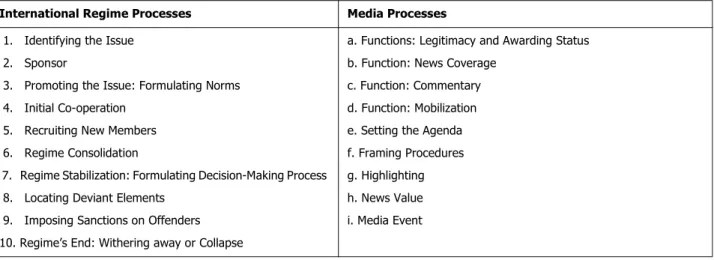
The following table (Table 2) summarizes the media’s part in the evolution of international, including security regimes:
Table 2: Regime and media processes
The column on the right represents the key stages in the lifecycle of an international regime: its establishment, it stabili-zation period, and its eventual demise. The column on the left lists the specific media processes that accord with each particular stage. It appears that each phase in the life of an international regime is associated with the relevant media process.
3.4 The Role of the Media in Security Regimes
Security regimes come into being when actors on the international stage, fearful of the prospect of violence, even war, decide to co-operate with one another in order to prevent such an eventuality from coming to pass. Like other international regimes, security regimes are also heavily influenced by media activity. Here too, media and regime processes intermingle, affecting the regime’s development. The global news media play an important part in the process of establishing security regimes. It will, for example, promote the initiative to set up the regime, by, among other things, impressing upon elements within the nation states as well as in the international arena, the fact that the alternative, war, will exact a very high price. The media will also detail the regime’s incipient norms and explain how they will prevent further acts of violence. In order to generate maximum transparency and facilitate the decision-making process, the media will provide information on po-tential regime members, to both their prospective partners and rivals within the nascent regime. Finally, covering media events such as the formal establishment of a coalition, signing ceremonies etc., the media place the security regime firmly in the public eye and so on the international stage.
During the security regime’s consolidation period, the media help to develop Confidence Building Measure by reporting on developments within and without the regime, and by acting as a channel of communication between actors wishing to con-verse, albeit indirectly, with one another, forge a degree of trust among regime members. Media activities also increase the levels of transparency needed to uphold the regime. Lastly, the media help the regime by drawing attention to actors in breach of its norms and reporting on the measures taken against the offenders.
When, for whatever reason, a security regime ends, the media will be quick to inform both members and non-members of its demise. On occasion, the media may push the process along by accentuating the security regime’s failures, thus en-couraging its termination.
Both the national and global media have played a part in the lifecycles of numerous security regimes, as demonstrated in the examples.
The media proved indispensable to the evolution of the Conference for Security and Co-operation in Europe (CSCE) Regime. The CSCE regime was first broached during the Helsinki conferences of the 1970s. Its consolidation phase culminated in the establishment of the Organization for Security and Co-operation in Europe (OSCE). During each stage of its develop-ment, the media, reporting on events, helped push the process along. They rallied to the cause by portraying the CSCE regime as vital to European security because, as the media noted, the regime, among other things, was careful to integrate the Soviet Union into the process.
The Non-Proliferation Treaty Regime, one of the world’s key arms control regimes, exploited the media in order publicize its activities and obtain legitimacy. The media also proved useful in identifying offenders against the regime, that is states that either refused to sign the Treaty or violated its articles. The Anti Personnel Mine Regime took advantage of Princess
International Regime Processes Media Processes
1. Identifying the Issue
2. Sponsor
3. Promoting the Issue: Formulating Norms
4. Initial Co-operation
5. Recruiting New Members
6. Regime Consolidation
7. Regime Stabilization: Formulating Decision-Making Process
8. Locating Deviant Elements
9. Imposing Sanctions on Offenders
10. Regime’s End: Withering away or Collapse
a. Functions: Legitimacy and Awarding Status
b. Function: News Coverage
c. Function: Commentary
d. Function: Mobilization
e. Setting the Agenda
f. Framing Procedures
g. Highlighting
h. News Value
Diana’s media appeal. Enlisting the Princess in its service, it sent her to Angola, where she was to meet with land mine victims. Not surprisingly, the visit, part of the regime’s promotion campaign, received wide news coverage. The media war waged by MTV on France, following French nuclear testing in the Moruroa Atoll was a unique and still unrivalled instance of media involvement in a security regime. Producing its owns campaign ads, MTV embarked on a public crusade against the French government and its blatant violation of the NPT regime.
The global news media play a similar role in security regimes integral to peace and reconciliation processes or which are formed in order to underwrite an international settlement. During Sadat’s visit to Jerusalem in November 1977, media ac-tivity gave the embryonic Egyptian-Israeli reconciliation regime (which was also, as noted, a security regime), a significant push forward. The visit received extensive media coverage and is rightly remembered as an archetypal media event, i.e. an event in which the media are involved a priori. The media’s contribution to the Israeli-Jordanian and Israeli-Palestinian security cum reconciliation regimes was much the same. Both regimes were mixed security cum political regimes, and the media, by publicizing their norms (sometimes even before any formal agreement had been signed) in effect sponsored the regimes and helped bring them into being. Later, by exposing infractions and violations of the regimes’ norms on the part of all parties to the regime, the media helped prop up these regimes and ensure their continuity. In reconciliation regimes, the media, by using framing techniques and by agenda setting, help determine and define the key issues under discussion. They may also help to mobilize national and international support for the reconciliation process throughout the regime’s life.
The part played by the media in the establishment of the coalitions formed to challenge Saddam’s Iraq and Milosevic’s Serbia was much the same. In both cases, the media took a definite stand on the issues at stake. Adopting, virtually without question, the pro-war coalition members’ view of things, it sided unreservedly with the "Good Guys" against the "Bad."
4. The War in Iraq – The Media and International Security Regimes: 4.1 The Advent of The Anti-Iraq Regime
The period prior to the outbreak of the war in Iraq saw the birth of two parallel yet antithetical regimes. First, there was the regime founded by those states that held Iraq to be a rogue state in the process of developing weapons of mass de-struction, supported the war against it. Then there was the regime formed by elements opposed to the war, starting with France, and Germany and Russia, who were soon joined by broad swathes of society across the globe. Both regimes ex-ploited the global news media, as well as the local and national media, in order to advance their cause and garner support.
Prior to the Pro-war regime, the United States led the anti-terrorist regime established on September 11th 2001 after the attack on the World Trade Center (see introduction). On September 20th 2001, the UN General Assembly internationally adopted the regime’s norms, followed eight days later by the Security Council (resolution 13731). On October 7th 2001 we see the next stage of the anti-terror regime – the War in Afghanistan, implementing the regime’s norms by fighting El-Qaida terrorists. The United States led in this war a coalition of 40 states in Afghanistan, but it was as well a war against a "rogue state", as the Taliban internal regime in Afghanistan was perceived.
The majority of the international media supported the anti-terror regime, as they did when it developed into the pro-war (anti-Iraq) regime.
The pro-war regime was led by the United States. Having identified the problem: "Iraq is a rogue state in possession of weapons of mass destruction", and its solution: using force. The United States became the driving force and mainspring behind the nascent regime. It stage-managed the entire affair, it instigated the regime, and it defined and validated its underlying norms. Finally, it offered the world proof, often elicited from media reports, that Iraq had broken the rules and was in breach of said norms. It should be noted that at present there is more than some doubt as to the nature, indeed worth of the administration’s evidence. But valid or not, the fact that the United States exploited the media to make public both the regime’s norms and Iraq’s alleged violations, is a prime example of the way in which the media and the Pro-War security regime converged on the eve of war.
4.2 The Formal Declaration of the Regime
One of the main milestones of establishing this regime was President Bush’s declaration of the "Axis of Evil" in his State of the Union Address (January 29th 2002), referring to Iraq, Iran and North Korea2. Here the anti-terror regime was broad-ened and became the anti rogue states3 regime, focused specifically on Iraq, and its members endeavored to devise new rules and regulations, as well as common decision-making processes and actual targets. In this regime, the United States served as the catalyst, arguing that it was the best way to resolve the problem at hand.
1. http://www.un.org/News/Press/docs/2001/sc7158.doc.htm
2. http://www.whitehouse.gov/news/releases/2002/01/20020129-11.html
The international media adopted the White House slogan "Axis of Evil" and framed it in its reports without hesitation. It was a worldwide mobilization of the media, legitimizing the regime with hardly any criticism (except for the BBC, which expressed concern about the US position1).
4.3 The Consolidation of the Regime
The next stages of the regime centered around US activity in the United Nations, and especially the Security Council’s de-liberations were particularly noteworthy. The media, focusing especially on the frequently contentious discussions within the Security Council, followed almost word for word the grueling diplomatic process leading up to Resolution 1441.2 Well aware of this, pro-war Security Council members used the debate on the regime’s norms and Iraq’s violations as a platform from which to publicly expound their views (the same held true of members of the anti-war regime). Happy to play along, the media became an important factor in the crystallization of the anti-Iraq regime.3
4.4 The Opposing International Regime
On the other side of the Iraqi divide was the coalition sponsored by France, Germany and Russia. The members sought to create a rival regime that would offer a different, less violent, solution to the same problem: Iraq is a rogue state in pos-session of weapons of mass destruction. But, as soon became clear, some members of the regime thought this problem to be less serious than generally assumed, while others denied its existence altogether. In any case, the anti-war regime hoped to forge and validate its norms using the same mechanisms as its rival, the United Nations Security Council. This proving difficult, the regime fell back on other international organizations such as the European Union. The anti-war re-gime’s activities received wide media coverage. The result was an increased awareness of the anti-war stand, which in turn generated public support for the regime. This, in turn, galvanized states opposed to the war to form an unofficial counter-alliance. It is not unreasonable to assume that one reason why Turkey felt able to turn down the United States’ request that it play a greater, more public part in the war against Iraq was because it was encouraged by news reports on the up-and-coming anti-war regime.
Alongside official, state activity, extra-parliamentary organizations, groups and individuals across the world rallied to the anti-war cause. Opposed to aggressive action against Iraq, they formed a cross-border global coalition which, whenever it seemed that events were moving yet another step closer to war, would engineer a series of protests across the world. Indeed, as the political process leading to war accelerated, the number of demonstrations rose, increasing in size and in-tensity as well. The two biggest and most striking demonstrations took place on 26 October 2002 and 19 January 2003 respectively. Both received extensive domestic as well as global media coverage. At this point, it is worth noting the war coalition’s astute exploitation of the WEB. Making effective use of the Net’s communications potential, it set up anti-war sites4; took advantage of Internet news resources, such as Indymedia; distributed petitions; composed blogs, most famously the journals written by the "human shields" who had traveled to Iraq to prevent the bombing of civilian targets; set up discussion forums; dispatched carbon copy e-mails, etc.
During this period, the global media’s activity was confined to two key media environments: the global news television networks, such as the BBC, Sky News and CNN, and the Internet. In the months leading up to the war in Iraq, but even more markedly during the war itself, the leading global news networks’ national affiliates (a) determined their editorial de-cisions and (b) supported their "news value" judgments. This was certainly true of the American CNN, but also, if to a lesser degree, of the two British networks, the BBC and Sky News. CNN emerged as a patriotic American channel par excellence, while Sky News took a markedly pro-British, pro-government view. Only the BBC adopted, on occasion, a slightly more critical approach to the ‘powers that be’. Thus, the three networks, thanks to their well-disposed reporting, helped the Unit-ed States (and Britain) to establish their pro-war regime.
4.5 The Regime in the Pre-War period
The American drive to promote the anti-Iraq regime reached its peak six weeks prior to the outbreak of the war. US Sec-retary of State Collin Powell spoke at the UN Security Council on 5 February 2003. In the course of his speech, Powell, conscious of the power of television, introduced a series of visual aids in order to prove the existence of Iraqi weapons of mass destruction.5 This was also the peak of international media support of the anti-Iraq regime, and it was broadcast live by all the major television stations, internationally, and in many countries domestically as well.
1. http://news.bbc.co.uk/1/hi/world/americas/1796034.stm
2. http://ods-dds-ny.un.org/doc/UNDOC/GEN/N02/682/26/PDF/N0268226.pdf?OpenElement 3. http://www.cnn.com/2002/US/11/08/resolution.text/
http://query.nytimes.com/gst/abstract.html?res=F2061EFF3E550C7A8CDDA80994DA404482 4. http://www.internationalanswer.org/; http://www.unitedforpeace.org/; http://www.peacenowar.net/
President Bush did not succeed in getting formal international approval for a military move, but he moved on towards war, and on March 17th 2003 used the media to present a "last minute" public ultimatum to Saddam Hussein1. As expected, the ultimatum got maximum media coverage, and there was no questioning of the move (almost mobilized media).
4.6 The War
The offensive started on March 20th 2003 with missile attacks on Saddam’s suspected hiding place. This war witnessed a new development in the utilization of the media with the effective communication management technique of "embedded journalists." This media strategy helped the Pentagon in gaining press support and mobilization for military action in the field (Bennett, 2003; Wells, 2003; Shinar, 2004)2. This way of controlling the media continued until the takeover of the Baghdad airport3. It should be noted that the international press legitimized the war, and it can be seen symbolically by adopting the Pentagon terms of "Coalition" and the "Shock and Awe" bombing in Iraq.
4.7 The Regime’s Demise
Two events covered live and extensively by the media symbolized the official end of the anti-Iraq regime. First, there was the demolition of Saddam’s statue in Baghdad (April 9th 2003), an image that became an icon of the end of the war.4 The second came eight months later when the US governor of Iraq initiated a media event by convening a press conference to announce the capture of Saddam Hussein, using the phrase "We got him," another media icon symbolizing the end of the former regime in Baghdad (December 13th 2003).5
In between, another media event was initiated by the White House to proclaim the formal end of combat. Here On the 1st of May 2003 President Bush, standing on the deck of the USS Lincoln, declared: "Major combat operations in Iraq have ended. In the battle of Iraq, the United States and our allies have prevailed. And now our coalition is engaged in securing and reconstructing that country."6
Officially, the regime ended on the day the American Administrator of Iraq, Paul Bremer, announced the capture of Saddam (December 13th 2003). This was an obvious media event (Dayan, and Katz, 1992), televised all over the world and the Middle East, repeating again and again Bremer’s words, "We got Him."7 This was a brief and last mobilization of the press, while making clear that the anti-Saddam regime was over. But the parallel regime of fighting terrorism is still active, while the media support and mobilization fades, and the robustness of the regime is questioned.
5. Conclusion
This paper dealt with two perspectives on the dynamics of international regimes and the media: a theoretical one, and the anti-Iraq case.
The theoretical perspective describes the processes of setting up international regimes, together with methods of classify-ing them. These combine to underline the strong links between international and security regimes and the global news media. Though the relationship is, in many ways, a reciprocal one, this article focused primarily on the media’s impact on regimes. It explores the ways the media affect international regimes’ lifecycles, from the time they are first conceived, through their establishment, consolidation and stabilization, until their ultimate demise. Though this paper highlights the media’s role in the evolution of security regimes, it is clear that, regardless of the regime in question, the media are involved throughout the lifecycle of all international regimes, whatever their character.
In order to analyze the media’s relationship with security regimes in general, and specifically its contribution to each and every stage in their development, the article utilizes methodologies from the field of communication studies. To date, most studies have explored the interaction between media communication patterns and global developments at the state level, or in relation to the formulation of foreign policy, while largely ignoring the international dimension of the relationship. This article is intended to remedy this, and these processes are demonstrated in the case study of the anti-Iraq security regime.
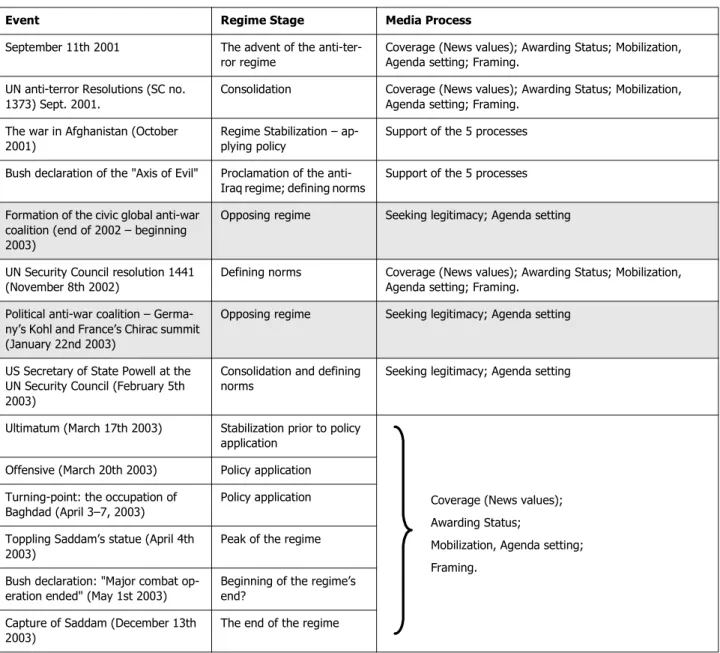
Table 3 summarizes the links of these regimes with the global news media.
1. http://www.whitehouse.gov/news/releases/2003/03/20030317-7.html
2. See also: The Berkeley Media at Iraq War Conference: http://journalism.berkeley.edu/conf/mediaatwar/index.html 3. http://www.cnn.com/2003/WORLD/meast/04/03/sprj.irq.war.main/ http://news.bbc.co.uk/2/hi/middle_east/2917381.stm 4. A demonstration of world newspapers at: http://www.newseum.org/frontpages/iraq/baghdadtoppled.asp
5. http://www.newseum.org/frontpages/iraq/saddamcaptured.asp
The gray colored stages are the formation of the opposing regime: the anti-war coalition.
Table 3: Regime and media processes - The anti-Iraq case
The table demonstrates the various actual stages of the development of the regime and matches them with the relevant media processes, pointing to the significant contribution of the global news to the advent, consolidation, stabilization and demise of this regime. It also demonstrates the connections between part of the global media and the opposing regime, the coalition of the anti-war civic groups with Germany and France.
The international media activity around and with the regimes was channeled mainly in the international TV news channels – CNN, BBC and Sky, but also in the main global newspapers, as well as in the Internet environment.
It should be noted that although the paper focuses on the specific anti-Iraq regime, it is part of a more general anti-rogue actors regime that includes the war against global terrorism. During the entire period the United States was and still is determined to confront rogue actors, be they states, for example, Iran, Syria, and North Korea, or terrorist organizations, including Al Qaeda, Hamas and the Hizbollah, wherever they may be found. It is interesting to note that the global news media, despite all the problems faced by the anti-Iraq regime, still belong to the ranks of this regime. Totally committed to the anti-terrorist and rogue states regime and anxious to promote its aims, the media have adopted in full the jargon employed by the regime’s most prominent member: the United States.
Event Regime Stage Media Process
September 11th 2001 The advent of the anti-ter-ror regime
Coverage (News values); Awarding Status; Mobilization, Agenda setting; Framing.
UN anti-terror Resolutions (SC no. 1373) Sept. 2001.
Consolidation Coverage (News values); Awarding Status; Mobilization, Agenda setting; Framing.
The war in Afghanistan (October 2001)
Regime Stabilization – ap-plying policy
Support of the 5 processes
Bush declaration of the "Axis of Evil" Proclamation of the anti-Iraq regime; defining norms
Support of the 5 processes
Formation of the civic global anti-war coalition (end of 2002 – beginning 2003)
Opposing regime Seeking legitimacy; Agenda setting
UN Security Council resolution 1441 (November 8th 2002)
Defining norms Coverage (News values); Awarding Status; Mobilization, Agenda setting; Framing.
Political anti-war coalition – Germa-ny’s Kohl and France’s Chirac summit (January 22nd 2003)
Opposing regime Seeking legitimacy; Agenda setting
US Secretary of State Powell at the UN Security Council (February 5th 2003)
Consolidation and defining norms
Seeking legitimacy; Agenda setting
Ultimatum (March 17th 2003) Stabilization prior to policy application
Coverage (News values);
Awarding Status;
Mobilization, Agenda setting;
Framing. Offensive (March 20th 2003) Policy application
Turning-point: the occupation of Baghdad (April 3–7, 2003)
Policy application
Toppling Saddam’s statue (April 4th 2003)
Peak of the regime
Bush declaration: "Major combat op-eration ended" (May 1st 2003)
Beginning of the regime’s end?
Capture of Saddam (December 13th 2003)