Albanian J. Agric. Sci. 2014 (Special edition) Agricultural University of Tirana
RESEARCH ARTICLE
(Open Access)
Effects of the endophyte
Acremonium alternatum
on oilseed rape
(
Brassica napus
) development and clubroot progression
SUSANN AUER, JUTTA LUDWIG-MÜLLER*
Technische Universität Dresden, Institute für Botanik, 01062 Dresden, Germany
*Corresponding author, E-mail: [email protected]
Abstract:
The clubroot pathogen Plasmodiophora brassicae infects economically important Brassica crops such as oilseed rape and vegetable brassicas. Clubroot results in abnormally growing roots and restricts the flow of water and nutrients to the upper plant parts, thereby inducing wilting. Yield loss affects about half the percentage of infected plants. Due to its complex and well-adapted life cycle the pathogen is difficult to control by chemical and cultural means and therefore continues to spread around the globe. Infested fields can no longer be used effectively for cultivation of crop plants for at least the next ten years. Despite costly breeding of resistant cultivars, recent research leans towards alternative, low-impact and environmentally friendly methods to control clubroot. To this end we have previously identified the endophyte Acremonium alternatum, a known biological control agent in several countries, to show promising antagonistic effects in clubroot-infected A. thaliana and Chinese cabbage (Brassica rapa). Here, we will describe its effect on the growth, development and clubroot control of oilseed rape (Brassica napus). While the clubroot symptoms were not clearly reduced after co-inoculation with A. alternatum and P. brassicae on oilseed rape roots, the aboveground plant parts were delayed in senescence and produced more seeds, which is indicative of an increase in yield after A. alternatum treatment. The long-term goal of this work is to contribute to a fundamental understanding of endophyte-plant interactions and an effective reduction of clubroot to be used in integrated pest management for oilseed rape and other cabbage varieties.
Keywords: Acremonium alternatum; Brassica napus; clubroot disease; endophytic fungus; Plasmodiophora brassicae; seed yield.
1. Introduction
The clubroot disease (Plasmodiophora
brassicae) causes severe crop loss in Brassica
cultivars worldwide, among them the important food plants Chinese cabbage (Brassica rapa) and oilseed rape (Brassica napus) [4]. The complex, two-stage life cycle of the obligate protist P. brassicae makes it hard to control this pathogen [7]. In addition, the protist forms durable resting spores that remain infectious in the soil for up to 18 years [22], therefore posing a threat to all subsequently farmed Brassicas on infested fields. Typical clubroot symptoms are a stunted growth and abnormally large root galls, called clubs. Agrochemicals are partially effective against clubroot, but with growing interest in environmental safety and human health concerns they become less available [7]. Recent attempts to control clubroot include the use of microbes that can act as biocontrol agents and reduce symptoms of infected plants at least to some extent [3, 13, 15].
Recently, we have investigated the potential of
Acremonium alternatum, a known biocontrol agent [1, 12, 17] to control the clubroot disease. Acremonium
alternatum is an endophytic Ascomycete that is
widespread in all soil types [8]. So far, the endophytic fungus has not been observed to alter host growth [18]. We have applied a spore solution of the endophytic fungus on Brassica rapa [6] and Arabidopsis thaliana [11] to assess its potential to
reduce clubroot. In Chinese cabbage co-inoculation with the endophyte resulted in smaller root galls and better performing plants [6]. Similarly, A. thaliana
plants were more tolerant to the clubroot pathogen when co-inoculated with A. alternatum [11]. In this
work it was also shown that the effect was a delay in clubroot development, but the endophyte did not inhibit resting spore germination of the pathogenic protist [11].
To test whether the same effect is true in other
Brassica species we carried out similar experiments
using A. alternatum on Brassica napus roots. Oilseed
2. Material and Methods
2.1 Plant cultivars and growing
conditions
Commercially available oilseed rape seeds cv. Ability (summer oilseed rape) and cv. Visby (winter oilseed rape) were obtained from the Deutsche Saatveredlung GmbH, Germany and the Sächsisches Ministerium für Umwelt und Landwirtschaft, Germany. These B. napus varieties are adapted to the German climate and soils. To simulate growth conditions throughout the year two growth periods were chosen: one for summer rape cv. Ability (end of May to October) and another for the winter period cv. Visby (end of October to April). Seeds were washed from their coating of fungicides and pre-germinated for two days on wet paper in the light. The emerging seedlings were planted in 11 x 11 x 12 cm pots filled with a mixture of standard soil (Pikiererde Cl P Profisubstrat, Einheitserde Classic; steam sterilized for two hours) and sand (commercial playground sand, sterilized for 24 hours) at the ratio 4:1. All experiments were performed in a green house with temperatures ranging from 14 (night) to 27°C (day) and a relative humidity of 40 to 80 %.
B. napus cv. Ability was fertilized three times
throughout the five months growth period with commercial fertilizer (Blumendünger mit Guano, COMPO GmbH, Germany), B. napus cv. Visby was
fertilized weekly with a nutrient solution diluted 1/8 according to Smeets et al. [21].
2.2 Inoculation procedure
Spore suspensions of Plasmodiophora brassicae
and Acremonium alternatum were prepared as
described elsewhere [11].
For the inoculation of the summer rape cv. Ability a spore concentration of 107 spores ml-1 was used. Since all clubroot infected plants died during the summer before the flowering stage a slightly lower concentration (106) was used for winter rape cv. Visby to ensure flowering and seed production of the plants. There were four treatment groups: control, A. alternatum inoculated, P. brassicae inoculated and a combined inoculation with A. alternatum and P.
brassicae. Spore suspensions were adjusted to the
desired concentration of 106 or 107 spores ml-1 using potassium buffer (50 mM KH2PO4, pH 5.5). Each
plant was inoculated by pipetting 3 ml of the spore suspension directly on the soil next to the plant.
Control plants were treated with the same volume of buffer.
2.3 Disease rating
Per treatment 14 to 16 plants were harvested for disease classification of the roots six (summer oilseed rape cv. Ability) or nine (winter oilseed rape cv. Visby) weeks after inoculation. For this, the soil around the roots was carefully removed and the gall size categorized according to Yoshikawa et al. [23]: 0 – no visible swelling, 1 – very light swelling at lateral roots, 2 – moderate swelling, 3 – severe swelling, 4 – severe swelling or decay of lateral roots. The disease severity is shown as percentage of plants in individual disease classes or by calculating the disease index (DI) according to the following equation: (n0*0) +
(n1x10) + (n2*30) + (n3*60) + (n4*100)/ntotal [23].
2.4 Determination of fresh weight,
stem lengths and growth stages
Fresh weight of the green parts was determined for harvested plants at the time point of the disease rating 6 to 9 weeks after treatment. Stems of the cv. Ability were measured five months and of cv. Visby nine weeks after treatment. Growth stages of cv. Ability were assessed at two time points according to the BBCH-scale for oilseed rape [14].
2.5 Root histology
Scanning microscopy was used to assess the disease progress inside the plant roots. For this, root samples of cv. Visby were harvested nine weeks after treatment and fixed on slides suitable for the scanning electron microscope (n = 2 per treatment). The samples were cryofixed for 30 minutes and broken to preserve the natural structures of cells and prevent artefacts that result from cutting with blades.
2.6 Statistics
3. Results and Discussion
3.1 Acremonium alternatum cannot
control clubroot in oilseed rape
According to experiments with Brassica rapa
(Chinese cabbage) and Arabidopsis thaliana the clubroot disease symptoms could be reduced by co-inoculation with the endophytic fungus Acremonium alternatum [6, 11]. These results encouraged us to investigate the effect of A. alternatum on a major energy and oil crop worldwide Brassica napus
(oilseed rape). Two cultivars, one winter and one summer oilseed rape, were chosen for this investigation. In both cultivars the effect of A. alternatum on root symptoms caused by P. brassicae
was barely visible. The disease index was only slightly decreased in summer oilseed rape (cv. Ability) six weeks after inoculation and not affected in winter oilseed rape (cv. Visby) nine weeks after treatment (Figure 1). Disease indices in the fertilized plants were generally lower. It is known that some plant nutrients reduce disease development of P. brassicae [9].
This was supported by microscopy at late stages of the infection (9 weeks after treatment of cv. Visby). No changes in disease progression were observed in co-inoculated samples (Figure 2). In contrast to Chinese cabbage [6] and Arabidopsis [11], no delay in
P. brassicae development was observed in the two
root samples of co-inoculated plants in comparison to the plants inoculated with P. brassicae only. This was also reflected in the general appearance of root galls and the disease index (Figure 1).
Another goal in this experiment was to assess the performance of the aboveground plant parts after treatments with the different microorganisms. For this stem length and weight, and different developmental stages (i.e. flower development) were recorded since the endophytic fungus was able to shift the onset of senescence (see 3.2). No changes could be detected between P. brassicae and combined treatments on any
of the above mentioned parameters for the upper plant parts (data not shown). In summer rape with the higher spore concentration of 107 spores ml-1 all plants
inoculated with clubroot died within the five months growth period at the stage of leaf development.
Oilseed rape plants inoculated with both organisms were doing better in terms of overall survival compared to P. brassicae infection alone. Nine-week-old cv. Ability plants showed a shift in senescence. While the controls and endophyte
inoculated plants were already in the stage of flowering, P. brassicae inoculated plants did not produce flowers and some were dead already (Figure 3).
Figure 1. Percentage of plants in individual
disease classes and the disease index (above the histograms) of two oilseed rape (Brassica napus) cultivars. In cv. Visby (n = 16 per treatment) there is not much difference between treatments, whereas in cv. Ability (n = 14 per treatment) more plants were found in lower disease classes, which is also reflected in a lower disease index, when the plants were co-treated with Acremonium alternatum.
3.2 A. alternatum promotes
senescence of oilseed rape and increases seed
production
Five months old plants treated with A. alternatum
Figure 2. Scanning Electron Microscopy images of control (A), Acremonium alternatum (B), Plasmodiophora brassicae (C) and co-inoculated with both organisms (D) Brassica napus cv. Visby roots. The scale bar always represents 100 µM. The typical enlarged cells contain resting spores (RS) of P. brassicae. Hyphae of A. alternatum are not visible in these pictures, but the fungus was detected by PCR (data not shown).
Figure 3. Growth stages of summer oilseed rape cv. Ability. For evaluation the plants were 5 months old.
Acremonium alternatum (+A) increased the number of flowering plants compared to controls, while the plants only inoculated with Plasmodiophora brassicae (+P) showed the highest mortality rate compared to all other treatments. Co-inoculation with A. alternatum and P. brassicae (+A+P) did reduce the number of dead plants within the population, but could not delay senescence.
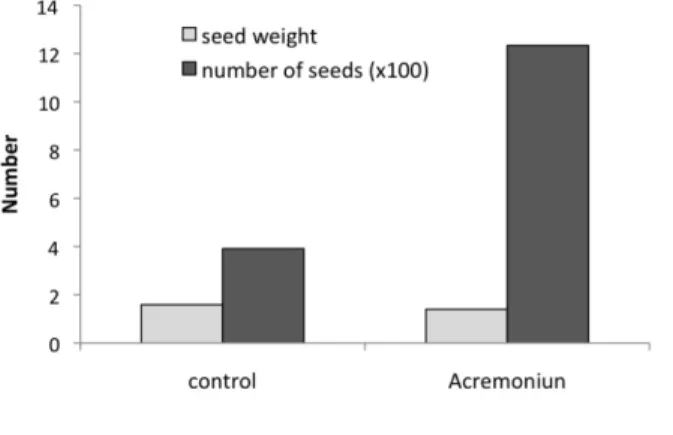
Oilseed rape treated with the endophyte exhibited more siliques per plant, resulting in more seeds
Acremonium species are known to grow within the seeds and therefore have a better chance for propagation [2].
The cultivar Visby did not produce flowers within the growth period of six months. In all experiments the fresh weight of treated plants was lower than that of the controls, but this was only statistically significant in the Ability cultivar (ANOVA; p<0.05).
It has been reported that due to biochemical changes in the plant upon pathogen challenge less resources are available for growth [10]. The process of inducing resistance is costly for the plant and detection mechanisms to distinguish hostile from non-hostile influences are switched on within minutes of an invasion. Hence plants which are “busy” to defend themselves are smaller in comparison to control plants.
Interestingly, A. alternatum treated five months old cv. Ability had significantly longer stems than the controls (t-test; p=0,007). This could indicate that the fungus is able to modify the hormonal balance of the plant, probably by inducing gibberellins, which are known inducers of internode length [19, 20].
Figure 4. Seed weight and yield of summer
oilseed rape cv. Ability.
4. Conclusion
Viable spores of the endophyte Acremonium alternatum are not suitable for clubroot control in oilseed rape. A recent paper [13] used a formulation of an endophyte to suppress clubroot in oilseed rape successfully. Therefore, a suppressive effect might well be dependent on the microorganism used for biocontrol, but also maybe on the cultivars. Interestingly, most biocontrol agents used to suppress clubroot were root endophytes, whereas A. alternatum
readily colonizes leaves [11]. This difference in colonization behavior of the endophyte could also
influence the outcome of a disease suppression reaction, especially in a plant with large stems such as oilseed rape. In the summer cultivar Ability endophyte inoculated plants were more successful in terms of competition (longer stems) and reproduction (more seeds per plant). Brassica napus seeds are used to manufacture oils for the industry, biofuel and for food products. Therefore the impact on seed production is crucial for a broader application of this potential biocontrol agent.
5. Acknowledgment
This research work was supported by ESF grant number 100097596. The authors thank Markus Günther for help with preparing the SEM slides.
6. References
1. Bettiol W: Biological control of plant pathogens in Brazil: application and current research. World Journal of Microbiology and Biotechnology 1996, 12: 505–510.
2. Breen JR: Acremonium endophyte interactions with enhanced plant resistance to insects. Annual Review of Entomology 1994, 39: 401– 423.
3. Cheah LH, Kent G, Gowers S: Brassica crops and a Streptomyces sp. as potential biocontrol for clubroot of Brassicas. New Zealand Plant Protection 2001, 54: 80–83.
4. Dixon GR: The occurrence and economic impact of Plasmodiophora brassicae and Clubroot disease. Journal of Plant Growth Regulation 2009, 28: 194–202.
5. Dixon GR: Clubroot (Plasmodiophora brassicae Woronin) – an agricultural and biological challenge worldwide. Canadian Journal of Plant Pathology 2014, 36: 5-18.
6. Doan TT, Jäschke D, Ludwig-Müller J: An endophytic fungus induces tolerance against the clubroot pathogen Plasmodiophora brassicae in Arabidopsis thaliana and Brassica rapa roots. Acta Horticulturae 2010, 867: 173– 180.
7. Donald C, Porter I: Integrated control of clubroot. Journal of Plant Growth Regulation 2009, 28: 289–303.
9. Gossen BD, Deora A, Peng G, Hwang S-F, McDonald MR: Effect of environmental parameters on clubroot development and the risk of pathogen spread. Canadian Journal of Plant Pathology 2014, 36: 37-48.
10. Heil M, Hilpert A, Kaiser W, Linsenmair KE: Reduced growth and set seed following chemical induction of pathogen defence: does systemic aquired resistance (SAR) incur allocation costs? Journal of Ecology 2000, 88: 645-654.
11. Jäschke D, Dugassa-Gobena D, Karlovsky P, Vidal S, Ludwig-Müller J: Suppression of clubroot (Plasmodiophora brassicae) development in Arabidopsis thaliana by the endophytic fungus Acremonium alternatum. Plant Pathology 2010, 59: 100–111.
12. Kasselaki A-M, Shaw MW, Malathrakis NE, Haralambous J: Control of Leveillula taurica in tomato by Acremonium alternatum is by induction of resistance, not hyperparasitism. European Journal of Plant Pathology 2006, 115: 263–267.
13. Lahlali R, McGregor L, Song T, Gossen BD, Narisawa K, Peng G: Heteroconium chaetospira
induces resistance to clubroot via upregulation of host genes involved in jasmonic acid, ethylene, and auxin biosynthesis. PloS One 2014, 9: e94144.
14. Meier U (ed): Growth stages of mono- and dicotyledonous plants. BBCH-Monograph, 2. Edition 2001. Federal Biological Research Centre for Agriculture and Forestry.
15. Narisawa K, Ohiki KT, Hashiba T: Suppression of clubroot and Verticillium yellows in Chinese cabbage in the field by the root endophytic fungus, Heteroconium chaetospira. Plant Pathology 2000, 49: 141–146.
16. Nesi N, Delourme R, Brégeon M, Falentin C, Renard M: Genetic and molecular approaches to improve nutritional value of Brassica napus
L. seed. Comptes Rendus Biologies 2008: 331: 763–771.
17. Pal KK, Gardener BM: Biological control of plant pathogens. The Plant Health Instructor 2006, doi:10.1094/PHI-A-2006-1117-02.
18. Raps A: Der Einfluß pilzlicher Endophyten auf die Entwicklung von Herbivoren unterschiedlicher Lebensweise an Kulturpflanzen. Hannover, Germany: University of Hannover, PhD thesis. 1997.
19. Richards DE, King KE, Ait-ali T, Harberd NP: How gibberellin regulated plant growth and development: A molecular genetic analysis of gibberellin signaling. Annual Reviews of Plant Physiology and Plant Molecular Biology 2001, 52: 67–88.
20. Rood SB, Mandel R, Pharis RP: Endogenous gibberellins and shoot growth and development in Brassica napus. Plant Physiology 1989, 89: 269-273.
21. Smeets K, Ruytinx J, Van Belleghem F, Semane B, Lin D, Vangronsveld J, Cuypers A: Critical evaluation and statistical validation of a hydroponic culture system for Arabidopsis thaliana. Plant Physiology and Biochemistry 2008, 46: 212–218.
22. Wallenhammar A-C: Monitoring and control of
Plasmodiophora brassicae in spring oilseed
Brassica crops. Acta Horticulturae 2010, 867: 181-190.