Virgílio Moraes FerreiraI
Tania RuizII
I Programa de Pós-Graduação em Saúde Coletiva. Departamento de Saúde Pública. Faculdade de Medicina de Botucatu. Universidade Estadual Paulista. Botucatu, São Paulo, Brasil
II Departamento de Saúde Pública. Faculdade de Medicina de Botucatu. Universidade Estadual Paulista. Botucatu, São Paulo, Brasil
Correspondence: Virgílio Moraes Ferreira Rua Alzira Rocha, 39 17511-335 Marília, SP, Brasil E-mail: [email protected] Received: 3/1/2011
Approved: 4/30/2012
Article available from: www.scielo.br/rsp
Community health workers
'
attitudes and beliefs toward the
elderly
ABSTRACT
OBJECTIVE: To describe community health workers’ attitudes and beliefs toward the elderly.
METHODS: Cross-sectional descriptive study conducted with 213 community health workers (CHWs) at 12 primary care units and 29 family health centers in the city of Marília, State of São Paulo, Southeastern Brazil, in 2010. Data were collected by means of a sociodemographic questionnaire, a scale of attitudes toward aging (Neri Scale), and a questionnaire to assess gerontological knowledge (the Palmore-Neri-Cachioni Aging Quiz). The Statistical Package for the Social Sciences v. 16.0 was used for data analysis.
RESULTS: CHWs predominantly consisted of young female adults, married, with more than 12 years of schooling and who worked in this activity for over 6 years. Most CHWs reported having experience with elderly people and having elderly people in the family. However, less than half of them received training on the topic of aging. As for attitudes towards the elderly, CHWs stressed both positive aspects such as their wisdom and generosity and negative aspects such as slowness and strictness. They showed low gerontological knowledge, which was directly associated with the training received. Many CHWs stereotyped the elderly as dissatisfi ed and dependent.
CONCLUSIONS: Changing attitudes and improving knowledge on aging are critical for meeting health care demands of elderly people. More appropriate training of CHWs is key for providing adequate primary care to elderly population.
DESCRIPTORS: Community Health Workers. Health Knowledge, Attitudes, Practice. Aging.
INTRODUCTION
Aging and its wider implications are great challenges of this century. For health services these challenges translate into increasing complex demands for providers’ expertise in geriatrics and gerontology and multidisciplinary care to address health needs of the elderly.
Health agents working with elderly population are required to have a good understanding of the meanings of aging. The concept of attitude is key and has a major role in social psychology. Attitude can be defi ned as a consistent structured manner of thinking, feeling and responding to people, groups, social issues or any events in one’s environment.12
According to Neri16 beliefs about a certain object may relate to objective facts or
may involve bipolar dimensions of judgement such as good/bad, favorable/unfavorable and able/unable.1,3
Cavazza5 and many other scholars conceive attitudes
as constructs consisting of different components. This concept of attitude as an overall judgement of an object derives from three sources of information: affective, cognitive, and behavioral.
It is assumed there is more than one attitude toward aging because aging is a heterogeneous phenomenon with various meanings and possibilities. The literature on atti-tudes toward aging shows they are neither a matter of all or nothing nor positive or negative judgements but rather an expression of intricate multifaceted judgements.4
Neri18 pointed that the perception of aging among
elderly (88%) and non-elderly respondents (90%) in Brazil was mainly associated with negative aspects (n = 3,000). The large majority of elderly (80%) and non-elderly (85%) perceived there is prejudice against old age in Brazil but few admitted to being prejudiced (4% of non-elderly respondents).
A Swedish study with 928 people including students of health-related careers, nurses and nursing assistants showed higher positive scores on the Kogan’s Attitudes Toward Old People Scale6 among nurses. They found
that attitudes scores of students in the second term were signifi cantly higher than of those in the fi rst one.
Community health workers (CHWs) play a central role in communities in the context of primary health care in Brazil. Despite their lack of formal training to adequately perform their activities CHWs have an important role of an intermediary between health care providers and the local community.2
Aging constitutes a complex population phenomenon and CHWs are involved with their care. Thus, the study of attitudes toward aging can help understand the relationships that are established between the elderly and CHWs with important implications to this population’s care.
The present study aimed to describe community health workers’ attitudes and beliefs toward the elderly.
METHODS
Study conducted with a sample of 213 CHWs, 112 from 12 primary care units (PCUs) and 101 from 29 family health centers (FHCs) in the city of Marília, state of São Paulo, Southeastern Brazil, in 2010. Marília is a city located in the Midwest region of the state of São Paulo
a Instituto Brasileiro de Geografi a e Estatística. Censo demográfi co: Cidades: Marília. Rio de Janeiro; 2010 . [cited 2011 Aug 15]. Available from: http://www.ibge.gov.br/cidadesat/link.php?codmun=352900
b Cachioni M. Envelhecimento bem-sucedido e participação numa universidade para a terceira idade: a experiência dos alunos da Universidade São Francisco [dissertation]. Campinas: Faculdade de Educação da, Universidade Estadual de Campinas; 1998.
with a population of 216,684 inhabitants according to the 2010 Population Census.a Twenty-fi ve CHWs
were not enrolled in the study because they were on leave or on vacation or did not agree to participate. No statistical association was found between the reasons for not participating in the study and the variables studied.
The participating health units provided two different lines of primary care services. PCUs use the old tradi-tional model covering extensive centralized areas and providing services through individual practices. On the other hand, FHCs use a newer care model covering peripheral areas and providing services through a multi-disciplinary approach focused on family care and health surveillance. Although these two models have been established at different times in the city the inclusion of CHWs in both models was in 1998.
Visits were pre-scheduled with managers of each partic-ipating facility. CHWs at each facility were individually instructed on the study purposes and importance and how to fi ll out the questionnaires.
Information on sociodemographic characteristics (type of health unit, age, gender, marital status, education level, length of time in the job, household income) was collected in the questionnaire. In addition there were asked the following three questions: “Do you currently live or have lived with elderly people?;” “Do you have any experience working with the elderly?;” “Have you received any training on elderly health?.”
A validated semantic differential scale was used to assess attitudes toward aging.4,14,15,b The Attitudes
Toward Old People Scale consists of 30 pairs of adjectives with opposite meanings addressing the following conceptual domains: cognitive (ability to process information and solve problems with social adaptation implications); area of agency (autonomy and instrumentality to perform activities); interpersonal relationships (affective-motivational aspects related to social interaction) and persona (common social labels used to describe or discriminate against the elderly).
The Palmore-Neri-Cachioni questionnaire was applied to assess basic knowledge about aging. This question-naire was validated in a sample of 102 college educators in gerontology in 2002 and translated and adapted from the Palmore’s Facts on Aging Quiz.10 It consists of 25
multiple-choice questions that address general knowl-edge about the elderly and the aging process covering physical, cognitive, psychological and social domains.
2010. The mean proportions of elderly were 17.7% and 10.8% in PCUs and FHCs, respectively.
The sociodemographic variables were dichotomized by the means and medians as follows: age (≤ 40, > 40 years); education level (≤ 12, > 12 years); length of time in the job (≤ 6, > 6 years); household income (≤ 3, > 3 monthly minimum wages); and marital status (married, not married). To assess differences in the proportion of elderly population by area, a 12% proportion was used as it is close to the current proportion of elderly in the Brazilian population. Thus, facilities were divided into those with a lower (< 12% of elderly based on SIAB data) and a higher proportion (> 12%) of elderly users.
A 1-to-5 rating scale was used to categorize the results of positive and negative adjectives; means greater than 3 were negative, lower than 3 were positive, and equal to 3 were neutral. In the gerontological knowledge questionnaire, ≤ 11 and > 11 correct answers out of 25 questions were considered low and high gerontological knowledge, respectively.
The study project was approved by the institutional review board of Marília Medical School and Research Evaluation Committee (protocol no. 643/09).
RESULTS
Most CHWs were young adult females, married, mean schooling > 12 years and length of time in the job > 6 years (Table 1).
Of all, 59.6% had experience working with elderly people, 53.1% currently lived or have lived with elderly and 45.1% were trained in elderly health.
CHWs’ experience was associated with age, training and length of time in the jobs. Younger respondents reported 2.1 times more having no experience working with the elderly than the older ones. The proportion of CHWs trained in elderly health was 48% greater among those who reported experience working with the elderly, and of them, 60.4% had more than six years in the job.
CHWs working at PCUs were older and more frequently reported living with elderly people, work experience, and training than those working at FHCs (51%, 58%, and 82%, respectively).
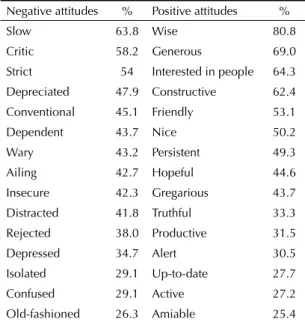
Overall, CHWs showed positive attitudes (score < 3) toward aging (total mean score 2.92). Positive attitudes were more common regarding social aspects of the elderly as they were regarded to be helpful, good-humored, friendly, generous, and concerned for the people. Negative attitudes were more frequently seen in the domain regarding autonomy to perform activities as elderly people were regarded to be ailing and dependent.
More positive attitudes were seen among those working at facilities with a lower proportion of elderly, non-trained, non-married, more educated CHWs, with lower income and longer time working in the job (Table 2).
There was a mean of 40% correct answers to 25 ques-tions of gerontological knowledge (range one to 17; median = 11).
Table 1. Characteristics of community health workers (CHWs). Marilia, Southeastern Brazil, 2010.
Variable n % Mean (SD)
Gender
Male 13 6
Female 200 94
Age 38.9 (7.68)
40 years 127 59.6
> 40 86 40.4
Marital status
Married 156 73.2
Non-married 57 26.8
Education (years of schooling) 12.8 (2.58)
Up to 12 108 50.7
> 12 105 49.3
Family income (minimum wages) 3.4 (1.46)
Up to 3 103 48.4
> 3 110 51.6
Length of time in the job (years) 6.5 (2.09)
Up to 6 97 45.5
> 6 116 54.5
Table 2. Characteristics of the elderly attributed by community health workers. Marilia, Southeastern Brazil, 2010.
Negative attitudes % Positive attitudes %
Slow 63.8 Wise 80.8
Critic 58.2 Generous 69.0
Strict 54 Interested in people 64.3
Depreciated 47.9 Constructive 62.4
Conventional 45.1 Friendly 53.1
Dependent 43.7 Nice 50.2
Wary 43.2 Persistent 49.3
Ailing 42.7 Hopeful 44.6
Insecure 42.3 Gregarious 43.7
Distracted 41.8 Truthful 33.3
Rejected 38.0 Productive 31.5
Depressed 34.7 Alert 30.5
Isolated 29.1 Up-to-date 27.7
Confused 29.1 Active 27.2
The top four questions correctly answered covered the following topics in a descending order: physical strength of the elderly; value of friendships in old age; work ability; and response speed in the elderly. Three questions were about physical aspects of aging. Respondents showed the lowest level of knowledge on psychological and social issues.
The study showed 30% of CHWs believed life satisfac-tion among the elderly was lower than among young people; 23% believed a small proportion of the elderly remains active between 60 and 70 years of age; 55.4% believed the elderly people lose interest in sex; and 77.9%t believed they are more emotional. Most CHWs agreed there is physical decline in older people.
CHWs with training in elderly health showed a 33% higher rate of correct answers than those with no training. In addition, those working in areas with high elderly population showed a 38% higher rate of correct answers than those working in areas with low elderly population.
DISCUSSION
CHWs were predominantly young female adults, married and with middle school education, as reported in other studies.8,11,c,d
Younger CHWs had less experience working with the elderly, probably because they had more recently moved to the area and were less involved with the community. According to Ferraz & Aerts,8 despite younger CHWs
tend to be less familiar and involved with the commu-nity, they have less deep-rooted concepts of health and disease, which may help acquisition and development of the required CHW skills.
CHWs working at PCUs were more involved with elderly care. PCUs mostly serve elderly patients in their areas of coverage, and CHWs working at these units are usually older and have been in the job for a long time, which are conditions that favor their involvement with this population.
There was a low proportion of CHWs who were trained in elderly health. Fernandes et al7 showed that 88%
of 51 CHWs working in a municipality in the state of São Paulo were not trained in gerontology although most of them (78%) reported providing care to the elderly. Bearing in mind that households with an elderly member are quite common in Brazil, it is concerning that CHWs are not properly qualifi ed to approach this
population that have special needs, are subject to a variety of risks and whose rights are not often protected.
More positive attitudes were found regarding the concept of being wise and the domain of “social rela-tionships” on the scale of attitudes, especially regarding affective aspects. These fi ndings are consistent with those reported in a study by Cachioni4 with college
professors from universities of the third age that found more positive attitudes regarding “social relationships”. These results are recurrent and point to positive stereo-types about the elderly; many people wrongly believe that old people are wise.
Slightly negative mean scores were found regarding aspects related to mobility, general health, and lack of autonomy of the elderly. These fi ndings contrast with those by Fernandes et al7 that found predominantly
negative concepts of aging associated with chrono-logical age, declining health, lack of autonomy and a “burden to the family.” Negative attitudes associated with illness, dependence, and rejection were also described by Neri.14
Despite a low rate of correct answers in the question-naire on knowledge about aging, these results are consistent with those reported by Fitzgerald et al9 in
their study of medical school freshman at the University of Michigan using an instrument that originated the Palmore-Neri-Cachioni questionnaire. They also found a low rate of correct answers (37%). It is a very low score that was even found among more educated CHWs with longer work experience stressing their lack of expertise in gerontology. The questionnaire analysis showed that most CHWs agreed there is physical decline in older people. A study conducted with nearly 4,000 elderly and non-elderly people in 2006 showed the perception of aging mostly associated with negative aspects among elderly (88%) and non-elderly respon-dents (90%). Most saw diseases and physical frailties as a major sign of old age (spontaneous opinion of 62% of non-elderly and 58% of elderly).18
Similar to the previously mentioned fi nding that training in elderly health was associated with higher rates of correct answers in the questionnaire, a study with students of physical education, education, nursing and medicine showed that a theoretical approach to aging topics also resulted in greater success rates in the same questionnaire.17
In 2004 the Brazilian Ministry of Healthe developed a
specialized training program for CHWs consisting of
c Nascimento CMB. Análise do cumprimento das práticas dos agentes comunitários de saúde em municípios da região metropolitana do Recife [Master’s dissertation]. Recife: Centro de Pesquisas Aggeu Magalhães da Fundação Oswaldo Cruz; 2008.
d Peres CRFB. O trabalho do agente comunitário de saúde no município de Marília-SP [Master’s dissertation]. Botucatu: Faculdade de Medicina de Botucatu da Universidade Estadual Paulista; 2006.
sequential modules and stages. The fi rst stage of the training program was provided in the city of Marília in 2006 and focused on the role of CHWs in a multidisci-plinary team. This program is now supported by local administrations (in cities with over 100,000 inhabit-ants), professional practice schools, and the Brazilian National Health System (SUS) training centers, and it is crucial for building the capacity of CHWs in the process of change in health practices. Although CHWs are involved in the life context of users of health facili-ties, greater knowledge of physical to the detriment of social and psychological aspects of aging evidences that biological knowledge on the elderly is more prevalent. These fi ndings are corroborated by a study with college professors from universities of the third age.4 Many
CHWs regard the elderly as people who are inactive, more emotive, and unhappy with their lives. It suggests that negative stereotypes persist in our midst reinforcing discrimination against older people and undermining the very process of aging.
Levy et al13 explored the impact of stereotypes on the
vision of life and death in a sample of young and old people, assessed by respondents’ will to accept or refuse life-prolonging medical interventions. Based on their answers, respondents were categorized as holders of
positive or negative stereotypes about aging. Elderly respondents revealing negative stereotypes tended to refuse life-prolonging interventions whereas those revealing positive stereotypes tended to accept them, which suggest that socially transmitted negative stereo-types about aging can weaken elderly will-to-live.
There are gaps in gerontological knowledge of CHWs and training was crucial for best results in the study questionnaire. To meet their needs and overcome major weaknesses found in this study, continuing education of CHWs focused on different aspects of aging with an emphasis on psychosocial issues is needed.
The low rate of trained CHWs found in the present study may be due to recall bias, especially in those with longer work experience, and it may be a limitation of this study. Still, the study results are valid.
1. Ajzen I. Nature and operation of attitudes.
Annu Rev Psychol. 2001;52:27-58. DOI:10.1146/annurev.psych.52.1.27
2. Bachilli RG, Scavassa AJ, Spiri WC. A identidade do agente comunitário de saúde: uma abordagem fenomenológica.
Cienc Saude Coletiva. 2008;13(1):51-60. DOI:10.1590/S1413-81232008000100010
3. Braghirolli EM, Pereira S, Rizzon LA. Temas de psicologia social. 7.ed. Petrópolis: Vozes; 1994.
4. Cachioni M. Quem educa os idosos: um estudo sobre professores de universidades da terceira idade. Campinas: Alínea; 2003.
5. Cavazza N. Psicologia das atitudes e das opiniões. São Paulo: Loyola; 2008.
6. Engströn G, Fagerberg I. Attitudes towards older people among Swedish health care students and health
care professionals working in elder care. Nurs Rep.
2011;1(1):2-6. DOI:10.4081/nursrep.2011.e2
7. Fernandes HCL, Pavarini SCI, Barham EJ, Mendiondo MSZ, Lucchesi BM. Envelhecimento e demência: o que sabem os agentes comunitários
de saúde? Rev Esc Enferm USP. 2010;44(3):782-8.
DOI:10.1590/S0080-62342010000300033
8. Ferraz L, Aerts DRGC. O cotidiano de trabalho do agente comunitário de saúde no PSF em Porto
Alegre. Cienc Saude Coletiva. 2005;10(2):347-55.
DOI:10.1590/S1413-81232005000200012
9. Fitzgerald JT, Wray LA, Halter JBH, Williams BC, Supiano MA. Relating medical students’ knowledge, attitudes, and experience to an interest in geriatric
medicine. Gerontologist. 2003;43(6):849-55.
10. Harris DK, Changas PS, Palmore EB. Palmore’s fi rst facts on aging quiz in a multiple-choice
format. Educ Gerontol. 1996;22(6):575-89.
DOI:10.1080/0360127960220605
11. Kluthcovsky ACGC, Takayanagui AMM, Santos CB, Kluthkovsky FA. Avaliação da qualidade de vida geral de agentes comunitários de saúde: a contribuição relativa das variáveis sociodemográfi cas e dos domínios
da qualidade de vida. Rev Psquiatr RS. 2007;29(2):176-83.
12. Lambert WW, Lambert WE. Psicologia social. 5.ed. Rio de Janeiro: Zahar; 1981.
13. Levy B, Ashman O, Dror I. To be or not to be: the
effects of aging stereotypes on the will to live. Omega
(Westport). 2000;40(3):409-20.
14. Neri AL. Envelhecer num país de jovens: signifi cados de velho e velhice segundo brasileiros não idosos. Campinas: Editora da UNICAMP; 1991.
15. Neri AL. Atitudes e crenças em relação à velhice: o que pensa o pessoal do Senac/ São Paulo? São Paulo: Senac; 1995.
16. Neri AL. Atitudes em relação à velhice: questões científi cas e políticas. In: Freitas EV, et al, editores. Tratado de geriatria e gerontologia. 2.ed. Rio de Janeiro: Guanabara Koogan; 2006. p.1316-23.
17. Neri AL, Jorge MD. Atitudes e conhecimentos em relação à velhice em estudantes de graduação em educação e em saúde: subsídios ao planejamento
curricular. Estud Psicol. 2006;23(2):127-37.
DOI:10.1590/S0103-166X2006000200003.
18. Neri AL. Idosos no Brasil: vivências, desafi os e expectativas na terceira idade. São Paulo: Edições SESC-SP; 2007.
REFERENCES