Himaja M
et al. IRJP 2011, 2 (12), 270-273
INTERNATIONAL RESEARCH JOURNAL OF PHARMACY, 2(12), 2011
INTERNATIONAL RESEARCH JOURNAL OF PHARMACY ISSN 2230
–
8407
Available online www.irjponline.com
Research Article
SYNTHESIS AND BIOLOGICAL STUDIES OF CHERIMOLACYCLOPEPTIDE E AND ITS
N- METHYLATED ANALOG
Himaja M
1*, Siji Rajan
1, Karigar A.A
2, Ramana M.V
2, Napoleon A.A
1
Pharmaceutical Chemistry Division, School of Advanced Sciences, VIT University, Vellore-632014, TN, India 2
Maratha Mandal’s College of Pharmacy, Belgaum 590016, Karnataka, India
Article Received on: 17/11/11 Revised on: 09/12/11 Approved for publication: 21/12/11
*Dr (Mrs).M. Himaja, Professor, Pharmaceutical Chemistry Division, School of Advanced Sciences, VIT University, Vellore-632014 Tamil Nadu, India Email: [email protected]
ABSTRACT
The N-methyl derivative of Cherimolacyclopeptide E cyclo[Phe-(Dimethyl)Tyr-Pro-Gly-Leu-Gly] was synthesized using solution phase peptide synthesis. The synthesized compound was characterized by spectral data and was evaluated for anthelmintic and insecticidal activities. The compound exhibited potent anthelmintic activity as compared to the standard drug mebendazole.
Keywords: Cherimolacyclopeptide E, N-methylation, Anthelmintic activity, Insecticidal activity.
INTRODUCTION
Two novel cyclopeptides: Cherimolacyclopeptide E (a cyclic hexapeptide), Cherimolacyclopeptide F (a cyclic nonapeptide) were isolated by Alassane We’le’ et. al.1 in 2005 by bioassay-guided fractionation of methanol extract of the seeds of Annona Cherimola, which exhibited cytotoxic activity against KB cell culture system. Plants of the Annonaceae family are very important sources of edible fruits and material for perfumery, and are used in folk medicine in various capacities, such as antitumoral, paraciticidal and antidiarrhoeal agents2-5. The complete structural data of naturally occurring Cherimolacyclopeptide E have been accomplished by using Mass and NMR spectroscopic techniques. The structure of Cherimolacyclopeptide E is Cyclo(Pro-Gly-Leu-Gly-Phe-Tyr) where all amino acids are in L-configuration.
N-methylated amino acids are commonly found in naturally occurring peptide antibiotics. The methylation of N-atom eliminates the hydrogen, responsible for cleavage of peptide bond. The hydrogen bonding pattern of peptide containing these amino acids is different from that of unmethylated peptides. Studies have shown that N-methylated peptide antibiotics are found to possess enhanced activity as compared to unmethylated forms6,7. Hence an attempt has been made to synthesize the methylated derivative of Cherimolacyclopeptide E by incorporating methyl groups in Tyrosine.
Himaja M
et al. IRJP 2011, 2 (12), 270-273
INTERNATIONAL RESEARCH JOURNAL OF PHARMACY, 2(12), 2011
N H N
O N
O O
N H
NH O
NH O
O RO
R
SCHEME-I
EXPERIMENTAL
Melting points of the intermediates were determined by open capillary method and were uncorrected. All the chemicals and solvents used were of laboratory grade, obtained from Spectrochem Ltd, Mumbai. Solvents were purified by suitable methods. Purity of the compounds was tested by preloaded TLC using silica gel G254 as stationary phase and chloroform: methanol (9:1) as mobile phase. IR spectra were recorded on Jasco FT/IR-5300 IR spectrometer using a thin film supported on KBr pellets for solids and chloroform as a solvent for semi solids (lmax cm-1). 1H NMR spectra were
recorded in CDCl3 on Bruke-AC NMR 400 MHz spectrometer using TMS as internal standard. Mass spectra were obtained from IICT, Hyderabad.
General Procedure For Peptide Coupling
Amino acid methyl ester hydrochloride (5 mmol) was dissolved in chloroform (10mil). To this, N-methylmorpholine (1.3ml) was added at 00C and the reaction mixture was stirred for 15 minutes. Boc- amino acid (5.0 mmol) in CHCl3 (10ml) and DCC (5.0 mmol, 1.2g) were added with stirring. After 24 hours, the reaction mixture was filtered, and the residue was washed with CHCl3 (30ml) and added to the filtrate. The filtrate was washed with saturated NaHCO3 (20ml) , 5% dilute HCl (20ml) and finally with water. The organic layer was dried over anhydrous Na2SO4, filtered and evaporated. It’s kept in desiccators for two days. Precipitated dicyclohexylurea was removed by dissolving the crude sample in ice-cold chloroform followed by filtration. The filtrate was again evaporated to get the pure sample.
Preparation Of BOC-Tyrosine Methyl Esters
To a solution Tyrosine methyl ester hydrochloride (20 mmol) in CHCl3 (20 ml) was added N-methyl morpholine (NMM, 4 mmol) followed by (Boc)2O (6 ml). The solution was stirred for 2 hours at
room temperature, diluted with ether (15 ml ) and washed with 10% NaHCO3 (10 ml). The organic layer was separated, dried and concentrated under vacuum to get Boc-Tyrosine methyl ester and the product was recrystallized from chloroform.
Preparation Of BOC-(N,O-Dimethyl)Tyrosine Methyl Ester
Boc-tyrosine methyl ester (5.5 mmol) was dissolved in DMF (30ml), sodium hydride (0.75 gm, 16.5 mmol) was added at room temperature. Sodium hydride was first activated by washing with sodium- dried ether. (The ether was then decanted into a dry container containing methanol and then discarded). The activated NaH was then transferred into the reaction mixture, followed by methyl iodide (6.3 gm, 44 mmol). The solution was stirred for 4 hours at room temperature then diluted with ether. The solution was washed with saturated with NH4Cl (20 ml) 20% Na2S2O3 (20ml). The organic layer was dried with anhydrous Na2SO4 and concentrated under reduced pressure to give the title compound, obtained as viscous oil11-13.
Procedure For Cyclization Of Linear Peptide
Cyclization of the linear fragments was attempted by p-nitrophenyl ester method. The ester group of the linear segment was removed with LiOH and the p-nitrophenyl ester group was introduced using the following procedure :
The Boc-peptide (1.5 mmol) was dissolved in CHCl3 (15 ml) at 00C. Then DCC (1.89gm, 15mmol) and p-nitrophenol(pnp) was added (0.27 g, 2 mmol) and stirred for 12 hours at room temperature. The reaction mixture was filtered and the filtrate was washed with NaHCO3 solution (10%) until excess of p-nitrophenol was removed and finally washed with 5% HCl (5 ml) to get Boc-Peptide-pnp
-ester.
Boc-Pro + Gly-OMe Boc-Leu + Gly-OMe Boc-Phe + (N,O-diMe)Tyr-OMe
¯
c, a
¯
c, b
¯
c
Boc-Pro-Gly + Leu-Gly-OMe Boc-Phe-(N,O-DiMe)Tyr-OMe
¯
c, a
¯
b
Boc-Pro-Gly-Leu-Gly + Phe-(N,O-diMe)Tyr-OMe
¯
c
Boc-Pro-Gly-Leu-Gly-Phe-(N,O-diMe)Tyr-OMe
¯
a,d,b,e
Cherimolacyclopeptide E
Compound 1, R = H
Compound 2, R = CH
3a = LiOH, 1h, RT
Himaja M
et al. IRJP 2011, 2 (12), 270-273
INTERNATIONAL RESEARCH JOURNAL OF PHARMACY, 2(12), 2011
To the above Boc-peptide-pnp-ester (1.2mmol) in CHCl3 (15 ml), CF3COOH (0.274 g, 2.4mmol) was added, stirred for 1 hour at room temperature and washed with 10% NaHCO3 solution. The organic layer was dried over anhydrous Na2SO4. To the Boc
-deprotected peptide-pnp-ester in CHCl3 (15 ml), NMM(1.4 ml, 2mmol.) was added and kept at stirring for 3days kept at 0oC for 2 days. The reaction mixture was washed with 10% NaHCO3 until the byproduct p-nitrophenol was removed completely and finally washed with 5% HCl (5ml).The organic layer was dried over anhydrous Na2SO4 and concentrated under vacuum. The crude product was further recrystallised from chloroform and petroleum ether.
Spectral Data
1H NMR(400MHz, CDCl
3): d 8.0 (2H, br), 7.95 (2H, br), 7.21 (2H,
m), 7.01 - 7.12 (5H, m), 6.72 (2H, dd), 4.90 – 4.92 (2H, m), 4.53 (1H, m), 4.40 (1H, m), 4.08 – 4.11 (4H, dd), 3.73 (3H, s), 3.41 –
3.51 (2H, m), 2.92 – 3.17 (4H, m), 2.90 (3H, s), 1.75 – 2.34 (7H, m), 1.01 (6H, d).
13C NMR:
175.7, 172, 170.7, 157.9, 139, 133, 128.7, 128.9, 126, 114.2, 65.7, 60.7, 55.9, 52, 50.8, 45.6, 43.4, 41.2, 37.9, 35.4, 31.7, 29.5, 22.1, 22.5.
IR (CHCl3): 3322.77 (-NH str), 2931.85 (aliph –CH str),
1662.96(C=O amide str), 1513.68(-NH bend) cm-1.
FABMass: (M+1)+ : 663
Biological Evaluation
a) Evaluation of Anthelmintic Activity: Anthelmintics are therapeutic agents used to destroy parasitic worms or remove them from the infected host. The ultimate test of anthelmintic activity is the ability of a chemical agent to eliminate the worms from a specifically parasitized animal with a minimum of toxic effect to the host. A suitable in vitro test can be considered as a useful screening method, although in vivo screening methods provide a natural environment for the studies.
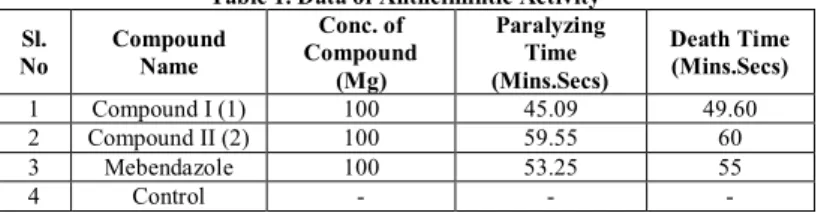
General Procedure: Anthelmintic activity studies were carried out against earthworms (Eudrilus eugeniea) by Garg’s method14. Suspensions of the samples were prepared by triturating the samples with 15% Tween 80 and distilled water and the resultant mixtures were stirred using a mechanical stirrer for 30 mins. The resulting suspensions were used for the activity studies. The suspensions were diluted to contain 100 mg in 20ml of the test samples. standard drug, Mebendazole was also prepared with the same concentration in a similar way. Earthworm was placed in a beaker containing 20ml of suspension of the test standard drugs (Mebendazole) at RT. Another set of earth worm was kept as control in 20ml suspension of distilled water and 15% Tween 80. 20ml each of the suspensions of the test compounds were added into separate beaker containing one earthworm in each. The time required for the paralysis and death of the worms was noted. The death time was ascertained by placing the earthworms in warm water at 50°C, which stimulated the movement if the worm was alive. The results of Anthelmintic Activity of the newly synthesized compounds are given in Table 1.
Table 1. Data of Anthelmintic Activity
Sl. No Compound Name Conc. of Compound (Mg) Paralyzing Time (Mins.Secs) Death Time (Mins.Secs)
1 Compound I (1) 100 45.09 49.60 2 Compound II (2) 100 59.55 60 3 Mebendazole 100 53.25 55
4 Control - - -
b) Evaluation of Insecticidal Activity
Insecticides are pesticides used against insects. A suitable invitro
test can be considered as a useful screening method.
General Procedure: Insecticidal studies of the synthesized compounds were carried out against termites (Coptotermes formosanus) by Morita et. al. method15.
Watt Mann filter paper was first cut according to the inner diameter of the Petri plate, 100mg of test compounds were dissolved in chloroform (2ml) and were poured uniformly on the Petri plates fitted with filter paper. Standard drug (Chloropyrifos) solution was also prepared in similar way and poured in the Petri plate. For control only the solvent was poured on the filter paper placed in plate. Five termites were placed in each of the Petri plate and covered with lid, wet cotton was attached to the upper lid. Set up was kept undisturbed and death time was noted. The results of Insecticidal Activity of the newly synthesized compounds are given in Table 2.
Table 2. Data of Insecticidal Activity Sl. No. Compound Name Conc. of Compound (Mg) Death Time (Hrs.Mins)
1. Compound 1 100 3.55 2. Compound 2 100 3.35 3. Chloropyrifos 100 2.45
RESULTS AND DISCUSSION
The two compounds, Compound I and its N-Methyl analog could be conveniently and efficiently synthesized by prescribed Scheme I with good yields. The newly synthesized compounds were characterized by IR, 1HNMR and MASS. The spectral data revealed the formation of linear hexapeptide and its N-Methylated analog. All the synthesized compounds were subjected to anthelmintic activity by Garg et.al. method and insecticidal activity by Morita et. al. The compounds exhibited potent anthelmintic activity against Eudrillus Eugeniea at the concentration of 100mg/20ml of test samples, similar to the standard drug, Mebendazole. The synthesized compounds showed moderate activity against Coptotermes Formosanus at the concentration of 100mg/2ml of test samples, as compared to the standard Chloropyrifos.
CONCLUSION
The two compounds could be conveniently and efficiently synthesized by prescribed Scheme with good yields. The newly synthesized compounds showed potent anthelmintic activity similar to that of standard drug Mebendazole. All the analogs were tested for insecticidal activity and exhibited moderate activity in comparison to standard drug Chloropyrifos.
ACKNOWLEDGMENT
The authors are thankful to VIT, Vellore for providing the necessary facilities and IR data. And also thankful to IICT, Hyderabad for 1H NMR and Mass data.
REFERENCES
1. Alassane W, Zheng Y, Brouard JP, Pousset JL, Bodo B, Cherimolacyclopeptide E, a novel cyclohexapeptide from the seeds of Annona cherimola,
Phytochemistry., 2005; 66: 2376.
2. Ahammadsahib KI, Hollingworth RM, McGovren JP., Hui YH, McLaughlin JL, Mode of action of bullatacin; A potent antitumor and pesticidal annonaceous acetogenins, Life Sci., 1993; 53: 1113.
3. Leboeuf M, Cave A, Bhaumik P., Mukherjee B, Bukherjee R, The Phytochemistry of Annonaceae, Phytochemistry., 1982; 21: 2783.
4. Cave A, Cortes D, Figardere B., Laurens A, Pettit GR, Progress in the Chemistry of Natural Products. Springer-Verlag Wien, Austria., 1997; 4: 81.
5. Chang FR, Cheng JL, Chui HF., Wu MJ, Wu YC, 1998. Acetogenins from the seeds of Annona reticulate, Phytochemistry., 1998; 47: 1057–1061.
6. Belagali SL, Mathew T, Himaja M, Kocienski PA,A highly efficient method of N-methylation for the amino acid derivatives Indian J. Org. Chem., 1995; 34: 44. 7. Shinde NV, Himaja M, Bhosale SK, Wagh RD, Synthesis and Biological
Evaluation of Analogue of Dalavayin-C: A Cyclic Heptapeptide, Asian Journal of Chemistry., 2010;
8. 22: 996.
9. Bodanszky M, Bodanszky A, Practice of Peptide synthesis. 1st Ed. New York: Springer-Verlag; 1984:78.
Himaja M
et al. IRJP 2011, 2 (12), 270-273
INTERNATIONAL RESEARCH JOURNAL OF PHARMACY, 2(12), 2011 11. .Himaja M, Ramana MV, Sahoo AK., Ranjitha A, Karigar AA, Synthesis and
antimicrobial activity of dichotomin A analogs, International Journal of Research in Ayurveda and Pharmacy., 2010; 1: 247.
12. Webb RG, Haskell MW, Stammer CH, Novel method for the protection of Carboxyl group. J Org Chem., 1994; 59: 5912.
13. Bentoin NL, Akyusckli D, Chen FM, N, N-dialkoxy-carbonyl amino acid from the sodium hydroxide mediated reaction of akyl chloroformates with anhydrides of N.alkoxy carbonyl amino acids, Ind J pro protein Res., 1995; 45: 446.
14. Scott CM, Joshi R, Meyhew DV, Amy JP, Joullie MM, Novel method for the coupling of Amino acids, J Org Chem., 1994; 59: 5912.
15. Garg L C, Atal CK, Evaluation of anthelmintic activity, Ind J Pharmacol., 1969; 31: 104.
16. Morita Y, Matsumura E, Okabe T, Shibata M, Sugiura M, Ohe T, Tsujibo H, Ishida N, Inamori Y, Biological activity of tropolone, Bio. Pharm. Bull., 2003;
26: 1487-1490 .