BGD
9, 17913–17937, 2012
Dissolved carbon supply to Orca Basin
brine
S. R. Shah et al.
Title Page
Abstract Introduction
Conclusions References
Tables Figures
◭ ◮
◭ ◮
Back Close
Full Screen / Esc
Printer-friendly Version Interactive Discussion
Discussion
P
a
per
|
Dis
cussion
P
a
per
|
Discussion
P
a
per
|
Discussio
n
P
a
per
|
Biogeosciences Discuss., 9, 17913–17937, 2012 www.biogeosciences-discuss.net/9/17913/2012/ doi:10.5194/bgd-9-17913-2012
© Author(s) 2012. CC Attribution 3.0 License.
Biogeosciences Discussions
This discussion paper is/has been under review for the journal Biogeosciences (BG). Please refer to the corresponding final paper in BG if available.
Carbon isotopic evidence for microbial
control of carbon supply to Orca Basin at
the brine-seawater interface
S. R. Shah1, S. B. Joye2, J. A. Brandes3, and A. P. McNichol1
1
Geology and Geophysics Department, Woods Hole Oceanographic Institution, Woods Hole MA 02543, USA
2
Department of Marine Sciences, University of Georgia, Athens, GA 30602–3636, USA 3
Skidaway Institute for Oceanography, Savannah, GA 31411, USA
Received: 27 November 2012 – Accepted: 5 December 2012 – Published: 13 December 2012
Correspondence to: S. R. Shah ([email protected])
Published by Copernicus Publications on behalf of the European Geosciences Union.
BGD
9, 17913–17937, 2012
Dissolved carbon supply to Orca Basin
brine
S. R. Shah et al.
Title Page
Abstract Introduction
Conclusions References
Tables Figures
◭ ◮
◭ ◮
Back Close
Full Screen / Esc
Printer-friendly Version Interactive Discussion
Discussion
P
a
per
|
Dis
cussion
P
a
per
|
Discussion
P
a
per
|
Discussio
n
P
a
per
Abstract
Orca Basin, an intraslope basin on the Texas–Louisiana continental slope, hosts a hy-persaline, anoxic brine in its lowermost 200 m. This brine contains a large reservoir of reduced and aged carbon, and appears to be stable at decadal time scales: concen-trations and the isotopic composition of dissolved inorganic (DIC) and organic carbon
5
(DOC) are similar to previous reports. Both DIC and DOC are more “aged” within the brine pool than in overlying water, and the isotopic contrast between brine carbon and seawater carbon is much greater for DIC than DOC. While the stable carbon isotopic composition of brine DIC points towards a combination of methane and organic car-bon re-mineralization as its source, radiocarcar-bon and box model results point to the
10
brine interface as the major source region for DIC with oxidation of methane diffusing upwards from sediments supplying only limited DIC to the brine. This conclusion is con-sistent with previous studies reporting microbial activity focused at the seawater-brine interface. Isotopic similarities between DIC and DOC suggest a different relationship between these two carbon reservoirs than is typically observed in deep ocean basins.
15
Radiocarbon values implicate the seawater-brine interface region as the likely source region for DOC as well as DIC. Further investigations of the seawater-brine interface are needed to advance our understanding of the specific microbial processes contribut-ing to dissolved carbon storage in the Orca Basin brine.
1 Introduction
20
The continental slope of the northern Gulf of Mexico is characterized by numerous basins and pockmarks extending from the shelf edge to the basin floor (Bouma and Bryant, 1994 and references therein). This complex bathymetry is produced by the in-teraction of sediments and underlying salt, which drives salt deformation (Humphris, 1978), a process also associated with brine formation and brine seepage along
25
BGD
9, 17913–17937, 2012
Dissolved carbon supply to Orca Basin
brine
S. R. Shah et al.
Title Page
Abstract Introduction
Conclusions References
Tables Figures
◭ ◮
◭ ◮
Back Close
Full Screen / Esc
Printer-friendly Version Interactive Discussion
Discussion
P
a
per
|
Dis
cussion
P
a
per
|
Discussion
P
a
per
|
Discussio
n
P
a
per
|
seepage is considered widespread in the northwestern Gulf of Mexico, only a few brine pools have been detected and studied (Joye et al., 2005; Macdonald et al., 1990; Shokes et al., 1977). The largest among these is Orca Basin, a deep basin lo-cated on the Texas–Louisiana slope at a water depth of approximately 2000 m (Pilcher and Blumstein, 2007; Shokes et al., 1977; Trabant and Presley, 1978). Below 2240 m
5
depth, the basin is occupied by an anoxic, hypersaline brine. Both the geochemistry of the brine and composition of underlying sediments indicate the∼200-m thick brine
originates from dissolution of a nearby salt exposure and lateral advection of brine to the basin (Addy and Behrens, 1980; Pilcher and Blumstein, 2007; Sheu et al., 1988; Shokes et al., 1977; Trabant and Presley, 1978).
10
The onset of brine accumulation in Orca Basin is thought to be signaled by a tran-sition from shallow, black anoxic sediments to more deeply-buried gray sediments. This transition, reported in both slope sediments and in deeper basin sediments (Addy and Behrens, 1980; Leventer et al., 1983; Meckler et al., 2008; Northam et al., 1981) has been dated by three methods: radiocarbon analysis of total carbonate (Addy and
15
Behrens, 1980); radiocarbon analysis of foraminifera (Leventer et al., 1983; Meckler et al., 2008); and biostratigraphy (Leventer et al., 1983), yielding similar ages of ap-proximately 7900 to 8500 calendar years.
Within the Orca Basin brine, oxygen and nitrate are not detectable while phosphate concentrations are elevated compared to overlying seawater as a result of
organic-20
matter decomposition (Leventer et al., 1983; Shokes et al., 1977; Van Cappellen et al., 1998). Sulfate concentrations, however, are not depleted within the brine suggest-ing a limited role for microbial sulfate reduction (Leventer et al., 1983; Wiesenburg et al., 1985). Active and diverse microbial communities have been reported in deep-sea brines of the Red Sea, Mediterranean and elsewhere in the Gulf of Mexico (reviewed
25
in Antunes et al., 2011), although these brines often have in situ hydrothermal or salt tectonic sources (e.g. Joye et al., 2009). Studies of microbial abundance and activity in Orca Basin have concluded that very little physiological activity can be measured below the seawater-brine interface (Dickins and Van Vleet, 1992; LaRock et al., 1979;
BGD
9, 17913–17937, 2012
Dissolved carbon supply to Orca Basin
brine
S. R. Shah et al.
Title Page
Abstract Introduction
Conclusions References
Tables Figures
◭ ◮
◭ ◮
Back Close
Full Screen / Esc
Printer-friendly Version Interactive Discussion
Discussion
P
a
per
|
Dis
cussion
P
a
per
|
Discussion
P
a
per
|
Discussio
n
P
a
per
Tuovila et al., 1987; Wiesenburg et al., 1985). The brine interface region, a particle trap where successive depletion of oxygen, nitrate and oxidized manganese has been observed (Trefry et al., 1984; Van Cappellen et al., 1998) along with narrowly-defined peaks of methane, ethane, propane and hydrogen sulfide concentrations (Wiesenburg et al., 1985), is where the most intense microbial activity is focused (LaRock et al.,
5
1979; Sheu et al., 1988; Van Cappellen et al., 1998; Wiesenburg et al., 1985). These authors propose that accumulation of reduced gases and oxygen depletion in the brine result from the long residence time of brine combined with slow in situ decomposition of organic carbon in the basin (Wiesenburg et al., 1985). Here we use radiocarbon to show that a large fraction of the dissolved inorganic (DIC) and organic carbon (DOC)
10
reservoirs in Orca Basin also result from slow but cumulative microbial processes.
2 Material and methods
2.1 Sampling
Brine from the southern lobe of Orca Basin and overlying seawater was sampled by CTD rosette at 26◦54.5′N, 91◦20.1′W from the R/V Atlantis during cruise AT18-2.
15
Whole seawater was collected for radiocarbon analysis of DIC following the NOSAMS DIC sampling protocol (http://www.whoi.edu/NOSAMS DIC collection, accessed in 2010). Briefly, 500 ml of seawater was collected in pre-combusted glass bottles af-ter thorough rinsing with sample seawaaf-ter, poisoned with mercuric chloride and sealed with greased, ground-glass stoppers. Filtered DOC samples were collected directly
20
from Niskin bottles into 1-liter amber bottles through an in-line, pre-combusted 47 mm Whatman GF/F filter. Multiple filters were necessary to collect 200 to 300 ml brine samples. DOC bottles were capped with Teflon-lined lids and stored at −20◦C until
BGD
9, 17913–17937, 2012
Dissolved carbon supply to Orca Basin
brine
S. R. Shah et al.
Title Page
Abstract Introduction
Conclusions References
Tables Figures
◭ ◮
◭ ◮
Back Close
Full Screen / Esc
Printer-friendly Version Interactive Discussion
Discussion
P
a
per
|
Dis
cussion
P
a
per
|
Discussion
P
a
per
|
Discussio
n
P
a
per
|
2.2 DIC and DOC concentrations
Samples for DIC analysis were filter-sterilized (0.2 µm) and stored in gas-tight 2 mL au-tosampler vials at 4◦C prior to analysis (Brandes, 2009) using liquid chromatography-isotope-ratio-monitoring mass spectrometry (LC-IRMS) with a Delta V Plus. Samples were calibrated against sodium bicarbonate standards. Samples for DOC analysis were
5
filter-sterilized on board the ship (0.2 µm Target® filters) and stored frozen at −20◦C
prior to analysis using a Shimadzu TOC-V high temperature catalytic oxidation system (Joye et al., 2010). As a precautionary measure, the Target®filters were rinsed by run-ning 10–15 mL of UV-oxidized milliQ water through the filters and dried by passing 5– 10 mL of dry sterile (0.2 µm filtered) air through the filter. Blanks for DOC, UV-oxidized
10
milliQ filtered through similarly cleaned 0.2 µm Target®filters, were collected along side DOC samples in the field and run in the laboratory; blanks were consistently less than 0.2 µM.
2.3 δ13C and∆14Canalysis
Stable carbon isotopic analysis and radiocarbon analysis of DIC and DOC was
per-15
formed at the National Ocean Sciences Accelerator Mass Spectrometry (NOSAMS) facility. Inorganic carbon was extracted from DIC samples by water-stripping method (McNichol et al., 1994).δ13C values were determined on a split of the sample CO2by
dual-inlet Optima IRMS, and the remainder of the CO2 was converted to graphite for radiocarbon analysis by AMS. This method has been successfully used to analyze DIC
20
from brine samples previously (e.g., Ma et al., 2005; Mikucki et al., 2009). Ongoing analysis of reproducibility across all sample types at NOSAMS indicates measurement uncertainty is±0.05 ‰ forδ13C values and±4.9 ‰ for∆14C of modern samples (Elder
et al., 1998; Jenkins et al., 2010). Independentδ13C measurements of separate DIC
samples were performed by LC-IRMS (as described in Sect. 2.2; Brandes, 2009) at
25
Skidaway Institute of Oceanography (SkIO). Reproducibility of DIC standards by
LC-IRMS method was±0.04 ‰.
BGD
9, 17913–17937, 2012
Dissolved carbon supply to Orca Basin
brine
S. R. Shah et al.
Title Page
Abstract Introduction
Conclusions References
Tables Figures
◭ ◮
◭ ◮
Back Close
Full Screen / Esc
Printer-friendly Version Interactive Discussion
Discussion
P
a
per
|
Dis
cussion
P
a
per
|
Discussion
P
a
per
|
Discussio
n
P
a
per
DOC was converted to CO2 by the UV oxidation method (Beaupr ´e et al., 2007).
Brine samples were diluted with pre-irradiated MilliQ water (dilution factors: 2.9, 3.0) and a split of sample CO2was reserved for δ13C analysis by dual-inlet Prism IRMS.
The remainder was graphitized for radiocarbon analysis by AMS. Sample results are all corrected for process blanks determined using the method of Currie et al. (2000) and
5
Santos et al. (2007). Measurement of modern and dead standards indicates processing introduces the equivalent of 0.21±0.2 µmol modern carbon and 0.33±0.28 µmol dead
carbon, and we observe an overall reproducibility of±0.3 ‰ for DO13C and±7 to 10 ‰
for modern DO14C.
3 Results
10
3.1 Salinity and dissolved oxygen
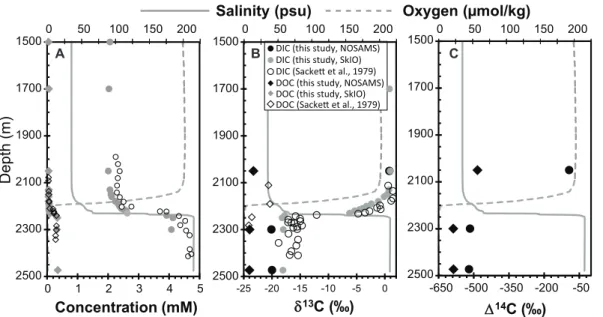
Salinity and dissolved oxygen profiles are illustrated in Fig. 1. Oxygen depletion begins above the sharp salinity increase at approximately 2100 m, definining the upper limit of the seawater-brine interface region. Salinity increases sharply to the brine value at approximately 2240 m resulting in an estimated thickness of 140 m for the
seawater-15
brine transition region. This is the same thickness reported by Sackett et al. (1979), suggesting the interface is very stable with little change observed since the late 1970s.
3.2 Dissolved inorganic carbon
DIC concentrations also show a similar pattern to that observed in 1976–1977 with a doubling of concentrations between overlying seawater (2.0–2.1 mM) and brine (3.9–
20
BGD
9, 17913–17937, 2012
Dissolved carbon supply to Orca Basin
brine
S. R. Shah et al.
Title Page
Abstract Introduction
Conclusions References
Tables Figures
◭ ◮
◭ ◮
Back Close
Full Screen / Esc
Printer-friendly Version Interactive Discussion
Discussion
P
a
per
|
Dis
cussion
P
a
per
|
Discussion
P
a
per
|
Discussio
n
P
a
per
|
1977; Wiesenburg et al., 1985) and small-scale gradients in DIC concentration would therefore be surprising. In addition, our low-precision estimates of DIC concentration obtained from two brine depths during CO2 extraction for radiocarbon analysis agree
within analytical uncertainty, arguing against DIC gradients within the brine. Combined, these observations give confidence to our DIC profile with its absence of small-scale
5
variability throughout the depth profile.
Brine DIC is significantly depleted in 13C relative to overlying seawater (Table 1, Fig. 1b), indicating substantial contributions from re-mineralized organic carbon or methane. Sackett et al. (1979) present a detailed profile documenting the transition between overlying seawater and brineδ13C values, and here we describe the present
10
isotopic state of the DIC reservoir using two independent methods: CO2extraction fol-lowed by offline δ13C analysis by dual-inlet IRMS (NOSAMS) and LC-IRMS (SkIO).
Both methods indicate a DIC reservoir that is more depleted in 13C than any value reported by Sackett et al. (1979). Similar to DIC concentrations, brineδ13C
DICvalues
measured at NOSAMS agree within analytical uncertainty.δ13CDICvalues determined
15
at SkIO also agree closely within the brine, which contrasts with the∼4 ‰ range
ob-served previously (Fig. 1b). As described above, the small-scale variability recorded by Sackett et al. (1979) is not expected within a well-mixed brine and also not represented in our more recent analyses.
Our δ13CDIC values are significantly different than those reported previously,
al-20
though also significantly different from each other, despite their internal consistency (Fig. 1b). Rather than representing a decadally dynamic DIC reservoir, we believe the 2 or 4 ‰ difference is more likely to be a result of analytical bias. Since we can-not reconcile our NOSAMSδ13CDIC values (−20.0±0.05 ‰) with values measured at
SkIO (−18.1±0.1 ‰), or the average δ13CDIC value (−16.4±1 ‰) reported by
Sack-25
ett et al. (1979), we include the averageδ13CDIC value from both of our measurement
methods as well as that reported by Sackett et al. (1979) in our calculations and dis-cussion below.
BGD
9, 17913–17937, 2012
Dissolved carbon supply to Orca Basin
brine
S. R. Shah et al.
Title Page
Abstract Introduction
Conclusions References
Tables Figures
◭ ◮
◭ ◮
Back Close
Full Screen / Esc
Printer-friendly Version Interactive Discussion
Discussion
P
a
per
|
Dis
cussion
P
a
per
|
Discussion
P
a
per
|
Discussio
n
P
a
per
The radiocarbon contents of brine DIC at 2300 and 2473 m depth agree within an-alytical uncertainty, showing no variation with depth (Table 1, Fig. 1c). Our values are in general agreement with ∆14CDIC values reported previously (decay corrected
to−509 ‰,−496 ‰ and−492 ‰; from Sackett et al., 1979; Stuiver and Polach, 1977),
although these values were not reported with sample depths. Both the∆14C andδ13C
5
values of DIC from overlying seawater are similar to World Ocean Circulation Experi-ment (WOCE) values from 2000–3000 m depth in the North Atlantic (WOCE line A22, 1997).
3.3 Dissolved organic carbon
DOC concentrations within the brine (320–349 µM) are greater than those in the
over-10
lying seawater (50–59 µM) by a factor of seven and are in good agreement with DOC concentrations reported by Sackett et al. (1979; Fig. 1a). The δ13C values of DOC
are also very similar to those reported by Sackett et al. (1979) and do not show any variation with depth. The radiocarbon contrast between DOC in the brine and overly-ing seawater is considerably smaller than for DIC (Table 1, Fig. 1b, c). The DOC of
15
overlying seawater is also isotopically similar to DOC measured in the North Atlantic at similar depths (Druffel et al., 1992).
4 Discussion
Comparison between our isotopic results and similar values reported three decades ago (Sackett et al., 1979) suggests that Orca Basin lacks a dynamic carbon cycle.
20
Multiple studies of the sediments underlying Orca Basin have converged on a 7900 to 8500-yr timescale for the establishment of anoxic, hypersaline conditions in the basin (Addy and Behrens, 1980; Leventer et al., 1983; Meckler et al., 2008). For this study, we compared our radiocarbon values with the most recent foram record reported by Meckler et al. (2008) because it includes a radiocarbon date in close proximity to
BGD
9, 17913–17937, 2012
Dissolved carbon supply to Orca Basin
brine
S. R. Shah et al.
Title Page
Abstract Introduction
Conclusions References
Tables Figures
◭ ◮
◭ ◮
Back Close
Full Screen / Esc
Printer-friendly Version Interactive Discussion
Discussion
P
a
per
|
Dis
cussion
P
a
per
|
Discussion
P
a
per
|
Discussio
n
P
a
per
|
the black-gray sediment transition depth and because radiocarbon analysis of individ-ual foraminiferal species has confirmed stratigraphic continuity in this location (Flower et al., 2011). Adjusting these reported radiocarbon ages by the more recent, smaller reservoir age determined at the nearby Flower Garden Banks (Wagner et al., 2009) results in an 8700±100 yr calendar age for Orca Basin brine. However, the
estab-5
lishment of the brine is not necessarily coupled to the establishment of its dissolved carbon reservoir. This brine age requires a greater depletion of14C than was actually measured in brine DIC, pointing towards the input of more modern carbon to the DIC reservoir in the Orca Basin.
4.1 Conservative mixing of brine and seawater end-members
10
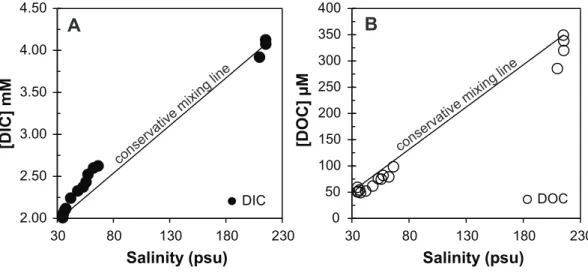
The depth profiles of DIC and DOC concentrations closely parallel that of salinity through the seawater-brine interface of Orca Basin (Fig. 1a), and Fig. 2 illustrates the relationship between DIC, DOC and salinity across this interface. Conservative mixing between seawater and a brine end-member source is implied by the strong linearity ob-served between salinity and DIC as well as salinity and DOC concentrations. However,
15
small deviations from the conservative mixing line (Fig. 2) allow for a limited DIC source in the low-salinity region of the seawater-brine interface as well as non-conservative behavior of DOC within the brine.
The isotopic composition of this brine end-member can be calculated by constructing an isotopic mixing model. Solving the following equations:
20
mmeasured=mseawater+mbrine (1)
mmeasured·δmeasured=mseawater·δseawater+mbrine·δbrine (2) mmeasured·∆measured=mseawater·∆seawater+mbrine·∆brine (3)
for the concentration (mbrine), δ13C value (δbrine) and ∆14C value (∆brine) of the brine
25
end-member by using the average measured brine values for mmeasured, δmeasured
BGD
9, 17913–17937, 2012
Dissolved carbon supply to Orca Basin
brine
S. R. Shah et al.
Title Page
Abstract Introduction
Conclusions References
Tables Figures
◭ ◮
◭ ◮
Back Close
Full Screen / Esc
Printer-friendly Version Interactive Discussion
Discussion
P
a
per
|
Dis
cussion
P
a
per
|
Discussion
P
a
per
|
Discussio
n
P
a
per
δseawater and∆,
seawateryields an δ 13
C estimate of −40±3 ‰ (NOSAMS) or−36±2 ‰
(SkIO) and ∆14C estimate of −930±64 ‰. This approach, similar to that utilized by
Sackett et al. (1979), suggests that brine DIC is supplied by a source depleted in both
13
C and14C. Using theδ13CDIC values reported by Sackett et al. (1979), however,
in-dicate a brine endmember that is a bit less13C-depleted (−33±2 ‰). Theδ13C value
5
of the brine end-member likely reflects a combination of POC re-mineralization with typical marine values of −21 to −22 ‰ (Northam et al., 1981; Sackett et al., 1979)
and oxidation of methane having aδ13C value of−72 to−75 ‰ (Sackett et al., 1979;
Wiesenburg et al., 1985). This mixing model, however, is unable to account for the time-evolving nature of14C concentration and is most representative of a single
mod-10
ern mixing event. The three similar estimates of brine age from slope sediments (Lev-enter et al., 1983; Meckler et al., 2008) and the deep basin (Addy and Behrens, 1980) suggest that the current brine thickness accumulated quickly and makes a single mod-ern mixing event unlikely. If any single episode (i.e. of short enough duration that DIC does not “age” significantly) mixed seawater and end-member brine to produce the
15
current brine composition, it would have occurred at the onset of brine accumulation, 8700 calendar years (or 807814C years) ago. However, a long-ago mixing event is in-compatible with the radiocarbon age of brine DIC (∼580014C year), which is younger
than the age of the brine relative to the onset of anoxic conditions. Thus we conclude that an isotopic mixing model cannot accurately represent the radiocarbon content of
20
a brine end-member and that the true brine DIC source is likely to be significantly more modern than the value calculated above.
Although it does not represent the 14C contents of reduced carbon sources which ultimately contribute DIC to Orca Basin brine, δ13C results from the isotopic mixing
model highlight the significant contribution that microbial oxidation of reduced carbon
25
BGD
9, 17913–17937, 2012
Dissolved carbon supply to Orca Basin
brine
S. R. Shah et al.
Title Page
Abstract Introduction
Conclusions References
Tables Figures
◭ ◮
◭ ◮
Back Close
Full Screen / Esc
Printer-friendly Version Interactive Discussion
Discussion
P
a
per
|
Dis
cussion
P
a
per
|
Discussion
P
a
per
|
Discussio
n
P
a
per
|
following equation:
δ13C brine=
[DIC]seawater [DIC]brine ·δ
13C
seawater+fPOC
[DIC]brine−[DIC]seawater
[DIC]brine ·δ
13C
POC (4)
+(1−fPOC)·[DIC]brine−[DIC]seawater
[DIC]brine
·δ13Cmethane
using the expectedδ13C values for methane and sinking POC described above
indi-5
cates 65±6 % (NOSAMS) or 72±6 % (SkIO) of brine end-member DIC must come
from POC re-mineralization and the remainder from methane oxidation. Using the av-erageδ13C
DICvalue reported by Sackett et al. (1979) results in an estimate of 80±8 %
of brine DIC deriving from POC re-mineralization.
4.2 Box-model estimates of brine DIC sources
10
Microbially-mediated DIC addition to Orca Basin argues against the model of a single mixing episode and instead implies a slow accumulation of excess DIC and there-fore an uncoupling between brine formation and DIC accumulation within the brine. To better capture this model of DIC buildup and constrain the radiocarbon age of the microbially-contributed DIC, we constructed a box model to represent the evolution of
15
DIC during the 8700-yr history of Orca Basin brine. Brine DIC can be contributed by the re-mineralization of sinking organic carbon (“modern”, with an age of contempora-neous marine organic carbon from photosynthesis), methane from the brine interface (“modern”) or methane diffusing upwards from sediments (“aged”). We assume a con-stant rate of DIC increase added to an initial DIC concentration and isotopic
composi-20
tion equivalent to overlying seawater. We do not explicitly include molecular diffusion as only picomolar DIC loss can be expected over the entire lifetime of the brine with a molecular diffusivity of 0.5×10⁻⁹m2s−1(Zeebe, 2011). Eddy diffusion is likely to have
a somewhat greater effect than molecular diffusion, although the sharp and stable DIC gradient at the brine interface (Fig. 1a) argues against any large diffusive losses from
25
BGD
9, 17913–17937, 2012
Dissolved carbon supply to Orca Basin
brine
S. R. Shah et al.
Title Page
Abstract Introduction
Conclusions References
Tables Figures
◭ ◮
◭ ◮
Back Close
Full Screen / Esc
Printer-friendly Version Interactive Discussion
Discussion
P
a
per
|
Dis
cussion
P
a
per
|
Discussion
P
a
per
|
Discussio
n
P
a
per
the Orca Basin brine. Because we cannot measure eddy diffusivity for the brine inter-face and because the large density contrast between the brine and overlying seawater will inhibit turbulent diffusion making it unlikely to have a significant influence on the evolution of the DIC reservoir, we do not include DIC loss due to eddy diffusion in the box model. 14C decay is incorporated into each timestep following Eq. (7), and the
5
fraction of POC and methane added at each time increment is determined by the frac-tions calculated in Sect. 4.1. We prescribe the ∆14C value of sinking POC over the lifetime of the brine as atmospheric∆14C values according to IntCal09 (Reimer et al., 2009) offset by the reservoir age from the nearby Flower Garden Banks (−53.2±1 ‰;
Wagner et al., 2009) to account for atmospheric14C variability through time and solve
10
iteratively for the∆14C of methane. The following equations describe the concentration and isotopic composition of DIC at timetin the box model:
[DIC]t=[DIC]t−1+
[DIC]final−[DIC]initial
tfinal−tinitial (5)
δ13Ct=[DIC]t−1· δ13Ct
−1
[DIC]t
(6)
+
f · [DIC]t−[DIC]t −1
·δ13CPOC
[DIC]t
15
+(1−
f)· [DIC]t−[DIC]t −1
·δ13Cmethane
[DIC]t
h
∆14Ct
i
AGED=
"
∆14Ct 1000 +1
!
·eλ(−5)−1 #
BGD
9, 17913–17937, 2012
Dissolved carbon supply to Orca Basin
brine
S. R. Shah et al.
Title Page
Abstract Introduction
Conclusions References
Tables Figures
◭ ◮
◭ ◮
Back Close
Full Screen / Esc
Printer-friendly Version Interactive Discussion
Discussion
P
a
per
|
Dis
cussion
P
a
per
|
Discussion
P
a
per
|
Discussio
n
P
a
per
|
∆14Ct=
[DIC]t−1·
h
∆14Ct−1
i
AGED
[DIC]t
(8)
+
f · [DIC]t−[DIC]t −1
·∆14CPOC
[DIC]t
(9)
+(1−
f)· [DIC]t−[DIC]t −1
·∆14Cmethane
[DIC]t
5
Using the parameters in Table 2 (with either NOSAMS or SkIO value for finalδ13C)
and a 5-yr time resolution, this model calculates a∆14C value of−31±102 ‰ for DIC
resulting from methane oxidation (Fig. 3). Substituting in the average δ13CDIC value
reported by Sackett et al. (1979) changes the result by less than 1 ‰ because the calculated methane source has very similar radiocarbon contents to the average
pre-10
scribed POC source. It also does not increase uncertainty in the model output due to the larger uncertainties assigned to the δ13C values of POC and methane (Table 2).
This “modern” result points to the brine interface as the dominant source region for methane that is oxidized by the microbial assemblage in Orca Basin, resulting in DIC with a radiocarbon value similar to sinking POC (time average:−18 ‰, Fig. 3, gray line).
15
Considering the slightly14C-depleted value compared to time-averaged POC and con-sidering the uncertainties of this approach (Fig. 3, dashed lines), it does not exclude a small contribution from the oxidization of aged methane diffusing into the brine from sediments (Wiesenburg et al., 1985). The importance of the brine interface as a poten-tial DIC source to the brine below is suggested by the multiple studies that point toward
20
high rates of microbial activity focused in this region ( LaRock et al., 1979; Sheu et al., 1988; Van Cappellen et al., 1998; Wiesenburg et al., 1985). But the small deviation of DIC concentrations from a conservative mixing line (Fig. 2) compared to the devia-tions observed for alkalinity and Mn2+(Van Cappellen et al., 1998) lend support to the interface being a slow, cumulative source of DIC.
25
BGD
9, 17913–17937, 2012
Dissolved carbon supply to Orca Basin
brine
S. R. Shah et al.
Title Page
Abstract Introduction
Conclusions References
Tables Figures
◭ ◮
◭ ◮
Back Close
Full Screen / Esc
Printer-friendly Version Interactive Discussion
Discussion
P
a
per
|
Dis
cussion
P
a
per
|
Discussion
P
a
per
|
Discussio
n
P
a
per
4.3 Isotopic composition and sources of brine DOC
In the seawater overlying Orca Basin, the contrast between the radiocarbon contents of DIC and DOC is 389 ‰, not significantly different from the 300–380 ‰ contrasts observed in the Arctic (Griffith et al., 2012), Atlantic, Pacific and Southern Oceans (Druffel and Bauer, 2000) at similar depths. Within the Orca Basin brine, however, the
5
difference between the radiocarbon contents of DIC and DOC is much smaller (∼70 ‰,
Table 1). This smaller contrast implies sources and sinks of Orca Basin DOC that are distinct from deep-ocean refractory DOC despiteδ13C values that are indistinguishable
(δ13C
brineDOC−δ 13
CseawaterDOC=−0.7±1 ‰).
In addition to the similarity in radiocarbon contents, theδ13C values of brine DIC and
10
brine DOC are also strikingly similar (δ13CbrineDOC−δ13CbrineDIC=4±2 ‰ (NOSAMS),
6±2 ‰ (SkIO)). Thisδ13C similarity is not typical of open ocean basins and suggests
a stronger linkage between these two reservoirs in Orca Basin than that observed in other parts of the deep ocean. DOC is enriched within Orca Basin brine by ap-proximately sevfold compared to overlying seawater (Fig. 1a). This is a greater
en-15
richment than is observed for DIC and points to the importance of in situ brine DOC sources. These sources are likely to include incorporation of refractory deep-ocean DOC, incorporation of DOC produced from DIC by chemoautotrophy at the brine in-terface (Joye et al., 2009), microbial conversion of POC to DOC and disaggregation of POC to DOC. Theδ13C value of DOC does not allow for a significant13C-depleted
20
source from methane oxidation as it is not more13C-depleted than DOC in the water column above.
Although constructing a conservative mixing model of brine and seawater end-members would not be appropriate because DOC is likely to be a more dynamic reservoir than DIC with potential for microbial sinks as well as sources, results of
25
BGD
9, 17913–17937, 2012
Dissolved carbon supply to Orca Basin
brine
S. R. Shah et al.
Title Page
Abstract Introduction
Conclusions References
Tables Figures
◭ ◮
◭ ◮
Back Close
Full Screen / Esc
Printer-friendly Version Interactive Discussion
Discussion
P
a
per
|
Dis
cussion
P
a
per
|
Discussion
P
a
per
|
Discussio
n
P
a
per
|
the greater enrichment of brine DOC concentrations compared to overlying seawater and the greater14C-depletion of overlying DOC, and presumably original end-member DOC, compared to overlying DIC implies an even more dominant “modern” source to brine DOC than DIC. Along with evidence fromδ13C values, this further minimizes the
potential for microbial interaction with aged methane to create brine DOC.
5
5 Conclusions
Both the concentration and isotopic composition of dissolved carbon reservoirs in the Orca Basin brine pool appear to be stable over the past three decades. Modeled re-sults point toward the importance of in situ microbial contributions to the inorganic carbon pool and emphasize the importance of the brine interface as the location of
10
this microbial activity. Although both organic carbon and methane are implicated as the ultimate sources of brine DIC, box-modeled results show potential contributions from the oxidization of methane diffusing upwards from sediments are limited. The relative importance of individual DIC sources to Orca Basin brine is summarized in Table 3.
The isotopic composition of brine DOC is similar to brine DIC suggesting a stronger
15
coupling between these two reservoirs than is observed in overlying seawater. Stable carbon isotopic values only allow for a small DOC source from microbial incorporation of methane, unlike the proportionally-important source expected for DIC. Further inves-tigations of the seawater-brine interface are needed to form a better understanding of specific microbial processes contributing to dissolved carbon storage in the Orca Basin
20
brine.
BGD
9, 17913–17937, 2012
Dissolved carbon supply to Orca Basin
brine
S. R. Shah et al.
Title Page
Abstract Introduction
Conclusions References
Tables Figures
◭ ◮
◭ ◮
Back Close
Full Screen / Esc
Printer-friendly Version Interactive Discussion
Discussion
P
a
per
|
Dis
cussion
P
a
per
|
Discussion
P
a
per
|
Discussio
n
P
a
per
Acknowledgements. We are grateful for the assistance of the crew and Shipboard Scientific Services Group of the R/VAtlantisand to Pete Girguis for enabling the collection of brine sam-ples. The box model presented in this manuscript has been improved greatly from discussions with Bill Jenkins and Ann Pearson. This work was funded by the WHOI Postdoctoral Scholar program, NSF Cooperative Agreement for the Operation of a National Ocean Sciences
Ac-5
celerator Mass Spectrometry Facility (OCE-0753487 to APM), and the US National Science Foundation’s Emerging Frontiers program (award 0801741 to SBJ).
References
Addy, S. K. and Behrens, E. W.: Time of accumulation of hypersaline anoxic brine in Orca Basin (Gulf of Mexico), Mar. Geol., 37, 241–252, 1980.
10
Antunes, A., Ngugi, D. K., and Stingl, U.: Microbiology of the Red Sea (and other) deep-sea anoxic brine lakes, Environ. Microbiol. Rep., 3, 416–433, doi:10.1111/j.1758-2229.2011.00264.x, 2011.
Beaupr ´e, S. R., Druffel, E. R. M., and Griffin, S.: A low-blank photochemical extraction sys-tem for concentration and isotopic analyses of marine dissolved organic carbon, Limnol.
15
Oceanogr.-Meth., 5, 174–184, doi:10.4319/lom.2007.5.174, 2007.
Bouma, A. H. and Bryant, W. R.: Physiographic features on the northern Gulf of Mexico conti-nental slope, Geo-Mar. Lett., 14, 252–263, 1994.
Brandes, J. A.: Rapid and preciseδ13C measurement of dissolved inorganic carbon in natural
waters using liquid chromatography coupled to an isotope-ratio mass spectrometer, Limnol.
20
Oceanogr.-Meth., 7, 730–739, doi:10.4319/lom.2009.7.730, 2009.
Dickins, H. D. and Van Vleet, E. S.: Archaebacterial activity in the Orca Basin determined by the isolation of characteristic isopranyl ether-linked lipids, Deep Sea Res., 39, 521–536, 1992. Druffel, E. R. M. and Bauer, J. E.: Radiocarbon distributions in Southern Ocean dissolved and
particulate organic matter, Geophys. Res. Lett., 27, 1495–1498, 2000.
25
Druffel, E. R. M., Williams, P. M., Bauer, J. E., and Ertel, J. R.: Cycling of dissolved and particulate organic matter in the open ocean, J. Geophys. Res., 97, 15639–15659, doi:10.1029/92JC01511, 1992.
Elder, K. L., McNichol, A. P., and Gagnon, A. L.: Reproducibility of seawater, inorganic and organic carbon14C results at NOSAMS, Radiocarbon, 40, 223–230, 1998.
BGD
9, 17913–17937, 2012
Dissolved carbon supply to Orca Basin
brine
S. R. Shah et al.
Title Page
Abstract Introduction
Conclusions References
Tables Figures
◭ ◮
◭ ◮
Back Close
Full Screen / Esc
Printer-friendly Version Interactive Discussion
Discussion
P
a
per
|
Dis
cussion
P
a
per
|
Discussion
P
a
per
|
Discussio
n
P
a
per
|
Flower, B. P., Hastings, D. W., and Randle, N. J.: Paired AMS14C dates on planktic foraminifera from a Gulf of Mexico sediment core: an assessment of stratigraphic continuity, Radiocarbon, 53, 337–344, 2011.
Griffith, D. R., McNichol, A. P., Xu, L., McLaughlin, F. A., Macdonald, R. W., Brown, K. A., and Eglinton, T. I.: Carbon dynamics in the western Arctic Ocean: insights from full-depth carbon
5
isotope profiles of DIC, DOC, and POC, Biogeosciences, 9, 1217–1224, doi:10.5194/bg-9-1217-2012, 2012.
Humphris, C. C.: Salt movement on continental slope, Northern Gulf of Mexico, in: Framework, Facies, and Oil-Trapping Characteristics of the Upper Continental Margin: Studies in Geology No. 7, edited by: Bouma, A. H., Moore, G. T., and Coleman, J. M., American Association of
10
Petroleum Geologists, Tulsa, Oklahoma, 69–85, 1978.
Jenkins, W. J., Elder, K. L., McNichol, A. P., and von Reden, K.: The passage of the bomb radiocarbon pulse into the Pacific Ocean, Radiocarbon, 52, 1182–1190, 2010.
Joye, S. B., MacDonald, I. R., Montoya, J. P., and Peccini, M.: Geophysical and geochemical signatures of Gulf of Mexico seafloor brines, Biogeosciences, 2, 295–309,
doi:10.5194/bg-2-15
295-2005, 2005.
Joye, S. B., Samarkin, V. A., Orcutt, B. N., Macdonald, I. R., Hinrichs, K.-U., Elvert, M., Teske, A. P., Lloyd, K. G., Lever, M. A., Montoya, J. P., and Meile, C. D.: Metabolic variabil-ity in seafloor brines revealed by carbon and sulphur dynamics, Nat. Geosci., 2, 349–354, doi:10.1038/ngeo475, 2009.
20
Joye, S. B., Bowles, M. W., Samarkin, V. A., Hunter, K. S., and Niemann, H.: Biogeochemical signatures and microbial activity of different cold-seep habitats along the Gulf of Mexico deep slope, Deep Sea Res. Pt. II, 57, 1990–2001, doi:10.1016/j.dsr2.2010.06.001, 2010.
LaRock, P. A., Lauer, R. D., Schwarz, J. R., Watanabe, K. K., and Wiesenburg, D. A.: Microbial biomass and activity distribution in an anoxic, hypersaline basin, Appl. Environ. Microb., 37,
25
466–470, 1979.
Leventer, A., Williams, D. F., and Kennett, J. P.: Relationships between anoxia, glacial meltwa-ter and microfossil preservation in the Orca Basin, Gulf of Mexico, Mar. Geol., 53, 23–40, doi:10.1016/0025-3227(83)90032-4, 1983.
Ma, L., Castro, M. C., Hall, C. M., and Walter, L. M.: Cross-formational flow and salinity sources
30
inferred from a combined study of helium concentrations, isotopic ratios, and major el-ements in the Marshall aquifer, southern Michigan, Geochem. Geophy. Geosy., 6, 1–21, doi:10.1029/2005GC001010, 2005.
BGD
9, 17913–17937, 2012
Dissolved carbon supply to Orca Basin
brine
S. R. Shah et al.
Title Page
Abstract Introduction
Conclusions References
Tables Figures
◭ ◮
◭ ◮
Back Close
Full Screen / Esc
Printer-friendly Version Interactive Discussion
Discussion
P
a
per
|
Dis
cussion
P
a
per
|
Discussion
P
a
per
|
Discussio
n
P
a
per
Macdonald, I. R., Reilly, J. F., Guinasso, N. L. J., Brooks, J. M., Carney, R. S., Bryant, W. R., and Bright, T. J.: Chemosynthetic mussels at a brine-filled pockmark in the northern Gulf of Mexico., Science, 248, 1096–1099, doi:10.1126/science.248.4959.1096, 1990.
McNichol, A. P., Jones, G. A., Hutton, D. L., and Gagnon, A. R.: The rapid preparation of seawa-terΣCO2for radiocarbon analysis at the National Ocean Sciences AMS facility, Radiocarbon,
5
36, 237–246, 1994.
Meckler, A. N., Schubert, C. J., Hochuli, P. A., Plessen, B., Birgel, D., Flower, B. P., Hinrichs, K.-U., and Haug, G. H.: Glacial to Holocene terrigenous organic matter input to sediments from Orca Basin, Gulf of Mexico – a combined optical and biomarker approach, Earth Planet. Sc. Lett., 272, 251–263, doi:10.1016/j.epsl.2008.04.046, 2008.
10
Mikucki, J. A., Pearson, A., Johnston, D. T., Turchyn, A. V., Farquhar, J., Schrag, D. P., An-bar, A. D., Priscu, J. C., and Lee, P. A.: A contemporary microbially maintained subglacial ferrous “ocean”, Science, 324, 397–400, 2009.
Northam, M. A., Curry, D. J., Scalan, R. S., and Parker, P. L.: Stable carbon isotope ratio vari-ations of organic matter in Orca Basin sediments, Geochim. Cosmochim. Ac., 45, 257–260,
15
1981.
Pilcher, R. S. and Blumstein, R. D.: Brine volume and salt dissolution rates in Orca Basin, northeast Gulf of Mexico, AAPG Bull., 91, 823–833, 2007.
Reilly, J. F. J., Macdonald, I. R., Biegert, E. K., and Brooks, J. M.: Geologic controls on the distribution of chemosynthetic communities in the Gulf of Mexico, in: Hydrocarbon
Migra-20
tion and its Near-Surface Expression: AAPG Memoir 66, edited by: Schumacher, D. and Abrams, M. A., 39–62, 1996.
Reimer, P. J., Baillie, M. G. L., Bard, E., Bayliss, A., Beck, J. W., Blackwell, P. G., Bronk Ram-sey, C., Buck, C. E., Burr, G. S., Edwards, R. L., Friedrich, M., Grootes, P. M., Guilder-son, T. P., Hajdas, I., Heaton, T. J., Hogg, A. G., Hughen, K. A., Kaiser, K. F., Kromer, B.,
25
McCormac, F. G., Manning, S. W., Reimer, R. W., Richards, D. A., Southon, J. R., Talamo, S., Turney, C. S. M., van der Plicht, J., and Weyhenmeyer, C. E.: IntCal09 and Marine09 radio-carbon age calibration curves, 0–50,000 years cal BP, Radioradio-carbon, 51, 1111–1150, 2009. Roberts, H. H. and Carney, R. S.: Evidence of episodic fluid, gas, and sediment venting on the
northern Gulf of Mexico continental slope, Econ. Geol., 92, 863–879, 1997.
30
BGD
9, 17913–17937, 2012
Dissolved carbon supply to Orca Basin
brine
S. R. Shah et al.
Title Page
Abstract Introduction
Conclusions References
Tables Figures
◭ ◮
◭ ◮
Back Close
Full Screen / Esc
Printer-friendly Version Interactive Discussion
Discussion
P
a
per
|
Dis
cussion
P
a
per
|
Discussion
P
a
per
|
Discussio
n
P
a
per
|
Santos, G. M., Southon, J. R., Griffin, S., Beaupre, S. R., and Druffel, E. R. M.: Ultra small-mass AMS14C sample preparation and analyses at KCCAMS/UCI Facility, Nucl. Instrum. Meth. B, 259, 293–302.
Sheu, D.-D., Shakur, A., Pigott, J. D., Wiesenburg, D. A., Brooks, J. M., and Krouse, H. R.: Sulfur and oxygen isotopic compositions of dissolved sulfate in the Orca Basin: implications
5
for origin of the high-salinity brine and oxidation of sulfides at the brine-seawater interface, Mar. Geol., 78, 303–310, doi:10.1016/0025-3227(88)90115-6, 1988.
Shokes, R. F., Trabant, P. K., Presley, B. J. and Reid, D. F.: Anoxic, hypersaline basin in the Northern Gulf of Mexico, Science, 196, 1443–1446, 1977.
Stuiver, M. and Polach, H. A.: Reporting of14C Data, Radiocarbon, 19, 355–363, 1977.
10
Trabant, P. K. and Presley, B. J.: Orca Basin, anoxic depression on the continental slope, north-west Gulf of Mexico., in: Framework, Facies, and Oil-Trapping Characteristics of the Upper Continental Margin: Studies in Geology No. 7, edited by: Bouma, A. H., Moore, G. T., and Coleman, J. M., American Association of Petroleum Geologists, Tulsa, Oklahoma, 303–311, 1978.
15
Trefry, J. H., Presley, B. J., Keeney-Kennicutt, W. L., and Trocine, R. P.: Distribution and chem-istry of manganese, iron, and suspended particulates in Orca Basin, Geo-Mar. Lett., 4, 125– 130, doi:10.1007/BF02277083, 1984.
Tuovila, B. J., Dobbs, F. C., LaRock, P. A., and Siegel, B. Z.: Preservation of ATP in hypersaline environments, Appl. Environ. Microb., 53, 2749–2753, 1987.
20
Van Cappellen, P., Viollier, E., Roychoudhury, A., Clark, L., Ingall, E., Lowe, K., and DiChristina, T.: Biogeochemical cycles of manganese and iron at the oxic-anoxic transition of a stratified marine basin (Orca Basin, Gulf of Mexico), Envir. Sci. Tech., 32, 2931–2939, 1998.
Wagner, A. J., Guilderson, T. P., Slowey, N. C., and Cole, J. E.: Pre-bomb surface water
radio-25
carbon of the Gulf of Mexico and Caribbean as recorded in hermatypic corals, Radiocarbon, 51, 947–954, 2009.
Wiesenburg, D. A., Brooks, J. M., and Bernard, B. B.: Biogenic hydrocarbon gases and sulfate reduction in the Orca Basin brine, Geochim. Cosmochim. Ac., 49, 2069–2080, doi:10.1016/0016-7037(85)90064-X, 1985.
30
Zeebe, R. E.: On the molecular diffusion coefficients of dissolved CO2, HCO−
3, and CO 2− 3 and their dependence on isotopic mass, Geochim. Cosmochim. Ac., 75, 2483–2498, doi:10.1016/j.gca.2011.02.010, 2011.
BGD
9, 17913–17937, 2012
Dissolved carbon supply to Orca Basin
brine
S. R. Shah et al.
Title Page
Abstract Introduction
Conclusions References
Tables Figures
◭ ◮
◭ ◮
Back Close
Full Screen / Esc
Printer-friendly Version Interactive Discussion
Discussion
P
a
per
|
Dis
cussion
P
a
per
|
Discussion
P
a
per
|
Discussio
n
P
a
per
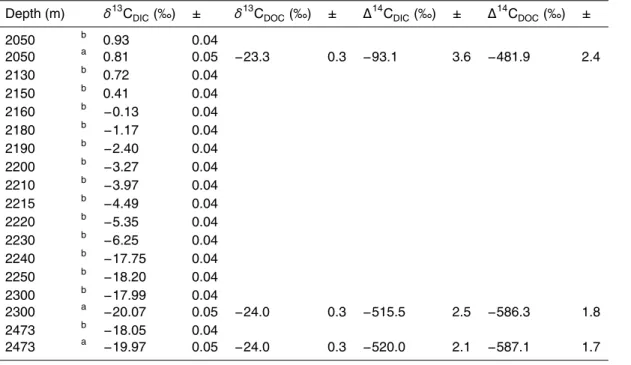
Table 1.Isotopic composition of Orca Basin brine and overlying water.
Depth (m) δ13CDIC(‰) ± δ13CDOC(‰) ± ∆14CDIC(‰) ± ∆14CDOC(‰) ±
2050 b 0.93 0.04
2050 a 0.81 0.05 −23.3 0.3 −93.1 3.6 −481.9 2.4
2130 b 0.72 0.04 2150 b 0.41 0.04 2160 b −0.13 0.04
2180 b −1.17 0.04 2190 b −2.40 0.04 2200 b −3.27 0.04
2210 b −3.97 0.04 2215 b −4.49 0.04 2220 b −5.35 0.04
2230 b −6.25 0.04 2240 b −17.75 0.04 2250 b −18.20 0.04
2300 b −17.99 0.04
2300 a −20.07 0.05 −24.0 0.3 −515.5 2.5 −586.3 1.8
2473 b −18.05 0.04
2473 a −19.97 0.05 −24.0 0.3 −520.0 2.1 −587.1 1.7
BGD
9, 17913–17937, 2012
Dissolved carbon supply to Orca Basin
brine
S. R. Shah et al.
Title Page
Abstract Introduction
Conclusions References
Tables Figures
◭ ◮
◭ ◮
Back Close
Full Screen / Esc
Printer-friendly Version Interactive Discussion
Discussion
P
a
per
|
Dis
cussion
P
a
per
|
Discussion
P
a
per
|
Discussio
n
P
a
per
|
Table 2.Box model parameters, values and uncertainties.
Symbol Parameter value ± Source
t0 initial time in years 0 t
f final time in years 8078 74 uncalibrated radiocarbon age of brine
[DIC]0(µM) final DIC concentration 2006 20 value from overlying seawater at 2063 m [DIC]f(µM) initial DIC concentration 4086 41 average brine [DIC]
δ13C0(‰) initialδ13C value 0.81 0.01 value from overlying seawater at 2050 m δ13Cf(‰) finalδ13C value −20.02 0.01 average brineδ13CDIC(NOSAMS)
−18.08 0.11 average brineδ13CDIC(SkIO) δ13C
POC(‰) sinking POCδ
13C value
−22 1 Holocene organic mattera
δ13Cmethane(‰) methaneδ13C value −74 2 average methane valuesb
fPOC-methane fraction POC 0.65 0.06 calculated in Sect. 4.1, Eq. (4)
λ 1/true mean-life 1/8267 Stuiver and Polach (1977) ∆14C0(‰) initial∆
14
C value −93.1 3.6 value from overlying seawater at 2050 m ∆14CPOC(‰) sinking POC∆14C value −53.2 1.0 IntCal09 valuescminus reservoir aged ∆14Cf( ‰) final∆
14
C value −517.8 2.5 average brine∆14CDIC
aNortham et al. (1981). bWiesenburg et al. (1985). cReimer et al. (2009). dWagner et al. (2009).
BGD
9, 17913–17937, 2012
Dissolved carbon supply to Orca Basin
brine
S. R. Shah et al.
Title Page
Abstract Introduction
Conclusions References
Tables Figures
◭ ◮
◭ ◮
Back Close
Full Screen / Esc
Printer-friendly Version Interactive Discussion
Discussion
P
a
per
|
Dis
cussion
P
a
per
|
Discussion
P
a
per
|
Discussio
n
P
a
per
Table 3.Modeled apportionment of DIC sources in Orca Basin brine.
Modern Brine DIC sources Contribution ∆14C (‰) δ13C (‰)
original seawater DIC 49±1 % −93.1a +1a oxidized sinking POC 33±4 % IntCal09b −22c oxidized methane from interface 18±3 % IntCal09b −74d oxidized methane from sediments 0±3 % “aged”e −74d
aOverlying seawater from 2050 m, Table 1. bReimer et al. (2009).
BGD
9, 17913–17937, 2012
Dissolved carbon supply to Orca Basin
brine
S. R. Shah et al.
Title Page
Abstract Introduction
Conclusions References
Tables Figures
◭ ◮
◭ ◮
Back Close
Full Screen / Esc
Printer-friendly Version Interactive Discussion
Discussion
P
a
per
|
Dis
cussion
P
a
per
|
Discussion
P
a
per
|
Discussio
n
P
a
per
|
0 50 100 150 200
Δ14C (‰)
0 50 100 150 200
δ13C (‰)
0 50 100 150 200
Depth (m)
Concentration (mM)
Salinity (psu) Oxygen (µmol/kg)
A B C
1500
1700
1900
2100
2300
2500
0 1 2 3 4 5 -650 -500 -350 -200 -50
1500
1700
1900
2100
2300
2500
-25 -20 -15 -10 -5 0 DIC (this study, NOSAMS) DIC (this study, SkIO) DIC (SackeƩ et al., 1979) DOC (this study, NOSAMS)
DOC (SackeƩ et al., 1979)
1500
1700
1900
2100
2300
2500 DOC (this study, SkIO)
Fig. 1. Depth profiles of salinity (gray solid line) and dissolved oxygen concentrations (gray dashed line) are plotted for the South Basin of Orca Basin brine along with(A)concentrations of DIC (filled circles, this study; open circles from Sackett et al., 1979) and DOC (filled diamonds, this study; open diamonds from Sackett et al., 1979);(B) δ13C values of DIC (filled circles,
this study; open circles from Sackett et al., 1979) and DOC (filled diamonds, this study; open diamonds from Sackett et al., 1979); and(C)∆14C values for DIC (filled circles, this study) and DOC (filled diamonds, this study). Error bars are smaller than symbols for this study (±0.04– 0.5 ‰ forδ13C values and±1–3 ‰ for∆14C values).
BGD
9, 17913–17937, 2012
Dissolved carbon supply to Orca Basin
brine
S. R. Shah et al.
Title Page
Abstract Introduction
Conclusions References
Tables Figures
◭ ◮
◭ ◮
Back Close
Full Screen / Esc
Printer-friendly Version Interactive Discussion
Discussion
P
a
per
|
Dis
cussion
P
a
per
|
Discussion
P
a
per
|
Discussio
n
P
a
per
2.00 2.50 3.00 3.50 4.00 4.50
30 80 130 180 230
[DIC] mM
Salinity (psu)
DIC
0 50 100 150 200 250 300 350 400
30 80 130 180 230
[DOC] µM
Salinity (psu)
DOC
conservative mixing line conservative mixing line
B
A
BGD
9, 17913–17937, 2012
Dissolved carbon supply to Orca Basin
brine
S. R. Shah et al.
Title Page
Abstract Introduction
Conclusions References
Tables Figures
◭ ◮
◭ ◮
Back Close
Full Screen / Esc
Printer-friendly Version Interactive Discussion
Discussion
P
a
per
|
Dis
cussion
P
a
per
|
Discussion
P
a
per
|
Discussio
n
P
a
per
|
Δ
14C
Δ
14C
t
POC
-800
-600
-400
-200
0
200
0
2000
4000
6000
8000
ΔΔ
14
C (‰)
Time since brine formation (years)
uncertainty
Fig. 3. Box modeled results for the ∆14C value of DIC (solid black line) over the 8078 radiocarbon-year history of Orca Basin brine plotted along with dashed lines representing un-certainty in model results. The solid gray line represents∆14C values of POC input driven by IntCal09 (Reimer et al., 2009) adjusted for a local reservoir age from the nearby Flower Garden Banks (Wagner et al., 2009).