159
APPARENT DEGESTEBELTY EXPEREMENT WETH NELE
TELAPEA I
OREOCHROMIS NILOTICUS
) FED DEETS
CONTAENENG
CITRULLUS LANATUS
SEEDMEAL
Wasiu Adeyemi JEMOH1, Olusola Adedayo AWODELE2, Francis Yinka OKEMAKEN3, Ahmed Ayodeji AYELOJA1, Somrat Adeola ABDULSALAME5, Fatai Adedayo AZEEZ4
1
Department of Fisheries Technology, Federal College of Animal Health and Production Technology, PMB 5029, Ibadan, Nigeria
2
Department of Animal Production Technology, Federal College of Animal Health and Production Technology
3
Department of Biology, The Polytechnic, Ibadan
4
Department of Animal Health, Federal College of Animal Health and Production Technology
5
Fisheries and Aquaculture Unit, Department of Biological Sciences, Crescent University, Abeokuta, Ogun State
Corresponding author e-mail: [email protected]
Received 5 November 2015; accepted 3 December 2015
ABSTRACT
Apparent digestibility coefficients of nutrients in Citrullus lanatus based diets were determined for Nile tilapia (Oreochromis niloticus) using AIA as marker or indicator. 150 tilapia fingerlings of average weight 6.12±0.05g were acclimatized for a week, weighed and allotted into five dietary treatments; CTR, DT2, DT3, DT4 and DT5 containing 0, 15, 30, 45 and 60% Citrullus lanatus respectively. The diets were isonitrogenous, isocaloric and isolipidic. Each treatment was replicated three times with ten fish per replicate. Fish were fed 5% body weight on two equal proportions per day. The results from the study indicated that there was no significant variation (p>0.05) in the apparent organic matter and gross energy digestibility coefficients of the diets; that there was significant (p<0.05) reduction in apparent digestibility coefficients of protein with increasing level of inclusion of Citrullus lanatus seed meal; that there was no significant difference (p>0.05) in the apparent digestibility coefficients of nutrients (protein, energy, lipid and carbohydrates) between the diets up to 30% replacement levels for tilapia.
KEYWORDS: watermelon. tilapia, digestibility, acid insoluble ash, Citrullus lanatus
ENTRODUCTEON
160
protein source feed ingredients prominent among which are watermelon (Jimoh et al.,
2013); sunflower and sesame as protein source feed ingredients for Clarias gariepinus; Fagbenro et al, 2010; Fagbenro et al, 2013; a, b); jackbean as protein source feed ingredients for Oreochromis niloticus (Fagbenro et al, 2007; Jimoh et al, 2010).
Watermelon belongs to the family Curcubitaceae. It is a tropical, semi tropical and arid region crop of the world (Razavi & Milani, 2006). It seeds have nutritional density comparable to other oilseed proteins including soybean and other conventional legumes (Mustapha & Alamin, 2012). Wani et al (2011) reported that watermelon seedmeal contains adequate amount of nutritional protein that could be used as nutritional ingredients in food products. More so, there is paucity of information on the use of Citrullus lanatus seeds as dietary protein source of fish feed especially its digestibility.
Borghesi et al (2008) reported that knowing nutrient digestibilities of feed ingredients show how possible feed ingredients can be interchanged without reducing animal performance. Apparent digestibility coefficient (ADC) results allow us to precisely estimate the contribution of a particular protein source to a complete fish feed (Koprucu & Ozdemer, 2005). The importance of knowing the digestibility of feed ingredients is well highlighted in the work of De Silva & Anderson (1995). Digestibility of nutrients in fish diets needs to be studied because it is the digested feed, which is absorbed, that is made available for cellular metabolism. The resultant of which will be tissue synthesis, and repair of worn-out tissues and various energy utilization channels.
Various methods have been used to study digestibility. The indirect method is chosen in this study which is based on the concentration of an indigestible marker (an indicator) in the feed and in the fecal samples. Various researchers have identified this indirect methods as being reliable in carrying out digestibility study for fish (Takeuchi
et al., 1979; Wilson & Poe, 1985; Satoh et al., 1992) and in collecting the faecal sample, Smith (1989) reported that fish can be sacrificed and the faecal samples removed from the lower large intestine, faecal samples can also be gotten by gentle pressure in the abdomen of the fish, suction method has also been used. Faecal samples can also be periodically removed from the tank by siphoning or the use of settling column (Smith, 1989).
In conducting indirect method of digestibility study using marker, generally there are two types of markers; the exogenous and endogenous markers. Halver et al
161
using naturally occurring AIA. This work therefore seeks to evaluate the apparent digestibility coefficients of nutrients in the diets containing Citrullus lanatus seedmeal fed to Oreochromis niloticus using AIA as an indicator.
MATEREALS AND METHODS Sources and Processing of Engredients.
Sample of dried water melon seeds were obtained in Bodija market, Ibadan, Oyo state. The water melon seed was rinsed with water and boiled for 15 minutes after which it was sundried for some days and then ground in a hammer mill and the oil therein was removed using the pressure generated from locally made screw press (cassava-presser type). The cakes therefore were analysed for their proximate composition (AOAC 1990). Fish meal, soybean meal and other feedstuffs obtained from commercial sources in Nigeria were separately milled screened to fine particles size and triplicate samples were analyzed for their proximate composition (AOAC, 1990).
Experimental Diets.
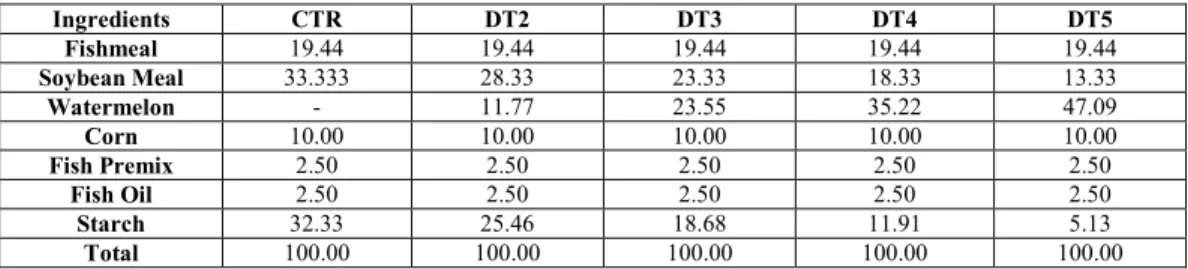
Based on the nutrient composition of the protein feedstuffs (Table 1), the experimental diets were formulated (Table 2) containing soybean meal which was replaced by cooked water melon seed meal at the rate of 0, 15, 30, 45, and 60. The diets were isolipidic and isonitrogenous containing 40% crude protein and 10% lipid with fish meal (72%), soya bean meal (45%), fish oil, vitamin premix and starch serving as ingredients. The feedstuffs were ground and water was added to aid binding after which it was introduced into a pelleting and mixing machine to obtain a homogenous mass and then passed through a mincer to produce 2mm size pellet which was immediately sundried at 30 - 32°C. After drying for three days, the diet was kept in a cool place.
Experimental Fish and System.
162
dissolved oxygen meter (YSI Model 57, Yellow Spring Ohio); pH was monitored weekly using pH meter (Mettler Toledo – 320, Jenway UK).
TABLE 1. Proximate Composition of the Protein Feed Engredients
Parameter Fish meal Soybean Meal **CLM
Moisture 9.75 10.70 9.69
Crude Protein 72.4 45.74 19.11
Crude Lipid 10.45 9.68 15.35
Crude Fibre - 5.10 4.97
Ash 8.32 4.48 5.39
*NFE - 30.00 45.49
*Nitrogen Free Extract; ** Citrulluslanatus Meal
TABLE 2. Gross composition Ig/100g) of experimental diets containing Citrullus lanatus seedmeal fed to Oreochromis niloticus
Engredients CTR DT2 DT3 DT4 DT5
Fishmeal 19.44 19.44 19.44 19.44 19.44
Soybean Meal 33.333 28.33 23.33 18.33 13.33
Watermelon - 11.77 23.55 35.22 47.09
Corn 10.00 10.00 10.00 10.00 10.00
Fish Premix 2.50 2.50 2.50 2.50 2.50
Fish Oil 2.50 2.50 2.50 2.50 2.50
Starch 32.33 25.46 18.68 11.91 5.13
Total 100.00 100.00 100.00 100.00 100.00
* Specification: each kg contains: Vitamin A , 4,000,000IU; Vitamin B, 800,000IU; Vitamin E, 16,000mg, Vitamin K3, 800mg; Vitamin B1, 600mg; Vitamin B2, 2,000mg; Vitamin B6, 1,600mg, Vitamin B12,8mg; Niacin,16,000mg; Caplan,
4,000mg; Folic Acid, 400mg; Biotin, 40mg; Antioxidant 40,000mg; Chlorine chloride, 120,000mg; Manganese, 32,000mg; Iron 16,000mg; Zinc, 24,000mg; Copper 32,000mg; Iodine 320mg; Cobalt,120mg; Selenium, 800mg manufactured by DSM Nutritional products Europe Limited, Basle, Switzerland.
Proximate Analyses.
The proximate analyses of feed ingredients, diets and faeces for crude protein, crude fibre, crude lipid, fat and ash were carried out in triplicate using the methods described by the AOAC, (1990). A factor of 6.25 was used to convert nitrogen to protein. The nitrogen free extract was estimated by difference. Energy content of faeces and diets were determined using the physiological value of 5.61kcal/g protein 4.11kcal/g carbohydrate and 9.50 kcal/g lipid.
AEA Analyses.
AIA analyses were carried out on test diets and faeces using the methods described in Halver (1997) and Adeparusi & Jimoh (2002).
Determination of Digestibility Coefficient.
This was calculated on the percentage of AIA in feed and in faeces and the percentage of nutrient on diets and feaces.
163
Statistical Analysis. Data obtained from the experiment was expressed in
mean ±SD and it was subjected to one way Analysis of Variance (ANOVA) using SPSS 16.0 version. Where the ANOVA reveals significant difference (P<0.05) Duncan multiple range test was used to compare differences among individual treatment means.
RESULTS AND DESCUSSEONS
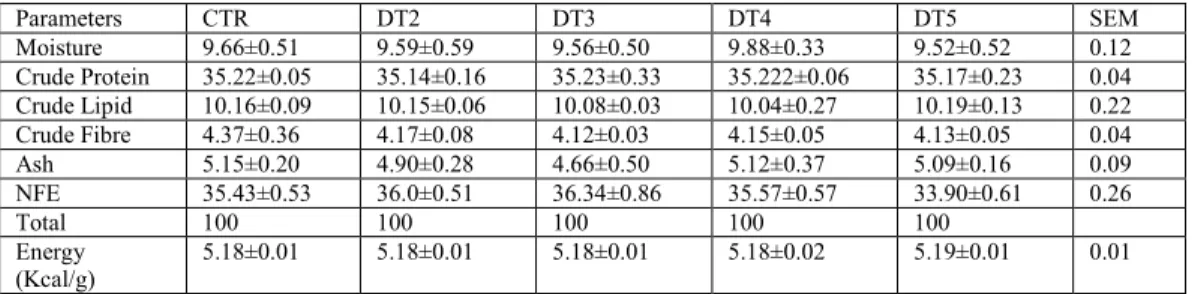
Table 3 reveals the proximate composition of experimental diets fed to
Oreochromis niloticus. It shows that there was no significant difference (P > 0.05) in moisture, protein, lipid, fibre, ash and Nitrogen Free Extract (NFE). All the fish responded well to the dietary treatment given to them.
The table of proximate composition of the experimental diets showed that the various diets prepared were isonitrogenous, isocalorific and isolipidic as there was no significant difference (P>0.05) in the crude protein and crude lipid content of the diets. The protein and lipid requirement of Oreochromis niloticus was met by the 35 and 10% provided in the experimental diets (Jauncey & Ross, 1982; Luquet 1991).
Table 4 revealed the proximate composition of the faecal output of
Oreochromis niloticus fed diets containing Citrullus lanatus seedmeal. Generally there was reduction in the parameters of the proximate composition of the faeces when compared with that of their corresponding diets and significant variation (p<0.05) existed in the parameters of the proximate composition. This indicates that certain fractions of the nutrients had been absorbed and made available for metabolism and eventual tissue synthesis. This agrees with the work of Jimoh et al (2010) who fed
Cannavalia ensiformis to Oreochromis niloticus and Fagbenro et al (2013) who fed sunflower and sesame seedmeal to Clarias gariepinus. Adeparusi & Jimoh (2002) reported that there was reduction in the parameters of the proximate composition in the faeces compared to the diet when Oreochromis niloticus was fed lima bean (Phaseolus lunatus).
164
Table6 showed the apparent digestibility coefficient of nutrients in the diets containing Citrullus lanatus seedmeal fed to Oreochromis niloticus. There was no significant variation (p>0.05) in the apparent organic matter digestibility coefficients of the diets fed to Oreochromis niloticus. The apparent organic matter digestibility coefficient reported in this study was slightly higher than the value reported by Fagbenro (1998a and b) the variation may be attributed to processing methods applied and or experimental methodology; different seed meal and fish species was used as it is known that digestibility of nutrients are species specific however the result closely related to that reported in Martinez – Palacois et al.(1988) and Yue & Zhou (2008) for juvenile hybrid tilapia fed cottonseed meal.
TABLE 3. Proximate composition Ig/100g) of experimental diets containing Citrullus lanatus seedmeal fed to Oreochromis niloticus
Parameters CTR DT2 DT3 DT4 DT5 SEM
Moisture 9.66±0.51 9.59±0.59 9.56±0.50 9.88±0.33 9.52±0.52 0.12
Crude Protein 35.22±0.05 35.14±0.16 35.23±0.33 35.222±0.06 35.17±0.23 0.04
Crude Lipid 10.16±0.09 10.15±0.06 10.08±0.03 10.04±0.27 10.19±0.13 0.22
Crude Fibre 4.37±0.36 4.17±0.08 4.12±0.03 4.15±0.05 4.13±0.05 0.04
Ash 5.15±0.20 4.90±0.28 4.66±0.50 5.12±0.37 5.09±0.16 0.09
NFE 35.43±0.53 36.0±0.51 36.34±0.86 35.57±0.57 33.90±0.61 0.26
Total 100 100 100 100 100
Energy (Kcal/g)
5.18±0.01 5.18±0.01 5.18±0.01 5.18±0.02 5.19±0.01 0.01
Figures in each row with different superscripts are significantly different (P<0.05) from each other
TABLE 4. Proximate composition Ig/100g) of faecal output of Oreochromis niloticus fed diets containing Citrullus lanatus seedmeal
Parameters CTR DT2 DT3 DT4 DT5 SEM
Moisture 10.70±0.71a 10.77±1.18a 11.19±0.97a 11.25±0.95a 11.13±0.93a 0.21
Crude Protein 10.35±0.25b 10.84±0.10ab 11.29±0.59a 11.63±0.44a 11.67±0.72a 0.17
Crude Lipid 3.42±0.35d 3.57±0.08cd 3.73±0.456bc 3.78±0.11b 3.97±0.12a 0.05
Crude Fibre 3.69±0.30b 3.66±0.08b 3.77±0.26b 3.80±0.13b 4.52±0.06a 0.95
Ash 3.68±0.49b 4.43±0.53ab 4.45±0.17ab 4.90±0.22a 4.69±0.50a 0.14
NFE 68.15±0.56a 66.73±0.89ab 65.56±0.62bc 64.61±1.15c 64.02±1.16c 0.44
Total 100 100 100 100 100
Energy (Kcal/g)
3.56±0.01c 3.57±0.01bc 3.59±0.02ab 3.60±0.01a 3.59±0.01ab 0.04
Figures in each row with different superscripts are significantly different (P<0.05) from each other
TABLE 5. Acid insoluble ash content IAEA in %) in experimental diets containing Citrullus lanatus seedmeal fed
to Oreochromis niloticus and its faecal output
CTR DT2 DT3 DT4 DT5 SEM
AIA in Feed 2.83±0.67 2.89±0.02 2.83±0.45 2.85±0.03 2.87±0.06 0.01
AIA in Faeces 7.84±0.11 7.84±0.12 7.86±0.08 7.68±0.16 7.82±0.11 0.03
165
TABLE 6. Apparent digestibility coefficent of nutrients in the diets containing Citrullus lanatus seedmeal fed to Oreochromis niloticus
Parameters CTR DT2 DT3 DT4 DT5 SEM
AOMD 63.87±0.36a 63.14±0.65a 63.92±0.91a 62.93±0.74a 63.28±1.01a 0.20
APD 89..39±0.15a 88.63±0.28ab 88.63±0.69ab 87.76±0.24b 87.81±1.01b 0.20
ALP 87.31±1.01ab 87.03±0.06abc 86.63±0.49bc 86.01±0.45c 88.04±0.27a 0.22
AFD 69.43±1.41a 67.67±1.35a 66.95±3.02a 66.06±1.13a 59.08±1.60b 0.96
AAD 74.06±4.43a 66.713.35b 65.26±3.88b 64.39±2.61b 66.21±2.83b 1.20
ACD 30.52±0.80b 31.76±0.25b 34.89±2.47a 32.64±1.86ab 30.66±0.53b 0.53
AED 75.18±0.20a 74.55±0.43a 74.96±0.61a 74.20±0.39a 75.07±0.75a 0.14
Figures in each row with different superscripts are significantly different (P<0.05) from each other
AOMD: Apparent organic matter digestibility; APD: Apparent Protein Digestibility; ALP: Apparent Lipid Digestibility; AFD: Apparent Fibre Digestibility; AAD: Apparent Ash Digestibility; ACD: Apparent Carbohydrate Digestibility; AED: Apparent Energy Digestibility
Control diet CTR had the highest apparent protein digestibility coefficient while diet DT5 had the lowest apparent protein digestibility coefficient. There was significant (p>0.05) reduction trend in the apparent protein digestibility coefficient with increasing inclusion of Citrullus lanatus. However, there was no significant difference (p>0.05) in the apparent protein digestibility coefficient up to 30% replacement level when compared to that of control diet. This agrees with the work of Hossain & Jauncey (1989), Muckhopadyay (2001), Jimoh et al (2010), Fagbenro et al
(2013). Hossain et al (1992) reported apparent protein digestibility coefficients of 84.7% for soybean meal based diets by Oreochromis mossambicus; a result closely related to what was reported in this study.
Same trends of results as recorded above were recorded for apparent lipid digestibility coefficient for Nile Tilapia fed control diets and test diets containing
Citrullus lanatus seedmeal. Up to 30% replacement level, there was no significant variation (p>0.05) in the apparent lipid digestibility coefficient of the diets. There was significant (p<0.05) reduction in apparent digestibility of lipid with increasing level of inclusion of Citrullus lanatus seed meal; a similar observation were made by Fagbenro
et al (2013); Muckopadlyay (2001), Hossain & Jauncey (1989).
There was no significant difference (p>0.05) in the apparent energy digestibility coefficient between the control diets and test diets containing Citrullus lanatus seedmeal. The values of apparent energy digestibility coefficients reported in this study agree with earler work by Fagbenro (1998 a, b). Fagbenro (1998a) reported the apparent energy digestibility coefficients value of 60.2 to 78.6% for different legumes seedmeal fed to Oreochromis niloticus while Fagbenro (1998b) reported apparent energy digestibility coefficients value of 77.4 to 75.6% for different oilseed cakes/meals fed to African catfish.
The lower digestibility coefficient recorded for crude fibre and carbohydrate in
166
digestibility recorded in this study was similar to that reported by Adeparusi & Jimoh (2002) for Oreochromis niloticus fed lima bean diets (Phaseolus lunatus).The values of apparent carbohydrate digestibility coefficients reported in this study was lower than the values reported by Jimoh et al (2010) who fed diets containing Cannavalia ensiformis seedmeal to Oreochromis niloticus. Lovell (1988) reported that the tilapias has ability to digest carbohydrates relatively well in feedstuff but not as well as protein or lipid. The experiment was conducted under optimum environmental condition for the growth of warm water fish species; the physico-chemical conditions were within the optimum range (Boyd, 1990)..
CONCLUSEONS
From the foregoing, it
can be concluded that up to 30% replacement level of soybean meal by Citrullus lanatus seedmeal, no significant difference existed in their apparent protein, lipid, and energy digestibility coefficients.
REFERENCES
• Adeparusi O, Jimoh W.A. 2002. Digestibility coefficients of raw and processed lima bean diet for Nile
Tilapia, Oreochromis niloticus. Journal of Appl.Aquac 1-2 (3):89-98.
• Association of official Analytical chemists (AOAC) 1990. Official method of analysis. K. Helrich (ed).
15th edn, vol 1, AOAC, Arlington, VA, 684PP.
• Borghesi R., Portz L., Oetterer M., Cyrino J.E.P 2008. Apparent digestibility coefficient of protein and
amino acids of acid, biological and enzymatic silage for Nile Tilapia (Oreochromis niloticus). Aquaculture
Nutr., 14: 242 – 248.
• Boyd C.E. 1990. Water Quality in warm water fish pond, Auburn University Agriculture Experiment
Station, Auburn Al.
• De Silva S.S., Anderson T.A. 1995. Fish Nutrition in Aquaculture, Chapman and Hall, London.
• Fagbenro O. A, Adeparusi E. O, Jimoh W. A.2007. Evaluation and nutrients quality of detoxified jackbean
seeds cooked in distilled water or trona solution, as a substitute for soybean meal in Nile tilapia,
Oreochromis niloticus diets. Journal of Applied Aquaculture. 19 (2):83-100.
• Fagbenro O. A, Adeparusi E. O, Jimoh W. A.2010. Nutritional evaluation of raw sunflower and sesame
seed meal in Clarias gariepinus: an assessment by growth performance and nutrient utilization. African
Journal of Agricultural Research, 5 (22): 3096- 3101.
• Fagbenro O. A, Adeparusi E. O, Jimoh W. A.2013a. Apparent nutrient digestibility of sunflower and
sesame seed meal in Clarias gariepinus (Burchell, 1822) fingerlings. Journal of Fisheries and Aquatic
Sciences. 8 (1): 43-50.
• Fagbenro O. A, Adeparusi E. O, Jimoh W. A.2013b. Haematological profile of blood of African catfish
(Clarias gariepinus, Burchell, 1822) fed sunflower and sesame meal based diet. Journal of Fisheries and Aquatic Sciences. 8(1):80-86.
• Fagbenro, A.O., 1998a. Apparent digestibility of various legume seed meals in Nile tilapia diets short
communication. Aquac. Intern. 6: 83-87.
• Fagbenro, A.O., 1998b. Apparent digestibility of various oilseed cakes/ meals in African catfish diets short
communication. Aquac. Intern. 6: 317-322.
• Goddard J.S., McLean L.C. 2001. Acid-insoluble ashbas an inert reference material for digestibility studies
in tilapia, Oreochromis niloticus. Aquaculture 194: 93-98.
• Gul Y., Salim M., Rabbani B. 2007. Evaluation of apparent digestibility coefficients of different dietary
167
• Halver, J.C., Yiman A., Smith R.R. 1993. Acid Insoluble Ash as a convenient method for estimating
digestible components in diet. Abstracts of contribution of international conference on World Aquaculture. fresh water fish posters pp230.
• Hossain M.A., Nahar N., Kamal M., Islam, M.N. 1992. Nutrient digestibility coefficient of some plants and
animal proteins for tilapia (Oreochromisniloticus). Journal of Aquaculture in the Tropics, 7: 257-260.
• Jauncey K., Ross B. 1982. A Guide to Tilapia feeds and feeding. Institute of Aquaculture, University of
Stirling, Scotland. Pp III.
• Jimoh W. A., Fagbenro O. A, Adeparusi E.O. 2010. Digestibility coefficients of processed jackbean meal
for Nile Tilapia, Oreochromis niloticus diets. International Journal of Fisheries and Aquaculture,
2(4):102-107.
• Köprücü K., Özdemir Y. 2005. Apparent digestibility of selected feed ingredients for Nile Tilapia
(Oreochromis niloticus). Aquaculture, 250: 308 – 316.
• Lovell R.T. 1988. Use of soybean product in diets for Aquaculture species. Journal of Aquatic Production.
2: 27-52.
• Luquet P. 1991. Tilapia (Oreochromis Spp) P. 161-179 in R.P Wilson (ed). CRC handbook of fin fish.
CRC press, Inc. Florida.
• Martinez-Palacios C.A., Galvan Cruz R., Olvera Novoa M.A, Chavez-Martinez C. 1988. The use of
Jackbean (Canavalia ensiformis Leguminosae) meal as a partial substitute for fish meal in diet for tilapia
(Oreochromis mossambicus Cichlidae). Aquaculture, 68: 165-175.
• Mukhopadyay M., Ray A.K. 2001. Effect of amino acid supplementation on the nutritive quality of
fermented linseed protein in the diet of Rohu, Labeo rohuta fingerlins. Journal of Applied Ichthyology
17(5): 220-226.
• Mustapha A.B., Alamin A.A.M. 2012. Chemical Composition and protein degradability off watermelon
(Citrulluslanatus) seed cake grown in Western Sudan. Asian Journal of Animal Sciences. 6: 33-37.
• Olivera-Novoe M.A, Campus G, Sabido G.M., Martinez-Palacois. 2002. Sunflower seed meal protein
concentrate as a protein source in the diet of Tilapia rendalli fingerlins. Aquaculture research.
33(3):223-230.
• Olvera-Novoa M, A., Martinez P. C.A., Galvan C.R., Chavez S. C., 1988. The use of seed of the
leguminous plant sesbania grandiflora as a partial replacement for fishmeal in diets of tilapia
(Oreochromis mossambicus). Aquaculture, 71: 51-60.
• Razavi S.M.A, Milani F. 2006. Some physical properties of watermelon seeds. African Journal of
Agricultural Research. 1 (3): 65-69.
• Satoh S., Cho C.Y., Watanabe T. 1992. Effect of fecal retrieval timing on digestibility of nutrients in
rainbow trout diet with the Guelph and TUF faeces collection systems. Nippon Suisan Gakkaishi, 58:
1123-1127.
• Siddhuraju P., Becker K. 2001. Preliminary nutritional evaluation of mucuna seed meal (Mucuna pruriens
var. utilis) in common carp (Cyprinus carpio L.): An assessment by growth performance and feed
utilization. Aquaculture. 196: 105 – 123.
• Smith R.R. 1989. Nutitional energetic. J.E Halver eds. in Fish nutrition. New York Academic Press, pp
1-29.
• Takeuchi T., Watanabe T., Ogino C. 1979. Digestibility of hydrogenated fish oils in carp and rainbow
trout. Bull. Jpn. Soc. Sci. Fish, 45: 1521-1525.
• Wani A.A., Sogi D.S., Singh P., Wani I.A., Shivhare U.S. 2011. Characterisation and functional properties
of watermelon (Citrulluslanatus) seed proteins. Journal of the Science of Food and Agriculture. 91 (1):
113-121.
• Wilson R.P., Poe W. E. 1985. Apparent digestibility of protein and energy in feed ingredients for channel
catfish. Prog. Fish-Cult., 47: 154-158.
• Yue Y, -R, Zhou Q – C. 2008. Effect of replacing soybean meal with cotton seed meal on growth, feed
utilisation and haematological indexes for juvenile hybrid tilapia Oreochromis niloticus x O.aureus.