N-Methyl D-Aspartate 2A (
GRIN2A
) Gene Reveals Their
Relative Importance as Genetic Susceptibility Factors for
Heroin Addiction
Bin Zhao1., Yongsheng Zhu1,3., Wei Wang1
, Hai-min Cui1, Yun-peng Wang1, Jiang-hua Lai1,2*
1College of Forensic Science, Xi’an Jiaotong University, Key Laboratory of Ministry of Public Health for Forensic Science, Xi’an, Shaanxi, PR China,2Key Laboratory of Environment and Genes Related to Diseases, Xi’an Jiaotong University, Ministry of Education, Xi’an, Shaanxi, PR China,3Department of Medical Genetics and Cell Biology, Ningxia Medical University, Key Laboratory of Fertility Preservation and Maintenance, Ningxia Medical University, Ministry of Education, Ningxia, Yinchuan, PR China
Abstract
The glutamate receptor, N-methyl D-aspartate 2A (GRIN2A) gene that encodes the 2A subunit of the N-methyl D-aspartate (NMDA) receptor was recently shown to be involved in the development of opiate addiction. Genetic polymorphisms in GRIN2A have a plausible role in modulating the risk of heroin addiction. An association of GRIN2A single-nucleotide polymorphisms (SNPs) with heroin addiction was found earlier in African Americans. To identify markers that contribute to the genetic susceptibility to heroin addiction, we examined the potential association between heroin addiction and forty polymorphisms of theGRIN2Agene using the MassARRAY system and GeneScan in this study. The frequency of the (GT)26 repeats (rs3219790) in the heroin addiction group was significantly higher than that in the control group (x2
= 5.360, P= 0.021). The allele frequencies of three polymorphisms (rs1102972, rs1650420, and rs3104703 in intron 3) were strongly associated with heroin addiction (P,0.001, 0.0002, and,0.001, after Bonferroni correction). Three additional SNPs from the same intron (rs1071502, rs6497730, and rs1070487) had nominally significantPvalues for association (P,0.05), but did not pass the threshold value. Haplotype analysis revealed that the G-C-T-C-C-T-A (block 6) and T-T (block 10) haplotypes of the GRIN2Agene displayed a protective effect (P=,0.001 and 0.003). These findings point to a role forGRIN2Apolymorphisms in heroin addiction among the Han Chinese from Shaanxi province, and may be informative for future genetic or neurobiological studies on heroin addiction.
Citation:Zhao B, Zhu Y, Wang W, Cui H-m, Wang Y-p, et al. (2013) Analysis of Variations in the Glutamate Receptor, N-Methyl D-Aspartate 2A (GRIN2A) Gene Reveals Their Relative Importance as Genetic Susceptibility Factors for Heroin Addiction. PLoS ONE 8(8): e70817. doi:10.1371/journal.pone.0070817
Editor:Ralf Krahe, University of Texas MD Anderson Cancer Center, United States of America
ReceivedFebruary 19, 2013;AcceptedJune 23, 2013;PublishedAugust 5, 2013
Copyright:ß2013 Zhao et al. This is an open-access article distributed under the terms of the Creative Commons Attribution License, which permits unrestricted use, distribution, and reproduction in any medium, provided the original author and source are credited.
Funding:This research was supported by the National Science Foundation of China (#NSFC81172910).(http://www.nsfc.gov.cn/Portal0/default152.htm). The funders had no role in study design, data collection and analysis, decision to publish, or preparation of the manuscript.
Competing Interests:The authors have declared that no competing interests exist.
* E-mail: [email protected]
.These authors contributed equally to this work.
Introduction
Heroin addiction is a chronically relapsing disease characterized by compulsive drug seeking, drug abuse, tolerance, and physical dependence. According to an adoption study, substance depen-dence, in general, and opioid addiction, in particular, has a genetic component [1]. Family and twin studies have consistently demonstrated a substantial genetic influence on the development of drug addiction, with inherited risk estimates in the range of 40– 60% [2,3]. Chronic drug use alters gene expression, which activates or attenuates biochemical pathways and produces neuroadaptive changes in signal transduction functions. Recent studies suggested that polymorphisms in the N-methyl D-aspartate 2A (GRIN2A) gene may be associated with drug addiction, including alcohol and heroin addiction [4,5].
Glutamatergic neurotransmission is the major excitatory system in the human brain, and genes encoding glutamate receptors are candidate targets for treatment of neuropsychiatric disorders. N-methyl D-aspartate (NMDA) receptors are key factors in
glutamatergic neurotransmission which are involved in brain development, excitatory neurotransmission, synaptic plasticity, and memory formation [6–10]. The NMDA receptors are composed of multiple subunits, including at least one NR1 subunit and one or more NR2 subunits (GRIN2A-D) [11], and less commonly, a NR3 subunit (GRIN3A-B) [12].GRIN2Aknockout mice show increased spontaneous locomotor activity and deficits in contextual fear conditioning and spatial learning, along with reduced hippocampal long-term potentiation [13,14] that is thought to be involved in addiction [15]. Moreover, GRIN2A
nucleus accumbens, probably contributes to the development of opiate addiction and confirms the hypothesis that subtype-selective NMDA receptor antagonists may be beneficial in the treatment of opiate addiction and withdrawal [21].
The humanGRIN2Agene is located on chromosome 16p13.2 and consists of twelve exons and thirteen introns which undergo alternative splicing to form a family ofGRIN2Aisoforms. Itokawa et al. [22] have identified a variable (GT)n repeat polymorphism (rs3219790) in the promoter region of this gene that elicited repression of transcriptional activity in a length-dependent manner. Recently, a case-control study showed evidence of an association between the repeat polymorphism and alcohol dependence, with longer alleles overly represented in patients with alcoholism [5]. Moreover, screenings of single-nucleotide polymorphisms (SNPs) in 130 candidate genes incriminated in heroin addiction have recently identified GRIN2A as the most significant candidate, and significantly more C-A-T (rs4587976-rs1071502-rs1366076) haplotypes were found in African American heroin-addicted patients [4]. More studies need to be carried out to determine whether these SNPs modulate the risk of disease by themselves or whether they correlate with other causative SNPs and are repeated in other populations.
We hypothesized that common variants in theGRIN2Amight contribute significantly to the predisposition to develop heroin addiction. In this study, we investigated forty loci in a Chinese population from Shaanxi province to verify the putative associa-tion betweenGRIN2Apolymorphisms and heroin addiction.
Subjects and Methods
1 Subjects
A total of 210 unrelated subjects with heroin addiction (mean age of 34.8267.57, 167 males, 43 females) were recruited from the Methadone Maintenance Treatment (MMT) program of Xi’an Mental Health Center. Participants were daily or nearly daily users of heroin for a minimum of one year prior to assessment. The diagnosis of opioid addiction was based on the Diagnostic and Statistical Manual of Mental Disorders (DSM)-IV criteria, medical history, urine test results, and interview responses. Participants were excluded if they: met DSM-IV criteria for an additional Axis I disorder; had a history of alcohol, cigarette, amphetamine, or other drug addiction according to DSM-IV; were taking other prescribed medications that could affect the central nervous system; had a history of seizures, hematological diseases, or severe liver or kidney impairment. In all, 205 healthy blood donors (mean age of 36.1366.83, 164 males, 41 females) were recruited at the First Hospital Affiliated to the Medical College of Xi’an Jiaotong
University. Subjects who had substance abuse, participated in other studies, or suffered from chronic brain diseases were excluded. From 210 subjects, 198 (94%) were tobacco smokers. From 205 controls, 127 (62%) were tobacco smokers. All participants completed a family history questionnaire and were self-identified as Han Chinese from Shaanxi province for three generations. Participants were excluded from the study if they had a relative in this study, or had a mixed ancestry. Written informed consent was obtained from all participants. The study protocol was approved by the Ethical Committee of the Medical College, Xi’an Jiaotong University.
2 Selection of Polymorphisms
Polymorphisms in the promoter region, untranslated regions (UTRs), exons, and introns of the gene for glutamate receptor, ionotropic, N-methyl D-aspartate 2A (GRIN2A) were systemati-cally screened. Thirty-nine SNPs with minor allele frequencies (MAF) greater than 0.05 were selected from theGRIN2Agene and nearby regions based on a review of published literature (Table S1, Table S2) and a search of HapMap and dbSNP (Han Chinese population). The positions of the polymorphisms in theGRIN2A
gene are shown in Fig. 1 and Table 1.
3 Genotyping
Peripheral blood were collected from the enrolled subjects in tubes coated with EDTA. Genomic DNA was extracted from blood leukocytes using the EZNATM Blood DNA Midi Kit (Omega Bio-Tek, Norcross, GA, USA) according to the manu-facturer’s protocol. Probes and primers were designed using the Assay Design Software (Sequenom, San Diego, CA, USA). SNP genotyping was performed using matrix assisted laser desorption ionization-time of flight (MALDI-TOF; MassARRAY system, Sequenom Inc., San Diego, CA, USA) mass spectrometry. Briefly, one 5-ml PCR reaction include the following reagents: 1ml of diluted DNA sample, 0.95ml of water, 0.625ml of PCR buffer containing 15 mM MgCl2, 1ml of 2.5 mM dNTP, 0.325ml of
25 mM MgCl2, 1ml of PCR primers and 0.1ml of 5 units/ml HotStarTaq(Qiagen). The reaction was incubated at 94uC for 15 minutes followed by 45 cycles at 94uC for 20 seconds, 56uC for 30 seconds, and 72uC for 1 minute, and a final incubation at 72uC for 3 minutes. The single base extension reaction was carried out at 94uC for 30 seconds and then 94uC for 5 seconds, followed by 5 cycles of 52uC for 5 seconds and 80uC for 5 seconds, total 40 cycles, then 72uC for 3 minutes. The reaction mix was desalted by adding 6 mg of cation exchange resin (Sequenom), mixed and resuspended in 25ml of water. The completed genotyping
Figure 1. Gene structure of humanGRIN2Aand the relative positions of the 40 variations used in our study.
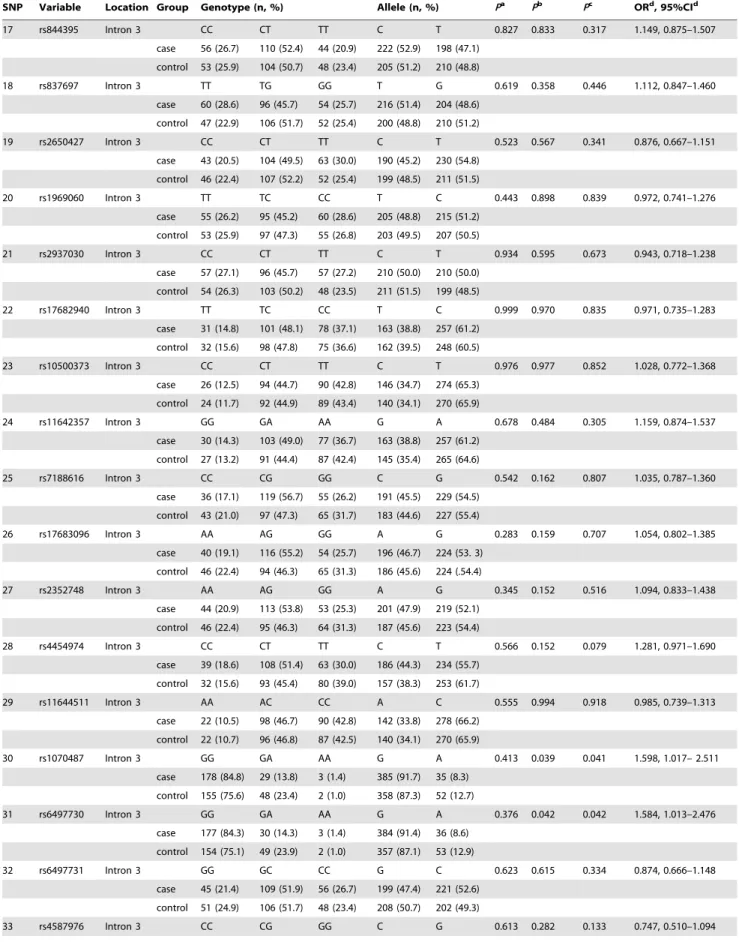
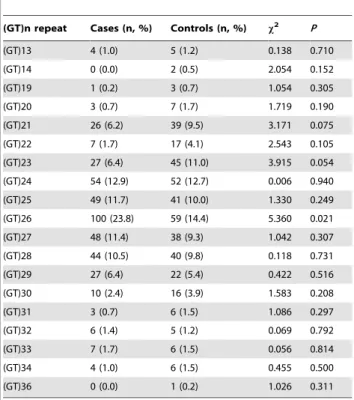
Table 1.Genotype and allele frequencies of theGRIN2Agene SNPs in cases and controls and the results of their associations with risk of heroin addiction.
SNP Variable Location Group Genotype (n, %) Allele (n, %) Pa Pb Pc
ORd, 95%CId
1 rs767749 39UTR TT TG GG T G 0.147 0.578 0.271 1.172, 0.884–1.554
case 37 (17.6) 89 (42.4) 84 (40.0) 163 (38.8) 257 (61.2)
control 30 (14.6) 84 (41.1) 91 (44.4) 144 (35.2) 266 (64.8)
2 rs1420040 39UTR AA AG GG A G 0.684 0.543 0.263 0.854, 0.647–1.126
case 70 (33.3) 99 (47.1) 41 (19.6) 239 (56.9) 181 (43.1)
control 77 (37.6) 95 (46.3) 33 (16.1) 249 (60.7) 161 (39.3)
3 rs9940680 39UTR GG GC CC G C 0.960 0.482 0.232 0.845, 0.640–1.114
case 70 (33.3) 100 (47.6) 40 (19.1) 240 (57.1) 180 (42.2)
control 77 (37.6) 97 (47.3) 31 (15.1) 251 (61.2) 159 (38.8)
4 rs9933624 39UTR TT TC CC T C 0.818 0.536 0.261 0.853, 0.647–1.126
case 70 (33.3) 100 (47.6) 40 (19.1) 240 (57.1) 180 (42.9)
control 77 (37.6) 96 (46.8) 32 (15.6) 250 (61.0) 160 (39.0)
5 rs8045712 39UTR TT TC CC T C 0.754 0.362 0.181 1.209, 0.916–1.595
case 40 (19.1) 100 (47.6) 70 (33.3) 180 (42.9) 240 (57.1)
control 29 (14.1) 99 (48.3) 77 (37.6) 157 (38.3) 253 (61.7)
6 rs8044472 39UTR GG GA AA G A 0.566 0.216 0.578 0.923, 0.697–1.223
case 22 (10.5) 109 (51.9) 79 (37.6) 153 (36.4) 267 (63.6)
control 32 (15.6) 93 (45.4) 80 (39.0) 157 (38.3) 253 (61.7)
7 rs1014531 39UTR AA AG GG A G 0.897 0.688 0.3901 0.864, 0.600–1.21
case 8 (3.8) 68 (32.4) 134 (63.8) 84 (20.0) 336 (80.0)
control 10 (4.9) 72 (35.1) 123 (60.0) 92 (22.4) 318 (77.6)
8 rs11866328 Intron13 TT TG GG T G 0.897 0.584 0.302 0.839, 0.619–1.206
case 8 (3.8) 66 (31.5) 136 (64.7) 82 (19.5) 338 (80.5)
control 10 (4.9) 72 (35.1) 123 (60.0) 92 (22.4) 318 (77.6)
9 rs7191784 Intron12 AA AG GG A G 0.779 0.835 0.601 1.078, 0.813–1.429
case 30 (14.3) 100 (47.6) 80 (38.1) 160 (38.1) 260 (61.9)
control 28 (13.7) 93 (45.4) 84 (41.0) 149 (36.3) 261 (63.7)
10 rs7191241 Intron12 CC CT TT C T 0.720 0.875 0.706 1.056, 0.797–1.398
case 30 (14.3) 100 (47.6) 80 (38.1) 160 (38.1) 260 (61.9)
control 29 (14.1) 93 (45.4) 83 (40.5) 151 (36.8) 259 (63.2)
11 rs1362319 Intron12 CC CA AA C A 0.851 0.724 0.622 0.934, 0.711–1.226
case 57 (27.1) 97 (46.2) 56 (26.7) 211 (50.2) 209 (49.8)
control 56 (27.3) 101 (49.3) 48 (23.4) 213 (51.9) 197 (48.1)
12 rs1362321 Intron12 AA AG GG A G 0.556 0.946 0.985 1.003, 0.763–1.317
case 51 (24.3) 97 (46.2) 62 (29.5) 199 (47.4) 221 (52.6)
control 48 (23.4) 98 (47.8) 59 (28.8) 194 (47.3) 216 (52.7)
13 rs3104703 Intron 3 TT TG GG T G 0.884 0.0003 ,0.001 0.576, 0.437–0.758
case 43 (20.5) 92 (43.8) 75 (35.7) 178 (42.4) 242 (57.6)
control 64 (31.2) 102 (49.8) 39 (19.0) 230 (56.1) 180 (43.9)
14 rs2650432 Intron 3 CC CT TT C T 0.827 0.524 0.760 0.955, 0.711–1.283
case 23 (11.0) 80 (38.1) 107 (50.9) 126 (30.0) 294 (70.0)
control 19 (9.3) 89 (43.4) 97 (47.3) 127 (31.0) 283 (69.0)
15 rs2650431 Intron 3 CC CT TT C T 0.670 0.341 0.289 1.162, 0.880–1.533
case 41 (19.5) 95 (45.2) 74 (35.3) 177 (42.1) 243 (57.9)
control 29 (14.1) 100 (48.8) 76 (37.1) 158 (38.5) 252 (61.5)
16 rs3859125 Intron 3 CC CT TT C T 0.616 0.513 0.479 1.110, 0.832–1.481
case 28 (13.3) 90 (42.9) 92 (43.8) 146 (34.8) 274 (65.2)
Table 1.Cont.
SNP Variable Location Group Genotype (n, %) Allele (n, %) Pa Pb Pc ORd, 95%CId
17 rs844395 Intron 3 CC CT TT C T 0.827 0.833 0.317 1.149, 0.875–1.507
case 56 (26.7) 110 (52.4) 44 (20.9) 222 (52.9) 198 (47.1)
control 53 (25.9) 104 (50.7) 48 (23.4) 205 (51.2) 210 (48.8)
18 rs837697 Intron 3 TT TG GG T G 0.619 0.358 0.446 1.112, 0.847–1.460
case 60 (28.6) 96 (45.7) 54 (25.7) 216 (51.4) 204 (48.6)
control 47 (22.9) 106 (51.7) 52 (25.4) 200 (48.8) 210 (51.2)
19 rs2650427 Intron 3 CC CT TT C T 0.523 0.567 0.341 0.876, 0.667–1.151
case 43 (20.5) 104 (49.5) 63 (30.0) 190 (45.2) 230 (54.8)
control 46 (22.4) 107 (52.2) 52 (25.4) 199 (48.5) 211 (51.5)
20 rs1969060 Intron 3 TT TC CC T C 0.443 0.898 0.839 0.972, 0.741–1.276
case 55 (26.2) 95 (45.2) 60 (28.6) 205 (48.8) 215 (51.2)
control 53 (25.9) 97 (47.3) 55 (26.8) 203 (49.5) 207 (50.5)
21 rs2937030 Intron 3 CC CT TT C T 0.934 0.595 0.673 0.943, 0.718–1.238
case 57 (27.1) 96 (45.7) 57 (27.2) 210 (50.0) 210 (50.0)
control 54 (26.3) 103 (50.2) 48 (23.5) 211 (51.5) 199 (48.5)
22 rs17682940 Intron 3 TT TC CC T C 0.999 0.970 0.835 0.971, 0.735–1.283
case 31 (14.8) 101 (48.1) 78 (37.1) 163 (38.8) 257 (61.2)
control 32 (15.6) 98 (47.8) 75 (36.6) 162 (39.5) 248 (60.5)
23 rs10500373 Intron 3 CC CT TT C T 0.976 0.977 0.852 1.028, 0.772–1.368
case 26 (12.5) 94 (44.7) 90 (42.8) 146 (34.7) 274 (65.3)
control 24 (11.7) 92 (44.9) 89 (43.4) 140 (34.1) 270 (65.9)
24 rs11642357 Intron 3 GG GA AA G A 0.678 0.484 0.305 1.159, 0.874–1.537
case 30 (14.3) 103 (49.0) 77 (36.7) 163 (38.8) 257 (61.2)
control 27 (13.2) 91 (44.4) 87 (42.4) 145 (35.4) 265 (64.6)
25 rs7188616 Intron 3 CC CG GG C G 0.542 0.162 0.807 1.035, 0.787–1.360
case 36 (17.1) 119 (56.7) 55 (26.2) 191 (45.5) 229 (54.5)
control 43 (21.0) 97 (47.3) 65 (31.7) 183 (44.6) 227 (55.4)
26 rs17683096 Intron 3 AA AG GG A G 0.283 0.159 0.707 1.054, 0.802–1.385
case 40 (19.1) 116 (55.2) 54 (25.7) 196 (46.7) 224 (53. 3)
control 46 (22.4) 94 (46.3) 65 (31.3) 186 (45.6) 224 (.54.4)
27 rs2352748 Intron 3 AA AG GG A G 0.345 0.152 0.516 1.094, 0.833–1.438
case 44 (20.9) 113 (53.8) 53 (25.3) 201 (47.9) 219 (52.1)
control 46 (22.4) 95 (46.3) 64 (31.3) 187 (45.6) 223 (54.4)
28 rs4454974 Intron 3 CC CT TT C T 0.566 0.152 0.079 1.281, 0.971–1.690
case 39 (18.6) 108 (51.4) 63 (30.0) 186 (44.3) 234 (55.7)
control 32 (15.6) 93 (45.4) 80 (39.0) 157 (38.3) 253 (61.7)
29 rs11644511 Intron 3 AA AC CC A C 0.555 0.994 0.918 0.985, 0.739–1.313
case 22 (10.5) 98 (46.7) 90 (42.8) 142 (33.8) 278 (66.2)
control 22 (10.7) 96 (46.8) 87 (42.5) 140 (34.1) 270 (65.9)
30 rs1070487 Intron 3 GG GA AA G A 0.413 0.039 0.041 1.598, 1.017– 2.511
case 178 (84.8) 29 (13.8) 3 (1.4) 385 (91.7) 35 (8.3)
control 155 (75.6) 48 (23.4) 2 (1.0) 358 (87.3) 52 (12.7)
31 rs6497730 Intron 3 GG GA AA G A 0.376 0.042 0.042 1.584, 1.013–2.476
case 177 (84.3) 30 (14.3) 3 (1.4) 384 (91.4) 36 (8.6)
control 154 (75.1) 49 (23.9) 2 (1.0) 357 (87.1) 53 (12.9)
32 rs6497731 Intron 3 GG GC CC G C 0.623 0.615 0.334 0.874, 0.666–1.148
case 45 (21.4) 109 (51.9) 56 (26.7) 199 (47.4) 221 (52.6)
control 51 (24.9) 106 (51.7) 48 (23.4) 208 (50.7) 202 (49.3)
Table 1.Cont.
SNP Variable Location Group Genotype (n, %) Allele (n, %) Pa Pb Pc ORd, 95%CId case 6 (2.9) 44 (20.9) 160 (76.2) 56 (13.3) 364 (86.7)
control 7 (3.4) 56 (27.3) 142 (69.3) 70 (17.1) 340 (82.9)
34 rs1071502 Intron 3 CC CT TT C T 0.759 0.029 0.007 1.465, 1.109–1.937
case 43 (20.5) 102 (48.6) 65 (30.9) 188 (44.7) 232 (55.3)
control 27 (13.2) 92 (44.9) 86 (41.9) 146 (35.6) 264 (64.4)
35 rs1366076 Intron 3 AA AT TT A T 0.506 0.336 0.153 0.819, 0.623–1.077
case 35 (16.7) 109 (51.9) 66 (31.4) 179 (42.6) 241 (57.4)
control 44 (21.5) 107 (52.2) 54 (26.3) 195 (47.6) 215 (52.4)
36 rs1070502 Intron 3 GG GT TT G T 0.318 0.431 0.358 0.880, 0.670–1.156
case 55 (26.2) 103 (49.0) 52 (24.8) 213 (50.7) 207 (49.3)
control 56 (27.3) 109 (53.2) 40 (19.5) 221 (53.9) 189 (46.1)
37 rs1650420 Intron 3 AA AG GG A G 0.562 0.001 0.0002 1.671, 1.270–2.198
case 68 (32.4) 103 (49.0) 39 (18.6) 239 (56.9) 181 (43.1)
control 42 (20.5) 97 (47.3) 66 (32.2) 181 (44.1) 229 (55.9)
38 rs1102972 Intron 3 CC CT TT C T 0.771 ,0.001 ,0.001 2.143, 1.624–2.828
case 73 (34.8) 99 (47.2) 38 (18.0) 245 (58.3) 175 (41.7)
control 33 (16.1) 96 (46.8) 76 (37.1) 162 (39.5) 248 (60.5)
39 rs7499321 Intron 3 CC CT TT C T 0.396 0.327 0.233 1.180, 0.899–1.550
case 55 (26.2) 102 (48.6) 53 (25.2) 212 (50.5) 208 (49.5)
control 41 (20.0) 108 (52.7) 56 (27.3) 190 (46.3) 220 (53.7)
avalues for Hardy-Weinberg equilibrium in controls. bvalues for genotype frequency dirrerence. cvalues for allele frequency dirrerence. dvalues for allele frequency dirrerence.
Alpha value is adjusted by Bonferroni correction and significant results (P,0.0013). doi:10.1371/journal.pone.0070817.t001
Figure 2. Allele frequency distribution of theGRIN2A(GT)n repeat in heroin addiction and controls. Allele size is expressed as the number of GT repeats.
reactions were spotted onto a 384 well spectroCHIP (Sequenom) using the MassARRAY Nanodispenser (Sequenom) and deter-mined by the matrix-assisted laser desorption ionization time-of-flight mass spectrometer. Genotype calling was performed in real time with the MassARRAY RT software version 3.0.0.4 and analyzed using the MassARRAY Typer software version 3.4 (Sequenom).
The primers specific for the (GT)n repeat used to amplify the repeat-containing genomic fragment were: a 6-carboxyfluorescein
(FAM)-labeled upstream primer, 59-GAAGGAAGCA
TGTGGGAAATGCAG-39(the 39end is 98 bp upstream of the 59end of the (GT)n repeat; see GenBank accession No.AF443855), and a non-labeled downstream primer, 59-gtttcttGCTGG. GTA-CAGTTATCCCCCT-39(the 39end is 19 bp downstream of the 39end of the (GT)n repeat) [22]. Polymerase chain reaction (PCR) amplification was performed with an initial denaturation at 95uC for 8 min, prior to 10 cycles of denaturation at 95uC for 30 s, annealing at 60uC for 30 s (21uC per cycle) and extension for 30 s at 72uC, followed by a further 20 cycles of denaturation at 95uC for 30 s, annealing at 55uC for 30 s and extension for 30 s at 72uC, and a final extension at 72uC for 6 min, using AmpliTaq Gold DNA polymerase (Applied Biosystems, Foster City, CA, USA). PCR products were analyzed using an ABI 3730 sequencer equipped with GeneScan software(Applied Biosystems).
4 Statistical Analysis
The allele and genotype frequencies for each individual polymorphism were compared, and Hardy-Weinberg equilibrium was evaluated using the Chi-square test. Associations between polymorphisms and heroin addiction were assessed by the Fisher’s exact test or the Pearson Chi-square test. The statistically Table 2.The statistics of theGRIN2A(GT)n repeat in heroin
addiction and controls.
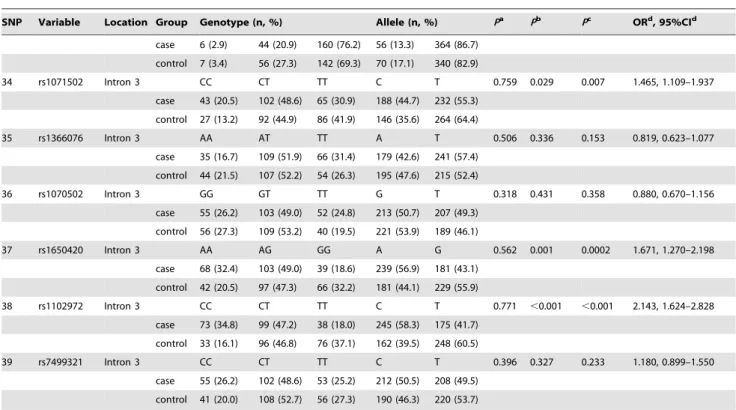
(GT)n repeat Cases (n, %) Controls (n, %) x2 P
(GT)13 4 (1.0) 5 (1.2) 0.138 0.710
(GT)14 0 (0.0) 2 (0.5) 2.054 0.152
(GT)19 1 (0.2) 3 (0.7) 1.054 0.305
(GT)20 3 (0.7) 7 (1.7) 1.719 0.190
(GT)21 26 (6.2) 39 (9.5) 3.171 0.075
(GT)22 7 (1.7) 17 (4.1) 2.543 0.105
(GT)23 27 (6.4) 45 (11.0) 3.915 0.054
(GT)24 54 (12.9) 52 (12.7) 0.006 0.940
(GT)25 49 (11.7) 41 (10.0) 1.330 0.249
(GT)26 100 (23.8) 59 (14.4) 5.360 0.021
(GT)27 48 (11.4) 38 (9.3) 1.042 0.307
(GT)28 44 (10.5) 40 (9.8) 0.118 0.731
(GT)29 27 (6.4) 22 (5.4) 0.422 0.516
(GT)30 10 (2.4) 16 (3.9) 1.583 0.208
(GT)31 3 (0.7) 6 (1.5) 1.086 0.297
(GT)32 6 (1.4) 5 (1.2) 0.069 0.792
(GT)33 7 (1.7) 6 (1.5) 0.056 0.814
(GT)34 4 (1.0) 6 (1.5) 0.455 0.500
(GT)36 0 (0.0) 1 (0.2) 1.026 0.311
doi:10.1371/journal.pone.0070817.t002
Figure 3. LD plot of the 39 SNPs inGRIN2Agene in controls (n = 205). Values in squares are the pair-wise calculation of D’.
significance was set at 0.05. Unconditional logistic regression was used to calculate the odds ratio (OR) and 95% confidence interval (CI) in independent association between each locus and the presence of heroin addiction. The Bonferroni correction was used to adjust the test level when multiple comparisons were conducted, and the P value was divided by the total number of loci or haplotypes. All statistical analyses were performed using the SPSS 17.0 software (SPSS Inc., Chicago, IL, USA). Haplotype blocks were defined according to the criteria of Gabriel et al. [23], as implemented in Haploview 4.0, to examine if some SNPs significant in the single marker association analysis also exist in the haplotype blocks. Pair-wise linkage disequilibrium (LD) statistics (D’ and r2) and haplotype frequency were computed, and haplotype blocks were constructed using Haploview 4.0 [24].
Results
We detected repeat numbers ranging from 13 to 36 in the samples in this study. The dominant allele was (GT)26. The allele distribution histogram of heroin-addictedpatients was shifted to the right, with longer alleles over-represented in heroin addiction (Fig. 2). The frequency of the (GT)26 allele in the heroin addiction group was significantly higher than that in the control group (x2= 5.360,P= 0.021) (Table 2). When we tested for single allelic association of common alleles [frequency .5%: (GT)21 to (GT)29], the Pearson Chi-square test gave the following P values: 0.075 for (GT)21, 0.105 for (GT)22, 0.054 for (GT)23, 0.940 for (GT)24, 0.249 for (GT)25, 0.021 for (GT)26, 0.307 for (GT)27, 0.731 for (GT)28 and 0.516 for (GT)29 (Table 2).
The distribution frequencies of thirty-nine genotyped SNPs were in agreement with the Hardy-Weinberg equilibrium(P.0.05, Table 1). Linkage disequilibrium (LD) analyses data revealed 10
haplotypes in controls, and also showed that 8 SNPs (rs767749, rs1420040, rs9940680, rs9933624, rs8045712, rs8044472, rs1014531, and rs11866328) were located in block 1, 2 SNPs (rs7191784 and rs7191241) in block 2, 2 SNPs (rs1362319 and rs1362321) in block 3, 2 SNPs (rs2650432 and rs2650431) in block 4, 2 SNPs (rs3859125 and rs844395) in block 5, 7 SNPs (rs837697, rs2650427, rs1969060, rs2937030, rs17682940, rs10500373, and rs11642357) in block 6, 3 SNPs (rs7188616, rs17683096, and rs2352748) in block 7, 4 SNPs (rs4454974, rs11644511, rs1070487, and rs6497730) in block 8, 2 SNPs (rs1071502 and rs1366076) in block 9, and 2 SNPs (rs1102972 and rs7499321) in block 10 (Fig. 3 and Fig. 4). The genotype distributions, allelic frequencies, and haplotypes in the patient and control groups, together with the results of statistical analysis are listed in Tables 1 and 3.
The frequency of the T allele in rs1102972 (x2= 29.408,
P,0.001, odds ratio [OR] = 2.143, 95% confidence interval [CI] = 1.624–2.828) and the G allele in rs1650420 (x2= 13.511,
P= 0.0002, OR = 1.671, 95% CI = 1.270–2.198) in heroin-addict-ed subjects was significantly lower than that in the controls (Table 1). The rs3104703 G allele frequency in heroin-addicted subjects was significantly higher than that in the controls (x2= 15.618, P,0.001, OR = 0.576, 95% CI = 0.437–0.758) (Table 1). Furthermore, the rs1071502 T, rs6497730 G, and rs1070487 G allele frequency in heroin addicts were higher than that in the controls (P,0.05), but did not pass the threshold value. Thirty-three additional GRIN2A SNPs gave negative results (Table 1).
The G-C-T-C-C-T-A haplotype in block 6 occurred signifi-cantly more frequently (x2= 37.305, P,0.001, OR = 0.203, 95%
CI = 0.118–0.349, protective) and the T-T haplotypes in block 10 occurred more frequently (x2= 8.919, P= 0.003, OR = 0.554, Figure 4. LD plot of the 39 SNPs inGRIN2Agene in controls (n = 205). Values in squares are the pair-wise calculation of r2.
95% CI = 0.375–0.817, protective) in controls (Table 3). These differences were retained even after Bonferroni correction.
Discussion
GRIN2A regulates reward-related associative learning, cogni-tion, memory, and structural and behavioral plasticity in the context of drug addiction [13–16,21,25,26], suggesting that GRIN2A acts upon the brain’s reward system, which plays a key role in drug addiction. In the past decade, accumulated evidence indicates that NMDA receptors play a pivotal role in the development of tolerance and physical dependence to opiates [27– 29]. Our results provide direct evidence that a genetic change in
GRIN2Ais linked to heroin addiction in humans, and extends the list of variants that may affect the development of heroin addiction [4].
A variable (GT)n repeat in the 59-regulatory region of the
GRIN2A gene has been identified [22]. It was shown that the repeat sequence repressed transcriptional activity in a length-dependent manner, such that the longer the repeat, the lower the promoter activity. In this case-controlled association study, significant differences were found in the distribution of allele frequencies of (GT)n repeats in theGRIN2Agene between
heroin-addicted subjects and healthy controls. The frequency of the (GT)26 repeat in heroin addicts was significantly higher than that in the controls. To our knowledge, our study is the first to identify a significant association between (GT)n repeats in the 59 -regulatory region of the GRIN2A gene and heroin addiction. Indeed, heroin-addicted patients had overall longer alleles than the control subjects. The (GT)n polymorphism in the promoter of
GRIN2Ahas been reported to be associated with schizophrenia and bipolar disorder [22,30,31]. Similarly, a previous study showed that longer alleles of (GT)n repeats were significantly more frequent among alcohol dependence [5]. The average observed repeat number distributions were significantly different in alcohol-dependent subjects (GT repeats: n = 24.5) and the control subjects (GT repeats: n = 23.7) [5]. It is possible that the presence of longer (GT)26 repeat results in decreased GRIN2A receptor function in patients with heroin addiction. This finding represents clinical-genetic evidence pointing toward the role of promoter (GT)n polymorphisms in the GRIN2A gene in the pathophysiology of heroin addiction.
In this study, we evaluated the association between thirty-nine SNPs that efficiently tag the common variation in the GRIN2A
gene and heroin addiction. The most intriguing finding of the Table 3.GRIN2Ahaplotype frequencies and the results of their associations with risk of heroin addiction.
Block SNP Haplotypea Case (n, %) Control(n, %) x2 P OR, 95%CI
1 1/2/3/4/5/6/7/8 G-G-C-C-T-A-G-G 86 (37.1) 79 (38.5) 0.253 0.615 1.106, 0.746–1.639
T-A-G-T-C-G-G-G 68 (32.4) 70 (34.1) 2.048 0.152 1.338, 0.898–1.993
G-A-G-T-C-A-A-T 38 (18.1) 46 (22.4) 1.212 0.271 0.764, 0.472–1.235
2 9/10 G-T 127 (60.5) 133 (64.9) 0.859 0.354 0.828, 0.556–1.123
A-C 78 (37.1) 76 (37.1) 0.000 0.988 1.003, 0.673–1.494
3 11/12 C-A 97 (46.2) 100 (48.8) 0.279 0.597 0.901, 0.613–1.325
A-G 102 (48.6) 100 (48.8) 0.002 0.966 0.992, 0.675–1.457
T-C 86 (41.0) 81 (39.5) 0.089 0.765 1.062, 0.717–1.572
4 14/15 C-T 62 (29.5) 65 (31.7) 0.233 0.629 0.902, 0.594–1.370
T-T 57 (27.1) 64 (31.2) 0.835 0.361 0.821, 0.537–1.254
C-C 68 (32.4) 67 (32.7) 0.004 0.948 0.986, 0.654–1.487
5 16/17 T-T 94 (44.8) 101 (49.3) 0.846 0.359 0.834, 0.567–1.227
T-C 40 (19.0) 41 (20.0) 0.060 0.807 0.941, 0.579–1.529
6 18/19/20/21/22/23/24 G-C-T-C-T-C-G 69 (32.9) 67 (32.7) 0.001 0.970 1.008, 0.669–1.519
T-T-C-T-C-T-A 97 (46.2) 101 (49.3) 0.394 0.530 0.884, 0.601–1.300
G-C-T-C-C-T-A 137 (65.2) 185 (90.2) 37.305 ,0.001 0.203, 0.118–0.349
7 25/26/27 C-A-A 93 (44.3) 92 (44.9) 0.015 0.903 0.976, 0.663–1.438
G-G-G 106 (50.5) 113 (55.1) 0.898 0.343 0.830, 0.564–1.221
8 28/2930/31 C-C-G-G 88 (41.9) 78 (38.0) 0.643 0.423 1.174, 0.793–1.740
T-A-G-G 66 (31.4) 71 (34.6) 0.482 0.488 0.865, 0.574–1.303
T-C-G-G 31 (14.8) 32 (15.6) 0.058 0.810 0.936, 0.548–1.601
T-C-A-A 16 (7.6) 26 (12.7) 2.924 0.087 0.568, 0.295–1.093
9 34/35 C-T 91 (43.3) 73 (35.6) 2.589 0.108 1.383, 0.931–2.053
T-A 87 (41.4) 98 (47.8) 1.707 0.191 0.772, 0.524–1.138
T-T 26 (12.4) 37 (18.0) 2.588 0.108 0.642, 0.373–1.105
10 38/39 C-C 103 (49.0) 83 (40.5) 3.073 0.080 1.415, 0.959–2.087
T-T 85 (40.5) 113 (55.1) 8.919 0.003 0.554, 0.375–0.817
T-C 17 (8.1) 14 (6.8) 0.241 0.624 1.202, 0.576–2.506
Haplotypesawith frequency
present study is that three GRIN2A variants (rs1102972, rs1650420, and rs3104703), all located within a 32-kb area of intron 3, accounted for some of the strongest signals in the association test. Three additional SNPs from the same intron (rs1071502, rs6497730, and rs1070487) had nominally significant
Pvalues for association (P,0.05), but did not pass the threshold value.GRIN2Ahas also recently been shown to be of the highest relevance in human alcohol dependence, among 10 glutamatergic neurosignaling genes [32], and in heroin addiction, among 6 glutamatergic neurosignaling genes [4]. Previously, Levran et al. [4] confirmed a statistically significant association between 6 polymorphisms located at intron 3 (rs1070487, rs6497730, rs4587976, rs1650420, rs1071502, and rs1366076) and heroin-addiction in African Americans. Differences of this kind may be correlated with alterations in hormone levels, neuronal system adaptations, and the pharmacokinetics of substances of abuse [33]. Population stratification is an important issue to be considered when conducting human genetic surveys [34]. In the present study, the experimental and control groups were matched for ethnicity by enrolling subjects from a homogeneous population. Our analysis also has sufficient statistical power to argue an epidemiologically-relevant impact of hereditary variations among the studied genes.
We further investigated the interaction among polymorphisms and observed strong linkage disequilibrium. Haplotype analysis revealed that the G-C-T-C-C-T-A (block 6) and T-T (block 10) haplotypes of the GRIN2A gene displayed a protective effect. There were significant point-wise associations of these variants with heroin addiction. These results indicated that people with these two haplotypes of theGRIN2Agene were less prone to heroin addiction. A previous haplotype analysis of
rs4587976-rs1071502-rs1366076 revealed significant association of the G-A-T (protec-tive) and C-A-T (risk) haplotypes in heroin-dependent patients and healthy controls, respectively [4]. To some extent, this finding further supports a role of GRIN2A polymorphisms in heroin addiction, with differences in the specifics of the association between ethnic groups.
In conclusion, these findings encourage future efforts aimed at identifying functional polymorphisms within, and close to, the
GRIN2Agene using a systemic approach in a larger sample set. Our results are in line with the glutamatergic hypothesis developed to understand the acute and chronic effects of heroin on the brain. The results of this and similar future studies could help understand the neurobiological mechanisms of heroin addiction better, allowing us to devise better treatment strategies.
Supporting Information
Table S1 Summary of published psychiatric disorder-association studies forGRIN2A.
(DOC)
Table S2 Comparison of the MAF of 39 SNPs between African American (AA) and Chinese Han (CH) popula-tion. It should list the source of this informapopula-tion.
(DOC)
Author Contributions
Conceived and designed the experiments: BZ YZ HC. Analyzed the data: YW JL. Contributed reagents/materials/analysis tools: WW. Wrote the paper: BZ YZ. Managed the literature search: WW. Contributed to and approved the final manuscript: BZ YZ WW HC YW JL.
References
1. Cadoret RJ, Yates WR, Troughton E, Woodworth G, Stewart MA (1995) Adoption study demonstrating two genetic pathways to drug abuse. Arch Gen Psychiatry 52: 42–52.
2. Uhl GR (2004) Molecular genetics of substance abuse vulnerability: remarkable recent convergence of genome scan results. Ann N Y Acad Sci 1025: 1–13. 3. Uhl GR, Drgon T, Johnson C, Fatusin OO, Liu QR, et al. (2008) ‘‘Higher
order’’ addiction molecular genetics: convergent data from genome-wide association in humans and mice. Biochem Pharmacol 75: 98–111.
4. Levran O, Londono D, O’Hara K, Randesi M, Rotrosen J, et al. (2009) Heroin addiction in African Americans: a hypothesis-driven association study. Genes Brain Behav 8: 531–540.
5. Domart MC, Benyamina A, Lemoine A, Bourgain C, Blecha L, et al. (2012) Association between a polymorphism in the promoter of a glutamate receptor subunit gene (GRIN2A) and alcoholism. Addict Biol 17: 783–785.
6. Paoletti P, Neyton J (2007) NMDA receptor subunits: function and pharmacology. Curr Opin Pharmacol 7: 39–47.
7. Bliss TV, Collingridge GL (1993) A synaptic model of memory: long-term potentiation in the hippocampus. Nature 361: 31–39.
8. Yang SN, Tang YG, Zucker RS (1999) Selective induction of LTP and LTD by postsynaptic [Ca2+]i elevation. J Neurophysiol 81: 781–787.
9. Akashi K, Kakizaki T, Kamiya H, Fukaya M, Yamasaki M, et al. (2009) NMDA receptor GluN2B (GluR epsilon 2/NR2B) subunit is crucial for channel function, postsynaptic macromolecular organization, and actin cytoskeleton at hippocampal CA3 synapses. J Neurosci 29: 10869–10882.
10. Zhuo M (2009) Plasticity of NMDA receptor NR2B subunit in memory and chronic pain. Mol Brain 2: 4.
11. McBain CJ, Mayer ML (1994) N-methyl-D-aspartic acid receptor structure and function. Physiol Rev 74: 723–760.
12. Chatterton JE, Awobuluyi M, Premkumar LS, Takahashi H, Talantova M, et al. (2002) Excitatory glycine receptors containing the NR3 family of NMDA receptor subunits. Nature 415: 793–798.
13. Sakimura K, Kutsuwada T, Ito I, Manabe T, Takayama C, et al. (1995) Reduced hippocampal LTP and spatial learning in mice lacking NMDA receptor epsilon 1 subunit. Nature 373: 151–155.
14. Kiyama Y, Manabe T, Sakimura K, Kawakami F, Mori H, et al. (1998) Increased thresholds for long-term potentiation and contextual learning in mice lacking the NMDA-type glutamate receptor epsilon1 subunit. J Neurosci 18: 6704–6712.
15. Squire LR (1992) Memory and the hippocampus: a synthesis from findings with rats, monkeys, and humans. Psychol Rev 99: 195–231.
16. Boyce-Rustay JM, Holmes A (2006) Ethanol-related behaviors in mice lacking the NMDA receptor NR2A subunit. Psychopharmacology (Berl) 187: 455–466. 17. Nagy J, Kolok S, Boros A, Dezso P (2005) Role of altered structure and function of NMDA receptors in development of alcohol dependence. Curr Neurophar-macol 3: 281–297.
18. Simoes PF, Silva AP, Pereira FC, Marques E, Milhazes N, et al. (2008) Methamphetamine changes NMDA and AMPA glutamate receptor subunit levels in the rat striatum and frontal cortex. Ann N Y Acad Sci 1139: 232–241. 19. Ben-Shahar O, Obara I, Ary AW, Ma N, Mangiardi MA, et al. (2009) Extended daily access to cocaine results in distinct alterations in Homer 1b/c and NMDA receptor subunit expression within the medial prefrontal cortex. Synapse 63: 598–609.
20. Wang F, Chen H, Steketee JD, Sharp BM (2007) Upregulation of ionotropic glutamate receptor subunits within specific mesocorticolimbic regions during chronic nicotine self-administration. Neuropsychopharmacology 32: 103–109. 21. Murray F, Harrison NJ, Grimwood S, Bristow LJ, Hutson PH (2007) Nucleus
accumbens NMDA receptor subunit expression and function is enhanced in morphine-dependent rats. Eur J Pharmacol 562: 191–197.
22. Itokawa M, Yamada K, Iwayama-Shigeno Y, Ishitsuka Y, Detera-Wadleigh S, et al. (2003) Genetic analysis of a functional GRIN2A promoter (GT)n repeat in bipolar disorder pedigrees in humans. Neurosci Lett 345: 53–56.
23. Gabriel SB, Schaffner SF, Nguyen H, Moore JM, Roy J, et al. (2002) The structure of haplotype blocks in the human genome. Science 296: 2225–2229. 24. Barrett JC, Fry B, Maller J, Daly MJ (2005) Haploview: analysis and
visualization of LD and haplotype maps. Bioinformatics 21: 263–265. 25. Schumann J, Matzner H, Michaeli A, Yaka R (2009) NR2A/B-containing
NMDA receptors mediate cocaine-induced synaptic plasticity in the VTA and cocaine psychomotor sensitization. Neurosci Lett 461: 159–162.
26. Kindlundh-Hogberg AM, Blomqvist A, Malki R, Schioth HB (2008) Extensive neuroadaptive changes in cortical gene-transcript expressions of the glutamate system in response to repeated intermittent MDMA administration in adolescent rats. BMC Neurosci 9: 39.
27. Trujillo KA (2000) Are NMDA receptors involved in opiate-induced neural and behavioral plasticity? A review of preclinical studies. Psychopharmacology (Berl) 151: 121–141.
29. Martin G, Guadano-Ferraz A, Morte B, Ahmed S, Koob GF, et al. (2004) Chronic morphine treatment alters N-methyl-D-aspartate receptors in freshly isolated neurons from nucleus accumbens. J Pharmacol Exp Ther 311: 265–273. 30. Iwayama-Shigeno Y, Yamada K, Itokawa M, Toyota T, Meerabux JM, et al. (2005) Extended analyses support the association of a functional (GT)n polymorphism in the GRIN2A promoter with Japanese schizophrenia. Neurosci Lett 378: 102–105.
31. Tang J, Chen X, Xu X, Wu R, Zhao J, et al. (2006) Significant linkage and association between a functional (GT)n polymorphism in promoter of the N-methyl-D-aspartate receptor subunit gene (GRIN2A) and schizophrenia. Neurosci Lett 409: 80–82.
32. Schumann G, Johann M, Frank J, Preuss U, Dahmen N, et al. (2008) Systematic analysis of glutamatergic neurotransmission genes in alcohol dependence and adolescent risky drinking behavior. Arch Gen Psychiatry 65: 826–838. 33. Russo SJ, Festa ED, Fabian SJ, Gazi FM, Kraish M, et al. (2003) Gonadal
hormones differentially modulate cocaine-induced conditioned place preference in male and female rats. Neuroscience 120: 523–533.