196 www.hrmars.com/journals
Stress among Malaysian Academics:
A Conceptual Study
Zafir Mohd Makhbul
Faculty of Economics and Management, Universiti Kebangsaan Malaysia
Sheikh Muhamad Hizam Sheikh Khairuddin
Faculty of Business and Management , Kuala Lumpur Metropolitan University College
Abstract
Academic stress had been prevalent in universities all around the world. This shows that the academic environment no longer provides the low-stress working environment that the academician once enjoyed. Rapid development, global competition, technology and changes in the nature of jobs today could make the job more demanding than ever, and workers are more prone to injuries and illnesses. Stressors such as work relationship, work-life balance, job overload, job control, job security, pay and benefits, resources and communication, as well as aspects of the job could also be the source of pressure in the workplace. As the effects of the stressors, individual and organizational commitment, as well as physical health and psychological well-being of the employees will suffer. This in turn will impede the productivity of the organization such as teaching, supervision, publication, training, student service, administrative duties, and social responsibility productivity. However, the study between stress and academic productivity is very limited. Proper interventions are required to minimize stress at the workplace.
Keywords: Stress, commitment, academicians, environment
Introduction
197 www.hrmars.com/journals Malaysian Research Universities (MRUs)
Currently, there are five research universities in Malaysia, namely: Universiti Kebangsaan Malaysia, Universiti Malaya, Universiti Sains Malaysia, Universiti Teknologi Malaysia, and Universiti Putra Malaysia. The history of its development can be traced back from its first inauguration in 2007 (Maah & Muhamad, 2009). The National Higher education transformation roadmap is embodied in the two strategic documents launched on August 27, 2007. The first is the The National Higher Education Strategic Plan whereby it involves the laying of the foundation beyond 2020. While, the second document is The National Higher Education Action Plan that will pave the way in triggering transformations for the year 2007-2010.
The goals of the Malaysian research universities (MRUs) are (1) to be a leader in innovation; (2) to set up and enhance centers of excellence in prioritized areas of the nations; (3) to produce world class research outputs; (4) to generate high impact research publications; (5) to attract graduate students of high standards; and (6) to provide a conducive environment for research (Ministry of Higher Education, 2004). The MRUs performance indicators are shown in Table 1.1 below. Despite the fact that the government spent about RM600 million to transform the four Malaysian universities into full-fledged research institutions, their world rankings are still far behind (Azizan, 2007). Furthermore, senior academic managers (SAMs) of one of the research universities reported that the demands from globalization of higher education have created global competition and the subsequent impact on the operations of senior managers within a research intensive university. According to Singh and Schapper (2009), the senior academic
a age s e pe ie ed p essu es i thei effo ts to uild the u i e sit ’s i te atio al
198 www.hrmars.com/journals Table 1.1: Performance Indicators for Malaysian Research Universities
Source Ministry of Higher Education (2004)
Indicator Criteria Research University
1. Quantity and
quality of
researchers
Critical mass 60 per cent of academic staff will be involved as Principal Investigator
Percentage of academic staff with PhD or equivalent
60 per cent
Research experience (3 cohorts) With balanced distribution of staff with > 20 years experience, 10-20 years and < 10 years experience
Number of recognitions/ awards/stewardship conferred by national and international learned and professional bodies
100
2. Quantity and quality of research
Publications Two papers in national/
international refereed and cited journals per staff / year or cumulative impact factor for the institution of not less than 5,000 Research grants for S&T
academic staff a. Public
b. Private (including contact research)
c. International
At RM50,000/staff / year of which at least 20 per cent is from international sources and 20 per cent from private sector
3. Quantity of postgraduates
Ratio PhDs graduated to academic staff
1: 18 academic staff of which 60 per cent will be from S&T
Ratio of postgraduates to academic staff (enrolment)
3 postgraduates: 1 staff
Ratio of postgraduates (based on research and mixed method) to undergraduates
1 postgraduates: 4 undergraduates
Percentage of international graduates
10 per cent
4. Quality of postgraduates
Percentage postgraduate intake 50 per cent of postgraduates with
CGPA ≥ . Percentage of postgraduate
fellowships/ grants from prestigious bodies awarded to postgraduates via research
199 www.hrmars.com/journals Definitions and Theories of Stress
There are three types of the definitions of stress (Beehr & Franz, 1987).The first type is stimulus-based. In this point of view, stress is defined as the stimulus that came from the environment or situation that impinges on the person. Second type of the definition of stress is response- ased. It is defi es as the i di idual’s ph siologi al o ps hologi al espo se to the environment or situation. However, the third stress definition is more generally accepted. It is interactional-based definition of stress, and often called the stressor-strain approach. It brings together the concepts put forward of the first two definitions. That is, it defines both the stimulus (source of stress or stressor) and the response (the outcome or the manifestation of stress or strain). Theories based on this definition are usually considered to be superior since
the offe a o e o plete ie of the d a i s of st ess a d a a ou t fo do u e ted
differential experiences with a single situation (Arnold, Cooper & Robertson, 1998).
The Beehr a d New a ’s Model 1
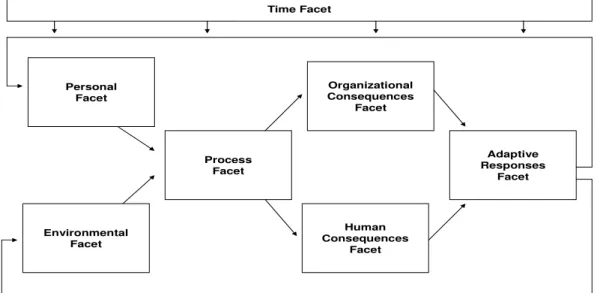
The general model work within the job stress, employee health and organization effectiveness domain. Overall, there are seven elements or facets exist in this model, namely: personal facet, environmental facet, process facet, human consequences facet, organizational consequences
mode
5. Innovation Number of patents attained/ number of products commercialized/ number of technology know-how licensing/ number of IPR/ copyrights (including original writings)
30/ year
6. Professional services/ gift
Income generated from training courses/ services/ consultancy/ postgraduate student fees/ endowment/ gift
Not less than RM20 million/ year
7. Networking and linkages
Inter-institution (national) participation
70 per cent
Inter-institution (international) participation
30 per cent 8. Support facilities Equipment fully operational and
calibrated or physical facilities that meet safety and quality standards (accreditation to GLP/ ISO17025) or library facilities or service centres or recreational or access to high end research facilities
On site auditing
200 www.hrmars.com/journals facet, adaptive responses facet, and time facets (refer to Figure 1.1). The personal and environmental facets interact via the process facet to produce human and organizational consequences facets. Various agents undertake the task of adaptation to reduce the undesirable effects of stress or increase the beneficial effects of stress. The adaptive responses facet in turn affects the personal and environmental facets. The time facet runs through all of the other facets. For example, the elements of the environmental facet require time to exhibit their effects, etc.
The e i o e tal fa et o tai s the ele e ts of the e plo ee’s o k e i o e t that a e
201 www.hrmars.com/journals
Time Facet
Personal Facet
Environmental Facet
Process Facet
Human Consequences
Facet Organizational Consequences
Facet
Adaptive Responses
Facet
Figure 1.1: The Beehr a d New a ’s Ge eral Model of Stress
Source: Beehr & Newman (1978)
The Asset Model of Stress
The ASSET model is depicted in Figure 1.2. The ASSET model, which stands for An Organizational Stress Screening Tool (Cartwright & Cooper, 2002) is the latest stress model used and adapted to study stress in the workplace (Viljoen & Rothmann, 2009). The model is influenced by existing established models of stress (e.g. Cooper & Marshall, 1978).
•WORK RELATIONSHIPS
•WORK-LIFE BALANCE
•OVERLOAD
•JOB SECURITY
•CONTROL
•RESOURCES AND
COMMUNICATION
•PAY & BENEFITS
ASPECTS OF THE JOB
COMMITMENT:
•ORGANIZATION TO EMPLOYEE &
•EMPLOYEE TO ORGANIZATION
PHYSICAL HEALTH & WELL-BEING
Figure 1.2: The ASSET Model of Stress
202 www.hrmars.com/journals Work Environment as the Source of Job Stress
Accordi g to the Beeh a d Ne a ’s ge e al theo of st ess , the e i o e tal fa et
o sist of e plo ee’s o k e i o e t that a e likel to e i ol ed i jo st ess. The o k
environment is by no means a place where individuals are likely to be inflicted by stress since they spent most of their lives at work.
Work-related stress is the adverse reactions people have to excessive pressures or other type of demands placed on them (Health & Safety Executive, 2006). The sources of stress or stressors are conditions that cause stress (Newstrom & Davis, 2002). According to the ASSET model of stress (Cartwright & Cooper, 2002), there are eight commonly found stressors in the workplace, namely: Work Relationship, Work-Life Balance, Overload, Job Security, Control, Resources and Communication, Pay and Benefits, and Job Aspects.
Work Relationship – Most jobs demands working with people. Thus, poor or unsupportive colleagues, clients, subordinates and bosses will be a potential source of stress (Cartwright & Cooper, 2002). Kahn et al., (1964) in his study of poor working relations found that mistrust of colleagues created role ambiguity that leads to psychological strain. Supportive managers and supportive colleagues are the two factors in the workplace that are most likely to help employees cope with stress (Industrial Society Survey, 2001). Manshor et al (2003) reported that relationship at work is a main source of stress among managers in all organizations. Confrontation with colleagues was also found to impact a ade i leade s’ st ess G el h, 2006; Gmelch & Burns, 1994). Provost/supervisor-related stress such as, resolving differences with my superior is found to be the second most important factors of stress in US sample of deans (Gmelch et al., 1999). Conflict-mediating stress such as, complying with rules and regulations, obtaining program approval and support, and resolving differences with /among colleagues registered the highest stress in stress for academic departments chairs (Gmelch & Burns, 1994). According to Janus description, chairs are caught in the middle and stressed by their need to mediate the constraints of the institutions and faculty differences.
Work-Life-Balance – The demands of work have the potential to spillover and interfere with
o e’s personal life (Cartwright & Cooper, 2002). This can put a strain on the outside relationship and increase stress level (Confederation of British Industry, 1998), health and safety (Health and Safety Executive, 2000). The primary cause of occupational stress is balancing the differing demands of work and home (Industrial Society Survey, 2001). Finding balance between professional and personal lives was found to be one the most important stressors in faculty deans (Gmelch et al, 1999; Gmelch & Burns, 1994). Academic administrators also identified
ei g pa t of a dual a ee ouple as o e of the ai sou e of st ess i the No the A izo a
University Study (Northern Arizona University, 2005). Work imbalance was also one of the key stressors in head teachers’ st ess Phillips et al., .
Overload–Unmanageable workloads and time pressure can be a source of stress (Cartwright &
Coope , . T ade U io Cou il’s su e , fo e a ple, ide tified high o kloads as
203 www.hrmars.com/journals unrealistic deadlines/constant time pressures as the second most influential cause of stress. Furthermore, French and Caplan (1973) found that overload can produce symptoms of psychological stress. Chairs experienced most stress from their heavy workload, and time pressures (Gmelch & Burns, 1994). Attending too many meetings was ranked number 1 in the 10 most stressful individual stress variables in United States of America and Australian academic deans study (Gmelch et al., 1999; Gmelch, 2006). Meanwhile, Gmelch and Burns (1994) found out that task-based stress such as, heavy workloads, trying to keep current in their disciplines, and attending meetings were second highest categories of stress for academic
hai s. Co fli ti g alls o thei ti e as fou d affe ti g a ade i leade s’ st ess G el h,
2006). Time pressures were also found to be the most important stresses in department chair stress (Gmelch & Burns, 1994). Work load was also found to be one of the key stressors to head
tea he s’ st ess Phillips et al., . Wo kload fo esea h u i e sities has ee epo ted to
be the highest among other types of universities in US. In addition, all universities have been reported to have an increase in their faculty workload from the year 1972 to 1998. Shuster and Finkelstein (2006) reported that mean hours worked per week in research universities in 1998 were 50.6 as compared to 43.7 in 1972. The proportion working more than 50 hours a week have doubled and the proportion working more than 55 hours a week has also increased from 13.1 to 25.6 %.
Job security – Fewer employees do not expect a life time employment today, but the fear of losing a job still remains a potential source of stress (Cartwright & Cooper, 2002). Job insecurity
has ee ide tified to e the ost salie t fa to s of st ess O’D is oll & Coope , . Fo
example, a quarter of the Industrial Society survey respondents rated job insecurity as one of the six most common causes of occupational stress. Source of pressure for three groups of staff namely are: administrators, faculty and coordinators were scored above average for career and achievement scales (Michailidis & Asimenos, 2002). In addition, Tytherleigh et al. (2005) found out that job insecurity was the most significant source of stress in all staff categories in 14 UK universities and colleges. Universities have also been linked to cuts in staffing levels (Winefield et al., 2003) and downsizing (Sarros et al., 1999).
Control– The experience of stress is strongly linked to perceptions of control. Lack of influence in the way in which work is organized and performed can be a potential source of stress (Cartwright & Cooper, 2002). Indeed, those who percepts that they can control the environment are less likely to suffer from stress than those who do not (Makin, Cooper & Cox, 2000). In the study by Boice and Myers (1986) on stresses and satisfaction of chairing in psychology, the 4 most powerful stressors of chairing involved faculty control: they are, faculty misbehaviors (e.g. loud arguments at faculty meetings, refusals to cooperate) rank first, followed by the awkwardness of giving faculty evaluative feedback, dealing with faculty complaints, and faculty politics.
204 www.hrmars.com/journals stress. Furthermore, poor communications were found to be the third most highly rated stressor (in terms of its commonality) in the British Industrial Society referred to earlier. The conservation of resource theory by Hobfoll (1989) stated that people will protect their resources if they are threatened. Issues like inappropriate training facilities for example, are a threat to their resource conservation strategy and therefore could cause stress. One of the general stresses of the department chair stress is the organizational constraints (Gmelch & Burns, 1994). University department chairs/heads in United States and Australia functioned under increased uncertainty and stress: such as a diverse student population, funding shortages, demands for great quality, finding the upside to downsizing, and balancing academic/administrative roles (Sarros et al., 1999). Big stressors for academic administrators were referred to as inter-playing multiple demands such as policy decisions, personnel and resource management (Academic Leader, 2009).
Pay and Benefits – The financial rewards that work brings are obviously important in that they will determine which type of lifestyle that an individual can lead. In addition, they often
i flue e the i di idual’s feeli gs of self-worth and value to the organization (Cartwright & Cooper, 2002). Salary/recognition stress was the sixth most important factor in the US and seventh i Aust alia dea s’ st ess stud G el h et al., . Despite the fa t that these chairs advocating successfully for the faculty, they still feel that they are unappreciated of by the faculty members (Boice & Myers, 1986).
Aspects of the Job– The potential sources of stress can be related to the fundamental nature of the job itself. Factors, such as physical working conditions, type of tasks and the amount of satisfaction derived from the job itself are all included (Cartwright & Cooper, 2002). This subscale correlates highly with established measures of job satisfaction. Job dissatisfaction can be the outcome of work-related stress or can be a source of stress in its own right. When job dissatisfaction is a reflection of reality, for example, if an individual is dissatisfied because they have outgrown their job, it is likely to be a cause of stress rather than an effect (Lyne et al., 1994). According to the Northern Arizona University (NAU) study (Northern Arizona University, 2005), in comparison to the national norm, the administrators at NAU were less likely to identify aspects of their jobs satisfactorily. They are opportunity to develop new ideas, overall job satisfaction, teaching load, clerical/administrative support, relationship with administration, opportunity for scholarly pursuits, prospects for career advancement, quality of students, visibility for jobs at other institutions/organizations, salary & fringe benefits, and availability of child care at this institution.
Commitment and Health as the Human Consequences of Job Stress
I the Beeh a d Ne a ’s odel , the hu a o se ue es fa et i ludes the hu a ’s
physical and mental health. Stress affects commitment and health, according to Cartwright and
205 www.hrmars.com/journals Stress is the non-specific bodily response made to any demand (Selye, 1973) or commonly known as the General Adaptation Syndrome (GAS). According to his general theory of stress (Selye, 1976), the effects of stress are cumulated overtime, and are related to morbidity and pathology if not abated. In other words, the outcomes of stress are aggravated by the passage of time and the number and severity of stressors experienced, the eventual results will inevitably be serious disease and/or death of the organism.
Strain or the outcomes of stress (effects) is the reactions to the condition of stress (Dollard, Winefield & Winefield, 2003). According to the ASSET model of stress, stress outcomes or effects include four subscales, namely: Commitment from the Organization, Commitment from the Employees, Physical Health, and Psychological Well-Being.
Commitment of the organization to the individual – Employees expect to be trusted and respe ted a d a t to feel that it is o th goi g the e t a ile fo thei o ga izatio (Cartwright & Cooper, 2002). However, issues other than workplace stress may affect
e plo ee’s le el of o it e t. Fo e a ple, i dust ial a tio su h as a th eate ed u ion
st ike a affe t e plo ee’s o it e t to thei o ga izatio . Ad i ist ati e st esses su h as
too frequent meetings, having too heavy workloads, report writing deadlines, and frequent interruptions were ranked among the top ten most stressful for US deans (Gmelch et al., 1999).
Commitment of individual to the organization - Employers expect their employees to do their job as best they can and expect them to be loyal and dedicated to the organization (Cartwright & Cooper, 2002). Scholarly stress is ranked number two for Australian deans, whereby having insufficient time to stay current in their academic field, attempting to balance their leadership and scholarly responsibilities, and believing their academic career progress is not what it should be were common concerns. They also impose high self expectations to create excessive stress levels (Gmelch et al., 1999). University administrators also have been reported to be a misfit, have poor coping ability, and consider changing jobs due to stress (Blix & Lee, 1991; Boice & Myers, 1986).
Physical health– There are ample evidence showing that occupational stress has an impact on
o ke ’s e tal a d ph si al ell-being (Kahn & Byosierre, 1992). According to Siu (2002) and Winefield, Gillespie, Stough, Dua and Hapuararchchi (2003), there is significant evidence that chronic and high levels of occupational stress, left unchecked, are related to mental and physical well-being, job dissatisfaction, absenteeism, stress-related injuries, turnover, and intention to quit. Administrators and coordinators all demonstrated a high level of poor physical health as the effects of stress (Michailidis & Asiemenos, 2001). Stress in head teachers had also been affecting their physical health (Phillips et al., 2008).
206 www.hrmars.com/journals Asiemenos, 2001). Stress in head teachers had also been reported to affect their psychological well-being (Phillips et al., 2008).
Productivity as the Organizational Consequences of Job Stress
The sources of stress from the work environment cause human consequences that result in organizational consequences. This is alled the st ess p o ess. A o di g to Bee a d Ne a ’s general theory of stress (1978), organizational consequences consist of key aspects of organizational effectiveness that may be affected by job stress. Productivity or outputs of the Malaysian academics can be assessed through their teaching, supervision, publication, training, student service, administrative duties, and social responsibility. Teaching as a profession has been ranked as the second most stressful occupation (Johnson, 2005). This could be related to high emotional labor attached to it. Research has also been associated with stress (e.g. McKeachie, 1983). However, service is the least studied upon.
Interventional Development
There are three methods of interventions, namely, primary interventions, secondary interventions, and tertiary interventions (Cooper et al., 2001). These approaches are differentiated according to their scope, target, underlying assumption, and examples (refer to Table 1.2).
207 www.hrmars.com/journals Table 1.2: A Framework for Stress Management Interventions
Primary Interventions
Scope: Preventative – Reduce the number and/or intensify of stressors Target: Alter work environments, technologies, or organizational structures
Underlying assumption: Most effective approach to stress management is to remove stressors Examples: job redesign; role restructuring; organizational restructuring
Secondary Interventions
Scope: Preventative/reactive –Modif i di idual’s espo ses to st esso s Target: Individual
Underlying assumption: May not be able to remove/reduce stressors, so best to focus on
i di idual’s ea tio s to these st esso s
E a ples: st ess a age e t t ai i g; o u i atio a d i fo atio sha i g; ell ess
programs
Tertiary Interventions
Scope: Treatment – Minimize the damaging consequences of stressors by helping individuals cope more effectively with these consequences
Target: Individual
U de l i g assu ptio : Fo us is o t eat e t of p o le s o e the ha e o u ed
Examples: employee assistance programs; counseling Source: Cooper et al. (2001)
Conclusion
Academic stress is a wide-spread phenomenon. Malaysian research universities will have to be careful to avoid stress in their workplace. Stress can come from the environment, or as a response to it. Through these interactions, organizations can suffer. Intervention programs are essential in order to eliminate stress at the workplace.
References
Academic Leader. (2009). Stress and the academic leader. Academic Leader. 25 (10): 3-7.
Aniza, I., Malini, R. & Khalib, L. (2010). A study on organizational factors that influence job stress among medical laboratory technologists in Klang Valley hospitals. Medical Journal of Malaysia. 65 (2): 103-107.
208 www.hrmars.com/journals Aziah, B.D., Mohd Nazri, S., Zaki, A.H., Edimansyah, B.A., Azwan, A., Rusli, B.A. & Rusli, B.N. (2008). Prevalence of stress, anxiety and depression among petrochemical workers in Kertih, Terengganu. MalaysianJournal of Public Health Medicine. 8(1).
Aziah, B.D., Rusli, B.N., Winn, T. & Tengku, M.A. (2004). Prevalence and risk factors of job strain among laboratory technicians in Hospital Universiti Sains Malaysia. Singapore Medical Journal. 45(4): 170-175.
Azizan, H. (2007). Yet to stamp mark. The Star Online. 11 November
Beehr, T.A. & Franz, T.M. (1987). The current debate about the meaning of job stress. In J. M. Ivancevich and D. C. Ganster (Eds). Job stress: from theory to suggestion. pp. 5-18. New York: Haworth Press.
Beehr, T.A. & Newman, J.E. (1978). Job stress, employee health and organizational effectiveness: A facet analysis, model, and literature review. Personnel Psychology. 31: 665-699.
Biron, C., Brun, J.P. & Ivers, H. (2008). Extent and sources of occupational stress in university staff. Work. 30: 511-522.
Blix, A.G. & Lee, J.W. (1991). Occupational stress among university administrators. Research in Higher Education. 32(3)
Boice, R., & Myers, P. E. (1986). Stresses and satisfactions of chairing in psychology. Professional Psychology: Research and Practice, 17, 200-204.
Cartwright, S. & Cooper, C.L. (2002). ASSET: The management guide. Manchester: Robertson Cooper Ltd.
Confederation of British Industry. (1998). Life on the edge. Confederation of British Industry Magazine, July-August.
Coope , C.L., De e, P.J. & O’D is oll, M.P. (2001). Organizational stress: A review and critique of theory, research, and applications. Foundations for organizational science. United Kingdom: Sage.
Cooper, C.L. & Marshall, J. (1978). Understanding executive stress. In Cartwright, S. & Cooper, C.L. ASSET: The management guide. Manchester: RCL
Dollard, M.F., Winefield, A.H. & Winefield, HR. (2003). Occupational Stress in the Service Profession. London: Taylor & Francis.
Edimansyah Abdin. (2008). Assessing and managing risk of occupational stress in male automotive assembly workers in Malaysia. PhD thesis. University Sains Malaysia.
French, J.R.P., & Caplan, R.D. 1973. Organizational stress and individual strain. In A.J. Marrow (Ed.). The failure of success. New York: AMACOM.
Gmelch, W.H. (2006). Effective practices for academic leaders.
http://stylus.metapress.com/app/contribution.asp?referrer=parent&backto=issue,..[Ma rch 10, 2010]
Gmelch, W.H. & Burns, J.S. (1994). Sources of stress for academic department chairpersons.
Journal of Educational Administration. 32 (1): 79-94
Gmelch, W.H & Miskin, V.D. (1993). Ledaership skills for department chairs. Bolton, MA: Anker Publications
209 www.hrmars.com/journals Gmelch, W.H., Wolverton, M., Wolverton, M.L. & Sarros, J.C. (1999). The academic dean: An
imperil species searching for balance. Research in Higher Education. 40 (6): 717-740 Haq, F.S., Halim, L., Buang, N.A. & Nordin, T.A. (2010). Stress among special education, science
and vocational teachers. Retrieved from
http://research.ukm.my/publications/sainssosial/2003rh9.htm
Health and Safety Executive (2006). Definition of stress. Retrieved from
http://www.hse.gov.uk/stress/index.htm (5 [February, date last accessed].
Health & Safety Executive. (2000). Organizational interventions for work stress – a risk manageme t app oa h’ CRR /
Hobfoll, S.E. (1989). Conservation of resources: A new attempt at conceptualizing stress.
American Psychologist. 44: 513-524.
Industrial society survey. 2001. Managing best practice. Occupational Stress. 83.
Jacobs, P.A.; Tytherleigh, M.Y.; Webb, C.; Cooper, C.L. (2007). Predictors of work performance among higher education employees: An examination using ASSET model of stress. International Journal of Stress Management. 14(2): 199-210.
Johnson, S., Cooper, C.L., Cartwright, S., Donald, I, Taylor, P. & Millet, C. (2005). The experience of work-related stress across occupations. Journal of Managerial Psychology. 20(2): 178-187.
Kahn, R.L. & Byosierre, P. (1992). Stress in organizations. In: M.D. Dunnette (ed.), Handbook of industrial and organizational psychology, pp. 571-648. Chicago: Rand McNally.
Kahn, R.L., Wolfe, D.M., Quin, R.P.Snoek, J.D., & Rosenthal, R.A. 1964. Organizational stress: studies in role conflict and ambiguity. New York: John Wiley.
Kamal, I., Nur Hidayah M., Anita, A.R., & Mohd Yusoff, A. (2008). Occupational stress among state registered nurses in a government hospital in Johor Bahru. Malaysian Journal of Public Health Medicine. 8(1).
Kumaresan, S., Nasurdin A.M. & Ramayah, T. (2004). Organizational and personality influences on job stress: the case of Malaysian managers. 39(2):1-13.
Leung, T.W., Siu, O.L. & Spector, P.E. (2000). Faculty stressors, Job Satisfaction and psychological distress among university teachers in Hong Kong: The role of locus of control. International Journal of Stress Management. 7(2).
Lyne, K.D., Barrett, P.T., Williams, C., & Coley, K. (1994). A psychometric evaluation of the Occupational Stress Indicator. Journal of Occupational and Organizational Psychology.
73: 195-127.
Maah, M.A. & Muhamad, R. (2009). Implementation of Malaysian research university programe
– The experience of University of Malaya. 5th QS-APPLE Annual Conference, 24-26 November 2009, KLCC.
Makin, P.J., Cooper, C.L., & Cox, C. (2000). Organizations and the psychological contract.
Leicester: British Psychological Society Books.
Manshor, A.T., Fontaine, R., & Choy, C.S. (2003). Occupational stress among managers: A Malaysian survey. Journal of Managerial Psychology. 18(6): 622-628
210 www.hrmars.com/journals Michailidis, M. & Asimenos, A. (2002). Occupational stress as it relates to higher education,
individuals and organizations. Work. 19: 137-147.
Ministry of Higher Education. (2004). In Komoo, I., Azman, N. & Aziz, Y.F.A. Malaysian research universities and their performance indicators. Bulletin of Higher Education Research. 11: 5-7
Mohd Bokti, N.L. & Abu Talib, M. (2009). A preliminary study on occupational stress and job satisfaction among male navy personnel at a naval base in Lumut, Malaysia. The Journal of International Social Research. 2(9): 299-307.
Mohd Kamel Idris. (2009). Occupational stress in academic life: A study on academics of Malaysian Public Universities. PhD Thesis. The University of Waikato.
Myrtle, R.C., Glogow, E. & Glogow, C.D. (2010). Stress among Malaysian education officials:
causes and coping methods. Retrieved from
http://mgv.mim.edu.my/MMR/8812/881207.Htm
Nasurdin, A.M., Ramayah, T. & Beng, Y.C. (2006). Organizational structure and organizational climate as potential predictors of job stress: Evidence from Malaysia. International Journal of Commerce & Management. 16(2): 116-129
Newstrom, J.W. & Davis, K. (2002) .Organizational Behavior: Human behavior at work. (11th edition). New York: McGraw Hill.
Northern Arizona University. (2005). Comparison of responses from the Higher Education
Resea h I stitute HERI Fa ult “u e : No the A izo a U i e sit ’s Fa ult a d
Academic Administrators. (Supplement to the 2004 – 2005 Faculty Survey Report). Office of Planning, Budget & Institutional Research. Retrieved from http://www4.nau.edu/pair/
Nurfazila, S., Zailina, H. & Nurul Izzah, A.S. (2008). Work stress and Melatonin Levels among shift workers in a Printing Industry. MalaysianJournal of Public Health Medicine. 8(1). Nilufar, A., Abdullah, Z., Fie, D.Y.G. & Alam, S.S. (2009). A study of job stress on job satisfaction
among university staff in Malaysia: Empirical study. European Journal of Social Sciences.
8 (1): 121-131.
NIOSH-Sauter, S., Murphy, L., Colligan, M., Hurrel. J., Scharf, F., Sinclair, R., Grubb, Goldenhar, L., Alterman, T., Johnston, J., Hamilton, A., & Tisdale, J. (1999). Stress at work. Retrieved from http//www.cdc.gov/niosh/stresswk.html [January 1999].
O’D is oll, M.P., & Coope , C.L. (1996). Sources and management of excessive stress and burnout. In P. Warr (Ed.), Psychology at work. London: Penguin.
Phillips, S., Sen, D. & McNamee, R. (2007). Prevalence and causes of self-reported work-related stress in head teachers. Occupational Medicine. 57: 367-376.
Phillips, S., Sen, D. & McNamee, R. (2008). Risk factors for work-related stress and health in head teachers. Occupational Medicine. 58: 584-586
Rusli, B.N., Edimansyah, B.A. & Naing, L. (2006). Prevalence and associated factors of stress in dental healthcare workers of a higher institution of learning in Kelantan. Archives of Orofacial Sciences. 1: 51-56.
Sarros, J.C., Wolverton, M., Gmelch, W.H. Wolverton, M.L. (1999). Stress in academic leadership: U.S. and Australian Department chairs/heads. The Review of Higher Education. 22 (2): 165-185
211 www.hrmars.com/journals Selye, H. (1976). The stress of life. In Sulsky, L & Smith, C. 2005. Workstress. USA: Thomson. Shuster, J.H. & Finkelstein, M.J. (2006). The American faculty: The restructuring of academic
o k a d a ee s. I “ a t, J.C.’s Highe Edu atio : Ha d ook of Theo a d Resea h.
New York: Springer
Singh, N & Schapper, J. (2009). Policy development and globalization of higher education: A case study of the research university in Malaysia. Retrieved from gheforum.usm.my/2009/doc/preghef/Jasvir Kaur& Jan Schapper_Monash U...
Siu, O.L. (2002). Occupational stressors and well-being among Chinese employees: The role of organizational commitment. Applied Psychology: An International Review, 5: 527-544. Smith, E., Anderson, J.L. & Lovrich, N.P. (1995). The multiple sources of workplace stress among
land-grant university faculty. Research in Higher Education. 36(3).
Trade Union Council (TUC). (2000). Focus on health and safety: stress at work tops safety poll.
Retrieved from http//www.tuc.org.uk/h_and_s/tuc-2390-f0.cf [December 2000].
Tytherleigh, M.Y., Webb, C., Cooper, C.L. & Ricketts, C. (2005). Occupational stress in UK higher education institutions: a comparative study of all staff categories. Higher Education Research & Development. 24(1): 41-61.
Viljoen, J.P. & Rothmann, S. (2009). Occupational stress, ill health and organizational commitment of employees at a university of technology. SA Journal of Industrial Psychology/SA Tydskrif vir Bedryfsielkunde. 35(1).
Wai, C.K., Ching, P.W. & Abdul Rahim, M.F. (2006). Working environment and stress: A survey on Malaysian employees in commercial banks. Malaysian Management Review. 41(1): 1-11.
Winefield, A.H., Gillespie, N., Stough, C., Dua, J.K. & Hapuararchchi, J. (2003). Occupational stress in Australian universities: A national survey. Melbourne: National Tertiary Education Union