_____________________________
*)Corresponding author: [email protected]
doi: 10.2298/SOS1303351S
UDK 622.785
Microstructure and Densification Behavior of Liquid Phase
Sintered Cu-28Zn Prealloyed Powder
A. Sabahi Namini
*)M. Azadbeh,
A. Mohammadzadeh
Department of Materials Engineering, Sahand University of Technology, P.O. Box
51335-1996, Tabriz, Iran.
Abstract:
The present study investigates the effect of sintering temperature on densification behavior and properties of liquid phase sintered Cu-28Zn brass alloy. Microstructural evolution, chemical analysis and mechanical properties measurements have been studied in details. Obtained results allowed to accurately evaluating the sintering characteristicof this alloy. It is especially relevant in sintered samples that exhibits a pronounced variation of microstructure from top to down part of the specimens and consequently graded densification which was due to gravitational effect.
Keywords: Supersolidus liquid phase sintering, Gravitational effect, Graded densification
1. Introduction
interval between formation and solidification of liquid. Though there is lack of information on supersolidus liquid phase sintering of brass components, recently Azadbeh et al [16] has reported that the successful sintering of Cu-20Zn brass alloyed powder required controlling sintering temperature in the process of liquid phase formation to prevent graded densification and shape distortion during SLPS. The present study investigates the effect of sintering temperature on densification behavior and properties variations of Cu-28Zn brass alloy through SLPS process. In particular, physical and mechanical properties, microstructure and phase evolution on this alloy are detailed. To better determine the phase transformation and microstructural evaluation Differential scanning calorimetry (DSC), X-ray flouresance (XRF) and X-ray diffraction (XRD) obtained from consolidated and unconsolidated samples.
2. Material and Experimental Procedure 2.1. Raw materials
A water-atomized prealloyed Cu-28Zn brass powder (made by Tabriz Powder Metallurgy Company) was used. Physical properties of started powder such as apparent density (based on ASTM B212) and flowability (based on ASTM B213) were measured for powder characterization. Particle size analysis by sieving method (according to ASTM E11 standard) was used to determine the particle size distribution of powder. Particle morphology (size and shape) was also studied using scanning electron microscopy. DSC was carried out underpure argonat a heating rate of 20 oC / min to study any changes in the material and formation of liquid phase which may occur during heating. The chemical composition of the as-received powder was analyzed by XRF.
2.2. Powder forming
The brass powder was mixed with 0.75 wt% lithium stearate as lubricant in a V shaped mixer at 65 rpm for a period of 60 minutes. The obtained powder, used as the base material for all compacts, was compacted into Charpy bars of 55 × 10 × 10 mm using a pressure of 600 MPa in a uniaxial hydraulic press, using a floating die. The green density was calculated by measuring the compact weight and dimensions.
2.3. Sintering
The heating cycle included a 30 min dwell at 540 °C for delubrication followed by sintering at different temperatures between 850 to 890 °C for 30 min in a small laboratory furnace (type, TFS/25-1250) with the constant heating rate of 15 °C/min and Argon flow of 2 l/min was maintained throughout the entire cycle.
2.4. Properties, microstructure and fracture surface of sintered materials
The sintered specimens were characterized by measuring density through water displacement by Archimedes method (DIN ISO 3369), since this technique is more precise than calculating the density from the dimensions as done with the green compacts.The degree of densification after sintering was measured using a densification parameter, ψ, which is expressed as: g t g s
ρ
ρ
ρ
ρ
ψ
−
−
=
(1)∑
=
Ni i i
t
w
ρ
ρ
1
(2)
Where N = the number of elements in the mixture, wi = the weight fraction of ith component, and ρi is the theoretical density of ith element. The length of green and sintered compact was determined by a caliper with 0.02 mm precision, and the dimensional changes were calculated. The apparent hardness for all specimens was measured according to DIN ISO 4498 using a standard Vickers indenter at a load of 30 kgf. The recorded hardness values are the average of six readings taken at random spots throughout the metallographic sections. Impact energy was measured using a 300 J Charpy impact tester (type, ROELL AMSLER) according to ASTM En23-01 standard. The sintered specimens were sectioned in parallel to the pressing direction, polished and etched (8 g FeCl3, 25 ml HCl, 50 ml H2O). Microstructural characterization was carried out using an optical microscope, scanning electron microscopeand image analysis system. The constituent phases and chemical composition of the sintered materials were analyzed by XRD and Energy dispersive x-ray (EDX) microanalyser.
3. Results and discussion
3.1. Powder characteristics
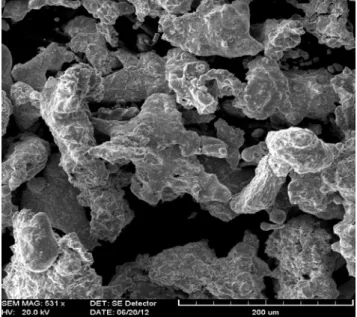
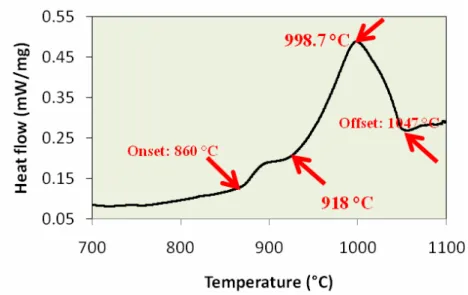
Table I and Fig. 1 represent the characteristics, chemical analysis, the particle size distribution and the scanning electron micrograph of as-received brass powder. The non-equilibrium nature of the powder production method makes it difficult to accurately predict sintering window using phase diagrams. Hence, DSC is employed to study the melting behavior of Cu-28Zn prealloyed powder.
Fig. 1. Scanning electron micrograph of as-received powder.
Fig. 2. DSC plot showing melting behavior of as-received water atomized Cu-28Zn powder.
Tab. I. Chemical composition and physical characteristics of the used brass powder in as-received condition.
Chemical analysis (wt%)
Cu Balance Zn 28.6 Al 0.14 Fe 0.085 S 0.062 Si 0.054 P 0.0084
Properties
Flowability (sec/50g) 21
Apparent density (g/cm3) 3.2
Powder shape Irregular
Sieve analysis
Weight percentage Particle size (µm)
9.75 125- 180
24.63 90 – 125
23.53 63 – 90
42.09 <63
50 °C lower than indicated by the phase diagram [3]. Thus temperature window of 860 °C to 900 °C is suitable for performing experiments.
3.2. The effect of sintering temperature on properties, microstructural evolution
and fracture surface
3.2.1. Physical and mechanical properties
The physical and mechanical properties (sintered density, dimensional changes, hardness and impact energy) are graphically presented as a function of the sintering temperature in Fig. 3. These properties demonstrate the progress of sintering. The calculated theoretical density according to equation (2), using the results of chemical analysis, was equal to 8.27 g/cm3. As well, green density of samples was calculated by measuring the dimensions and weight of each specimen, was 6.65±0.01 g/cm3. With sintering at 850 °C, the sintered density increases to 7.86 g/cm3 (Fig. 3a) and based on the equation (1), the densification parameter is 33%.By increasing the sintering temperature up to 870 °C, the sintered density reaches a maximum of 7.98 g/cm3, which corresponds to 44% densification.With further increasing sintering temperature above 870 °C, the sintered density decreases. So, for obtaining maximum density too high sintering temperatures are detrimental. It stands out clearly from the obtained microstructures (as will be shown below in Fig. 3), that the changes in density as a consequence of the sintering temperature can be related to microstructural evolution. The changes in length of the sintered samples are shown in Fig. 3b. The response of dimensional change to sintering temperature is in good agreement to that of the density. Accordingly, up to 870 °C with increasing densification there is a significant shrinkage (about 2.35%) of the sintered compact compared to the green one, while at 850 and 890 °C it is lower.
(a) (b)
Fig. 3. The effect of sintering temperature on Cu-28Zn properties; (a) sintered density, dimensional changes, (b) impact energy, hardness (compacting pressure = 600 MPa, sintering
time = 30 min, in argon atmosphere).
pore enlargement as a result of increasing sintering temperature are unfavorable. In addition, the values for impact energy, as the most sensitive property indicating the interparticle strength of Cu-28Zn obtained after sintering at different temperatures, is shown in Fig. 3b. As it is clear, the maximum value of impact energy (which is about 62 J/cm2) is achieved also at 870 °C, due to an increase in load bearing cross-section caused by liquid formation enhancement.
3.2.2. Structural analysis
Mechanical and physical properties of the materials are also depending on microstructural features as a result of the processing conditions. According to the Cu-Zn binary diagram, the chemical composition of the used powder is in the α phase area and its sintering between the solidus and liquidus temperatures results in a mixture of liquid and α phase.
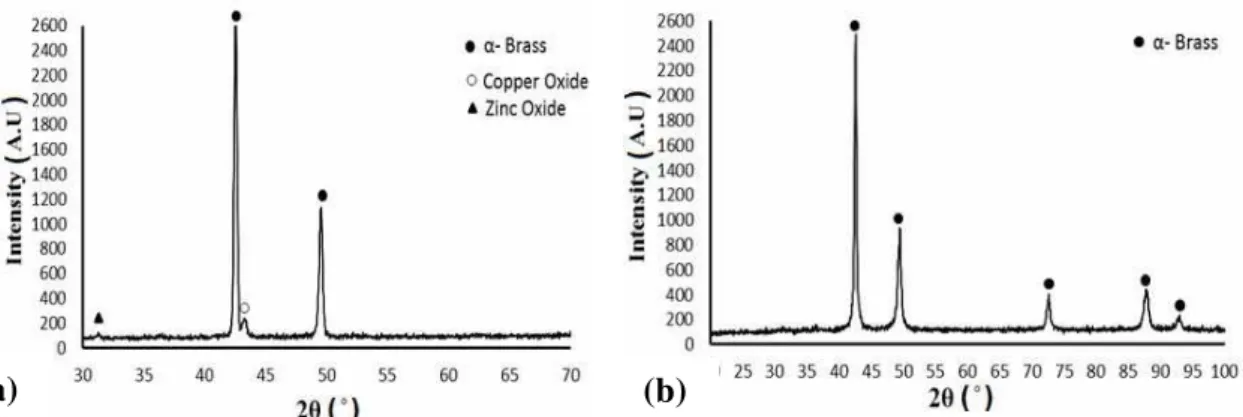
Fig. 4. XRD pattern of (a) started powder, (b) sintered compact at 890˚C.
Fig. 4 compares the XRD patterns of the starting powders and of the samples sintered
at 870 °C for 30 min in Ar atmosphere. The comparison reveals that the phase composition of the starting powders contains α phase, Copper Oxide and Zinc Oxide, but as might be expected from the Cu-Zn binary diagram, the XRD analysis of the sintered sample reveals only α phase.
Fig. 5. Schematic stages of supersolidus sintering processes in a narrow temperature window between solidus and liquidus, (a) initial particle packing, (b) formation of initial liquid with insufficient penetration of grain boundaries for densification, (c) viscous flow densification of
semisolid particles, (d) final stage densification with closed, spherical pores[2].
As the powder used is prealloyed, the sintering process is of SLPS type, the schematic stages of which are shown in Fig. 5. By increasing the sintering temperature to a level
between solidus and liquidus, according to the schematic images of the binary diagram (Fig. 5), the amount of formed liquid is augmented and rearrangement of grains is developed.
(g) (d)
(a)
(h) (e)
(b)
(i) (f)
(c)
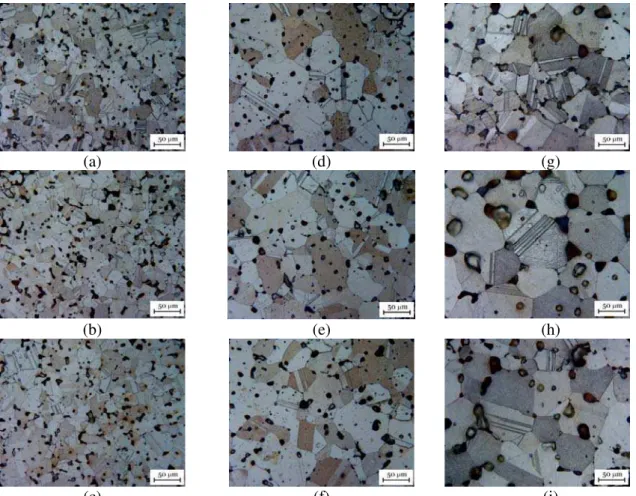
Fig. 6. Microstructure of specimens sintered at different temperatures for 30 min in Ar atmosphere followed by cooling in exit zone of furnace (top, center and bottom of broken
cross sections at a distance of 1.6, 4.9 and 8.2 mm from upper surface of the sample), (a) 850 °C-top, (b) 850 °C-center, (c) 850 °C-bottom,
(d) 870 °C-top, (e) 870 °C-center, (f) 870 °C-bottom, (g) 890 °C-top, (h) 890 °C-center, (i) 890 °C-bottom.
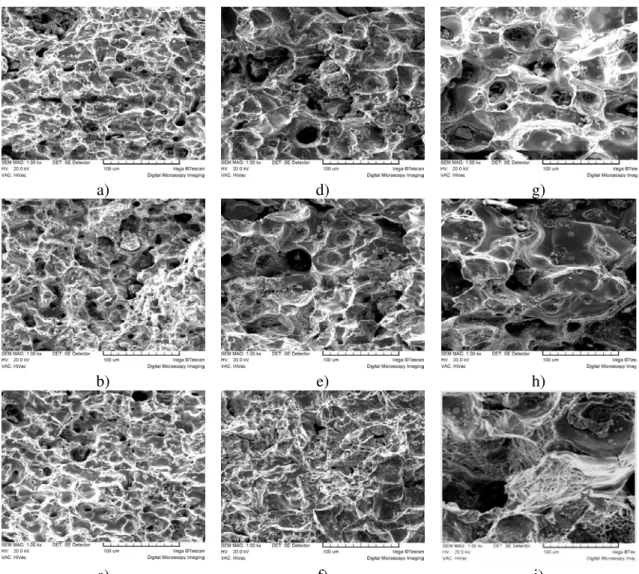
number and smaller pore size can be achieved by sintering at 870 °C. Moreover, due to formation of excess liquid phase and the effect of gravity on it, some events such as settling of liquid occurred. This feature was evaluated by studying various regions of each fracture surface.
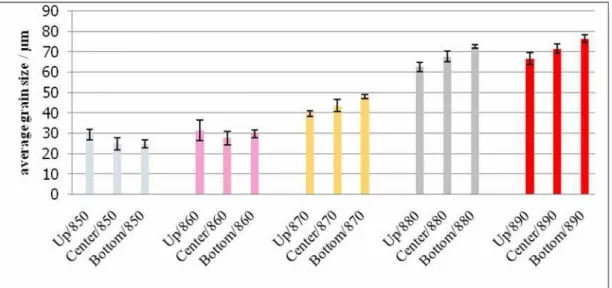
Fig. 7. Average grain size of specimens sintered at different temperature.
The average grain size as a function of sintering temperature is plotted in Fig. 7, for each part of the samples cross section, with standard deviation as error bars. As can be seen, increasing sintering temperature produces significant grain growth in this material, because grain coarsening as a result of diffusion is a thermally activated process. Furthermore, as a consequence of liquid settling due to gravitational force, the grain growth at the down part of sintered compacts is more than other parts which is clearly shown in Fig. 7.
3.2.3. Fractography
rearrangement of fragmented grains of powder particles as a result of liquid phase formation leads to a significant increase in load bearing cross section area.
a) d) g)
b) e) h)
c) f) i)
Fig. 8. Fracture surface of specimens sintered at different temperatures for 30 min in Ar atmosphere followed by cooling in exit zone of furnace (top, center and bottom of broken
cross sections at a distance of 1.6, 4.9 and 8.2 mm from upper surface of the sample), (a) 850 °C-top, (b) 850 °C-center, (c) 850 °C-bottom,
(d) 870 °C-top, (e) 870 °C-center, (f) 870 °C-bottom, (g) 890 °C-top, (h) 890 °C-center, (i) 890 °C-bottom.
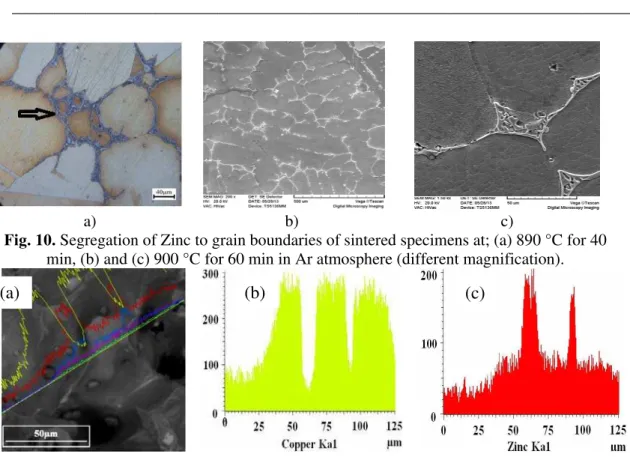
a) b) c)
Fig. 10. Segregation of Zinc to grain boundaries of sintered specimens at; (a) 890 °C for 40 min, (b) and (c) 900 °C for 60 min in Ar atmosphere (different magnification).
Fig. 11. Linear analysis images of alloying elements distribution in the grains and grain boundaries of specimen’s fracture surface sintered at 890 °C; (a) Image of fracture surface,
(b) Copper, (c) Zinc.
There is an almost full covering of melt in grain boundaries and particle contacts at 870 °C, while grain growth at higher temperatures results in coarser voids. Grain growth and voids widening at 890 °C due to the higher proportion of liquid phase are more than other temperatures.It should be taken into consideration that because of more porosity and lack of full densification at 850 °C, capillary force induces the melt penetration into the pores, but at higher temperatures and because of less porosity due to higher liquid formation, the capillary force decreases, and so, the gravity effect is dominant [15]. On micrograph of sintered sample at 890 °C (Fig. 10(a)), as well as samples sintered at 900 °C for 60 min in Ar atmosphere (Fig. 10(b) and (c)), segregated phase at grain boundary were observed, which was because of dezincification. The phase diagram of Cu-Zn provides an initial indicator of segregation due to alloying. The downward sloping liquidus and solidus lines indicate a tendency for Zn segregation at grain boundaries [6]. So, in order to investigate the changes in chemical composition caused by liquid phase formation, a linear analysis was done on the fracture surface of the compact sintered at 890 °C (Fig. 11). The difference in the chemical composition of grain boundary and grain interiors is clear, so that in the liquid formed at the grain boundaries the amount of Cu decreases but the Zn content increases. Such a change in chemical composition could be responsible for the different modes of fracture.
4. Conclusions
1. Sintering of Cu-28Zn prepared from prealloyed powder occurs along with liquid phase formation and is of supersolidus type.
2. Changes in physical and mechanical properties with rising sintering temperature agree well with each other, and the results of microstructural and fractographic analysis confirm them.
Based on the above mentioned changes, the optimum sintering temperature is approximately 870 °C.
3. An increase in sintering temperature results in decrease of pore number and causes sphericity as well as significant grain growth. As a result of grain growth, the pore size between them is increased. Moreover, at lower sintering temperatures, because of abundant porosity, the capillary force is the dominant factor and induces quick densification. While with filling voids by the liquid and decreasing porosity, the gravity force becomes dominant and induces the liquid to settle into bottom of the sample.
4. According to fractographic investigation and microstructural analysis it can be concluded that low sintering temperatures due to insufficient interparticle bonding and high sintering temperatures because of excess liquid phase formation are not favorable. There is an optimum temperature which can contribute to achieving improved physical and mechanical properties. 5. With increasing sintering temperature and liquid phase formation, as a result of
gravitational force, the settling of liquid to bottom of the sample is enhanced and the number of pores decreases from up to down and graded densification occurs.
Acknowledgment
The authors would like to thank prof. Herbert Danninger for informative discussions regarding this work. The authors are also wish to express their sincere gratitude and
appreciation to Mr. Tabatabai, the respected manager of Tabriz Powder Metallurgy Company because of his financial assistance for doing this research.
References
1. G. S. Upadhyaya, Sintered metallic and ceramic materials: Preparation, properties and applications. Wiley, 2000.
2. C. Padmavathi, A. Upadhyaya, Densification, microstructure and properties of supersolidus liquid phase sintered 6711Al-SiC metal matrix composites. Sci Sinter, 42, (2011) 363.
3. R. M. German, Supersolidus liquid-phase sintering of prealloyed powders. Metall Mater Trans A, 28, (1997), 1553.
4. R. M. German, Supersolidus liquid phase sintering. I: Process review. Int J Powder Metall, 26, (1990), 23.
5. R. M. German, Supersolidus liquid phase sintering. II: Densification theory. Int J Powder Metall, 26, (1990), 35.
6. R. M. German, Liquid phase sintering. Springer, 1985.
7. Y. Liu, R. Tandon, R. M. German, Advanced sintering technology for prealloyed powders. Adv Powder Metall Part Mater, (1995), 1.
8. Y. Liu, R. Tandon, R. M. German, Modeling of supersolidus liquid phase sintering: I. Capillary force. Metall Mater Trans A, 26, (1995) 2415.
9. Y. Liu, R. Tandon, R. M. German, Modeling of supersolidus liquid phase sintering: II. Densification. Metall Mater Trans A, 26, (1995); 2423.
10. J. R.Davis, Copper and copper alloys. Materials Park OH, ASM Specialty Handbook, 2001.
11. H. Baker, H. Okamoto, ASM Handbook. Vol. 3. Alloy Phase Diagrams. ASM International, Materials Park OH, 1992, 501.
13. Z. S. Nikolic, Computer simulation of grain growth by grain boundary migration during liquid phase sintering. J Mater Sc, 34, (1999), 783.
14. J. Liu, A. Lal, R. M.German, Densification and shape retention in supersolidus liquid phase sintering. Acta mater, 47, (1999), 4615.
15. C. S. Marchi, L. Felberbaum, A. Mortensen, The effect of gravity on solution-reprecipitation during liquid phase sintering. Metall Mater Trans A, 31, (2000), 397. 16. M.Azadbeh, H. Danninger, C. Gierl, “Euro PM 2011 International Powder
Metallurgy Congress & Exhibition”, 2011, European Powder Metallurgy Association. 17. R. F. Speyer, Thermal Analysis of Materials, CRC Press, Vol. 5, 1994.
Са р а:
Cu-28Z. Д
, .
.
.