CLASSIFICAÇÃO DE TÓPICOS ATRAVÉS DE
ALEXANDRE GUELMAN DAVIS
CLASSIFICAÇÃO DE TÓPICOS ATRAVÉS DE
MODELOS DE LINGUAGEM ENRIQUECIDOS
COM CONTEXTO
Dissertação apresentada ao Programa de Pós-Graduação em Ciência da Computação do Universidade Federal de Minas Gerais como requisito parcial para a obtenção do grau de Mestre em Ciência da Computação.
Orientador: Adriano Alonso Veloso
ALEXANDRE GUELMAN DAVIS
SUBJECT CLASSIFICATION THROUGH
CONTEXT-ENRICHED LANGUAGE MODELS
Dissertation presented to the Graduate Program in Computer Science of the Uni-versidade Federal de Minas Gerais in par-tial fulfillment of the requirements for the degree of Master in Computer Science.
Advisor: Adriano Alonso Veloso
c
2015, Alexandre Guelman Davis. Todos os direitos reservados.
Davis, Alexandre Guelman
D261s Subject Classification Through Context-Enriched Language Models / Alexandre Guelman Davis. — Belo Horizonte, 2015
xxiv, 58 f. : il. ; 29cm
Dissertação (mestrado) — Universidade Federal de Minas Gerais
Orientador: Adriano Alonso Veloso
1. Computação – Teses. 2. Processamento da linguagem natural (Computação) – Teses. 3. Redes sociais on-line – Teses. 4. Linguística - Processamento de dados. 5. Recuperação da informação. Orientador. II. Título.
Acknowledgments
This dissertation is far to be a single person work. The long and winding path that we walked to get to this moment would not be possible without the help of many important people in my life. In here, I thank them for not only for their support but also for helping me to become a better person and a better professional.
First of all, I would like to thank my family. To my parents Clodoveu and Elizabeth, who always did their best to provide me with everything that I needed and lead me in the way of excellence, rightousness and knowledge, I owe you everything that I am today. A special thanks to my sister Paula for the company and endless friendship. Without your readiness to help me (even, sometimes, without being able) I would not be completing this degree. I am really lucky of being born in such an amazing family. Thank you, I love you all.
To my greatest companion and loving girlfriend Bruna, who tirelessly helped me and supported me in all my decisions in the last eight years, you have my greatest gratitude. I simply cannot imagine what would my life be without you close to me. I am really gratefull for having such an amazing, big hearted, loving and intelligent life companion. I definetly have still a lot to learn with you, I hope that the rest of my life is time enough. Thank you.
For all the classes and technical learning, a really special thanks to all my profes-sors and teachers. Without your knowledge and patience I would not be finishing this important step in my life. To my advisor Adriano, who always helped me in reaching my goals and to achieve excellence in research, my gratitude.
Osvaldo, Glauber, Herico, Paulo, Leandro, Samuel and Juan, without you Saturday mornings would be a little sadder.
Thanks to my friends in grad 091: Victor, Vellozo, Mattos, Felipe, Anderson. Thanks to my friend Diogo Renno, for being the best partner in groups assignments. To Filipe, Dilson and Henrique, for all the amazing moments in programming contests and in Russia. Yes, I am still not sure how we survived that trip. Thanks, also, to all my school friends: Alexandre Morato, Vitor, Bu, Otoni and Andre. A special thanks to Tereza, to my grandparents, uncles, aunts and cousins.
To my friends at Microsoft and Google, especially to Angelo, Doug Szabo, Ivan Tang, Lucas Vendramin and Ranveer, my thanks for hosting me and teaching me how to be a better professional. Certainly, without these internships my degree would not be so complete.
At last but not least, I would like to thank one of my greatest inspiration sources, Clube Atletico Mineiro. A special thank to the team: Victor, Marcos Rocha, Leo Silva, Rever, Richarlyson, Pierre, Leandro Donizete, Bernard, Ronaldinho, Tardelli and Jo, the 2013 Libertadores title will be a unforgettable reminder in my life that every thing is possible and all of our dreams are achievable if we believe in them. I BELIEVE!
Resumo
Ao longo dos anos, humanos desenvolveram um complexo e intricado sistema de comu-nicação, com diversas maneiras de transmitir informações, que vão de livros, jornais e televisão até, mais recentemente, mídias sociais. No entanto, recuperar eficientemente e entender mensagens de mídias sociais para a extração de informações úteis é desafi-ador, especialmente considerando que mensagens mais curtas são mais dependentes do contexto. Usuários muitas vezes assumem que o público de suas mídias sociais está ciente do contexto associado e de eventos do mundo real subjacentes. Isso permite que eles encurtem as mensagens sem prejudicar a efetividade da comunicação.
Algoritmos tradicionais de mineração de dados não levam em consideração infor-mações contextuais. Consideramos que explorar o contexto pode levar a uma análise mais completa e precisa das mensagens de mídias sociais. Neste trabalho, portanto, é demonstrado o quão relevantes são as informações contextuais na filtragem de men-sagens que são relacionadas a um dado assunto (ou tópico). Também é mostrado que a taxa de recuperação aumenta se o contexto for levado em consideração. Além disso, são propostos métodos para filtrar mensagens relevantes sem utilizar apenas palavras-chave se o contexto for conhecido e datectável. Nesta dissertação, propomos uma nova abordagem para classificação de tópicos em mensagens de mídias sociais que considera tanto informações textuais como extra-textuais (ou contextuais). Essa abordagem propõe e utiliza modelo de linguagem enriquecido com contexto. Técni-cas baseadas em conceitos de linguística computacional, mais especificamente na área de Pragmática, são utilizadas. Para avaliar experimentalmente o impacto dessas pro-postas foram utilizados conjuntos de dados contendo mensagens sobre três importantes esportes americanos (futebol americano, baseball e basquete). Resultados indicam uma melhora de até 50% na recuperação de mensagens sobre estratégias baseadas em texto devido à inclusão de informação contextual.
Abstract
Throughout the years, humans have developed a complex and intricate system of com-munication with several means of conveying information that range from books, news-papers and television to, more recently, social media. However, efficiently retrieving and understanding messages from social media for extracting useful information is challenging, especially considering that shorter messages are strongly dependent on context. Users often assume that their social media audience is aware of the associated background and the underlying real world events. This allows them to shorten their messages without compromising the effectiveness of communication.
Traditional data mining algorithms do not account for contextual information. We argue that exploiting context could lead to more complete and accurate analyses of social media messages. For this work, therefore, we demonstrate how relevant is contextual information in the successful filtering of messages that are related to a selected subject. We also show that recall rate increases if context is taken into account. Furthermore, we propose methods for filtering relevant messages without resorting only to keywords if the context is known and can be detected. In this dissertation, we propose a novel approach for subject classification of social media messages that considers both textual and extra-textual (or contextual) information. This approach uses a proposed context-enriched language model. Techniques based on concepts of computational linguistics, more specifically in the field of Pragmatics, are employed. For experimentally analyzing the impact of the proposed approach, datasets containing messages about three major American sports (football, baseball and basketball) were used. Results indicate up to 50% improvement in retrieval over text-based approaches due to the use of contextual information.
List of Figures
4.1 Ilustration of the classic Katz backoff Model for n-gram language model . . 23 4.2 Ilustration of the context-enriched language model backoff . . . 26
5.1 Score of TF and IDF for each keyword ordered by the reverse TF order . . 30 5.2 Sum of all TF of a keyword by TF-IDF of that word . . . 30 5.3 LogLog of the number of users in each bin according to the keywords used
by them . . . 31 5.4 Frequency of keywords in each one-hour time window of the training stream 32 5.5 Situational Context score in each time window of the training stream . . . 33 5.6 Scatter plot showing the differences between AKC and SC . . . 34
6.1 Ilustration of the evaluation pipeline . . . 36 6.2 American Football (AKC): average recall by ranking position considering
all positive examples that do not contain keywords . . . 38 6.3 American Football (AKC): average recall by ranking position considering
all positive examples . . . 39 6.4 American Football (SC): average recall by ranking position considering all
positive examples that do not contain keywords . . . 40 6.5 American Football (SC): average recall by ranking position considering all
positive examples . . . 41 6.6 Baseball (AKC): average recall by ranking position considering all positive
examples that do not contain keywords . . . 42 6.7 Baseball (AKC): average recall by ranking position considering all positive
examples . . . 43 6.8 Baseball (SC): average recall by ranking position considering all positive
examples that do not contain keywords . . . 44 6.9 Baseball (SC): average recall by ranking position considering all positive
6.10 Basketball (AKC): average recall by ranking position considering all positive examples that do not contain keywords . . . 46 6.11 Basketball (AKC): average recall by ranking position considering all positive
examples . . . 47 6.12 Basketball (SC): Average recall by ranking position considering all positive
examples that do not contain keywords . . . 48 6.13 Basketball (SC): Average recall by ranking position considering all positive
examples . . . 48
List of Tables
List of Acronyms
AKC: Agent Knowledge Context.
CMC: Computer Mediated Communication.
MLB: Major League Baseball.
MLE: Maximum Likelihood Estimator.
NBA: National Basketball League.
NFL: National Football League.
NLP: Natural Language Processing.
OCR: Optical Character Recognition.
PDF: Probability Distribution Function.
Contents
Acknowledgments ix
Resumo xiii
Abstract xv
List of Figures xvii
List of Tables xix
1 Introduction 1
1.1 Statement . . . 4 1.2 Objectives . . . 4 1.3 Specific objectives . . . 5 1.4 Challenges and contributions . . . 5 1.5 Structure . . . 6
2 Related Work 7
2.1 Pragmatic effects and conversational implicatures . . . 7 2.2 Language models . . . 8 2.3 Text categorization . . . 9 2.4 Alternative data sources . . . 10
3 Pragmatic Contextual Modeling 13
3.1 Agent Knowledge Context . . . 16 3.2 Situational Context . . . 17
4 Language Model 21
4.1.2 Katz backoff . . . 22 4.2 Context-enrichedn-gram language model . . . 24
5 Dataset 27
5.1 Dataset information . . . 27 5.2 Training stream . . . 28 5.2.1 Characterization . . . 29 5.3 Test stream . . . 32 5.3.1 Characterization . . . 33
6 Results 35
6.0.2 Evaluation Workflow . . . 35 6.1 Evaluation Method . . . 36 6.2 Language model evaluation . . . 36 6.3 American football data . . . 38 6.3.1 Agent Knowledge Context . . . 38 6.3.2 Situational Context . . . 39 6.3.3 Summary . . . 40 6.4 Baseball data . . . 41 6.4.1 Agent Knowledge Context . . . 42 6.4.2 Situational Context . . . 42 6.4.3 Summary . . . 43 6.5 Basketball data . . . 44 6.5.1 Agent Knowledge Context . . . 45 6.5.2 Situational Context . . . 46 6.5.3 Summary . . . 47
7 Conclusions and Future Work 49
7.1 Future Work . . . 50
Bibliography 51
Attachment A Chosen Keywords 57
Chapter 1
Introduction
Human communication involves a sender, a medium, a message, and a receiver. Vari-ations and combinVari-ations in these four elements allow for a broad set of communi-cation alternatives, that range from personal oral conversations to complex written documents. Over time, the forms of communication between humans have evolved significantly, especially through the use of technology. The rise of new communication technologies have been associated, in the past, to revolutions in human behavior: the invention of the telegraph, of the telephone, and of the television have been decisive in defining the characteristics of modern human societies all over the world. Computer-based communications followed, granting a new and faster way to exchange messages, initially using e-mail and transmitting digital versions of written documents, and then evolving to mixing text with images and video. The increasing ease and reduced cost of electronically sending and receiving messages caused a significant increase in human communication, covering all kinds of subjects, from events of personal concern to news of global importance.
2 Chapter 1. Introduction
late 20141
. In another, the number of active users exceeds 1.3 billion (one of every 5 humans), and over 300 million images are uploaded and distributed every day2
. Since in this kind of communication messages can be digitally encoded, stored, accumulated and analyzed as a stream of data, many interesting research opportuni-ties arise, associated to the challenge of handling large volumes of real-time data and fueled by the overall goal of increasing our understanding of human societies. Sup-pose that a social scientist becomes interested in analyzing the repercussion of some theme, or subject, of current interest. If it is possible to, routinely, (1) tap into a social media source, (2) filter out messages that are associated to the selected subject, and (3) analyze the set of messages according to parameters such as content, vocabulary, volume, emotional bias, propagation speed, spatial distribution, duration, and others, then the scientist can frequently have instantaneous glimpses on the way society treats that subject and can advance current knowledge for similar situations in the future. Using large volumes of data from social networks, social sciences achieve a scale that has never been possible before, in one of the many facets of the so called data science phenomenon.
However, there are numerous difficulties in every step of this process. In the first step, not every social media provider allows broad access to messages, user profiles and user relationships. The second and third steps introduce complex challenges as to accurately selecting messages as being related or not to a given subject, and on analyzing sets of messages related to a given theme. Furthermore, the sheer volumes of messages that are exchanged daily indicate that only automated approaches can be used in a meaningful way, and that the complexity of these approaches is limited by the computational infrastructure that is made available to run them.
Consider, specifically, the case of Twitter. It is the fifth social network as to the number of users, but its characteristics make it a primary source for research initiatives. Twitter offers a comprehensive Application Programming Interface (API), with clear rules for collecting and filtering messages in significant volumes. User profiles can be obtained, and user relationships can be retrieved. On the other hand, messages are limited to 140 characters, and thus issues such as abbreviations, misspelled words and informal lexical and grammatical constructions are common. Twitter users also frequently rely on contextual information3
as a way to keep messages short. Assuming that the receivers will be able to recognize the context, users frequently omit key parts
1
WhatsApp, according to http://www.statista.com/statistics/258743/daily-mobile-message-volume-of-whatsapp-messenger/
2
Source: https://zephoria.com/social-media/top-15-valuable-facebook-statistics/
3
By context we mean all non-written information that is relevant to understand a message, such
3
of the message, posting incomplete sentences or chaining ideas over several messages spread through time.
Regardless of such difficulties, filtering and analyzing short messages in a medium such as Twitter has been successfully done in the recent past, with significant re-sults regarding problems such as sentiment analysis [Guerra et al., 2011], spatial loca-tion [Davis Jr et al., 2011] and epidemics forecasting [Gomide et al., 2011] (all of these are results from our research group at UFMG). A broad range of techniques has been used in those studies, including data mining, machine learning, and natural language processing (NLP). In most cases, filtering has been simplified to use sets of keywords, in a strategy applied in large scale by the Observatory of the Web project4
. Contextual information has usually not been taken into consideration. In part, the success of such initiatives comes from the fact that the number of messages for which context is not necessary is still large, allowing for the recognition of trends and for the identification of relevant information.
Consider, for example, an individual social media user A, that at some point in time issues a message containing the sentence “And he scores!!”. Without any contex-tual information, an automated filtering or analysis agent would have trouble associ-ating such a message to any possible subject. However, the receivers of the message, individualsBiinA’ s social network, know from previous interactions thatAis a soccer fan, who roots for a specific team T. Some of those may further know that a game is going on at the moment the message is issued, therefore deducing that some player of
T has scored. Others may have read A’s previous messages, in which he criticized a specific player for his disappointing performance so far in the game, and can infer who is the player (“he”) implicitly mentioned in the message. Therefore, a message con-taining only three words and only 15 characters can convey a lot of information to its receivers, but most of that information has to be gathered from the context, including information on user previous behavior, preferences, habits, and external information on game schedule, news and much more. A keyword-based filtering system would have missed all this information, losing a valid indication of a crucial moment (scoring) in the event (the soccer match)5
. Humans can do that in a natural way, but transferring this kind of possibility to a computer represents a big challenge.
For this work, therefore, we pose some questions: how relevant is contextual in-formation in the successful filtering of messages that are relevant to a selected subject?
4
observatorio.inweb.org.br/
5
4 Chapter 1. Introduction
Can the recall rate increase if context is taken into account? Furthermore, if the context is known and can be detected, is it possible to filter relevant messages without resorting only to keywords? In this dissertation, we propose a novel approach for subject clas-sification of social media messages that considers both textual and extra-textual (or contextual) information. Techniques based on concepts of computational linguistics, more specifically in the field ofpragmatics, are employed. For experimentally analyz-ing the impact of the proposed approach, different datasets containanalyz-ing messages about three major American sports leagues (football, baseball and basketball) were used.
1.1
Statement
Based on Pragmatics theory, we posit that text is not informative enough for subject classification in social media. Therefore, we need extra-textual information to supple-ment written message in this scenario to achieve better classification recall. In this dissertation, we propose contextual models (from Pragmatics) and language models that approximate human reasoning to include contextual information in message in-terpretation. Finally, we claim that messages uttered in personal and informal media require this kind of information to be fully understood.
1.2
Objectives
The main objective of this work is to demonstrate the importance of context to infer the subject of social media messages. We propose a novel method for identifying subjects, considering both textual and extra-textual information. This method is an adapted language model that uses context models (also proposed as part of this work) to supplement written information.
1.3. Specific objectives 5
1.3
Specific objectives
The following specific objectives were pursued in this work:
• To study and organize concepts related to computational linguistics, more specif-ically about pragmatics, in order to apply them to the problem of filtering social media messages;
• To obtain, organize and annotate a corpus of messages pertaining to popular sports (football, baseball and basketball), with which to analyze and measure the effect of context;
• To conceive and implement filtering algorithms that are able to consider contex-tual information;
• To experimentally analyze the proposed techniques, quantifying their effect over the test data, and obtaining valuable insights as to the application of the proposed techniques in other applications.
1.4
Challenges and contributions
The challenges and contributions of this work follow:
• Data gathering without keywords: Retrieving a tweet stream without using bag-of-words selection was a great challenge. Twitter’s API only provides three options: (1) retrieve all messages that contain a set of keywords, (2) retrieve 1% of the entire message stream and (3) retrieve all messages posted by a set of users. Since we want to identify subjects in tweets without resorting to keywords, and in the second option we would get an extremely sparse stream, the only option left was to select by users. We proposed a method and demonstrated some hypotheses for choosing a particular set of users and enabling the use of this stream.
6 Chapter 1. Introduction
background image), previous posts, and considering the time of posts to the hu-man rater to give a better background understanding. This is an uncommon approach in the literature, which usually restricts rating to text only.
• Pragmatic contextual models: Contextual models are an innovative way of scoring the likelihood of a message to be related to a subject according to its contextual information. The score generated by these models can be used alone or associated with a language model.
• Context-enriched language models: To combine the novel pragmatic contex-tual model with the text posted in messages, we propose a new language model. The idea of combining non-textual elements with text is a major contribution of this dissertation.
1.5
Structure
Chapter 2
Related Work
In this chapter, we present some literature related to this dissertation. We start with a section discussing pragmatic effects and conversational implicatures, which are our main motivation to claim the importance of context for social media messages interpre-tation. Then, we discuss language models, which are the foundations of the proposed technique. Next, we show other works on text categorization, a more general version of the subject classification problem. Finally, we show some initiatives that tried to include information from different sources to enrich text when it is scarce.
2.1
Pragmatic effects and conversational
implicatures
Contextual influence over text has been studied by linguists, comprising the so-called pragmatic effects [Levinson, 1983]. Pragmatic effects are related to the human abil-ity to use context for changing the uttered message’s semantic meaning. They are frequently present in communication and may manifest themselves in several different ways, according to the medium (e.g. written, oral, computer mediated), subjects in-volved, situation of communication, previous shared knowledge between subjects, and others. Pragmatics effects have a major role in short and informal messages, such as those that are common in social media.
8 Chapter 2. Related Work
indicate changes in the meaning of uttered messages [Hanna and Tanenhaus, 2004]. However, one of the most common pragmatic effects are theconversational implicatures [Cruse, 2006; Levinson, 2000].
Conversational implicatures are an implicit speech act. In other words, they are part of what is meant by a speaker’s utterance1
without being part of what was uttered. Implicatures have a major contribution to sentence meaning without being strictly part of ‘what is said’ in the act of their enunciation, nor following logically from what was said. Therefore, implicatures can be seen as a method of reducing the gap between what is literally expressed and the intended message [Levinson, 1983]. A good example of implicatures is given by Levinson [1983]. If a speakerA tells receiverB “The cat is on the mat”, without any contextual information, this sentence may be interpreted as a simple statement and no action is required. However, if bothAandB know that this cat usually goes to the mat when it is hungry, the uttered message may be interpreted by B as “The cat is hungry. Please feed it”. This example is interesting because the intended meaning of the message is completely modified once both A and B share a common piece of information.
Conversational implicatures are essential to expand oral language expressiveness, since humans have a tendency to contract spoken messages as much as possible without compromising message comprehension [Levinson, 2000, 1983]. Conversational implica-tures, however, are not exclusively used in spoken communication, they are also impor-tant on computer mediated communication (CMC), especially on social media (such as blogs, instant messaging, and in social media messages typical of Twitter and Face-book, among others) [Barbulet, 2013]. As previously mentioned, in this kind of media users want to post short and concise messages because of time and space constraints.
Despite of being really important for informal and personal communication, most of the natural language processing (NLP) approaches overlook conversational implica-tures. In this thesis, we propose to consider implicatures in language models, one of the most traditional NLP techniques. In the next section, we discuss some previous works on language models.
2.2
Language models
Statistical language models are an important class of algorithms in natural language processing (NLP) literature. The main goal of these models is to estimate the prob-ability of finding a given sequence of words in a set of sentences, commonly called
1
2.3. Text categorization 9
in this context a language. One of the most traditional methods for estimating that probability is then-gram language model [Pauls and Klein, 2011]. This model assumes that words in the input sequence are not independent. Moreover, it argues that the probability of a word w in the input sequence depends only on its textual context C
(usually described as thenwords preceding w). Therefore, then-gram language model estimates the probability P(w|C), which is useful in many applications, such as auto-matic translation [Pauls and Klein, 2011] and speech recognition [Saluja et al., 2011]. For these applications, however, methods that considerP(w|C)6=P(w)perform much better than those that assume independence between words in a sentence [Ifrim et al., 2008]. We argue that, in social media text, conversational implicatures make textual context C unreliable to estimate this probability. For this matter, we propose to add extra-textual context to improve the accuracy of language models for this specific kind of data.
Another interesting aspect of language models is that they can be used as an unsupervised learning method, since they use a set of unlabeled sentences in their construction. This characteristic makes them useful for information retrieval and text categorization applications. Many information retrieval techniques, for instance, im-prove the ranking of Web pages or texts by using language models [Kurland and Lee, 2010]. In these cases, the input word sequence is given by the user while constructing a query. Regarding text categorization, some authors proposed approaches that use language models for improving robustness in texts with misspelled words and syntac-tic errors [Cavnar and Trenkle, 1994], such as those extracted from e-mails and from documents generated by optical character recognition (OCR). Alternatively, language models may be used for clustering similar documents into categories [Erkan, 2006] and for improving hypotheses in vastly used classifiers, such as Naive-Bayes [Peng et al., 2004] and Logistic Regression [Ifrim et al., 2008]. In the next section, we show some other approaches for text categorization.
2.3
Text categorization
10 Chapter 2. Related Work
2005a,b] and spam filtering [Androutsopoulos et al., 2000; Drucker et al., 1999]. Some challenges associated with these new datasets are text sparsity and oralism, which lead to adaptations in traditional machine learning algorithms.
Traditional machine learning text classification approaches have addressed some of these issues by using a bag-of-words model, in which each word is used as a feature for a supervised classifier [Joachims, 1998]. Unfortunately, this model produces an enor-mous number of dimensions, which may impact in the classifier’s accuracy [Sebastiani, 2002]. Therefore, authors have proposed dimensionality reduction techniques [Yang and Pedersen, 1997; Guyon and Elisseeff, 2003] for achieving better results. Other authors argue that generative models are more robust to unstructured text and to situations where a document may have multiple labels [Schwartz et al., 1997; Natara-jan et al., 2007]. Such approaches are heavily dependent on textual features and on big training sets. Thus, it would be unfeasible to use them on social media message streams. Our proposal uses contextual features and unsupervised methods (language models). Consequently, our approach is less dependent on text quality and does not require any previous manual labeling effort.
Recently, incremental online classifiers were proposed for solving text categoriza-tion in scenarios that require constant updates in training data [Crammer et al., 2012; Guan et al., 2009]. Another possibility is to automatically update online classifiers with techniques such as EM2
[Davis et al., 2012]. However, in some datasets, such as blogs and social media text, changing the training set may not be enough. Many authors ad-dressed the vocabulary dynamicity and text sparsity problems using semantic analysis [Li et al., 2011; Guo et al., 2010; Qiming et al., 2011]. We believe that this approach is not effective in social media datasets, given the number of grammatical and spelling errors usually found in this kind of text. Therefore, in these cases, we may need to find other information sources to complement or substitute textual information. In the next section, we show some works that used alternative data sources for improving the accuracy of categorization and classification systems in scenarios which the textual information is scarce or incomplete.
2.4
Alternative data sources
2.4. Alternative data sources 11
[Machhour and Kassou, 2013]. Another usage for external knowledge sources is to relate entities using inference rules [Lao et al., 2012; Raghavan et al., 2012]. Although this is a good way of contextualizing information, we observe that external sources are not updated at the same pace as new expressions and terms are created in social media (for instance, slang, nicknames, ironic expressions). Alternatively, we may search for contextual information within the dataset itself [Lam et al., 2001]. One contribution of our proposed approach is to extract this information using mostly meta-information on the messages. Our goal is to use this kind of information to mimic conversational implicatures, as described by Pragmatics Theory [Levinson, 2000], commonly used in human communication.
Chapter 3
Pragmatic Contextual Modeling
Previous pragmatics studies argue that context is an important information source for understanding the message’s utterance. One of the most common examples is spoken communication, where, the meaning of the speaker’s message is frequently not clear in the utterance and, therefore, requires additional knowledge to be interpreted. For better comprehending the dimensions of communication, Grice introduced the coopera-tive principle [Grice, 1975], a major contribution to pragmatics theory, which describes how people communicate with each other. This principle defines assumptions or max-ims on the nature of the information that is expected to be exchanged in conversation (Definition 3.1).
Definition 3.1 (Cooperative Principle) Pragmatic contributions to sentence meaning should follow the accepted purpose or direction of the talk exchange in which the speaker is engaged. Therefore, contributions should usually respect the following maxims:
Maxim of Quantity: The author provides only the amount of explicit information necessary for the listeners to complete the communication.
Maxim of Quality: There is no false information.
Maxim of Relevance: The information needs to be relevant to the conversation topic.
Maxim of Manner: The information should be clear.
14 Chapter 3. Pragmatic Contextual Modeling
the receiver is required to do if he believes the sender is following the cooperative principle. Therefore, propositions can be seen as bits of information that are consid-ered by the sender to be known by the receiver as well. If this assumption is false, the cooperative principle fails and, usually, there is a communication break. In some cases, however, violations in the cooperative principle are used for humor and irony [Attardo, 1993; Eisterhold et al., 2006]. Because of that, violation in Maxim of Quality is common in social media.
Definition 3.2 (Hirschberg’s proposition) Given a utterance U and a context C, proposition q is part of a conversational implicature of U by agent B if and only if:
1. B believes that it is public knowledge in C for all the discourse participants that
B is obeying the cooperative principle.
2. B believes that, to maintain item 1 given U, the receiver will assume that B
believes q.
3. B believes that it is mutual and public knowledge for all the discourse participants that, to preserve item 1, one must assume that B believes q.
Definitions 3.1 and 3.2 can be better explained using an example, as follows. During a football match someone listens agent B uttering “Oh NO!” (this is U). Un-consciously, the recipient of U infers that “Something bad happened with the team B
cheers for” (this is q). The context C, in this example, informs not only that there is a match happening at utterance time, but also the team B cheers for. Therefore, q
follows definition 3.2.(1), by whichB expects that the discourse participants are aware of the necessary knowledge in C to understand the message.
Both the cooperative principle and Hirschberg’s definition guide some properties in conversational implicatures that are essential to the proposed contextual models. The first important property is that implicatures are non-lexical; therefore, they cannot be linked to any specific lexical items (e.g. words, expressions). Second, impli-caturescannot be detached from utterances by simple word substitution. In the football match example, it is clear that implicatures are not linked to any word in U
(i.e., the proposition would be the same if the utterance was different, but issued to the same effect). Another important property is calculability: the recipient should be able to infer implicatures from utterances. In the football example, the recipient of the message needs to be able to deduce to which team something bad is happening.
15
to computer mediated communication (CMC), especially in social media [Yus, 2011]. Twitter messages provide many clear situations that fit these theories. For instance, the maxim of quantity is usually present in a considerable share of the messages, due to message size limitations - messages must have less than 140 characters. Also, the maxim of relevance is essential in Twitter, since messages are closely related to real time events. Finally, it is important to notice that the sources of contextual information in social media are not as rich as in spoken communication. Consequently, users add new forms of context to increase their expressiveness in this media, such as emoticons, memes, hashtags, videos and photos. All these characteristics make it even harder to understand the meaning of a social media message just by reading the plain text.
Recently, we have seen many approaches for sentiment analysis [Silva et al., 2011] and topic tracking [Phuvipadawat and Murata, 2010] on social media. Unfortunately, most of these proposals completely ignore extra-textual features. Many of those au-thors, for instance, use as data source a stream of messages selected by keywords. Under the conversational implicature hypothesis, we argue that keyword selection is not enough for filtering a subject-related message stream. Therefore, many of these works are using biased data streams with limited recall. In Chapter 5 (Table 5.3), we show an estimate of how much data is lost using keyword-selection. Our objective is to increase recall in Twitter subject-related data gathering. This approach relies on contextual scores given to each tweet. These contextual scores were proposed to imitate the role of information that is commonly used in conversational implicatures.
16 Chapter 3. Pragmatic Contextual Modeling
3.1
Agent Knowledge Context
A user in social media is generally interested in several subjects. It is straightforward to assume that a user interested in american football will issue messages about this subject many times. Therefore, receivers would often be able to identify the interests of a given user by looking at the distribution of messages related to each subject over time. It is also interesting to notice that knowledge about a user is built based on a longer term relation, needed to increase the quality of the contextual information the receivers have about the user.
The proposed agent knowledge model tracks the amount of messages uttered by a userb in a long period training stream related to the subjectS. As argued throughout this dissertation, due to some characteristics in communication, it is hard to identify whether a message is related toS. For that matter, we use an heuristic to compute the proposed agent knowledge model that is based on the frequency of manually selected keywords Ks related to S in previous messages from b. We select keywords that are trivially related to the subjectS to be includedKs, the criteria will be better explained in Chapter 5 (The exact slected keywords can be further analyzed in Attachment A). This heuristic considers two important hypotheses, as follows:
Hypothesis 3.1 The chance of a user b being interested in a subject S is proportional to the frequency of keywords fromKS that have been used by b related to S.
Hypothesis 3.2 Ambiguous keywords are used by more users (including users that are not interested in S) than unambiguous ones.
The intuition behind Hypothesis 3.1 is that if a userb frequently utilizes words in
Ks, it is probable thatb is interested in S. For instance, a user that, over two months, has posted a hundred keywords related to baseball is more likely to be interested in baseball than a user that posted only ten keywords of the same set in that period. However, these keywords can be ambiguous, (i.e., keywords in Ks can also belong to
Kt, whereT is a subject that is different fromS) and Hypothesis 3.2 tries to neutralize this.
For understanding the intuition behind Hypothesis 3.2, consider two sets of users:
3.2. Situational Context 17
With Hypotheses 3.1 and 3.2, we can propose a score for the relation between an agent and a subject S given the agent knowledge context. The score is similar to the traditional TF-IDF (text frequency - inverse document frequency) measures used in information retrieval. Following Hypothesis 3.1, we define a value T Fb
k (Equation 3.2) that represents the normalized number of times that a keyword k ∈ Ks was used by a user b in the analyzed period. For each keyword, we define a valueIDFk (Equation 3.1), which gives a weight tokaccording to the ambiguity Hypothesis 3.2. These values are calculated using the following formulas, where N is the number of users, nk is the number of users that used k at least once in the given stream and fb
k is the number of times k was uttered by user b.
IDFk=log(
N nk
) (3.1)
T Fb
k = 1 +log(fkb) (3.2)
Finally, we define a score AKCb for each user b in the stream, defined by the product of IDFk and T Fkb (Equation 3.3). Information retrieval approaches normalize the TF-IDF score by the document size. As described ahead, in Chapter 5, the stream used for model generation (i.e. training stream) was created by keyword projection. Therefore, it is impossible to normalize this value by the number of messages posted by
b, since the dataset contains only messages that include at least one keyword k∈K.
AKCb =
∀k∈Ks
X
(IDFk∗T Fkb) (3.3)
Having thus defined the agent knowledge context, which will allow us to quantify the effect of the user’s knowledge of a subject, next section approaches the situational context, by which the effects of concurrent events on the utterance of messages will be evaluated.
3.2
Situational Context
18 Chapter 3. Pragmatic Contextual Modeling
Hypothesis 3.3 Messages are more likely to be related to a subject S if they were posted within a timeframe that contains meaningful real world events related to S.
In the proposed situational model, our goal is to measure the relation of a message posted during a time window T with subject S1
. Given Hypothesis 3.3, we want to assign higher scores for messages that were posted during important events related to
S. Unfortunately, since most subject-related events are highly dynamic, it is unfeasible to extract such contextual knowledge from external sources. In this section, we define methods for estimating the likelihood of such events to be happening during T given the messages posted in that period of time.
For estimating this likelihood, we hypothesize that events are more likely to occur in timeframes in which a higher frequency of unambiguous keywords related to S is observed (Hypothesis 3.4). For instance, during American football season matches, a much higher frequency of unambiguous football-related keywords are expected, such as “Green Bay Packers”, “GoPats” and “New York Jets”. If there was no match happening, the frequency of those keywords would be much lower. It is important to notice that matches are not the only important events in this scenario, breaking news, hiring and draft may also impact the Situational Context of a message.
Hypothesis 3.4 The probability of a meaningful event related to S to be occurring during time window T is correlated with the number of unambiguous keywords related to S that are posted during T.
Following Hypothesis 3.4, we define a score SCT (Equation 3.5) for each fixed time window T, to measure the likelihood of a meaningful event related to S to be happening duringT. To calculate this score, we use T FT
k to track the frequency of a keywordkduring a time window ofT. Finally, we normalize the score with the number of tweets in the training stream that have been issued during that time window.
T FT
k = 1 +log(f
T
k) (3.4)
SCT =
∀k∈Ks
X IDFk∗T FkT
|T| (3.5)
It is important to notice that, despite of being TF-IDF-based, situational context and agent knowledge are not correlated. Therefore, these contextual sources may be used simultaneously by human cognition in the message interpretation process. Con-sequently, to improve even further the ability to reproduce cognition using pragmatics,
1
3.2. Situational Context 19
Chapter 4
Language Model
As discussed previously, conversational implicatures are a common pragmatic effect in social media text. Space constraints and speech informality increase the importance of context for interpreting short messages. Unfortunately, most of the traditional NLP and Machine Learning techniques ignore extra-textual information, mainly because they were developed for self-contained textual sources, such as news and books. One of the most important classic NLP techniques, Language Models have been used as abstract methods of representing language patterns. This representation involves using probability estimations for the presence of a word within a sentence. We propose a novel approach for estimating such probabiities using extra-textual information. This approach is detailed in Section 4.2, after reviewing the classic n-gram language model.
4.1
n
-gram language model
The traditional n-gram language model assumes that the probability of a wordwto be part of a language depends only on the previousn−1words. These sequences of words are called n-grams. This way, the goal of a n-gram language model is to estimate the probability Pˆ(wi|wi−1, wi−2, ..., wi−n), given L, a training set of text (commonly called a language sample). The probability of a text fragment, or message,m to be part of a language is given by the following formula:
P(m ∈L) =
wi∈m
Y
P(wi|wi−1, ..., wi−n) (4.1)
22 Chapter 4. Language Model
belonging to the language. Many previous works have used smoothing methods to forceP(wi|wi−1, ..., wi−n)>0. For this work, we are using Katz backoff with Lidstone Smoothing, described in the next subsections, to estimate the probability of an-gram belonging to the language.
4.1.1
Lidstone smoothing
Lidstone smoothing (or additive smoothing) is a technique used by the probability estimator to attribute a probability for items unseen in the training set. The main idea of this method is to add a constant value αfor each event in the amostral space. This way, every time the estimator receives an n-gram not found in the training examples, it attributes a very small but greater than zero probability to then-gram.
Consider ci as the number of times an event i happens, and C as the amostral space (P
ci =N, ci ∈C). The estimated probability for the eventiis given by a small modification to the Maximum Likelihood Estimator (MLE) (Equation 4.2). Notice that for each event in the amostral space, a value α is added independently from the event’s frequency. Therefore, ifcj = 0, Pˆ(j) =α/(N +α|C|).
ˆ
P(i) = ci+α
N +α|C| (4.2)
The choice ofα is essential for the smoothing quality, since bigger values imply in attributing a larger share of the probability space to unseen examples. Consequently, if α is too large, events with low frequency will be attributed a probability that can be similar to those with high frequency. This is called smoothing underfitting. In this dissertation, we chose the bestα experimentally.
For the language model, we need to adapt this estimator to be used with condi-tional probabilities. To estimate the probability Pˆ(wi|wi−1, ..., wi−n), we also adapt from MLE. Therefore, we have the estimated probability in Equation 4.3, where
fwi,...,wi−n is the frequency of a n-gram and fwi−1,...,wi−n is the frequency of the (n−1) -gram in conditional probability prior.
ˆ
P(wi|wi−1, ..., wi−n) =
fwi,...,wi−n+α
fwi−1,...,wi−n+α|C|
(4.3)
4.1.2
Katz backoff
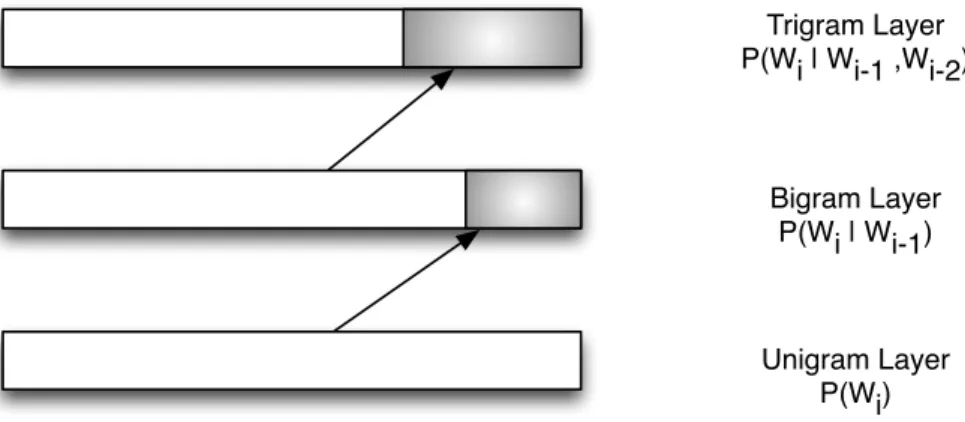
4.1. n-gram language model 23
Trigram Layer P(Wi | Wi-1 ,Wi-2)
Bigram Layer P(Wi | Wi-1)
Unigram Layer P(Wi)
Figure 4.1. Ilustration of the classic Katz backoff Model for n-gram language
model
feature of this kind of language model, enabling recursive search for a textual token in simpler models, also known as backoff. With the backoff, n-gram based language models are able to attribute a probability for a not found item that is proportional to the probability of finding it in a more general model. This is expected to perform better than attributing a constant probability, as in Lidstone smoothing. For this dissertation, we use Katz backoff, which is a method for estimating the probabilities
ˆ
P(wi|wi−1, ..., wi−n).
Katz backoff definesN levels of language models according to the generality. The first level is the most specific language model, which estimates Pˆ(wi|wi−1, ..., wi−n). If
fwi = 0 or fi−1,...,i−n = 0, backoff to the next level is needed. Similarly, the next level
estimates Pˆ(wi|wi−1,...,i−n−1). In the last level, we get the most general language model that estimates the probability of a unigram (or single token) belonging to the language model: Pˆ(wi). The discount and backoff processes are illustrated in figure 4.1.
In order to maintain the main property of conditional probabilities, it is necessary that P ˆ
P(w|wi−1, ..., wi−n) = 1,∀w ∈ L. Katz backoff accomplishes this by reserving part of the probability space for backing off. In our case, the reserve is similar to the Lidstone probability estimator (as seen on equation 4.3). The method adds a discount factor α|Cw
Sn| in the denominator of the MLE estimator, where α is the Lidstone
pa-rameter, Sn is a sequence of n words and |CSwn| is the number of different words that
appear after the sequence of words. Once we do that, we have an discounted value
DSn (equation 4.4) to be distributed in next level of the backoff. This way, we define
24 Chapter 4. Language Model
DSn =
|Cw Sn| fwi−1,...wn +α|C
w Sn|
(4.4)
β = DSn
1−DSn−1
(4.5)
Finally, the general Katz backoff formula has two cases: (1) when the n-gram is in the dataset, we run a discounted probability estimation, (2) otherwise we call the backoff model and move it to the new probability space using the factor β (Equation 4.6).
P(wi|Sn−1) =
fwi fwi,Sn −1 +α|Cw
Sn|, if wi, ...wi−n ∈L βP(wi|Sn−2), otherwise
(4.6)
In the last level (unigram level), we apply the classic Lidstone smoothing. Therefore, in a case where wi ∈/ L, we would still get a non-null probability of
ˆ
P(wi) = α/(N +α|C|). Notice that this only happens in the last level. In all other levels, Katz backoff prefers to search for a more general version of the n-gram in the following levels than atributing the same probaility to all not found items.
4.2
Context-enriched
n
-gram language model
n-gram models associated with Katz backoff are efficient methods for estimating the probability of sentences belonging to a language. However, based on Pragmatics theory, we believe that the decision whether a tokenwibelongs to a languageLdoes not depend only on the sequence of tokens that occurred before it in the sentence. We believe that context may be as important, or even more important, than this sequence in some cases. Therefore, we need new language models that do not rely solely on text but also on features used by human cognition to interpret sentences. In this section, we propose a novel language model that considers a contextual score as one of the priors in the conditional probability.
In this novel language model, we want to estimate the probability
ˆ
P(wi|Cj, wi−1, wi−2, wi−3, ..., wi−n), where Cj is the contextual score of one of the pro-posed contextual models (j ={AKC, SC}, whereAKC is the agent knowledge context and SC is the situational context). For maintaining the same probability estimation method (i.e. Katz backoff and Lidstone smoothing), we useCj, a discretized value
1 of
1
4.2. Context-enriched n-gram language model 25
the contextual score. This way, Cj can be considered as an artificial “word” that rep-resents how likely it is for the message to be related to the subject or, in other words, to belong to the language. It is also important to stress thatCj is a message attribute. Therefore, its value is the same for all n-grams extracted in a single message.
The intuition behind the proposed attribute Cj is that we expect that some
n-grams may belong to the language only in the presence of important contextual information. For instance, the trigram “And he scores” is much more likely to be related to the subject “football” when there is a football match going on. In this case,
Cj would get a higher score during a football match and the language model would return a much higher value than for a contextualized n-gram. Another good example is when there is ambiguity in the n-gram. For example, if the trigram “NY is terrible” was uttered by a basketball fan, this would likely to be related to the NBA team, not to the city. In this scenario, Cj would be high when j is theAKC score and the language model would recognize that “NY is terrible ” is a common trigram in this case. Unfortunately, adding the context into the language model is not trivial. In order to fully integrate it with classic n-gram model we had to modify Katz backoff.
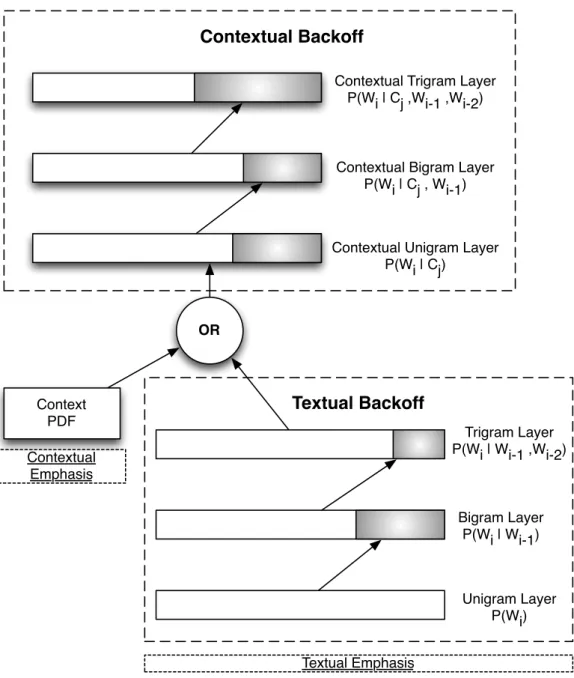
To include context in the backoff process, we added new levels to the lan-guage model. The first level is the full contextual n-gram, for which the probability,
ˆ
P(wi|Cj, wi−1, ..., wi−n)is estimated. In the following level, we maintain the contextCj and remove the word token wi−n from the prior, therefore we estimate the probability
ˆ
P(wi|Cj, wi−1, ..., wi−n−1). The contextual unigram is the last level in the contextual backoff. In this level, we maintain only theCj in the prior, so the estimated probability is Pˆ(wi|Cj). If this contextual unigram still cannot be found in the training set, we run the previous n-gram language model ignoring context.
Notice that, in this solution, we fall back to the traditional n-gram whenever context associated with text fails. However, it is possible to prioritize context when this happens. In order to accomplish that, we compute the probability distribution function (PDF) for the contextual scores and attribute it to the the token when we fail to find the contextual unigram. This way, instead of receivingPˆ(wi|wi−1, ..., wi−n), which depends only on text, the backoff would get P DFj(C
j), which relies only on context.
26 Chapter 4. Language Model
Textual Backoff
Trigram Layer P(Wi | Wi-1 ,Wi-2)
Bigram Layer P(Wi | Wi-1)
Unigram Layer P(Wi) Contextual Trigram Layer
P(Wi | Cj ,Wi-1 ,Wi-2)
Contextual Bigram Layer P(Wi | Cj , Wi-1)
Contextual Unigram Layer P(Wi | Cj)
Contextual Backoff
Context PDF
OR
Contextual Emphasis
Textual Emphasis
Figure 4.2. Ilustration of the context-enriched language model backoff
Chapter 5
Dataset
For the experimental evaluation of the proposal in this dissertation, a dataset was gathered using Twitter’s streaming API. This dataset comprises tweets which could be related to three popular American sports and their leagues: american football (NFL), baseball (MLB) and basketball (NBA). Our goal is to define if a given message ref-erences one of these subjects. For that, we define two subsets of messages: training stream and test stream. The training stream is used exclusively for model generation, while the test stream is the one we extract messages for labeling. In the next sessions, we are describe the process of data gathering and some characterizations of the dataset.
5.1
Dataset information
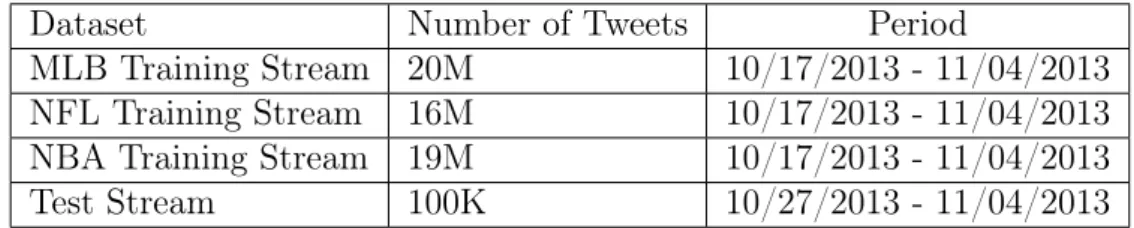
For evaluating our hypotheses and the proposed language model we use three training streams (one for each subject) and one test stream collected using Twitter’s streaming API. The training streams were collected by keyword-selection approach. Since the keywords were manually choosen focusing on recall, they may include some ambiguous keywords. Consequently, the training stream may contain tweets that are not related to the subject.
For the test stream, we employed a user-selection approach. The set of users was chosen from each training stream according to the method we presented in the previous chapter. Then, we collected all tweets posted by these users.
28 Chapter 5. Dataset
Dataset Number of Tweets Period
MLB Training Stream 20M 10/17/2013 - 11/04/2013
NFL Training Stream 16M 10/17/2013 - 11/04/2013
NBA Training Stream 19M 10/17/2013 - 11/04/2013
Test Stream 100K 10/27/2013 - 11/04/2013
Table 5.1. Information about the collected streams
During the test set period, the following events, related to the target subjects, took place:
• Baseball (MLB):World Series 2013 St Louis Cardinals vs. Boston Red Sox -Matches happened on 10/23, 10/24, 10/26, 10/27, 10/28 and 10/30. In the end, the Red Sox won the series and became the 2013 champions.
• American Football (NFL): Mid Regular Season 2013 - Weeks 8 and 9 - All regular season matchups on NFL happen on Thursdays, Sundays and Mondays. Therefore, all matches happened on 10/27, 10/28, 10/31, 11/03 and 11/04.
• Basketball (NBA): Preseason and early season - Week 1 - There are matches every day since the start of the preseason.
It is expected that characteristics of these events have a major impact on con-textual features and on the language model result. We will explore this in the next sections.
Labeling messages from the test dataset was not a trivial task. Since we wanted to improve the recall in messages that do not have textual references to the subject, we could not rely on traditional methods of annotation that only consider the text of the message. Therefore, to annotate a tweet we consider user profile, previous messages, time of post, mentions to other users and other contextual information. Of course, such annotations had to be performed manually, thus limiting the size of the training set.
In the next sections, we show some interesting information about the collected training stream and test stream. Since they were collected using different approaches, we discuss characteristics of these streams separately.
5.2
Training stream
5.2. Training stream 29
(for more information look at the appendice). To increase recall in the training stream, we chose to include many ambiguous keywords inK. Sport teams in the United States are trditionally named after a location and a nickname, for instance, “New York Giants” and “Baltimore Ravens”. We chose to include in K, the location and the nickname of all teams separetely (following the last example we would include “New York”, “Giants”, “Baltimore” and “Ravens”) and some other keywords referencing to the sport (such as “touchdown”, “nfl” and “field goal”). Notice that some nicknames and all locations are ambiguous. Fortunately, the proposed algorithms are robust towards ambiguity and are able to generate good contextual models even if many tweets in R do not reference subject s, as the experimental results in Chapter 6 show.
5.2.1
Characterization
5.2.1.1 Users
In Chapter 3, we proposed using weights inspired in TF-IDF for modeling the agent knowledge context (AKC). In our model, users are characterized by the set of keywords
k ∈ K used by them in R. The model proposes an analogy, in which users play the role of documents in traditional TF-IDF. In order to use TF-IDF-like weights for the
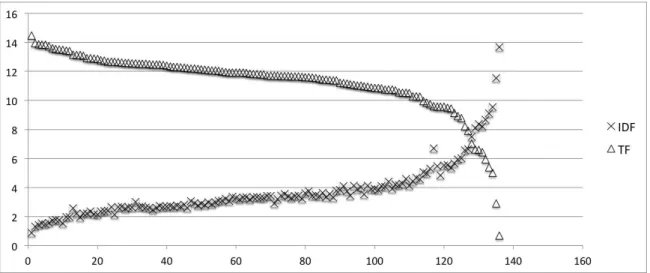
AKC model, we need to show that the distribution of the TF component is similar to the IDF one [Baeza-Yates and Ribeiro-Neto, 1999]. It is intuitive to think that if one of them grows faster than the other, one term would be dominant. Figure 5.1 shows that this is not case in our database. In this figure, we plot the TF and IDF values for each keyword. We can see that many words have similar TF and IDF values in the center portion of the graph. This happens because of the similarity between keywords (most are team names and nicknames). The words with high IDF and low TF are the least ambiguous ones. We show an example of those in Table 5.2.
30 Chapter 5. Dataset
Figure 5.1. Score of TF and IDF for each keyword ordered by the reverse TF
order
Figure 5.2. Sum of all TF of a keyword by TF-IDF of that word
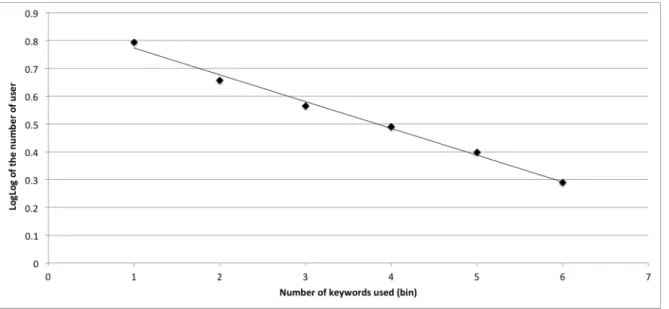
examples of keywords that can be considered ambiguous and unambiguous and their IDF score. Moreover, both Figure 5.1 and Table 5.2 are empirical demonstrations of Hypothesis 3.2, which posits that the ambiguity degree of a word is related with its frequency.
5.2. Training stream 31
Unambiguous Keywords Ambiguous Keywords
Keyword IDF Keyword IDF
cheesehead 52.51 SF 27.50
nyj 44.98 miami 21.19
white sox 52.75 boston 20.29
SF giants 52.70 NY 12.76
diamondbacks 53.76 new york 21.27
Table 5.2. Examples of ambiguous and unambiguous keywords
Figure 5.3. LogLog of the number of users in each bin according to the keywords
used by them
5.2.1.2 Time Frame
For estimating the likelihood of a message to be related to a subject during an arbi-trarily defined frame of one hour, we consider the frequency of keywords posted during that timeframe. By Hypothesis 3.3, we believe that this likelihood is related to the amount of messages containing keywords posted during the timeframe. For penalizing ambiguous keywords, our proposed model uses the IDF score computed in the AKC
model.
32 Chapter 5. Dataset
Figure 5.4. Frequency of keywords in each one-hour time window of the training
stream
the World Series. Therefore, this is a good example of Hypothesis 3.3: the increase in the frequency of these unambiguous keywords shows that there is an important event happening by that time. On the other hand we can see an ambiguous keyword (“boston”) that followed the event peaks, but also had a really big peak on the last frames. Since “boston” has a low IDF, this probably offtopic peak does not have a major impact in the proposed model.
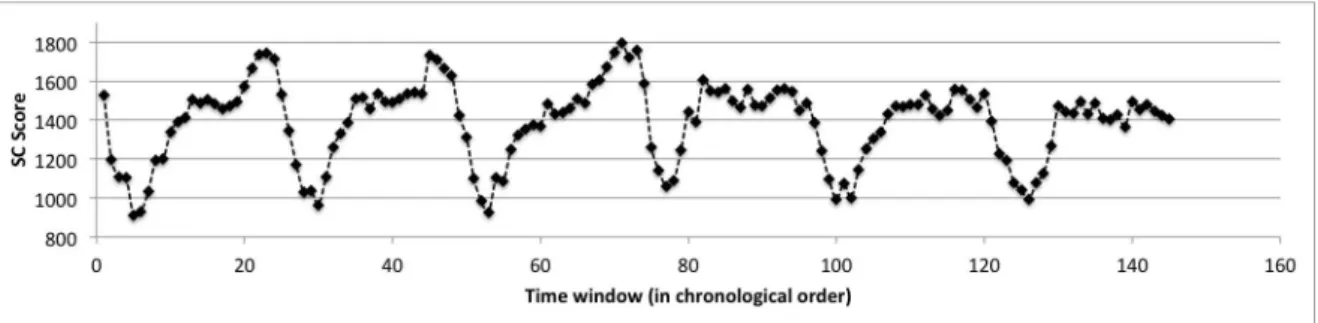
Figure 5.5 shows the Situational Context value (defined in Equation 3.5) for each time frame in the MLB dataset. It is easy to see that it followed the peak pattern from Figure 5.4, and also that noisy ambiguous words such as “NY” did not reduce the quality of the model. It is interesting to notice also that the higher values seen in this figure occur in late night periods with low traffic of messages in the United States. This is a good result, since we do not expect to have many messages related to the topic late at night. Another interesting observation is that our proposed situational context modeling is only sensitive for messages posted during major events. Therefore, when there is nothing relevant happening, we need to rely in other forms of context.
5.3
Test stream
5.3. Test stream 33
Figure 5.5. Situational Context score in each time window of the training stream
that reference the subjects. It is important for our purposes to have messages that make both kinds of references (implicit and explicit) to s in the test stream, since one of the major objectives of this dissertation is to improve the recall in messages with implicit references to the subject. To collect the test stream we chose users that posted at least one message in the training stream.
Sampling the users to be collected is not an easy task. As shown in the previous section, the estimated interest degree of a user towards a subject follows a power law. Consequently, if we simply select users at random in the training stream, it is likely that we will only get users that are not really interested in the subject. This would result in a test stream with too few positive examples. For solving this problem, we discretized our user set in 10 buckets with different sizes, according to their AKC
context. Then we sampled the same amount of users in each of them. IWe collected all tweets posted by a set of 300 sampled users.
Despite of the fact that we used different methods for collecting messages in each stream, we expect that all messages mentioning s implicitly or explicitly are under the same context and the same pragmatics effects. Consequently, we assume that using only messages that contain explicit references to s for training does not affect the perfomance of contextual models.
5.3.1
Characterization
34 Chapter 5. Dataset
Subject Positive Examples % without keywords % positives
Football 16 56.3 2.0
Baseball 14 71.4 2.0
Basketball 72 47.2 10.0
Table 5.3. Positive examples in the test stream
Figure 5.6. Scatter plot showing the differences between AKC and SC
context.
Figure 5.6 shows a scatter plot in which each point is a tweet, annotated as being related to a subject. The horizontal axis is the SC score of the message, while the vertical axis is the AKC score of the message. One important observation we can get is that there is no concentration of points with or without keywords in any region of the graph. This way we can conclude that, for our dataset, the contextual scores are independent from the presence of keywords. Another interesting side conclusion we can draw from this graph is thatSC and AKC scores do not seem to be correlated.
Chapter 6
Results
In this chapter, we discuss the results of our proposed contextual-enriched language model for our three datasets. In these experiments, we add context scores for each tweet in both training and test stream according to our models. Once we have annotated all messages with contextual scores, we generate the language model using the training stream and then we evaluate it with messages in the test stream.
In this chapter, we denote messages referring to the target subject as positive examples, while the unrelated ones as negative. In the following sections, we discuss the evaluation method, and present experimental results.
6.0.2
Evaluation Workflow
For evaluating both the context-enriched language model and the pragmatic contextual models, we use the pipeline represented in Figure 6.1. In this pipeline, we start with two separate datasets: training stream and test stream. As we argue in the Chapter 5, training stream is generated by keyword selection of messages while test stream is generated by all messages posted by a predefined set of users. The training stream is then used for generating the contextual model, Agent Knowledge or Situational. Once the model is generated, we attribute the contextual score for each message in both training and test stream.
36 Chapter 6. Results Training Stream Contextual Models [AKC, SC] Context-Enriched Training Stream Context-Enriched Test Stream Language Model Test Stream Attach context Attach context Generate Models Generate Language Model Test Input Weighted Test Stream
Figure 6.1. Ilustration of the evaluation pipeline
6.1
Evaluation Method
For evaluating the language model we used a test stream being all messages posted by a subset of users, as explained in the previous chapter. Unfortunately, positive examples are scarce on the test stream (Table 5.3). Since less than 10% of the messages are positive examples, we use a ranking evaluation method [Cremonesi et al., 2010].
The evaluation method assumes that most of the unlabeled examples are negative. Given this assumption, we sample 100 unlabeled examples into a probe set. It is expected that most of those 100 examples are negative ones. Then, we add a positive example from the annotated ones into the probe set. Next, we rank all these examples according to the proposed model and baseline scores. Once this ranking is complete, we expect the positive example to figure at one of the top positions. We run this procedure 200 times for each positive example. Finally, we plot the average number of positives found up to thenth position. Since we want to improve recall, our goal is to have a higher percentage of examples seen for every n positions. In other words, we expect the line for the proposed method to be always over the baseline.