Receptor-Mediated Vascular Contractility in Adult
Offspring
DaLiao Xiao*, Chiranjib Dasgupta, Yong Li, Xiaohui Huang, Lubo Zhang
Center for Perinatal Biology, Department of Basic Sciences, Loma Linda University School of Medicine, Loma Linda, California, United States of America
Abstract
Previous studies have reported that perinatal nicotine exposure causes development of hypertensive phenotype in adult offspring.
Aims:The present study was to determine whether perinatal nicotine exposure causes an epigenetic programming of vascular Angiotensin II receptors (ATRs) and their-mediated signaling pathway leading to heightened vascular contraction in adult offspring.
Main methods:Nicotine was administered to pregnant rats via subcutaneous osmotic minipumps from day 4 of gestation to day 10 after birth. The experiments were conducted at 5 months of age of male offspring.
Key Findings:Nicotine treatment enhanced Angitension II (Ang II)-induced vasoconstriction and 20-kDa myosin light chain phosphorylation (MLC20-P) levels. In addition, the ratio of Ang II-induced tension/MLC-P was also significantly increased in nicotine-treated group compared with the saline group. Nicotine-mediated enhanced constrictions were not directly dependent on the changes of [Ca2+]i concentrations but dependent on Ca2+ sensitivity. Perinatal nicotine treatment
significantly enhanced vascular ATR type 1a (AT1aR) but not AT1bR mRNA levels in adult rat offspring, which was associated with selective decreases in DNA methylation at AT1aR promoter. Contrast to the effect on AT1aR, nicotine decreased the mRNA levels of vascular AT2R gene, which was associated with selective increases in DNA methylation at AT2R promoter.
Significance:Our results indicated that perinatal nicotine exposure caused an epigenetic programming of vascular ATRs and their-mediated signaling pathways, and suggested that differential regulation of AT1R/AT2R gene expression through DNA methylation mechanism may be involved in nicotine-induced heightened vasoconstriction and development of hypertensive phenotype in adulthood.
Citation:Xiao D, Dasgupta C, Li Y, Huang X, Zhang L (2014) Perinatal Nicotine Exposure Increases Angiotensin II Receptor-Mediated Vascular Contractility in Adult Offspring. PLoS ONE 9(9): e108161. doi:10.1371/journal.pone.0108161
Editor:Nick Ashton, The University of Manchester, United Kingdom
ReceivedApril 19, 2014;AcceptedAugust 18, 2014;PublishedSeptember 29, 2014
Copyright:ß2014 Xiao et al. This is an open-access article distributed under the terms of the Creative Commons Attribution License, which permits unrestricted use, distribution, and reproduction in any medium, provided the original author and source are credited.
Data Availability:The authors confirm that all data underlying the findings are fully available without restriction. All relevant data are within the paper.
Funding:This research was supported by funds provided by The Regents of the University of California, Tobacco-Related Diseases Research Program (TRDRP), grant#22XT-0022 (DX) and by the National Institutes of Health grants HL089012, HL110125 (LZ), and DA032510 (DX). The funders had no role in study design, data collection and analysis, decision to publish, or preparation of the manuscript.
Competing Interests:The authors have declared that no competing interests exist.
* Email: [email protected]
Introduction
Maternal cigarette smoking is the single most widespread perinatal insult in the world [1]. Epidemiological studies have shown that maternal smoking is associated with increased risk of cardiovascular disease in offspring later in life [1–3]. As one of the major active components in cigarette smoking, nicotine readily crosses the placenta and produces higher nicotine concentrations in the fetal circulation than that experienced by the mother [4]. The heightened nicotine concentration may contribute to the maternal cigarette smoking-induced developmental programming of cardiovascular dysfunction in offspring. Indeed, nicotine use during pregnancy can cause cardiovascular disorders and hyper-tension of offspring in different animal models [5–7]. Our recent studies have demonstrated that perinatal nicotine exposure
reprograms cardiovascular functions and causes an exaggerated vascular reactivity and heightened blood pressure (BP) response in adult offspring [8–13]. However, the epigenetic and molecular mechanisms underlying the perinatal nicotine-induced heightened vascular reactivity in offspring are not fully understood.
It has been well documented that Angiotensin II (Ang II) has been implicated in pathophysiology of hypertension and other cardiovascular dysfunction induced by adversein utero environ-ment during the fetal developenviron-ment [14–16]. In an animal model of dietary restriction during pregnancy, elevated BP in adult offspring was associated with an increased sensitivity to Ang II [16]. Inhibition of Ang II type 1 receptor (AT1R) in early postnatal life
reported at an early age of spontaneously hypertensive rats [18]. Our recent studies have demonstrated that perinatal nicotine exposure enhances AT1R but decreases AT2R protein levels in the
vasculatures, resulting in a significant increased vascular reactivity and elevated BP response to Ang II in adult offspring [9]. Furthermore, previous studies have demonstrated that fetal nicotine exposure impairs kidney development and reprograms renal ATR expression which may contribute to fetal programming of hypertension [19,20]. These studies suggest that the program-ming of Ang II receptor-mediated signaling pathways is a mechanistic link between programmed cardiovascular dysfunction and intrauterine adverse factors during early development. However, the mechanisms underlying perinatal nicotine-mediated Ang II receptors expressions and transduction signaling in the developing vasculatures remain elusive.
The present study was designed to test the hypothesis that maternal nicotine administration during pregnancy causes a differential epigenetic regulation of AT1R and AT2R gene
expression via DNA methylation mechanism, leading to increase in down-stream signaling transduction pathway and enhance vascular reactivity in adult offspring. The specific aims of the present study were to determine in adult offspring whether and to what extent perinatal nicotine exposure affects 1) arterial mRNA levels of AT1R and AT2R, 2) DNA methylation levels in specific
CpG sites at AT1R and AT2R promoter regions, 3) Ang
II-induced intracellular Ca2+([Ca2+]i) signaling, 4) 20-kDa myosin
light chain phosphorylation (MLC20-P) levels, and 5) vascular
contractile function.
Material and Methods
Experimental animals
All procedures and protocols were approved by the Institutional Animal Care and Use Committee of Loma Linda University, and followed the guidelines by the National Institutes of Health Guide for the Care and Use of Laboratory Animals. Time-dated pregnant Sprague-Dawley rats were randomly divided into two groups: 1) saline control; and 2) nicotine administration through an osmotic minipump at 4mg/kg/min from day 4 of pregnancy to
day 10 after birth, as previously described [8–13]. In brief, on the fourth day of pregnancy, rats were lightly anesthetized with ketamine and xylazine, and an incision was made on their back to insert osmotic minipumps (Type 2ML4). The incision was closed with four sutures. Twelve pregnant rats were implanted with minipumps containing nicotine solution, and other eleven pregnant rats were implanted with minipumps containing only saline which served as the vehicle control. A total of 134 pups from the control and 141 pups from nicotine-treated pregnant rats were delivered. Our previous studies [8,9,12] and current studies did not show any significant differences in litter size following the nicotine exposure. Therefore, the litter size was intact as nature in each dam and all of the newborn pups were kept with their mothers until weaning. At weaning (3-weeks age), the male and female offspring were separated. Because our previous studies have demonstrated that fetal nicotine exposure causes a hypertensive response in male but not female offspring [9], the male offspring were kept and used for present studies at 5 months of age. Male offspring were anesthetized with ketamine and xylazine and scarified by removing the heart, and aortas or mesenteric arteries were isolated for functional and molecular biological studies at 5 months of age. In each experiment, the sample sizes represented the number of animal used and each animal was from a different litter.
Contractions of aortic rings
At 5 months of age, aortas were isolated and cut into 4-mm rings and mounted in 10-ml tissue baths containing modified Krebs solution equilibrated with a mixture of 95%O2 and
5%CO2.Isometric tensions were measured at 37uC, as described
previously [9]. After 60 min of equilibration, each ring was stretched to the optimal resting tension as determined by the tension developed in response to 120 mmol/L KCl added at each stretch level. Tissue were then stimulated with different doses of Angiotensin II (Ang II, 1029,1026M) (Sigma; St. Louis, MO),
and contractile tensions and 20-kDa myosin light chain phos-phorylation (MLC20-P) levels were measured simultaneously in the
same tissues. Tensions developed were continuously recorded with an online computer. To measure phosphorylated MLC20
simul-taneously in the same tissue, arterial rings were snap frozen with liquid N2-cooled clamps at the indicated times and were rapidly
immersed in a dry ice-acetone slurry that contained a 10% trichloroacetic acid (TCA) and 10 mM DTT mixture. Tissues were then stored at280uC until analysis of MLC20
phosphory-lation.
Measurement of MLC20 phosphorylation
Tissue MLC20 phosphorylation levels were measured as
described previously [21]. Briefly, tissues were brought to room temperature in a dry ice-acetone-TCA-DTT mixture and then washed three times with ether to remove the TCA. Tissues were then extracted in 100mL of sample buffer containing 20 mM Tris base and 23 mM glycine (pH 8.6), 8.0 M urea, 10 mM DTT, 10% glycerol and 0.04% bromophenol blue, as previously described [19]. Samples (20mL) were electrophoresed at 12 mA for 2.5 h after a 30 min pre-run in 1.0 mm mini-polyacrylamide gels containing 10% arcelamide, 0.27% bisacrylamide, 40% glycerol and 20 mM Tris Base (pH 8.8). Proteins were transferred to nitrocellulose membranes and subjected to immunoblot with a specific MLC20 antibody (1:500, Sigma, St. Louis, MO). Goat
anti-mouse IgG conjugated with horseradish peroxidase was used as a secondary antibody (1:2000, Calbiochem). Bands were detected with enhanced chemiluminsecence (ECL), visualized on films and analyzed with the Kodak ID image analysis software. Moles of phosphate per mole of MLC20 (fraction of MLC20
phosphorylated) were calculated by dividing the density of the phosphorylated band by the sum of the densities of the phosphorylated plus the unphosphorylated bands.
Contractions of pressurized small mesenteric arteries
Also at 5 months of age, the mesenteric arcade was excised and small mesenteric arteries (,200mm in diameter) were dissected
out under a dissecting microscope. The arterial segments were mounted and pressurized in an organ chamber (Living Systems, Burlington, VT), as previously described [9]. Vascular intracellular Ca2+concentrations ([Ca2+]i) were measured in the same tissues
Real-Time Reverse Transcription–Polymerase Chain Reaction (RT-PCR)
RNA was extracted from aortic rings and abundance of AT1aR,
AT1bR, and AT2R mRNA was determined by real-time reverse
transcription–polymerase chain reaction using an Icycler Thermal cycler (Bio-Rad, Hercules, CA), as described previously [22,23]. The primers used were: AT1aR, 59-ggagaggattcgtggcttgag-39
(forward) and 59-ctttctgggagggttgtgtgat-39 (reverse); AT1bR, 59
-atgtctccagtcccctctca-39 (forward) and 59-tgacctcccatctccttttg-39
(reverse); and AT2R, 59-caatctggctgtggctgactt-39 (forward) and
59-tgcacatcacaggtccaaaga-39(reverse). Real-time reverse transcrip-tion–polymerase chain reaction was performed in a final volume of 25mL. Each polymerase chain reaction mixture consisted of 600 nmol/L of primers, 33 U of M-MLV reverse transcriptase (Promega, Madison, WI), and iQ SYBR Green Supermix (Bio-Rad) containing 0.625 U Taq polymerase, 400mmol/L each of dATP, dCTP, dGTP, and dTTP, 100 mmol/L KCl, 16.6 mmol/ L ammonium sulfate, 40 mmol/L Tris-HCl, 6 mmol/L MgSO4,
SYBR Green I, 20 nmol/L fluorescing, and stabilizers. The following reverse transcription–polymerase chain reaction proto-col was used: 42uC for 30 minutes, 95uC for 15 minutes followed by 40 cycles of 95uC for 20 seconds, 56uC for 1 minute, 72uC for 20 seconds. Glyceraldehyde-3-phosphate dehydrogenase was used as an internal reference and serial dilutions of the positive control was performed on each plate to create a standard curve. Polymerase chain reaction was performed in triplicate, and threshold cycle numbers were averaged.
Quantitative Methylation-Specific Polymerase Chain Reaction (qMS-PCR)
CpG methylation at rat AT1aR and AT2R gene promoter was
determined as previously described [22,23]. Briefly, genomic DNA were isolated from aortic rings from control and nicotine-treated 5 month-old offspring using a GenElute Mammalian Genomic DNA mini-Prep kit (Sigma), denatured with 2 N NaOH at 42uC for 15 min, and treated with sodium bisulfite at 55uC for 16h, as previously described [13,22,23]. Bisulfite treatment of DNA converted cytosines to uracils. However, methylated cytosines at CpG were not converted. DNA was purified with a Wizard DNA clean up system (Promega). The bisulfite-modified DNA was used as a template for PCR. Specific primers were designed to amplify the target regions of interest with unmethylated CpG by detecting uracils and those with methylated CpG by detecting cytosines. GADPH was used as an internal reference gene. Real-time methylation-specific PCR was performed using iCycler real-time PCR system (BioRad). Data were presented as the percentage of methylation of the regions of interest (methylated CpG/[methyl-ated CpG + ummethylated CpG] X 100%). The significant differences in the level of methylation of individual CpG between control and nicotine treated offspring were tested by Student’s unpaired t test.
Statistical analysis
Data were presented as the mean6SEM. The differences were evaluated for statistical significance (P,0.05) by ANOVA or byt
test, where appropriate.
Results
Effects of nicotine on Ang II-induced contraction and MLC20phosphorylation
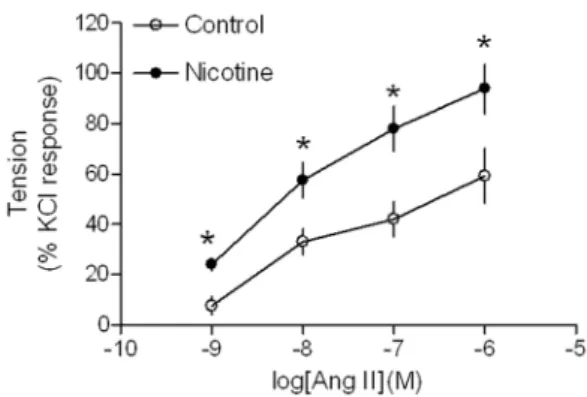
Ang II produced dose-dependent increases in contractions of aortic rings from both saline control and nicotine-treated animals
(Fig. 1). However, Ang II-induced dose-dependent contractions were significantly higher in nicotine-treated group than those in saline control group. Similar to the contractions, Ang II-induced,
Figure 1. Effect of nicotine on Ang II-induced contractions in aortic rings in adult offspring.Ang II-induced contractions of aortic rings were determined in male adult offspring that had been exposed in utero to saline control or nicotine. Data are expressed as percentage of maximal KCl-induced contractions of the same tissue. Data are means6
SEM of tissues from saline control (n = 4) and nicotine (n = 5). The sample sizes represent the animal number from different litters of each group. Data were analyzed by studentt-test at each correspondent Ang
II dose point between saline control and nicotine-treated group.*P,
0.05 vs. control.
doi:10.1371/journal.pone.0108161.g001
Figure 2. Effect of nicotine on Ang II-induced 20-kDa myosin light chain (MLC20) phosphorylation in aortic rings in adult
offspring.Aortic rings from saline control and nicotine-treated groups were stimulated with increasing doses of Ang II. Phosphorylation of MLC20 (MLC20-P) was detected by Western blot (as described in
METHODS). Representative immunoblot (top) shows unphosphorylated MLC20and phosphorylated MLC20(MLC20-P) induced by Ang II. Data are
means6SEM of tissues from saline control (n = 4) and nicotine (n = 5). The sample sizes represent the animal number from different litters of each group. Data were analyzed by studentt-test at each
correspon-dent Ang II dose point between saline control and nicotine-treated group.*P
,0.05 vs. control.
dose-dependent increases in phosphorylation levels of MLC20
were also significantly enhanced in aortic rings of nicotine-treated rats compared with saline control rats (Fig. 2). To further determine whether nicotine affected the force-MLC20
phosphor-ylation relation, Ang II-induced tensions (Fig. 1) were plotted against their corresponding MLC20-P levels of both control and
nicotine-treated groups (Fig. 2). The slope value obtained from the tension-MLC20-P relation curve in nicotine-treated group was
significantly higher than that in control group (11.82 6 1.1 vs. 7.0460.96, P,0.05).
Effects of nicotine on Ang II-induced contraction and [Ca2+]
i
As shown in Figure 3A (trace), Ang II (100 nM) produced vasoconstrictions and decreases in the arterial diameter of pressurized small mesenteric arteries, which were associated with increases in [Ca2+]i. As shown in Figure 3 (bar graph), nicotine
treatment significantly enhanced Ang II-induced contractile responses compared with the control group (Fig. 3B). Ang II-induced increases in [Ca2+]i were not significant differences
between nicotine-treated and control groups (Fig. 3C). However, the ratio of diameter change/[Ca2+]i-induced by Ang II was
significantly higher in nicotine-treated group that that in control
group (Fig. 3D) (974.46125.3 vs. 479.2681.8mm/Rf340/f380, P ,0.05).
Effect of nicotine on vascular expression patterns of AT1R and AT2R in adult offspring
Our previous studies have demonstrated that perinatal nicotine exposure significantly increases AT1R but decreases AT2R protein
levels, resulting in a significant increase in the ratio of AT1R/
AT2R protein abundances in the aorta of adult male offspring [9].
To determine whether the protein expressions were regulated through transcriptional mechanism, we measured the mRNA abundance of ATR in the aorta of adult offspring. As shown in Figure 4, nicotine treatment significantly increased AT1aR mRNA
but not AT1bR mRNA abundance in aorta as compared with the
control. However, vascular AT2R mRNA abundance was
significantly decreased in nicotine-treated group as compared with the control group.
Effect of nicotine on DNA methylation of CpG locus at AT1R and AT2R promoter
Recent studies indicated that alteration of CpG methylation in sequence-specific transcription factor binding sites played an important role in epigenetic modification of gene expression
Figure 3. Effect of nicotine on Ang II-induced contractions and Ca2+mobilization in mesenteric arteries in adult offspring.Ang II-induced contractions of pressurized mesenteric arteries were determined in male adult offspring that had been exposed in utero to saline control or nicotine.A, Typical recordings of Ang II (100 nM)-induced decreases in the arterial diameter and increments in [Ca2+]
iin the same tissue from saline
control and nicotine-treated groups. Ang II-induced contractions (B), [Ca2+
]i(C), and arterial diameter change/[Ca2+]iratio (D) in mesenteric arteries
from the control and nicotine-treated animals. Data are means6SEM of tissues from saline control (n = 7) and nicotine (n = 8). The sample sizes represent the animal number from different litters of each group. Data were analyzed by studentt-test.*P,0.05 vs. control.
patterns in the developing fetus in response to perinatal stress [13,24–26]. From rat AT1aR gene bank, we have identified, at
least five transcription factors binding sites located in CpG locus at rat AT1aR gene promoter region (Figure 5A). As shown in
Figure 5B, the methylation levels of CpG locus at ERa,bbinding site (2484) and Sp1 transcription factor binding site (296) of
AT1aR promoter region were significantly decreased in the aorta
of adult offspring with maternal nicotine administration, when compared with the control. However, nicotine did not significantly alter the methylation status of CpG sites at2809,2725 and2
150. In contrast to the effect of nicotine on AT1aR, nicotine
selectively increased methylation levels of CpG locus at CREB binding site (2444) and GRE binding site (+11) of AT2R promoter
region as compared with the control (Figure 6). However, the methylation levels at the CpG site (252) near TATA box were not significant difference between the nicotine-treated and control animals.
Discussion
Our previous studies have demonstrated that perinatal nicotine exposure causes a sex-dependent increase in blood pressure response in adult male rat offspring [9]. The present study provides new evidence that epigenetic programming of vascular Ang II receptors gene expressions and their-mediated signaling pathway plays a key role in nicotine-mediated developmental programming of hypertensive phenotype in adult offspring. The major findings in present study are the following: (1) perinatal nicotine exposure enhanced contractile responses to Ang II in both aortic and mesenteric arteries in adult offspring; (2) the enhanced vasoconstriction was not associated with changes of intracellular Ca2+concentration ([Ca2+]i) but dependent on Ca
2+
sensitivity of myofilaments; (3) nicotine enhanced Ang II-induced MLC20
phosphorylation level and the ratio of tension/MLC20-P; (4)
nicotine exposure differentially increased AT1aR mRNA but
decreased AT2R mRNA abundance in vasculatures; (5) the
enhanced AT1aR gene expression was associated with decreased
Figure 4. Effect of nicotine on mRNA abundance of AT1R and
AT2R in aortic rings in adult offspring.RNA was extracted from
aortic rings isolated from saline control and nicotine-treated animals. The abundance of AT1aR, AT1bR, and AT2R mRNA was determined by
real-time reverse transcription-polymerase chain reaction analysis (as described in METHODS). Data are means6SEM of tissues from saline control (n = 4) and nicotine (n = 4). The sample sizes represent the animal number from different litters of each group. Data were analyzed by studentt-test.*P,0.05 vs. control.
doi:10.1371/journal.pone.0108161.g004
Figure 5. Effect of nicotine on CpG methylation of AT1aR
promoter in aortic rings in male offspring. Aortic rings were freshly isolated from male adult offspring that had been exposed in utero to saline control or nicotine. DNA was isolated and methylation levels were determined by methylation-specific real-time PCR. Data are means6SEM of tissues from saline control (n = 4) and nicotine (n = 4). The sample sizes represent the animal number from different litters of each group. Data were analyzed by studentt-test.*P,0.05 vs. control.
doi:10.1371/journal.pone.0108161.g005
Figure 6. Effect of nicotine on CpG methylation of AT2R
promoter in aortic rings in male offspring. Aortic rings were freshly isolated from male adult offspring that had been exposed in utero to saline control or nicotine. DNA was isolated and methylation levels were determined by methylation-specific real-time PCR. Data are means6SEM of tissues from saline control (n = 4) and nicotine (n = 4). The sample sizes represent the animal number from different litters of each group. Data were analyzed by studentt-test.*P,0.05 vs. control.
methylation levels of specific CpG sites at AT1aR promoter, and
the decreased AT2R expression was associated with selectively
increased methylation levels of specific CpG sites at AT2R
promoter.
In the present study, we found that Ang II-induced vasocon-strictions were significantly increased in both aortic and mesenteric arteries of adult male offspring in perinatal nicotine treated group compared with the control group, which is consistent with previous findings that perinatal nicotine exposure enhances vasoconstriction and blood pressure response in male offspring in the similar animal model [8–10]. Heightened vascular contractility and programmed elevation of blood pressure has been reported in several different animal models, including in utero and neonatal exposure to secondhand smoke [27], antenatal glucocorticoid exposure [15] and maternal food restriction [28]. However, little is known about the programming of contractile signaling of vascular smooth muscle in response to in utero adverse environmental stress. Smooth muscle contraction is regulated through both thick and thin-filament regulatory pathways [29– 31]. Thick-filament regulation is mediated through MLC20
phosphorylation-dependent pathway including both Ca2+ -depen-dent and –indepen-depen-dent mechanisms. Increased intracellular Ca2+ concentration leads to activation of myosin light chain kinase (MLCK) and phosphorylation of MLC20, but Ca2+-independent
mechanisms mainly involve inactivation of myosin light chain phosphatase (MLCP) and decreased MLC20 dephosphorylation.
Present findings that nicotine enhanced Ang II-induced vasocon-striction without significant change of intracellular Ca2+ concen-tration, suggesting that nicotine-mediated enhanced vasoconstric-tion may predominately regulated through Ca2+-independent
mechanism, i.e. Ca2+ sensitivity of myofilaments. Because alterations in the activities of MLCK and/or MLCP at fixed [Ca2+]ican alter the Ca2+sensitivity of MCL20phosphorylation,
the present results that nicotine enhanced Ang II-induced MLC20
phosphorylation levels, suggest that nicotine exposure may regulate MLCK or/and MLCP activities independent of changes in [Ca2+]i. Previous studies have reported that MLCP is the
primarily involved in agonist-induced Ca2+ sensitization, but MLCK is mainly regulated through agonist-induced changes in [Ca2+]i [31]. These findings suggest that alteration of MLCP
activity may play a key role in the regulation of the Ca2+sensitivity of MLC20 phosphorylation in adaptation of vasculatures to
nicotine exposure. Ang II-induced vascular contraction is regulat-ed through G-protein couplregulat-ed receptor-mregulat-ediatregulat-ed signaling path-ways [32]. Typically, Ang II binding with its receptor activates phospholipase C, leading to generate inositol trisphosphate (IP3)
which increases in [Ca2+]i and increase diacylglycerol (DAG)
production which results in activation of protein kinas C (PKC). It has been demonstrated that PKC is able to modulate the Ca2+
sensitivity via phosphorylation of MLCP subunit, which leads to inhibition of MLCP activity [33]. Therefore, changes of Ang II/ ATR-mediated PKC may play a key role in the adaptation of vascular thick-filament function to perinatal nicotine exposure.
In addition to the thick filament regulation, thin filament regulatory pathway also plays a key role in regulation of Ca2+ sensitivity. Smooth muscle thin filament-associated proteins, such as caldesmon, can inhibit myosin ATPase activity and generate vascular force without changes of [Ca2+]iand MLC20
phosphor-ylation level [34]. In support this concept, our present results by experiments of simultaneous measurement of tension and MLC20
phosphorylation in the same tissue indicated that the ratio of Ang II-induced tension to MLC20phosphorylation level was higher in
nicotine-treated group than in saline control group, which suggest that thin filament regulatory pathway, i.e. increased tension at
fixed MLC20-P, occurs in Ang II-mediated contraction and it is
enhanced by nicotine exposure. In present study we can simultaneously measure the changes of pressurized arterial diameter and Ca2+ signal only in the small mesenteric artery (100,200mm in diameter) but not in the large aortic ring by using
the IonOptix instrument system. However, we can simultaneously measure the changes of vascular tension and phosphorylation level of 20-kDa myosin light chain only in the aortic ring but not in the mesenteric artery in tissue bath. Therefore, we have to measure Ang II-induced changes of Ca2+signal in mesenteric artery and but myosin light chain phosphorylation level in aortic ring. Although the technique limitation may affect our data interpre-tation, our previous studies have demonstrated that the effect of nicotine on Ang II-induced vascular contractile response is the same in both mesenteric artery and aortic ring [9]. This suggests that Ang II-induced signal response to nicotine exposure may be not changed by vessel type.
Our previous studies have demonstrated a significant increase in AT1R but decrease in AT2R protein abundances, resulting in a
significant increase in the ratio of AT1R/AT2R of vasculatures in
adult offspring in response to fetal nicotine exposure [9]. It suggests that epigenetic mechanisms are involved in reprogram-ming of the gene expression pattern of Ang II receptors in arteries that persist into adulthood. In the present studies, our data indicated that nicotine treatment significantly increased AT1aR
mRNA but decreased AT2R mRNA abundance in vasculatures of
adult offspring as compared with the control group, suggesting that nicotine-mediated alteration of ATR protein level is mainly regulated at transcriptional level. Change of transcriptional level of gene in fetal programming suggests epigenetic mechanisms involved. One of the major epigenetic mechanisms is DNA methylation. Recent studies have reported that DNA methylation is a key mechanistic link between cigarette smoking and cancer, as well as prenatal cigarette-smoke exposure and the development of adult chronic diseases [35]. DNA methylation is one of the most important mechanisms for epigenetic modification of gene expression patterns and occurs at cytosine in the CpG dinucleotide sequence [36,37]. Methylation of CpG islands in gene promoter region can alter chromatin structure and transcription, leading to a long-term shutdown of the gene expression. In addition, methylation of a single CpG dinucleotide at sequence-specific transcription factor binding sites may inhibit gene expression through changes in the binding affinity of transcription factors [38]. Recent studies have demonstrated that CpG methylation in sequence-specific transcription factor binding sites play an important role in epigenetic modification of gene expression patterns in the developing fetus in response to different perinatal stresses [13,24–26]. In the present study, we have identified several CpG islands located in the transcription factor binding sites in rat AT1aR promoter. Of these CpG sites, nicotine selectively
decreased the methylation levels at -484 and -96 CpG locus, suggesting that hypomethylation of the selective CpG locus may be an important epigenetic mechanism in up-regulation of AT1R
gene expression of vasculatures in response to perinatal nicotine exposure. Since CpG at the sites of -449 and -63 have been identified respectively as ERa,b and Sp1 transcription factor binding sites in rat AT1aR promoter, we might speculate that
nicotine-mediated decrease in sequence-specific CpG methylation at ERa,b or Sp1 binding site may be a novel mechanism of altering those transcription factors binding affinity to AT1aR
promoter and altering AT1aR promoter activity and gene
decreased the transcription factors binding affinity and activity in PKCe promoter, leading to PKCe gene repression in the developing heart [13,24,25].
The effect of nicotine on ERa,b binding sites within AT1aR
promoter is interesting and may have significant implication. Epidemiological evidence indicates that the incidence of cardio-vascular disease is low in premenopausal women, but it increases steadily in postmenopausal women, which suggests that estrogen may play an important role in the pathogenesis of hypertension and other cardiovascular diseases [39]. One of the key mecha-nisms underlying estrogen-mediated cardiovascular protection is the modulation of renin-angiotensin system (RAS). Indeed, previous studies have demonstrated that estrogen induces a down-regulation of AT1R gene expression in vasculatures,
resulting in decreased vasoconstriction and blood pressure [40,41]. Our current study shows an ER binding site at AT1aR
promoter region, suggesting that estrogen can directly regulate AT1R gene promoter activity in vasculatures. Furthermore, our
present finding that a lower methylation at the estrogen receptor binding site within the AT1aR promoter in response to nicotine
exposure, suggests that nicotine-induced demethylation may counteract the inhibitory effect of estrogen on AT1R promoter
activity, resulting in increased AT1R gene expression.
Numerous studies have shown that the effect of fetal stress on DNA methylation is a species-, gender- tissue-, organelle-, and gene-dependent [22,42–45]. In contrast to the hypomethylation at specific CpG islands in AT1aR promoter, nicotine treatment
selectively increased the methylation levels at2444 and+11 CpG locus in AT2R promoter in vasculatures. This suggests that the
effect of perinatal nicotine exposure on DNA methylation is gene-specific. In a similar animal model, previous studies have demonstrated that perinatal nicotine exposure decreases DNA methylation at AT2R promoter and AT2R protein repression of
neonatal brain in male offspring but not in female offspring [23]. These studies suggest that the effect of perinatal nicotine exposure on DNA methylation is, at least gene- and gender-dependent. The molecular mechanisms of perinatal exposure to nicotine on DNA methylation in adulthood are unclear. Given the fact that perinatal exposure to nicotine enhances vascular oxidative stress in offspring [11], we speculate that the heightened oxidative stress may directly alter methylation pattern at ATR promoter region, resulting in change of its gene expression, which open a broad door for us to further study of the potential molecular mechanisms underlying nicotine-induced DNA methylation of ATR gene.
In conclusion, the present studies provide evidence of a novel mechanism of the selectively altered methylation of specific CpG at AT1R/AT2R gene promoter in epigenetic modification of gene
expression patterns in the developing vasculature and the resultant increase in vascular contractility in adult offspring caused by perinatal nicotine exposure. As shown in Figure 7 (diagram), perinatal nicotine exposure selectively enhanced AT1R but
decreased AT2R gene expression patterns through DNA
methyl-ation mechanism. The increased AT1R/AT2R ratio enhanced
both thick-filament regulatory pathway (i.e. MLC20-P -dependent
signaling) and thin-filament regulatory pathway (i.e. MLC20P
-independent signaling), resulting in heightened vascular contrac-tility and development of hypertensive phenotype in adult offspring. Given the fact that maternal tobacco cigarette or e-cigarette smoking and use of nicotine gum and patch during
pregnancy is a major stress to the developing fetus and newborn, which may cause an increased risk of hypertension and other cardiovascular disease in adulthood, further studies on the epigenetic regulation of AT1R and AT2R gene expression patterns
in the developing cardio-vasculature should provide more insights into molecular mechanisms in maternal smoking-related cardio-vascular disease, and may suggest new insights of therapeutic strategies in the treatment of cardiovascular dysfunction in adulthood.
Author Contributions
Conceived and designed the experiments: DX CD YL XH LZ. Performed the experiments: DX CD YL XH. Analyzed the data: DX CD YL XH LZ. Contributed reagents/materials/analysis tools: DX LZ. Wrote the paper: DX LZ.
References
1. Slotkin TA (1998) Fetal nicotine or cocaine exposure: which one is worse?J Pharmacol Exp Ther.285: 931–945.
2. Beratis NG, Panagoulias D, Varvarigou A (1996) Increased blood pressure in neonates and infants whose mothers smoked during pregnancy.J Pediatr.128: 806–812.
Figure 7. Diagram of potential mechanisms underlying fetal nicotine exposure-induced hypertensive response in adult offspring.Perinatal nicotine exposure enhances AT1R and attenuate
AT2R gene expression through DNA methylation mechanism.
Nicotine-mediated enhanced AT1R/AT2R ratio predominately heightens Ca2+
sensitivity of myofilaments, leading to exaggerated vasoconstriction through both MCL20phosphorylation-dependent (thick filament) and –
independent (thin filament) signaling pathways and development of hypertensive phenotype in adult offspring.
3. Blake KV, Gurrin LC, Rvans SF, Beilin LJ, Landau LI, et al. (2000) Maternal cigarette smoking during pregnancy, low birth weight and subsequent blood pressure in early childhood.Early Hum Dev.57: 137–147.
4. Lambers DS, Clark KE (1996) The maternal and fetal physiologic effects of nicotine.Semin Perinatol.20: 115–126.
5. Pausova Z, Paus T, Sedova L, Berube J (2003) Prenatal exposure to nicotine modifies kidney weight and blood pressure in genetically susceptible rats: a case of gene-environment interaction.Kidney Int.64: 829–835.
6. Gao YJ, Holloway AC, Su LY, Takemori K, Lu C, et al. (2008) Effects of fetal and neonatal exposure to nicotine on blood pressure and perivascular adipose tissue function in adult life.Eur J Pharmacol.590: 264–268.
7. Tao H, Rui C, Zheng J, Tang J, Wu L, et al. (2013) Angiotensin II-mediated vascular changes in aged offspring rats exposed to perinatal nicotine.Peptides. 44: 111–119.
8. Xiao D, Huang X, Lawrence J, Yang S, Zhang L (2007) Fetal and neonatal nicotine exposure differentially regulates vascular contractility in adult male and female offspring.J Pharmacol Exp Ther.320: 654–661.
9. Xiao D, Xu Z, Huang X, Longo LD, Yang S, et al. (2008) Prenatal gender-related nicotine exposure increases blood pressure response to angiotensin II in adult offspring.Hypertension.51: 1239–1247.
10. Xiao D, Huang X, Yang S, Zhang L (2011) Antenatal nicotine induces heightened oxidative stress and vascular dysfunction in rat offspring. Br J Pharmacol.164: 1400–1409.
11. Xiao D, Huang X, Yang S, Zhang L (2013) Estrogen normalizes perinatal nicotine-induced hypertensive responses in adult female rat offspring. Hyper-tension.61: 1246–1254.
12. Lawrence J, Xaio D, Xue Q, Rejali M, Yang S, et al. (2008) Prenatal Nicotine Exposure Increases Heart Susceptibility to Ischemia/Reperfusion Injury in Adult Offspring.J Pharmacol Exp Ther.324: 331–341.
13. Lawrence J, Chen M, Xiong F, Xaio D, Zhang H, et al. (2011) Foetal nicotine exposure causes PKCegene repression by promoter methylation in rat hearts. Cardiovasc Res.89: 89–97.
14. Franco Mdo C, Akamine EH, Di Marco GS, Casarini DE, Fortes ZB, et al. (2003) NADPH oxidase and enhanced superoxide generation in intrauterine undernourished rats: involvement of the renin-angiotensin system.Cardiovasc Res.59: 767–775.
15. Hadoke PW, Lindsay RS, Seckl JR, Walker BR, Kenyon CJ (2006) Altered vascular contractility in adult female rats with hypertension programmed by prenatal glucocorticoid exposure.J Endocrinol.188: 435–442.
16. Langley-Evans SC, Sherman RC, Welham SJ, Nwagwu MO, Gardner DS, et al. (1999) Intrauterine programming of hypertension: the role of the renin-angiotensin system.Biochem Soc Trans.27: 88–93.
17. Sherman RC, Langley-Evans SC (1998) Early administration of angiotensin-converting enzyme inhibitor captopril, prevents the development of hyperten-sion programmed by intrauterine exposure to a maternal low-protein diet in the rat.Clin Sci (Lond).94: 373–381.
18. Wu JN, Edwards D, Berecek KH (1994) Changes in renal angiotensin II receptors in spontaneously hypertensive rats by early treatment with the angiotensin-converting enzyme inhibitor captopril.Hypertension.23: 819–822. 19. Mao C, Wu J, Xiao D, Lv J, Ding Y, et al. (2009) The effect of fetal and neonatal nicotine exposure on renal development of AT(1) and AT(2) receptors.Reprod Toxicol.27: 149–54.
20. Toledo-Rodriguez M, Loyse N, Bourdon C, Arab S, Pausova Z (2012) Effect of prenatal exposure to nicotine on kidney glomerular mass and AT1R expression in genetically diverse strains of rats.Toxicol Lett.213:228–234.
21. Xiao D, Zhang L (2005) Adaptation of uterine artery thick- and thin-filament regulatory pathways to pregnancy.Am J Physiol Heart Circ Physiol.288: H142– H148.
22. Li Y, Xiao D, Dasgupta C, Xiong F, Tong W, et al. (2012) Perinatal nicotine exposure increases vulnerability of hypoxic-ischemic brain injury in neonatal rats: role of Angiotensin II receptors.Stroke.43: 2483–2490.
23. Li Y, Xiao D, Yang S, Zhang L (2013) Promoter methylation represses AT2R gene and increases brain hypoxic-ischemic injury in neonatal rats.Neurobiology of Disease.60: 32–38.
24. Meyer K, Zhang H, Zhang L (2009) Direct effect of cocaine on epigenetic regulation of PKCegene repression in the fetal rat heart.J Mol Cell Cardiol.47: 504–511.
25. Patterson AJ, Xiao D, Xiong F, Dixon B, Zhang L (2012) Hypoxia-derived oxidative stress mediates epigenetic repression of PKCegene in foetal rat hearts. Cardiovasc Res.93: 302–10.
26. Xiong F, Xiao D, Zhang L (2012) Norepinephrine causes epigenetic repression of PKCegene in rodent hearts by activating Nox1-dependent reactive oxygen species production.FASEB J.26: 2753–63.
27. Hutchison SJ, Glantz SA, Zhu BQ, Sun YP, Chou TM, et al. (1998) In-utero and neonatal exposure to secondhand smoke causes vascular dysfunction in newborn rats.J Am Coll Cardiol.32: 1463–1467.
28. Ozaki T, Nishina H, Hansan MA, Poston T (2001) Dietary restriction in pregnant rats causes gender-related hypertension and vascular dysfunction in offspring.J Physiol.503: 141–152.
29. Horowitz A, Menice CB, Laporte R, Morgan KG (1996) Mechanisms of smooth muscle contraction.Physiol Rev.76: 967–1003.
30. Kamm KE, Stull JT (1985) The function of myosin and myosin light chain kinase phosphorylation in smooth muscle.Annu Rev Pharmacol Toxicol.25: 593–620.
31. Pfitzer G (2001) Invited review: regulation of myosin phosphorylation in smooth muscle.J Appl Physiol.91: 497–503.
32. Touyz RM, Schiffrin EL (2000) Signal transduction mechanisms mediating the physiological and pathophysiological actions of angiotensin II in vascular smooth muscle cells.Pharmacol Rev.56: 145–153.
33. Woodsome TP, Eto M, Everett A, Brautigan DL, Kitazawa T (2001) Expression of CPI-17 and myosin phosphatase correlates with Ca2+
sensitivity of protein kinase C-induced contraction in rabbit smooth muscle.J Physiol.535: 553–564. 34. Morgan KG, Gangopadhyay SS (2001) Cross-bridge regulation by thin
filament-associated proteins.J Appl Physiol.91: 953–962.
35. Lee KW, Pausova Z (2013) Cigarette smoking and DNA methylation.Front Genet.4:132.
36. Jaenisch R, Bird A (2003) Epigenetic regulation of gene expression: how the genome integrates intrinsic and environmental signals.Nat Genet.33: 245–254. 37. Jones PA, Taki D (2001) The role of DNA methylation in mammalian
epigenetics.Science.293: 1068–1070.
38. Campanero MR, Armstrong MI, Flemington EK (2000) CpG methylation as a mechanism for the regulation of E2F activity.Proc Natl Acad Sci USA.97: 6481–6486.
39. Wenger NK, Speroff L, Packard B (1993) Cardiovascular health and disease in women.N Engl J Med.329: 247–58.
40. Nickenig G, Baumer AT, Grohe C, Kahlert S, Strehlow K, et al. (1998) Estrogen modulates AT1 receptor gene expression in vitro and in vivo.Circulation.97: 2197–201.
41. Nickenig G, Strehlow K, Wassmann S, Baumer AT, Albory K, et al. (2000) Differential effects of estrogen and progesterone on AT(1) receptor gene expression in vascular smooth muscle cells.Circulation.102:1828–33. 42. Mckay JA, Wong YK, Relton CL, Ford D, Mathers JC (2011) Maternal folate
supply and ses influence gene-specific DNA methylation in the fetal gut.Mol Nutr Food Res.55: 1717–23.
43. Cryzinska M, Blaszczak E, Strachecka A, Jezewska-Witkowska G (2013) Analysis of age-related global DNA methylation in chicken.Biochem Genet.51: 554–563. 44. Jiang D, Zhang D, Wang L. Huang Y, Liu H, et al. (2013) Elevated PLA2G7 gene promoter methylation as a gender-specific marker of aging increases the risk of coronary heart disease in females.PLoS One.8: e59752.