DOI 10.1140/epjc/s10052-014-2951-y Regular Article - Experimental Physics
Studies of dijet transverse momentum balance and pseudorapidity
distributions in pPb collisions at
√
s
NN
=
5
.
02 TeV
The CMS Collaboration∗
CERN, Geneva, Switzerland
Received: 18 January 2014 / Accepted: 23 June 2014 / Published online: 23 July 2014
© CERN for the benefit of the CMS collaboration 2014. This article is published with open access at Springerlink.com
Abstract Dijet production has been measured in pPb collisions at a nucleon–nucleon centre-of-mass energy of 5.02 TeV. A data sample corresponding to an integrated luminosity of 35 nb−1 was collected using the Compact Muon Solenoid detector at the Large Hadron Collider. The dijet transverse momentum balance, azimuthal angle cor-relations, and pseudorapidity distributions are studied as a function of the transverse energy in the forward calorime-ters (ET4<|η|<5.2). For pPb collisions, the dijet transverse momentum ratio and the width of the distribution of dijet azimuthal angle difference are comparable to the same quan-tities obtained from a simulated pp reference and insensitive toET4<|η|<5.2. In contrast, the mean value of the dijet pseu-dorapidity is found to change monotonically with increasing
ET4<|η|<5.2, indicating a correlation between the energy emit-ted at large pseudorapidity and the longitudinal motion of the dijet frame. The pseudorapidity distribution of the dijet system in minimum bias pPb collisions is compared with next-to-leading-order perturbative QCD predictions obtained from both nucleon and nuclear parton distribution functions, and the data more closely match the latter.
1 Introduction
Relativistic heavy ion collisions allow to study the fun-damental theory of strong interactions—quantum chromo-dynamics (QCD)—under extreme conditions of tempera-ture and energy density. Lattice QCD calculations [1] pre-dict a new chirally-symmetric form of matter that consists of an extended volume of deconfined quarks and gluons above the critical energy density of the phase transition, about 1 GeV/fm3[2–5]. One of the most interesting exper-imental signatures of the formation of this novel matter, the quark-gluon plasma (QGP), is “jet-quenching” result-ing from the energy loss of hard-scattered partons passresult-ing
∗e-mail: [email protected]
through the medium. Back-to-back dijets have long been proposed as a particularly useful tool for studying the QGP properties [6,7]. In PbPb collisions at the Large Hadron Col-lider (LHC), the effects of this medium were observed in the first jet measurements as a dijet transverse momentum imbalance [8,9].
Recent data at the LHC for jets [8–12], correlations between jets and single particles [13–15], and charged-particle measurements [16,17], provide unprecedented infor-mation about the jet-quenching phenomenon. For head-on collisions, a large broadening of the dijet transverse momen-tum ratio (pT,2/pT,1) and a decrease in its mean is observed where, as is the case for all the dijet observables in the fol-lowing discussion, the subscripts 1 and 2 in the kinemati-cal quantities refer to the leading and subleading jets (the two highest-pTjets), respectively. This observation is con-sistent with theoretical calculations that involve differential energy loss of back-to-back hard-scattered partons as they traverse the medium [18–20]. At leading order (LO) and in the absence of parton energy loss in the QGP, the two jets have equal transverse momenta (pT) with respect to the beam axis and are back-to-back in azimuth (e.g. with the rel-ative azimuthal angleφ1,2 = |ϕ1−ϕ2| ≈ π). However, medium-induced gluon emission in the final state can signif-icantly unbalance the energy of leading and subleading jets and decorrelate the jets in azimuth.
Studies of dijet properties in pPb collisions are of great importance to establish a QCD baseline for hadronic inter-actions with cold nuclear matter [21,22]. This is crucial for the interpretation of the PbPb results, which could include the effects of both cold nuclear matter and a hot partonic medium. The dijet production rates as a function of jet pseudorapidity (η) have also been proposed as a tool to probe the nuclear modifications of the parton distribution functions (PDFs) [23–28]. Pseudorapidityη is defined as
−ln[tan(θ/2)], whereθ is the polar angle with respect to the proton beam direction.
colli-sions are presented as a function of the transverse energy in the forward calorimeters (ET4<|η|<5.2). This analysis uses pPb data recorded with the Compact Muon Solenoid (CMS) detector in 2013, corresponding to an integrated luminos-ity of 35±1 nb−1. The lead nuclei and protons had beam energies of 1.58 TeV per nucleon and 4 TeV, respectively, corresponding to a nucleon–nucleon centre-of-mass energy of√sNN =5.02 TeV. Jets are reconstructed within|η|<3 using the anti-kTsequential recombination algorithm [29,30] with a distance parameter of 0.3. This analysis is performed using events required to have a dijet with a leading jet
pT,1 > 120 GeV/c, a subleading jet pT,2 > 30 GeV/c, andφ1,2>2π/3.
2 The CMS detector
A detailed description of the CMS experiment can be found in Ref. [31]. The silicon tracker, located in the 3.8 T mag-netic field of the superconducting solenoid is used to measure charged particles within the pseudorapidity range|η|<2.5. It provides an impact parameter resolution of≈15µm and a pT resolution of about 1.5 % for particles with pT = 100 GeV/c. Also located inside the solenoid are an elec-tromagnetic calorimeter (ECAL) and a hadron calorime-ter (HCAL). The ECAL consists of more than 75 000 lead tungstate crystals, arranged in a quasi-projective geometry, and distributed in a barrel region (|η| < 1.48) and in two endcaps that extend up to|η| =3.0. The HCAL barrel and endcaps are sampling calorimeters composed of brass and scintillator plates, covering|η|<3.0. Iron hadron-forward (HF) calorimeters, with quartz fibers read out by photomul-tipliers, extend the calorimeter coverage up to|η| =5.2 and are used to differentiate between central and peripheral pPb collisions. Calorimeter cells are grouped in projective towers of granularity in pseudorapidity and azimuthal angle given byη×φ = 0.087×0.087 close to midrapidity, hav-ing a coarser segmentation at large rapidities. An efficient muon system is deployed for the reconstruction and identifi-cation of muons up to|η| =2.4. The detailed Monte Carlo (MC) simulation of the CMS detector response is based on
Geant4[32].
Because of the different energies of the two beams, the nucleon–nucleon centre-of-mass frame in pPb collisions is not at rest in the detector frame. Results are presented in the laboratory frame, where the higher energy proton beam is defined to travel in the positive η direction (θ = 0). Therefore, a massless particle emitted atηcm = 0 in the nucleon–nucleon centre-of-mass frame will be detected at
ηlab = +0.465 in the laboratory frame. During part of the data taking period, the directions of the proton and lead beams were reversed. For the dataset taken with the opposite
direc-tion proton beam, the standard CMS definidirec-tion of η was flipped so that the proton always moves towards positiveη.
3 Jet reconstruction
Offline jet reconstruction is performed using the CMS “particle-flow” algorithm [33,34]. By combining informa-tion from all sub-detector systems, the particle-flow algo-rithm attempts to identify all stable particles in an event, classifying them as electrons, muons, photons, charged and neutral hadrons. These particle-flow objects are first grouped into “pseudo-towers” according to the CMS HCAL granu-larity. The transverse-energy of the pseudo-towers is calcu-lated from the scalar sum of the transverse-energy of the particle-flow objects, assuming zero mass. Then, jets are reconstructed based on the pseudo-towers, using the anti-kT sequential recombination algorithm provided in theFastJet
framework [29,30] with a distance parameter of 0.3. To subtract the underlying event (UE) background in pPb collisions, an iterative algorithm described in Ref. [35] is employed, using the same implementation as in the PbPb analysis [8]. The energies of the particle-flow candidates are mapped onto projective towers with the same segmentation as the HCAL, and the mean and the dispersion of the energies detected in rings of constant ηare subtracted from the jet energy. Jets reconstructed without UE subtraction are used to estimate the systematic uncertainty associated with the subtraction algorithm.
The measured jet energies are then corrected to the ener-gies of the corresponding true particle jets using a factor-ized multi-step approach [36]. The MC jet energy corrections which remove the non-linearity of the detector response are derived using simulatedpythiaevents [37] (tune D6T with
PDFs CTEQ6L1 used for 2.76 TeV, tune Z2 for pp 7 TeV). The residual corrections, accounting for the small differences between data and simulation, are obtained from dijet and pho-ton+jet data and simulated events.
4 The Monte Carlo simulation
In order to study the jet reconstruction performance in pPb collisions, dijet events in pp collisions are first simulated with thepythiaMC generator (version 6.423, tune Z2) [38] and
later embedded in the simulated pPb underlying events. A minimum hard-interaction scale (pˆT) selection of 30 GeV/c is used to increase the number of dijet events produced in the momentum range studied. To model the pPb underly-ing event, minimum bias pPb events are simulated with the
hijingevent generator [39], version 1.383 [40]. Thehijing
mul-tiplicities and charged-hadron spectra, and to approximate the underlying event fluctuations seen in data.
The complete detector simulation and analysis chain is used to processpythiadijet events and these events are then
embedded intohijingevents (denoted aspythia+hijing).
The effects of the pPb underlying event on the jet position res-olution, jet energy scale, and jet finding efficiency are studied as a function of the total transverse energy detected by the HF calorimeter, jet pseudorapidity and transverse momentum. These effects are small and do not require specific corrections to the measurements, but they are considered as systematic uncertainties.
5 Event selection
The CMS online event selection employs a hardware-based Level-1 trigger and a software-hardware-based high-level trig-ger (HLT). Events are selected using an inclusive single-jet trigger in the HLT, requiring a calorimeter-based single-jet with transverse momentum pT > 100 GeV/c. The trigger becomes fully efficient for events with a leading jet with
pT>120 GeV/c. In addition to the jet data sample, a mini-mum bias event sample is selected by requiring at least one track with pT >0.4 GeV/c to be found in the pixel tracker coincident with the pPb bunch crossing.
In the offline analysis, an additional selection of hadronic collisions is applied by requiring a coincidence of at least one of the HF calorimeter towers, with more than 3 GeV of total energy, from the HF detectors on both sides of the interaction point. Events are required to have at least one reconstructed primary vertex. The primary vertex is formed by two or more associated tracks and is required to have a distance from the nominal interaction region of less than 15 cm along the beam
axis and less than 0.15 cm in the transverse plane. If there are more than 10 tracks in the event, the fraction of good-quality tracks originating from the primary vertex is required to be larger than 20 % in order to suppress beam backgrounds [41]. In addition to the selection of inelastic hadronic collisions, the analysis has extra requirements on the leading and sub-leading jet, which are the jets with the largest and the sec-ond largest pTin the|η| < 3 interval, respectively. These requirements are pT,1>120 GeV/c, pT,2>30 GeV/c, and φ1,2>2π/3. Only offline reconstructed jets within|η|<3 in the lab frame are considered in this analysis. In order to remove events with residual HCAL noise that are missed by the calorimeter noise rejection algorithms [42,43], either the leading or subleading jet is required to have at least one track withpT>4 GeV/c. This selection does not introduce a bias of the dijet kinematic distributions based on studies using
pythia+hijingMC simulation.
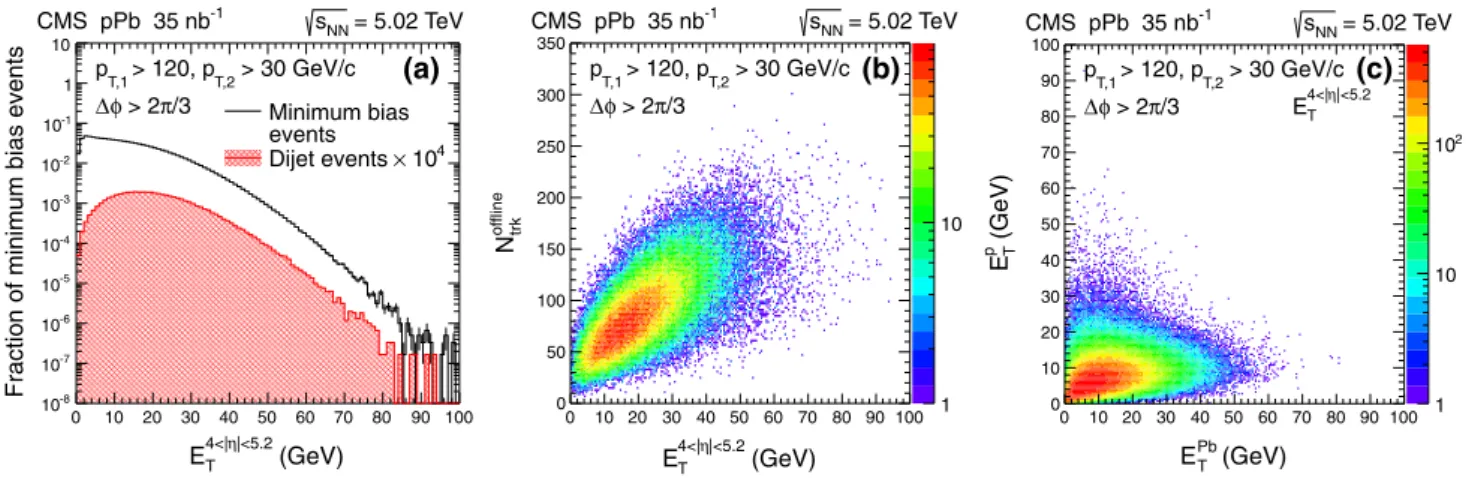
The selected minimum bias and dijet events are divided into HF activity classes according to the raw transverse energy measured in the HF detectors within the pseudora-pidity interval 4.0 < |η| < 5.2, denoted as E4T<|η|<5.2. This pseudorapidity interval is chosen in order to separate the transverse energy and dijet measurements by a pseudo-rapidity gap of at least one unit (3.0 <|η| <4.0). The HF transverse energy distribution for the selected dijet events in comparison to that for minimum bias events is shown in Fig.1a. It can be seen that the selection of a high-pT dijet leads to a bias in theET4<|η|<5.2distributions toward higher values. The correlation betweenET4<|η|<5.2and the raw num-ber of tracks originating from the primary vertex (Ntrkoffline) with|η| < 2.4 and pT > 0.4 GeV/c (before the tracking efficiency correction) is shown in Fig.1b. A broad correla-tion between the two quantities is observed in the inclusive
(GeV) |<5.2 η 4<| T E
0 10 20 30 40 50 60 70 80 90 100
Fraction of minimum bias events 10-8 -7 10 -6 10 -5 10 -4 10 -3 10 -2 10 -1 10 1 10 Minimum bias events 4 10 × Dijet events = 5.02 TeV
NN
s
-1
CMS pPb 35 nb
(a)
> 30 GeV/c
T,2
> 120, p
T,1 p /3 π > 2 φ Δ (GeV) |<5.2 η 4<| T E
0 10 20 30 40 50 60 70 80 90 100
of fline trk N 0 50 100 150 200 250 300 350 1 10
= 5.02 TeV
NN
s
-1
CMS pPb 35 nb
(b)
> 30 GeV/c
T,2
> 120, p
T,1 p /3 π > 2 φ Δ (GeV) Pb T E
0 10 20 30 40 50 60 70 80 90 100
(GeV) p T E 0 10 20 30 40 50 60 70 80 90 100 1 10 2 10
= 5.02 TeV
NN
s
-1
CMS pPb 35 nb
(c)
> 30 GeV/c
T,2
> 120, p
T,1 p /3 π > 2 φ
Δ E4<|Tη|<5.2
Fig. 1 aRaw transverse energy measured by the HF detector in the pseudorapidity interval 4.0 < |η| < 5.2 for minimum bias colli-sions (black open histogram) and dijet events passing the dijet selection defined in this analysis (red hatched histogram).bCorrelation between the raw number of reconstructed tracks from the primary vertex (Noffline
trk ) with|η|<2.4 and pT>0.4 GeV/c and raw transverse energy
Table 1 Fractions of the data sample for each HF activity class cal-culated for the minimum bias data passing DS selection and for the jet-triggered data passing dijet selection. The fourth column shows the
average multiplicity of reconstructed charged particles per bin with |η| < 2.4 and pT > 0.4 GeV/c (Ntrkcorrected). The fifth column gives the mean HF activity in each class calculated from DS events E4T<|η|<5.2range
(GeV)
Fraction of DS data (%)
Fraction of dijet data (%)
Ntrkcorrected in DS data
E4T<|η|<5.2(GeV) in DS data
<20 73.1 52.6 33±2 9.4
20–25 10.5 16.8 75±3 22.4
25–30 7.1 12.7 89±4 27.3
30–40 6.8 13.0 108±5 34.1
>40 2.5 4.9 140±6 46.3
pPb collisions. The correlation between the raw transverse energy measured by the HF detector in the pseudorapidity interval 4.0< η <5.2 (in the proton direction,ETp) and in the pseudorapidity interval−5.2 < η < −4.0 (in the lead direction,EPbT ) is also shown in Fig.1(c). It can be seen that
ETp and EPbT are only loosely correlated. In the sample of selected dijet events, 2 % contain at least one additional jet withpT>20 GeV/c and 4.0<|η|<5.2. The potential bias due to the presence of forward jets is found to be negligible and is included in the systematic uncertainty estimation.
The analysis is performed in five E4T<|η|<5.2 bins, sep-arated by the boundaries 20, 25, 30 and 40 GeV. The same analysis is also performed with inclusive data with-outET4<|η|<5.2selection, where the mean value ofE4T<|η|<5.2
is 14.7 GeV. The total number of selected events in data is corrected for the difference between the double-sided (DS) selections using particle- and detector-level information in inelastic hadronichijingMC simulation [44]. The DS
cor-rection inhijingis found to be 0.98±0.01. The
particle-level selection is very similar to the actual selection described above: at least one particle (proper life timeτ >10−18s) with
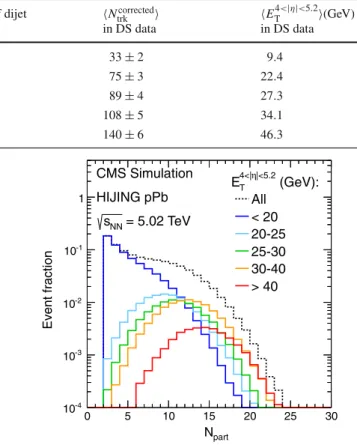
E >3 GeV in the pseudorapidity range−5< η <−3 and one in the range 3< η < 5 [44]. The efficiency-corrected fractions of minimum bias events with DS selection [44], as well as the selected dijet events from the jet-triggered sample falling into each HF activity class are provided in Table1. The average multiplicity of reconstructed charged particles per bin with|η|<2.4 andpT>0.4 GeV/c (Ntrkcorrected) after efficiency, acceptance, and misreconstruction corrections as described in Ref. [44] is also included in this table. In order to study the correlation between the collision geometry and forward calorimeter energy, the distributions of number of participating nucleons (Npart) in thehijingMonte Carlo sim-ulation in the fiveET4<|η|<5.2bins are shown in Fig.2. While the mean of theNpartdistribution is found to be increasing monotonically as a function ofE4T<|η|<5.2, the fluctuation of
Npartis found to be large in each HF activity class.
The instantaneous luminosity of the pPb run in 2013 resulted in a∼3 % probability of at least one additional inter-action occurring in the same bunch crossing. Events with more than one interaction are referred to as “pileup events”.
part
N
0 5 10 15 20 25 30
Event fraction
-4
10
-3
10
-2
10
-1
10 1
CMS Simulation
HIJING pPb
= 5.02 TeV NN
s
All < 20 20-25 25-30 30-40 > 40
(GeV): |<5.2
η
4<| T E
Fig. 2 Number of participating nucleons (Npart) in thehijingMC
sim-ulations for five differentET4<|η|<5.2bins and the cumulative distribution without any requirement onET4<|η|<5.2
Since the event classes are typically determined from the forward calorimeter information, the energy deposits from each collision in a given pileup event cannot be separated. Therefore, a pileup rejection algorithm developed in Ref. [45] is employed to select a clean single-collision sample. The pileup rejection efficiency of this filter is greater than 90 % in minimum bias events and it removes a very small fraction (0.01 %) of the events without pileup. The fraction of pileup events after pileup rejection is increasing as a function of
ET4<|η|<5.2. This fraction is found to be smaller than 2 % in the highestET4<|η|<5.2bins.
6 Results and discussion
0 0.05 0.1 0.15 0.2 0.25 0.05 0.1 0.15 0.2 0.25 0.05 0.1 0.15 0.2 0.25 0.05 0.1 0.15 0.2 0.25
0 0.2 0.4 0.6 0.8 1
Event fraction 0.05 0.1 0.15 0.2 0.25 |<5.2 η 4<| T All E (a) pPb
PYTHIA + HIJING PYTHIA
-1
CMS pPb 35 nb
0 0.2 0.4 0.6 0.8 1
Event fraction 0.05 0.1 0.15 0.2 0.25
< 30 GeV
|<5.2
η
4<| T
25 GeV < E
(d) 0 0.2 0.4 0.6 0.8 1
< 20 GeV
|<5.2 η 4<| T E (b)
= 5.02 TeV
NN
s
> 30 GeV/c
T,2
> 120, p
T,1 p T,1 /p T,2 p
0 0.2 0.4 0.6 0.8 1 < 40 GeV
|<5.2
η
4<| T
30 GeV < E
(e) 0.2 0.4 0.6 0.8 1
< 25 GeV
|<5.2
η
4<| T
20 GeV < E
(c) /3 π > 2 1,2 φ Δ
0 0.2 0.4 0.6 0.8 1 > 40 GeV
|<5.2 η 4<| T E (f)
Fig. 3 Dijet transverse momentum ratio (pT,2/pT,1) distributions for
leading jets with pT,1 > 120 GeV/c, subleading jets with pT,2 > 30 GeV/c, andφ1,2>2π/3 are shown (a) without any selection on the HF transverse energyET4<|η|<5.2, andb–ffor differentET4<|η|<5.2 classes. Results for pPb events are shown as thered solid circles, while
thecrossesshow the results forpythia+hijingsimulated events.
Results for the simulatedpythiaevents are shown as thegreyhistogram which is replicated in all thepanels. Theerror barsfor the statistical uncertainties are smaller than the marker size and the total systematic uncertainties are shown asyellow boxes
nuclei (nPDF) with respect to that of the nucleons, are also studied.
6.1 Dijet transverse momentum balance
As a function of collision centrality (i.e. the degree of over-lap of the two colliding nuclei), dijet events in PbPb colli-sions were found to have an increasing transverse momen-tum imbalance for more central events compared to a pp reference [8–10]. The same analysis is performed in pPb collisions. To characterize the dijet transverse momentum balance (or imbalance) quantitatively, the dijet transverse momentum ratio pT,2/pT,1 is used. As shown in Fig. 3, pT,2/pT,1 distributions measured in pPb data,pythiaand
pythia+hijingagree within the systematic uncertainty in
differentET4<|η|<5.2intervals, including the event class with the largest forward calorimeter activity. The residual differ-ence in the dijet transverse momentum ratio between data and MC simulation can be attributed to a difference in the jet energy resolution, which is better in the MC simulation by about∼1–2 % compared to the data [36].
In order to compare results from pPb and PbPb data, PbPb events which pass the same dijet criteria are selected for
fur-ther analysis with an additional requirement on the forward activity E4T<|η|<5.2 < 60 GeV, since the bulk of the pPb events satisfy this condition, as can be seen in Fig.1b. The measured mean value of pT,2/pT,1from these PbPb data is 0.711±0.007(stat.)±0.014(syst.), which is slightly higher than that in inclusive pPb collisions (0.689 ±0.014(syst.), with a negligible statistical uncertainty). The difference between theET4<|η|<5.2distributions for pPb and PbPb data, which results in a higher mean ET4<|η|<5.2 value for PbPb events (35 GeV), as well as the difference in centre-of-mass energy, should be taken into account in this comparison. The predictedpT,2/pT,1 is 6 % higher at√sNN = 2.76 than that at 5.02 TeV inpythiaMC simulations.
The main contributions to the systematic uncertainties of
-3 10 -2 10 -1 10 1 -3 10 -2 10 -1 10 1 -3 10 -2 10 -1 10 1 -3 10 -2 10 -1 10 1
0.5 1 1.5 2 2.5 3
φ Δ d dijet dN dijet N 1 -3 10 -2 10 -1 10 1 |<5.2 η 4<| T All E (a) pPb
PYTHIA + HIJING PYTHIA
Fit
-1
CMS pPb 35 nb
0 0.5 1 1.5 2 2.5 3
φ Δ d dijet dN dijet N 1 -3 10 -2 10 -1 10 1
< 30 GeV
|<5.2
η
4<| T
25 GeV < E
(d) 0 0.5 1 1.5 2 2.5 3
< 20 GeV
|<5.2 η 4<| T E (b)
= 5.02 TeV
NN
s
> 30 GeV/c
T,2
> 120, p
T,1
p
1,2 φ Δ
0.5 1 1.5 2 2.5 3
< 40 GeV
|<5.2
η
4<| T
30 GeV < E
(e) 0 0.5 1 1.5 2 2.5 3
< 25 GeV
|<5.2
η
4<| T
20 GeV < E
(c)
0.5 1 1.5 2 2.5 3
> 40 GeV
|<5.2 η 4<| T E (f)
Fig. 4 Distributions of the azimuthal angle differenceφ1,2between the leading and subleading jets for leading jets withpT,1>120 GeV/c and subleading jets withpT,2>30 GeV/c are shown (a) without any selection on the HF transverse energyET4<|η|<5.2, andb–ffor different E4T<|η|<5.2classes. The range forφin this figure extends below the lower bound of 2π/3, which is used in the selection of the dijets for the
other observables. Results for pPb events are shown as thered solid cir-cles, while thecrossesshow the results forpythia+hijingsimulated events. Results for the simulatedpythiaevents are shown as thegrey histogramwhich is replicated in all thepanels. Theerror barsfor the statistical uncertainties are smaller than the marker size and the total systematic uncertainties are shown asyellow boxes
jet reconstruction efficiency are found to be at the 0.1 % level based on Monte Carlo simulation.
6.2 Dijet azimuthal correlations
Earlier studies of the dijet and photon-jet events in heavy-ion collisheavy-ions [8–11] have shown very small modifications of dijet azimuthal correlations despite the large changes seen in the dijet transverse momentum balance. This is an important aspect of the interpretation of energy loss obser-vations [46].
The distributions of the relative azimuthal angleφ1,2 between the leading and subleading jets that pass the respec-tive pT selections in six HF activity classes, compared to
pythiaandpythia+hijingsimulations, are shown in
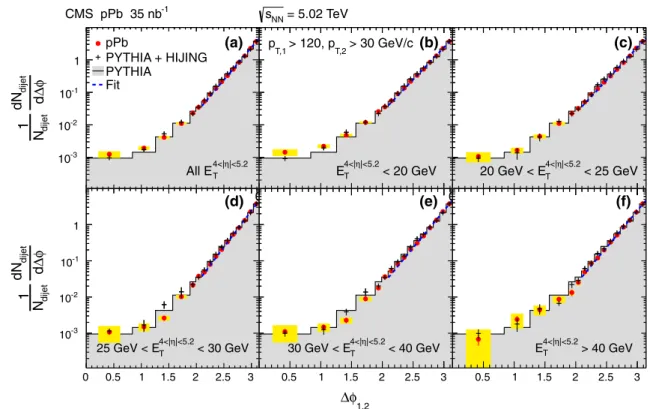
Fig-ure4. The distributions from pPb data are in good agree-ment with thepythiareference. To study the evolution of
the shape, the distributions are fitted to a normalized expo-nential function:
1
Ndijet dNdijet dφ1,2 =
e(φ−π )/σ
(1−e−π/σ) σ (1)
The fit is restricted to the regionφ1,2 >2π/3. In the data, the width of the azimuthal angle difference distribution (σ in Eq. (1)) is 0.217±0.0004, and its variation as a func-tion ofE4T<|η|<5.2is smaller than the systematic uncertainty, which is 3–4 %. The width in the data is also found to be 4–7 % narrower than that in thepythiasimulation.
6.3 Dijet pseudorapidity
The normalized distributions of dijet pseudorapidity ηdijet, defined as (η1+η2)/2, are studied in bins of ET4<|η|<5.2. Sinceηdijetand the longitudinal-momentum fractionxof the hard-scattered parton from the Pb ion are highly correlated, these distributions are sensitive to possible modifications of the PDF for nucleons in the lead nucleus when comparing
Fig. 5 aDistribution of dijet pseudorapidity
(ηdijet= [η1+η2]/2) is shown for pPb dijet events with pT,1>120 GeV/c, pT,2>30 GeV/c, and φ1,2>2π/3 as thered solid circles. The results are compared to NLO calculations using CT10 (black dashed curve) and CT10 + EPS09 (blue solid curve) PDFs.bThe difference between ηdijetin data and the one calculated with CT10 proton PDF. Theblack squares represent the data points, and the theoretical uncertainty is shown with theblack dashed line.cThe difference between ηdijetin data and the one calculated with CT10+EPS09 nPDF. Theblue solid circles show the data points andblue solid curvethe theoretical uncertainty. Theyellow bandsin
bandcrepresent experimental uncertainties. The experimental and theoretical uncertainties at differentηdijetvalues are correlated due to normalization to unit area
-1
CMS pPb 35 nb
= 5.02 TeV
NN
s
> 120 GeV/c
T,1
p
> 30 GeV/c
T,2
p
/3 π > 2
1,2
φ Δ
|<5.2 η 4<| T
All E
dijet
η
-2 -1 0 1 2
dijet
η
d
dijet
dN
dijet
N
1
0.1 0.2 0.3 0.4
0.5 CT10
CT10 + EPS09 pPb
(a)
dijet
η
-2 -1 0 1 2
Data-NLO
-0.02 0 0.02
(b)
CT10 CT10 Unc. Exp. Unc.
dijet
η
-2 -1 0 1 2 3
(c)
CT10+EPS09 CT10+EPS09 Unc. Exp. Unc.
from the uncertainty in the jet energy correction. Varying the transverse momentum of the jets by<2 % up (down) for the jet at positive (negative)ηresults in a shift of theηdijet value by±0.03. The uncertainty associated with the HF activ-ity selection bias is estimated from the difference between
pythiawithout HF activity selection andpythia+hijing
with HF activity selection. The uncertainty is found to be in the range 0.002–0.020. The uncertainty associated with the UE subtraction is studied by comparing the results with and without subtraction, which causes a shift of 0.01 in the two highest HF activity classes. Due to the normalisation to unity, a change in one data point moves the other points in the opposite direction on average, which results in a correlation of the systematic uncertainties at differentηdijetvalues.
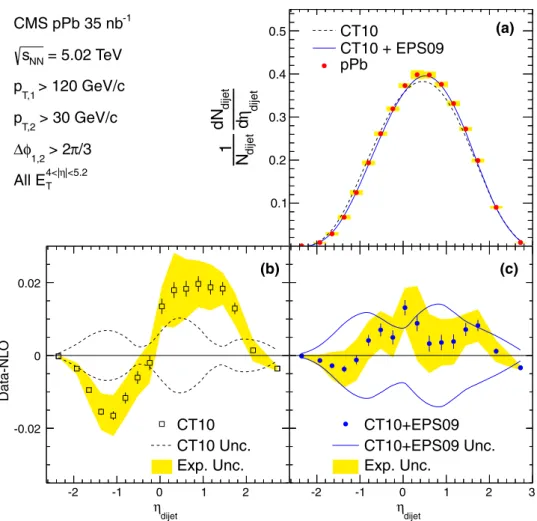
The normalized ηdijet distribution measured in inclu-sive pPb collisions, which is compared to next-to-leading-order (NLO) perturbative QCD predictions [47] using the CT10 [48] and EPS09 [24] PDFs, is shown in Fig.5. The measurement and the NLO calculation based on CT10 + EPS09 PDFs are consistent within the quoted experimen-tal and theoretical uncertainties in the wholeηdijetrange. On the other hand, the calculation using CT10 alone, which does not account for possible nuclear modifications of the PDFs,
gives a poorer description of the observed distribution. This also shows thatηdijetin pPb collisions could be used to better constrain the nPDFs by including the measurement in stan-dard global fits of parton densities.
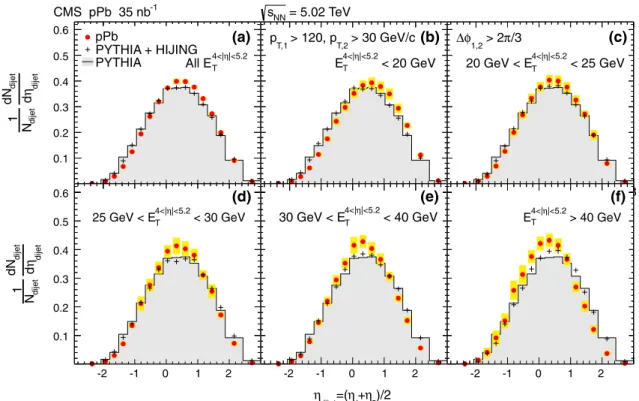
The ηdijet distributions are also studied in different HF activity classes, as shown in Fig.6. The pPb data are com-pared topythia andpythia+hijingsimulations.
Devia-tions of theηdijetdistributions in each class are observed with respect to thepythiareference without HF activity selection.
The analysis was also performed using thepythia+hijing
simulation in the same HF activity classes and no sizable deviation was observed with respect to thepythiareference.
This shows that thepythia+hijingembedded sample, which
modifi-0.1 0.2 0.3 0.4 0.5 0.6 0.1 0.2 0.3 0.4 0.5 0.6 0.1 0.2 0.3 0.4 0.5 0.6 0.1 0.2 0.3 0.4 0.5 0.6
-2 -1 0 1 2 3
dijet η d dijet dN dijet N 1 0.1 0.2 0.3 0.4 0.5 0.6 |<5.2 η 4<| T All E (a) pPb
PYTHIA + HIJING PYTHIA
-1
CMS pPb 35 nb
-2 -1 0 1 2 3
dijet η d dijet dN dijet N 1 0.1 0.2 0.3 0.4 0.5 0.6
< 30 GeV
|<5.2
η
4<| T
25 GeV < E
(d) -2 -1 0 1 2 3
< 20 GeV
|<5.2 η 4<| T E (b)
= 5.02 TeV
NN
s
> 30 GeV/c
T,2
> 120, p
T,1 p )/2 2 η + 1 η =( dijet η
-2 -1 0 1 2 3
< 40 GeV
|<5.2
η
4<| T
30 GeV < E
(e) -2 -1 0 1 2 3
< 25 GeV
|<5.2
η
4<| T
20 GeV < E
(c) /3 π > 2 1,2 φ Δ
-2 -1 0 1 2 3
> 40 GeV
|<5.2 η 4<| T E (f)
Fig. 6 Distributions of the dijet pseudorapidity (ηdijet) for leading jets withpT,1>120 GeV/c and subleading jets withpT,2>30 GeV/c are shown (a) without any selection on the HF transverse energyET4<|η|<5.2, andb–f for different ET4<|η|<5.2 classes. Results for pPb events are shown as thered solid circles, while thecrossesshow the results for
pythia+hijingsimulated events. Results for the simulatedpythia
events are shown as thegrey histogramwhich is replicated in all the panels. Theerror barsfor the statistical uncertainties are smaller than the marker size and the total systematic uncertainties are shown as yellow boxes 3 0.2 dijet η (dN/d 0.4 0.6 0.8 All ) dijet η
)/(dN/d 1.21
1.4 1.6 1.8 2 0 All ) dijet η )/(dN/d dijet η (dN/d 0 0.2 0.4 0.6 0.8 1 1.2 1.4 1.6 1.8 2 η dijet (dN/d 0.2 0.4 0.6 0.8 1 1.4 ) η All dijet )/(dN/d 1.2 1.6 1.8 2 -1
CMS pPb 35 nb
= 5.02 TeV
NN
s
> 120 GeV/c
T,1
p
> 30 GeV/c
T,2 p /3 π > 2 1,2 φ Δ
-2 -1 0 1 2 3
All ) dijet η )/(dN/d dijet η (dN/d 0 0.2 0.4 0.6 0.8 1 1.2 1.4 1.6 1.8 2
< 20 GeV
|<5.2 η 4<| T E (a) pPb Systematic Uncertainty
-2 -1 0 1 2
< 25 GeV
|<5.2
η
4<| T
20 GeV < E
(b)
-2 -1 0 1 2 3
All ) dijet η )/(dN/d dijet η (dN/d 0 0.2 0.4 0.6 0.8 1 1.2 1.4 1.6 1.8 2
< 30 GeV
|<5.2
η
4<| T
25 GeV < E
(c) )/2 2 η + 1 η =( dijet η
-2 -1 0 1 2 3
< 40 GeV
|<5.2
η
4<| T
30 GeV < E
(d)
-2 -1 0 1 2 3
> 40 GeV
|<5.2 η 4<| T E (e)
dijet
η
-2 -1 0 1 2 3
dijet η d dijet dN dijet N 1 0 0.1 0.2 0.3 0.4 0.5 -1
CMS pPb 35 nb sNN = 5.02 TeV
> 120 GeV/c
T,1
p
> 30 GeV/c
T,2 p /3 π > 2 1,2 φ Δ (a) < 20 20 - 25 25 - 30 30 - 40 > 40 classes (GeV): |<5.2 η 4<| T E dijet η
-2 -1 0 1 2 3
dijet η d dijet dN <0] dijet η [ dijet N 1 0 0.2 0.4 0.6 0.8 1 1.2 -1
CMS pPb 35 nb sNN = 5.02 TeV
> 120 GeV/c
T,1
p
> 30 GeV/c
T,2 p /3 π > 2 1,2 φ Δ (b) < 20 20 - 25 25 - 30 30 - 40 > 40 classes (GeV): |<5.2 η 4<| T E
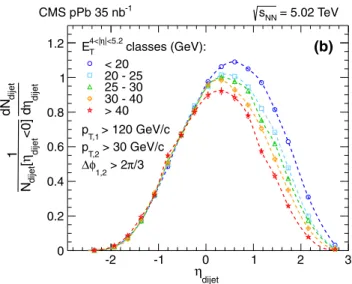
Fig. 8 Dijet pseudorapidity distributions in the five HF activity classes.
a The distributions are normalized by the number of selected dijet events.bThe distributions are normalized by the number of dijet events
withηdijet<0. Theerror barsrepresent the statistical uncertainties and thedashed linesconnecting the data points are drawn to guide the eye
cation is much larger than the predictions from the NLO cal-culations based on impact-parameter dependent nPDFs [49] in the regionx < 0.1 for partons in lead nuclei. Note that theory calculations are based on impact parameter, which can take a large range of values in each HF activity class.
The pPb distributions for different HF activity classes, from panels (b)–(f) of Fig.6, are overlaid in Fig.8. As shown in Fig.8a, a systematic monotonic decrease of the average
ηdijetas a function of the HF transverse energyET4<|η|<5.2is observed. A decrease in the longitudinal momentum carried by partons that participate in hard scattering coming from the proton, or an increase in the longitudinal momentum of partons from the lead nucleus, with increasing HF transverse energyET4<|η|<5.2would result in a shift in this direction. In order to compare the shape of theηdijetdistributions in the intervalηdijet<0 the spectra from pPb data are normalized by the number of dijet events withηdijet < 0 in the corre-sponding HF activity class. In inclusive pPb collisions, this interval roughly corresponds tox >0.1 for partons in lead, a region where the measurement is sensitive to the nuclear EMC effect [50]. Using this normalization, the shapes of the
ηdijet distributions in the regionηdijet < 0 are found to be similar, as is shown in Fig.8b.
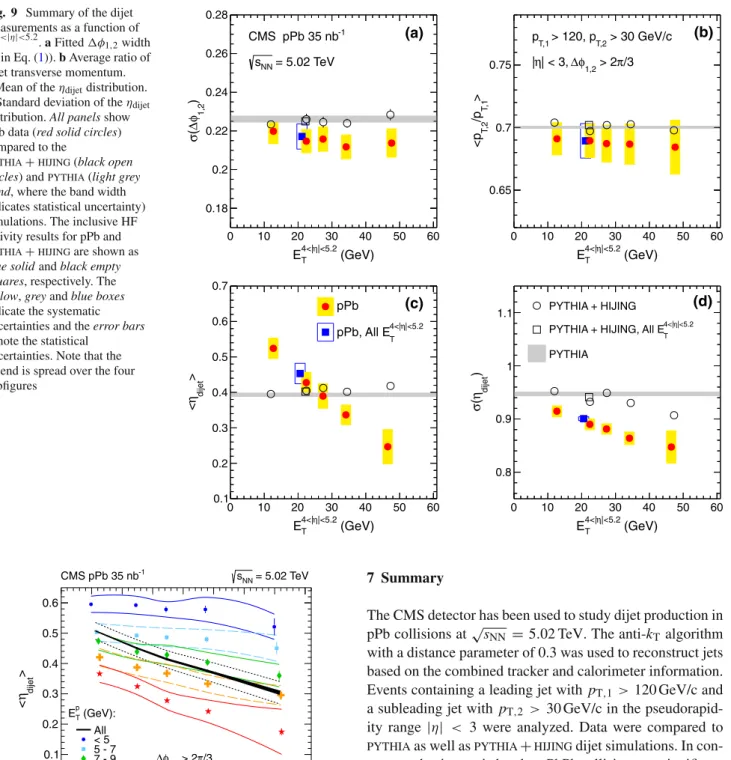
Figure9summarizes all of theET4<|η|<5.2dependent dijet results obtained with pPb collisions. A nearly constant width in the dijet azimuthal angle difference distributions and trans-verse momentum ratio of the dijets as a function ofE4T<|η|<5.2
is observed. The lower panels show the mean and standard deviation of the dijet pseudorapidity distribution, measured using jets in the pseudorapidity interval|η| <3 in the lab-oratory frame, as a function of the HF transverse energy. Those quantities change significantly with increasing
for-ward calorimeter transverse energy, while the simulated pp dijets embedded inhijingMC, representing pPb collisions,
show no noticeable changes.
One possible mechanism which could lead to the observed modification of theηdijetdistribution in events with large for-ward activity is the kinematical constraint imposed by the selection. Jets with a given transverse momentum at larger pseudorapidity will have a larger energy (E =cosh(η)pT). If a large part of the available energy in the collision is observed in the forward calorimeter region, jets above a cer-tain transverse momentum threshold are restricted to be in mid-rapidity, which leads to a narrower dijet pseudorapidity distribution. Moreover, the modification of the PDFs due to the fluctuating size of the proton, as well as the impact param-eter dependence of the nuclear PDFs, may further contribute to the observed phenomenon. Therefore, theηdijet is also studied as a function of the forward calorimeter activity in the lead direction (ETPb) at fixed values of forward activity in the proton direction (EpT).
Fig. 9 Summary of the dijet measurements as a function of ET4<|η|<5.2.aFittedφ1,2width (σin Eq. (1)).bAverage ratio of dijet transverse momentum.
cMean of theηdijetdistribution.
dStandard deviation of theηdijet distribution.All panelsshow pPb data (red solid circles) compared to the
pythia+hijing(black open
circles) andpythia(light grey
band, where the band width indicates statistical uncertainty) simulations. The inclusive HF activity results for pPb and
pythia+hijingare shown as
blue solidandblack empty squares, respectively. The yellow,greyandblue boxes indicate the systematic uncertainties and theerror bars denote the statistical
uncertainties. Note that the legend is spread over the four subfigures (GeV) |<5.2 η 4<| T E
0 10 20 30 40 50 60
) 1,2 φ Δ ( σ 0.18 0.2 0.22 0.24 0.26 0.28 -1
CMS pPb 35 nb
= 5.02 TeV
NN s (a) (GeV) |<5.2 η 4<| T E
0 10 20 30 40 50 60
> T, 1 /p T, 2 <p 0.65 0.7 0.75
> 30 GeV/c
T,2
> 120, p
T,1 p /3 π > 2 1,2 φ Δ | < 3, η | (b) (GeV) |<5.2 η 4<| T E
0 10 20 30 40 50 60
> dijet η < 0.1 0.2 0.3 0.4 0.5 0.6 0.7 (c) pPb |<5.2 η 4<| T
pPb, All E
(GeV) |<5.2 η 4<| T E
0 10 20 30 40 50 60
) dijet η ( σ 0.8 0.9 1
1.1 PYTHIA + HIJING (d)
|<5.2
η
4<| T
PYTHIA + HIJING, All E
PYTHIA
(GeV)
Pb T
E
0 5 10 15 20 25 30 35 40
> dijet η < 0 0.1 0.2 0.3 0.4 0.5 0.6 -1
CMS pPb 35 nb sNN = 5.02 TeV
> 30 GeV/c
T,2
> 120, p
T,1 p /3 π > 2 1,2 φ Δ All < 5 5 - 7 7 - 9 9 - 11 > 11 (GeV):
p T
E
Fig. 10 Mean ofηdijetdistribution as a function of the raw transverse energy measured in the HF calorimeter in the lead direction (EPb
T ) in bins of forward transverse energy in the proton direction (ETp). The linesindicate the systematic uncertainty on the points with matching color, and theerror barsdenote the statistical uncertainties. The results without selection on (ETp) are also shown as asolid black linewith statistical uncertainties represented by the line width. Thedashed black linesindicate the systematic uncertainty on thesolid black line
7 Summary
The CMS detector has been used to study dijet production in pPb collisions at√sNN =5.02 TeV. The anti-kTalgorithm with a distance parameter of 0.3 was used to reconstruct jets based on the combined tracker and calorimeter information. Events containing a leading jet with pT,1>120 GeV/c and a subleading jet with pT,2 >30 GeV/c in the pseudorapid-ity range |η| < 3 were analyzed. Data were compared to
pythiaas well aspythia+hijingdijet simulations. In
con-trast to what is seen in head-on PbPb collisions, no significant dijet transverse momentum imbalance is observed in pPb data with respect to the simulated distributions. These pPb dijet transverse momentum ratios confirm that the observed dijet transverse momentum imbalance in PbPb collisions is not originating from initial-state effects.
mean of the distribution shifts monotonically as a function of
ET4<|η|<5.2. This indicates a strong correlation between the energy emitted at large pseudorapidity and the longitudinal motion of the dijet frame.
Acknowledgments We would like to thank Jose Guilherme Milhano and Nestor Armesto for their suggestion to study the dijet pseudorapid-ity shift as a function of HF transverse energy in the proton and lead directions, which extended the scope of this analysis. We congratulate our colleagues in the CERN accelerator departments for the excellent performance of the LHC and thank the technical and administrative staffs at CERN and at other CMS institutes for their contributions to the success of the CMS effort. In addition, we gratefully acknowledge the computing centres and personnel of the Worldwide LHC Computing Grid for delivering so effectively the computing infrastructure essen-tial to our analyses. Finally, we acknowledge the enduring support for the construction and operation of the LHC and the CMS detector pro-vided by the following funding agencies: the Austrian Federal Min-istry of Science and Research and the Austrian Science Fund; the Bel-gian Fonds de la Recherche Scientifique, and Fonds voor Wetenschap-pelijk Onderzoek; the Brazilian Funding Agencies (CNPq, CAPES, FAPERJ, and FAPESP); the Bulgarian Ministry of Education and Sci-ence; CERN; the Chinese Academy of Sciences, Ministry of Science and Technology, and National Natural Science Foundation of China; the Colombian Funding Agency (COLCIENCIAS); the Croatian Min-istry of Science, Education and Sport, and the Croatian Science Foun-dation; the Research Promotion Foundation, Cyprus; the Ministry of Education and Research, Recurrent financing contract SF0690030s09 and European Regional Development Fund, Estonia; the Academy of Finland, Finnish Ministry of Education and Culture, and Helsinki Institute of Physics; the Institut National de Physique Nucléaire et de Physique des Particules / CNRS, and Commissariat à l’Énergie Atom-ique et aux Énergies Alternatives / CEA, France; the Bundesministerium für Bildung und Forschung, Deutsche Forschungsgemeinschaft, and Helmholtz-Gemeinschaft Deutscher Forschungszentren, Germany; the General Secretariat for Research and Technology, Greece; the National Scientific Research Foundation, and National Innovation Office, Hun-gary; the Department of Atomic Energy and the Department of Science and Technology, India; the Institute for Studies in Theoretical Physics and Mathematics, Iran; the Science Foundation, Ireland; the Istituto Nazionale di Fisica Nucleare, Italy; the Korean Ministry of Education, Science and Technology and the World Class University program of NRF, Republic of Korea; the Lithuanian Academy of Sciences; the Min-istry of Education, and University of Malaya (Malaysia); the Mexican Funding Agencies (CINVESTAV, CONACYT, SEP, and UASLP-FAI); the Ministry of Business, Innovation and Employment, New Zealand; the Pakistan Atomic Energy Commission; the Ministry of Science and Higher Education and the National Science Centre, Poland; the Fun-dação para a Ciência e a Tecnologia, Portugal; JINR, Dubna; the Min-istry of Education and Science of the Russian Federation, the Federal Agency of Atomic Energy of the Russian Federation, Russian Academy of Sciences, and the Russian Foundation for Basic Research; the Min-istry of Education, Science and Technological Development of Serbia; the Secretaría de Estado de Investigación, Desarrollo e Innovación and Programa Consolider-Ingenio 2010, Spain; the Swiss Funding Agencies (ETH Board, ETH Zurich, PSI, SNF, UniZH, Canton Zurich, and SER); the National Science Council, Taipei; the Thailand Center of Excellence in Physics, the Institute for the Promotion of Teaching Science and Tech-nology of Thailand, Special Task Force for Activating Research and the National Science and Technology Development Agency of Thailand; the Scientific and Technical Research Council of Turkey, and Turkish Atomic Energy Authority; the Science and Technology Facilities Coun-cil, UK; the US Department of Energy, and the US National Science Foundation. Individuals have received support from the Marie-Curie
programme and the European Research Council and EPLANET (Euro-pean Union); the Leventis Foundation; the A. P. Sloan Foundation; the Alexander von Humboldt Foundation; the Belgian Federal Science Pol-icy Office; the Fonds pour la Formation à la Recherche dans l’Industrie et dans l’Agriculture (FRIA-Belgium); the Agentschap voor Innovatie door Wetenschap en Technologie (IWT-Belgium); the Ministry of Edu-cation, Youth and Sports (MEYS) of Czech Republic; the Council of Science and Industrial Research, India; the Compagnia di San Paolo (Torino); the HOMING PLUS programme of Foundation for Polish Sci-ence, cofinanced by EU, Regional Development Fund; and the Thalis and Aristeia programmes cofinanced by EU-ESF and the Greek NSRF.
Open Access This article is distributed under the terms of the Creative Commons Attribution License which permits any use, distribution, and reproduction in any medium, provided the original author(s) and the source are credited.
Funded by SCOAP3/ License Version CC BY 4.0.
References
1. F. Karsch, E. Laermann, Thermodynamics and in-medium hadron properties from lattice QCD, inQuark–Gluon Plasma III, ed by R. Hwa, p. 1. (Hackensack, USA, 2003).arXiv:hep-lat/0305025
2. J.C. Collins, M.J. Perry, Superdense matter: neutrons or asymptot-ically free quarks? Phys. Rev. Lett.34, 1353 (1975). doi:10.1103/ PhysRevLett.34.1353
3. N. Cabibbo, G. Parisi, Exponential hadronic spectrum and quark liberation. Phys. Lett. B 59, 67 (1975). doi:10.1016/ 0370-2693(75)90158-6
4. B.A. Freedman, L.D. McLerran, Fermions and gauge vector mesons at finite temperature and density. III. The ground-state energy of a relativistic quark gas. Phys. Rev. D16, 1169 (1977). doi:10.1103/PhysRevD.16.1169
5. E.V. Shuryak, Theory of hadronic plasma. Sov. Phys. JETP47, 212 (1978)
6. D.A. Appel, Jets as a probe of quark–gluon plasmas. Phys. Rev. D
33, 717 (1986). doi:10.1103/PhysRevD.33.717
7. J.P. Blaizot, L.D. McLerran, Jets in expanding quark–gluon plas-mas. Phys. Rev. D34, 2739 (1986). doi:10.1103/PhysRevD.34. 2739
8. C.M.S. Collaboration, Observation and studies of jet quenching in PbPb collisions at nucleon–nucleon center-of-mass energy = 2.76 TeV. Phys. Rev. C84, 024906 (2011). doi:10.1103/PhysRevC.84. 024906,arXiv:1102.1957
9. ATLAS Collaboration, Observation of a centrality-dependent Dijet asymmetry in lead–lead collisions at√sNN= 2.76 TeV with the ATLAS detector at the LHC, Phys. Rev. Lett.105, 252303 (2010). doi:10.1103/PhysRevLett.105.252303,arXiv:1011.6182
10. C.M.S. Collaboration, Jet momentum dependence of jet quenching in PbPb collisions at√sNN =2.76 TeV. Phys. Lett. B712, 176 (2012). doi:10.1016/j.physletb.2012.04.058,arXiv:1202.5022
11. C.M.S. Collaboration, Studies of jet quenching using isolated-photon+jet correlations in PbPb andppcollisions at√sN N=2.76
TeV. Phys. Lett. B718, 773 (2013). doi:10.1016/j.physletb.2012. 11.003,arXiv:1205.0206
12. ATLAS Collaboration, Measurement of the jet radius and trans-verse momentum dependence of inclusive jet suppression in lead– lead collisions at √sN N= 2.76 TeV with the ATLAS detector,
Phys. Lett. B719, 220 (2013). doi:10.1016/j.physletb.2013.01.024,
arXiv:1208.1967
14. ALICE Collaboration, Particle-yield modification in jet-like azimuthal di-hadron correlations in Pb–Pb collisions at√sN N =
2.76 TeV”, Phys. Rev. Lett. 108, 092301 (2012). doi:10.1103/ PhysRevLett.108.092301,arXiv:1110.0121
15. C.M.S. Collaboration, Modification of jet shapes in PbPb collisions at√sN N=2.76 TeV. Phys. Lett. B730, 243–263 (2014) doi:10.
1016/j.physletb.2014.01.042,arXiv:1310.0878
16. C.M.S. Collaboration, Study of high-pTcharged particle suppres-sion in PbPb compared toppcollisions at√sN N=2.76 TeV. Eur.
Phys. J. C72, 1945 (2012). doi:10.1140/epjc/s10052-012-1945-x.
arXiv:1202.2554
17. ALICE Collaboration, Suppression of charged particle produc-tion at large transverse momentum in central Pb–Pb collisions at √s
N N=2.76 TeV”, Phys. Lett. B696, 30 (2011). doi:10.1016/j.
physletb.2010.12.020,arXiv:1012.1004
18. Y. He, I. Vitev, B.-W. Zhang,O(αs3)Analysis of inclusive jet and di-jet production in heavy ion reactions at the Large Hadron Collider. Phys. Lett. B713, 224 (2012). doi:10.1016/j.physletb.2012.05.054.
arXiv:1105.2566
19. C. Young, B. Schenke, S. Jeon, C. Gale, Dijet asymmetry at the energies available at the CERN Large Hadron Collider. Phys. Rev. C 84, 024907 (2011). doi:10.1103/PhysRevC.84.024907.
arXiv:1103.5769
20. G.-Y. Qin, B. Muller, Explanation of Dijet asymmetry in Pb–Pb col-lisions at the Large Hadron Collider. Phys. Rev. Lett.106, 162302 (2011). doi:10.1103/PhysRevLett.106.162302.arXiv:1012.5280. Erratum at doi:10.1103/PhysRevLett.108.189904
21. C.A. Salgado et al., Proton–nucleus collisions at the LHC: scien-tific opportunities and requirements. J. Phys. G39, 015010 (2012). doi:10.1088/0954-3899/39/1/015010.arXiv:1105.3919
22. J.L. Albacete et al., Predictions for p+Pb Collisions at√sN N=5
TeV. Int. J. Mod. Phys. E 22, 1330007 (2013). doi:10.1142/ S0218301313300075.arXiv:1301.3395
23. K.J. Eskola, V.J. Kolhinen, P.V. Ruuskanen, Scale evolution of nuclear parton distributions. Nucl. Phys. B535, 351 (1998). doi:10. 1016/S0550-3213(98)00589-6.arXiv:hep-ph/9802350
24. K.J. Eskola, H. Paukkunen, C.A. Salgado, EPS09—a new generation of NLO and LO nuclear parton distribution func-tions. JHEP04, 065 (2009). doi:10.1088/1126-6708/2009/04/065,
arXiv:0902.4154
25. M. Hirai, S. Kumano, T.-H. Nagai, Nuclear parton distribution functions and their uncertainties. Phys. Rev. C70, 044905 (2004). doi:10.1103/PhysRevC.70.044905.arXiv:hep-ph/0404093
26. I. Schienbein et al., Parton distribution function nuclear correc-tions for charged lepton and neutrino deep inelastic scattering pro-cesses. Phys. Rev. D80, 094004 (2009). doi:10.1103/PhysRevD. 80.094004.arXiv:0907.2357
27. D. de Florian, R. Sassot, Nuclear parton distributions at next-to-leading order. Phys. Rev. D69, 074028 (2004). doi:10.1103/ PhysRevD.69.074028.arXiv:hep-ph/0311227
28. L. Frankfurt, V. Guzey, M. Strikman, Leading twist nuclear shad-owing phenomena in hard processes with nuclei. Phys. Rept.512, 255 (2012). doi:10.1016/j.physrep.2011.12.002.arXiv:1106.2091
29. M. Cacciari, G.P. Salam, G. Soyez, The anti-ktjet clustering
algo-rithm. JHEP04, 063 (2008). doi:10.1088/1126-6708/2008/04/063,
arXiv:0802.1189
30. M. Cacciari, G.P. Salam, G. Soyez, FastJet user manual. Eur. Phys. J. C72, 1896 (2012). doi:10.1140/epjc/s10052-012-1896-2.
arXiv:1111.6097
31. CMS Collaboration, The CMS experiment at the CERN LHC. JINST3, S08004 (2008). doi:10.1088/1748-0221/3/08/S08004
32. Nucl. Instrum. Meth. GEANT4—a simulation toolkit.506, 250 (2003). doi:10.1016/S0168-9002(03)01368-8
33. CMS Collaboration, Particle-flow event reconstruction in CMS and performance for jets, Taus, and Emiss
T ”, CMS Physics Analysis Summary CMS-PAS-PFT-09-001 (2009)
34. CMS Collaboration, Commissioning of the particle-flow event reconstruction with the first LHC collisions recorded in the CMS detector, CMS Physics Analysis Summary CMS-PAS-PFT-10-001 (2010)
35. O. Kodolova, I. Vardanian, A. Nikitenko, A. Oulianov, The per-formance of the jet identification and reconstruction in heavy ions collisions with CMS detector. Eur. Phys. J. C50, 117 (2007). doi:10. 1140/epjc/s10052-007-0223-9
36. CMS Collaboration, Determination of jet energy calibration and transverse momentum resolution in CMS, JINST6, P11002 (2011). doi:10.1088/1748-0221/6/11/P11002,arXiv:1107.4277
37. T. Sjöstrand, S. Mrenna, P. Skands, PYTHIA 6.4 physics and man-ual, JHEP05, 026 (2006). doi:10.1088/1126-6708/2006/05/026,
arXiv:hep-ph/0603175
38. R. Field, Early LHC, (Underlying Event Data—Findings and Sur-prises) (2010).arXiv:1010.3558
39. X.-N. Wang, M. Gyulassy, HIJING: A Monte Carlo model for multiple jet production in pp, pA, and AA collisions. Phys. Rev. D
44, 3501 (1991). doi:10.1103/PhysRevD.44.3501
40. M. Gyulassy, X.-N. Wang, HIJING 1.0: A Monte Carlo program for parton and particle production in high-energy hadronic and nuclear collisions. Comput. Phys. Commun.83, 307 (1994). doi:10.1016/ 0010-4655(94)90057-4.arXiv:nucl-th/9502021
41. C.M.S. Collaboration, CMS tracking performance results from early LHC operation. Eur. Phys. J. C70, 1165 (2010). doi:10.1140/ epjc/s10052-010-1491-3.arXiv:1007.1988
42. CMS Collaboration, Electromagnetic calorimeter commissioning and first results with 7TeV data, CMS Note CMS-NOTE-2010-012 (2010)
43. CMS Collaboration, Identification and filtering of uncharacteristic noise in the CMS hadron calorimeter, JINST5, T03014 (2010). doi:10.1088/1748-0221/5/03/T03014,arXiv:0911.4881
44. CMS Collaboration, Study of the production of charged pions, kaons, and protons in pPb collisions at√sN N=5.02 TeV (2013).
arXiv:1307.3442(Submitted to EPJC)
45. C.M.S. Collaboration, Multiplicity and transverse momentum dependence of two- and four-particle correlations in pPb and PbPb collisions. Phys. Lett. B724, 213 (2013). doi:10.1016/j.physletb. 2013.06.028.arXiv:1305.0609
46. J. Casalderrey-Solana, J.G. Milhano, U.A. Wiedemann, Jet quench-ing via jet collimation. J. Phys. G38, 035006 (2011). doi:10.1088/ 0954-3899/38/3/035006.arXiv:1012.0745
47. K. Eskola, H. Paukkunen, C. Salgado, A perturbative QCD study of dijets in p+Pb collisions at the LHC, JHEP10, 213 (2013). doi:10. 1007/JHEP10(2013)213
48. H.-L. Lai et al., New parton distributions for collider physics. Phys. Rev. D 82, 074024 (2010). doi:10.1103/PhysRevD.82.074024.
arXiv:1007.2241
49. I. Helenius, K. J. Eskola, H. Honkanen, C.A. Salgado, Impact-parameter dependent nuclear parton distribution functions: EPS09s and EKS98s and their applications in nuclear hard pro-cesses. JHEP1207, 073 (2012). doi:10.1007/JHEP07(2012)073,
arXiv:1205.5359
The CMS Collaboration
Yerevan Physics Institute, Yerevan, Armenia
S. Chatrchyan, V. Khachatryan, A. M. Sirunyan, A. Tumasyan
Institut für Hochenergiephysik der OeAW, Wien, Austria
W. Adam, T. Bergauer, M. Dragicevic, J. Erö, C. Fabjan1, M. Friedl, R. Frühwirth1, V. M. Ghete, C. Hartl, N. Hörmann, J. Hrubec, M. Jeitler1, W. Kiesenhofer, V. Knünz, M. Krammer1, I. Krätschmer, D. Liko, I. Mikulec, D. Rabady2, B. Rahbaran, H. Rohringer, R. Schöfbeck, J. Strauss, A. Taurok, W. Treberer-Treberspurg, W. Waltenberger, C.-E. Wulz1
National Centre for Particle and High Energy Physics, Minsk, Belarus V. Mossolov, N. Shumeiko, J. Suarez Gonzalez
Universiteit Antwerpen, Antwerpen, Belgium
S. Alderweireldt, M. Bansal, S. Bansal, T. Cornelis, E. A. De Wolf, X. Janssen, A. Knutsson, S. Luyckx, L. Mucibello, S. Ochesanu, B. Roland, R. Rougny, H. Van Haevermaet, P. Van Mechelen, N. Van Remortel, A. Van Spilbeeck
Vrije Universiteit Brussel, Brussel, Belgium
F. Blekman, S. Blyweert, J. D’Hondt, N. Heracleous, A. Kalogeropoulos, J. Keaveney, T. J. Kim, S. Lowette, M. Maes, A. Olbrechts, D. Strom, S. Tavernier, W. Van Doninck, P. Van Mulders, G. P. Van Onsem, I. Villella
Université Libre de Bruxelles, Bruxelles, Belgium
C. Caillol, B. Clerbaux, G. De Lentdecker, L. Favart, A. P. R. Gay, A. Léonard, P. E. Marage, A. Mohammadi, L. Perniè, T. Reis, T. Seva, L. Thomas, C. Vander Velde, P. Vanlaer, J. Wang
Ghent University, Ghent, Belgium
V. Adler, K. Beernaert, L. Benucci, A. Cimmino, S. Costantini, S. Dildick, G. Garcia, B. Klein, J. Lellouch, J. Mccartin, A. A. Ocampo Rios, D. Ryckbosch, S. Salva Diblen, M. Sigamani, N. Strobbe, F. Thyssen, M. Tytgat, S. Walsh, E. Yazgan, N. Zaganidis
Université Catholique de Louvain, Louvain-la-Neuve, Belgium
S. Basegmez, C. Beluffi3, G. Bruno, R. Castello, A. Caudron, L. Ceard, G. G. Da Silveira, C. Delaere, T. du Pree, D. Favart, L. Forthomme, A. Giammanco4, J. Hollar, P. Jez, M. Komm, V. Lemaitre, J. Liao, O. Militaru, C. Nuttens, D. Pagano, A. Pin, K. Piotrzkowski, A. Popov5, L. Quertenmont, M. Selvaggi, M. Vidal Marono, J. M. Vizan Garcia
Université de Mons, Mons, Belgium
N. Beliy, T. Caebergs, E. Daubie, G. H. Hammad
Centro Brasileiro de Pesquisas Fisicas, Rio de Janeiro, Brazil
G. A. Alves, M. Correa Martins Junior, T. Martins, M. E. Pol, M. H. G. Souza
Universidade do Estado do Rio de Janeiro, Rio de Janeiro, Brazil
W. L. Aldá Júnior, W. Carvalho, J. Chinellato6, A. Custódio, E. M. Da Costa, D. De Jesus Damiao, C. De Oliveira Martins,
S. Fonseca De Souza, H. Malbouisson, M. Malek, D. Matos Figueiredo, L. Mundim, H. Nogima, W. L. Prado Da Silva, J. Santaolalla, A. Santoro, A. Sznajder, E. J. Tonelli Manganote6, A. Vilela Pereira
Universidade Estadual Paulista, São Paulo, Brazil
F. A. Dias7, T. R. Fernandez Perez Tomei, C. Lagana, S. F. Novaes, Sandra S. Padula
Universidade Federal do ABC, São Paulo, Brazil C. A. Bernardes, E. M. Gregores, P. G. Mercadante
Institute for Nuclear Research and Nuclear Energy, Sofia, Bulgaria
V. Genchev2, P. Iaydjiev2, A. Marinov, S. Piperov, M. Rodozov, G. Sultanov, M. Vutova
University of Sofia, Sofia, Bulgaria
Institute of High Energy Physics, Beijing, China
J. G. Bian, G. M. Chen, H. S. Chen, M. Chen, R. Du, C. H. Jiang, D. Liang, S. Liang, X. Meng, R. Plestina8, J. Tao, X. Wang, Z. Wang
State Key Laboratory of Nuclear Physics and Technology, Peking University, Beijing, China
C. Asawatangtrakuldee, Y. Ban, Y. Guo, Q. Li, W. Li, S. Liu, Y. Mao, S. J. Qian, D. Wang, L. Zhang, W. Zou
Universidad de Los Andes, Bogota, Colombia
C. Avila, C. A. Carrillo Montoya, L. F. Chaparro Sierra, C. Florez, J. P. Gomez, B. Gomez Moreno, J. C. Sanabria
Technical University of Split, Split, Croatia N. Godinovic, D. Lelas, D. Polic, I. Puljak
University of Split, Split, Croatia Z. Antunovic, M. Kovac
Institute Rudjer Boskovic, Zagreb, Croatia
V. Brigljevic, K. Kadija, J. Luetic, D. Mekterovic, S. Morovic, L. Tikvica
University of Cyprus, Nicosia, Cyprus
A. Attikis, G. Mavromanolakis, J. Mousa, C. Nicolaou, F. Ptochos, P. A. Razis
Charles University, Prague, Czech Republic M. Finger, M. Finger Jr.
Academy of Scientific Research and Technology of the Arab Republic of Egypt, Egyptian Network of High Energy Physics, Cairo, Egypt
A. A. Abdelalim9, Y. Assran10, S. Elgammal9, A. Ellithi Kamel11, M. A. Mahmoud12, A. Radi13,14 National Institute of Chemical Physics and Biophysics, Tallinn, Estonia
M. Kadastik, M. Müntel, M. Murumaa, M. Raidal, L. Rebane, A. Tiko
Department of Physics, University of Helsinki, Helsinki, Finland P. Eerola, G. Fedi, M. Voutilainen
Helsinki Institute of Physics, Helsinki, Finland
J. Härkönen, V. Karimäki, R. Kinnunen, M. J. Kortelainen, T. Lampén, K. Lassila-Perini, S. Lehti, T. Lindén, P. Luukka, T. Mäenpää, T. Peltola, E. Tuominen, J. Tuominiemi, E. Tuovinen, L. Wendland
Lappeenranta University of Technology, Lappeenranta, Finland T. Tuuva
DSM/IRFU, CEA/Saclay, Gif-sur-Yvette, France
M. Besancon, F. Couderc, M. Dejardin, D. Denegri, B. Fabbro, J. L. Faure, F. Ferri, S. Ganjour, A. Givernaud, P. Gras, G. Hamel de Monchenault, P. Jarry, E. Locci, J. Malcles, A. Nayak, J. Rander, A. Rosowsky, M. Titov
Laboratoire Leprince-Ringuet, Ecole Polytechnique, IN2P3-CNRS, Palaiseau, France
S. Baffioni, F. Beaudette, P. Busson, C. Charlot, N. Daci, T. Dahms, M. Dalchenko, L. Dobrzynski, A. Florent,
R. Granier de Cassagnac, P. Miné, C. Mironov, I. N. Naranjo, M. Nguyen, C. Ochando, P. Paganini, D. Sabes, R. Salerno, Y. Sirois, C. Veelken, Y. Yilmaz, A. Zabi
Institut Pluridisciplinaire Hubert Curien, Université de Strasbourg, Université de Haute Alsace Mulhouse, CNRS/IN2P3, Strasbourg, France
J.-L. Agram15, J. Andrea, D. Bloch, J.-M. Brom, E. C. Chabert, C. Collard, E. Conte15, F. Drouhin15, J.-C. Fontaine15, D. Gelé, U. Goerlach, C. Goetzmann, P. Juillot, A.-C. Le Bihan, P. Van Hove
Centre de Calcul de l’Institut National de Physique Nucleaire et de Physique des Particules, CNRS/IN2P3, Villeurbanne, France
Institut de Physique Nucléaire de Lyon, Université de Lyon, Université Claude Bernard Lyon 1, CNRS-IN2P3, Villeurbanne, France
S. Beauceron, N. Beaupere, G. Boudoul, S. Brochet, J. Chasserat, R. Chierici, D. Contardo, P. Depasse, H. El Mamouni, J. Fan, J. Fay, S. Gascon, M. Gouzevitch, B. Ille, T. Kurca, M. Lethuillier, L. Mirabito, S. Perries, J. D. Ruiz Alvarez, L. Sgandurra, V. Sordini, M. Vander Donckt, P. Verdier, S. Viret, H. Xiao
Institute of High Energy Physics and Informatization, Tbilisi State University, Tbilisi, Georgia Z. Tsamalaidze16
RWTH Aachen University, I. Physikalisches Institut, Aachen, Germany
C. Autermann, S. Beranek, M. Bontenackels, B. Calpas, M. Edelhoff, L. Feld, O. Hindrichs, K. Klein, A. Ostapchuk, A. Perieanu, F. Raupach, J. Sammet, S. Schael, D. Sprenger, H. Weber, B. Wittmer, V. Zhukov5
RWTH Aachen University, III. Physikalisches Institut A, Aachen, Germany
M. Ata, J. Caudron, E. Dietz-Laursonn, D. Duchardt, M. Erdmann, R. Fischer, A. Güth, T. Hebbeker, C. Heidemann, K. Hoepfner, D. Klingebiel, S. Knutzen, P. Kreuzer, M. Merschmeyer, A. Meyer, M. Olschewski, K. Padeken, P. Papacz, H. Reithler, S. A. Schmitz, L. Sonnenschein, D. Teyssier, S. Thüer, M. Weber
RWTH Aachen University, III. Physikalisches Institut B, Aachen, Germany
V. Cherepanov, Y. Erdogan, G. Flügge, H. Geenen, M. Geisler, W. Haj Ahmad, F. Hoehle, B. Kargoll, T. Kress, Y. Kuessel, J. Lingemann2, A. Nowack, I. M. Nugent, L. Perchalla, O. Pooth, A. Stahl
Deutsches Elektronen-Synchrotron, Hamburg, Germany
I. Asin, N. Bartosik, J. Behr, W. Behrenhoff, U. Behrens, A. J. Bell, M. Bergholz17, A. Bethani, K. Borras, A. Burgmeier, A. Cakir, L. Calligaris, A. Campbell, S. Choudhury, F. Costanza, C. Diez Pardos, S. Dooling, T. Dorland, G. Eckerlin, D. Eckstein, T. Eichhorn, G. Flucke, A. Geiser, A. Grebenyuk, P. Gunnellini, S. Habib, J. Hauk, G. Hellwig, M. Hempel, D. Horton, H. Jung, M. Kasemann, P. Katsas, J. Kieseler, C. Kleinwort, M. Krämer, D. Krücker, W. Lange, J. Leonard, K. Lipka, W. Lohmann17, B. Lutz, R. Mankel, I. Marfin, I.-A. Melzer-Pellmann, A. B. Meyer, J. Mnich, A. Mussgiller, S. Naumann-Emme, O. Novgorodova, F. Nowak, H. Perrey, A. Petrukhin, D. Pitzl, R. Placakyte, A. Raspereza, P. M. Ribeiro Cipriano, C. Riedl, E. Ron, M. Ö. Sahin, J. Salfeld-Nebgen, P. Saxena, R. Schmidt17, T. Schoerner-Sadenius, M. Schröder, M. Stein, A. D. R. Vargas Trevino, R. Walsh, C. Wissing
University of Hamburg, Hamburg, Germany
M. Aldaya Martin, V. Blobel, H. Enderle, J. Erfle, E. Garutti, K. Goebel, M. Görner, M. Gosselink, J. Haller, R. S. Höing, H. Kirschenmann, R. Klanner, R. Kogler, J. Lange, I. Marchesini, J. Ott, T. Peiffer, N. Pietsch, D. Rathjens, C. Sander, H. Schettler, P. Schleper, E. Schlieckau, A. Schmidt, M. Seidel, J. Sibille18, V. Sola, H. Stadie, G. Steinbrück, D. Troendle, E. Usai, L. Vanelderen
Institut für Experimentelle Kernphysik, Karlsruhe, Germany
C. Barth, C. Baus, J. Berger, C. Böser, E. Butz, T. Chwalek, W. De Boer, A. Descroix, A. Dierlamm, M. Feindt,
M. Guthoff2, F. Hartmann2, T. Hauth2, H. Held, K. H. Hoffmann, U. Husemann, I. Katkov5, A. Kornmayer2, E. Kuznetsova, P. Lobelle Pardo, D. Martschei, M. U. Mozer, Th. Müller, M. Niegel, A. Nürnberg, O. Oberst, G. Quast, K. Rabbertz, F. Ratnikov, S. Röcker, F.-P. Schilling, G. Schott, H. J. Simonis, F. M. Stober, R. Ulrich, J. Wagner-Kuhr, S. Wayand, T. Weiler, R. Wolf, M. Zeise
Institute of Nuclear and Particle Physics (INPP), NCSR Demokritos, Aghia Paraskevi, Greece
G. Anagnostou, G. Daskalakis, T. Geralis, S. Kesisoglou, A. Kyriakis, D. Loukas, A. Markou, C. Markou, E. Ntomari, A. Psallidas, I. Topsis-giotis
University of Athens, Athens, Greece
L. Gouskos, A. Panagiotou, N. Saoulidou, E. Stiliaris
University of Ioánnina, Ioánnina, Greece
X. Aslanoglou, I. Evangelou, G. Flouris, C. Foudas, P. Kokkas, N. Manthos, I. Papadopoulos, E. Paradas
Wigner Research Centre for Physics, Budapest, Hungary
Institute of Nuclear Research ATOMKI, Debrecen, Hungary N. Beni, S. Czellar, J. Molnar, J. Palinkas, Z. Szillasi
University of Debrecen, Debrecen, Hungary J. Karancsi, P. Raics, Z. L. Trocsanyi, B. Ujvari
National Institute of Science Education and Research, Bhubaneswar, India S. K. Swain
Panjab University, Chandigarh, India
S. B. Beri, V. Bhatnagar, N. Dhingra, R. Gupta, M. Kaur, M. Z. Mehta, M. Mittal, N. Nishu, A. Sharma, J. B. Singh
University of Delhi, Delhi, India
Ashok Kumar, Arun Kumar, S. Ahuja, A. Bhardwaj, B. C. Choudhary, A. Kumar, S. Malhotra, M. Naimuddin, K. Ranjan, V. Sharma, R. K. Shivpuri
Saha Institute of Nuclear Physics, Kolkata, India
S. Banerjee, S. Bhattacharya, K. Chatterjee, S. Dutta, B. Gomber, Sa. Jain, Sh. Jain, R. Khurana, A. Modak, S. Mukherjee, D. Roy, S. Sarkar, M. Sharan, A. P. Singh
Bhabha Atomic Research Centre, Mumbai, India
A. Abdulsalam, D. Dutta, S. Kailas, V. Kumar, A. K. Mohanty2, L. M. Pant, P. Shukla, A. Topkar
Tata Institute of Fundamental Research-EHEP, Mumbai, India
T. Aziz, R. M. Chatterjee, S. Ganguly, S. Ghosh, M. Guchait21, A. Gurtu22, G. Kole, S. Kumar, M. Maity23, G. Majumder, K. Mazumdar, G. B. Mohanty, B. Parida, K. Sudhakar, N. Wickramage24
Tata Institute of Fundamental Research-HECR, Mumbai, India S. Banerjee, S. Dugad
Institute for Research in Fundamental Sciences (IPM), Tehran, Iran
H. Arfaei, H. Bakhshiansohi, H. Behnamian, S. M. Etesami25, A. Fahim26, A. Jafari, M. Khakzad, M. Mohammadi Najafabadi, M. Naseri, S. Paktinat Mehdiabadi, B. Safarzadeh27, M. Zeinali
University College Dublin, Dublin, Ireland M. Grunewald
INFN Sezione di Bari, Bari, Italy
M. Abbrescia, L. Barbone, C. Calabria, S. S. Chhibra, A. Colaleo, D. Creanza, N. De Filippis, M. De Palma, L. Fiore, G. Iaselli, G. Maggi, M. Maggi, B. Marangelli, S. My, S. Nuzzo, N. Pacifico, A. Pompili, G. Pugliese, R. Radogna, G. Selvaggi, L. Silvestris, G. Singh, R. Venditti, P. Verwilligen, G. Zito
Università di Bari, Bari, Italy
M. Abbrescia, L. Barbone, C. Calabria, S. S. Chhibra, M. De Palma, B. Marangelli, S. Nuzzo, A. Pompili, R. Radogna, G. Selvaggi, G. Singh, R. Venditti
Politecnico di Bari, Bari, Italy
D. Creanza, N. De Filippis, G. Iaselli, G. Maggi, S. My, G. Pugliese
INFN Sezione di Bologna, Bologna, Italy
G. Abbiendi, A. C. Benvenuti, D. Bonacorsi, S. Braibant-Giacomelli, L. Brigliadori, R. Campanini, P. Capiluppi, A. Castro, F. R. Cavallo, G. Codispoti, M. Cuffiani, G. M. Dallavalle, F. Fabbri, A. Fanfani, D. Fasanella, P. Giacomelli, C. Grandi, L. Guiducci, S. Marcellini, G. Masetti, M. Meneghelli, A. Montanari, F. L. Navarria, F. Odorici, A. Perrotta, F. Primavera, A. M. Rossi, T. Rovelli, G. P. Siroli, N. Tosi, R. Travaglini
Università di Bologna, Bologna, Italy
INFN Sezione di Catania, Catania, Italy
S. Albergo, G. Cappello, M. Chiorboli, S. Costa, F. Giordano2, R. Potenza, A. Tricomi, C. Tuve
Università di Catania, Catania, Italy
S. Albergo, M. Chiorboli, S. Costa, R. Potenza, A. Tricomi, C. Tuve
INFN Sezione di Firenze, Firenze, Italy
G. Barbagli, V. Ciulli, C. Civinini, R. D’Alessandro, E. Focardi, E. Gallo, S. Gonzi, V. Gori, P. Lenzi, M. Meschini, S. Paoletti, G. Sguazzoni, A. Tropiano
Università di Firenze, Firenze, Italy
V. Ciulli, R. D’Alessandro, E. Focardi, S. Gonzi, V. Gori, P. Lenzi, A. Tropiano
INFN Laboratori Nazionali di Frascati, Frascati, Italy L. Benussi, S. Bianco, F. Fabbri, D. Piccolo
INFN Sezione di Genova, Genova, Italy
P. Fabbricatore, R. Ferretti, F. Ferro, M. Lo Vetere, R. Musenich, E. Robutti, S. Tosi
Università di Genova, Genova, Italy R. Ferretti, M. Lo Vetere, S. Tosi
INFN Sezione di Milano-Bicocca, Milan, Italy
A. Benaglia, M. E. Dinardo, S. Fiorendi2, S. Gennai, A. Ghezzi, P. Govoni, M. T. Lucchini2, S. Malvezzi, R. A. Manzoni2, A. Martelli2, D. Menasce, L. Moroni, M. Paganoni, D. Pedrini, S. Ragazzi, N. Redaelli, T. Tabarelli de Fatis
Università di Milano-Bicocca, Milan, Italy
M. E. Dinardo, S. Fiorendi2, A. Ghezzi, P. Govoni, M. T. Lucchini2, R. A. Manzoni2, A. Martelli2, M. Paganoni, S. Ragazzi, T. Tabarelli de Fatis
INFN Sezione di Napoli, Naples, Italy
S. Buontempo, N. Cavallo, F. Fabozzi, A. O. M. Iorio, L. Lista, S. Meola2, M. Merola, P. Paolucci2
Università di Napoli ’Federico II’, Naples, Italy A. O. M. Iorio
Università della Basilicata (Potenza), Naples, Italy N. Cavallo, F. Fabozzi
Università G. Marconi (Roma), Naples, Italy S. Meola2
INFN Sezione di Padova, Padua, Italy
P. Azzi, N. Bacchetta, M. Bellato, D. Bisello, A. Branca, R. Carlin, T. Dorigo, F. Fanzago, M. Galanti2, F. Gasparini, U. Gasparini, P. Giubilato, F. Gonella, A. Gozzelino, K. Kanishchev, S. Lacaprara, I. Lazzizzera, M. Margoni,
A.T. Meneguzzo, J. Pazzini, N. Pozzobon, P. Ronchese, F. Simonetto, E. Torassa, M. Tosi, S. Vanini, P. Zotto, A. Zucchetta, G. Zumerle
Università di Padova, Padua, Italy
D. Bisello, A. Branca, R. Carlin, M. Galanti, F. Gasparini, U. Gasparini, P. Giubilato, M. Margoni, A.T. Meneguzzo, J. Pazzini, N. Pozzobon, P. Ronchese, F. Simonetto, M. Tosi, S. Vanini, P. Zotto, A. Zucchetta, G. Zumerle
Università di Trento (Trento), Padua, Italy K. Kanishchev, I. Lazzizzera
INFN Sezione di Pavia, Pavia, Italy M. Gabusi, S. P. Ratti, C. Riccardi, P. Vitulo
Università di Pavia, Pavia, Italy