ACPD
12, 24643–24676, 2012CALIOP polar stratospheric cloud
composition classification
M. C. Pitts et al.
Title Page
Abstract Introduction
Conclusions References
Tables Figures
◭ ◮
◭ ◮
Back Close
Full Screen / Esc
Printer-friendly Version Interactive Discussion
Discussion
P
a
per
|
Dis
cussion
P
a
per
|
Discussion
P
a
per
|
Discussio
n
P
a
per
Atmos. Chem. Phys. Discuss., 12, 24643–24676, 2012 www.atmos-chem-phys-discuss.net/12/24643/2012/ doi:10.5194/acpd-12-24643-2012
© Author(s) 2012. CC Attribution 3.0 License.
Atmospheric Chemistry and Physics Discussions
This discussion paper is/has been under review for the journal Atmospheric Chemistry and Physics (ACP). Please refer to the corresponding final paper in ACP if available.
An assessment of CALIOP polar
stratospheric cloud composition
classification
M. C. Pitts1, L. R. Poole2, A. Lambert3, and L. W. Thomason1
1
NASA Langley Research Center, Hampton, Virginia 23681, USA
2
Science Systems and Applications, Incorporated, Hampton, Virginia 23666, USA
3
Jet Propulsion Laboratory, California Institute of Technology, Pasadena, California 91109, USA
Received: 15 August 2012 – Accepted: 4 September 2012 – Published: 20 September 2012 Correspondence to: M. C. Pitts ([email protected])
ACPD
12, 24643–24676, 2012CALIOP polar stratospheric cloud
composition classification
M. C. Pitts et al.
Title Page
Abstract Introduction
Conclusions References
Tables Figures
◭ ◮
◭ ◮
Back Close
Full Screen / Esc
Printer-friendly Version Interactive Discussion
Discussion
P
a
per
|
Dis
cussion
P
a
per
|
Discussion
P
a
per
|
Discussio
n
P
a
per
|
Abstract
This study assesses the robustness of the CALIOP (Cloud-Aerosol Lidar with Orthog-onal Polarization) polar stratospheric cloud (PSC) composition classification algorithm – which is based solely on the spaceborne lidar data - through the use of nearly coinci-dent gas-phase HNO3data from the Microwave Limb Sounder (MLS) on Aura and
God-5
dard Earth Observing System Model, Version 5 (GEOS-5) temperature analyses. Fol-lowing the approach of Lambert et al. (2012), we compared the observed temperature-dependent HNO3 uptake by CALIOP PSCs with modeled uptake for equilibrium STS
(supercooled ternary solution) and NAT (nitric acid trihydrate), which indicates how well PSCs in the various composition classes conform to expected temperature
exis-10
tence regimes and also offers some insight into PSC growth kinetics. We examined the CALIOP PSC data record from both polar regions over the period from 2006 through 2011 and over a range of potential temperature levels spanning the 15–30 km alti-tude range. We found that most PSCs identified as STS exhibit gas phase uptake of HNO3 consistent with theory, but with a small temperature bias, similar to Lambert et
15
al. (2012). Ice PSC classification is also robust in the CALIOP optical data, with the mode in the ice observations occurring about 0.5 K below the frost point. We found that CALIOP PSCs identified as liquid/NAT mixtures exhibit two distinct preferred modes. One mode is significantly out of thermodynamic equilibrium with respect to NAT (4–5 K below the equilibrium NAT existence temperature), with HNO3 uptake dominated by
20
the more numerous liquid droplets. The other liquid/NAT mixture mode is much closer to NAT thermodynamic equilibrium, indicating that the particles have been exposed to temperatures below the NAT existence temperature for extended periods of time. The CALIOP PSC composition classification scheme was found to be excellent in an overall sense, and we have a good understanding of the cause of the minor
misclas-25
ACPD
12, 24643–24676, 2012CALIOP polar stratospheric cloud
composition classification
M. C. Pitts et al.
Title Page
Abstract Introduction
Conclusions References
Tables Figures
◭ ◮
◭ ◮
Back Close
Full Screen / Esc
Printer-friendly Version Interactive Discussion
Discussion
P
a
per
|
Dis
cussion
P
a
per
|
Discussion
P
a
per
|
Discussio
n
P
a
per
1 Introduction
Polar stratospheric clouds (PSCs) play two essential roles in the springtime chemical depletion of ozone at high latitudes (Solomon, 1999). First of all, PSC particles serve as catalytic sites for heterogeneous chemical reactions that transform stable chlorine and bromine reservoir species into highly reactive ozone-destructive forms. These
hetero-5
geneous reactions are most efficient on liquid supercooled ternary (HNO3/H2SO4/H2O)
solution (STS) PSC particles because of the larger total surface area and higher reac-tion efficiencies associated with STS (Lowe and MacKenzie, 2008). Secondly, if PSC particles grow sufficiently large, they can remove gaseous odd nitrogen from the lower stratosphere through gravitational sedimentation, which slows the reformation of the
10
chlorine reservoirs and prolongs the ozone depletion process. This so-called denitrifi-cation is caused primarily by solid nitric acid trihydrate (NAT) PSC particles because the high number density (∼10 cm−3) of STS particles limits them to sub-micron sizes
with concomitantly small fall speeds. Thus, it is important to better understand parti-cle composition in order to capture PSCs processes more accurately in global models
15
used to predict the future state of the stratospheric ozone layer.
Spaceborne observations from the CALIOP (Cloud-Aerosol Lidar with Orthogonal Polarization) lidar on the CALIPSO (Cloud-Aerosol Lidar and Infrared Pathfinder Satel-lite Observations) satelSatel-lite, which commenced in June 2006, are providing a rich new dataset for studying PSCs (e.g., Noel et al., 2008; Pitts et al., 2007, 2009, 2011; Noel
20
and Pitts, 2012). CALIPSO is part of the NASA A-train satellite constellation (Stephens et al., 2002), flying in formation with the Aqua, CloudSat, and Aura satellites. Pitts et al. (2009) (hereafter referred to as P09) developed an approach for both detection and composition classification of PSCs observed by CALIOP. The P09 composition classi-fication algorithm infers PSC composition based on theoretical calculations of 532-nm
25
ACPD
12, 24643–24676, 2012CALIOP polar stratospheric cloud
composition classification
M. C. Pitts et al.
Title Page
Abstract Introduction
Conclusions References
Tables Figures
◭ ◮
◭ ◮
Back Close
Full Screen / Esc
Printer-friendly Version Interactive Discussion
Discussion
P
a
per
|
Dis
cussion
P
a
per
|
Discussion
P
a
per
|
Discussio
n
P
a
per
|
lidar measurements indicate are quite common (e.g., Biele et al., 2001; Toon et al., 2000).
In the absence of simultaneous in situ particle observations, the CALIOP PSC com-position classification scheme can be evaluated by comparison with other remote mea-surements that provide information on particle composition. In one such study, H ¨opfner
5
et al. (2009) reported a high degree of consistency between CALIOP PSC composi-tions for the 2006–2007 Antarctic and 2006/07–2007/08 Arctic winters and those de-rived from MIPAS (Michelson Interferometer for Passive Atmospheric Sounding) data on the Envisat spacecraft. A finding of particular note was that for PSCs in which the spectral signature of NAT was detected by MIPAS, about 90 % of coincident CALIOP
10
data were classified as mixed liquid/NAT clouds, lending credence to the CALIOP com-position classification scheme.
A recent study of the early 2008 Antarctic PSC season by Lambert et al. (2012) demonstrated that one can also gain valuable insight into PSC processes by analyzing the CALIOP data in combination with nearly coincident gas phase HNO3and H2O
mea-15
surements from the Microwave Limb Sounder (MLS) on the Aura satellite. Since HNO3
and/or H2O are the major constituents of all PSC particles (STS, NAT, and H2O ice), tracking their uptake by PSCs as a function of temperature using MLS data provides constraints on particle composition and volume density. In this study, we follow the ap-proach of Lambert et al. (2012) to analyze CALIOP PSC observations from 2006–2011
20
in conjunction with the Aura MLS data and temperature analyses from the Goddard Earth Observing System Data Assimilation System (GEOS-5 DAS). Comparison of the observed uptake of HNO3 by CALIOP PSCs with modeled uptake for equilibrium STS and NAT indicates how well PSCs in the various composition classes conform to expected temperature existence regimes and offers some insight into the kinetics of
25
ACPD
12, 24643–24676, 2012CALIOP polar stratospheric cloud
composition classification
M. C. Pitts et al.
Title Page
Abstract Introduction
Conclusions References
Tables Figures
◭ ◮
◭ ◮
Back Close
Full Screen / Esc
Printer-friendly Version Interactive Discussion
Discussion
P
a
per
|
Dis
cussion
P
a
per
|
Discussion
P
a
per
|
Discussio
n
P
a
per
2 Datasets
2.1 CALIOP PSC data
CALIOP was launched aboard the CALIPSO satellite in April 2006 and became op-erational in June 2006. CALIPSO is in a 98.2◦ inclination orbit which provides
excel-lent coverage over the polar regions of both hemispheres with measurements up to
5
about 82◦ latitude. CALIOP is a dual-wavelength (532 nm and 1064 nm),
polarization-sensitive (532 nm) elastic backscatter lidar (Winker et al., 2009). The polarization sen-sitive measurements allow discrimination between spherical (liquid) and non-spherical (solid) particles. A more detailed description of CALIOP and its on-orbit performance can be found in Hunt et al. (2009) and information on calibration of the CALIOP data
10
can be found in Powell et al. (2009).
The P09 PSC detection algorithm uses both the CALIOP 532-nm scattering ratio (R532, the ratio of total to molecular backscatter, e.g., Cairo et al., 1999) and the
532-nm perpendicular backscatter coefficient (βperp). A CALIOP observation is assumed to
be a PSC if eitherR532orβperp exceeds a statistical threshold defined as the median
15
plus four times the median deviation of the background aerosol ensemble (those data at temperatures above 200 K). The CALIOP data are initially smoothed to a common 5-km horizontal by 180-m vertical grid, and PSC detection is then performed using a suc-cessive horizontal averaging (5, 15, 45, 135 km) procedure. This ensures that optically thicker clouds (e.g., ice and fully developed STS) are detected at the finest possible
20
spatial resolution while also enhancing the detection of tenuous PSCs (e.g., low num-ber density NAT mixtures) that are detectable only through additional averaging. The P09 algorithm also introduced a scheme for classifying PSCs by composition based on comparison of CALIOP aerosol depolarization ratio (δaerosol, the ratio of the
perpendic-ular to parallel components of aerosol backscatter, e.g., Cairo et al., 1999) and inverse
25
scattering ratio (1/R532) with theoretical optical calculations for equilibrium STS and
ACPD
12, 24643–24676, 2012CALIOP polar stratospheric cloud
composition classification
M. C. Pitts et al.
Title Page
Abstract Introduction
Conclusions References
Tables Figures
◭ ◮
◭ ◮
Back Close
Full Screen / Esc
Printer-friendly Version Interactive Discussion
Discussion
P
a
per
|
Dis
cussion
P
a
per
|
Discussion
P
a
per
|
Discussio
n
P
a
per
|
subsequently modified by Pitts et al. (2011) (hereafter referred to as P11), the CALIOP PSC algorithm now includes six composition classes: three classes of liquid/NAT mix-tures, with Mix1, Mix2, and Mix2-enhanced denoting increasingly higher NAT number density/volume; STS (which also includes low number densities of NAT particles whose optical signature is masked by the much more numerous STS droplets at cold
tem-5
peratures); H2O ice; and mountain wave ice, the latter having high particle number
densities (∼10 cm−3) but concomitantly small (1.0–1.5 µm radius) particles. Figure 1
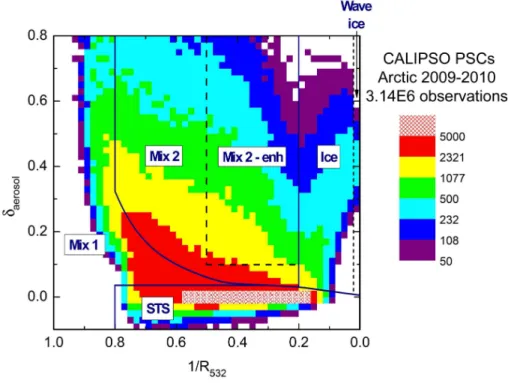
shows a composite 2-D histogram of CALIOP PSC observations from the 2009–2010 Arctic winter in theδaerosol vs. 1/R532 coordinate system, with the boundaries of the
six composition classes denoted by the black lines. The boundaries drawn between
10
the composition classes are based on a limited set of optical calculations and, with the exception of the boundary separating STS from Mix1/Mix2/ice (P09), do not reflect the inherent uncertainty in the CALIOP measurements, especially inβperp. Hence, the
boundaries should be considered fuzzy, and “jumps” between adjacent composition classes occurring on small spatial scales may be simply a reflection of measurement
15
noise rather than a true change in cloud composition.
For this study, we have made a slight modification to the P09/P11 composition clas-sification scheme. PSC detection and composition clasclas-sification were done indepen-dently in the P09/P11 algorithm and, as a result, it is possible that a PSC may be detected through an enhancement inβperp, a clear indication of the presence of solid
20
particles, but the derivedδaerosolmay fall into the STS composition regime due to noise
in the calculated aerosol depolarization ratio. Similarly, a cloud may be detected strictly through an enhancement inR532(no detectable enhancement inβperp), yet the derived
δaerosolmay fall into one of the mixture regimes. Although this discrepancy only impacts
a very small fraction of PSC observations, it is straightforward to correct by including
25
two additional constraints to the P09/P11 composition classification scheme: (1) if a PSC is detected through an enhancement inβperp, it will be classified as a liquid/NAT
mixture or ice PSC (depending on the magnitude of R532) regardless of its derived
ACPD
12, 24643–24676, 2012CALIOP polar stratospheric cloud
composition classification
M. C. Pitts et al.
Title Page
Abstract Introduction
Conclusions References
Tables Figures
◭ ◮
◭ ◮
Back Close
Full Screen / Esc
Printer-friendly Version Interactive Discussion
Discussion
P
a
per
|
Dis
cussion
P
a
per
|
Discussion
P
a
per
|
Discussio
n
P
a
per
PSC does not exhibit an enhancement inβperp, it will be classified as STS regardless
of its derivedδaerosol value.
Temperature profiles at each CALIOP measurement location are also included in the CALIOP Level 1 data files. The temperature data have been interpolated to the CALIOP Level 1 measurement locations from the Goddard Earth Observing System
5
Model, Version 5 (GEOS-5) six-hourly gridded analyses (Rienecker et al., 2008). To match the standard PSC grid, the GEOS-5 data are smoothed to the 5-km horizontal resolution and interpolated to the 180-m vertical grid.
2.2 Aura MLS
The Aura MLS detects thermal microwave emission from the Earth’s limb (Waters et
10
al., 2006) along the line-of-sight in the forward direction of the Aura spacecraft flight track. Vertical scans made from the Earth’s surface to a 90 km tangent height every 24.7 s provide a total of 3500 vertical profiles per day with a horizontal along track spacing of 1.5 degrees (165 km) and nearly global latitude coverage from 82◦S–82◦N.
The limb radiance measurements are inverted using a 2-D optimal estimation retrieval
15
(Livesey et al., 2006) to yield atmospheric profiles of temperature and composition in the vertical range 8–90 km (Livesey et al., 2006). The MLS version 3.3 measurements (Livesey et al., 2011) have typical single-profile precisions of 4–15 % for H2O (Read et al., 2007; Lambert et al., 2007) and 0.7 ppbv for HNO3 (Santee et al., 2007). Vertical
and horizontal along-track resolutions are 3.1–3.5 km and 180–290 km for H2O, and
20
3.5–5.5 km and 400–550 km for HNO3.
Since Aura flies in formation with CALIPSO in the A-train satellite constellation, CALIOP and MLS measurement tracks are closely aligned with spatial and tempo-ral differences less than 10 km and 30 s after a repositioning of the Aura satellite in 2008 and about 200 km and 7–8 min. prior to 2008 (see Lambert et al., 2012).
25
ACPD
12, 24643–24676, 2012CALIOP polar stratospheric cloud
composition classification
M. C. Pitts et al.
Title Page
Abstract Introduction
Conclusions References
Tables Figures
◭ ◮
◭ ◮
Back Close
Full Screen / Esc
Printer-friendly Version Interactive Discussion
Discussion
P
a
per
|
Dis
cussion
P
a
per
|
Discussion
P
a
per
|
Discussio
n
P
a
per
|
Meteorological Products (DMPs), such as equivalent latitude, are also mapped onto the PSC grid.
3 Data analyses
Our basic approach is to combine CALIOP PSC observations with nearly coincident Aura MLS gas species measurements and GEOS-5 temperature analyses to track the
5
uptake of gas phase HNO3 as a function of temperature. Comparing the observed
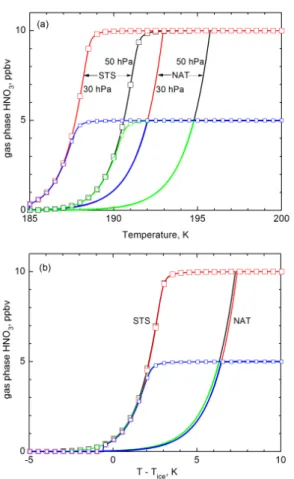
HNO3uptake with theoretical equilibrium HNO3uptake for NAT and STS indicates how well CALIOP PSCs in the various composition classes conform to expected tempera-ture existence regimes and also offers some insight into PSC growth kinetics. Figure 2 shows theoretical gas-phase HNO3 uptake curves assuming thermodynamic
equilib-10
rium conditions for STS (Carslaw et al., 1995) and NAT (Hanson and Mauersberger, 1988) at pressures of 30 and 50 hPa, assuming mixing ratios of 5 and 10 ppbv of total HNO3, 5 ppmv of H2O, and 0.1 ppbv H2SO4. The curves are presented as a function
of absolute temperature in Fig. 2a and as a function ofT−Tice in Fig. 2b, whereTiceis
the frost point temperature calculated using the Murphy and Koop (2005) relationship.
15
The figure illustrates clearly that in theT−Tice coordinate system, the individual curves
collapse into essentially single STS and NAT uptake curves, removing variations due to differences in atmospheric pressure level and local changes in H2O partial pressure
(Drdla et al., 2003).
For this assessment, we examined the CALIOP PSC data record from both polar
20
regions over the period from 2006 through 2011 and over a range of potential tem-perature levels spanning the 15–30 km altitude range. As will be discussed in Sect. 4, particle sedimentation and subsequent denitrification complicate the interpretation of the gas-phase HNO3 uptake and can also affect composition classification. As a
re-sult, data from the Antarctic, where the stratosphere is subject to severe denitrification
25
ACPD
12, 24643–24676, 2012CALIOP polar stratospheric cloud
composition classification
M. C. Pitts et al.
Title Page
Abstract Introduction
Conclusions References
Tables Figures
◭ ◮
◭ ◮
Back Close
Full Screen / Esc
Printer-friendly Version Interactive Discussion
Discussion
P
a
per
|
Dis
cussion
P
a
per
|
Discussion
P
a
per
|
Discussio
n
P
a
per
complemented focused measurements from an extensive field campaign under the European Union RECONCILE (reconciliation of essential process parameters for an enhanced predictability of Arctic stratospheric ozone loss and its climate interactions) project conducted that winter from Kiruna, Sweden (P11; D ¨ornbrack et al., 2012). The 2009–2010 winter was characterized by unusually cold conditions in the stratosphere
5
from mid-December through January that resulted in widespread PSCs (D ¨ornbrack et al., 2012; P11, Khosrawi et al., 2011). The distribution of PSCs observed by CALIOP during the 2009–2010 winter (Fig. 1) spans nearly the entireδaerosol vs. 1/R532
mea-surement space with significant numbers of PSCs in all six composition classes, pro-viding an excellent dataset for assessing the robustness of our composition
classifi-10
cation. Although denitrification occurred during the 2009–2010 Arctic winter, average HNO3 abundances between 475–575 K potential temperature in January were close
to 10 ppbv (Khosrawi et al., 2011), our standard value for defining the composition boundaries. We will examine an Antarctic case later in the paper to illustrate how se-vere denitrification/dehydration impacts our composition classification.
15
An interesting aspect of the 2009–2010 winter was the observation by CALIOP of tenuous liquid/NAT mixture PSCs with low NAT number densities in December, prior to the occurrence of ice (P11). These observations support the conclusions of Voigt et al. (2005) and Pagan et al. (2004) that ice nuclei are not a prerequisite for NAT PSC formation. To examine our classification scheme prior to the onset of denitrification, we
20
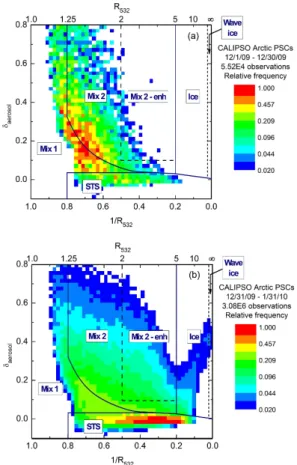
will analyse this period (1–30 December 2009) separately. The remainder of the PSC season (31 December 2009–31 January 2010) was characterized by extensive regions of PSCs in all composition classes. 2-D histograms of CALIOP PSC observations for these two periods are shown in Fig. 3.
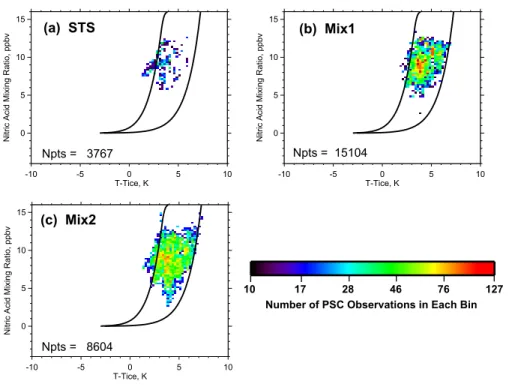
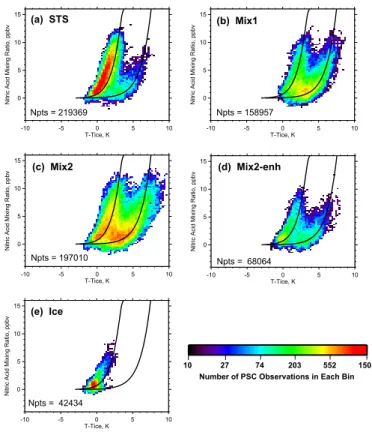
Figure 4 shows 2-D histograms of MLS HNO3uptake vs.T−Ticefor CALIOP PSC
ob-25
servations by composition class for 1–30 December at the 490 K potential temperature level (∼21 km).T is the ambient temperature at the CALIOP observation point (from
the GEOS-5 gridded analyses) and Tice is the frost point temperature (Murphy and
ACPD
12, 24643–24676, 2012CALIOP polar stratospheric cloud
composition classification
M. C. Pitts et al.
Title Page
Abstract Introduction
Conclusions References
Tables Figures
◭ ◮
◭ ◮
Back Close
Full Screen / Esc
Printer-friendly Version Interactive Discussion
Discussion
P
a
per
|
Dis
cussion
P
a
per
|
Discussion
P
a
per
|
Discussio
n
P
a
per
|
a guide for the reader’s eye, reference equilibrium uptake curves for STS and NAT are overlaid in the figures assuming total abundances of 16 ppbv HNO3and 5 ppmv H2O,
which are representative of early season values at this level. As vortex temperatures fell below NAT equilibrium during mid-December, tenuous NAT mixture clouds were observed, with some indication of STS clouds on the coldest days. No ice or Mix2-enh
5
PSCs were observed during this period. The majority of Mix1 and Mix2 PSC observa-tions are in an uptake regime that falls between the reference NAT and STS equilibrium uptake curves at temperatures betweenTice+1 K andTice+7 K, with a larger range of
HNO3 uptake occurring on Mix2 particles. The observed uptake suggests that these
non-equilibrium NAT mixtures have been exposed to temperatures belowTNATfor
mod-10
erate time periods, but not long enough for the NAT particles to reach thermodynamic equilibrium. The limited number of STS observations during this period is not sufficient to adequately assess this composition class at this time.
Histograms of HNO3 uptake as a function of T−Tice for 31 December–31 January
are shown in Fig. 5. PSCs in all composition classes were observed during this period.
15
Most observations in the STS class (Fig. 5a) are clearly aligned with the reference STS equilibrium uptake curve, as would be anticipated since STS particles are thought to grow fast enough to maintain equilibrium with the gas phase HNO3. The main STS data
cluster does lie at slightly lower temperatures than the reference equilibrium curve, a finding consistent with Lambert et al. (2012). Also of note is the secondary family of
20
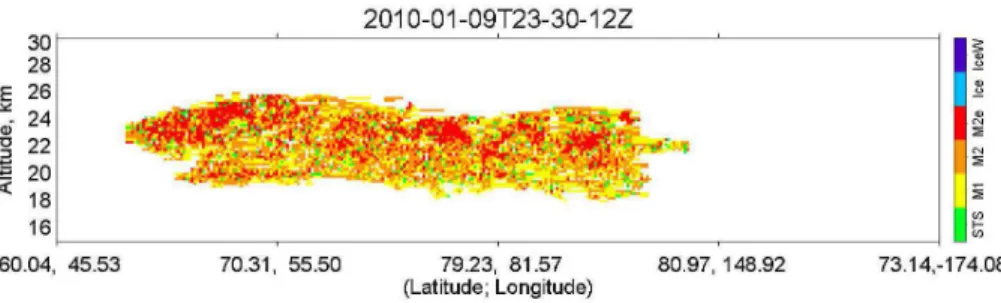
STS observations that lie along the reference NAT equilibrium uptake curve at tem-peratures too warm to support STS existence. These points are classified as STS because they do not exhibit a detectable enhancement in perpendicular backscatter, which would signal the presence of solid particles. An example of points classified as STS but at anomalously warm temperatures is shown in Fig. 6 for a PSC observed by
25
ACPD
12, 24643–24676, 2012CALIOP polar stratospheric cloud
composition classification
M. C. Pitts et al.
Title Page
Abstract Introduction
Conclusions References
Tables Figures
◭ ◮
◭ ◮
Back Close
Full Screen / Esc
Printer-friendly Version Interactive Discussion
Discussion
P
a
per
|
Dis
cussion
P
a
per
|
Discussion
P
a
per
|
Discussio
n
P
a
per
observed perpendicular backscatter signal, which lowers the measured perpendicular backscatter to values below our detection threshold for NAT particles. Hereafter we re-fer to this noise-induced misclassification as “speckle” based on how it manifests itself in CALIOP PSC images. For the 2009–2010 winter, we estimate that approximately 6 % of all measurements classified as STS are likely NAT mixtures misclassified due
5
to speckle. Similar noise-induced misclassification likely occurs to some degree in all composition classes, but is only detectable when the misclassification puts the com-position in an unexpected temperature regime. It may be possible to eliminate speckle by applying a spatial filter that assumes composition homogeneity over appropriately small spatial scales. This will be investigated for our next generation algorithm.
10
The HNO3 uptake as a function ofT−Tice for PSCs identified as NAT mixtures by
our composition classification scheme are shown in Fig. 5b–d. The mixture observa-tions cover a broad range of temperatures from 7–8 K above the frost point to near the frost point. The uptake of HNO3 for each of the mixture classes has two distinct modes: one closely aligned with the STS equilibrium curve and another aligned with
15
the NAT equilibrium curve, but there are also numerous points falling in between the two reference curves. At first glance, the mixture points that exhibit HNO3uptake sim-ilar to STS may appear to be misclassified STS. However, these points actually rep-resent STS/NAT mixtures in which the uptake of HNO3 by the relatively low number
density NAT particles is a slow process, whereas HNO3 condensation on the much
20
more numerous liquid droplets occurs rapidly in response to decreases in temperature. In these mixture cases, the presence of the NAT particles produces a detectable en-hancement in the CALIOP perpendicular backscatter signal, hence their classification as NAT mixtures, but at colder temperatures the more numerous liquid droplets dom-inate the uptake of HNO3. For these mixtures, the CALIOP perpendicular backscatter
25
ACPD
12, 24643–24676, 2012CALIOP polar stratospheric cloud
composition classification
M. C. Pitts et al.
Title Page
Abstract Introduction
Conclusions References
Tables Figures
◭ ◮
◭ ◮
Back Close
Full Screen / Esc
Printer-friendly Version Interactive Discussion
Discussion
P
a
per
|
Dis
cussion
P
a
per
|
Discussion
P
a
per
|
Discussio
n
P
a
per
|
of time, allowing a larger fraction of the gas phase HNO3 to condense onto the NAT particles and bringing the mixture closer to thermodynamic equilibrium.
The HNO3uptake for observations identified as ice PSCs during this period is shown
in Fig. 5e. Ice PSCs are expected to occur only at temperatures below the frost point, with almost complete uptake of gas-phase HNO3 by STS (or NAT) prior to the
tem-5
perature having reached the frost point. In the CALIOP observations, there is a clear maximum in ice PSCs at temperatures near or below the frost point and HNO3values below 2 ppbv, but ice observations also extend to temperatures above the frost point and larger HNO3abundances. Although this would appear to be a misclassification, i.e.
ice PSCs occurring at temperatures outside their expected thermodynamic existence
10
regime, we are confident that the ice classification is correct since the large optical sig-nal (bothR532andβperp) produced by ice PSCs is a robust signature. The anomalous
points in Fig. 5e are likely caused by differences in measurement resolution among CALIOP, GEOS-5, and MLS. During the first half of this period (31 December–14 Jan-uary), the vast majority of ice PSCs were associated with orographic wave events that
15
occurred on relatively small spatial scales (e.g., P11). With the high spatial resolution sampling of CALIOP and the inherently large scattering ratio values associated with ice PSCs, mountain wave ice PSCs are easily detected and properly classified by CALIOP at the highest PSC resolution (5 km × 180 m). However, given the relatively coarse
resolution of both the GEOS-5 gridded analyses (0.5 degrees) and Aura MLS HNO3
20
measurements (400–550 km horizontal× 3.5–5.5 km vertical), small scale wave
fea-tures are more difficult to fully resolve. The amplitude of the temperature perturbations associated with these waves is typically underestimated in the GEOS-5 gridded anal-yses, and the localized uptake of HNO3 by the STS in the cold phase of the waves
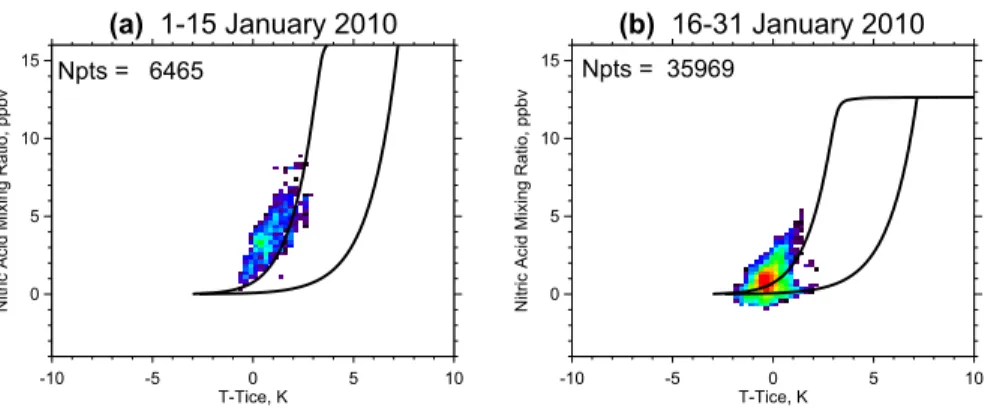
will be underestimated by MLS. To illustrate this point further, gas-phase HNO3uptake
25
associated with CALIOP ice PSCs for the two distinct periods are shown in Fig. 7. The ice observations at anomalously warm temperatures and relatively large HNO3mixing
ACPD
12, 24643–24676, 2012CALIOP polar stratospheric cloud
composition classification
M. C. Pitts et al.
Title Page
Abstract Introduction
Conclusions References
Tables Figures
◭ ◮
◭ ◮
Back Close
Full Screen / Esc
Printer-friendly Version Interactive Discussion
Discussion
P
a
per
|
Dis
cussion
P
a
per
|
Discussion
P
a
per
|
Discussio
n
P
a
per
PSCs were observed on much larger spatial scales associated with synoptic-scale re-gions of temperatures below the frost point, and both GEOS-5 and MLS are able to better resolve such features.
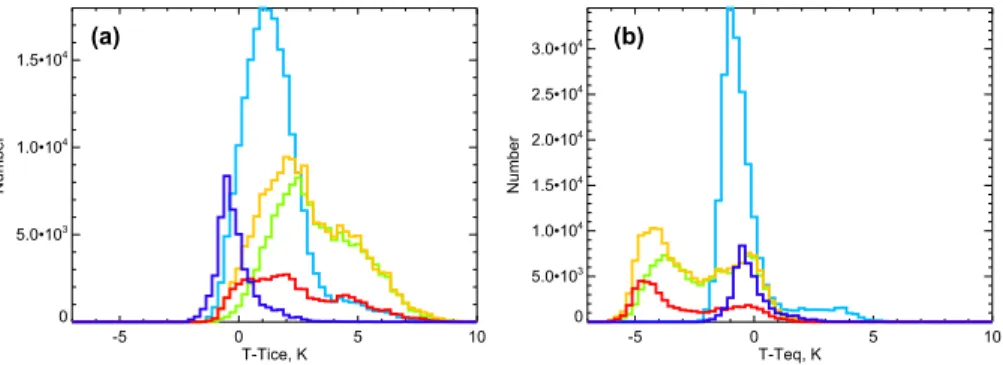
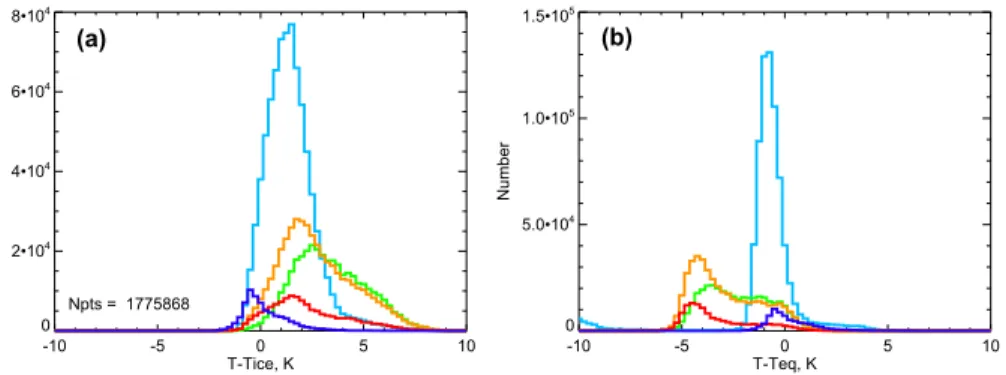
Histograms of PSC occurrence vs.T−TiceandT−Teq for 31 December 2009–31
Jan-uary 2010 are depicted in Fig. 8 for all CALIOP composition classes shown in Fig. 5.
5
Teq is defined asTice,TNAT, orTSTS, depending on the PSC composition classification,
and is calculated using the Murphy and Koop (2005) (Tice), Hanson and Mauersberger (1988) (TNAT), and Carslaw et al. (1995) (TSTS) relationships with the coincident MLS
HNO3 and H2O abundances. For compositions other than ice, the histograms are
re-stricted to observations with HNO3values greater than 1 ppbv to avoid the region where
10
the NAT and STS equilibrium curves converge. To a large degree, observations in each composition class conform to their expected temperature existence regimes, except for the points misclassified as STS at too warm temperatures (speckle) and the warm-biased ice PSCs associated with small-scale orographic waves. Ignoring the positive tail in the distribution of STS observations due to speckle, STS PSCs occur over a
15
relative narrow temperature range centered about 1 K below the STS equilibrium tem-perature. The peak at 1 K below equilibrium may be an indication of a cold bias in the GEOS-5 temperature analyses as noted by Lambert et al. (2012). The distribution of each NAT mixture class has a bimodal appearance with one mode near the NAT equi-librium temperature and a second, more populous mode at 4-5 K below NAT equiequi-librium
20
– which is very near the STS mode inT−Ticespace (Fig. 8a). This more populous mode
is far out of equilibrium with respect to NAT and corresponds to mixtures with NAT par-ticles producing a large enough perpendicular backscatter signal to be detectable by CALIOP, but whose gas-phase HNO3 uptake is dominated by the much more
numer-ous STS droplets. The fact that the NAT mixture histograms are distinctly bimodal, i.e.
25
the mixtures do not occur uniformly over the space between TNAT and TSTS, is quite
interesting and may indicate a rapid switch from the thermodynamically metastable STS to stable NAT after sufficient exposure of air parcels to temperatures below TNAT.
ACPD
12, 24643–24676, 2012CALIOP polar stratospheric cloud
composition classification
M. C. Pitts et al.
Title Page
Abstract Introduction
Conclusions References
Tables Figures
◭ ◮
◭ ◮
Back Close
Full Screen / Esc
Printer-friendly Version Interactive Discussion
Discussion
P
a
per
|
Dis
cussion
P
a
per
|
Discussion
P
a
per
|
Discussio
n
P
a
per
|
frost point (also consistent with Lambert et al., 2012) with a full-width-half-maximum of about 1.5 K. The longer positive tail in the ice PSC distribution is due to warm biased temperatures associated with the wave ice events.
Histograms of PSC occurrence vs.T−Tice andT−Teq for five seasons in the Arctic
(2006–2011) are shown in Fig. 9. These multi-year histograms are similar in nature to
5
as those for the 2009–10 Arctic season (Fig. 8), with observations in all composition classes conforming to expected thermodynamic existence regimes. The notable ex-ceptions again are observations classified as STS at anomalously warm temperatures, which are likely NAT clouds misclassified due to noise in βperp (speckle) and the ice
PSCs at (apparent) temperatures above the frost point, which are associated with
oro-10
graphic waves, the predominant mechanism for ice PSC formation in the Arctic. Com-position classification is also robust in the Antarctic, as illustrated by the histograms of PSC occurrence vs.T−Tice and T−Teq for six seasons in the Antarctic (2006–2011)
in Fig. 10. Although less pronounced in than in the Arctic, a small number of anoma-lously warm STS points also appear in the Antarctic STS histogram. Ice PSC formation
15
in the Antarctic occurs more frequently and generally on larger spatial scales than in the Arctic and as a consequence the number of ice PSCs at (apparent) temperatures above the frost point are less common. These multi-year histograms represent over 1.7 million Arctic and 10.1 million Antarctic PSC observations and provide compelling evidence that the P09/P11 composition classification is robust.
20
4 Impact of denitrification on composition classification
The composition class boundaries defined by P09 and P11 are based on a standard set of conditions: 50 hPa atmospheric pressure and nominal mixing ratios of 10 ppbv HNO3and 5 ppmv H2O. For most Arctic winters and early in the Antarctic winter, these
values are representative. However, the Antarctic is subject to severe denitrification
25
ACPD
12, 24643–24676, 2012CALIOP polar stratospheric cloud
composition classification
M. C. Pitts et al.
Title Page
Abstract Introduction
Conclusions References
Tables Figures
◭ ◮
◭ ◮
Back Close
Full Screen / Esc
Printer-friendly Version Interactive Discussion
Discussion
P
a
per
|
Dis
cussion
P
a
per
|
Discussion
P
a
per
|
Discussio
n
P
a
per
on the composition class boundaries. Shown in Fig. 11a are theoretical calculations of CALIOP optical signals for various liquid/NAT mixtures and ice computed for the standard conditions (10 ppbv HNO3). The ice PSCs are the arm of points extending
up and to the right from the STS domain at 1/R532 ∼0.2. For comparison, Fig. 11b
depicts theoretical calculations for denitrified conditions of 5 ppbv HNO3. The reduction
5
in available condensable HNO3 limits the growth potential of the particles, resulting
in a systematic shift of the optical signals to smaller scattering ratios (larger 1/R532) values. For these conditions, the arm of ice points is shifted to the left and departs from the STS domain at 1/R532∼0.3. Therefore, to properly account for denitrification
in our composition classification scheme, the boundary between ice and NAT mixture
10
(Mix2 and Mix2-enh) PSC domains should shifted to smaller scattering ratio values (larger 1/R532 values). The magnitude of the shift is a function of the total abundance
of HNO3.
The effects of denitrification can also clearly be seen in the CALIOP PSC observa-tions. For example, shown in Fig. 12a is the distribution of PSCs observed by CALIOP
15
for June 2009 in an equivalent latitude band between 60◦S and 70◦S. The total HNO
3
mixing ratio during June was decreasing as denitrification began, but on average was close to our standard value of 10 ppbv. The period was dominated by fully developed STS (maximum along theδaerosol=0 axis) and ice PSCs, with a small number of
mix-tures. Similar to the theoretical calculations (Fig. 11a), the arm of ice PSC observations
20
(dashed white line) departs from the STS maximum at 1/R532 values of 0.2. In
con-trast, Fig. 12b depicts CALIOP observations in August 2009 deep inside the vortex at equivalent latitudes between 75◦S and 90◦S. The total HNO
3 abundance at this time
had dropped significantly from early season values to around 5 ppbv or less resulting in a discernible shift in the point where the axis of the ice arm departs from the STS
25
mode, to a 1/R532value of about 0.3 (similar to Fig. 11b).
ACPD
12, 24643–24676, 2012CALIOP polar stratospheric cloud
composition classification
M. C. Pitts et al.
Title Page
Abstract Introduction
Conclusions References
Tables Figures
◭ ◮
◭ ◮
Back Close
Full Screen / Esc
Printer-friendly Version Interactive Discussion
Discussion
P
a
per
|
Dis
cussion
P
a
per
|
Discussion
P
a
per
|
Discussio
n
P
a
per
|
Mix2 PSC observations from the Antarctic during August 2009, when denitrification is severe. Histograms of ice and Mix2-enh PSC occurrence as a function of T−Tice
from the interior of the vortex in August 2009 are shown in Fig. 13. Figure 13a depicts histograms for composition classification using our standard ice/Mix2-enh boundary (1/R532=0.2). With random measurement noise and no bias in temperature andTice,
5
one would expect the ice PSC histogram to be Gaussian with a mode atT−Tice=0. The
mode of the actual histogram is slightly below the frost point, but the positive tail of the distribution appears to be truncated relative to the negative tail. The Mix2-enh distribu-tion also has a maximum near the frost point, some of which may be misclassified ice, but also extends to warmer temperatures as would be expected for NAT mixtures. To
10
account for denitrification in our composition classification, we should shift the composi-tion boundaries appropriately based on the total abundance of HNO3. To demonstrate
this, Fig. 13b shows histograms for composition classification using an ice/mix2-enh boundary of 1/R532=0.3. For this case, there has been a redistribution of
composi-tions with over a 50 % increase in the number of ice clouds which had been classified
15
as Mix2-enh in our standard case. The shape of the ice PSC distribution in this case appears to be more Gaussian-like than in the standard case, with no obvious trun-cation of the positive tail. Figure 13c shows histograms for composition classifitrun-cation using an ice/mix2-enh boundary of 1/R532=0.4. This results in more than a doubling
of the number of ice PSCs relative to the standard case, but the ice PSC distribution
20
now shows a noticeable extension to warmer temperatures (Tice+3 K), indicating that
the boundary has been shifted too far to the left and with some Mix2-enh clouds now being misclassified as ice. In practice, it will be difficult to accurately account for the magnitude of denitrification since most HNO3measurements are gas phase only and
are impacted by uptake on PSC particles.
ACPD
12, 24643–24676, 2012CALIOP polar stratospheric cloud
composition classification
M. C. Pitts et al.
Title Page
Abstract Introduction
Conclusions References
Tables Figures
◭ ◮
◭ ◮
Back Close
Full Screen / Esc
Printer-friendly Version Interactive Discussion
Discussion
P
a
per
|
Dis
cussion
P
a
per
|
Discussion
P
a
per
|
Discussio
n
P
a
per
5 Summary and future direction
We have used Aura MLS gas phase HNO3and H2O measurements along with GEOS-5
temperature analyses to independently assess the CALIOP PSC composition classifi-cation scheme, which is based solely on the lidar optical measurements. Our approach was to examine the uptake of HNO3 as a function of T−Tice to determine if the
as-5
signed PSC composition is consistent with the thermodynamic existence regimes for STS, NAT, and ice. The results indicate that, overall, the CALIOP PSC composition classification performance is excellent with each class exhibiting uptake behavior con-sistent with theoretical expectations.
PSCs identified as STS exhibit gas phase uptake of HNO3 consistent with theory,
10
but with a small temperature bias, consistent with previous studies. Some (∼6 %) of
points being classified as STS are actually liquid/NAT mixtures being misclassified due to the so-called speckle effect caused by pixel-scale negative noise excursions in the CALIOP perpendicular backscatter measurements. Although not detectable in these analyses, misclassification due to such speckle likely occurs at a similar rate in other
15
composition classes.
PSCs identified as liquid/NAT mixtures exhibit two distinct preferred modes. One such mode is significantly out of thermodynamic equilibrium with respect to NAT (4– 5 K belowTNAT), with HNO3 uptake dominated by the more numerous liquid droplets.
The other liquid/NAT mode is much closer to NAT thermodynamic equilibrium indicating
20
that the particles have been exposed to temperatures belowTNAT for extended periods
of time.
Ice PSC classification is robust in the CALIOP optical data, and the mode in the ice observations occurs about 0.5 K below the frost point. The anomalously warm tem-peratures and high HNO3values associated with CALIOP observations of small-scale
25
ACPD
12, 24643–24676, 2012CALIOP polar stratospheric cloud
composition classification
M. C. Pitts et al.
Title Page
Abstract Introduction
Conclusions References
Tables Figures
◭ ◮
◭ ◮
Back Close
Full Screen / Esc
Printer-friendly Version Interactive Discussion
Discussion
P
a
per
|
Dis
cussion
P
a
per
|
Discussion
P
a
per
|
Discussio
n
P
a
per
|
We also demonstrated that severe denitrification can impact the CALIOP compo-sition classification. The P09/P11 compocompo-sition class boundaries are based on nomi-nal vapor abundances, and during periods of severe denitrification these boundaries should be adjusted to account for the reduced growth potential of the PSC particles. The biggest impact is a shift in the boundary between ice PSCs and NAT mixtures. As
5
a result, some ice PSCs are being misclassified as NAT mixtures using the P09/P11 scheme during periods of moderate to severe denitrification, primarily in the Antarctic. We will investigate methods to correct these deficiencies for our next generation algorithm.
Acknowledgements. The Aura MLS gas species data and Derived Meteorological Products
10
(DMP) were provided courtesy of the MLS team and obtained through the Aura MLS web-site (http://mls.jpl.nasa.gov/index-eos-mls.php). We would also like to thank David Considine, Program Scientist for the CALIPSO/CloudSat Missions for continued support of this research. Support for L. Poole is provided under NASA contract NNL11AA10D. Work at the Jet Propul-sion Laboratory, California Institute of Technology, was carried out under a contract with the
15
National Aeronautics and Space Administration.
References
Biele, J., Tsias, A., Luo, B. P., Carslaw, K. S., Neuber, R., Beyerle, G., and Peter, T.: Nonequi-librium coexistence of solid and liquid particles in Arctic stratospheric clouds, J. Geophys. Res., 106, 22991–23007, 2001.
20
Cairo, F., Di Donfrancesco, G., Adriani, A., Pulvirenti, L., and Fierli, F.: Comparison of various linear depolarization parameters measured by lidar, Appl. Opt., 38, 4425–4432, 1999. Carslaw, K. S., Luo, B. P., and Peter, T.: An analytic expression for the composition of aqueous
HNO3-H2SO4stratospheric aerosols including gas phase removal of HNO3, Geophys. Res. Lett., 22, 1877–1880, 1995.
25
ACPD
12, 24643–24676, 2012CALIOP polar stratospheric cloud
composition classification
M. C. Pitts et al.
Title Page
Abstract Introduction
Conclusions References
Tables Figures
◭ ◮
◭ ◮
Back Close
Full Screen / Esc
Printer-friendly Version Interactive Discussion
Discussion
P
a
per
|
Dis
cussion
P
a
per
|
Discussion
P
a
per
|
Discussio
n
P
a
per
H ¨opfner, M., Pitts, M. C., and Poole, L. R.: Comparison between CALIPSO and MI-PAS observations of polar stratospheric clouds, J. Geophys. Res., 114, D00H05, doi:10.1029/2009JD012114, 2009.
Hunt, W. H., Winker, D. M., Vaughan, M. A., Powell, K. A., Lucker, P. L., and Weimer, C.: CALIPSO Lidar Description and Performance Assessment, J. Atmos. Oceanic Technol., 26,
5
1214–1228, doi:10.1175/2009JTECHA1223.1, 2009.
Khosrawi, F., Urban, J., Pitts, M. C., Voelger, P., Achtert, P., Kaphlanov, M., Santee, M. L., Manney, G. L., Murtagh, D., and Fricke, K.-H.: Denitrification and polar stratospheric cloud formation during the Arctic winter 2009/2010, Atmos. Chem. Phys., 11, 8471–8487, doi:10.5194/acp-11-8471-2011, 2011.
10
Lambert, A., Read, W. G., Livesey, N. J., Santee, M. L., Manney, G. L., Froidevaux, L., Wu, D. L., Schwartz, M. J., Pumphrey, H. C., Jimenez, C., Nedoluha, G. E., Cofield, R. E., Cuddy, D. T., Daffer, W. H., Drouin, B. J., Fuller, R. A., Jarnot, R. F., Knosp, B. W., Pickett, H. M., Perun, V. S., Snyder, W. V., Stek, P. C., Thurstans, R. P., Wagner, P. A., Waters, J. W., Jucks, K. W., Toon, G. C., Stachnik, R. A., Bernath, P. F., Boone, C. D., Walker, K. A., Urban, J.,
15
Murtagh, D., Elkins, J. W., and Atlas, E.: Validation of the Aura Microwave Limb Sounder middle atmosphere water vapor and nitrous oxide measurements, J. Geophys. Res., 112, D24S36, doi:10.1029/2007JD008724, 2007.
Lambert, A., Santee, M. L., Wu, D. L., and Chae, J. H.: A-train CALIOP and MLS observations of early winter Antarctic polar stratospheric clouds and nitric acid in 2008, Atmos. Chem.
20
Phys., 12, 2899–2931, doi:10.5194/acp-12-2899-2012, 2012.
Livesey, N. J., Snyder, W. V., Read, W. G., and Wagner, P. A.: Retrieval algorithms for the EOS Microwave Limb Sounder (MLS), IEEE T. Geosci. Remote, 44, 1144–1155, 2006.
Livesey, N. J., Read, W. G., Froidevaux, L., Lambert, A., Manney, G. L., Pumphrey, H. C., Santee, M. L., Schwartz, M. J., Wang, S., Cofield, R. E., Cuddy, D. T., Fuller, R. A., Jarnot,
25
R. F., Jiang, J. H., Knosp, B. W., Stek, P. C., Wagner, P. A., and Wu, D. L.: Version 3.3 Level 3 data quality and description document, Tech. Rep. JPL D-33509, Jet Propulsion Laboratory, available at: http://mls.jpl.nasa.gov (last access: October 2011), 2011.
Lowe, D. and A. R. MacKenzie, Polar stratospheric cloud microphysics and chemistry, J. Atmos. Solar-Terr. Phys., 70, 13–40, 2008.
30
ACPD
12, 24643–24676, 2012CALIOP polar stratospheric cloud
composition classification
M. C. Pitts et al.
Title Page
Abstract Introduction
Conclusions References
Tables Figures
◭ ◮
◭ ◮
Back Close
Full Screen / Esc
Printer-friendly Version Interactive Discussion
Discussion
P
a
per
|
Dis
cussion
P
a
per
|
Discussion
P
a
per
|
Discussio
n
P
a
per
|
Noel, V. and Pitts, M.: Gravity wave events from mesoscale simulations compared to polar stratospheric clouds observed from spaceborne lidar over the Antarctic Peninsula, J. Geo-phys. Res., 117, D11207, doi:10.1029/2011JD017318, 2012.
Noel, V., Hertzog, A., Chepfer, H., and Winker, D., Polar stratospheric clouds over Antarctica from the CALIPSO spaceborne lidar, J. Geophys. Res., 113, D02205,
5
doi:10.1029/2007JD008616, 2008.
Pagan, K. L., Tabazadeh, A., Drdla, K., Hervig, M. E., Eckermann, S. D., Browell, E. V., Legg, M. J., and Foschi, P. G.: Observational evidence against mountain-wave generation of ice nuclei as a prerequisite for the formation of three solid nitric acid polar stratospheric clouds observed in the Arctic in early December 1999, J. Geophys. Res., 109, D04312,
10
doi:1029/2003JD003846, 2004.
Pitts, M. C., Thomason, L. W., Poole, L. R., and Winker, D. M.: Characterization of Polar Strato-spheric Clouds with spaceborne lidar: CALIPSO and the 2006 Antarctic season, Atmos. Chem. Phys., 7, 5207–5228, doi:10.5194/acp-7-5207-2007, 2007.
Pitts, M. C., Poole, L. R., and Thomason, L. W.: CALIPSO polar stratospheric cloud
observa-15
tions: second-generation detection algorithm and composition discrimination, Atmos. Chem. Phys., 9, 7577–7589, doi:10.5194/acp-9-7577-2009, 2009.
Pitts, M. C., Poole, L. R., D ¨ornbrack, A., and Thomason, L. W.: The 2009–2010 Arctic polar stratospheric cloud season: a CALIPSO perspective, Atmos. Chem. Phys., 11, 2161–2177, doi:10.5194/acp-11-2161-2011, 2011.
20
Powell, K. A., Hostetler, C. A., Liu, Z., Vaughan, M. A., Kuehn, R. E., Hunt, W. H., Lee, K., Trepte, C. R., Rogers, R. R., Young, S. A., and Winker, D. M.: CALIPSO Lidar Calibration Algorithms: Part I – Nighttime 532 nm Parallel Channel and 532 nm Perpendicular Channel, J. Atmos. Oceanic Technol., 26, 2015–2033, doi:10.1175/2009JTECHA1242.1, 2009. Read, W. G., Lambert, A., Bacmeister, J., Cofield, R. E., Christensen, L. E., Cuddy, D. T., Daffer,
25
W. H., Drouin, B. J., Fetzer, E., Froidevaux, L., Fuller, R., Herman, R., Jarnot, R. F., Jiang, J. H., Jiang, Y. B., Kelly, K., Knosp, B. W., Kovalenko, L. J., Livesey, N. J., Liu, H. C., Manney, G. L., Pickett, H. M., Pumphrey, H. C., Rosenlof, K. H., Sabounchi, X., Santee, M. L., Schwartz, M. J., Snyder,W. V., Stek, P. C., Su, H., Takacs, L. L., Thurstans, R. P., Vomel, H., Wagner, P. A., Waters, J.W.,Webster, C. R.,Weinstock, E. M., and Wu, D. L.: Aura Microwave Limb
30
ACPD
12, 24643–24676, 2012CALIOP polar stratospheric cloud
composition classification
M. C. Pitts et al.
Title Page
Abstract Introduction
Conclusions References
Tables Figures
◭ ◮
◭ ◮
Back Close
Full Screen / Esc
Printer-friendly Version Interactive Discussion
Discussion
P
a
per
|
Dis
cussion
P
a
per
|
Discussion
P
a
per
|
Discussio
n
P
a
per
Santee, M. L., Lambert, A., Read, W. G., Livesey, N. J., Cofield, R. E., Cuddy, D. T., Daffer, W. H., Drouin, B. J., Froidevaux, L., Fuller, R. A., Jarnot, R. F., Knosp, B. W., Manney, G. L., Perun, V. S., Snyder, W. V., Stek, P. C., Thurstans, R. P., Wagner, P. A., Waters, J. W., Muscari, G., de Zafra, R. L., Dibb, J. E., Fahey, D.W., Popp, P. J., Marcy, T. P., Jucks, K. W., Toon, G. C., Stachnik, R. A., Bernath, P. F., Boone, C. D., Walker, K. A., Urban, J., and Murtagh, D.:
5
Validation of the Aura Microwave Limb Sounder HNO3 measurements, J. Geophys. Res., 112, D24S40, doi:10.1029/2007JD008721, 2007.
Solomon, S.: Stratospheric ozone depletion: A review of concepts and history, Rev. Geophys., 37, 275–316, 1999.
Stephens, G. L., Vane, D. G., Boain, R. J., Mace, G. G., Sassen, K., Wang, Z., Illingworth, A.
10
J., O’Connor, E. J., Rossow, W. B., Durden, S. L., Miller, S. D., Austin, R. T., Benedetti, A., Mitrescu, C., and the CloudSat Science Team: The CloudSat mission and the A-Train: A new dimension of space-based observations of clouds and precipitation, B. Am. Meteorol. Soc., 83, 1771–1790, 2002.
Toon, O., Tabazadeh, A., Browell, E., and Jordan, J.: Analysis of lidar observations of Arctic
15
polar stratospheric clouds during January 1989, J. Geophys. Res., 105, 20589–20615, 2000. Voigt, C., Schlager, H., Luo, B. P., D ¨ornbrack, A., Roiger, A., Stock, P., Curtius, J., V ¨ossing,
H., Borrmann, S., Davies, S., Konopka, P., Schiller, C., Shur, G., and Peter, T.: Nitric Acid Trihydrate (NAT) formation at low NAT supersaturation in Polar Stratospheric Clouds (PSCs), Atmos. Chem. Phys., 5, 1371–1380, doi:10.5194/acp-5-1371-2005, 2005
20
Waters, J. W., Froidevaux, L., Harwood, R. S., Jarnot, R. F., Pickett, H. M., Read, W. G., Siegel, P. H., Cofield, R. E., Filipiak, M. J., Flower, D. A., Holden, J. R., Lau, G. K. K., Livesey, N. J., Manney, G. L., Pumphrey, H. C., Santee, M. L., Wu, D. L., Cuddy, D. T., Lay, R. R., Loo, M. S., Perun, V. S., Schwartz, M. J., Stek, P. C., Thurstans, R. P., Boyles, M. A., Chandra, K. M., Chavez, M. C., Chen, G. S., Chudasama, B. V., Dodge, R., Fuller, R. A., Girard, M. A.,
25
Jiang, J. H., Jiang, Y. B., Oswald, J. E., Patel, N. C., Pukala, D. M., Quintero, O., Scaff, D., Van Snyder, W., Tope, M. C., Wagner, P. A., and Walch, M. J.: The Earth Observing System Microwave Limb Sounder (EOS MLS) on the Aura satellite, IEEE T. Geosci. Remote, 44, 1075–1092, 2006.
Winker, D. M., Vaughan, M. A., Omar, A. H., Hu, Y., Powell, K. A., Liu, Z., Hunt, W. H., and
30
ACPD
12, 24643–24676, 2012CALIOP polar stratospheric cloud
composition classification
M. C. Pitts et al.
Title Page
Abstract Introduction
Conclusions References
Tables Figures
◭ ◮
◭ ◮
Back Close
Full Screen / Esc
Printer-friendly Version Interactive Discussion
Discussion
P
a
per
|
Dis
cussion
P
a
per
|
Discussion
P
a
per
|
Discussio
n
P
a
per
|
Fig. 1.Composite 2-D histogram of all CALIOP PSC observations during the 2009–2010 Arc-tic winter in theδaerosol vs. 1/R532 coordinate system, with the solid black lines denoting the boundaries of the six PSC composition domains defined by P09 and the dashed boxes denot-ing the domains of the two new composition sub-classes defined by P11. The histogram bin size is 0.02×0.02 (both unitless) and the color scale indicates the number of cloud observations
ACPD
12, 24643–24676, 2012CALIOP polar stratospheric cloud
composition classification
M. C. Pitts et al.
Title Page
Abstract Introduction
Conclusions References
Tables Figures
◭ ◮
◭ ◮
Back Close
Full Screen / Esc
Printer-friendly Version Interactive Discussion
Discussion
P
a
per
|
Dis
cussion
P
a
per
|
Discussion
P
a
per
|
Discussio
n
P
a
per
Fig. 2.Theoretical equilibrium uptake of HNO3by STS (square symbols) and NAT as a function of(a)temperature and(b)T−Tice. Red and black curves/symbols: 10 ppbv HNO3, 5 ppmv H2O;
ACPD
12, 24643–24676, 2012CALIOP polar stratospheric cloud
composition classification
M. C. Pitts et al.
Title Page
Abstract Introduction
Conclusions References
Tables Figures
◭ ◮
◭ ◮
Back Close
Full Screen / Esc
Printer-friendly Version Interactive Discussion
Discussion
P
a
per
|
Dis
cussion
P
a
per
|
Discussion
P
a
per
|
Discussio
n
P
a
per
|
Fig. 3.Composite 2-D histogram of all CALIOP PSC observations for two periods of the 2009– 2010 Arctic winter over the altitude range from 15–30 km in theδaerosol vs. 1/R532 coordinate
ACPD
12, 24643–24676, 2012CALIOP polar stratospheric cloud
composition classification
M. C. Pitts et al.
Title Page Abstract Introduction Conclusions References Tables Figures ◭ ◮ ◭ ◮ Back Close
Full Screen / Esc
Printer-friendly Version Interactive Discussion Discussion P a per | Dis cussion P a per | Discussion P a per | Discussio n P a per 0 1
- -5 0 5 10
0 5 0 1 5 1
Nitric Acid Mixing Ratio, ppbv
7 6 7 3 = s t p N 0 1
- -5 0 5 10
K , e c i T -T 0 5 0 1 5 1
Nitric Acid Mixing Ratio, ppbv
4 0 1 5 1 = s t p N 0 1
- -5 0 5 10
K , e c i T -T 0 5 0 1 5 1
Nitric Acid Mixing Ratio, ppbv
4 0 6 8 = s t p N
Number of PSC Observations in Each Bin 10 17 28 46 76 127
(a) STS (b) Mix1
(c) Mix2
K , e c i T -T
Fig. 4.Uptake of nitric acid as a function ofT−Ticefor CALIOP Arctic PSC observations at 490 K
potential temperature during 1–30 December 2009 for(a)STS,(b)Mix1, and(c)Mix2 clouds. The histogram bin size is 0.25 ppbv×0.25 K and the color scale indicates the number of cloud
ACPD
12, 24643–24676, 2012CALIOP polar stratospheric cloud
composition classification
M. C. Pitts et al.
Title Page Abstract Introduction Conclusions References Tables Figures ◭ ◮ ◭ ◮ Back Close
Full Screen / Esc
Printer-friendly Version Interactive Discussion Discussion P a per | Dis cussion P a per | Discussion P a per | Discussio n P a per | 0 1
- -5 0 5 10
K , e c i T -T 0 5 0 1 5 1
Nitric Acid Mixing Ratio, ppbv
9 6 3 9 1 2 = s t p N 0 1
- -5 0 5 10
K , e c i T -T 0 5 0 1 5 1
Nitric Acid Mixing Ratio, ppbv
7 5 9 8 5 1 = s t p N 0 1
- -5 0 5 10
K , e c i T -T 0 5 0 1 5 1
Nitric Acid Mixing Ratio, ppbv
0 1 0 7 9 1 = s t p N 0 1
- -5 0 5 10
K , e c i T -T 0 5 0 1 5 1
Nitric Acid Mixing Ratio, ppbv
4 6 0 8 6 = s t p N 0 1
- -5 0 5 10
K , e c i T -T 0 5 0 1 5 1
Nitric Acid Mixing Ratio, ppbv
4 3 4 2 4 = s t p N
Number of PSC Observations in Each Bin 10 27 74 203 552 1505
(a) STS (b) Mix1
(c) Mix2 (d) Mix2-enh
(e) Ice
Fig. 5.Uptake of nitric acid as a function of T−Tice for CALIOP Arctic PSC observations at
490 K potential temperature during 31 December 2009–31 January 2010 for(a)STS,(b)Mix 1,(c)Mix 2,(d)Mix 2-enh, and(e)ice clouds. The histogram bin size is 0.25 ppbv×0.25 K and
ACPD
12, 24643–24676, 2012CALIOP polar stratospheric cloud
composition classification
M. C. Pitts et al.
Title Page
Abstract Introduction
Conclusions References
Tables Figures
◭ ◮
◭ ◮
Back Close
Full Screen / Esc
Printer-friendly Version Interactive Discussion
Discussion
P
a
per
|
Dis
cussion
P
a
per
|
Discussion
P
a
per
|
Discussio
n
P
a
per
ACPD
12, 24643–24676, 2012CALIOP polar stratospheric cloud
composition classification
M. C. Pitts et al.
Title Page
Abstract Introduction
Conclusions References
Tables Figures
◭ ◮
◭ ◮
Back Close
Full Screen / Esc
Printer-friendly Version Interactive Discussion
Discussion
P
a
per
|
Dis
cussion
P
a
per
|
Discussion
P
a
per
|
Discussio
n
P
a
per
|
0 1
- -5 0 5 10
K , e c i T -T 0
5 0 1
5 1
Nitric Acid Mixing Ratio, ppbv
5 6 4 6 = s t p N
0 1
- -5 0 5 10
K , e c i T -T 0
5 0 1
5 1
Nitric Acid Mixing Ratio, ppbv
9 6 9 5 3 = s t p N
(a) 1-15 January 2010 (b) 16-31 January 2010
Fig. 7.HNO3uptake as a function ofT−Tice for CALIOP ice PSC observations during(a) 1–
ACPD
12, 24643–24676, 2012CALIOP polar stratospheric cloud
composition classification
M. C. Pitts et al.
Title Page
Abstract Introduction
Conclusions References
Tables Figures
◭ ◮
◭ ◮
Back Close
Full Screen / Esc
Printer-friendly Version Interactive Discussion
Discussion
P
a
per
|
Dis
cussion
P
a
per
|
Discussion
P
a
per
|
Discussio
n
P
a
per
5
- 0 5 10
K , e c i T -T 0
0 1 • 0 .
5 3
0 1 • 0 .
1 4
0 1 • 5 .
1 4
Number
5
- 0 5 10
K , q e T -T 0
0 1 • 0 .
5 3
0 1 • 0 .
1 4
0 1 • 5 .
1 4
0 1 • 0 .
2 4
0 1 • 5 .
2 4
0 1 • 0 .
3 4
Number
(a) (b)
Fig. 8. Histograms of CALIOP PSC observations at 490 K potential temperature during 31 December 2009–31 January 2010 as a function of(a)T−Tice and(b)T−Teqby composition:
ACPD
12, 24643–24676, 2012CALIOP polar stratospheric cloud
composition classification
M. C. Pitts et al.
Title Page
Abstract Introduction
Conclusions References
Tables Figures
◭ ◮
◭ ◮
Back Close
Full Screen / Esc
Printer-friendly Version Interactive Discussion
Discussion
P
a
per
|
Dis
cussion
P
a
per
|
Discussion
P
a
per
|
Discussio
n
P
a
per
|
0 1
- -5 0 5 10
K , e c i T -T 0
0 1 •
2 4
0 1 •
4 4
0 1 •
6 4
0 1 •
8 4
Number
8 6 8 5 7 7 1 = s t p N
0 1
- -5 0 5 10
K , q e T -T 0
0 1 • 0 .
5 4
0 1 • 0 .
1 5
0 1 • 5 .
1 5
Number
(a) (b)
Fig. 9.Histograms of CALIOP PSC observations at 490 K potential temperature during five Arctic winters (2006–2011) as a function of(a) T−Tice and (b) T−Teq by composition: STS
ACPD
12, 24643–24676, 2012CALIOP polar stratospheric cloud
composition classification
M. C. Pitts et al.
Title Page
Abstract Introduction
Conclusions References
Tables Figures
◭ ◮
◭ ◮
Back Close
Full Screen / Esc
Printer-friendly Version Interactive Discussion
Discussion
P
a
per
|
Dis
cussion
P
a
per
|
Discussion
P
a
per
|
Discussio
n
P
a
per
0 1
- -5 0 5 10
K , e c i T -T 0
0 1 • 2 5
0 1 • 4 5
0 1 • 6 5
0 1 • 8 5
Number
1 2 1 2 6 1 0 1 = s t p N
0 1
- -5 0 5 10
K , q e T -T 0
0 1 • 2 5
0 1 • 4 5
0 1 • 6 5
0 1 • 8 5
Number
(a) (b)
Fig. 10.Histograms of CALIOP PSC observations at 490 K potential temperature from six sea-sons in the Antarctic (2006–2011) as a function of(a)T−Tice and(b)T−Teqby composition:
ACPD
12, 24643–24676, 2012CALIOP polar stratospheric cloud
composition classification
M. C. Pitts et al.
Title Page
Abstract Introduction
Conclusions References
Tables Figures
◭ ◮
◭ ◮
Back Close
Full Screen / Esc
Printer-friendly Version Interactive Discussion
Discussion
P
a
per
|
Dis
cussion
P
a
per
|
Discussion
P
a
per
|
Discussio
n
P
a
per
|
ACPD
12, 24643–24676, 2012CALIOP polar stratospheric cloud
composition classification
M. C. Pitts et al.
Title Page Abstract Introduction Conclusions References Tables Figures ◭ ◮ ◭ ◮ Back Close
Full Screen / Esc
Printer-friendly Version Interactive Discussion Discussion P a per | Dis cussion P a per | Discussion P a per | Discussio n P a per 5 4 7 8 6 2 1 = s t n i o P f o r e b m u N . 0 9 - o t . 5 7 - = .t a L v q E 9 0 0 2 g u a 0 .
1 0.9 0.8 0.7 0.6 0.5 0.4 0.3 0.2 0.1 0.0
1 . 0 -0 . 0 1 . 0 2 . 0 3 . 0 4 . 0 5 . 0 6 . 0 7 . 0 8 . 0 0 7 7 2 0 6 = s t n i o P f o r e b m u N . 0 7 - o t . 0 6 - = .t a L v q E 9 0 0 2 n u j 0 .
1 0.9 0.8 0.7 0.6 0.5 0.4 0.3 0.2 0.1 0.0
1 . 0 -0 . 0 1 . 0 2 . 0 3 . 0 4 . 0 5 . 0 6 . 0 7 . 0 8 . 0
Relative Density of PSC Observations
1.0
0.4 0.6 0.8
0.2 0.0 (a) (b) d δaerosol δaerosol 1/R532 1/R532