Submitted1 August 2016 Accepted 11 November 2016 Published13 December 2016 Corresponding author
Evgeni Mekov, [email protected]
Academic editor Li Zuo
Additional Information and Declarations can be found on page 11
DOI10.7717/peerj.2788
Copyright 2016 Mekov et al.
Distributed under
Creative Commons CC-BY 4.0
OPEN ACCESS
One-year mortality after severe COPD
exacerbation in Bulgaria
Evgeni Mekov1, Yanina Slavova1, Adelina Tsakova2, Marianka P. Genova2,
Dimitar T. Kostadinov1, Delcho Minchev1, Dora Marinova1and
Mihail A. Boyanov3
1Clinical Center for Pulmonary Diseases, Medical University—Sofia, Sofia, Bulgaria
2Department of Clinical Laboratory and Clinical Immunology, Central Clinical Laboratory, Medical
University—Sofia, University Hospital ‘‘Alexandrovska,’’ Sofia, Bulgaria
3Department of Internal Medicine, Clinic of Endocrinology and Metabolism, Medical University—Sofia,
University Hospital ‘‘Alexandrovska,’’ Sofia, Bulgaria
ABSTRACT
Introduction. One-year mortality in COPD patients is reported to be between 4% and 43%, depending on the group examined.
Aim. To examine the one-year mortality in COPD patients after severe exacerbation and the correlation between mortality and patients’ characteristics and comorbidities.
Methods. A total of 152 COPD patients hospitalized for severe exacerbation were assessed for vitamin D status, diabetes mellitus (DM), arterial hypertension (AH), and metabolic syndrome (MS). Data were gathered about smoking status and number of exacerbations in previous year. CAT and mMRC questionnaires were completed by all patients. Pre- and post-bronchodilatory spirometry was performed. One-year mortality was established from national death register.
Results. One-year mortality is 7.2%. DM, MS, and VD are not predictors for one-year mortality. However there is a trend for increased mortality in patients with AH (9.5% vs. 2.1%,p=0.107). There is increased mortality in patients with mMRC > 2 (11.1 vs.
0%,p=0.013). The presence of severe exacerbation in the previous year is a risk factor
for mortality (12.5% vs. 1.4%,p=0.009). There is a trend for increased mortality in
the group with FEV1 < 50% (11.5 vs. 4.4%,p=0.094). Cox regression shows 3.7%
increase in mortality rate for 1% decrease in FEV1, 5.2% for 1% decrease in PEF, 7.8% for one year age increase and 8.1% for 1 CAT point increase (allp<0.05).
Conclusions. This study finds relatively low one-year mortality in COPD patients after surviving severe exacerbation. Grade C and FEV1 > 80% may be factors for good prognosis. Risk factors for increased mortality are age, FEV1 value, severe exacerbation in previous year and reduced quality of life.
SubjectsEpidemiology, Internal Medicine, Respiratory Medicine
Keywords COPD, Exacerbation, Mortality, Lung function, Quality of life, Comorbidities
INTRODUCTION
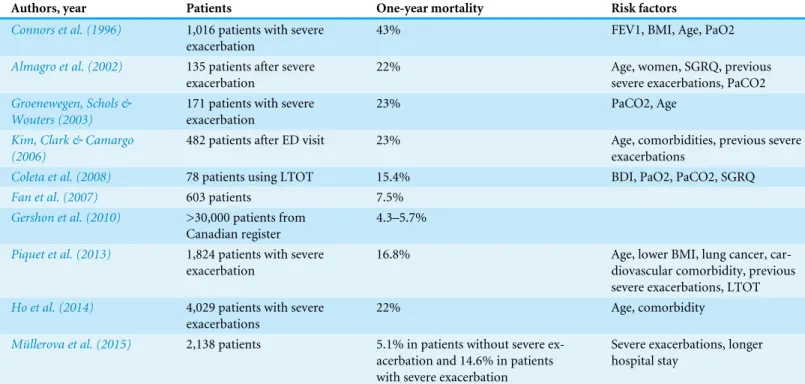
Table 1 One-year mortality in COPD.
Authors, year Patients One-year mortality Risk factors
Connors et al. (1996) 1,016 patients with severe exacerbation
43% FEV1, BMI, Age, PaO2
Almagro et al. (2002) 135 patients after severe exacerbation
22% Age, women, SGRQ, previous severe exacerbations, PaCO2
Groenewegen, Schols & Wouters (2003)
171 patients with severe exacerbation
23% PaCO2, Age
Kim, Clark & Camargo (2006)
482 patients after ED visit 23% Age, comorbidities, previous severe exacerbations
Coleta et al. (2008) 78 patients using LTOT 15.4% BDI, PaO2, PaCO2, SGRQ
Fan et al. (2007) 603 patients 7.5%
Gershon et al. (2010) >30,000 patients from Canadian register
4.3–5.7%
Piquet et al. (2013) 1,824 patients with severe exacerbation
16.8% Age, lower BMI, lung cancer, car-diovascular comorbidity, previous severe exacerbations, LTOT
Ho et al. (2014) 4,029 patients with severe exacerbations
22% Age, comorbidity
Müllerova et al. (2015) 2,138 patients 5.1% in patients without severe ex-acerbation and 14.6% in patients with severe exacerbation
Severe exacerbations, longer hospital stay
One-year mortality in COPD patients is 4.3–43%, depending on the subgroup examined (Table 1) (Connors et al., 1996;Almagro et al., 2002;Groenewegen, Schols & Wouters, 2003;
Kim, Clark & Camargo, 2006;Coleta et al., 2008;Fan et al., 2007;Gershon et al., 2010; Pi-quet et al., 2013;Ho et al., 2014;Müllerova et al., 2015). Mortality shows a downward trend in recent studies. Identified risk factors for increased mortality are: severe exacerbations, re-duced FEV1, age, rere-duced quality of life, hypoxemia, and presence of comorbidities. COPD patients with severe exacerbation have increased mortality rate. Among comorbidities, vita-min D deficiency and insufficiency, diabetes mellitus (DM), and metabolic syndrome (MS) are associated with increased mortality (Divo et al., 2012;Gudmundsson et al., 2006;Galassi, Reynolds & He, 2006;Mannino et al., 2008), but not in all studies (Benson et al., 2012;
Schelini et al., 2012;Holmgaard et al., 2013).
The aim of this study is to examine the one-year mortality in COPD patients after severe exacerbation and the correlation between mortality and patients’ characteristics and comorbidities.
MATERIAL AND METHODS
152 COPD patients hospitalized for COPD exacerbation were evaluated for presence of MS, DM, and hypovitaminosis D according to the following:
≥130 and/or diastolic≥85 mm Hg (or on therapy); 5. Fasting blood glucose > 5.5
mmol/L (or on therapy) (Alberti et al., 2009).
• DM: fasting plasma glucose≥7.0 mmol/L OR 2-h plasma glucose≥11.1 mmol/L during
an oral glucose tolerance test (OGTT) OR HbA1c≥6.5% OR on therapy (American Diabetes Association, 2012);
• Vitamin D deficiency: 25(OH)D <25 nmol/L; vitamin D insufficiency: 25(OH)D between 25 and 50 nmol/L; vitamin D sufficiency: 25(OH)D > 50 nmol/L (Borissova et al., 2012).
COPD diagnosis was established according to the Global Initiative for Chronic Obstruc-tive Lung Disease (GOLD) criteria (GOLD, 2016). Demographic variables such as age, sex, smoking status and number of pack-years were collected. CAT and mMRC questionnaires were completed by all patients. Pre- and post-bronchodilatory spirometry was performed, according to ERS/ATS recommendations (Miller et al., 2005). Blood pressure was measured according to the American Heart Association guidelines (Pickering et al., 2005). Taking antihypertensive medications is considered as presence of arterial hypertension. The number of severe exacerbations (hospitalizations) and moderate exacerbations (worsening of pulmonary symptoms with antibiotic or/and systemic steroid treatment without hospi-talization) (GOLD, 2016) in the previous year as well as the length of current hospital stay (in days) were recorded.
All patients with postbronchodilator obstruction (FEV1/FVC < 0.70) were considered eligible. The patients who did not comply with the study procedures were excluded. Informed consent was obtained by all participants.
One-year mortality was established from the national death register. Survival after hospital discharge was calculated in weeks. Statistical analyses were performed with the SPSS package for Windows software, version 22.0 (SPSS Inc., Chicago, IL, USA). Continuous variables were shown as mean±standard deviation and 95 Confidence intervals (95%CI)
and categorical variables (as percentages). The chi-squared test was used to assess the asso-ciations between categorical variables. Continuous variables were tested for normality by Shapiro–Wilk test. For normally distributed variables, independent-samplesT test for two samples and analysis of variance (ANOVA) for more than two samples were used for deter-mining differences between the groups. The Mann–WhitneyUtest was used for abnormally distributed variables with two samples and the Kruskal–Wallis test for variables with more than two samples. The Kaplan–Meier method was used for analyzing survival. Cox regression was used examine the importance of various covariates in the survival.
More detailed explanation of the study methods and sample characteristics, including prevalence of the comorbidities and their impact on COPD in this group of patients, are published elsewhere (Mekov et al., 2015c;Mekov et al., 2015b;Mekov et al., 2015a).
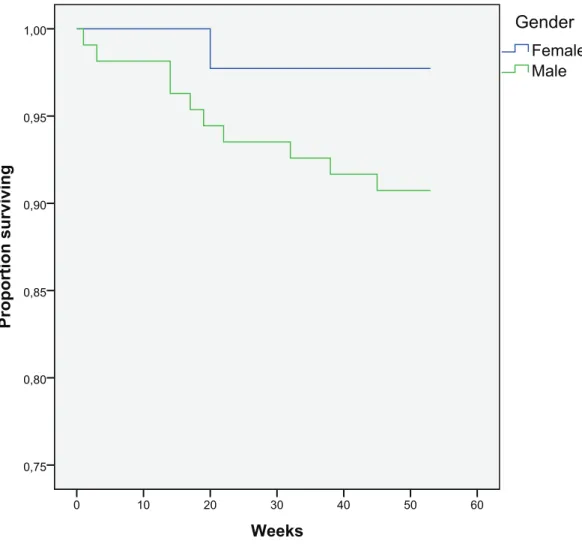
Figure 1 Kaplan–Meier curve for one-year survival depending on gender (in weeks).
RESULTS
Sample characteristics
A total of 152 COPD patients admitted for COPD exacerbation were recruited from University Specialized Hospital for Active Treatment of Pulmonary Diseases ‘Saint Sofia,’ Sofia, Bulgaria. The mean age of the patients was 65 ±10 years. There were 108 males (71.1%) and 44 females (28.9%). Mean post-bronchodilator FEV1 was 55.3±19.5%.
According to smoking patterns, the patients were: 15.8% never-smokers; 57.9% were former smokers, and 26.3% were current smokers. Mean BMI was 27.3±5.6. 127 patients
(83.6%) were on treatment with inhalatory corticosteroids. One-year mortality was 7.2% (11/152).
Mortality: role of demographic characteristics and smoking
The patients who died were older (72 vs. 65 years). Cox regression shows a 7.7% increase in mortality rate for every one year of age (p=0.031). There is a trend for a slight increase
Figure 2 Kaplan–Meier curve for one-year survival depending on the presence of severe exacerbation in the previous year (in weeks).
Ever-smokers (both current and former) had one-year mortality of 7.0%, whereas never smokers—8.3%. Smoking is not a risk factor for increased one-year mortality, both for current and ex-smokers (p=0.821).
BMI is also not a risk factor for increased mortality when tested as a scale variable and when grouped in four groups (BMI less than 18.5; 18.5–24.99; 25–29.99; and more than 30) or two groups (BMI less than 30; BMI more than 30) (allp<0.10).
Mortality: role of exacerbations and duration of hospital stay
The patients who died had more severe exacerbation last year (2.18 vs. 1.84). The presence of severe exacerbation in previous year is risk factor for mortality (12.5% vs. 1.4%,p=0.009)
(Fig. 2). The duration of hospital stay was not related to survival (p=0.416).
Mortality: role of quality of life
There was a 0% mortality in the group with mMRC < 2 (0 vs. 11.1%,p=0.013) (Fig. 3).
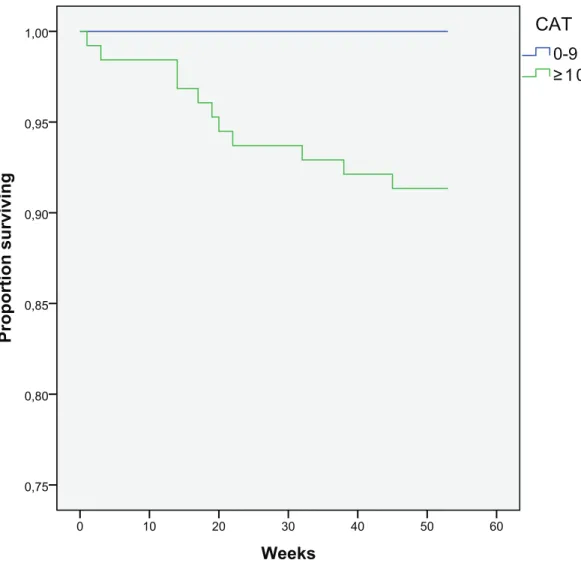
There is a trend for increased death in the group with CAT > 10 (8.7 vs. 0%,p=0.133)
Figure 3 Kaplan–Meier curve for one-year survival depending on mMRC results (in weeks).
The patients who died had a worse quality of life, measured with total CAT score (22 vs. 17), CAT3 (3.64 vs. 2.57), CAT4 (4.55 vs. 3.50), CAT6 (2.91 vs. 1.48), and CAT8 (3.64 vs. 2.67) questions.
Based on CAT and mMRC results, there is a trend for increased mortality in patients with GOLD grade D, compared to grade C (8.3% vs. 0%,p=0.2).
Mortality: role of lung function
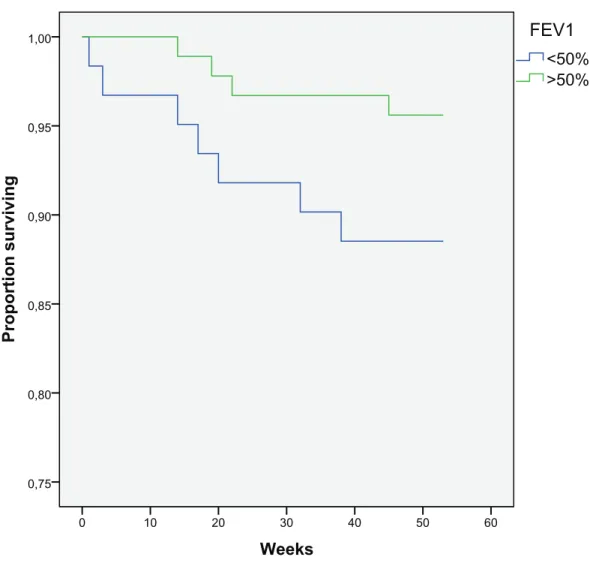
There is a trend for increased mortality in the group with FEV1 < 50% when compared to patients with FEV1 > 50% (11.5 vs. 4.4%,p=0.094) (Fig. 5). Cox regression shows 3.7%
increase in mortality rate for every 1% decrease in FEV1 (p=0.036) and 5.2% increase
in mortality rate for every 1% decrease in PEF (p=0.01). FVC and FEV1/FVC are not
predictors for mortality (p<0.1).
Figure 4 Kaplan–Meier curve for one-year survival depending on CAT results (in weeks).
30% and 50% and 18.7% in patients with FEV1 < 30%, but this difference is not statistically significant (p=0.18) (Fig. 6).
The patients who died had worse lung function—FEV1 (43 vs. 56%) and PEF (37 vs. 51%).
Mortality: role of comorbidities
DM, MS, and vitamin D status are not predictors for one-year mortality (allp<0.1).
How-ever there is an increased trend for mortality in patients with arterial hypertension (9.5% vs. 2.1%,p=0.107). Cox regression shows that vitamin D levels and HbA1c are not predictors
for mortality. Two MS components also show dissociation trend for mortality—HDL (12.5% vs. 6.2%, p=0.258) and interestingly, increased triglycerides shows protective
Figure 5 Kaplan–Meier curve for one-year survival depending on FEV1 (in weeks).
DISCUSSION
This study finds relatively low overall one-year mortality in COPD patients after surviving severe exacerbation. This could be attributed to young age of the group (mean 65 years), high duration of hospital stay (mean 7.5 days), and high FEV1 (55%). Second, this group does not include in-hospital mortality because all patients are examined before discharging at stable condition in order to assess comorbidities as accurate as possible. Nonetheless, this study supports the downward mortality trend in the recent studies which could be attributed to improved care in last decade, particularly in assessing and managing cardiovascular risk and comorbidities.
Weeks
60 50
40 30
20 10
0
Proportion surviving
1,00
0,95
0,90
0,85
0,80
0,75
FEV1<30% 30%<FEV1<50% 50%<FEV1<80% FEV1>80%
GOLD stages
Figure 6 Kaplan–Meier curve for one-year survival depending on GOLD stages (in weeks).
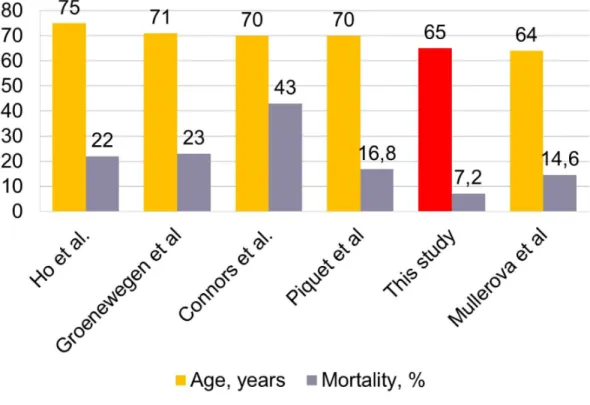
Figure 8 Association between mortality and Age. Age (years) in the current study shown in red.
This study confirms age as a risk factor for one-year mortality as shown by other authors (Connors et al., 1996;Almagro et al., 2002;Groenewegen, Schols & Wouters, 2003;
Kim, Clark & Camargo, 2006;Piquet et al., 2013;Ho et al., 2014). Male gender is also asso-ciated with increased mortality, although not statistically significant. Although studies find correlation between gender and mortality, some of them suggest increased risk in males (Faustini et al., 2008;Suissa, Dell’Aniello & Ernst, 2012), while others in females (Almagro et al., 2002).
The presence of severe exacerbation in the previous year is a risk factor for mortality, which confirms the results from other studies (Almagro et al., 2002;Kim, Clark & Camargo, 2006;Piquet et al., 2013;Müllerova et al., 2015). However, in this study, the number of moderate exacerbations, the total number of exacerbations, and the duration of the hospital stay were not related to mortality, as suggested by other authors (Müllerova et al., 2015).
Reduced quality of life is a risk factor for mortality which confirms previous find-ings (Almagro et al., 2002;Coleta et al., 2008). This study finds mMRC being more strong predictor than CAT, but there is 0% mortality in patients with less symptoms (CAT < 10) or dyspnea (mMRC < 2). The patients who died had worse quality of life, measured with total CAT score with highest impact on CAT3 (chest tightness), CAT4 (walking up), CAT6 (confidence), and CAT8 (energy) questions. There is also a trend for increased mortality in patients with GOLD grade D, compared to grade C. It is notable that grade C one-year mortality is 0% in this study.
statistical significance. It is notable that there was 0% mortality in GOLD stage 1 group (FEV1 > 80%).
Interestingly, the presence of comorbid conditions such as hypovitaminosis D, DM or MS is not associated with increased one-year mortality. This finding could be attributed to the short investigation period and low mortality rate.
Respiratory failure is significant, but not the only major death cause in COPD. Other common causes of death in these patients were cardiovascular disease and lung cancer (Sin et al., 2006), although the underlying mechanisms are not fully understood. A possible ex-planation could be chronic systemic and pulmonary inflammation. An interesting hypoth-esis on molecular level is increased reactive oxygen species formation and oxidative stress (Zuo et al., 2012). This could lead to increased TNFαlevels, which reduce skeletal muscle
force and resistance to fatigue (Zuo, Nogueira & Hogan, 2011). As a systemic inflammatory disorder, COPD is associated with respiratory muscle dysfunction (Wouters, 2002) which could be further worsened by this mechanism and contribute to the mortality. The recognition and treating of systemic COPD manifestations could be associated with the reduced mortality, showed in recent studies.
One of the important strengths of this study is the precise measurement and investigation of many outcomes, including demographic characteristics, number of exacerbations in the previous year, duration of hospital stay, lung function and quality of life. Second, it shows the influence of a common comorbidities, with focus on endocrine ones such as vitamin D, DM, and MS which are diagnosed according to the international guidelines and thus, minimizing the risk of bias.
The weak side of this study is a relatively small number of participants which may result in lack of power for some of the outcomes. However, it provides excellent information about the risk factors for one-year mortality of these patients. Nonetheless, some of the cited studies have a similar number of participants.
CONCLUSIONS
This study finds relatively low one-year mortality in COPD patients after surviving severe exacerbation. Grade C and FEV1 > 80% may be factors for good prognosis. Risk factors for increased mortality are age, FEV1 value, severe exacerbation in previous year, and reduced quality of life.
ADDITIONAL INFORMATION AND DECLARATIONS
Funding
The authors received no funding for this work.
Competing Interests
Author Contributions
• Evgeni Mekov conceived and designed the experiments, performed the experiments,
analyzed the data, contributed reagents/materials/analysis tools, wrote the paper, prepared figures and/or tables, reviewed drafts of the paper.
• Yanina Slavova conceived and designed the experiments, analyzed the data, contributed
reagents/materials/analysis tools, reviewed drafts of the paper.
• Adelina Tsakova and Marianka P. Genova performed the experiments, contributed
reagents/materials/analysis tools, reviewed drafts of the paper.
• Dimitar T. Kostadinov, Delcho Minchev and Mihail A. Boyanov contributed reagents/materials/analysis tools, reviewed drafts of the paper.
• Dora Marinova analyzed the data, contributed reagents/materials/analysis tools, wrote the paper, reviewed drafts of the paper.
Human Ethics
The following information was supplied relating to ethical approvals (i.e., approving body and any reference numbers):
Clinical Center for Pulmonary Diseases Ethical Committee Approval number 31a/02.12.2015 Protocol 76/25.11.2015.
Data Availability
The following information was supplied regarding data availability: The raw data has been supplied asData S1.
Supplemental Information
Supplemental information for this article can be found online athttp://dx.doi.org/10.7717/ peerj.2788#supplemental-information.
REFERENCES
American Diabetes Association. 2012.Diagnosis and classification of diabetes mellitus.
Diabetes Care35:S64–S71DOI 10.2337/dc12-s064.
Alberti KGMM, Eckel RH, Grundy SM, Zimmet PZ, Cleeman JI, Donato KA, Fruchart J-C, James PT, Loria CM, Smith Jr SC. 2009.Harmonizing the metabolic syndrome: a joint interim statement of the International Diabetes Federation Task Force on Epidemiology and Prevention; National Heart, Lung, and Blood Institute; American Heart Association; World Heart Federation; International Atherosclerosis Society; and International Association for the Study of Obesity.Circulation120:1640–1645
DOI 10.1161/CIRCULATIONAHA.109.192644.
Almagro P, Calbo E, Echaguien A, Barreiro B, Quintana S, Heredia JL, Garau J. 2002.
Mortality after hospitalization for COPD.Chest121(5):1441–1448
DOI 10.1378/chest.121.5.1441.
Borissova A-M, Shinkov A, Vlahov J, Dakovska L, Todorov L, Svinarov D, Kasabova L. 2012.Determination of the optimal level of 25(OH)D in the Bulgarian population.
Endocrinologia17(3):135–142.
Coleta K, Silveira L, Lima D, Rampinelli E, Godoy I, Godoy I. 2008.Predictors of first-year survival in patients with advanced COPD treated using long-term oxygen therapy.Respiratory Medicine102(4):512–518DOI 10.1016/j.rmed.2007.12.003.
Connors A, Dawson N, Thomas C, Harrell Jr FE, Desbiens N, Fulkerson WJ, Kussin P, Bellamy P, Goldman L, Knaus WA. 1996.Outcomes following acute exacerbation of severe chronic obstructive lung disease. The SUPPORT investigators (Study to understand prognoses and preferences for outcomes and risks of treatments).
American Journal of Respiratory and Critical Care Medicine154(4):959–967
DOI 10.1164/ajrccm.154.4.8887592.
Divo M, Cote C, Torres J, Casanova C, Marin JM, Pinto-Plata V, Zulueta J, Cabrera C, Zagaceta J, Hunninghake G, Celli B, BODE Collaborative Group. 2012.
Comorbidities and risk of mortality in patients with chronic obstructive pulmonary disease.American Journal of Respiratory and Critical Care Medicine186(2):155–161
DOI 10.1164/rccm.201201-0034OC.
Fan VS, Ramsey SD, Giardino ND, Make BJ, Emery CF, Diaz PT, Benditt JO, Mosenifar Z, McKenna Jr R, Curtis JL, Fishman AP, Martinez FJ, National Emphysema Treatment Trial (NETT) Research Group. 2007.Sex, depression, and risk of hospitalization and mortality in chronic obstructive pulmonary disease.Archives of Internal Medicine167(21):2345–2353DOI 10.1001/archinte.167.21.2345.
Faustini A, Marino C, D’Ippoliti D, Forastiere F, Belleudi V, Perucci CA. 2008.The impact on risk-factor analysis of different mortality outcomes in COPD patients.
European Respiratory Journal32(3):629–636DOI 10.1183/09031936.00059807.
From the Global Strategy for the Diagnosis, Management and Prevention of COPD, Global Initiative for Chronic Obstructive Lung Disease (GOLD). 2016.Available at
http:// www.goldcopd.org/ (accessed on 20 September 2016).
Galassi A, Reynolds K, He J. 2006.Metabolic syndrome and risk of cardiovascular disease: a meta-analysis.The American Journal of Medicine119(10):812–819
DOI 10.1016/j.amjmed.2006.02.031.
Gershon AS, Wang C, Wilton AS, Raut R, To T. 2010.Trends in chronic obstructive pulmonary disease prevalence, incidence, and mortality in Ontario, Canada, 1996– 2007: a population-based study.Archives of Internal Medicine170(6):560–565
DOI 10.1001/archinternmed.2010.17.
Groenewegen K, Schols A, Wouters E. 2003.Mortality and mortality-related factors after hospitalization for acute exacerbation of COPD.Chest 124(2):459–467
DOI 10.1378/chest.124.2.459.
Gudmundsson G, Gislason T, Lindberg E, Hallin R, Ulrik CS, Brondum E, Nieminen M, Aine T, Bakke P, Janson C. 2006.Mortality in COPD patients discharged from hospital: the role of treatment and co-morbidity.Respiratory Research7(1):109
Ho TW, Tsai YJ, Ruan SY, Huang CT, Lai F, Yu CJ, HINT Study Group. 2014. In-hospital and one-year mortality and their predictors in patients In-hospitalized for first-ever chronic obstructive pulmonary disease exacerbations: a nationwide population-based study.PLoS ONE9(12):e114866DOI 10.1371/journal.pone.0114866.
Holmgaard DB, Mygind LH, Titlestad IL, Madsen H, Fruekilde PB, Pedersen SS, Pedersen C. 2013.Serum vitamin D in patients with chronic obstructive lung disease does not correlate with mortality—results from a 10-year prospective cohort study.
PLoS ONE8:e53670DOI 10.1371/journal.pone.0053670.
Kim S, Clark S, Camargo C. 2006.Mortality after an emergency department visit for exacerbation of chronic obstructive pulmonary disease.COPD: Journal of COPD 3(2):75–81DOI 10.1080/15412550600651271.
Mannino DM, Thorn D, Swensen A, Holguin F. 2008.Prevalence and outcomes of diabetes, hypertension and cardiovascular disease in COPD.European Respiratory Journal 32:962–969DOI 10.1183/09031936.00012408.
Mekov E, Slavova Y, Genova M, Tsakova A, Kostadinov D, Minchev D, Marinova D, Boyanov M. 2015a.Diabetes mellitus type 2 in hospitalized COPD patients.Comptes Rendus De l’Academie Bulgare Des Sciences68(8):1079–1086.
Mekov E, Slavova Y, Tsakova A, Genova M, Kostadinov D, Minchev D, Marinova D. 2015b.Metabolic syndrome in hospitalized patients with chronic obstructive pulmonary disease.PeerJ3:e1068DOI 10.7717/peerj.1068.
Mekov E, Slavova Y, Tsakova A, Genova M, Kostadinov D, Minchev D, Marinova D, Tafradjiiska M. 2015c.Vitamin D deficiency and insufficiency in hospitalized COPD patients.PLoS ONE10(6):e0129080DOI 10.1371/journal.pone.0129080.
Miller MR, Hankinson J, Brusasco V, Burgos F, Casaburi R, Coates A, Crapo R, Enright P, Van der Grinten C, Gustafsson P, Jensen R, Johnson D, MacIntyre N, McKay R, Navajas D, Pedersen O, Pellegrino R, Viegi G, Wanger J. 2005.Standardisation of spirometry.European Respiratory Society26:319–338
DOI 10.1183/09031936.05.00034805.
Müllerova H, Maselli DJ, Locantore N, Vestbo J, Hurst JR, Wedzicha JA, Bakke P, Agusti A, Anzueto A. 2015.ECLIPSE investigators. Hospitalized exacerbations of COPD: risk factors and outcomes in the ECLIPSE cohort.Chest 147(4):999–1007
DOI 10.1378/chest.14-0655.
Pickering TG, Hall JE, Appel LJ, Falkner BE, Graves J, Hill MN, Jones DW, Kurtz T, Sheps SG, Roccella EJ, Subcommittee of Professional and Public Education of the American Heart Association Council on High Blood Pressure Research. 2005.
Recommendations for blood pressure measurement in humans and experimental animals. Part 1: blood pressure measurement in humans.Hypertension45:142–161
DOI 10.1161/01.HYP.0000150859.47929.8e.
Schelini K, Tanni S, Zamuner A, Coelho L, Vale S, Ferrari R, Caram L, Godoy I, Paiva S, Godoy I. 2012.The influence of metabolic syndrome in mortality rate of COPD patients: a five years follow up study [Abstract 81s].European Respiratory Journal 40(Suppl 56).
Sin D, Anthonisen N, Soriano J, Agusti A. 2006.Mortality in COPD: role of comorbidi-ties.European Respiratory Journal28:1245–1257DOI 10.1183/09031936.00133805.
Suissa S, Dell’Aniello S, Ernst P. 2012.Long-term natural history of chronic obstructive pulmonary disease: severe exacerbations and mortality.Thorax67:957–963
DOI 10.1136/thoraxjnl-2011-201518.
Wouters EF. 2002.Chronic obstructive pulmonary disease. 5: systemic effects of COPD.
Thorax57:1067–1070DOI 10.1136/thorax.57.12.1067.
Zuo L, Hallman A, Yousif M, Chien M. 2012.Oxidative stress, respiratory muscle dysfunction, and potential therapeutics in chronic obstructive pulmonary disease.
Frontiers in Biology7(6):506–513DOI 10.1007/s11515-012-1251-x.
Zuo L, Nogueira L, Hogan M. 2011.Effect of pulmonary TNF- overexpression on mouse isolated skeletal muscle function.American Journal of Physiology. Regulatory, Integrative and Comparative Physiology301:R1025–R1031